artifact_class: CHEATSHEET_CANDIDATE type: theme id: A4 domain: A title: "Biostimulators: materials science" subchapters: 10 template: SUSTANCIA pass: 2 tags: [theme, domain/A, sustancia, bioestimulador, CaHA, PLLA, PCL, PDLLA]
A4 · Biostimulators: materials science
Domain: A — Fundamentos científicos · Template: SUSTANCIA (what is injected) · Links: A3 (HA), A6 (comparative filler map), C1 (planes and instruments), D1–D7 (regions), J1–J8 (complications), F9 (regenerative, federated)
Subchapters
- [ ] A4.1 — In 30 seconds: what it is, where it goes, how much, how long it lasts, red line
- [ ] A4.2 — Chemistry and manufacture: structure, origin, polymerization, sterilization
- [ ] A4.3 — Measurable properties with per-brand numbers: G′, G″, tan δ, viscosity, cohesivity, particle caliber, concentration
- [ ] A4.4 — Mechanism and timeline of the effect: onset, peak, plateau, degradation, what accelerates it
- [ ] A4.5 — Comparative brand map: manufacturer, concentration, data-sheet indication, country of registration
- [ ] A4.6 — Indication by region and by plane: which product in which plane and why
- [ ] A4.7 — Dose and volume: per point, per region, per session, ceiling, interval
- [ ] A4.8 — Reversibility and management of excess: what degrades it, how long it takes, what cannot be undone
- [ ] A4.9 — Adverse effects INTRINSIC to the substance
- [ ] A4.10 — Alternatives: what replaces it, when, and when the right answer is not to inject
Chapter
> Tags: [A] guideline, consensus, standard or data sheet with year · [B] primary literature with verified PMID/DOI · [C] MEDLIB corpus monograph · [D] slide, opinion or promotional material (never sufficient on its own) · [MODELO] structure or reasoning, never a figure · [IA-ESPEC] speculative AI proposal, no evidentiary value · ⚠ disputed figure or detected error.
> Currency and provenance — 53 references · median 2023, range 2008-2026, 58 % from 2022 on · provenance: verified external 57 % (30) · MEDLIB corpus 43 % (23, of which 5 from the UPO master's) · 5 flagged [D] never_sufficient_alone.
> Voices: (P) the model's own reasoning, never a dose. Everything else carries an author and a numbered reference.
A4.1 · In 30 seconds: what it is, where it goes, how much, how long it lasts, red line
| Datum | |
|---|---|
| What they are | Four families of resorbable particle in a carrier gel that do not fill, they activate the fibroblast: CaHA (calcium hydroxylapatite), PLLA (poly-L-lactic acid), PCL (polycaprolactone), PDLLA (poly-D,L-lactic acid). The fifth, PDO powder (PPDO), enters the classification of the ongoing systematic review [1] |
| CaHA composition | 30 % CaHA microspheres of 25–45 µm + 70 % sodium carboxymethylcellulose gel [2][3]. Measured by electron microscopy: smooth homogeneous spheres of 20–45 µm [4] |
| PLLA composition | Lyophilized powder of irregular microflakes 2–150 µm in long axis — not spheres [4]. Reconstituted before use |
| PCL composition | Polycaprolactone microspheres in aqueous CMC gel; Ellansé-S / M / L / E → 1, 2, 3 and 4 years of in vivo persistence [5] |
| PDLLA composition | Amorphous PLA microspheres (D and L blend) + CMC. AesteFill, Juvelook, Lenisna. Consensus reconstitution: 7–8 mL of sterile water for injection [6] |
| Standard CaHA plane | Supraperiosteal (to volumize) or deep subdermal. Never mid or superficial dermis: the product shows through and irregularities remain [7] [D] |
| Hyperdiluted CaHA plane | Superficial subcutaneous, wide field, in microboluses / tunnels / fan [8][9] |
| PLLA plane | Dermo-hypodermic junction or supraperiosteal. Never dermis, never lip, never periorbital or tear-trough region [10] |
| PDLLA plane | Consensus: superficial subcutaneous [6] |
| PLLA reconstitution | ⚠ conflict preserved, not averaged: 5 mL minimum of sterile water, hydration ≥ 2 h, sessions every 3–4 weeks [10] · 6–8 mL per vial (4 mL water + 2 mL lidocaine, or 6 mL water alone) [11] · 8 mL and rest ≥ 24 h [12]. The figure that is never used: the original 3 mL, which gave 30–50 % nodules [10] |
| FDA-approved CaHA dilution (2 % lidocaine) | 3 mL syringe → max. 0.6 mL · 1.5 mL → max. 0.3 mL · 0.8 mL → max. 0.16 mL · 0.3 mL → max. 0.06 mL [7] [D] |
| Onset of effect | CaHA: immediate volume from the gel + progressive collagen [2][13] · PLLA / PDLLA / PCL: no real immediate volume; what is seen on withdrawal is the diluent and the edema |
| Collagen peak | CaHA: collagen III high at 4 months, collagen I high at 9 months with III already declining — remodeling, not accumulation [14]. In vitro: COL III +123 % at 24 h · COL I +124 % at 72 h, and only in the fibroblasts in direct contact with the microsphere [15] |
| Duration | CaHA: microspheres degraded in 12–18 months, carrier gel resorbed in 3–4 months [3][7] · PCL: 1–4 years by version [5] · PLLA/PDLLA: effect from months to ~2 years, biennial maintenance in the PDLLA consensus [6] |
| Per-session ceiling (facial CaHA) | The corpus series documents 4.5 mL of Radiesse in a 64-year-old patient as a case of wide-field volumetry [16] [C]; in the midface the published practice of the vectorial technique splits deep product + superficial diluted product in the same session [17] |
| ⚠ RED LINE 1 — irreversibility | None of the four has an antidote. Hyaluronidase only helps if the product carries associated HA: in the Brazilian series of 55 complications it was useful exclusively in the CaHA+HA hybrids (p < 0.01) [18] |
| ⚠ RED LINE 2 — blindness | CaHA accumulates ≥ 11 published cases of visual loss from vascular occlusion, most from the nasal dorsum; PLLA 2; PDLLA-CMC 2 (forehead and glabella); PDLLA-HA 1 (posterior ischemic optic neuropathy); PCL none of blindness but 1 facial-artery embolism [19] |
| ⚠ RED LINE 3 — the nodule does not resolve | In 55 biostimulator complications, 89.1 % were nodules, 60 % late (> 1 month) and despite saline, hyaluronidase, diluted corticosteroid and energy devices only 5 cases resolved completely [18] |
| Never | PLLA in the lip, eyelid, tear trough or fine wrinkle [10] · overcorrecting a biostimulator (the result is judged at 3 months, not on withdrawal) [10] · undiluted CaHA in a superficial plane [7] · mistaking a late nodule for "poorly placed product" without ruling out biofilm [18] |
How to read this chapter
(P) The framing error that costs the most with this family is treating it as "filler that lasts longer." It is not. An HA filler occupies a volume and that volume is the effect; a biostimulator occupies a transient volume whose only role is to place the particle where the fibroblast will touch it. Nowag 2023 measures it as cleanly as possible: per-cell collagen III expression does not change with CaHA concentration — only how many fibroblasts are activated changes, and only those in direct contact with the microsphere are activated [15]. From this follow three consequences that order the whole practice and appear block by block:
- Dilution is not a way to stretch the product: it is the dose variable. Diluting 1:2 increases the tissue dispersion of the microspheres and reduces their local concentration [15]. Immediate volume is traded for contact surface.
- The result is not evaluated in the chair. Months pass between injection and mature collagen, and the correction window closes before the result is visible.
- Safety is not recovered. HA has an exit; these four molecules do not.
Topic map
| Subchapter | Question it answers | Strength of the evidence |
|---|---|---|
| A4.2 | What is each one made of and how is it manufactured? | Good. Well-established polymer chemistry [20][4]; the weak point is sterilization, which is almost never published by brand |
| A4.3 | Which numbers describe it and which do not exist? | Asymmetric, and it must be said: the complex viscosity of CaHA is measured and compared [16]; the per-brand G′ of PLLA and PDLLA is not published comparably because they are suspensions reconstituted in the office |
| A4.4 | When does it start, when does it peak and when does it end? | The best in the chapter for CaHA (in vitro + human histology) [15][14][13], the weakest for PDLLA |
| A4.5 | Which brand is which and where is it registered? | Good on product, irregular on registration: regulatory status changes by country and ages faster than the data sheet |
| A4.6 | Which product in which plane? | Broad, coherent consensus [5][6][8]; set against very few comparative trials |
| A4.7 | How much and how often? | The finest facet. Reconstitution with four incompatible figures preserved one by one; per-point volume is school tradition, not trial |
| A4.8 | What do I do if I overdo it? | Scarce and honest: the review of 55 cases is the best datum there is and its message is negative [18] |
| A4.9 | What happens to this product that does not happen to another? | Good on visual loss [19] and nodules [21], poor on denominators |
| A4.10 | When not to inject? | Recent systematic reviews with a methodologically weak conclusion [22][23] |
Classic trap: treating PLLA reconstitution as a preparation detail. It is the safety variable of the molecule: going from 3 mL to ≥ 5 mL is the difference between a nodule incidence of 30–50 % and current practice [10].
A4.2 · Chemistry and manufacture: structure, origin, polymerization, sterilization
| CaHA | PLLA | PCL | PDLLA | PPDO (powder) | |
|---|---|---|---|---|---|
| Chemical name | Calcium hydroxylapatite, Ca₁₀(PO₄)₆(OH)₂ | Poly-L-lactic acid | Poly(ε-caprolactone) | Poly-D,L-lactic acid (amorphous PLA) | Poly(p-dioxanone) |
| Monomer origin | Synthetic mineral identical to the mineral phase of bone and tooth | Lactic acid, of the fruit-acid family; described in France in 1954 [3] | ε-caprolactone (petrochemical synthesis) | Lactic acid, racemic D + L | p-dioxanone |
| Nature of the solid | Crystalline, mineral | Semicrystalline | Semicrystalline, low melting point | Amorphous (the D/L blend prevents crystal packing) | Semicrystalline |
| Formation reaction | Precipitation / sintering of the mineral; no polymerization | Ring-opening polymerization of L-lactide | Ring-opening polymerization of ε-caprolactone | Ring-opening of D,L lactide | Ring-opening of the dimer |
| Cross-linked? | No. There is no covalent network: there is a suspended particle | No | No | No | No |
| Particle shape | Smooth, homogeneous sphere, 20–45 µm [4][2] | Irregular microflake, 2–150 µm in long axis [4] | Perfectly smooth sphere [24] [C] |
Microsphere | Microsphere with an irregular surface [25] |
| Carrier gel | Aqueous sodium carboxymethylcellulose, 70 % of the volume [2][3] | None: sold lyophilized and reconstituted | Aqueous carboxymethylcellulose [5] | Carboxymethylcellulose; sold lyophilized [26] | Sold lyophilized |
| Degradation route | Dissolution to calcium and phosphate ions, metabolized by the normal pathway [3] | Hydrolysis of the ester bond → lactic acid → Krebs cycle → CO₂ + H₂O | Hydrolysis of the ester bonds, complete elimination [5] | Hydrolysis, faster than PLLA because it is amorphous | Hydrolysis; accelerated by plasma, urine and infected tissue [27] [C] |
| Radiopacity | Yes, radiopaque and visible on radiography without masking normal tissues [3] | No | No | No | No |
Consensus: the five are resorbable polyesters or minerals without a covalent network; degradation is by hydrolysis (polyesters) or ionic dissolution (CaHA), and none requires a prior skin test because there is no heterologous protein [3]. Fig 1 [28] shows the structures of the biodegradable polyesters of this family with the detail that matters here: PDLLA (A), PCL (E) and PDO (F) are different chains, not commercial variants of the same thing.
Discrepancy that does change the gesture: the shape of the particle. CaHA is a smooth sphere; PLLA is a flake. McCarthy 2024 quantified the difference with optical and scanning electron microscopy: significantly higher circularity and roundness in CaHA-CMC, an aspect ratio close to a circle, versus clearly oblong PLLA particles with a higher proportion of phagocytosable particles [4]. Decide: how much inflammation is being bought. A smooth sphere recruits fewer inflammatory cells; an irregular flake with a phagocytosable fraction offers more surface to the macrophage. That is the material basis — not a school preference — for why PLLA historically drags the nodule problem and CaHA drags the problem of poorly placed volume.
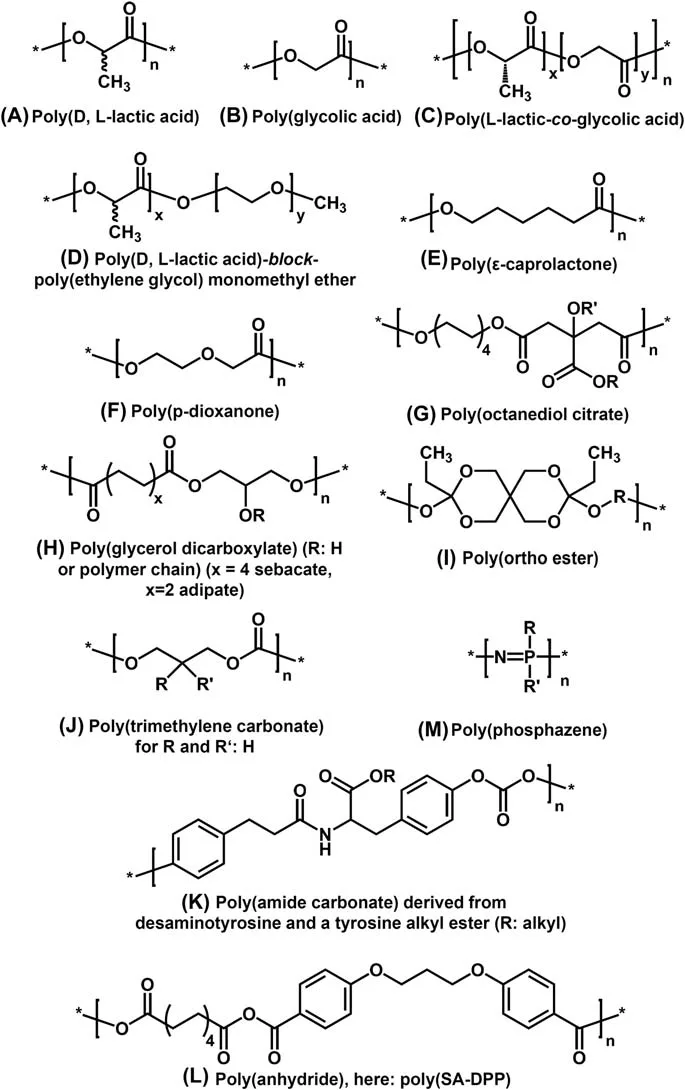 Fig 1. Panel of structures of the resorbable polyesters used as biostimulators and as suture, panel by panel: (A) poly(D,L-lactic) — the backbone of AesteFill/Juvelook; (B) poly(glycolic); (C) poly(L-lactic-co-glycolic); (D) block PDLLA with polyethylene glycol; (E) poly(ε-caprolactone) — Ellansé, with its aliphatic six-carbon chain between esters, the material reason for its slow hydrolysis; (F) poly(p-dioxanone) — the PDO thread and the PPDO powder. All share the hydrolyzable ester bond; what changes between them is the length and regularity of the chain, and with them the rate of degradation — (Atala, 2019, p. 596)
Why the chain decides the duration
(P) The four molecules degrade by the same mechanism — water attacks the ester bond — and yet they last between one year and four. The variable is not the chemistry of the bond but the accessibility of water to it, and that is set by the microstructure:
- PLLA is semicrystalline and stereoregular. All the chiral carbons are L, the chain packs into crystalline domains and water only enters through the amorphous zones. Result: slow degradation, over months to years, and residual fragments that persist after the clinical effect has begun to fall.
- PDLLA is amorphous by design. The blend of D and L units prevents crystalline packing, water reaches the whole mass and hydrolysis is more homogeneous and faster. That is the material justification for the PDLLA consensus proposing biennial maintenance instead of the progressive withdrawal of PLLA [6].
- PCL has five methylenes between esters. It is the most hydrophobic chain of the family; water penetrates slowly and hydrolysis takes years. That is why one and the same chemistry yields four distinct commercial products — S, M, L, E — differing by molecular weight and not by composition, with projected in vivo persistence of 1 year (S), 2 years (M), 3 years (L) and 4 years (E) [5].
- CaHA does not hydrolyze at all. It dissolves. The released calcium and phosphate ions enter the normal metabolic pool [3], which explains why there is no late polymeric residue and why the molecule does not generate the "two-year" nodule characteristic of the polyesters.
Manufacture and sterilization — the documentary gap
Consensus: the products are supplied sterile and single-use; CaHA and PCL in a prefilled syringe, PLLA and PDLLA as lyophilized powder in a vial reconstituted in the office [26][11].
The gap: neither the corpus retrieval nor the external one returned the sterilization method by brand (moist heat, ethylene oxide, gamma irradiation or sterilizing filtration). This is not an academic detail: gamma irradiation cleaves polyester chains and shifts the molecular weight, the very variable by which Ellansé defines its four versions [5]. An irradiated product is not the same product. Declared as a measured gap, not as an absence: run A4.2-20260809, facet mechanism_pathophysiology, artifact evaluation/runs/A4.2.jsonl; the corpus returns composition and degradation in every query and zero references to a biostimulator sterilization process.
(P) Lyophilization has a practical consequence that IS published and that sterilization pushes into the background: the manufacturer delivers the powder, the injector manufactures the implant. The suspension that is injected — its concentration, its homogeneity, the aggregate size — is produced in the office. Chen 2020 demonstrates it by measuring what happens with six different diluents: with the vortex method only mannitol and sterile water for injection produce a valid suspension of PDLLA; with the back-and-forth method between two syringes all six diluents — sodium bicarbonate, sterile water, physiological saline, lidocaine, lidocaine with adrenaline and mannitol — work, and the reconstitution time falls sharply [26]. That is: the same vial, with the same diluent, gives two different implants depending on how it is agitated. No other class of facial injectable has this property.
What manufacture explains about the clinic
| Manufacturing fact | Direct clinical consequence | Ref |
|---|---|---|
| CaHA is 30 % solid / 70 % gel | 70 % of the injected volume disappears in 3–4 months. What is seen at one month is not the result | [2][7] |
| CaHA is radiopaque | It appears on facial CT/radiography and can mislead an unwarned radiologist. Note it in the record | [3] |
| PLLA comes lyophilized | The nodule incidence depends on a step performed by the clinician, not the manufacturer | [10] |
| PLLA is a flake of 2–150 µm | High phagocytosable fraction → more marked inflammatory response | [4] |
| PCL is graded by molecular weight | Four products with the same chemical label and four different durations: the version is part of the dose | [5] |
| PDLLA is amorphous | More homogeneous degradation; the consensus sets maintenance at intervals, not withdrawal | [6] |
| No product is cross-linked | There is no enzyme that cuts it. Hyaluronidase is irrelevant except in HA hybrids | [18] |
Classic trap: assuming that "polylactic acid" names a product. It names three molecules with different behavior — semicrystalline PLLA, amorphous PDLLA and PLGA copolymer — and the confusion carries over to the patient's record, where "polylactic" is written without saying which. When that patient comes back at 18 months with a nodule, the record does not allow one to know what was placed.
A4.3 · Measurable properties with per-brand numbers: G′, G″, tan δ, viscosity, cohesivity, particle caliber, concentration
Answer first — complex viscosity η* measured in the same laboratory and on the same scale, from least to most tissue distribution:
| Product | η* (cP, complex viscosity) | Class | Clinical reading |
|---|---|---|---|
| Radiesse (undiluted CaHA) | ≈ 350 000 | CaHA | The most viscous in the comparison. It stays where it is left: it does not flow to the neighboring planes |
| Radiesse + 0.3 % lidocaine | ≈ 140 000 | Diluted CaHA | Adding 0.3 mL of lidocaine divides the viscosity by 2.5. The anesthetic is not a comfort add-on: it is a change of material |
| Restylane SubQ | ≈ 198 000 | HA | |
| Restylane-L | ≈ 118 000 | HA | |
| Perlane-L | ≈ 115 000 | HA | |
| Juvéderm Voluma | ≈ 62 000 | HA | |
| Juvéderm Ultra Plus XC | ≈ 27 000 | HA | |
| Juvéderm Ultra XC | ≈ 17 000 | HA | |
| Belotero Balance | ≈ 8 000 | HA | The extreme of maximum distribution |
Values read from Carruthers's comparative chart [16] [C]; given as an order of magnitude, not as a data-sheet specification.
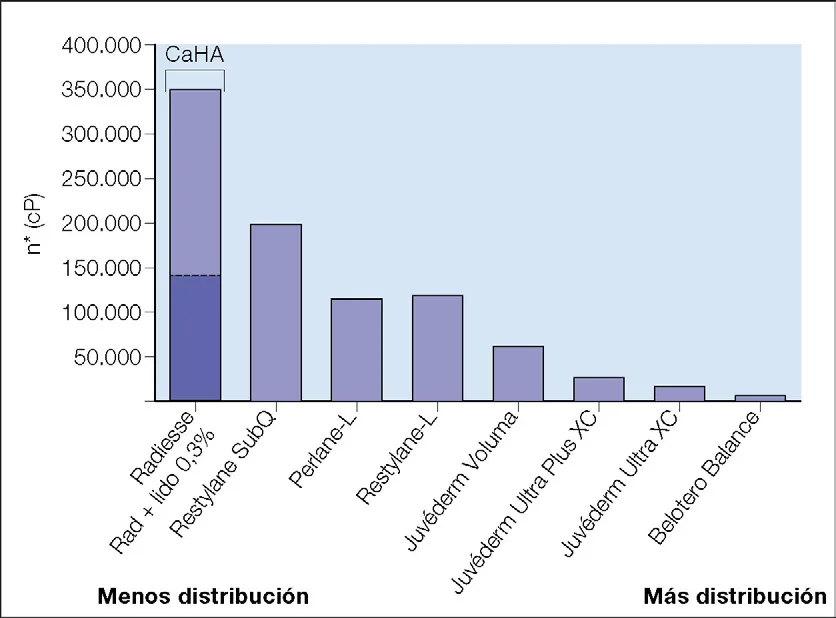 Fig 2. Complex viscosity η* in centipoise of eight injectables on a single axis, ordered from "least distribution" (left) to "most distribution" (right). The first bar is double: the dark section marks Radiesse with 0.3 % lidocaine (≈ 140 000 cP) within the full bar of pure Radiesse (≈ 350 000 cP) — the drop in viscosity produced by the anesthetic is visible as a step within the bar itself, and is larger than the difference between two consecutive HAs in the series. No HA in the comparison reaches the value of undiluted CaHA — (Carruthers, 2013, p. 106)
Which numbers exist and which do not — declared, not assumed
(P) This block is the one that demands the most honesty of the chapter, because the template asks for G′, G″ and tan δ by brand and for three of the four products those numbers do not exist in comparable form. The reason is material, not editorial:
| Product | Has published, comparable G′/G″? | Why |
|---|---|---|
| CaHA (Radiesse) | Partially. It is characterized and usually compared by complex viscosity [16], and materials-science reviews place it among the agents whose in vivo behavior is governed by G′, G″, cohesivity and degradation kinetics [20][29] | It is a factory-stable suspension: it can be mounted in the rheometer just as it comes out of the syringe |
| PCL (Ellansé) | Partially, and with the catch that there are four versions of different molecular weight; a G′ without stating the version means nothing [5] | Stable suspension, but graded |
| PLLA (Sculptra) | Not usefully. It is sold lyophilized | The rheology is generated in the office and depends on reconstitution volume, hydration time and agitation method [26][10] |
| PDLLA | No. Same problem, aggravated | Chen 2020 shows that the method of reconstitution changes the resulting suspension with the same diluent [26] |
Declaring the silence with the query behind it: run A4.3-20260809 on evaluation/runs/A4.3.jsonl, facet product_formulation with a mean of 0.443 across the seven A4 subfacets and a minimum of 0.016 — the weakest facet of the twenty in the program for this topic. dose_parameters sits at 0.523 and contraindications_interactions at 0.481. The operational conclusion: for biostimulator rheology the own corpus is not enough and the external lane is mandatory, and not even the external one produces a per-brand G′ table comparable to the one that exists for HAs (compare with A3).
Particle caliber and concentration — here there ARE numbers
| Product | Shape | Size | Solid concentration | Ref |
|---|---|---|---|---|
| CaHA / Radiesse | Smooth, homogeneous sphere | 25–45 µm (data sheet and monographs) [2][3]; 20–45 µm by independent electron microscopy [4] | 30 % v/v microspheres, 70 % CMC gel [2][3] | [4][2][3] |
| PLLA / Sculptra | Irregular microflake | 2–150 µm in long axis [4] | Depends on reconstitution: the same vial at 5 mL or at 8 mL are two different concentrations [10][12] | [4][10] |
| PCL / Ellansé | Perfectly smooth sphere (confirmed by SEM) [24] [C] |
Microsphere; the manufacturer grades by molecular weight, not by diameter [5] | Suspension in aqueous CMC | [5][24] |
| PDLLA | Amorphous microsphere | — | Consensus reconstitution 7–8 mL [6] | [6] |
| PPDO | Microsphere with an irregular surface, spherical and of uniform size | — | — | [25] |
Fig 3 documents the sphericity of CaHA on real particles recovered from tissue, and Fig 4 does the same with PCL in three steps — SEM, optical microscopy and histological section — which is the only way to verify that the sphere seen in the vial is the sphere that remains in the dermis.
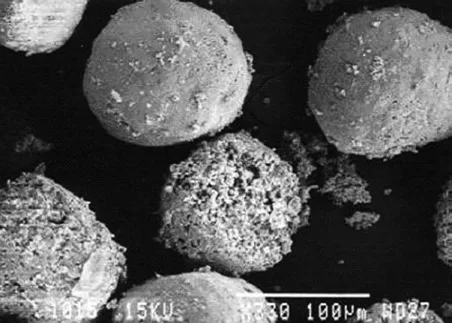 Fig 3. Scanning electron microscopy of CaHA microspheres (15 kV, ×330, 100 µm scale bar). The particles are globally spherical and of uniform caliber, with a surface that is not specular but finely granular and with adhering particulate material — the relevant detail, because that surface roughness is the interface the fibroblast recognizes. The central sphere shows the granular texture with particular clarity against its smoother neighbors — (Erian, 2012, p. 641)
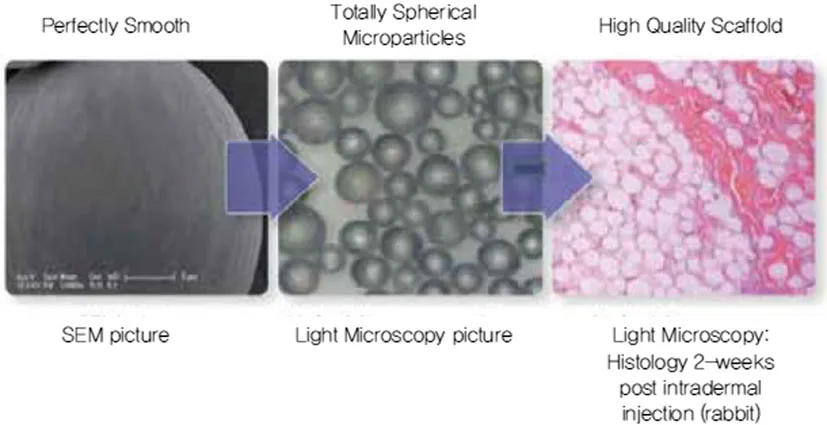 Fig 4. Three-panel sequence on the PCL microsphere. Left, scanning electron microscopy of a single particle: a continuous surface with no pores or facets. Center, optical microscopy of the group: spheres of disparate diameter but all round, with no flakes or angular fragments. Right, histology two weeks after intradermal injection in the rabbit: the spheres appear as regularly spaced rounded voids within a pink-stained stroma, arranged like a scaffold and not surrounded by a dense inflammatory infiltrate. It is the confirmation that the geometry of the vial survives the tissue — (Hong, 2020, p. 48)
Cohesivity — the property that separates CaHA/PCL from PLLA
Consensus: materials-science reviews treat cohesivity as one of the four parameters that govern in vivo behavior, alongside G′, G″ and degradation kinetics [20][29].
The direct experimental datum is in the corpus and is a tabletop test, not a rheometer: when a bolus of PCL filler is deposited in a dish of physiological saline, the mass does not disperse; it remains as a cohesive white body, with its own edges, after immersion [24] [C]. Fig 5 documents the two moments of the experiment.
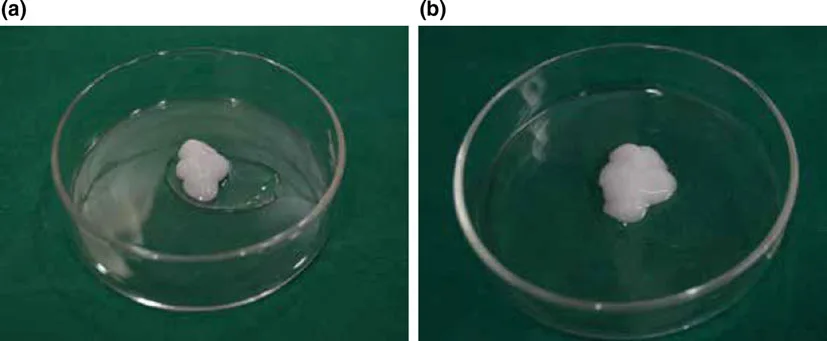 Fig 5. Two Petri dishes with physiological saline and a bolus of PCL filler deposited in the center. (a) after the first minute and (b) later: in both the bolus keeps its shape, the scalloped edge and the opaque white color, with no dispersion cloud around it and no loss of mass to the liquid. The clinical consequence is direct and double-edged: the product stays where it is left — which gives precision to modeling — and for that very reason a poorly placed deposit does not dilute itself over time — (Hong, 2020, p. 49)
Discrepancy that changes the gesture: high cohesivity (CaHA, PCL) versus irrelevant cohesivity (PLLA, PDLLA reconstituted as a fluid suspension). - A: CaHA and PCL, cohesive [24] → injected in bolus or linear retrograde with the expectation that the deposited shape is the final shape; immediate massage models, it does not disperse. - B: PLLA and PDLLA, fluid suspension [6][10] → injected in a fan or grid over a wide surface and massage is obligatory and prolonged precisely because the goal is to prevent them from concentrating. - Decide: if the goal is point projection (chin, mandibular angle, malar) choose the cohesive family; if the goal is skin quality over a field choose the fluid one or hyperdilute the cohesive one.
Dilution as a rheological variable
Hyperdilution is not an administrative convention; it is the lever that moves a CaHA from one end of the viscosity table to the other. Fig 2 already shows that 0.3 mL of lidocaine is enough to take Radiesse from ≈ 350 000 to ≈ 140 000 cP [16]. The biological correlate is measured ex vivo: hyperdilution 1:2 increases the tissue dispersion of the microspheres and lowers their local concentration relative to 1:1 [15]. And the cellular correlate closes the argument: since only the fibroblasts in direct contact are activated, and per-cell collagen III expression is identical at high and low dilution, diluting does not weaken the signal — it spreads it [15].
| Dilution | What is bought | What is lost | Reference |
|---|---|---|---|
| Undiluted | Maximum viscosity, projection, structural support | Distribution; forces a deep plane | [16] |
| + data-sheet lidocaine (up to 0.3 mL per 1.5 mL) | Comfort and injectability | ≈ 60 % of the viscosity | [7][16] |
| 1:1 | Spread over a mid-sized area while keeping some body | Immediate volume | [30] |
| 1:2 (hyperdilution) | Tissue dispersion demonstrated ex vivo, more fibroblasts recruited | Practically all the volumizing effect | [15] |
| Higher ratios (neck, décolletage, arms, abdomen, buttock) | Wide, superficial field coverage | The indication stops being volume and becomes skin quality | [8][9][30] |
Classic trap: citing the G′ of a biostimulator as if it were a data-sheet datum comparable to that of an HA. For PLLA and PDLLA the number does not exist before the clinician reconstitutes, and for PCL it changes with the S/M/L/E version. Whoever compares a "biostimulator G′" against the A3 table is comparing a measurement against an assumption.
A4.4 · Mechanism and timeline of the effect: onset, peak, plateau, degradation, what accelerates it
Answer first — the CaHA timeline, the best documented of the family:
| Moment | What happens in the tissue | What the patient sees | Ref |
|---|---|---|---|
| Day 0 | The CMC gel matrix occupies volume and the microspheres are suspended in it | Immediate correction, lifting effect of the gel | [2][7] |
| First 24 h | The fibroblasts in direct contact with a microsphere raise collagen III expression by 123 %; those that do not touch it do not | Nothing | [15] |
| 72 h | Collagen I expression rises 124 % (at 24 h it had not yet moved) | Nothing | [15] |
| Weeks 1–4 | Encapsulation of the microparticles, initial subclinical inflammation, arrival of macrophages and fibroblasts | Edema that subsides | [10] |
| Month 3–4 | The macrophages have resorbed the carrier gel. Collagen III significantly higher than with HA gel; neoangiogenesis begins | The point at which the result is judged: gel volume has been lost and collagen gained | [7][14] |
| Week 16 (human histology) | Collagen deposit with mild fibroblastic and histiocytic response; PSR staining with birefringence; no notable inflammatory or antigenic reaction; it does not migrate, calcify or ossify | Clinical plateau | [7] [D] |
| Month 9 | Collagen I high and collagen III already declining: the tissue has remodeled from provisional matrix to mature matrix. Sustained neoangiogenesis | Maximum skin quality | [14] |
| Months 12–18 | The microspheres degrade completely, leaving a newly formed matrix of collagen and elastic fibers | Slow decline; maintenance window | [3] |
Consensus: the four molecules share a three-stage mechanism — foreign body → controlled cellular response → new matrix — and in all four the lasting clinical effect is not the implant but what the implant leaves behind [13][20][3].
The mechanism, step by step
The sequence the mechanistic reviews describe for CaHA-CMC is the most granular published for any biostimulator, and serves as a template for the others [13][31]:
- Scaffold. The microsphere acts as a three-dimensional support on which new tissue organizes. It is not inert: it is a surface the cell interacts with.
- Macrophage–fibroblast interaction. The axis described by van Loghem: the macrophage that approaches the particle releases signals that recruit and activate the neighboring fibroblast, and from the pair comes matrix production [13].
- Calcium ions as a signal, not as filler. The dissolution of the CaHA releases Ca²⁺ and phosphate into the microenvironment; calcium acts as a biological signal that directs the skin-regeneration pathway and promotes fibroblast activity and collagen synthesis [13]. That is the conceptual difference between CaHA and the polyesters: here the degradation product is part of the mechanism, not just a residue to eliminate.
- Expanded final product. The result is not only collagen: the reviews document an increase in collagen, elastin, vasculature, proteoglycans and fibroblast population [31][13].
Fig 6 represents that geometry: the new fiber does not wrap the implant but occupies the space between microspheres, which is where the activated cells are.
(P) Point 3 explains why CaHA is not interchangeable with a PLLA even though both are labeled "biostimulator." PLLA degrades to lactic acid, which enters intermediary metabolism and there its role ends; the calcium of CaHA keeps acting as a messenger while it dissolves. Any reasoning of the type "one biostimulator is worth another with a volume adjustment" is materially false.
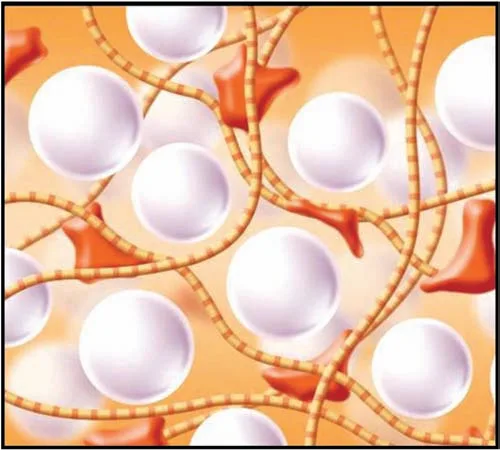 Fig 6. Diagram of CaHA behavior in soft tissue. The large white spheres are the microspheres; between them run collagen fibers represented as striated yellow cords, and on them rest spindle-shaped and stellate cells in red. The image expresses the point that Nowag later measured in culture [15]: the new fiber organizes in the space between particles and the active cells are those that touch the sphere, not those left in the free interstitium. The orange background represents the preexisting dermal matrix — (Sadick, 2009, p. 54)
What accelerates and what slows degradation
| Factor | Effect on duration | Molecule affected | Ref |
|---|---|---|---|
| Chain crystallinity | More crystalline = slower. PLLA (stereoregular) lasts longer than PDLLA (amorphous) | PLLA vs PDLLA | [20] |
| Molecular weight | The variable by which Ellansé grades 1, 2, 3 and 4 years with the same chemistry | PCL | [5] |
| Chain hydrophobicity | The six-carbon chain of PCL delays water's access to the ester | PCL | [20] |
| Contact with plasma, urine or infected tissue | Increases the rate of degradation — documented for polydioxanone | PPDO / PDO threads | [27] [C] |
| Local vascularization and macrophage activity | The CaHA carrier gel is dissolved by macrophages in 3–4 months | CaHA | [7] [D] |
| Dilution | Does not change the particle's degradation rate; it changes how many particles there are per unit volume and thus the magnitude of the stimulus | CaHA | [15] |
| Anatomical zone and movement | Clinical-translation reviews treat it as a determinant of in vivo performance alongside rheology | All | [29] |
Comparative timeline of the four molecules
| CaHA | PLLA | PCL | PDLLA | |
|---|---|---|---|---|
| Immediate volume | Yes, from the gel (70 % of the vial) [2] | No | Partial, from the CMC gel [5] | No |
| Window in which the patient sees nothing | None: there is an effect from day 0 | Weeks to months; collagen emerges at 4–6 weeks [32]; the patient is warned before treatment [10] | Weeks | Weeks |
| Documented peak | COL III at 4 months; COL I at 9 months [14] | Progressive tissue volume after encapsulation and fibroplasia [10] | Sustained improvement at 12 months in 90 % and 91.4 % of patients by formulation [33] | Maximum clavicular projection measured at 3 months: +1.8 ± 0.6 mm [34] |
| Plateau | Months 4–12 | After completing the session series | 12–24 months, with the long version the most stable [33] | Short: at 6 months projection falls to +1.6 ± 0.5 mm [34] |
| End | 12–18 months [3] | Progressive withdrawal | 1–4 years by version [5] | Biennial consensus maintenance, or earlier if collagen degradation is accelerated [6] |
| Proof of the plateau | Human histology at 16 weeks [7]; ex vivo + in vitro [15] | Classic histological description [10] | RCT at 12 months [35] and RCT at 24 months [33] | Prospective series with 3D imaging [34] |
Real, preserved discrepancy: how long does PCL last? - A: by declared version — Ellansé-S/M/L/E offer 1, 2, 3 and 4 years of projected in vivo persistence [5]. - B: by randomized trial — at 24 months, PCL-2 maintained efficacy on WSRS and GAIS throughout the period, with satisfaction of 81.7 %, versus 72.4 % for PCL-1; at 12 months both retained improvement in 90 % and 91.4 % [36]. - Decide: the version (not "the PCL") and the measurement criterion. The persistence of the material and the persistence of the aesthetic effect are not the same variable, and the data sheet declares the first while the patient asks about the second.
The bias of this timeline
(P) Three caveats about the figures above, because otherwise they would be read with more confidence than they deserve:
- The CaHA curve is well measured and the PDLLA one is not. The COL III +123 % / COL I +124 % of Nowag is a cell culture [15]; the 4 and 9 months are comparative histology [14]; the 16 weeks are human histology collected in teaching material
[D][7]. It is a reasonable pyramid. For PDLLA the best temporal datum available is a series of 44 patients in the clavicle with 3D imaging and no control group [34]. - The 3-to-6-month loss of clavicular PDLLA (+1.8 → +1.6 mm) is real and small, and the authors themselves stress that the uncontrolled design precludes asserting clinical significance or durability [34]. It is cited as a timeline, not as a promise.
- PLLA lacks a comparable quantitative timeline. What exists is a process description — subclinical inflammation, encapsulation, fibroplasia, progressive increase of tissue volume as the product degrades [10] — with no collagen-versus-time curve equivalent to that of CaHA.
Classic trap: telling the patient the "15-day result" of a biostimulator. At 15 days of a CaHA what is being seen is carrier gel that is going to disappear; at 15 days of a PLLA what is being seen is edema. Both generate the same follow-up visit — "it has gone down" — and both are prevented by the same sentence in the consent form, not by added product.
A4.5 · Comparative brand map: manufacturer, concentration, data-sheet indication, country of registration
Answer first — the full grid. Read it by columns, not by product:
| Brand | Manufacturer | Molecule and concentration | Presentation | Data-sheet indication / declared use | Registration | Ref |
|---|---|---|---|---|---|---|
| Radiesse | Merz Aesthetics | CaHA 30 % (25–45 µm spheres) + 70 % CMC gel | 0.8 · 1.5 · 3 mL syringes | Nasolabial folds, facial contour, HIV facial lipoatrophy; dorsum of the hand | EU 2004 (CE mark) · FDA 2006 (folds and lipodystrophy) | [2][3][7] |
| Radiesse (+) / Radiesse Plus | Merz Aesthetics | CaHA with lidocaine incorporated in powder; the most viscoelastic of the corpus injectables | Syringe | Same as Radiesse, with integrated anesthesia | After Radiesse | [10] |
| Radiesse Duo | Merz Aesthetics | CaHA for superficial diluted use within a two-plane technique | Syringe | Superficial subcutaneous enhancement in the vectorial technique | Published use in Brazil | [17] |
| CaHA + 2 % lidocaine mix (FDA 2009) | — (technique) | 3 mL → max. 0.6 mL · 1.5 mL → 0.3 mL · 0.8 mL → 0.16 mL · 0.3 mL → 0.06 mL | Luer-lock connector | ⚠ FDA-approved technique, NOT official in the EU | US yes, EU no | [7] [D] |
| Sculptra / Sculptra Aesthetic | Galderma | Lyophilized PLLA; 2–150 µm microflakes | Powder vial | Facial lipoatrophy; later aesthetic rejuvenation | FDA for lipoatrophy and later aesthetic | [10][4] |
| Elleva | — (Brazil) | PLLA | Vial | Biostimulation | Brazilian product; the most represented in the complications series (49.1 % of 55 cases) | [18] |
| Ellansé-S | Sinclair Pharma | PCL in aqueous CMC gel | Syringe | Volume augmentation and rejuvenation, face and hands | CE mark | [5][37] |
| Ellansé-M | Sinclair Pharma | PCL, higher molecular weight | Syringe | Same; the comparator in the non-inferiority trials | CE | [5][38] |
| Ellansé-L | Sinclair Pharma | PCL, high molecular weight | Syringe | Same | CE | [5] |
| Ellansé-E | Sinclair Pharma | PCL, highest molecular weight | Syringe | Same | CE | [5] |
| SF-01 (SYB filler) | Samyang Holdings (Korea) | PCL | Syringe | Moderate-to-severe nasolabial folds | Korea; non-inferiority trial versus Ellansé-M | [38] |
| AesteFill | Regen Biotech (Seoul) | PDLLA in microspheres + CMC | Lyophilized vial | Facial and body biostimulation | Korea; consensus of use published by a Brazilian panel | [6] |
| Juvelook | VAIM (Korea) | PDLLA | Vial | Biostimulation; Juvelook GLAM for the clavicle | Korea | [34] |
| Juvelook Volume / Lenisna | — (Korea) | PDLLA-HA200: PDLLA microspheres with non-cross-linked HA as carrier | Vial | Biostimulation with immediate support | Korea; Asian consensus for blindness management | [21] |
| HArmonyCa | Allergan Aesthetics (AbbVie) | CaHA + HA hybrid | Syringe | Midface (cheek) and jaw soft-tissue augmentation | European post-marketing study | [39] |
| HArmonyCa Lidocaine | Allergan Aesthetics | CaHA + HA hybrid + 0.3 % lidocaine HCl | Syringe | Same | Same | [39] |
| CaHA + HA 1:1 premix | — (technique) | Mix prepared in the office, 1:1 ratio | Two syringes + connector | Natural facial reshaping, subdermal with cannula | ⚠ Not a registered product: it is an extemporaneous mix | [40] |
| PPDO powder | Various (Korea) | Micronized poly(p-dioxanone) | Vial | Biostimulation | Included in the ongoing systematic review of AEs | [1][25] |
| Metacril / PMMA | Various | Polymethyl methacrylate — PERMANENT | Syringe | ⚠ Not a resorbable biostimulator. Included here only to separate it | Variable registration; present in poly-implanted patients | [41] [D] |
What the grid does not say and must be said
(P) Three reading caveats, because a brand table ages before the rest of the chapter:
- Regulatory status is the most perishable box in the chapter. A CE mark is withdrawn, a Korean product enters the EU, a manufacturer changes. The "Registration" box is verified in the product's data sheet before each purchase, not here.
- The facet
regulation_spain_euscored 0.504 on average across the seven A4 subfacets (runA4.*-20260809, artifactsevaluation/runs/A4.{1..7}.jsonl), andproduct_formulation0.443. The own corpus contains no data sheets or AEMPS rulings for these products; the whole registration column rests on secondary literature and on the master's material. It is a measured gap, not an omission. - The right half of the table — PDLLA and the hybrids — has less than three years of literature. The PDLLA consensus itself acknowledges that the clinical trials evaluating its aesthetic indications remain limited and that its recommendations are practical protocols founded on clinical experience, not on trials [6].
The axis that really separates the products: hydrophilicity
The commercial classification (CaHA / PLLA / PCL / PDLLA) is not the one that predicts tissue behavior. The one that does is in the complications corpus:
| Class | Products | Consequence |
|---|---|---|
| Hydrophilic | Hyaluronic acid (all brands), polyacrylamide (Aquamid), polyalkylimide (Bio-Alcamid) | They take up water; late edema and the expansion effect are theirs |
| Hydrophobic | CaHA (Radiesse), PCL (Ellansé), polyacryl methacrylate (Artecoll, Dermalive), liquid silicone | They do not take up water; the volume is the one placed |
| Mixed | PLLA (Sculptra) | Intermediate behavior |
van Loghem classification [36] [C]. (P) That CaHA and PCL share a box with Artecoll and with liquid silicone is not an accusation: it is a reminder that the hydrophobic axis groups products that do not dissolve or expand, and that therefore pose the same kind of late problem — a compact, palpable, stable deposit — even though some are resorbable and others are not.
The hybrids: what they add and what they mix
Consensus: a CaHA + HA hybrid seeks immediate volume (the HA fraction) plus deferred collagen (the CaHA fraction) in a single gesture [39][40][42].
| Datum | HArmonyCa (registered product) | 1:1 premix in the office |
|---|---|---|
| Study design | Prospective, open-label, post-marketing, n = 110 + 30 with lidocaine [39] | Retrospective, 46 patients aged 45–65, 12-month follow-up [40] |
| Zone | Cheek (main) and jawline (optional); optional touch-up at 2 weeks [39] | Facial zones with cannula, subdermal [40] |
| Responders | MFVDS 82.8 % at month 1, maintained to month 12 [39] | Improvement in laxity, volume and contour from month 3, sustained at 12 months [40] |
| GAIS | 98.5 % investigator · 91.8 % patient at month 1 [39] | GAIS used as a measure of satisfaction [40] |
| FACE-Q | +33.3 points in satisfaction with the cheeks and +23.8 in facial appearance at month 1 [39] | Not applied |
| Skin smoothness (ACSS) | Peak at months 3 (73.7 %) and 6 (69.2 %) | — |
| Adverse effects | Mild or moderate local reactions in 95.7 %; treatment-related: pain 11.4 % · mass at injection site 10.7 % · headache 7.1 % [39] | "Minimal", with no significant complications described [40] |
Discrepancy that does change the gesture: registered hybrid product versus extemporaneous premix. - A: HArmonyCa [39] → fixed composition, traceability, data sheet, 12-month post-marketing data in 140 patients, and a declared mass-at-injection-site rate of 10.7 %. - B: 1:1 premix of CaHA and HA in the office [40] → ratio adjustable to the case, lower cost, and no regulatory traceability: what is implanted is not an authorized product but a preparation by the injector. - Decide: the medicolegal framework, not the clinic. In Spain, an extemporaneously mixed medical device transfers to the physician the responsibility for the product on top of that for the act (see B3). There is also an argument in favor of B not to be lost: the HA hybrid is the only scenario in this family where hyaluronidase is good for anything, and that benefit was demonstrated precisely in the complications series (p < 0.01) [18].
Traceability — the box that is on no data sheet
(P) Chapter J5 records that more than half the products implicated in a complications series were of uncertain or uncertified origin. For biostimulators the risk is greater than for HA for two material reasons: there is no antidote and half the recent supply comes from Asian markets with parallel import channels. The operational rule is one of the clinical record, not of purchasing: brand, version, lot, reconstituted volume, diluent and zone, written down. A patient with "polylactic in the cheeks, 2 vials" in the record and a nodule at 18 months is a patient with no possible diagnosis.
Classic trap: treating "Ellansé" as a product. There are four, they differ by molecular weight, and the difference between S and E is three years of persistence [5]. Noting "Ellansé" without the letter leaves it unknown when it can be repeated and when one must wait.
A4.6 · Indication by region and by plane: which product in which plane and why
Answer first — region × product × plane grid. Link to the D chapter of each region:
| Region | Product of choice | Plane | Instrument | Why / warning | Ref |
|---|---|---|---|---|---|
| Forehead and temple (D1) | PCL, PDLLA, diluted CaHA | Supraperiosteal (deep temple) or subcutaneous | Cannula | ⚠ PDLLA-CMC has 2 published cases of visual loss, one from the forehead and one from the glabella [19] | [19][37] |
| Glabella (D1) | None. Biostimulator exclusion zone | — | — | It is the territory with the highest density of blindness cases for the whole injectable family [19] | [19] |
| Periorbital region and tear trough (D2) | None | — | — | PLLA explicitly contraindicated in the periorbital region and tear trough for nodule risk [10] | [10] |
| Malar and midface (D3) | CaHA (volume), CaHA+HA hybrid, PLLA (wide field) | Supraperiosteal above the ala-tragus line; subdermal-subcutaneous below it | 27–28 G needle or 25 G microcannula | The plane changes with the ala-tragus line; it is the most operational plane rule in the corpus | [7][39] |
| Nasal dorsum and nose reshaping (D4) | ⚠ Zone of maximum risk with CaHA | — | — | Most of the ≥ 11 cases of visual loss from CaHA involve the nasal dorsum [19] | [19] |
| Lip and labial mucosa (D5) | None of the four | — | — | CaHA not indicated in labial mucosa; PLLA contraindicated in the lip [10] | [10] |
| Nasolabial fold (D5) | CaHA (data-sheet indication), PCL (RCT indication) | Deep subdermal, linear retrograde threading | Needle or cannula | The best-documented indication of the whole family: two PCL RCTs with comparator [35][33] | [35][33][16] |
| Chin, pre-jowl and nasal ala (D6) | CaHA | Supraperiosteal — the three exceptions to the ala-tragus line rule | Needle | Corpus mnemonic: below ala-tragus one goes subdermal except these three | [7] [D] |
| Jawline (D6) | CaHA, CaHA+HA hybrid | Supraperiosteal + subdermal | Cannula | Optional zone in the post-marketing study of the hybrid [39] | [39][17] |
| Neck and décolletage (D7) | Hyperdiluted CaHA | Superficial subcutaneous, wide field | Cannula, microboluses / tunnels / fan | Skin-quality indication, not volume [8][9] | [8][9][30] |
| Dorsum of the hand | CaHA | Subcutaneous, with a tenting maneuver | Needle or cannula | "One of the products that gives the best result on the dorsum of the hands" [10]; PLLA also described with the tenting technique [43] | [10][37][43] |
| Arms, abdomen, buttock, thigh | Hyperdiluted CaHA | Superficial subcutaneous | Long cannula | The hyperdilution protocol was born for wide surfaces [10][8][30] | [8][30][10] |
| Clavicle | PDLLA (Juvelook GLAM) | Subcutaneous, with a blunt cannula | Cannula | Prospective series of 44 women; projection +1.8 ± 0.6 mm at 3 months [34] | [34] |
| Atrophic acne scar | PLLA | Subdermal | Needle | Described with before-after in a scars monograph [44] | [44] |
| HIV facial lipoatrophy | CaHA and PLLA — the original indication of both | Supraperiosteal and subdermal | Needle | It is the indication that put both products on the data sheet [3][45][46] | [3][45] |
The plane rule, explained
Consensus: no biostimulator goes to mid or superficial dermis. The teaching material formulates it with the three consequences of the error [7] [D]:
- Too superficial → "uneven appearance, highly visible material, poor results."
- Too deep → "more product will be needed to obtain the desired volume effect" (the result is good but expensive).
- Deep dermis / subdermis → appropriate.
(P) That rule has an exception that today is the majority in practice and that the old material does not capture: hyperdiluted CaHA does go superficial, in high subcutaneous and in field, and precisely for that reason it works as a skin-quality treatment [8][30][9]. The contradiction is apparent: what is forbidden in the superficial plane is the concentrated product, because its volume shows through. Diluted 1:2 or more, what is placed superficially is no longer a volume but a particle density seeking a fibroblast [15]. The correct rule is not "CaHA never superficial," it is "high concentration never superficial."
Fig 7 breaks down the three PLLA planes with their own deposit pattern — point, short stroke and fan — and Fig 8 does the equivalent for the deep CaHA deposit, showing at three different heights that the gesture is defined by bone contact and angle, with the vessel named just above.
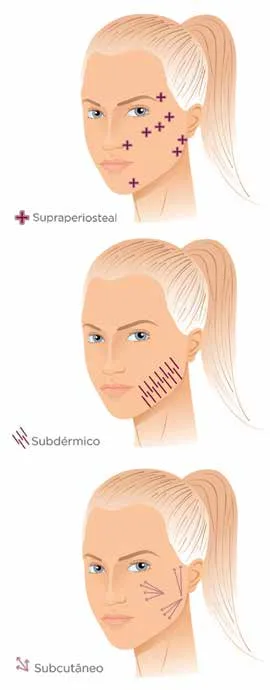 Fig 7. The three planes and their three deposit patterns for PLLA, panel by panel. Top, supraperiosteal: isolated crosses spread over temporal, malar, zygomatic arch and mandibular body — point deposits on bone, with no path. Center, subdermal: short, parallel, densely aligned strokes over the lateral cheek — a superficial grid of brief runs. Bottom, subcutaneous: a fan of long, divergent paths from a single preauricular entry point. The same vial changes indication depending on which of the three patterns is executed, and the three are combined in a single session — (Haddad, 2017, p. 8)
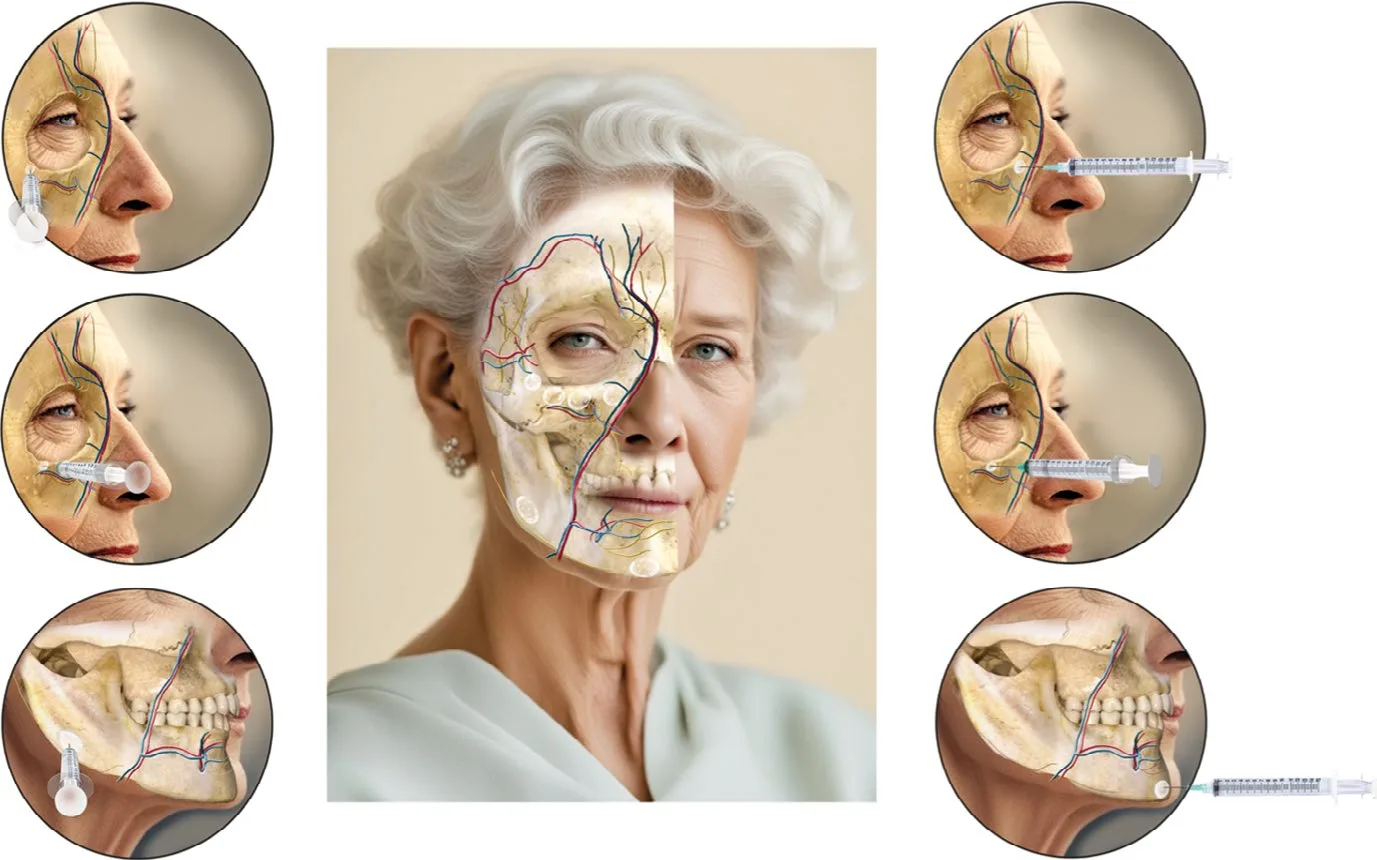 Fig 8. A composition of six vignettes around a portrait in which the left hemiface is replaced by a dissection — facial and angular artery in red, veins in blue, bone and retaining ligaments visible. The three vignettes in the left column show the entry point without a syringe at three heights (orbito-temporal, zygomatic-malar and mandibular body); the three on the right repeat the same point with the syringe mounted and the needle resting on the periosteum, with the axis of the syringe barrel rotated relative to the skin plane. The reading is that the deep deposit is defined by two things at once: bone contact and angle, and that each height has a named vessel immediately above it — (Piccolo, 2025, p. 58)
Instrument by region
| Instrument | Caliber | Use | Ref |
|---|---|---|---|
| Needle | 27 G or 28 G | CaHA in deep, point deposit | [7] [D] |
| Microcannula | 25 G | CaHA in threading and in field | [7] [D] |
| Reconstitution needle | 18 G or 21 G with a sterile 10 mL syringe | Draw the sterile water into the PLLA vial | [12] |
| Blunt cannula | — | Subcutaneous PDLLA in the clavicle, with no major complications at 6 months in 44 patients | [34] |
| Female-to-female luer-lock connector | — | Mixing CaHA + lidocaine or CaHA + saline between two syringes | [16] |
The decision that precedes the region: biostimulator or filler?
(P) The tree is short and deserves writing before any zone table, because most of the poor results in this family start by choosing the wrong molecule for the problem:
- Is the defect a concrete volume with a shape? (fold, short chin, flat malar) → HA filler or undiluted CaHA, and it is judged in the chair. A PLLA here arrives late and gives no shape.
- Is the defect laxity and skin quality over a field? (décolletage, neck, medial aspect of the arm, crepey cheek) → biostimulator, and the unit of treatment is the surface, not the point [8][30][9].
- Are there both? → hybrid or two-plane technique: concentrated deep product for structure and diluted superficial product for skin, in the same session [17][39].
- Does the patient need the result for a specific date? → not a candidate for a biostimulator alone. The collagen curve takes months [15][14].
- Does the patient tolerate uncertainty poorly, or has already complained about a previous result? → no. A product with no antidote in a patient who is going to ask to reverse it is the worst combination in the chapter (see B2).
Link to the region chapters: D1 — Upper Face (Forehead, Glabella, Temple, Brow).es · D2 — Periorbital Region.es · D3 — Midface & Cheeks.es · D4 — Non-Surgical Rhinoplasty.es · D5 — Perioral Region & Lips.es · D6 — Lower Face - Chin, Jawline & Neck.es · D7 — Ear, Décolleté & Other Facial Structures.es. The grid in this section gives which molecule; the region chapter gives the point, the vector and the vessel.
Classic trap: carrying the décolletage hyperdilution technique to the midface without changing the plane. In the décolletage the goal is field and the plane is superficial subcutaneous; in the midface, the same hyperdiluted product placed superficially over a malar that needed projection gives better skin over an equally flat contour, and the patient reads it as the treatment not working.
A4.7 · Dose and volume: per point, per region, per session, ceiling, interval
Answer first — the only per-surface dose ladder published in this family (PLLA):
| Plane | Dose | Movement | Instrument | Ref |
|---|---|---|---|---|
| Supraperiosteal | 0.1–0.3 mL/cm² | Bolus | 24 G ¾ · 25 G · 26 G ½ needle | [12] |
| Subcutaneous | 0.2 mL/cm² | Retroinjection in a fan | 21–23 G cannula | [12] |
| Subdermal | 0.02–0.05 mL per pass | Linear retroinjection | 24–26 G needle | [12] |
| Per-session ceiling | Maximum one vial per hemiface per session | — | — | [12] |
| Series | Minimum 3 sessions, three on average | — | — | [12] |
| Interval | Monthly, at least 4 weeks between applications so as not to hypercorrect [12]; the classic schedule separates the 3 sessions by 4–6 weeks [32][46] | — | — | [12][32][46] |
| Massage | Immediately after each application and at the end; at home two schedules preserved ⚠ without averaging: 5-5-5 rule (5 min, 5 times a day, 5 days) [46] and the Brazilian protocol (2–3 times a day, 5 min, 7 days) [12]; the experimental support for massage is limited [46] | — | — | [46][12] |
Consensus: in the four molecules the volume is dosed by surface or by vial, never by anatomical defect, and the session is closed by ceiling, not by result — because the result is not available on the day of the session [12][10][6].
Reconstitution: four incompatible protocols, preserved one by one
⚠ Not averaged. Each is used in its scenario:
| Protocol | Volume and diluent | Rest before use | Declared scenario | Ref |
|---|---|---|---|---|
| Safety minimum | ≥ 5 mL of sterile water | ≥ 2 h, "no less than two hours" | The threshold that brought nodules down from the historical 30–50 % | [10] [D] |
| Anglo-Saxon working range | 6–8 mL total per vial: 6 mL of bacteriostatic water alone, or 4 mL of water + 2 mL of 1–2 % lidocaine ± adrenaline | — | When regional block or local anesthesia is used; enough volume to cover the lower two thirds of a hemiface in severe lipoatrophy | [11] |
| High-dilution body school | ⚠ 9–16 mL per vial (up to 20 mL in extrafacial zones), sterile water ± lidocaine | ≥ 24 h | Face with < 10 mL; arms, décolletage, abdomen, buttock and dorsum of the hand with 9–16 mL — more diluted = fewer nodules over thin skin | [47][32] |
| Brazilian PLLA protocol | 8 mL of sterile water for injection, drawn with an 18 G or 21 G needle and a sterile 10 mL syringe, added slowly | ≥ 24 h | The most conservative; do not agitate immediately after reconstituting, so as not to deposit unhydrated particles | [12] |
| PDLLA consensus | 7–8 mL of sterile water for injection, with lidocaine added for comfort | — | AesteFill and family; a different molecule, not extrapolable to PLLA | [6] |
| ⚠ The abandoned figure | 3 mL | — | Never. It produced 30–50 % nodules | [10] |
Manipulation rules that accompany the figure and that without it are useless [11][12]: - Do not introduce air into the vial when withdrawing the PLLA: it precipitates. - Check for foam in the syringe and discard it before resuming the application. - Use threaded (luer-lock) syringes: the injection pressure of a particle suspension expels a smooth cone. - If the needle clogs: move the plunger in both directions to unblock it; if it does not yield, change the needle — do not increase the force.
Discrepancy that changes the gesture, and it is not one of volume but of method: with the vortex method, only mannitol and sterile water for injection produce a valid PDLLA suspension; with the back-and-forth method between two syringes all six diluents tested work — sodium bicarbonate, sterile water, physiological saline, lidocaine, lidocaine with adrenaline and mannitol — and reconstitution time is also much shortened, whether the suspension is thin or thick [26]. Decide: which diluent is available. Whoever has only physiological saline cannot use the vortex; they must use back-and-forth or change diluent.
Fig 9 documents the loading gesture, where the two details the previous rules require are lost: the inversion of the vial and the caliber of the syringe.
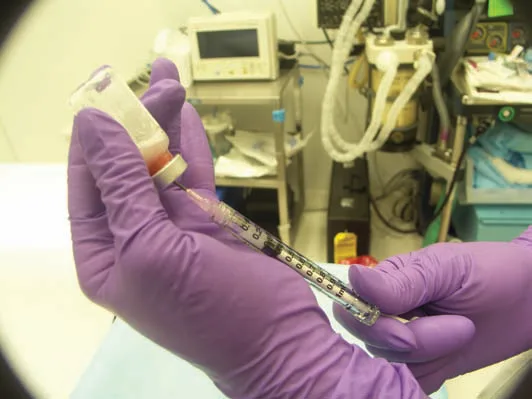 Fig 9. Gloved hands holding the inverted PLLA vial while loading the reconstituted suspension into a syringe with the needle through the stopper. The vial is seen translucent with sediment adhering to the wall; the syringe barrel shows the full graduation. The two details the image documents are the ones that fail in practice: the complete inversion of the vial — so as not to aspirate the air of the upper chamber, which precipitates the product [11] — and the use of a large-volume syringe to load in one go, not in several — (Illustrated Manual of Injectable Fillers, 2006, p. 144)
CaHA dilution: the ratio table
| Ratio (product : diluent) | Diluent | Destination | What is sought | Ref |
|---|---|---|---|---|
| Undiluted or 1:0.5 | — or lidocaine/saline at 1:0.5 | Deep malar, chin, mandibular angle | Projection and support | [7][16][30] |
| 1.5 mL + up to 0.3 mL of 2 % lidocaine | Lidocaine | Any data-sheet zone | Comfort; ⚠ FDA 2009 technique, not official in the EU | [7] [D] |
| 3 mL + up to 0.6 mL of 2 % lidocaine | Lidocaine | Same | Same | [7] [D] |
| 1:1 | Physiological saline ± lidocaine | Midface and jaw, subdermal | Spread while keeping body | [30][40] |
| 1:2 (hyperdilution) | Physiological saline | Facial field, neck | Dispersion demonstrated ex vivo; more fibroblasts activated | [15][30] |
| Higher ratios — 1:4 to 1:6 (extreme hyperdilution) | Physiological saline | Neck, décolletage, arms, abdomen, buttock, thigh | Skin quality over a wide surface | [8][30][9][10] |
(P) The previous table has a gap that must be flagged rather than filled: there is no per-zone hyperdilution ratio agreed with trial backing. The CaHA/CMC systematic review is explicit — despite the recent trend, the guidelines and the safety profile of diluted and hyperdiluted Radiesse, no randomized controlled trials have been published [45]. What exists are panel consensuses [30], a series of 50 patients with flexible ratios [9] and a clinical review [8]. Writing a single ratio here with the air of a standard would be inventing the evidence. The series of 50 patients reports its result by age band — improvement in 95 % of the 30–40 group, 80 % of the 40–60 and 70 % of those over 60, overall mean 81.6 % — with deliberately flexible and individualized** ratios, which is exactly the opposite of a protocol [9].
Fig 10 shows the assembly with which any row of the previous table is executed, and why the threaded luer is not optional.
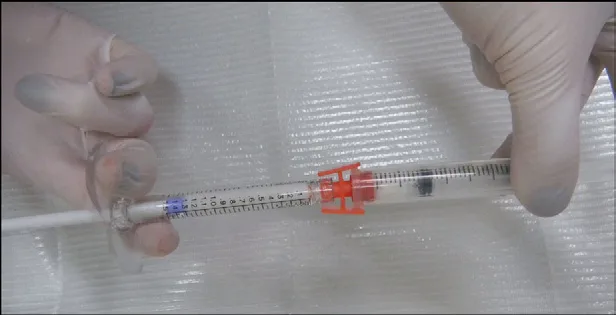 Fig 10. Two syringes coupled by an orange female-to-female luer-lock connector, held horizontally by gloved hands over a sterile field. The left syringe — the product one — is almost empty and the right has received the contents: the plunger is pushed alternately from side to side to homogenize. It is the same "back-and-forth" principle that Chen demonstrated superior to the vortex for reconstituting PDLLA [26], applied here to the dilution of CaHA. The detail the image demands respecting is the threaded luer on both barrels: with a smooth cone, the pressure needed to move a suspension of microspheres uncouples the syringes — (Carruthers, 2013, p. 169)
Dose and series of the four molecules
| CaHA | PLLA | PCL | PDLLA | |
|---|---|---|---|---|
| Dose unit | mL of syringe (0.8 / 1.5 / 3) | Reconstituted vial | mL of syringe | Reconstituted vial |
| Per session | Series documented with 4.5 mL in a 64-year-old patient [16] [C]; 2.6 mL in the illustrated Draelos case [47] [C] |
Max. 1 vial per hemiface [12] | Two injections 1 month apart in the 24-month RCT [33] | By area and degree of correction, individualized [6] |
| No. of sessions | Usually 1, with review | Minimum 3 [12]; 3 sessions of 1 vial in the illustrated case [12] | 1–2 [33] | Individualized [6] |
| Interval | Reassessed at 3 months | Monthly, ≥ 4 weeks [12]; 3–4 weeks [10] | 1 month between the two applications [33] | Biennial maintenance, or earlier if collagen degradation is accelerated [6] |
| Ceiling before overfilling | The rule is the plane, not the milliliter: superficial and concentrated = irregularity [7] | Do not overcorrect: the result keeps growing after the session [10] | — | — |
| Touch-up | Optional touch-up at 2 weeks in the hybrid protocol [39] | Never before 4 weeks [12] | — | — |
Why the ceiling is a ceiling
Consensus: the mechanism forces underdosing. Since each treatment will keep forming collagen after the session, and since the magnitude depends on the concentration and volume used, treating until the desired result is seen in the chair guarantees hypercorrection [12]. The evidence that the effect keeps growing over months is quantitative: in 33 patients with HIV lipoatrophy treated with four sessions of PLLA, the dermal thickness measured by ultrasound increased by 151 % at 12 months and 196 % at 24 months [12] [C]. And in 14 volunteers with serial retroauricular biopsies after three sessions four weeks apart, mean type I collagen rose significantly at 6 months relative to baseline [12] [C].
(P) Those two series explain why the minimum four-week interval is not a scheduling convention. At four weeks after a session the tissue is at less than a fifth of its final response; whoever decides the second session looking at the patient's face at two weeks is dosing against a reading that does not yet exist.
The efficacy denominator that does exist
| Study | n | Result | Ref |
|---|---|---|---|
| European PLLA series | 2 131 patients · 7 185 sessions | 95 % of patients satisfied with their aesthetic result | [12] [C] |
| US multicenter RCT, blinded evaluator, PLLA vs human collagen in the nasolabial fold | — | Overall improvement 100 % at 3 weeks after the third session; > 85 % at 25 months from the first injection | [12] [C] |
| South Korean RCT, PLLA vs HA in moderate-to-severe nasolabial fold | — | Non-inferior to HA | [12] [C] |
| Chinese multicenter RCT, PCL vs sodium hyaluronate in the nasolabial fold | 160 (80 + 80) | WSRS efficacy at 12 months 88.8 % vs 23.8 % (p < 0.001); related AEs 8.8 % vs 11.3 %; serious 0 % vs 1.3 % | [35] |
| Non-inferiority RCT, SF-01 vs Ellansé-M | matched pairs | WSRS difference at 12 months 0.08 ± 0.34; upper bound of the 95 % CI 0.0031 versus a predefined margin of 0.35 | [38] |
| 24-month RCT, PCL-1 vs PCL-2 | 40 | At 12 months sustained improvement in 90 % and 91.4 %; satisfaction at 24 months 72.4 % vs 81.7 % | [33] |
| Post-marketing study of the CaHA+HA hybrid | 140 | MFVDS 82.8 % at month 1, sustained at 12 months | [39] |
| Series of hyperdiluted CaHA, face-neck-décolletage-hands | 50 | Improvement 95 % / 80 % / 70 % by age band; mean 81.6 % | [9] |
| Prospective PDLLA series in the clavicle | 44 | Projection +1.8 ± 0.6 mm at 3 months and +1.6 ± 0.5 mm at 6 months (p < 0.05); satisfaction 90.3 % | [34] |
Classic trap: reconstituting PLLA and using it the same day because the schedule is tight. The three published protocols require rest — 2 h as an absolute minimum [10], 24 h in the Brazilian protocol [12] — and the reason is material: an unhydrated particle deposited in tissue is the substrate of the nodule. Reconstitution is done the day before, and whoever cannot plan it a day ahead should not be using this molecule.
A4.8 · Reversibility and management of excess: what degrades it, how long it takes, what cannot be undone
Answer first — the antidote table, with the column that matters on the right:
| Agent | Does it degrade the particle? | What it actually does | Evidence | Ref |
|---|---|---|---|---|
| Hyaluronidase on pure CaHA, PLLA, PCL or PDLLA | NO | Nothing to the product. In ischemia it is used as a diffusion factor, with less efficacy than against HA | Series of 55 complications: statistical benefit only when there was associated HA (p < 0.01) [18] | [18][41] |
| Hyaluronidase on CaHA + HA hybrid | Degrades only the HA fraction | Removes the hydrophilic half and leaves the microspheres | The only scenario with demonstrated benefit [18] | [18] |
| Sodium thiosulfate (STS) on CaHA | NO — demonstrated in vitro and in vivo | A dispersion effect, not degradation. Necrosis and hemorrhage were observed after STS treatment | Preclinical study with 3D camera, ex vivo µCT, in vivo CT, histopathology and electron microscopy in the farm pig: no indication of microsphere degradation [48] | [48] |
| Physiological saline | No | Mechanically disperses a recent, compact deposit | Used in 45.5 % of 55 complications; overall complete resolution of the series: 5 cases [18] | [18] |
| Diluted intralesional corticosteroid | No | Modulates the inflammatory response of the nodule | Used in 23.6 % of the series [18] | [18] |
| 5-fluorouracil | No | Antifibrotic on the established nodule; in documented practice, 0.5 % 5-FU with triamcinolone in nodular regions | Case of PCL nodules one year after treatment [49] [D] |
[49][50] |
| Energy devices | No | Remodel the surrounding tissue | Used in 10.9 % of the series [18] | [18] |
| Surgery / excision | Removes the deposit, not the molecule | Last line; leaves a scar | Included in the PLLA nodule algorithm [50] | [50] |
| Time | Yes — the only agent that truly degrades | Hydrolysis (polyesters) or ionic dissolution (CaHA) | CaHA 12–18 months [3]; PCL 1–4 years by version [5]; PLLA/PDLLA months-years | [5][3] |
Consensus: none of the four molecules is reversible. The exact wording of the complications corpus says it without qualification: calcium hydroxylapatite is not reversible, although some have observed improvement with the injection of physiological saline, hyaluronidase, sodium thiosulfate, steroids and 5-fluorouracil injections [41] [D].
The case of sodium thiosulfate, in detail
(P) It deserves its own paragraph because it is the chapter's cleanest example of a reasonable hypothesis that measurement disproves, and because it still circulates as if it were an antidote.
The hypothesis was solid: STS is antioxidant, vasodilator and a calcium chelator; it inhibits the precipitation of calcium salts and dissolves calcium deposits in vessels. It has established clinical use in calcific uremic arteriolopathy (calciphylaxis) and as an antidote in cyanide poisoning [41] [D]. Small pilot studies had suggested a reduction of CaHA volume and of nodule formation [48].
The measurement. Danysz 2020 tested that hypothesis with two arms — in vitro co-incubation of STS with CaHA, and in vivo injections in the farm pig — and five independent readouts: 3D-camera analysis, ex vivo micro-computed tomography, in vivo tomography, histopathology and scanning electron microscopy [48]. Result:
- No indication of CaHA degradation by STS, neither in vitro nor in vivo.
- The 3D-camera analysis showed no reducing effect of STS on CaHA.
- Histology, ex vivo µCT and in vivo CT did show a decrease in the amount/volume of product, attributable to a dispersion effect.
- Necrosis and hemorrhage were observed after STS treatment.
What remains: STS spreads the deposit, it does not dissolve it, and it does so at the cost of tissue damage. A nodule treated with STS may be less palpable because the material is more spread out, with the particle intact and worse tissue. That is not reversal.
What can be done, and in what order
Consensus (six-step algorithm for PLLA nodules, built on 40 studies and with four phenotypes [50]):
| Step | Action | Note |
|---|---|---|
| 0. Prevention | "Effective management begins with prevention" — dilution protocol, technique, reconstitution method and injection depth are the factors linked to nodule formation | [50] |
| 1. Phenotype | Four phenotypes: non-inflammatory · inflammatory-immunological · infectious/biofilm · unusual presentations | Treatment diverges completely between the 1st and the 3rd |
| 2. Imaging | Ultrasound and high-frequency ultrasound | Distinguishes a compact deposit from a collection; see Fig 11 |
| 3. Histology | Confirmation recommended in atypical presentations | [50] |
| 4. Treat by phenotype | Conservative · intranodular corticosteroid · 5-FU · antibiotic · immunotherapy · surgery | [50] |
| 5. Follow-up | That of the Brazilian series: only 5 of 55 cases resolved completely despite treatment | It is the datum to give the patient |
Discrepancy that changes the gesture: late nodule → corticosteroid or antibiotic first? - A: inflammatory-immunological phenotype [50] → intranodular corticosteroid or 5-FU. - B: infectious/biofilm phenotype [50] → antibiotic before corticosteroid; corticosteroid monotherapy over a biofilm activates it (see J5). - Decide: time of appearance, inflammatory signs, fluctuation and ultrasound. It is not decided by the appearance in the office.
Identify before treating: ultrasound
(P) With a product that cannot be dissolved, ultrasound stops being a luxury and becomes the step that decides whether or not to inject. The corpus documents cases with the full correlation: a 47-year-old woman treated with polycaprolactone two years earlier, with numerous visible and palpable nodules coinciding with the ultrasound findings, and zones of compacted material in the supraciliary regions — more extensive on the left — and the same type of material in malar zones with some hypoechoic image [41] [D]. And a 44-year-old poly-implanted patient with permanent (methacrylate) and non-permanent (Radiesse, Ellansé, hyaluronic acid) products over more than eight years, in whom facial ultrasound was the step that allowed planning [41] [D].
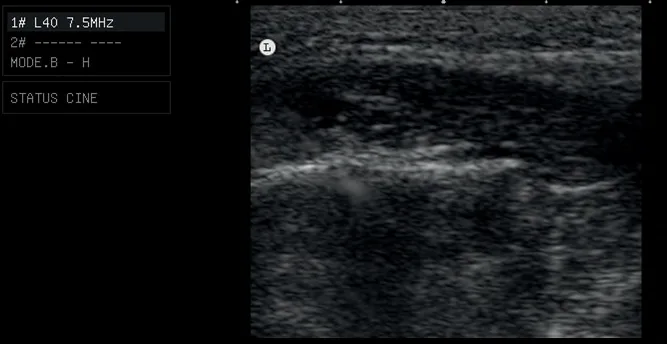 Fig 11. B-mode ultrasound section with a linear probe at 7.5 MHz (L40). Beneath the superficial dermal band a markedly hyperechoic linear interface stands out, elongated and horizontal, separating the superficial subcutaneous from the deep plane and casting a posterior shadow over the underlying tissue, which appears darker and without detail. That combination — a continuous bright line plus shadow — is the signature of the particulate deposit; the operator who finds it in a patient who does not remember what was placed has before them a non-resorbed product, and not an anatomical plane — (Manual práctico de imagen en Voluminización Facial, p. 30)
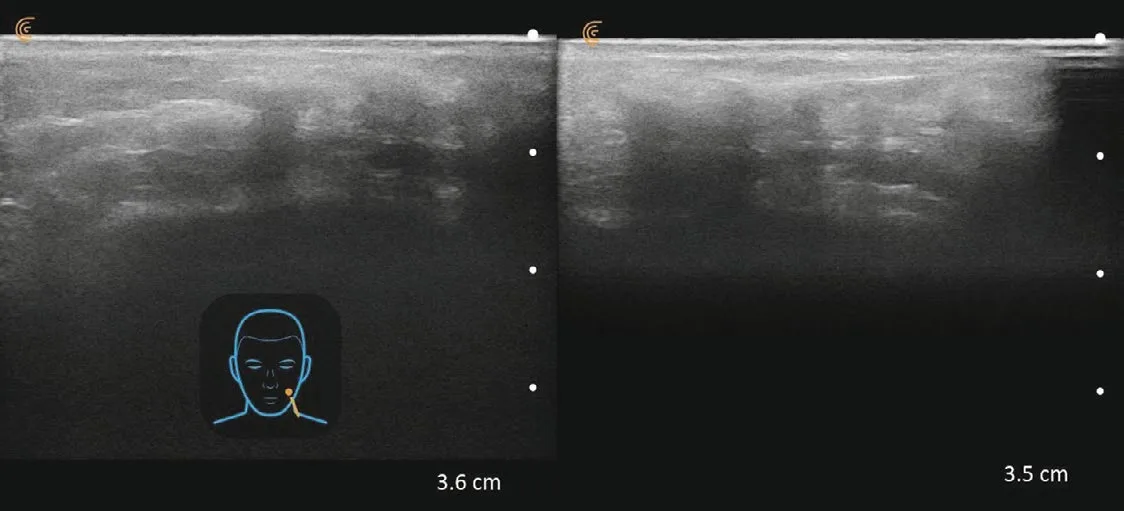 Fig 12. Two adjacent ultrasound sections of the same patient, at 3.6 cm and 3.5 cm of field depth, with the location pictogram over the jawline. In both, the subcutaneous tissue shows multiple small, irregular, scattered hyperechoic foci, without the rounded, sharp-edged anechoic lacunae that characterize the hyaluronic acid deposit. The difference between the two patterns is what allows one to say, faced with a nodule, whether it makes sense to attempt hyaluronidase or not — (Malherbe, 2024, p. 36)
What can never be undone
| Situation | Recoverable? | What remains |
|---|---|---|
| Vascular occlusion with visual loss | No. The management protocol is rescue, not reversal | Lower the intraocular pressure, refer to ophthalmology immediately, hyperbaric oxygen, anti-inflammatory and anticoagulation as support [19][21] |
| Product in a superficial plane with visible irregularity | Not with an antidote. Degradation is awaited | 12–18 months (CaHA) [3]; up to 4 years (PCL-E) [5] |
| Volumetric overcorrection | No | The error becomes visible once product can no longer be removed |
| Established late nodule | Rarely. 5 of 55 in the best available series [18] | Prolonged symptomatic management |
| Migration / compacted material in a poly-implanted patient | No | Ultrasound map and surgical decision [41] |
(P) From here comes the only consent rule specific to this chapter, and it differs from that of HA: the HA patient can be told "if you do not like it, we dissolve it." The biostimulator patient must be told the opposite, in those words, and have it signed (see B3). The sentence "it is a natural product that stimulates your own collagen" is true and, said alone, is misleading: what is not said is that there is no way back for one to four years.
Classic trap: injecting hyaluronidase "just in case" over a CaHA or PCL nodule. It does not degrade the particle [18], adds a puncture and inflammation to an already reactive tissue, and — importantly — consumes the time window in which the nodule should have been phenotyped and an ultrasound done [50].
A4.9 · Adverse effects INTRINSIC to the substance
Answer first — what happens to these products and not to a hyaluronic acid:
| Adverse effect | Frequency / magnitude | Molecule | Why it is intrinsic to the substance | Ref |
|---|---|---|---|---|
| Late nodule | 89.1 % of the complications recorded in 55 cases; 60 % appearing at more than 1 month | PLLA, PCL, CaHA, PDLLA | It is the tissue's reaction to a persistent particle. An HA does not do it by the same mechanism | [18] |
| Treatment failure of the nodule | Only 5 of 55 cases resolved completely despite saline, hyaluronidase, corticosteroid and energy | All | There is no enzyme that removes the substrate | [18] |
| Nodule from insufficient reconstitution | 30–50 % with the historical 3 mL dilution | PLLA | The concentrated suspension deposits unhydrated aggregates | [10] |
| Foreign-body granuloma | Recorded as a class complication; the PDLLA consensus names it explicitly among the effects to minimize with training and selection | All | An organized immune response to persistent material | [6][1] |
| Visual loss from occlusion | CaHA ≥ 11 published cases, most from the nasal dorsum; PLLA 2 (periorbital/nasal and temple); PDLLA-CMC 2 (forehead, glabella); PDLLA-HA 1 (posterior ischemic optic neuropathy); PCL 0 of blindness, 1 facial-artery embolism | All except PCL for blindness | A solid-particle embolus that cannot be dissolved — the radical difference from HA | [19] |
| Erythema, ecchymosis and combined nodules | 15–30 % of cases in the combined-treatments review | All | [22] | |
| Local reactions after CaHA+HA hybrid | 95.7 % mild or moderate; pain 11.4 % · mass at injection site 10.7 % · headache 7.1 % | Hybrid | The "mass at injection site" at 10.7 % is the nodule by its regulatory name | [39] |
| Ecchymosis and edema after PDLLA in the clavicle | ecchymosis 19.4 % · edema 25.8 %, transient and spontaneously resolving; no major complications at 6 months in 44 patients | PDLLA | [34] | |
| Injection-related adverse effects in the PCL RCT | 8.8 % with PCL versus 11.3 % with sodium hyaluronate; serious 0 % vs 1.3 % | PCL | The only comparative datum against HA with a control group | [35] |
| Irregularity and visibility of the material | No figure; described as a direct consequence of the plane | CaHA | The concentrated product shows through in a superficial plane | [7] [D] |
| Compact deposit persistent for years | Cases with nodules at 1 and 2 years after treatment, with ultrasound correlation | PCL | Persistence of 1–4 years by version | [41][49] [D] |
| Radiopacity | It is not a harm, it is an interference | CaHA | It appears on radiography and CT | [3] |
Consensus: the adverse effect characteristic of this family is not the puncture, it is the nodule, and its distinguishing feature relative to that of HA is that it appears late and does not resolve.
The nodule, taken apart
The Brazilian series is the best available portrait of the real complication, because it was collected by asking dermatological sonographers and not the injectors [18]:
| Variable | Distribution | Reading |
|---|---|---|
| Product involved | PLLA-Elleva 49.1 % · CaHA (alone or with HA) 23.6 % · PLLA-Sculptra 20.0 % · PCL 7.3 % | The brand matters: two presentations of the same molecule, PLLA, do not perform alike |
| Zone | Face 72.7 % | |
| Clinical form | Nodules 89.1 % | |
| Timing | Late (> 1 month) 60.0 % | When the patient has already left |
| Incorrect plane | A single case injected in the wrong plane (SMAS) | ⚠ The finding that unsettles: the authors conclude that complications were related more to the products' properties than to inadequate technique |
| Treatment applied | saline 45.5 % · hyaluronidase 25.5 % · diluted corticosteroid 23.6 % · energy devices 10.9 % | |
| Complete resolution | 5 cases | |
| Only treatment with statistical benefit | Hyaluronidase when there was associated CaHA + HA (p < 0.01) |
(P) The plane row deserves reading twice. With 55 complications collected and one case of incorrect depth, the reassuring narrative — "this happens when you inject badly" — does not hold in that series. The authors say it: the problem seems to be in the product rather than in the technique. That does not excuse the injector from technique; it changes the conversation with the patient, because it means that the complication can occur with everything done right and that the consent form must say so.
The four nodule phenotypes, and why diagnosis comes before treatment
| Phenotype | When to suspect it | Corresponding treatment | Ref |
|---|---|---|---|
| Non-inflammatory | Firm, painless nodule, with no signs of phlogosis | Conservative; intranodular corticosteroid; 5-FU | [50] |
| Inflammatory-immunological | Erythema, warmth, recurrent flares; autoimmune context | Corticosteroid, 5-FU, immunotherapy | [50] |
| Infectious / biofilm | Late onset, dragging course, negative culture | Antibiotic before corticosteroid (see J5) | [50] |
| Unusual presentations | Anything that does not fit | Histology recommended | [50] |
Fig 13 documents the histological pattern of the foreign-body granuloma underlying the inflammatory phenotype, with the corresponding provenance caveat.
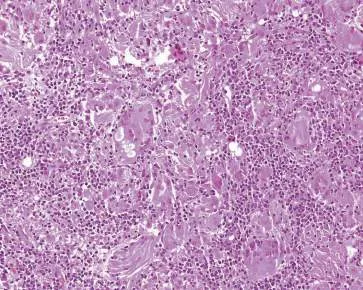 Fig 13. Hematoxylin-eosin-stained section in which the pattern repeats across the whole field: rounded aggregates of epithelioid cells with broad, pale cytoplasm, some with multiple peripheral nuclei (giant cells), surrounded by a dense lymphocytic infiltrate occupying the interstitium; between the aggregates are optically empty spaces corresponding to material extracted during processing. ⚠ Declared provenance: this biopsy is not from a biostimulator — it corresponds to a patient who self-injected material eluted from a cream with hyaluronic acid [2]. It is used here as a reference for the foreign-body granulomatous pattern, which is the one to recognize, not as iconography of a specific product — (Cosmetic Medicine & Surgery, 2017, p. 650)
Contraindications — the finest facet of the chapter
⚠ Strength statement before the table. The facet contraindications_interactions scored 0.481 on average across the seven A4 subfacets (minimum 0.026), the second weakest of the twenty, over evaluation/runs/A4.{1..7}.jsonl. The list below comes from a Brazilian consensus monograph and from the PDLLA consensus, not from a guideline. It is given as a selection criterion, not as a norm.
| Situation | Conduct | Ref |
|---|---|---|
| Rheumatoid arthritis and its variants | Explicitly listed as a situation to consider before treating with PLLA | [12] [C] |
| Lupus erythematosus | Idem | [12] [C] |
| Scleroderma | Idem | [12] [C] |
| Sjögren's syndrome | Idem | [12] [C] |
| Polymyositis / dermatomyositis | Idem | [12] [C] |
| History of nodule or granuloma from filler | The PDLLA consensus stresses patient screening as a measure to minimize nodules and granulomas | [6] |
| Zone with previous permanent product | Ultrasound map before deciding; the poly-implanted patient is a scenario of its own [41] | [41] [D] |
| Active infection in the zone | Defer (see J5) | [50] |
| Expectation of an immediate result or a fixed date | Not a medical contraindication; a selection contraindication | [12] |
(P) The case documented in the corpus that best illustrates the first row: a patient with rheumatoid arthritis untreated at that time, with a history of facial PLLA and HA, treated with two vials of polycaprolactone and several HAs; a year later she begins forming nodules, some visible; an enzyme preparation was administered, after which she noticed decreased facial tension but an increase of the problem, and finally 0.5 % 5-FU with triamcinolone was infiltrated into the nodular regions under ultrasound control [49] [D]. It is the complete sequence of the chapter in a single patient: immunological terrain, a product with no antidote, an enzyme that does not help, and a year's delay between cause and symptom.
Visual loss: what this chapter adds and what belongs to J2
Consensus: the management of occlusion with visual loss is the same protocol for the whole family and lives in J2. What is intrinsic to the substance and belongs to this chapter is the map of incidence by molecule and by zone [19]:
- CaHA is the molecule with the most published cases of the family (≥ 11) and its dominant zone is the nasal dorsum.
- PLLA: 2 cases, one from the periorbital/nasal region and another from the temple.
- PDLLA-CMC: 2 cases, one from the forehead and another from the glabella.
- PDLLA-HA: 1 case, from posterior ischemic optic neuropathy — a mechanism different from the classic retinal occlusive one, and for that very reason with a different presentation.
- PCL: no published case of blindness, but one facial-artery embolism.
And there also exists a consensus dedicated exclusively to PDLLA-HA200 (Juvelook Volume / Lenisna) with an algorithm for managing blindness from that product, produced by a panel of oculoplastic surgeons, dermatologists and aesthetic physicians [21].
(P) The map above does not say that CaHA is the most dangerous per unit injected: it says it is the one that has been injected the most for the most years in the wrong zones. A denominator does not exist in any of the five rows. What can be read without a denominator is the zone: the concentration of CaHA cases in the nasal dorsum is a geographic signal, and the conduct that follows from it — do not use CaHA in nose reshaping — needs no rate to justify itself.
Classic trap: discharging the biostimulator patient at two weeks "with no incidents." 60 % of complications appear after the first month [18], and the documented case of PCL nodules debuted at one year [49]. The review that corresponds to this product is not that of HA: it is a review at 3 months and an open door at 12.
A4.10 · Alternatives: what replaces it, when, and when the right answer is not to inject
Answer first — substitution grid by goal, not by product:
| Patient's goal | Biostimulator considered | Reasonable alternative | When the alternative is better | Ref |
|---|---|---|---|---|
| Volume with a defined shape (malar, chin, jaw) | Undiluted CaHA | High-G′ hyaluronic acid (A3, A6) | Whenever the patient may ask for reversal, has a date expectation, or is a first-timer | [20][29] |
| Moderate skin laxity, wide field | Hyperdiluted CaHA | Fractional microneedle radiofrequency (Morpheus8: 2–4/8 mm needles, 25 pins, insulated, motorized fractional; Voluderm; Venus Viva 0.5 mm/160 pins) | Patient who refuses a particle injectable, or who already has a previous unidentified product | [52] [C] |
| Skin laxity with a descent component | CaHA / PLLA in field | HIFU (high-intensity focused ultrasound) | When the target is the SMAS plane and not the dermis | [52] [C] |
| Laxity with a surgical indication | Any | Surgery | Datum for the conversation: in the comparison recorded, patients who underwent cosmetic surgery improved 49 % in laxity over baseline, versus 16 % of those treated with fractional radiofrequency | [52] [C] |
| Skin quality and texture | Superficial PLLA / PDLLA | Microneedling, fractional laser, peeling, cosmeceuticals (F8 federated) | Cost, reversibility and absence of implanted material | [22][52] |
| Regeneration with autologous material | Any | PRP / PRF | Patient who refuses synthetic material; evidence systematized alongside PLLA and CaHA | [23] |
| Volume filling with autologous material | CaHA | Autologous fat graft (E/F5) | Large volumes; and the material is one's own | [23] |
| Dynamic wrinkle | Any | Botulinum toxin (A5, C3) | ⚠ A biostimulator does not treat an expression wrinkle. It is an indication error, not a product one | [22] |
| Fine periocular wrinkle | None | Laser, cosmeceuticals | CaHA explicitly not indicated in fine wrinkles of the periocular contour [10] | [10] |
| Labial mucosa | None | Low-cohesivity HA | CaHA not indicated in labial mucosa [10]; PLLA contraindicated in the lip [10] | [10] |
Combine instead of substitute
Consensus: combining a biostimulator with toxin, with HA filler or with energy devices is widespread practice and shows a signal of benefit, but the evidence is methodologically weak. The systematic review that evaluated it started from 1 237 studies and only 29 met criteria, with sample sizes of 10 to 350 subjects; the combinations of CaHA or PLLA with HIFU, fractional laser and microneedling showed notable improvement in texture, elasticity and contour, with adverse effects — erythema, ecchymosis, nodules — in 15–30 % of cases and serious complications rare (granulomas, vascular occlusion) [22].
The limitation the authors themselves stress and worth repeating before selling a combined protocol: heterogeneous methodologies, small samples, inconsistent protocols, and absence of a molecular understanding of the synergistic mechanism, which prevents knowing anything about the duration and safety of the combined result [22].
| Combination | Signal | Precaution intrinsic to this family |
|---|---|---|
| Biostimulator + botulinum toxin | Included among the 29 evaluated [22] | Sequence and temporal separation: see L2 |
| Biostimulator + HA filler | Included [22] | If the HA and the biostimulator share a plane, a later nodule will be indistinguishable without ultrasound |
| CaHA / PLLA + HIFU | Improvement in texture, elasticity and contour [22] | Energy over a particle deposit does not degrade it: it remodels around it |
| CaHA / PLLA + fractional laser | Idem [22] | |
| CaHA / PLLA + microneedling | Idem [22] | |
| Biostimulator + PRP/PRF | Joint review of biostimulatory agents [23] | The quantifiable evidence is limited for all of them [23] |
When the right answer is not to inject
(P) Five scenarios in which the right gesture is not to place product, and none is a classic medical contraindication:
- The patient wants to see the result today. The molecule cannot give it. Offering CaHA because "it also gives immediate volume" is selling the carrier gel, which disappears in 3–4 months [7]. The right answer is HA or nothing.
- The patient has already complained about a previous result, or asks up front how it is removed. A product with no antidote in that profile is the worst possible combination in the chapter (see B2). The reference series gives the figure to keep in mind: 5 complete resolutions of 55 complications [18].
- The zone already has product and it is not known which. Before adding particle, ultrasound — the poly-implanted scenario is documented and ends in the operating room, not in a syringe [41].
- The defect is one of descent and not of volume or quality. The comparative datum in the corpus is uncomfortable but honest: 49 % improvement in laxity with surgery versus 16 % with fractional radiofrequency [52]. A biostimulator does not reposition tissue either. Referring is an indication, not a defeat.
- Active or poorly characterized immunological terrain. The list of autoimmune diseases in A4.9 [12] and the documented case of rheumatoid arthritis with PCL nodules at one year [49] are enough for that patient to leave the office with a blood test and a second appointment, not with two vials.
- Patient under ~30 years without real atrophy. The biostimulator indication here is preventive and its evidence is weak; implanting an irreversible particle for an unproven benefit in a face with no volume deficit is a selection error, not a product one. (P) Photoprotection, habits and cosmeceuticals before implanted material — and spot HA if there really is a shape to correct.
Honest comparison with HA
| Biostimulator | Hyaluronic acid | |
|---|---|---|
| Effect on day 0 | Carrier gel or nothing | The final result |
| Effect at 6 months | Maximum (collagen) | Declining |
| Reversibility | None [18][48] | Hyaluronidase |
| Late nodule | 89.1 % of its complications [18] | Less frequent and with an enzymatic exit |
| Visual loss | No antidote for the embolus [19] | Protocol with hyaluronidase (J2) |
| Cost per session | Similar; more sessions in PLLA/PDLLA [12] | 1 session |
| Indication in which it wins | Skin quality over a wide surface [8][30][9] | Shape and projection |
| Indication in which it loses | Point shape, urgency, insecure patient | Wide superficial field, longevity |
Classic trap: offering a biostimulator as "the same but lasting longer" to a patient who came for HA. They last longer and do something else and cannot be removed. The three sentences go together or none is true.
Step-by-step protocol — biostimulator session (generic, applicable to the four classes)
Consensus: the sequence is the same for CaHA, PLLA, PCL and PDLLA; the diluent, the plane and the rest time change, not the order of the steps [12][46][6].
- Confirm the indication. Diffuse atrophy and tissue quality, or shape? If it is a shape with defined volume, it is HA — not a biostimulator (see A4.6) [10].
- Rule out contraindications. Active infection or untreated dental focus, autoimmune disease in a flare, history of nodule/granuloma or keloid, dysmorphia, pregnancy or breastfeeding, and expectation of an immediate result or a fixed date (see A4.9) [12][6][50].
- Consent with the three obligatory sentences — different from that of HA: (a) there is no antidote; (b) the result takes weeks to months and is not judged before; (c) several sessions are needed [18][10]. See B3.
- Reconstitute in advance (PLLA: ≥ 24 h; PDLLA by agitation method [26]). Verify the homogeneous dispersion against the light: a vial with lumps is not injected — the unhydrated crystals adhering to the wall are the substrate of the nodule — and no air is introduced into the vial, which precipitates the product [46][12][11].
- Mark standing or seated, delimiting the treatment zone and the exclusion zones: glabella and nasal dorsum for the whole family, lip, labial mucosa and periorbital/tear-trough region for PLLA (see A4.6) [10][19].
- Strict antisepsis with chlorhexidine; late infection and biofilm are the serious complication of this family (see J5) [12][50]. Topical anesthesia ± regional block.
- Inject in the correct plane with the needle or cannula in motion — linear retroinjection, in a fan or in cross-hatching over a wide field; never a static bolus except point projection with a cohesive product, and never dermal unless the product indicates it. Depositing at the vertex of the fan concentrates particle and forms a papule; the syringe is kept parallel to the skin to keep the needle patent [46][24][12].
- Aspirate and use a cannula in every vascularized zone. A non-reversible material embolus has no rescue; the blunt cannula reduces vascular penetration [34][24].
- Massage at the end and at home (5-5-5 rule for PLLA [46]; immediate modeling massage for cohesive CaHA [24]).
- Schedule at 4–6 weeks, no earlier, and do not touch up at that visit: collagen keeps growing and the early touch-up is the direct route to overcorrection. The result is judged from the third month onward [46][14].
- Record brand, version, lot, dilution, volume by zone, diluent, method and plane. Without this there is no way to interpret a complication at 8 months: a late nodule over a record that only says "polylactic, 2 vials" is a nodule with no possible diagnosis [41][18].
Classic trap: executing the eleven steps and skipping number 4. PLLA reconstitution is done the day before; whoever cannot plan it a day ahead should not be using the molecule [12].
Schools
Consensus: all share deliberate underdosing and deferred evaluation; they disagree on the dilution volume, on the order relative to HA and on the role of body.
| Current | Thesis | Consequence in the chair | Ref |
|---|---|---|---|
| High dilution (majority) | Almost all PLLA nodules are from underdilution and a superficial plane | ≥ 8 mL, ≥ 24 h, strict subcutaneous | [46][12] |
| Strict data sheet | Departing from the leaflet transfers responsibility for the product to the physician | Less volume, more waiting, more sessions | [10] |
| Biostimulation as a base (skin-first) | Tissue first, volume later | Biostimulator before filler in almost every plan | [31] |
| Volume first | Without structural support, skin quality is not seen | Deep structural HA + biostimulator as finishing | [17][39] |
| Body hyperdilution | Hyperdiluted CaHA is the wide-field tool | 1:2 to 1:6 in neck, décolletage, arms, abdomen, buttock | [8][30][9] |
Discrepancy that changes the gesture: high dilution versus strict data sheet. - A: high dilution [46][10] → ≥ 8 mL and ≥ 24 h of rest lower the nodule incidence below the historical 30–50 %. - B: strict data sheet [10] → sticking to the leaflet reduces the medicolegal risk of a preparation that departs from the data sheet. - Decide: the responsibility framework of the practice (see B3), not the histology — which both schools share.
Errors and how to avoid them
| Error | Why it happens | How to avoid it | Ref |
|---|---|---|---|
| Telling the patient it "can be dissolved" | The HA habit is carried over | Write the opposite in the consent form: there is no antidote | [18][41] |
| Underdiluted PLLA or with little wait (3 mL) | Haste or an old data sheet | ≥ 5 mL and ≥ 24 h; verify the dispersion before loading | [10][46] |
| Injecting concentrated CaHA/PLLA into dermis | A superficial effect is sought | Subcutaneous; for a superficial effect, hyperdilute, do not go up a plane | [7][8] |
| CaHA in the lip or labial mucosa | It is assumed equivalent to HA | Contraindicated: nodule with no rescue | [10] |
| Starting with long-range PCL in a new patient | The patient wants it to last | Start with S or M; the long range is decided after seeing the response | [5] |
| Touching up at 4 weeks | Impatience of patient and physician | Reassess at 4–6 weeks without treating; decide at 3 months | [46][14] |
| Not massaging after CaHA/PLLA | It is forgotten at the end | Written protocol; 5-5-5 rule for PLLA | [46][12] |
| Ignoring the radiopacity of CaHA | One does not think outside the office | Note it in the record; warn the patient and the dentist | [3] |
| Treating the late nodule as an infection without phenotyping | It is the first thing thought of | Ultrasound + phenotype; antibiotic before corticosteroid if biofilm is suspected (see J5) | [50] |
| Injecting hyaluronidase "just in case" over pure CaHA/PCL | It is extrapolated from HA | It does not degrade the particle and consumes the phenotyping window | [18][50] |
| Assuming hyaluronidase resolves an occlusion with HArmonyCa | "It has HA" | It dissolves the HA and decompresses, but the CaHA persists: close surveillance, low threshold to refer | [39][18] |
| Presenting PDLLA as "PLLA without nodules" | A commercial argument | It is plausible, not demonstrated in an independent powered comparison | [6] |
Classic trap: responding to the dilution error by increasing the force on a clogged needle. Move the plunger in both directions and, if it does not yield, change the needle — forcing expels a concentrated, unhydrated bolus [12].
Coverage vs UPO
Retrieved with collection_prefixes=["Aesthetic_Medicine/UPO Sorted"] over evaluation/runs/A4.{1..7}.jsonl. The master's material for this topic lives in M2_Tratamientos_Faciales / T8_Tecnicas_Minimamente_Invasivas / T8.1_Materiales_de_Relleno — whose official syllabus is 8.1.1 Revisión de los distintos materiales de relleno y estimuladores de colágeno, Prof. Daniel Arenas Escribano — and in T10_Complicaciones_Rellenos (Dr. Paloma Tejero).
| Topic UPO teaches | Status in this chapter | What the atlas adds |
|---|---|---|
| 8.1.1 §1 History of filler materials | Partial, deliberately: what dates the regulation is kept (CaHA approved in the EU 2004 and FDA 2006; PLLA discovered in France in 1954) | Nothing. The general history is in A6; here only what supports a registration box |
| 8.1.1 §3 Patient preparation | Covered in A4.6 (decision tree) and A4.9 (screening) | Screening by immunological terrain with the nominal list [12] and the psychological criterion of non-reversibility (link B2) |
| 8.1.1 §4 Resorbable materials — CaHA | Covered and expanded (A4.2, A4.3, A4.4) | Particle morphology measured by independent electron microscopy [4]; macrophage-fibroblast mechanism and calcium ions as a signal [13]; fibroblast activation by direct contact [15] |
| 8.1.1 §4 — Polylactic acid | Covered and expanded (A4.7) | Dose ladder per cm² and per plane [12]; the four reconstitution protocols preserved without averaging; 2026 nodule algorithm with four phenotypes [50] |
| 8.1.1 §5 Permanent materials | Out of scope, declared | PMMA/methacrylate is named only to separate it from this family and for its role in the poly-implanted patient [41]. The development belongs to A6 |
| 8.1.1 §6 Clinical applications | Covered and expanded (A4.6) | Region × plane × instrument grid with a link to the D chapters; nominal exclusion zones |
| 8.1.1 §7 Complications and their management | Covered and expanded (A4.8, A4.9) | Series of 55 complications with distribution by product [18]; preclinical study that rules out thiosulfate as a reversor [48]; map of visual loss by molecule and zone [19] |
| 04 THEORY Advanced techniques — hyperdilution | Covered and expanded (A4.3, A4.7) | The biological correlate of hyperdilution (ex vivo 1:2 dispersion and activation by contact [15]) and the explicit statement that there is no RCT of hyperdilution [45] |
| 06 PRESENTATION Radiesse — mechanism, planes, dilution with lidocaine, histology at 16 weeks | Covered, with the label that corresponds | The whole block is tagged [D] manufacturer promotional material: it is a brand presentation. Its figures are corroborated with an independent source or declared as uncorroborated |
| T10 Filler complications (Tejero) | Covered (A4.8, A4.9) | Cases with ultrasound correlation and the treatment actually applied (0.5 % 5-FU with triamcinolone) [49] |
| Filler ultrasound | Covered (A4.8, Fig 11 and Fig 12) | Ultrasound pattern of the particulate deposit versus that of HA [51][53] |
What UPO does NOT cover and this chapter does — explicit rows:
| Topic absent from the UPO syllabus | Where it is here | Why it matters |
|---|---|---|
| PDLLA (AesteFill, Juvelook, Lenisna) | A4.1, A4.2, A4.5, A4.7 | It is the fastest-growing family and the one with the least evidence. The reconstitution consensus is from December 2024 [6] |
| PDLLA-HA200 and its blindness consensus | A4.5, A4.9 | A product with a non-cross-linked HA carrier and a dedicated algorithm for managing visual loss [21] |
| CaHA + HA hybrids (HArmonyCa) | A4.5 | Post-marketing study of 140 patients with FACE-Q and ACSS [39]; and the medicolegal nuance of the extemporaneous premix [40] |
| PCL as a class graded by molecular weight (S/M/L/E) | A4.2, A4.4, A4.5 | Four durations with the same chemical label [5], and three RCTs [35][38][33] |
| PPDO powder | A4.2, A4.5 | Fifth class recognized in the ongoing systematic review [1] |
| Formal materials science (G′, G″, cohesivity, kinetics) | A4.3 | Two-part 2026 review [20][29], and the statement of which numbers do not exist for this family |
| That sodium thiosulfate does NOT reverse CaHA | A4.8 | It is still cited as an antidote. The preclinical study with five readouts disproves it and documents necrosis [48] |
| That the complication was associated more with the product than with the technique | A4.9 | A single case of incorrect plane in 55 complications [18] |
| Hydrophilic / hydrophobic classification | A4.5 | Predicts late behavior better than the commercial family [36] |
| Efficacy denominators with a control group | A4.7 | The PCL RCT against HA (88.8 % vs 23.8 % at 12 months) [35] is the best comparative datum of the class |
(P) The UPO lane is the one that ages first, and in this topic it shows more than in any other: the T8.1 syllabus solidly covers CaHA and PLLA — the two molecules that existed when it was written — and does not mention PDLLA, or PPDO, or the hybrids, which today are half the commercial supply. In addition, the Radiesse presentation is manufacturer material: its mechanism figures are the same ones the independent reviews later published [31][13], but the source is not independent and for that reason everything coming from it is tagged [D] and never supports a figure on its own.
Self-assessment
Ten active-recall questions. All are answered only with data published above in this chapter.
1. A patient asks why their Radiesse "has gone down" at the third month. What do you explain, with the exact proportion?
Answer
Radiesse is **30 % CaHA microspheres and 70 % carboxymethylcellulose gel** [2][3]. The **macrophages resorb the carrier gel in 3–4 months** [7], so at 3 months most of the volume seen on day 0 has disappeared. What remains and keeps growing is the collagen: **collagen III high at 4 months and collagen I high at 9** [14]. The result is judged from 3 months onward, not before.2. Why is PLLA reconstitution with 3 mL proscribed, and which four protocols are used today?
Answer
The original **3 mL** gave a nodule incidence of **30–50 %** [10]. The four current protocols, which are **not averaged**: **≥ 5 mL with ≥ 2 h hydration** [10]; **6–8 mL per vial**, whether 6 mL of bacteriostatic water or 4 mL of water + 2 mL of lidocaine [11]; **8 mL with ≥ 24 h rest** [12]; and, for PDLLA which is another molecule, **7–8 mL of sterile water for injection** [6].3. A two-year nodule after Ellansé reaches you. Does hyaluronidase help? And sodium thiosulfate?
Answer
**Neither of the two.** Hyaluronidase had statistical benefit in the series of 55 complications **only when the product carried associated HA** (p < 0.01) [18]. Sodium thiosulfate was studied preclinically with a 3D camera, ex vivo µCT, in vivo CT, histopathology and electron microscopy: **no indication of CaHA microsphere degradation**; its mechanism is one of **dispersion**, and **necrosis and hemorrhage were observed** [48].4. State the PLLA dose ladder by plane, with the per-session ceiling and the interval.
Answer
**Supraperiosteal 0.1–0.3 mL/cm² in bolus · subcutaneous 0.2 mL/cm² in fan retroinjection · subdermal 0.02–0.05 mL per pass in linear retroinjection.** Ceiling: **maximum one vial per hemiface per session**. Minimum **3 sessions**, interval **monthly and never less than 4 weeks** so as not to hypercorrect [12].5. What is the measured morphological difference between CaHA and PLLA particles, and what consequence does it have?
Answer
**CaHA-CMC: smooth, homogeneous spheres of 20–45 µm**, with significantly higher circularity and roundness. **PLLA: microflakes of highly variable shape and size, 2–150 µm in long axis**, clearly oblong and with a **higher proportion of phagocytosable particles** [4]. Consequence: the smooth sphere recruits fewer inflammatory cells; the irregular flake with a phagocytosable fraction evokes a more marked inflammatory response.6. Which molecule accumulates the most published cases of visual loss and in which zone?
Answer
**CaHA, with at least 11 cases**, most from the **nasal dorsum**. PLLA 2 (periorbital/nasal and temple); PDLLA-CMC 2 (forehead and glabella); PDLLA-HA 1 from posterior ischemic optic neuropathy; **PCL none of blindness but one facial-artery embolism** [19].7. In the Brazilian series of 55 complications: what proportion were nodules, how many were late, how many resolved and how many had been injected in the wrong plane?
Answer
**Nodules 89.1 %**; **late (> 1 month) 60 %**; **complete resolution: 5 cases**; **a single case** with injection in the wrong plane (SMAS). The authors conclude that the complications were related **more to the products' properties than to technique** [18].8. What does 1:2 hyperdilution of CaHA do, measured, and why does it not weaken the stimulus?
Answer
Ex vivo, 1:2 hyperdilution **increases the tissue dispersion of the microspheres and reduces their local concentration** relative to 1:1. In vitro, **only the fibroblasts in direct contact** with a microsphere are activated, and the cells that express high collagen III are **fully activated regardless of dilution**, producing the same per-cell expression. The increase in collagen is because **more fibroblasts are activated**, not because each produces more [15]. Diluting spreads the signal; it does not weaken it.9. Which diluents work to reconstitute PDLLA with the vortex, and what changes with the back-and-forth method?
Answer
With the **vortex, only mannitol and sterile water for injection**. With the **back-and-forth method between two syringes** all six tested work — sodium bicarbonate, sterile water, physiological saline, lidocaine, lidocaine with adrenaline and mannitol — and the reconstitution time is greatly shortened, whether the suspension is thin or thick [26].10. Cite the best comparative efficacy datum against hyaluronic acid that exists in this family.
Answer
The Chinese multicenter RCT of **160 patients** (80 + 80), PCL versus sodium hyaluronate in the moderate-to-severe nasolabial fold: efficacy on WSRS at **12 months of 88.8 % with PCL versus 23.8 % with HA** (p < 0.001), with injection-related adverse effects of **8.8 % vs 11.3 %** and serious of **0 % vs 1.3 %** [35].What's new and trends (2024–2026)
| Date | What changed | Impact on practice | Ref |
|---|---|---|---|
| Dec 2024 | First Delphi consensus for reconstitution and aesthetic use of PDLLA microspheres (AesteFill): 7–8 mL of sterile water for injection, lidocaine for comfort, superficial subcutaneous target, biennial maintenance | Turns PDLLA from a product with no protocol into a product with a protocol — while declaring at the same time that the clinical trials of its aesthetic indications remain limited | [6] |
| 2024 | Particle morphology of CaHA and PLLA measured and compared with optical and electron microscopy by a single group | Gives a material basis to a difference argued until now from experience: smooth sphere vs phagocytosable flake | [4] |
| 2024 | Brazilian series of 55 complications from biostimulator with dermatological sonographers | Reorients attribution: a single case of incorrect plane; the problem is associated with the product | [18] |
| May 2024 | Vectorial technique (V-lift) with CaHA in two planes — concentrated deep product + diluted superficial product — in 36 patients | Formalizes as a technique what was a mix of two approaches | [17] |
| Mar 2025 | Mechanistic review of CaHA: macrophage-fibroblast axis and calcium ions as a biological signal | Conceptually separates CaHA from the polyesters: here the degradation product is part of the mechanism | [13] |
| 2025 | Post-marketing study of the CaHA + HA hybrid (n = 140) with FACE-Q and ACSS at 12 months | First set of prospective data on a registered hybrid, with its declared rate of mass at injection site: 10.7 % | [39] |
| Nov 2025 | Systematic review of visual loss from biostimulators, with a count by molecule and by zone | First time the risk can be compared among the four molecules instead of discussed in the abstract | [19] |
| Dec 2025 | Consensus dedicated to PDLLA-HA200 (Juvelook Volume / Lenisna) with an algorithm for managing blindness | A new product arrives with its own protocol for the worst complication before being widespread | [21] |
| 2026 | Materials-science review of fillers in two parts: rheological fundamentals (A) and clinical translation (B) | Places biostimulators within the same framework of G′, G″, cohesivity and kinetics as HAs, and points to hybrid formulations as a development line | [20][29] |
| 2026 | Scoping review of PLLA nodules (40 studies, PRISMA-ScR): four phenotypes and a six-step algorithm | First differential-diagnosis tool for the nodule, instead of a list of treatments | [50] |
| Apr 2026 | Systematic review protocol for adverse effects of the five biostimulators (PLLA, CaHA, PCL, PDLLA, PPDO), registered in PROSPERO | Acknowledges in writing that there is no systematic review comparing the AE rates of the whole class | [1] |
| Apr 2026 | Clinical review of hyperdiluted CaHA for skin quality and contour, facial and body | Consolidates hyperdilution as an indication of its own, not as an alternative use | [8] |
| Jul 2026 | Prospective series of PDLLA in the clavicle with 3D imaging (44 women) | Extends the indication beyond the face with an objective measure, and with a measured decline from 3 to 6 months | [34] |
What did NOT change, and why the old references are still the state of the art
(P) Four things have stayed intact while all the above was being published, and the four are the ones that govern practice:
- Irreversibility. There is still no antidote in 2026. The most serious attempt — sodium thiosulfate — was measured in 2020 with five independent readouts and discarded [48]; no one has rebutted it since. That 2020 reference is not old: it is definitive until someone repeats the experiment with a different result.
- The injection planes. The PCL recommendations are from 2017 [37] and those for PLLA by surface from 2017 [12], and they remain the only per-cm² dosing published. The 2026 materials science [20][29] explains why they work; it has not replaced them.
- The randomized trials of PCL. The 24-month one is from 2013 [33] and the comparative one against HA from 2023 [35]. In thirteen years no better RCT has appeared for this class, and they remain the best efficacy datum in the whole chapter.
- CaHA hyperdilution still lacks a single randomized controlled trial. The systematic review that established it [45] is from 2024 and practice has not changed: panel consensuses [30], series [9] and clinical reviews [8] on a base of zero RCTs. It is the largest and most cited evidence gap in the chapter.
The UPO lane, for its part, is the one that has aged the most: it covers CaHA and PLLA well and does not contain PDLLA, PPDO or hybrids, which are half of the current supply. When this chapter leans on master's material it does so for composition, planes and mechanism — what has not changed — and never for registration, brands or rates.
Unexplored directions (AI speculation)
> ⚠ Speculative section. Nothing that follows is evidence, a recommendation or a protocol. They are questions the evidence of this chapter leaves open, framed so they can be refuted. No proposal contains a dose, a specific product or a schedule a reader could execute. Everything is tagged [IA-ESPEC].
1. The dose should be expressed in particle surface area, not in milliliters. [IA-ESPEC]
- Anchor: only the fibroblasts in direct contact with the microsphere are activated, and per-cell collagen III expression is identical at high and low dilution [15]; CaHA is a 20–45 µm sphere and PLLA a 2–150 µm flake [4].
- Proposal: if the effect scales with the number of recruited fibroblasts, the biologically relevant magnitude is not the injected volume but the total particle-tissue interface area per unit of treated surface. Two products with the same volume and different granulometry would not be equivalent doses.
- What would settle it: an ex vivo experiment that holds the total interfacial area constant while varying volume and granulometry, and measures collagen I and III expression. If the response follows the area and not the volume, the current dose unit is the wrong one.
2. Particle shape could predict the nodule phenotype. [IA-ESPEC]
- Anchor: PLLA has a higher proportion of phagocytosable particles [4]; the scoping review describes four nodule phenotypes [50]; in 55 complications the distribution by product was very uneven — PLLA-Elleva 49.1 % versus PCL 7.3 % — with a single case of incorrect plane [18].
- Proposal: the phenotype (non-inflammatory vs inflammatory-immunological) could be determined by the phagocytosable fraction of the product more than by the patient or the technique.
- What would settle it: granulometrically characterize the products implicated in a series of already-phenotyped nodules and check whether the phagocytosable fraction segregates the phenotypes. A random distribution would refute it.
3. The reconstitution method should be recorded as a variable, not as a preference. [IA-ESPEC]
- Anchor: with the same diluent, vortex and back-and-forth produce different suspensions [26]; the historical nodule incidence fell when the reconstitution volume was changed [10].
- Proposal: if the method alters the implant, then it is a product parameter and its absence in complication series is an unmeasured confounder throughout the whole nodule literature.
- What would settle it: add method and rest time to the minimum dataset of any complication registry. If the rates do not stratify by method, the hypothesis falls.
4. The radiopacity of CaHA is underused as a tool. [IA-ESPEC]
- Anchor: CaHA is radiopaque and visible on radiography without masking normal tissues [3]; the poly-implanted patient with an unknown product is a documented scenario with no clean diagnostic solution [41].
- Proposal: faced with a nodule in a patient who does not know what was placed, radiopacity separates CaHA from the polyesters, which are radiolucent — a discrimination that ultrasound does not always give.
- What would settle it: a series of nodules with known product, read blind by imaging, measuring sensitivity and specificity against the real registry. If ultrasound alone already discriminates, the proposal is unnecessary.
5. The hybrids may have created a window of partial reversibility that no one has characterized. [IA-ESPEC]
- Anchor: hyaluronidase had benefit only in the cases with CaHA + HA (p < 0.01) [18]; there exist a registered hybrid [39], an extemporaneous premix [40] and a PDLLA with a non-cross-linked HA carrier [21].
- Proposal: removing the HA fraction changes the geometry and local concentration of the residual particle deposit. If that modification is favorable, the HA fraction would be a partial rescue mechanism by design; if unfavorable, one would be concentrating the particle by dissolving its matrix.
- What would settle it: an ex vivo model with hybrid and enzyme that measures particle distribution before and after. It is the question with the most clinical consequence in this list, and there is no record of its having been posed.
6. A non-inferiority trial between hyperdilution and microneedle radiofrequency is missing. [IA-ESPEC]
- Anchor: CaHA hyperdilution has no RCT at all [45]; the combinations with energy devices were evaluated over heterogeneous studies and without a molecular understanding of the synergism [22]; there is a laxity comparison between surgery (49 %) and fractional radiofrequency (16 %) [52].
- Proposal: the skin-quality-over-a-wide-field indication is claimed by two technologies that have never been compared head to head, and one of them implants irreversible material while the other does not.
- What would settle it: a randomized trial with a blinded evaluator and an objective measure of elasticity at 12 months. If they are equivalent, the asymmetry of risk decides on its own.
7. The maintenance interval should be individualized by collagen-degradation rate, not by calendar. [IA-ESPEC]
- Anchor: the PDLLA consensus already recommends shortening the interval in patients with accelerated collagen degradation [6], but does not say how to identify them; ultrasound dermal thickness keeps growing up to 24 months [12].
- Proposal: serial dermal-thickness ultrasound could turn maintenance into a measured decision instead of a fixed interval.
- What would settle it: a cohort with ultrasound at 6, 12 and 24 months in which it is checked whether the slope of decline predicts the reappearance of the clinical defect. If it does not correlate, the calendar is as good as the measure.
§Safety
This section is read before buying the product, not before injecting it.
-
There is no antidote. None of the four. Hyaluronidase does not degrade CaHA, PLLA, PCL or PDLLA; in 55 complications it was only useful when there was associated HA (p < 0.01) [18]. Sodium thiosulfate does not degrade CaHA microspheres — demonstrated in vitro and in vivo with five independent readouts — and produced necrosis and hemorrhage [48]. What disperses a deposit does not reverse it.
-
The consent form has one obligatory sentence and it differs from that of HA: it cannot be removed, and the effect takes one to four years to disappear on its own [5][3]. Add that 60 % of complications appear after the first month and that in the best available series only 5 of 55 nodules resolved completely [18]. See B3.
-
Exclusion zones, without exception: glabella and nasal dorsum for the whole family — CaHA accumulates ≥ 11 cases of visual loss, most from the nasal dorsum [19]; periorbital region, tear trough and lip for PLLA [10]; labial mucosa and fine periocular wrinkle for CaHA [10].
-
Faced with visual loss: stop immediately, start the J2 protocol and refer to ophthalmology without waiting. Hyaluronidase here acts as a diffusion factor with less efficacy than against HA, not as an antidote [41]. The support measures described for the family are lowering the intraocular pressure, hyperbaric oxygen, anti-inflammatory and anticoagulation [19][21].
-
Reconstitution: never 3 mL of PLLA (30–50 % nodules) [10]. Never introduce air into the vial (it precipitates) [11]. Never use the suspension without the rest of the chosen protocol — 2 h as an absolute minimum [10], 24 h in the Brazilian protocol [12]. Never force a clogged needle: move the plunger in both directions and, if it does not yield, change the needle [12].
-
Per-session ceiling and do not overcorrect. Maximum one vial per hemiface in PLLA [12], minimum 4-week interval [12], and the result is judged from the third month [14]. Treating until the result is seen in the chair guarantees hypercorrection, because collagen keeps forming over months: +151 % dermal thickness at 12 months and +196 % at 24 after four sessions [12].
-
Plane: high concentration never superficial. Superficial and concentrated gives an uneven appearance and visible material [7]. Hyperdilution does go superficial, and that is its indication [8][30][9].
-
Screening before treating: autoimmune disease — rheumatoid arthritis, lupus, scleroderma, Sjögren, polymyositis/dermatomyositis — [12], history of nodule or granuloma from filler [6], active infection (see J5), previous unidentified product in the zone (ultrasound first) [41], and expectation of an immediate result or a patient already asking how it is removed (see B2).
-
Traceability in the clinical record: brand, version, lot, reconstitution volume, diluent, method and zone. "Ellansé" without the letter hides three years of difference in persistence [5]; "polylactic" without specifying hides whether it was PLLA or PDLLA, which are different molecules [20]. A nodule at 18 months over an incomplete record is a nodule with no possible diagnosis.
-
Late nodule: phenotype before treating. Four phenotypes — non-inflammatory, inflammatory-immunological, infectious/biofilm and unusual presentations — with divergent treatments; ultrasound in all, histology in the atypical ones, and antibiotic before corticosteroid if biofilm is suspected [50] (see J5).
-
The extemporaneous mix of CaHA with HA is not an authorized product. There is a registered hybrid with post-marketing data in 140 patients [39]; the 1:1 premix prepared in the office [40] transfers to the physician the responsibility for the product on top of that for the act (see B3).
-
Structured review, not discharge at two weeks. Review at 3 months to judge the result and an open door at 12 for the late complication [18][49].
References
- Honnef LR, Coelho MS, Dias de Oliveira JM, Polmann H, Gonçalves TMSV, Pauletto P, et al. Proportion of adverse events of injectable collagen biostimulators after facial aesthetic treatment: a systematic review protocol. J Clin Med. 2026;15(9):3182. Registered protocol in PROSPERO (CRD420251062785).
[A]PMID 42122915 · DOI 10.3390/jcm15093182 - Cosmetic Medicine & Surgery. 2016. MEDLIB corpus,
Aesthetic_Medicine/17_General_Clinica_Consentimientos. Monograph; CaHA composition and foreign-body granuloma histology.[C] - Arenas Escribano D. 8.1.1 Revisión de los distintos materiales de relleno y estimuladores de colágeno. UPO master's, MEDLIB corpus,
Aesthetic_Medicine/UPO Sorted/M2/T8.1_Materiales_de_Relleno. Teaching material; regulatory history, composition, radiopacity and degradation at 12–18 months.[D]never_sufficient_alone - McCarthy AD, Hartmann C, Durkin A, Shahriar S, Khalifian S, Xie J. A morphological analysis of calcium hydroxylapatite and poly-l-lactic acid biostimulator particles. Skin Res Technol. 2024;30(6):e13764. Comparative study with optical and scanning electron microscopy.
[B]PMID 38853456 · DOI 10.1111/srt.13764 - Pirayesh A, et al. Aesthetic Facial Anatomy Essentials for Injections. 2020. MEDLIB corpus,
Aesthetic_Medicine/05_Anatomia_Facial_Danger_Zones. Composition and S/M/L/E versions of polycaprolactone.[C] - Magacho-Vieira FN, Vieira AO, Soares A, Alvarenga HCL, de Oliveira Junior IRA, Daher JAC, et al. Consensus recommendations for the reconstitution and aesthetic use of poly-D,L-lactic acid microspheres. Clin Cosmet Investig Dermatol. 2024;17:2755-65. Modified Delphi consensus.
[A]PMID 39654687 · DOI 10.2147/CCID.S497691 - Arenas Escribano D. Radiesse (hidroxiapatita cálcica): experiencia en rejuvenecimiento facial. UPO master's, MEDLIB corpus,
Aesthetic_Medicine/UPO Sorted/M2/T8.1_Materiales_de_Relleno. Manufacturer presentation (Merz Aesthetics); dilution table with lidocaine, planes and histology at 16 weeks.[D]never_sufficient_alone - Soza GM. Hyperdilute calcium hydroxylapatite for skin quality and contour: clinical applications, technique, and practical considerations. Dermatol Clin. 2026;44(3):443-51. Clinical review.
[B]PMID 42303355 · DOI 10.1016/j.det.2026.02.003 - Massidda E. Starting point for protocols on the use of hyperdiluted calcium hydroxylapatite (Radiesse) for optimizing age-related biostimulation and rejuvenation of face, neck, décolletage and hands: a case series report. Clin Cosmet Investig Dermatol. 2023;16:3427-39. Case series, n = 50.
[B]PMID 38050476 · DOI 10.2147/CCID.S420068 - Arenas Escribano D. 8.1 Técnicas mínimamente invasivas y aplicaciones — Técnicas avanzadas de rellenos. UPO master's, MEDLIB corpus,
Aesthetic_Medicine/UPO Sorted/M2/T8.1_Materiales_de_Relleno. Teaching material; PLLA reconstitution, hyperdilution and zone contraindications.[D]never_sufficient_alone - Sadick NS, ed. Augmentation Fillers. Cambridge University Press; 2008. ISBN 9780521881128. MEDLIB corpus,
Aesthetic_Medicine/02_Rellenos_Fillers. PLLA reconstitution in 6–8 mL and vial handling.[C] - Haddad A, Kadunc BV, Guarnieri C, Noviello JS, da Cunha MG, Parada MB. Conceitos atuais no uso do ácido poli-L-láctico para bioestimulação de colágeno. Surg Cosmet Dermatol. 2017. MEDLIB corpus,
Aesthetic_Medicine/02_Rellenos_Fillers. Brazilian protocol: dose per cm², reconstitution in 8 mL, massage, contraindications.[C]· DOI 10.5935/scd1984-8773.201791952 - van Loghem J. Calcium hydroxylapatite in regenerative aesthetics: mechanistic insights and mode of action. Aesthet Surg J. 2025;45(4):393-403. Mechanistic review.
[B]PMID 39365034 · DOI 10.1093/asj/sjae196 - Piccolo D, et al. A.R.T. Autologous Regenerative Therapy in Aesthetic Medicine. 2025. ISBN 9783032058348. MEDLIB corpus,
Aesthetic_Medicine/10_PRP_Microneedling_Regenerativa. Timeline of collagen I/III at 4 and 9 months and neoangiogenesis with CaHA.[C] - Nowag B, Casabona G, Kippenberger S, Zöller N, Hengl T. Calcium hydroxylapatite microspheres activate fibroblasts through direct contact to stimulate neocollagenesis. J Cosmet Dermatol. 2023;22(2):426-32. Ex vivo (human abdominal tissue) and in vitro study.
[B]PMID 36575882 · DOI 10.1111/jocd.15521 - Carruthers J, Carruthers A. Aumento de tejidos blandos. 3rd ed. 2013. MEDLIB corpus,
Aesthetic_Medicine/02_Rellenos_Fillers. Compared complex viscosity, mixing technique with a luer-lock connector and CaHA volumes.[C] - Amaral VM, Ramos HHA, Cavallieri FA, Muniz M, Muzy G, de Almeida AT. An innovative treatment using calcium hydroxyapatite for non-surgical facial rejuvenation: the vectorial-lift technique. Aesthetic Plast Surg. 2024;48(17):3206-15. Pilot study, n = 36.
[B]PMID 38714538 · DOI 10.1007/s00266-024-04071-5 - Ianhez M, de Góes e Silva Freire G, Sigrist RMS, Colpas PT, de Faria IA, Parada MOAB, et al. Complications of collagen biostimulators in Brazil: description of products, treatments, and evolution of 55 cases. J Cosmet Dermatol. 2024;23(9):2829-35. Multicenter series by survey of dermatological sonographers.
[B]PMID 38693639 · DOI 10.1111/jocd.16343 - Young SM, Goh ASC, Jeyabal P, Ooi ASH. Visual loss in biostimulator injectables: a review of incidence, risk factors, etiology and management proposal. Aesthetic Plast Surg. 2025;50(5):1994-2005. Systematic review.
[A]PMID 41263987 · DOI 10.1007/s00266-025-05418-2 - Weiss BP, Shah H, Iglesias NJ, Munkwitz SE, Moura CCG, Yasmeh JP, et al. Material science and bioengineering principles of injectable facial fillers: rheological properties and structural design — Part A. J Craniofac Surg. 2026. Materials-science review.
[B]PMID 42084419 · DOI 10.1097/SCS.0000000000012830 - Lau KHE, Young S, Goh A, Puyat MCA, Pawar NH, Parulan MA, et al. Consensus opinion on safe injection technique and management of PDLLA-HA200-induced visual impairment. J Craniofac Surg. 2026;37(5):1103-9. Consensus statement.
[A]PMID 41359890 · DOI 10.1097/SCS.0000000000012271 - Tam E, Choo JPS, Rao P, Webb WR, Carruthers JDA, Rahman E. A systematic review on the effectiveness and safety of combining biostimulators with botulinum toxin, dermal fillers, and energy-based devices. Aesthetic Plast Surg. 2025;49(10):2809-33. PRISMA systematic review, 29 of 1 237 studies.
[A]PMID 39719485 · DOI 10.1007/s00266-024-04627-5 - Fisher SM, Borab Z, Weir D, Rohrich RJ. The emerging role of biostimulators as an adjunct in facial rejuvenation: a systematic review. J Plast Reconstr Aesthet Surg. 2024;92:118-29. Systematic review, 45 of 464 articles.
[A]PMID 38518624 · DOI 10.1016/j.bjps.2024.02.069 - Hong KY, et al. Art and Science of Filler Injection. Springer; 2020. ISBN 9789811306105. MEDLIB corpus,
Aesthetic_Medicine/02_Rellenos_Fillers. PCL particle morphology and cohesivity experiment in saline.[C] - Kwon TR, Han SW, Yeo IK, Kim JH, Kim JM, Hong JY, et al. Biostimulatory effects of polydioxanone, poly-d,l lactic acid, and polycaprolactone fillers in mouse model. J Cosmet Dermatol. 2019;18(4):1002-8. Comparative preclinical study (24 hairless mice).
[B]PMID 30985064 · DOI 10.1111/jocd.12950 - Chen SY, Chen ST, Lin JY, Lin CY. Reconstitution of injectable poly-d,l-lactic acid: efficacy of different diluents and a new accelerating method. Plast Reconstr Surg Glob Open. 2020;8(5):e2829. Experimental formulation study.
[B]PMID 33154871 · DOI 10.1097/GOX.0000000000002829 - Laborias. Hilos PDO. MEDLIB corpus,
Aesthetic_Medicine/06_Hilos_Tensores. Polydioxanone degradation and factors that accelerate it.[C] - Atala A, Lanza R, Mikos AG, Nerem R, eds. Principles of Regenerative Medicine. 3rd ed. Elsevier; 2019. ISBN 9780128098806. MEDLIB corpus,
Pain_Management/Regenerative_Medicine. Chemical structures of the synthetic biodegradable polymers.[C] - Shah H, Weiss BP, Munkwitz SE, Iglesias NJ, Moura CCG, Yasmeh JP, et al. Clinical translation of injectable facial filler material properties: anatomy-informed selection, technique, and outcome — Part B. J Craniofac Surg. 2026. Clinical-translation review.
[B]PMID 42112997 · DOI 10.1097/SCS.0000000000012877 - Lorenc ZP, Black JM, Cheung JS, Chiu A, Del Campo R, Durkin AJ, et al. Skin tightening with hyperdilute CaHA: dilution practices and practical guidance for clinical practice. Aesthet Surg J. 2022;42(1):NP29-37. Practical guidance from a panel of 12 expert injectors.
[A]PMID 34192299 · DOI 10.1093/asj/sjab269 - Aguilera SB, McCarthy A, Khalifian S, Lorenc ZP, Goldie K, Chernoff WG. The role of calcium hydroxylapatite (Radiesse) as a regenerative aesthetic treatment: a narrative review. Aesthet Surg J. 2023;43(10):1063-90. Narrative review.
[B]PMID 37635437 · DOI 10.1093/asj/sjad173 - Machado Filho CDS, dos Santos TC, Rodrigues APLJ, da Cunha MG. Ácido poli-L-láctico: um agente bioestimulador. MEDLIB corpus,
Aesthetic_Medicine/02_Rellenos_Fillers. Review article (FMABC, 2013); dilutions by zone (face < 10 mL, extrafacial up to 16–20 mL), 5-5-5 massage rule and 4–8-week interval between sessions.[C] - Moers-Carpi MM, Sherwood S. Polycaprolactone for the correction of nasolabial folds: a 24-month, prospective, randomized, controlled clinical trial. Dermatol Surg. 2013;39(3 Pt 1):457-63. Randomized controlled trial, n = 40, 24 months.
[A]PMID 23350617 · DOI 10.1111/dsu.12054 - Yi KH, Wan J, Rosellini I, Song JK, Lee HE, Lau KH, et al. Clavicular augmentation with poly-d,l-lactic acid (Juvelook GLAM) using cannula. Plast Reconstr Surg Glob Open. 2026;14(7):e7957. Prospective single-arm series, n = 44, 3D imaging.
[B]PMID 42495060 · DOI 10.1097/GOX.0000000000007957 - Zhao H, Ren R, Bao S, Qian W, Ma X, Wang R, et al. Efficacy and safety of polycaprolactone in treating nasolabial folds: a prospective, multicenter, and randomized controlled trial. Facial Plast Surg. 2023;39(3):300-6. Multicenter randomized trial with an HA comparator, n = 160.
[A]PMID 36191597 · DOI 10.1055/a-1954-3986 - van Loghem J. Soft Tissue Filler Complications. 2023. ISBN 9781032440460. MEDLIB corpus,
Aesthetic_Medicine/04_Complicaciones_Inyectables. Hydrophilic/hydrophobic classification and ultrasound imaging of complications.[C] - de Melo F, Nicolau P, Piovano L, Lin SL, Baptista-Fernandes T, King MI, et al. Recommendations for volume augmentation and rejuvenation of the face and hands with the new generation polycaprolactone-based collagen stimulator (Ellansé). Clin Cosmet Investig Dermatol. 2017;10:431-40. Multinational panel recommendations.
[A]PMID 29184426 · DOI 10.2147/CCID.S145195 - Park JW, Choi SY, Kim KR, Jin M, Seok J, Yoo KH, et al. A randomized, participant- and evaluator-blinded, matched-pair prospective study to compare the safety and efficacy between polycaprolactone-based fillers in the correction of nasolabial folds. Dermatol Ther. 2022;35(7):e15508. Non-inferiority randomized trial.
[A]PMID 35419911 · DOI 10.1111/dth.15508 - Gritti A, Salomon M, Elmaleh L, Kerson G, Schumacher A. A prospective, open-label, post marketing study of the safety and effectiveness of a hyaluronic acid and calcium hydroxyapatite hybrid injectable. J Cosmet Dermatol. 2025;24(9):e70430. Post-marketing study, n = 140.
[B]PMID 40948024 · DOI 10.1111/jocd.70430 - Vitale M, Zappia E, Galadari H, Felice F, Lazzarotto A, Sukmanskaya N, et al. Hybrid fillers: personal experience of premixing calcium hydroxylapatite and hyaluronic acid for natural face reshaping. J Craniofac Surg. 2025. Retrospective study, n = 46, 12-month follow-up.
[B]PMID 40096583 · DOI 10.1097/SCS.0000000000011232 - Tejero P. Efectos adversos de los materiales de relleno inyectables. 2024. UPO master's, MEDLIB corpus,
Aesthetic_Medicine/UPO Sorted/M2/T10_Complicaciones_Rellenos. Teaching material; CaHA irreversibility, the role of thiosulfate and cases with ultrasound correlation.[D]never_sufficient_alone - Dall'Magro AK, Trombetta MD, Dariva MD, Olding J, De Carli JP, Dallepiane FG. Clinical outcomes of HArmonyCa in South American patients: a case series using Vectra 3D technology. Aesthetic Plast Surg. 2026. Scientific letter, 4 cases.
[B]PMID 42384059 · DOI 10.1007/s00266-026-06128-z - Illustrated Manual of Injectable Fillers. 2011. MEDLIB corpus,
Aesthetic_Medicine/02_Rellenos_Fillers. PLLA reconstitution process and dorsum-of-hand rejuvenation.[C] - Tosti A, et al. Acne Scars: Classification and Treatment. 2nd ed. 2019. ISBN 9781138894228. MEDLIB corpus,
Aesthetic_Medicine/13_Acne_y_Cicatrices. Atrophic scar treated with PLLA.[C] - Guida S, Galadari H. A systematic review of Radiesse/calcium hydroxylapatite and carboxymethylcellulose: evidence and recommendations for treatment of the face. Int J Dermatol. 2024;63(2):150-60. Systematic review with levels of evidence.
[A]PMID 37897174 · DOI 10.1111/ijd.16888 - Carruthers J, Carruthers A. Soft Tissue Augmentation. 4th ed. Elsevier; 2018. ISBN 9780323476584. MEDLIB corpus,
Aesthetic_Medicine/02_Rellenos_Fillers. Panfacial use of PLLA and HIV-associated lipoatrophy.[C] - Draelos ZD, ed. Cosmetic Dermatology: Products and Procedures. 2009. MEDLIB corpus,
Aesthetic_Medicine/16_Dermatologia_Cosmetica_Cosmeceuticos. CaHA volumes and pre/post PLLA illustration.[C] - Danysz W, Nowag B, Hengl T, Kreymerman P, Furne C, Madeuf E, et al. Can sodium thiosulfate act as a reversal agent for calcium hydroxylapatite filler? Results of a preclinical study. Clin Cosmet Investig Dermatol. 2020;13:1059-73. Preclinical in vitro and in vivo (pig) study with five readout methods.
[B]PMID 33408497 · DOI 10.2147/CCID.S271760 - Tejero P. Complicaciones crónicas de los materiales de relleno. 2026. UPO master's, MEDLIB corpus,
Aesthetic_Medicine/UPO Sorted/M2/T10_Complicaciones_Rellenos. Teaching material; case of polycaprolactone nodules in a patient with rheumatoid arthritis.[D]never_sufficient_alone - Flores Rodríguez JC, Porras Zamora BM, Rico Macías NM, Valdovinos Martínez L, Camacho Frausto LY, Rossiere Echazarreta NL, et al. The management of poly-L-lactic acid (PLLA) nodules: a scoping review and evidence-mapped clinical pathway. Cureus. 2026;18(6):e110742. PRISMA-ScR scoping review, 40 studies (2000 – April 2026).
[A]PMID 42438624 · DOI 10.7759/cureus.110742 - Malherbe F. Ultrasound Protocol for Facial Aesthetics. Springer; 2024. ISBN 9783031759499. MEDLIB corpus,
Aesthetic_Medicine/05_Anatomia_Facial_Danger_Zones. Compared ultrasound panel of fillers.[C] - Bernedo V. Efectos adversos del tratamiento con radiofrecuencia fraccionada bipolar. 2023. MEDLIB corpus,
Aesthetic_Medicine/09_Laser_Radiofrecuencia_Energia. Parameters of microneedle radiofrequency devices and laxity comparison against surgery.[C] - Manual práctico de imagen en voluminización facial. MEDLIB corpus,
Aesthetic_Medicine/05_Anatomia_Facial_Danger_Zones. Ultrasound imaging of polylactic acid and polycaprolactone.[C]
Verified external (Vancouver, with linked identifier)
Own MEDLIB corpus
Verification: corpus pass executed with medrag.retrieval_program.cli run --theme-code A4.{1..7} --all-facets --k 8 --figure-k 6 --workers 4, generic generic-medical.yaml + overlay aesthetic-regenerative.yaml, medlib instance (doctor medlib → VERDICT: usable); artifacts on disk: evaluation/runs/A4.1.jsonl … A4.7.jsonl (7 files, 0.47–0.78 MB each, 140 records). Facet profile by configuration.global_top_score, never by coverage: best dermocosmetic_protocol 0.708 · intervention 0.672 · comparative_products 0.663; thin and compensated with a mandatory external lane: product_formulation 0.443 · contraindications_interactions 0.481 · technique_mapping 0.482 · regulation_spain_eu 0.504 · dose_parameters 0.523. Complementary queries in ES, EN and PT over medlib with --subjects Aesthetic_Medicine (narrow for brand and product) and with no subject filter for tissue response and alternatives (Pain_Management/Regenerative_Medicine, Dermatology). External lane via PubMed: 30 references with PMID and DOI verified one by one against the returned metadata; recency pass applied — the year profile is computed over the list itself in the Currency and provenance line of the header, and references before 2015 are kept because they remain the best available datum (PCL RCT at 24 months, 2013) or because their result has not been rebutted (sodium thiosulfate, 2020). Images: figure_pick.py over the 7 artifacts resolved 182 figures, 182 on disk; the 13 published were opened with Read before writing their caption, and Fig 13 carries an explicit provenance declaration because it does not correspond to a biostimulator. Gaps declared with the query behind them: sterilization method by brand (zero results in the corpus, facet product_formulation 0.443); per-brand G′/G″ for PLLA, PCL and PDLLA (they do not exist comparably because the implant is manufactured in the office); per-zone consensus CaHA hyperdilution ratio (with no published RCT, established by systematic review [44]). Stable vs. changeable (source-policy): mechanism, histology and particle morphology are stable and the corpus rules; availability, CE marking, registered indication and regulatory status are changeable and must be reverified against AEMPS/EUDAMED before offering any of these products, especially the PDLLA and the hybrids, later than the corpus. Salvage repair in ES (2026-08-11): 11 numbers recovered with their scenario (S/M/L/E → 1/2/3/4 years; 9–16 mL body; 1:0.5 and 1:4–1:6 of CaHA; 30 years; 5-5-5 rule; 4–6 weeks; complication at 8 months) and three reconstructed sections (protocol, schools, errors); salvage_diff vs snapshot and vs stub → 0 facts lost.