E3 · Thread Lifting: Face & Body
> Evidence legend. [A] device/thread IFU or systematic review with pooled data · [B] primary literature with DOI/PMID from the ledger · [C] monograph/textbook · [D] slide deck or expert opinion · [MEDLIB] own corpus · [MODELO] structure only, never a figure · (P) model reasoning, never a dose · ⚠ disputed number or highlighted risk · [IA-ESPEC] AI speculation, never actionable. Vancouver [n] in order of appearance; [A–D] = source class, [n] = which source.
E3.1 · In 30 seconds
| Item | Value |
|---|---|
| What it is | Percutaneous suspension/biostimulation with tensor threads (absorbable PDO/PLLA/PCL or non-absorbable polypropylene) in the subcutaneous fat. Two effects: mechanical redraping (barbs/cogs/cones) + neocollagenesis (foreign-body fibrosis) [1][12][14] |
| What it is NOT | A rhytidectomy. It repositions tissue by millimetres and lasts months, not years; it does not remove skin [1][25][26] |
| Ideal candidate | Mild-to-moderate laxity, adequate skin thickness/quality, stable normal weight, light (not heavy) face, age ~30–50, realistic expectations [2] |
| Refer out | Frank skin excess; heavy/ptotic face; very thin atrophic skin; pinch-displacement of skin from start-to-endpoint >3–5 cm → surgery [2] |
| Plane | Subcutaneous fat, below dermis, above SMAS. Too superficial: dimpling/visibility/extrusion. Too deep: no traction + nerve/vessel/parotid risk [1] |
| Vector | Oblique up-and-out with a dominant vertical component (opposes the oblique-inferomedial descent). Mark seated, both sides, before touching skin [1][3] |
| Fixed anchor zones | Temporal region, preauricular, mastoid fascia. Traction from mobile tissue lifts nothing [1] |
| Durability (absorbable) | PDO ~6–18 months, largely fibrosis-driven; PLLA (Silhouette) up to ~24 months; recurrence is the natural course, not a complication [12][19][20][26] |
| Per-session ceiling | Overcorrection from excess traction, usually self-resolving in days; asymmetry is the #1 complaint [7][8] |
| Anaesthesia | Topical ± local infiltration/block; ~30–60 min; strict asepsis (implanted foreign body → link J5) [1] |
| Top red lines | Do not sell it as a facelift · do not thread a heavy face or very thin skin · never a horizontal vector · cut the cut end under counter-tension · plan the exit before the entry [1][5][6] |
The three sentences the whole chapter hangs on. (P) These are model framing, not data; every number sits below with its source.
> 1. A thread is not a facelift. It repositions tissue a few millimetres and lasts months; a facelift excises skin and lasts years. Two different operations on two different problems. Confusing them produces most of the dissatisfied patients in this indication [1][25][26]. > > 2. A thread is a barbed foreign body inside living, mobile tissue. Its signature complications (dimpling, extrusion, palpability, late infection, asymmetry) are the predictable consequence of what it is, not rare accidents. All are consented, in writing, beforehand [6][7][8]. > > 3. The result depends more on whom you treat than on how you place it. Selection is the dominant variable, above thread brand and vector sophistication [2][5].
The verb that orders the consultation. A thread repositions, a filler supports, a toxin relaxes, a device tightens. Four different verbs. When the problem is missing structural support, the thread is the wrong answer however well placed [1]. See A1 · vector: lifting versus volumizing and B1 · vertical thirds and the lower face.
Classic trap: offering "a lifting without surgery." The words the patient wants to hear are the words that generate the litigation. Say months, not years, at the first visit and in writing [1][6].
E3.2 · Indication and patient selection
The selection rule, learned before the technique.
| Profile | Thread? | Why |
|---|---|---|
| Mild-to-moderate laxity, skin of reasonable thickness/quality, stable weight, non-heavy face | ✅ The good candidate. Threads work here [2][12] | |
| Younger patient, mild laxity, good fibroblast reserve | ✅ Best served by biostimulation (mono PDO) ± light traction; lift lasts longer in younger skin [2][12] | |
| Heavy face, thick tissue, abundant fat, frank jowl | ⚠ No. The thread will not hold that mass and cheese-wires through it [1][2] | |
| Very thin, poor-quality, atrophic skin | ⚠ No. Palpable, visible, dimples. Mono thread or nothing [1][6] | |
| Frank skin excess (true redundancy) | ⚠ Surgical. Rhytidectomy, not a thread, whatever the suture [1][25][26] | |
| Expectation of "a facelift without surgery" that will not correct in the room | ⚠ Do not treat. See B2 · patient psychology & selection |
The pinch-displacement test (the one manoeuvre that gates the decision). With the patient seated, push the skin upward from the intended entry point toward the intended endpoint. If the displacement needed to reach the target is >3–5 cm, a thread will not deliver it: the redundancy is surgical [2]. (P) The test converts a subjective "how loose is this" into a reproducible number you can defend in the chart.
Yongtrakul patient-based algorithm (corpus [MEDLIB], [2]) sorts candidates by aging stage rather than by the operator's favourite thread:
| Stage | Signs | Thread strategy |
|---|---|---|
| Mild | Slightly unclear mandibular margin, mild V-shape loss, early naso-buccal deepening, relaxed neck/chin | Biostimulation-dominant: mono PDO mesh ± few cogs [2][12] |
| Moderate | Marked jawline blur, zygomatic-malar descent, early lipoatrophy, incipient double chin | Traction (barbed/anchored) + tension; restore support first if volume is lost [2][3] |
| Severe | Frank redundancy, heavy submental fat, deep folds, pinch >3–5 cm | ⚠ Not a thread candidate. Surgery ± energy ± volume [2][25] |
Skin-quality / Fitzpatrick gate. The skin must have enough dermal thickness to bury a barbed thread invisibly and enough elastic recoil to hold the redrape. Severe photoaging, dermal atrophy and heavy actinic damage are relative contraindications to cog threads (the barb telegraphs through thin skin) and shift the plan toward mono biostimulation, energy or resurfacing first. Fitzpatrick phototype is not itself an exclusion for a subcutaneous thread (the plane is below the melanocyte layer), but darker phototypes and keloid-prone skin raise the threshold for any entry-point scar and for post-inflammatory change at puncture sites (link A2 · pigmentation & PIH).
Efficacy and durability: a grounded disagreement, not averaged
The literature does not agree on how well or how long thread lifting works, and the honest chapter keeps both poles with their scenario rather than splitting the difference [source-policy: no averaging of conflicting outcomes].
Consensus (what every school accepts): - Absorbable PDO gives an immediate mechanical lift that is largely gone by ~6–18 months, the durable part being fibrosis, not suspension [12][18][26]. - A thread does not replace a rhytidectomy; magnitude and duration are not comparable [1][25][26]. - The recent syntheses still call the absorbable-thread evidence base thin: Contreras 2023 titled it a "scarcely studied" technique [12].
Discrepancy (changes the counselling, so it is kept):
| School | Claim | Evidence |
|---|---|---|
| Favourable-durability | Anchored/barbed suspension gives lasting lift | Sulamanidze 2001: n=186, correction held 2–30 months, only 4/186 (⚠ ~2.5%) invalid results [4]. Truswell cable-suspension: 85–100% correction maintained up to ~21 months [32] |
| Unfavourable-durability | High adverse events, early recurrence, poor longevity | Garvey 2009: n=72, instantaneous lift no longer apparent by 1 year, complication rate ~34% [5]. Rachel-type series: n=29, adverse events 69%, early recurrence 45% [6]. Barbed-suture facelift series confirm benefit fades by 12 months [7] |
| Consensus-core | Absorbable PDO ≈ 6–18 months, fibrosis-driven, adjunct not substitute | Pooled 2021/2026 analyses; systematic reviews [8][9][26] |
Decision variable that resolves it in the chair: what the patient was promised. For a mild-laxity patient told plainly "months, with a maintenance session, and it is not a facelift," both schools converge on a satisfied result. For a moderate-severe patient sold a surgical outcome, both schools predict dissatisfaction. (P) The disagreement in the papers is smaller than the disagreement between what is placed and what was promised.
What gets referred out, explicitly: true skin redundancy (surgery), volume loss masquerading as laxity (filler/lipofilling first, see A4 · dose and volume), body-dysmorphic or fixed unrealistic expectation (B2), and active local skin disease over the trajectory.
Classic trap: threading a patient whose problem is deflation, not descent. The cheek looks "dropped" because it lost malar volume; a thread drags soft tissue over an empty scaffold and the result collapses in weeks. Restore support first, thread second [1][37].
E3.3 · Materials and mechanism of action
By material (absorption profile decides maintenance interval)
| Material | What it is | Resorption speed | Profile |
|---|---|---|---|
| PDO (polydioxanone) | The classic, most widespread, cheapest. Hydrolyses | Fastest of the three | Widest range of brands/gauges. Collagen stimulus present but short. Non-pyrogenic, non-antigenic, minimal tissue reactivity [1][14] |
| PLLA (poly-L-lactic acid) | Silhouette family; also biostimulator (A4) | Intermediate | More sustained collagen stimulus than PDO; longer clinical durability (up to ~24 mo for cone suspension) [19][20] |
| PCL (polycaprolactone) | Slowest-degrading of the absorbables | Slowest | Holds tensile strength longest. Most expensive [11] |
| Polypropylene (APTOS, Contour, Woffles) | Non-absorbable monofilament | Permanent | Pure traction, no biostimulation. Reversibility/foreign-body issues drove the field to absorbables [4][7] |
> ⚠ Durations are not printed here in months, on purpose. Published figures vary by manufacturer, gauge, formulation and manufacture method, and the sources disagree; source-policy.yaml forbids averaging conflicting numbers. What transfers is the order (PDO < PLLA < PCL) and one distinction that matters clinically: material resorption, induced-collagen duration and traction duration are three different clocks. The thread disappears before the collagen it induced fades, and the traction effect is lost well before the thread resorbs [12][14][18]. The months are in the IFU of the thread in your hand.
By surface/design (decides what the operator can actually do)
| Design | What it does | Real indication |
|---|---|---|
| Smooth monofilament | No traction. Diffuse biostimulation and a support mesh | Skin quality + diffuse support. Mesh/grid/fan technique. Honest: delivers what it promises [1][12] |
| Spiral (screw, tornado) | Monofilament wound on the needle. Mild linear volumising | Fine grooves, small zones [1] |
| Barbed/cog | Traction. Barbs anchor tissue | The only design that repositions [1][14] |
| Coned (e.g. Silhouette) | Bidirectional cones grip without cutting the filament | Tissue repositioning; cones anchor superiorly so advanced tissue holds elevated [19][20] |
| Twin/multifilament, tubular/stent | Grouped smooth for denser biostimulation | Skin-quality programmes, thin skin [1] |
And within the cog, the manufacturing distinction that changes hold and breakage:
| Variable | Options | Consequence |
|---|---|---|
| Barb manufacture | Cut on the filament vs molded/pressed | ⚠ A cut barb removes material from the filament and weakens it at that point; a molded barb does not. At equal gauge, molded resists more [1] |
| Direction | Unidirectional vs bidirectional (convergent to centre) vs multidirectional/zigzag | Bidirectional/central-knot designs hold without a fixed anchor, gripping both ways (APTOS, Silhouette) [4][19] |
| Fixation | Anchored to a fixed structure vs free-floating | Two legitimate schools (see E3.4) [1] |
| Vehicle / gauge / length | Needle vs cannula vs L-needle; 18–31 G; 25–150 mm | Cannula lowers vessel/nerve risk. Kim's 8-axis classification (Table 12.1) crosses all these axes [1] |
Dual mechanism + time course
Two effects run on different clocks; the whole art of counselling is separating them.
1. Immediate mechanical (redraping). Barbs/cogs/cones engage ptotic subcutis and pull it along the vector. Available only with anchoring, barbs or cones. Visible on the table [1].
2. Delayed biostimulation (neocollagenesis). A controlled low-grade foreign-body/inflammatory reaction along the thread activates fibroblasts and lays down collagen I and III, building a fibrous collagen cuff around the barbs plus a microcirculation increase [14][16].
Time-course ladder (PDO, absorbable):
| Phase | Event |
|---|---|
| 0 (table) | Mechanical lift visible immediately (barbed/coned) [1] |
| ~2 weeks | Tensile strength ~70% retained [11] |
| ~4 weeks | Tensile strength ~50%; foreign-body reaction and fibroblast infiltration strongest at ~1 month on histology [11][14] |
| ~6 weeks | Tensile strength ~25% [11] |
| ~3 months | Clinical biostimulation apparent, progressive gain [12] |
| ~180 days | Hydrolysis essentially complete; thread resorbed [14] |
| ~7–12 months | Collagen I and TGF-β1 remain elevated vs normal skin; fibrosis sustains the residual effect after full resorption [14][16] |
Histology grounding. Kim 2017 (barbed PDO, animal model): a delicate fibrous capsule forms around the thread within the first month, inflammatory-cell and fibroblast infiltration peaks at ~1 month then declines, and type-I collagen and TGF-β1 stay significantly elevated versus normal skin across the 7-month study [14]. Yoon 2019 (Yucatan pig): PDO insertion produced neocollagenesis, a fibrous "merging" effect, local fat reduction, tissue contracture and an improved vascular environment [15]. Su 2024 confirmed the biostimulatory pattern in a pig model [16]. Smooth polypropylene, by contrast, elicits minimal tissue response: it is a pure suspension material, not a biostimulator [4].
The distinction that drives thread choice: traction vs tension
| Effect | Mechanism | Only available with | Limited by |
|---|---|---|---|
| Traction | Mechanical pull, redrapes tissue as desired | Anchoring / barbs / cones | Fixation quality and tissue weight [1] |
| Tension | Biostimulation, improves turgor and support | Any material, incl. smooth mono | The patient's own fibroblast capacity [12][16] |
Consensus: every school agrees mono/smooth threads give tension only (cannot traction) and non-absorbable polypropylene gives traction only (no biostimulation) [1][4]. Discrepancy: two framings of "what a thread lift is." The mechanical-suspension school treats it as a suture suspension requiring barbs/cones/anchoring; the biostimulation school treats it as collagen induction from smooth PDO with no mechanical pull. Decide by target: mild ptosis in younger skin responds to biostimulation; moderate ptosis in a non-surgical candidate needs the traction effect, ideally with tension added [1][2][12].
Classic trap: selling a smooth mono thread as a "lift." It builds collagen and diffuse support, which is worth doing, but it does not reposition tissue. Sold as traction, it fails and takes the operator's credibility with it [1][12].
E3.4 · Technique step by step
The session at a glance.
| Step | Endpoint |
|---|---|
| Mark seated | Vector drawn both sides, thread count written, before any skin prep |
| Asepsis + field | Foreign-body implantation standard (link J5) |
| Local anaesthesia | Entry point + along trajectory |
| Entry (awl/needle/cannula) | In the subcutaneous plane, constant depth |
| Pass along vector | Real-time depth feedback: superficial = dimple, deep = pain |
| Traction + moulding | Tissue accompanied over the thread, not thread dragged through tissue |
| Cut under counter-tension | Skin stretched opposite, cut end retracts inward |
| Seat patient, check symmetry | Before finishing the second side |
| Written post-op | See E3.6 |
The plane (the first error everyone makes)
> The barbed thread lives in the subcutaneous fat, below the dermis and above the SMAS. Entry does not need to penetrate SMAS or muscle [1]. > ⚠ Too superficial: palpable, visible, dimples, extrudes. > ⚠ Too deep: grips nothing useful, does not traction, and moves toward facial-nerve branches, the parotid and vessels. A deep thread is not safer: it is useless and dangerous.
A superficial pass gives visible linear dimpling; a deep pass gives pain/pressure. That is the operator's real-time depth gauge [1]. (P) Holding a constant plane across a several-centimetre curved trajectory over changing bony relief is the actual skill of this discipline; everything else is marking.
Vector planning
The rule. The correct vector undoes the descent. Facial descent is oblique down-and-in, so the correction vector is oblique up-and-out with a dominant vertical component. Kim formalises it as three points: the fixing point (a fixed structure to pull toward), the hanging point (where the thread grips the ptotic tissue), and the direction (fixing minus hanging). Pulling the hanging point toward the fixing point is the lift [1].
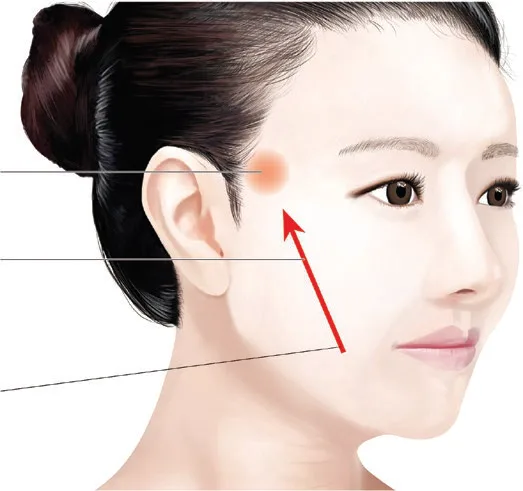 Fig 1. Definition of fixing point, hanging point and direction; the lift is the hanging point pulled toward the fixing point. (Kim, 2019, p.27) [1]
> Sources: Kim, The Art and Science of Thread Lifting, 2019, ch.1 [1][MEDLIB].
Fig 1. Definition of fixing point, hanging point and direction; the lift is the hanging point pulled toward the fixing point. (Kim, 2019, p.27) [1]
> Sources: Kim, The Art and Science of Thread Lifting, 2019, ch.1 [1][MEDLIB].
> ⚠ The classic error is the horizontal vector. Pulling laterally does not elevate: it widens. It produces the stretched, broad "operated" face nobody asks for. The more vertical the component, the more natural the result, and the correction must read with the patient seated, not supine [1][3].
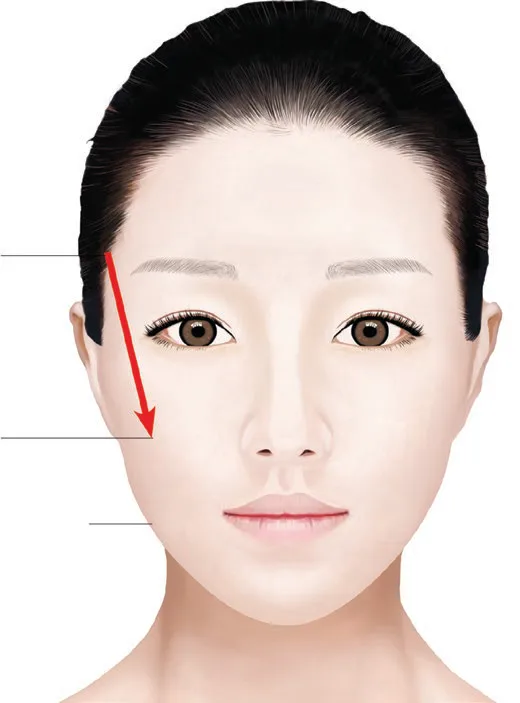 Fig 2. Hanging point versus the part to be pulled: a mismatch lifts the wrong tissue. (Kim, 2019, p.27) [1]
> Sources: Kim, 2019, ch.1 [1][MEDLIB].
Fig 2. Hanging point versus the part to be pulled: a mismatch lifts the wrong tissue. (Kim, 2019, p.27) [1]
> Sources: Kim, 2019, ch.1 [1][MEDLIB].
Fixed anchor zones (the fulcrum, without which there is no traction): the temporal region, the preauricular area, the mastoid fascia. Here the skin is adherent and bears load. Traction from mobile tissue toward mobile tissue lifts nothing [1].
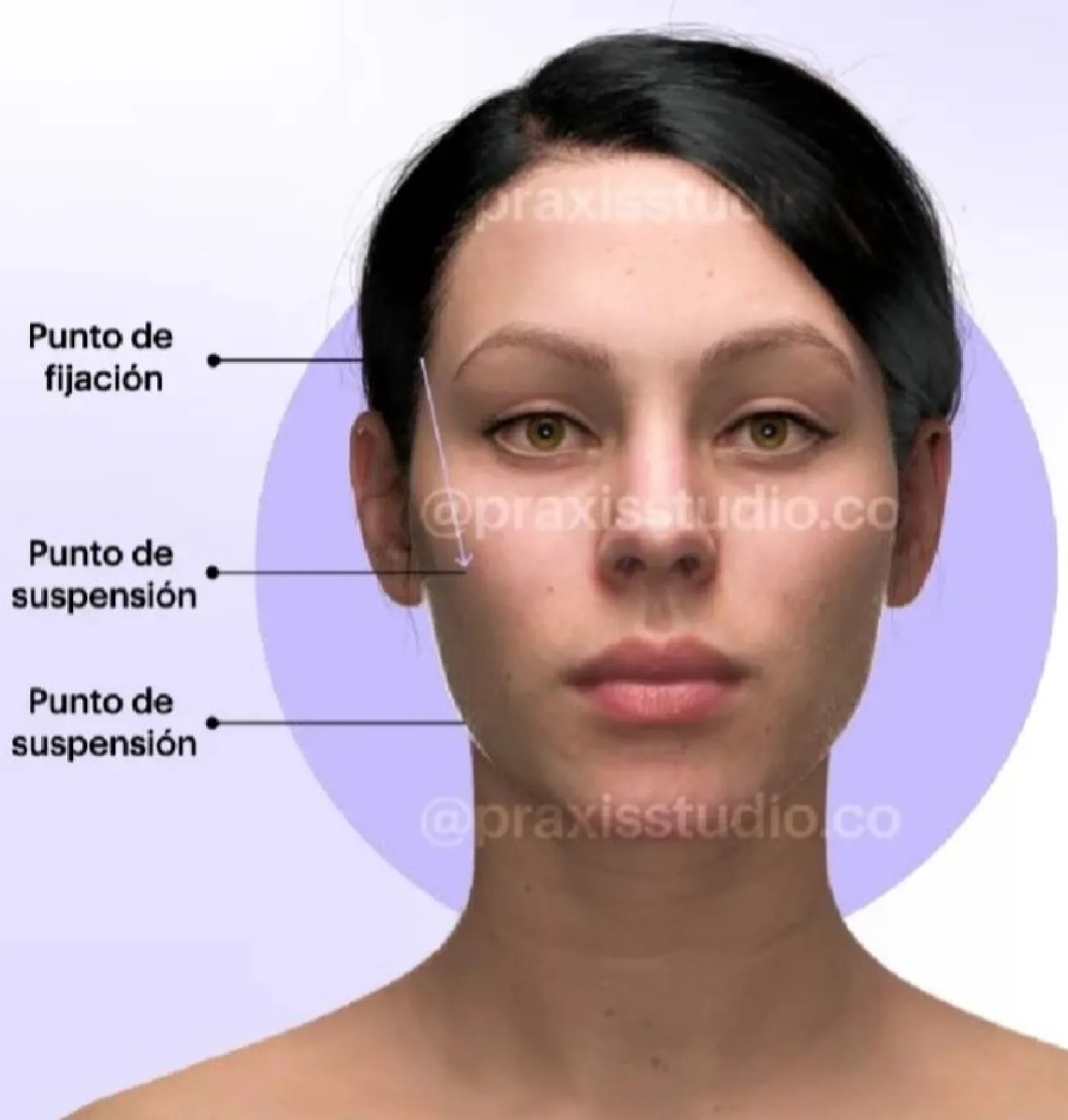 Fig 3. Fixation point (temporal) versus suspension points along the lift vector. (Hilos PDO en rejuvenecimiento facial, p.38) [40]
> Sources: Hilos PDO en rejuvenecimiento facial [40][MEDLIB].
Fig 3. Fixation point (temporal) versus suspension points along the lift vector. (Hilos PDO en rejuvenecimiento facial, p.38) [40]
> Sources: Hilos PDO en rejuvenecimiento facial [40][MEDLIB].
Fixation: two legitimate schools (a grounded disagreement)
| School | How | For | ⚠ Against |
|---|---|---|---|
| Anchored | Thread tied/hung on deep temporal fascia, mastoid fascia or periosteum | Strong fixing point, stronger and longer instant lift | More invasive, more pain, more risk, steeper learning curve; a fold at the anchor. If anchored only in subcutaneous fat the fixing force is weak [1] |
| Free-floating (self-anchoring) | Bidirectional barbs/cones or a central knot hold the tissue with no fixed point (APTOS bidirectional, Silhouette cones) | Less invasive, faster, no fascial incision, more reversible in practice | Less traction, less durable; must be disclosed [4][19] |
Consensus: for the same jowl/mid-face vector, both schools can work; the choice is invasiveness versus instant magnitude [1]. Discrepancy that changes the gesture: Kim reports the anchored method gives a stronger and longer instant result than a mono or simple-cog free-floating thread; the free-floating school accepts less magnitude for far less morbidity and is the more common office choice [1]. Do not average them into a "semi-anchored" compromise that delivers neither.
Named face techniques (the technique grid)
| Region | Technique | Notes |
|---|---|---|
| Lower face / jawline | Uni- vs bi-directional cog along the mandibular line | Threads oblique toward the preauricular/temporal fixed zone [1][2] |
| Mid-face / malar | Uni-directional, curved-needle, or double-needle from a single temple entry | Fan of vectors to redrape the malar pad [2] |
| Mid-face (Asian skeletal pattern) | Kang Vertical Lifting: short (~6 cm) wedge-shaped PDO placed vertically downward in anterior malar/submalar | Vector directly opposes vertical sag; lower risk of accentuating the cheekbone [3] |
| Eyebrow | Subgaleal placement | Brow-tail elevation; toxin protects the vector ([E3.10]) [1] |
| Mandibular contour | Double-needle | Sharpens the jaw angle transition [2] |
| Neck | Insertion posterior to SCM toward the mastoid | Thicker/heavier tissue; anchored preferred [1] |
| Silhouette cones | Pinch techniques by third (block / V / press) | Cone suspension, tissue repositioning not true lift [19][20] |
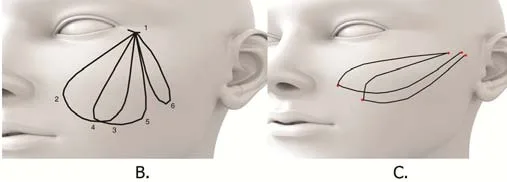 Fig 4. Mid-face lift: multi-vector fan from one entry (B) and curved/double-needle vectors (C). (Yongtrakul, 2016, p.6) [2]
> Sources: Yongtrakul, Thread Lift Classification, Technique and How to Approach the Patient [2][MEDLIB].
Fig 4. Mid-face lift: multi-vector fan from one entry (B) and curved/double-needle vectors (C). (Yongtrakul, 2016, p.6) [2]
> Sources: Yongtrakul, Thread Lift Classification, Technique and How to Approach the Patient [2][MEDLIB].
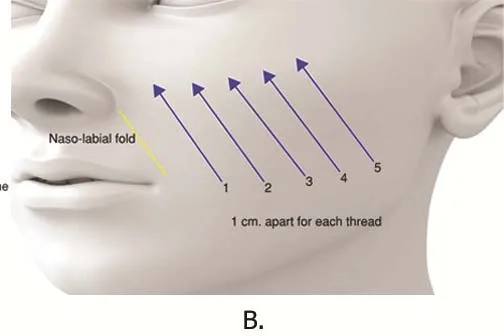 Fig 5. Short-suture lower-face technique, threads ~1 cm apart directed toward the nasolabial fold and jowl. (Yongtrakul, 2016, p.3) [2]
> Sources: Yongtrakul [2][MEDLIB].
Fig 5. Short-suture lower-face technique, threads ~1 cm apart directed toward the nasolabial fold and jowl. (Yongtrakul, 2016, p.3) [2]
> Sources: Yongtrakul [2][MEDLIB].
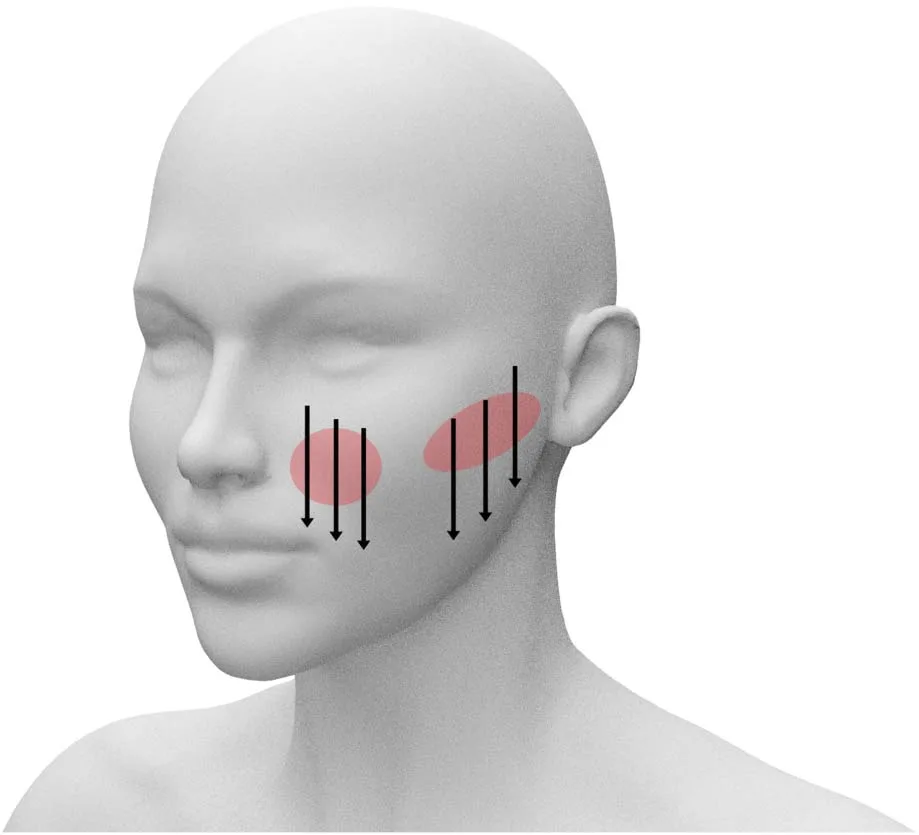 Fig 6. Vertical Lifting: short wedge-shaped PDO placed vertically in anterior malar/submalar. (Kang, 2017, p.3) [3]
> Sources: Kang, Vertical Lifting: A New Optimal Thread Lifting Technique for Asians, 2017 [3][MEDLIB].
Fig 6. Vertical Lifting: short wedge-shaped PDO placed vertically in anterior malar/submalar. (Kang, 2017, p.3) [3]
> Sources: Kang, Vertical Lifting: A New Optimal Thread Lifting Technique for Asians, 2017 [3][MEDLIB].
The Fig 4 panels document the mid-face options side by side: a single-entry fan (efficient, one puncture) versus curved/double-needle vectors (more coverage, two entries). Fig 5 shows the spacing rule for the lower face (roughly one thread per centimetre), and Fig 6 is the Kang school, where the vector is vertical rather than the classic oblique-superoposterior.
Danger-zone anatomy along the trajectory
Insertion is blind (no imaging guidance): safety rests on the operator's anatomy and on the patient's variation. Same exclusion zones as E1 · submental.
| Structure | Where | Consequence |
|---|---|---|
| Facial nerve, temporal branch | Crossing the zygomatic arch | ⚠ Frontalis paresis; the most feared motor injury on the temporal route [1] |
| Facial nerve, marginal mandibular branch | Mandibular border and below | ⚠ Asymmetric smile; same exclusion zone as E1 |
| Parotid gland / Stensen duct | Tragus-to-upper-lip line | ⚠ Deep placement can injure the gland/duct [1] |
| Facial artery | Variable; palpable at the antegonial notch | ⚠ Palpate the pulse before marking |
| Superficial temporal artery | Preauricular, very superficial | ⚠ Palpable; it is avoided, not guessed [1] |
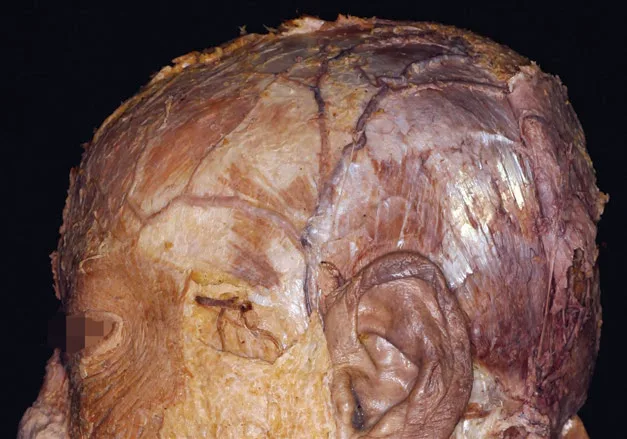 Fig 7. Temporal fascial layers, the anchoring and danger plane of the temporal route. (Kim, 2019, p.42) [1]
> Sources: Kim, 2019 [1][MEDLIB].
Fig 7. Temporal fascial layers, the anchoring and danger plane of the temporal route. (Kim, 2019, p.42) [1]
> Sources: Kim, 2019 [1][MEDLIB].
Correct subcutaneous plane and a gentle awl entry reduce vessel and nerve injury; deep puncture into muscle/periosteum risks the parotid, the vessels and pain, and superficial placement risks palpability, visibility and dimpling [1]. Fig 7 shows why the temporal anchor is powerful (dense fascia) and dangerous (the temporal branch runs in the same superficial fascial layer).
Body technique
Body skin is thicker and heavier than face, so it needs more PDO (thicker/longer threads, larger contact surface, more units) and staged sessions with progressive gain [39][40]. Example abdominal layout: map a horizontal imaginary line (LHI) through the umbilicus and a vertical midline (LVI), then place spiculated threads via cannula in a vertical + crosshatch mesh, with a knot per pair to inhibit migration, from proximal entry (PEH) to distal (PDH) points [40].
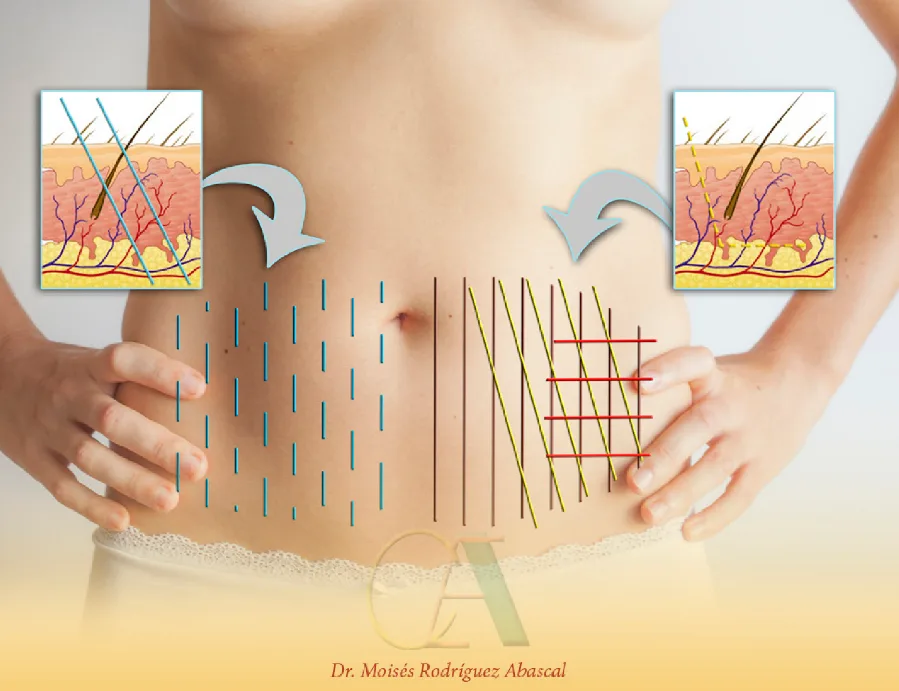 Fig 8. Abdominal PDO thread design (vertical + crosshatch mesh, subcutaneous plane). (Rodríguez Abascal, UPO, p.17) [39]
> Sources: Rodríguez Abascal, Hilos Tensores Abdomen/Brazos/Glúteos, UPO Sorted [39][D][MEDLIB].
Fig 8. Abdominal PDO thread design (vertical + crosshatch mesh, subcutaneous plane). (Rodríguez Abascal, UPO, p.17) [39]
> Sources: Rodríguez Abascal, Hilos Tensores Abdomen/Brazos/Glúteos, UPO Sorted [39][D][MEDLIB].
Fig 8 documents the body-mapping logic panel by panel: the mesh spreads load because there is no single fixed fascia to anchor to (the physical reason body traction underperforms, expanded in E3.9).
The clinical endpoint that stops the session
Stop when the marked vectors are filled, the two sides carry the written, equal thread count, and the seated symmetry check passes. Do not keep adding threads chasing a bigger lift: excess traction over-purses the skin and buys dimpling, not elevation [7][8]. The endpoint is symmetry and plane, not thread quantity.
The full sequence (salvage-preserved)
- Mark with the patient seated, not supine. Gravity is part of the diagnosis.
- Draw the complete vector, entry to exit, and mirror it on the other side before touching anything.
- Count threads per side and write it down. Asymmetry is the #1 complaint and almost always starts as a different count.
- Rigorous antisepsis and field. This is foreign-body implantation (J5 · infection, biofilm & sterilization).
- Local anaesthesia at the entry point and along the trajectory.
- Entry, then a pass in the correct subcutaneous plane, controlled advance.
- Traction and moulding: accompany the tissue over the thread; do not drag the thread through the tissue.
- ⚠ Cut the thread under tension, skin stretched the opposite way, so the cut end retracts inside. A cut end left slack is a future extrusion.
- Seat the patient and check symmetry before finishing the second side.
- Written post-operative instructions (E3.6).
Classic trap: marking supine because that is how you will work. The descent you are correcting is a gravity phenomenon; it only shows upright. Mark seated, verify seated, or you correct a face that does not exist [1].
E3.5 · Protocol and parameters
Dose = the amount of PDO placed. Biostimulation is dose-proportional: more material, more collagen signal, more diffuse support. Traction, by contrast, is not dose-proportional beyond the point where the vectors are filled; extra cogs past that buy dimpling, not lift [7][13].
Amount per region and per session (examples, not standards)
> ⚠ These are corpus examples for orientation, not a dosing standard. Thread count, gauge and length depend on the product and the anatomy; the IFU governs. A count supported only by one UPO slide is never_sufficient_alone [39].
| Target | Example placement | Source class |
|---|---|---|
| Per facial zone | ~12–15 threads per zone | [C][MEDLIB] example [1] |
| Full face incl. neck | ~40 threads total | [C][MEDLIB] example [1] |
| Neck / jawline (65-yo, moderate laxity) | 4 cog + 20 smooth PDO | Fernández-Tresguerres example [38] |
| Mid-face (Kang vertical) | Short ~6 cm wedge PDO, several per malar/submalar | [3] |
| Abdomen (body) | ~8 spiculated threads, knot per pair | [39][40] |
| Gauge / length by zone | 18–31 G, 25–150 mm | Kim classification [1] |
Threads are generally placed in pairs, which keeps the count symmetric by construction and makes the written per-side tally trivial to reconcile [1][40].
The RCT that put a number on "how many"
The "Is More Always Better?" randomized comparison tested PDO-thread quantity for facial lifting and found the relationship is not linear: beyond an adequate vector-filling count, adding threads did not proportionally improve the lift [13]. (P) That converts the operator's instinct ("more threads, more result") into a testable claim that the evidence does not support past the ceiling.
The dose ladder (how to escalate)
| Situation | Move |
|---|---|
| Mild laxity, good skin | Fewer cogs, more mono mesh (tension-dominant) [12] |
| Moderate laxity, non-surgical candidate | Fill each marked vector with paired cogs; add mono between vectors for skin quality [1][2] |
| Body / heavy zone | More material, thicker/longer threads, staged sessions [39] |
| Result fading | Maintenance session at the decay window, not before [12][26] |
Sessions, interval, maintenance
- Biostimulation and body work are staged: sessions build progressively, so a single session is rarely the whole plan [39][40].
- Maintenance is timed to the decay window of the specific material (absorbable effect fades over ~6–18 months for PDO, longer for PLLA cones), not to a fixed calendar [12][19][26].
- Interval between sessions allows the biostimulation phase to express (clinical gain is apparent from ~3 months), so re-treating a biostimulation series too early wastes material [12].
The ceiling and overtreatment
| Overtreatment sign | Cause | Course |
|---|---|---|
| Over-purse / pleating at placement | Excess traction folding the skin | Usually self-resolves in days; do not add threads to "fix" it [7][8] |
| Palpable ridge of material | Too many threads too superficial | Plane/quantity error; wait, then release if persistent [1][6] |
| Cheekbone accentuation (Asian face) | Oblique vector over-lateralised | Prefer vertical vector (Kang) [3] |
The dose safety rule: the ceiling is reached when the marked vectors are filled and the two sides carry the equal written count. Past that, quantity trades lift for dimpling and for a longer, lumpier recovery [7][8][13].
Body dosing caveat
Body zones need proportionally more material because the tissue mass and the vector length are larger, but the return per thread is lower (no fixed fascial fulcrum, see E3.9). Staging is mandatory, and the counselling ceiling ("skin quality, not a lift") is stricter than the anatomical one [39][40].
Classic trap: dosing by the brand's marketing "protocol card" instead of by the vectors you drew and the skin in front of you. The card sells threads; the vector map treats the patient. Count from the map, write it, place in pairs [1][13].
E3.6 · Anaesthesia, asepsis and periprocedure care
The period at a glance.
| Phase | Core actions |
|---|---|
| Pre | Consent (months not years; foreign body; can require removal); seated photos (frontal, three-quarter, profile); review antiplatelet/anticoagulant with the responsible physician; confirm no active local infection, skin lesion over the trajectory, or active dental focus [1][37] |
| Intra | Topical ± local infiltration or nerve block; ~30–60 min; strict aseptic technique and field; consider antibiotic prophylaxis if immunity is reduced or multiple packs are opened [1][12] |
| Post | Cold first hours; simple analgesia; soft diet, mouth closed, first days; written alarm signs; early review then a 1-month review with the same photo [1][37] |
Anaesthesia
Thread lifting is well tolerated under topical anaesthesia combined with local infiltration at the entry points and along the trajectory, or a regional nerve block for the lower face. The whole procedure runs about 30–60 minutes [1]. (P) Deep sedation is disproportionate for a subcutaneous suspension and adds risk without adding access; reserve it for the anxious patient, not the routine case.
Infiltration serves a second purpose beyond comfort: the fluid wheal along the trajectory helps define and hydrodissect the subcutaneous plane, which is the plane the thread must stay in. Over-infiltration, however, distorts the tissue you are trying to redrape, so mark and photograph before infiltrating, not after.
Asepsis (an implant, not an injection)
An infection here is a failure of asepsis, and the thread is an implanted foreign body, so the standard is the implant standard, not the injectable standard (full treatment in J5 · infection, biofilm & sterilization):
- Wide skin antisepsis and a sterile field; the entry points are portals into the subcutis.
- Antibiotic prophylaxis is considered when immunity is lowered or when multiple thread packs are opened, extending exposure [1].
- Because the material is implanted, an infection established on the thread is a biofilm problem: source control usually means removing the material, and antibiotics alone frequently fail while the implant remains (J5). The specific agent and course follow the local antibiogram and guideline; do not improvise a regimen from memory [MATERIAL GAP: precise antibiotic dose not in corpus].
Post-procedure instructions (written, or they do not exist)
| Restriction | Typical window | Reason |
|---|---|---|
| No facial massage / manipulation of the area | Per operator, commonly weeks | Displaces the fresh thread before fibrosis fixes it [1] |
| No energy treatments (RF, HIFU, laser) on the zone | ≥ weeks (see E3.10) | Heat/traction can move the thread [30] |
| No dental work that is not urgent | First days–weeks | Jaw excursion loads the lower-face threads |
| Limit exaggerated mimicry | ~7 days | Mimetic movement molds barbs out of position |
| No hot food / hard solids | ~3 days | Reduces chewing load and thermal effect |
| Avoid direct sun on the area | ~1 month | Puncture-site pigmentation |
| Avoid gym / sauna / swimming | ~3–5 weeks | Sweat, heat and Valsalva; infection portal |
| Avoid alcohol | ~2–3 weeks | Bleeding/bruising and healing |
| Sleep supine or on the side, on a pillow | First nights | Avoids pressure that molds the vector (face/neck/abdomen) |
Typical functional recovery is about 3–5 days, with the caveat that visible bruising and edema can run longer and that the patient must be told to judge the result against the baseline photo at one month, not the swollen next-day face [1][37].
Written alarm signs handed to the patient: growing pain, expanding erythema, fever, discharge, or a palpable/visible thread end. Any of these triggers early review, and a thread end that is extruding is managed actively, not watched (E3.8).
Classic trap: giving post-op rules verbally. Spoken instructions do not survive the drive home. Massage, energy, dentist and sleep position are written or they do not exist, and the alarm signs are on the same sheet [1].
E3.7 · Contraindications and precautions
Absolute
| Contraindication | Why |
|---|---|
| Active skin disease / acute acne over the target area | Threading through infected or inflamed skin seeds the implant [1][12] |
| Systemic infection | Bacteraemia + a fresh implant = colonised thread [1] |
| Active / ongoing cancer | Not the setting for elective foreign-body implantation |
| Immunosuppressant therapy | Impaired collagen response and raised infection risk on an implant [1] |
| Uncontrolled hypertension | Bleeding/haematoma along vascular trajectories |
| Active anticoagulation (uncorrected) | Haematoma and bleeding at entry/anchor points; manage with the responsible physician before proceeding |
Relative (proceed only after the specific risk is addressed)
| Relative contraindication | Consideration |
|---|---|
| Autoimmune disease / collagenopathy | Unpredictable foreign-body and healing response |
| Coronary heart disease | Comorbidity and antithrombotic load |
| Keloid / hypertrophic-scar tendency | Entry-point scarring; darker phototypes higher threshold |
| Prior biodegradable injectable in the same area | ⚠ Product interaction: hydrophilic filler can accelerate absorbable-thread hydrolysis; timing matters (E3.10) [30] |
| Individual drug intolerance / anaesthetic allergy | Allergic anamnesis is documented before any injection |
| Unrealistic expectation / body dysmorphia | The dominant "soft" contraindication; do not treat (B2) |
Pregnancy and lactation
Contraindicated as a precaution. There are no safety data for elective tensor-thread implantation in pregnancy or lactation, and an elective cosmetic implant has no indication that justifies the unknown; defer [1]. (P) This is the precautionary stance shared with the other elective injectables in the atlas, not a demonstrated fetal risk.
Drug and condition interactions
| Agent / condition | Interaction | Action |
|---|---|---|
| Antiplatelets / anticoagulants (ASA, clopidogrel, DOACs, warfarin) | Haematoma, bruising along the temporal/facial vessels | Review and, if appropriate and with the prescriber, adjust; palpate and avoid vessels; prefer cannula |
| Systemic immunosuppression / high-dose steroids | Infection risk on implant, blunted neocollagenesis | Relative/absolute per degree; defer elective work |
| Hydrophilic hyaluronic-acid filler, same area | ⚠ Can accelerate hydrolysis of an absorbable thread | Separate in time (E3.10); prefer lipofilling if volume is needed [30] |
| Isotretinoin / active retinoid course | Healing and skin-fragility considerations | Follow the same caution as for other procedures over treated skin |
| Diabetes (poorly controlled) | Infection and wound-healing risk | Optimise before elective implantation |
The precaution that is really a selection error
Most "precautions" that go wrong were selection errors upstream: the heavy face, the very thin skin, the deflated cheek, the fixed expectation. The contraindication list catches the medical exclusions; the selection gate (E3.2) catches the anatomical and psychological ones, and the second list fails more patients than the first [2][5].
Classic trap: clearing a patient medically and forgetting the local field. A clean systemic history does not license threading through an active perioral acne flare or over a herpetic lesion on the trajectory. Check the medical history and the skin over the exact path [1][12].
E3.8 · Complications specific to thread lifting
Framing. Most of these are predictable, most are manageable, and many are avoidable by selection and by plane. What is not acceptable is that the patient meets them without having consented to them. The overall complication rate is higher than for injectables because the learning curve is steeper, not because threads are exotic [7][10]. Generic vascular/injection emergencies are in the J-series; this block is the thread-specific set.
Incidence anchors (pooled, keep the range with its scenario)
| Complication | Pooled incidence | Source |
|---|---|---|
| Swelling / edema | ~16.8–35% | 2021 and 2024 syntheses [8][10] |
| Ecchymosis / bruising | ~19.5% | 2024 absorbable-materials review [10] |
| Skin dimpling | ~10% (single series 2.7–3.8%) | 2021 meta [8] |
| Tenderness | ~10% | 2024 review [10] |
| Paraesthesia | ~1.1–6% | [8][10] |
| Thread visibility / palpability | ~4% | 2021 meta [8] |
| Infection | ~2–2.5% | [8][10] |
| Thread extrusion | ~2% overall; 25.6% for large Aptos cables in heavy/redundant tissue | [8][32] |
| Haematoma | ~0.6% | 2024 review [10] |
| Facial asymmetry | most commonly reported adverse event across the pooled cohort | 2026 meta [9] |
(P) The extrusion spread (2% overall vs 25.6% for big cables in heavy tissue) is the whole selection argument in two numbers: the same complication is rare in the right patient and common in the wrong one.
Management grid
| Complication | Mechanism | Management |
|---|---|---|
| Extrusion / protrusion (most frequent) | Cut end left slack, superficial plane, barb in a high-movement zone; heavy/redundant tissue | ⚠ Intra-op: reposition. Post-op: remove the thread, disinfect, rest ~3 weeks, then reimplant if indicated. Do not leave it "to resorb" [32][40] |
| Migration / displacement | Barb releases, excess traction, wrong plane; worse with smooth threads in high-mimicry zones | Open a perpendicular hole with an 18 G × 40 mm needle and extract, with or without forceps [40] |
| Dimpling / puckering | Superficial pass or excess traction pursing the skin | Massage and wait the first weeks; if persistent, release the point; a transient filler can camouflage [1][8] |
| Asymmetry / overcorrection | Different count, vector or traction between sides | ⚠ The #1 complaint. Prevent with bilateral drawing, written count, seated check. Correct by adding threads to the deficient side or waiting ~15–30 days for spontaneous settling [7][9] |
| Palpability / visible thread | Wrong (superficial) plane; barbs not subcutaneous | Massage; persistent: remove or cut the segment [1][6] |
| Thread breakage | Excess or abrupt traction | Cut flush and place a new thread; careful, steady traction prevents it [1] |
| Bruising / haematoma | Vessel in the trajectory (temporal/facial) | Cold and compression; prevent with cannula and pre-marking palpation [10] |
| Infection / cellulitis / abscess | Implanted foreign body; biofilm | ⚠ Remove the thread + targeted oral antibiotic; infection on the implant usually needs the material out (J5) [12] |
| Granuloma / nodular reaction | Too superficial, not cut flush; material reaction | Assessment; intralesional steroid selectively; remove if warranted [1] |
| Nerve injury (motor) | ⚠ Facial branch in the trajectory (temporal, marginal mandibular) | Rare and serious. Document, explain, follow; usually transient (E3.4) [5][7] |
| Paraesthesia (sensory) | Sensory branch in the path | Usually transient; documented [10] |
| "Cord" sensation / linear tightness | Fibrosis along the trajectory | Massage; usually settles [1] |
| Persistent pain | Deep placement, periosteal contact, inflammation | Analgesia; reassess plane/position |
| Recurrence | ⚠ Not a complication: the natural course | Said beforehand; the difference between a thread and a facelift [12][26] |
| Patient dissatisfaction | Usually an expectation set wrong pre-op | Prevented at consent, not treated post-op [5] |
Removal is harder than placement
> ⚠ Plan the exit before the entry. What do you do if it dimples? If it extrudes at three weeks? If the patient sees asymmetry on day 10? Without an answer to all three, you are not ready to place a cog thread. And the uncomfortable fact: an integrated cog thread is not removed without an incision. Weeks in, pulling on the end does not extract it; the barbs and the fibrous cuff hold it [1][14].
Pain and trismus (expected, not a complication if warned)
Pain and limited mouth opening in the first days after lower-face threads are expected. Analgesia, soft diet and prior information cover it. It is only a complication if the patient was not warned [1][37].
Classic trap: promising the patient the thread can be taken out if they dislike the result. It sounds reassuring and it is false past a few weeks. An integrated cog does not come out without cutting down to it; say so at consent [1][14].
E3.9 · Alternatives and competing schools
Shared alternatives grid with E1 · submental lipolysis; this block is the thread-and-lift version.
The full product grid (by material and design)
| Class | Products (brands) | Design notes |
|---|---|---|
| PDO | NovaThreads, MINT, QT-Lift (= VOV = Blue Rose Forte, molding 18/19 G), N-Cog (cutting), i-Thread (spiculated cannula 19 G × 100/160 mm), Magic (double-needle), Croquis (3D bidirectional) | Fastest resorption; widest brand/gauge range; mono, cog, screw variants [1][40] |
| PLLA | Silhouette Soft / Silhouette InstaLift (82% PLLA / 18% PLGA, bidirectional cones, 12 cm needle both ends) | Tissue repositioning, not a true lift; longer durability than PDO (up to ~24 mo) [19][20] |
| PCL / PLA blends | HappyLift, Art Lift Combi, JBP V-Lift Pro | Slowest resorption; longest tensile hold [11] |
| Non-absorbable | APTOS (Sulamanidze, polypropylene), Contour Thread, Woffles, Serdev, gold thread (obsolete) | Pure traction, no biostimulation; reversibility problems drove the field to absorbables [4][7] |
Instrument axis, orthogonal to the material:
| Choice | Options | Consequence |
|---|---|---|
| Vehicle | Needle vs cannula vs L-needle | Cannula lowers vessel/nerve injury |
| Cog manufacture | Cutting (weaker hold, simpler) vs molding (stronger, thinner, tying method) | The single mechanical differentiator between two cog threads of equal gauge [1] |
| Cog geometry | Uni- vs bi-directional vs zigzag | Bidirectional/zigzag enables free-floating fixation [4] |
Regulatory device status (currency: web-verified, corpus gap)
> ⚠ This block is a declared corpus-acquisition gap. The corpus carries only a generic CE/FDA-label note (Raúl Pinto 2009) and brand names [37]; the specific current status below is web-verified currency and is not in the corpus. It is tagged accordingly and carries no fabricated identifier.
| Device / status | Fact |
|---|---|
| NovaThreads | First FDA-cleared PDO suture (device) |
| MINT | Reported as the first PDO thread with triple FDA 510(k) clearances (2024) |
| Silhouette InstaLift | PLLA/PLGA cones; FDA 510(k) cleared 2015 for facial tissue repositioning |
| Regulatory nuance | ⚠ PDO threads are 510(k)-cleared as sutures for soft-tissue approximation, not approved for cosmetic lifting/tightening. Cosmetic mid-face suspension is off-label reality |
| Cautionary tale | Contour Threads: FDA cleared 2004/2005, withdrawn ~2007 for poor outcomes and safety (non-absorbable, non-reversible) [7] |
| EU | Implantable medical device under MDR (Reg. EU 2017/745) |
(P) The off-label gap matters clinically: the device you implant for a "lift" is legally cleared as a suture, and the consent and marketing must not overstate a regulatory endorsement the device does not have.
When the correct answer is NOT a thread
| Finding | Correct answer |
|---|---|
| Severe laxity / frank redundant skin / pinch-displacement >3–5 cm / age >55 | Surgical facelift (rhytidectomy). A thread is a minor, minimally-invasive technique and does not replace a surgical lift, whatever the suture [1][25][26] |
| Advanced photoaging (texture, dyschromia, fine rhytids) | Add resurfacing (peel/laser); the thread does not treat skin surface [35] |
| Volume loss (deflation, not descent) | Filler / lipofilling, not a thread; restore support first (A4) [36][37] |
| Skin-quality only, mild | Mono biostimulation thread, energy, or topical/dermocosmetic programme; not a cog |
| Dynamic component (mimetic pull) | Toxin to protect the vector, before/with threads (E3.10) |
Endolift and subdermal fibre-laser lift (competing modality, carried in this chapter)
> This is not a thread. Endolift is a brand; the generic is a fibre-guided subdermal laser. It is here because it competes for the same indication (mild-to-moderate lower-face, jawline and submental laxity) and the patient compares them [28][31].
Principle. A very thin optical fibre (200–400 µm, radial or frontal FTF) is introduced into the superficial-mid hypodermis without incision, suture or, in many protocols, anaesthesia, delivering a 1470 nm diode wavelength strongly absorbed by water. Action is thermal from within: subdermal 45–55 °C (skin surface kept <40 °C), penetration 3–4 mm, a dual photothermal + mechanical effect that contracts the retinacula cutis and fibrous septa, drives fibroblast neocollagenesis, and produces selective lipolysis where fat is present [28][30][31].
| Item | Value |
|---|---|
| Wavelength | 1470 nm diode (evolved from 808/980/1064 nm laser-lipolysis) [28][30] |
| Fibre | 200–400 µm, radial or frontal |
| Subdermal temperature | 45–55 °C; surface kept <40 °C [31] |
| Penetration | 3–4 mm |
| Areas | Jawline/marionette, double chin, mid-face/NLF, lower eyelids, eyebrows, neck, inner arms, abdomen [30] |
| Time course | Immediate + progressive to 2–3 months [28] |
| Session | ~15–45 min |
| Dose (example, full face) | 300 µm fibre, ~900 J, 2.2 W; Joules are a secondary endpoint [31] |
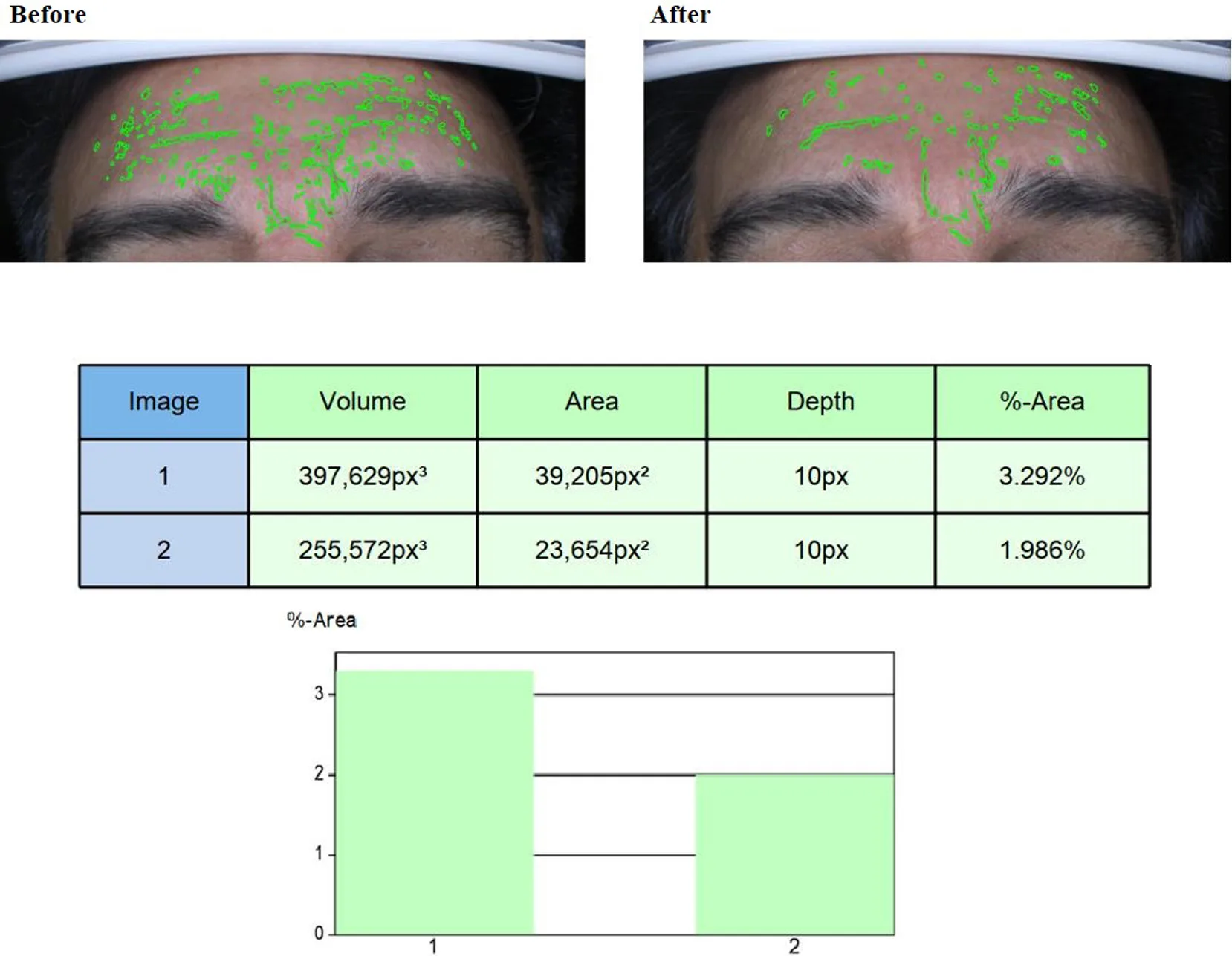 Fig 9. Endolift forehead: %-Area 3.292% → 1.986% on before/after biometric analysis. (Nilforoushzadeh, 2022, p.2) [28]
> Sources: Nilforoushzadeh, Endolift laser for forehead wrinkles and frown line, 2022 [28][MEDLIB]; Endo-lift systematic review 2024 [30].
Fig 9. Endolift forehead: %-Area 3.292% → 1.986% on before/after biometric analysis. (Nilforoushzadeh, 2022, p.2) [28]
> Sources: Nilforoushzadeh, Endolift laser for forehead wrinkles and frown line, 2022 [28][MEDLIB]; Endo-lift systematic review 2024 [30].
Fig 9 documents the objective read-out panel by panel: the green skin-topography overlay is denser before than after, and the paired table quantifies the wrinkle-area reduction rather than relying on a subjective global-aesthetic score.
> ⚠ Hard rules for Endolift. > 1. Parameters are from the equipment IFU. This chapter does not print energies as a protocol: they depend on the device, fibre and zone, and a mis-remembered energy inside the dermis is a burn [31]. > 2. Controlled subdermal plane and continuous movement. Stopping concentrates energy at one point [30]. > 3. Very thin skin: maximum caution. The margin between effect and burn narrows [31]. > 4. Same marginal-mandibular exclusion as E1 and E3.4. > 5. Photograph and set expectation: it is progressive, and early edema misleads the patient.
Evidence base: a 2024 systematic review of the 1470 nm intralesional laser found a favourable efficacy/safety profile across face and neck lifting, laxity and wrinkle indications [30]; Endolift-based subcision is also reported for rolling acne scars [29].
Energy and surgical alternatives (choose by ptosis severity, skin quality, downtime, durability)
| Modality | Target / mechanism | Where it wins over threads |
|---|---|---|
| Microfocused ultrasound (Ultherapy / HIFU) | Thermal coagulation points at SMAS depth (~1.5–4.5 mm), TCP >60 °C | Deeper SMAS tightening, no implant; layer threads cannot reach [30][41] |
| Monopolar / bipolar radiofrequency | Dermal/subdermal heating, collagen contraction | Diffuse skin tightening, no foreign body; combine (E3.10) |
| Endolift (1470 nm) | Subdermal photothermal + septal contraction | Reaches the fibrous septum no injectable touches [28][30] |
| Dermal filler / lipofilling | Volume restoration | When the problem is deflation, not descent [36][37] |
| Surgical facelift (rhytidectomy) | Skin excision + SMAS repositioning | Severe laxity, redundancy, durable years [25] |
Competing schools (kept, not averaged)
| School | Thesis | Where it fails |
|---|---|---|
| Selection first ✅ | Result depends on whom, not on the brand | The atlas position. Costs the operator the hard "no" [2][5] |
| Anchored to fascia | Real, durable traction needs a true fixed point | More invasive, more pain, long learning curve; legitimate in trained hands [1] |
| Free-floating bidirectional ✅ | Less invasive, enough for mild-to-moderate laxity | The common, reasonable office choice. ⚠ Less traction, less duration: say so [4][19] |
| Mono for skin quality ✅ | The smooth thread does not traction and must not be sold as a lift | Honest and coherent; fails only when sold as a lift [12] |
| Support before traction ✅ | Structure first, thread second | The atlas position. Raises cost and lengthens the plan [1][37] |
| Thread as a facelift alternative | Avoid the operating room | ⚠ Rejected. Duration and magnitude are not comparable. This is the promise that manufactures dissatisfied patients [25][26] |
| Body tractor threads | What works on the face works on the body | ⚠ Rejected on physics: no fixed fulcrum, more mass, constant movement. Smooth threads for skin quality, yes (E3.9 body) [39] |
Classic trap: picking the modality by what the clinic owns rather than by the finding. A device clinic threads everything; a surgeon cuts everything. The finding (descent vs deflation vs redundancy vs skin quality) picks the tool, and often the answer is a combination, not a single machine [1][2].
E3.10 · Combination and sequencing
The ordering principle, and it is anatomical common sense: support first, traction second. A thread over an empty scaffold drags soft tissue over nothing. If malar or mandibular projection is missing, restore it first (D3 · midface, A4), then the thread arrives to reposition tissue that has something to rest on [1][37]. Full sequencing logic in L2 · combination & sequencing.
The sequencing grid
| Modality | Relative to threads | Interval | Rule |
|---|---|---|---|
| Radiofrequency | Before (reduce laxity in moderate cases) or after | ≥ 3 months after threads | ⚠ Never in the same session as placement: RF traction/heat can displace the fresh thread [30] |
| HIFU / microfocused US | Before (deeper tightening) or after | Separate sessions | Deeper plane than the thread; do not co-heat the fresh implant |
| Filler (HA) | Before (restore support) | ⚠ ≥ 3 months after the last thread if injecting the same area | Hydrophilic HA can accelerate absorbable-thread hydrolysis; prefer lipofilling (autologous fat does not interfere with degradation) [30][36] |
| Lipofilling (autologous fat) | Before or combined | Per plan | Does not interfere with thread degradation; the preferred volumiser to combine [36] |
| Toxin (botulinum) | Before or with | Standard | Protects the new collagen and vectors from mimetic-muscle molding (brow, lower face) [1] |
| Peeling / resurfacing | Same act for photoaging | Same visit unless skin incisions were made | If incisions were made, wait for suture removal/healing first [35] |
| Endolift | Combined (septal contraction) | Separate energy session | Reaches the septum; do not co-heat a fresh thread |
What NOT to stack
- ⚠ RF or HIFU in the same session as thread placement. Heat and traction move the thread before fibrosis fixes it [30].
- ⚠ Hydrophilic HA in the same area within ~3 months of an absorbable thread. It shortens the thread's life; use fat if volume is needed then [30][36].
- ⚠ Everything the same day in the same zone. If something goes wrong, you will not know which modality caused it; separate them so complications are attributable [1].
Where combination is the right answer
- Deflation + descent (the common real face): volume first (fat or HA at the correct interval), threads second, toxin to protect the vector. The women's pattern loads malar/NLF; the men's pattern loads the supraciliary region and mandibular angle [36][37].
- Laxity + poor skin quality: mono-thread mesh or energy for quality, cog threads for the vector, resurfacing for surface.
- Korean dense-mesh PDO (no-anchor): a high-density smooth-thread mesh used for a combined lipolytic + neocollagenesis effect, a biostimulation-dominant strategy rather than a suspension [1][12].
Multimodal consensus
- Aseptic re-prep between modalities: each new instrument pass is a new portal; re-prep the field (J5).
- Visualise the tightening before injecting filler: threading/energy first can lower the volume requirement, so assess the redraped face before deciding filler dose [1][30].
Classic trap: injecting hydrophilic HA into the same jowl you threaded last month because "the patient is already here." It undoes the thread faster than it would have faded and wastes both treatments. Respect the interval, or use fat [30][36].
Coverage vs UPO
Retrieved from Aesthetic_Medicine/UPO Sorted (T9.3 dermosustentación, T9.5 endolifting, T16.2 body threads, T10 complications), Rodríguez Abascal [39].
| UPO topic | Status in this chapter | What the atlas adds |
|---|---|---|
| Thread types (PDO/PLLA/PCL, mono vs cog) (T9.3) | ✅ Covered (E3.3) | Cut-vs-molded barb mechanics; traction-vs-tension framing; histology time-course with TGF-β1/collagen-I numbers [14][16] |
| Facial insertion, vectors, fixation (T9.3) | ✅ Covered (E3.4) | Kim fixing/hanging/direction; Kang vertical school; anchored-vs-free-floating as a kept discrepancy; danger-zone table [1][3] |
| Sub-SMAS vs subcutaneous plane debate | ✅ Covered (E3.4) | UPO flags the SMAS/deep-fascia relationship as controversial [39]; atlas fixes the operating rule (subcutaneous fat, above SMAS) and the reason deep is not safer [1] |
| Post-care recommendations (T9.3) | ✅ Covered (E3.6) | UPO windows (analgesia 2–3 d, supine 5 d, sun/exercise 2 wk, dental/sauna 3 wk, facial treatments 4 wk) reconciled into the peri-procedure grid [39] |
| Endolift / laser-assisted (DEKA) (T9.5) | ✅ Covered (E3.9) | Named as brand, not a thread; 1470 nm parameters, biometric evidence figure, systematic-review currency [28][30] |
| Body threads: abdomen, arms, buttocks (T16.2) | ✅ Covered (E3.4, E3.9) | The physics of the missing fulcrum; ⚠ oriental abdomen technique uses 200–400 threads (UPO), a cost-benefit the atlas rejects for traction [39] |
| Complications: extrusion, migration, asymmetry (T9.3, T10) | ✅ Covered (E3.8) | Pooled incidence anchors (2021/2024/2026 meta-analyses); 18 G × 40 mm extraction; removal-needs-incision rule [8][9][10][40] |
Rows UPO does NOT cover (atlas-only):
| Topic | Why it matters |
|---|---|
| Grounded durability disagreement with numbers | UPO teaches the technique; it does not adjudicate Sulamanidze vs Garvey/Rachel with incidences [4][5][6] |
| Regulatory device status (FDA 510(k), Contour withdrawal, MDR) | Off-label reality of "suture cleared, lift not approved"; corpus gap filled from web currency [7] |
| Recent pooled evidence (2023–2026 PRISMA meta-analyses) | UPO material predates them; the atlas carries the pooled incidences [8][9][10] |
| Filler-accelerates-hydrolysis interaction and its interval | Changes sequencing; not in the UPO decks [30][36] |
| Kang Vertical Lifting as a distinct vector school | Surfaced by the wide reground, not the UPO curriculum [3] |
⚠ UPO is the fastest-aging lane here: its efficacy/technique decks are undated and predate the 2023–2026 syntheses, and a dose or durability supported only by a UPO slide is never_sufficient_alone. Every UPO-sourced number in this chapter is corroborated by an external reference or explicitly flagged as an example.
Self-assessment
Active recall built only from facts published above. Answers folded.
- What is the correct plane for a barbed thread, and what happens if you go too superficial or too deep?
Answer
Subcutaneous fat, below the dermis and above the SMAS. Too superficial: dimpling, visibility, extrusion. Too deep: no traction plus nerve/vessel/parotid risk (E3.4).- What pinch-displacement value sends the patient to surgery instead?
Answer
Skin displacement from start-to-endpoint >3–5 cm: the redundancy is surgical (E3.2).- Why is a horizontal vector the classic error?
Answer
Lateral traction does not elevate, it widens; it produces the broad "operated" face. The correction vector is oblique up-and-out with a dominant vertical component (E3.4).- Name the three fixed anchor zones.
Answer
Temporal region, preauricular area, mastoid fascia. Traction from mobile tissue lifts nothing (E3.4).- How does a cut barb differ mechanically from a molded barb?
Answer
A cut barb removes material from the filament and weakens it at that point; a molded barb does not. At equal gauge, molded resists more (E3.3).- PDO tensile-strength retention at ~2, ~4 and ~6 weeks?
Answer
~70% at 2 weeks, ~50% at 4 weeks, ~25% at 6 weeks; hydrolysis essentially complete by ~180 days (E3.3).- Thread-extrusion incidence overall versus large Aptos cables in heavy/redundant tissue?
Answer
~2% overall versus ~25.6% for large cables in heavy tissue: the selection argument in two numbers (E3.8).- What is the #1 patient complaint, and how is it prevented?
Answer
Asymmetry. Prevented by bilateral drawing, a written per-side thread count, and a seated symmetry check before finishing the second side (E3.8, E3.4).- Can an integrated cog thread be removed without an incision weeks later?
Answer
No. The barbs and the fibrous cuff hold it; pulling on the end does not extract it. Do not promise reversibility (E3.8).- Why never combine RF with thread placement in the same session, and which filler interaction shortens an absorbable thread's life?
Answer
RF heat/traction can displace the fresh thread (wait ≥3 months). Hydrophilic HA in the same area can accelerate thread hydrolysis; wait ≥3 months or use lipofilling (E3.10).- Endolift: is it a thread, and what is its wavelength?
Answer
Not a thread: a fibre-guided subdermal laser, brand name. Wavelength ~1470 nm, subdermal 45–55 °C with skin surface kept <40 °C (E3.9).- What restores first when the face is both deflated and descended?
Answer
Support first (volume: fat or HA at the correct interval), thread second, toxin to protect the vector. A thread over an empty scaffold collapses (E3.10, E3.2).What's new and trends (2022-2026)
| Year | Development | Maturity |
|---|---|---|
| 2026 | Pooled meta-analysis of thread-lift complications; facial asymmetry the most commonly reported adverse event across the cohort [9] | clinically actionable now |
| 2025 | "Is More Always Better?" RCT: PDO thread count is not linearly better past the vector-filling ceiling [13]; thread-types pre/post-procedural review [11] | clinically actionable now |
| 2024 | Absorbable-materials adverse-effect comparison (ecchymosis, swelling, tenderness leading) [10]; 1470 nm intralesional-laser systematic review [30]; MINT reported with triple FDA 510(k); Su pig biostimulation model [16] | promising but not validated |
| 2023 | Contreras systematic review calling PDO threads "scarcely studied" [12]; ultrasonographic quantification of PDO facelift-thread tissue effect [17] | promising but not validated |
| 2022 | Endolift forehead-wrinkle biometric evidence (%-area reduction) [28] | promising but not validated |
| Horizon | Croquis 3D bidirectional PDO with 3D imaging; adjunctive diffuse-biostimulator pairing to raise the collagen ceiling | preclinical/speculative |
What did not change, and why. The mechanism (immediate mechanical redraping plus delayed fibrosis), the operating plane (subcutaneous fat above the SMAS), the dominance of selection over brand, the "not a facelift" boundary, and the danger-zone anatomy all still rest on the older references (Kim 2019 [1], Sulamanidze 2001 [4], Suh 2015 [18], the 2015–2019 histology [14][15]). The 2023–2026 literature is largely meta-analytic: it pools the same pre-2020 case series into incidence estimates rather than overturning the technique. So the recent work sharpened the numbers (complication incidences, the non-linearity of thread count) while the procedure is unchanged, and the pre-2020 primary sources remain state of the art for technique and anatomy. The lane that ages fastest is the undated UPO material and any single-series durability figure; those are corroborated or flagged throughout.
Unexplored directions (AI speculation)
> Speculative extrapolation by an AI model. Nothing below is a recommendation, a dose, a product or a protocol. Each item is tagged [IA-ESPEC], anchored to a cited fact already in this chapter, and paired with what would falsify it. Do not act on any of it clinically.
[IA-ESPEC] 1 · Raising the biostimulation ceiling with a paired lane. Anchor: the PDO fibrous capsule peaks at ~1 month while collagen-I and TGF-β1 stay elevated to ~7 months [14], yet the tension effect is capped by the patient's own fibroblast capacity [12][16]. Proposal: pairing a diffuse biostimulator lane with a mono-thread mesh might lift the collagen ceiling above what fibroblast-limited monotherapy reaches. Expected effect: longer-sustained skin tension than mono thread alone in the same patient. Confounder: age and baseline fibroblast reserve co-vary with both interventions, so a younger cohort could show the effect without the pairing causing it. What would settle it: a split-face randomized comparison (mono mesh vs mono mesh + biostimulator) with objective dermal collagen density and durability endpoints.
[IA-ESPEC] 2 · Turning the pinch test into a validated extrusion cutoff. Anchor: extrusion is ~2% overall but ~25.6% for large cables in heavy/redundant tissue [8][32], while the pinch-displacement gate is still qualitative [2]. Proposal: a measured pinch-displacement (in cm) might predict extrusion quantitatively and convert the selection gate into a defensible numeric cutoff. Expected effect: a displacement value above which the extrusion rate rises steeply. Confounder: operator technique (plane, cut-under-tension) is a stronger driver and could swamp the tissue-mass signal. What would settle it: a prospective multi-operator cohort correlating pre-op pinch-cm with 3-month extrusion, adjusted for operator.
[IA-ESPEC] 3 · Quantifying the filler-accelerates-hydrolysis interaction. Anchor: hydrophilic HA can accelerate absorbable-thread hydrolysis, which is why a ≥3-month interval is advised, but the magnitude is unquantified [30]. Proposal: adjacent HA might measurably shorten PDO thread half-life by a defined factor rather than an unspecified "faster." Expected effect: faster PDO mass-loss with adjacent HA than without. Confounder: in-vivo local inflammation and vascularity differ from a dish, so an in-vitro result may not transfer. What would settle it: paired in-vivo degradation curves (thread with and without adjacent HA) with explanted mass or imaging at fixed timepoints.
[IA-ESPEC] 4 · Septum-then-redrape sequencing. Anchor: Endolift contracts the fibrous septum from within [28][30] and threads redrape the subcutis [1], two mechanically distinct targets. Proposal: sequential septal contraction followed by thread traction might outperform either alone for lower-face laxity. Expected effect: greater and more durable jawline improvement in the combined arm. Confounder: added downtime and cost, plus the risk that co-heating a fresh thread displaces it (E3.10), could bias real-world outcomes. What would settle it: a three-arm trial (Endolift, thread, sequential) with blinded 3D imaging at 6 and 12 months.
[IA-ESPEC] 5 · Vector direction as the natural-result variable across phenotypes. Anchor: Kang's vertical vector lowers cheekbone accentuation in Asian faces [3]. Proposal: vector direction (vertical vs oblique) might be the variable driving natural-versus-widened outcomes across face shapes generally, not only in Asian patients. Expected effect: vertical-dominant vectors yield less bizygomatic widening on 3D across phenotypes. Confounder: baseline facial width and malar projection differ by phenotype and could confound the vector effect. What would settle it: a split-face 3D morphometric study comparing vertical vs oblique vectors within the same patient.
§ Safety
The red lines, one screen.
| Rule | Consequence if broken |
|---|---|
| Do not sell a thread as a facelift | Most dissatisfied patients in this indication [25][26] |
| Do not thread a heavy face or very thin skin | Cheese-wiring, palpability, extrusion (extrusion ~25.6% in heavy tissue) [8][32] |
| Never a horizontal vector | Widens instead of elevates; the "operated" face [1] |
| Cut the cut end under counter-tension | A slack end is a future extrusion [1] |
| Treat it as an implant, not an injection | Biofilm and late infection; asepsis to the implant standard (J5) [12] |
| Plan the exit before the entry | An integrated cog does not come out without an incision [1][14] |
| Respect the ≥3-month HA and RF intervals | HA shortens thread life; same-session RF displaces it [30] |
Absolute stops (E3.7): active local skin disease/acute acne over the trajectory, systemic infection, active cancer, immunosuppression, uncontrolled hypertension, uncorrected anticoagulation. Pregnancy and lactation: deferred as a precaution, no data [1].
The implant principle. A thread is a barbed foreign body in living, mobile tissue, so its signature complications (dimpling, extrusion, palpability, asymmetry, late infection) are predictable and are consented in writing beforehand, not explained afterward [6][7][8]. An infection established on the thread is a biofilm problem: source control usually means removing the material, and antibiotics alone often fail while the implant remains (J5) [12].
Motor-nerve caution. The facial-nerve temporal branch (over the zygomatic arch) and the marginal mandibular branch are the feared motor injuries on the facial trajectory; keep the correct subcutaneous plane, avoid deep periosteal puncture, and document and follow any transient paresis [1][5].
Energy-device safety (Endolift). A 1470 nm fibre inside the dermis burns if it stops moving or if the energy is mis-set; parameters come from the equipment IFU, movement is continuous, and very thin skin narrows the margin [30][31].
Evidence-base note. The safety envelope reported above is consistent across the corpus and the product-specific primary series: absorbable suspension long-term cohorts [21], Mint Lift Fine [22], mini-midface cog series [23], multiple-plane thread-looping suspension [24], PDO-plus-filler case reports [27], and the surgical-technique corroboration in the corpus (Truswell [32], Erian [33], Florez-Mendez [34]). Where a number is supported only by one undated UPO slide it is never_sufficient_alone and is flagged in place [39].
References
- Kim WO. The Art and Science of Thread Lifting. Springer, 2019.
[C][MEDLIB][https://doi.org/10.1007/978-981-13-0614-3](https://doi.org/10.1007/978-981-13-0614-3 - Yongtrakul P, et al. Thread lift: classification, technique, and how to approach the patient. 2016.
[C][MEDLIB](WASET/Zenodo identifier, not Crossref-indexed; unverifiable via refverify, held in corpus) - Kang SH, Byun EJ, Kim HS. Vertical lifting: a new optimal thread lifting technique for Asians. 2017.
[B][MEDLIB][https://doi.org/10.1097/DSS.0000000000001169](https://doi.org/10.1097/DSS.0000000000001169 - Sulamanidze MA, et al. Facial lifting with APTOS threads. 2001.
[B][https://doi.org/10.1089/15308200152941199](https://doi.org/10.1089/15308200152941199 - Garvey PB, Ricciardelli EJ, Gampper T. Outcomes in threadlift for facial rejuvenation. 2009.
[B][https://doi.org/10.1097/SAP.0b013e31818c18ed](https://doi.org/10.1097/SAP.0b013e31818c18ed - Complications and early recurrence after facial rejuvenation with barbed suture lifting (n=29). 2010.
[B][https://pubmed.ncbi.nlm.nih.gov/20100265/](https://pubmed.ncbi.nlm.nih.gov/20100265/ - Effectiveness, longevity, and complications of facelift by barbed suture insertion. 2018.
[B][https://pubmed.ncbi.nlm.nih.gov/29474522/](https://pubmed.ncbi.nlm.nih.gov/29474522/ - Meta-analysis and systematic review of complication incidences following facial thread-lifting. 2021.
[A][https://doi.org/10.1007/s00266-021-02256-w](https://doi.org/10.1007/s00266-021-02256-w - A meta-analysis of complications of thread lifting. 2026.
[A][https://doi.org/10.3389/fsurg.2026.1769458](https://doi.org/10.3389/fsurg.2026.1769458 - Assessment and comparison of adverse-effect rates in differing absorbable thread-lift suture materials. 2024.
[A][https://pubmed.ncbi.nlm.nih.gov/39442180/](https://pubmed.ncbi.nlm.nih.gov/39442180/ - Pre- and post-procedural considerations and thread types for thread lifting. 2025.
[A][https://doi.org/10.3390/life15010085](https://doi.org/10.3390/life15010085 - Contreras C, Ariza-Donado A, Ariza-Fontalvo A. Using PDO threads: a scarcely studied rejuvenation technique. Case report and systematic review. 2023.
[B][https://doi.org/10.1111/jocd.15709](https://doi.org/10.1111/jocd.15709 - Is more always better? A randomized comparative clinical trial about the impact of polydioxanone thread quantity for facial lifting. 2025.
[B][https://doi.org/10.1093/asjof/ojaf002](https://doi.org/10.1093/asjof/ojaf002 - Kim J, et al. Investigation on the cutaneous change induced by face-lifting monodirectional barbed polydioxanone thread. 2017.
[B][https://doi.org/10.1097/DSS.0000000000000925](https://doi.org/10.1097/DSS.0000000000000925 - Yoon JH, et al. Tissue changes over time after polydioxanone thread insertion: an animal study with pigs. 2019.
[B][https://pubmed.ncbi.nlm.nih.gov/30058213/](https://pubmed.ncbi.nlm.nih.gov/30058213/ - Su, et al. Experimental investigation of biostimulatory effects after polydioxanone thread insertion in a pig model. 2024.
[B][https://doi.org/10.1111/jocd.15966](https://doi.org/10.1111/jocd.15966 - Lots T, et al. Effect of PDO facelift threads on facial skin tissues: an ultrasonographic analysis. 2023.
[B][https://doi.org/10.1111/jocd.15761](https://doi.org/10.1111/jocd.15761 - Suh DH, et al. Outcomes of polydioxanone knotless thread lifting for facial rejuvenation. 2015.
[B][https://pubmed.ncbi.nlm.nih.gov/25993611/](https://pubmed.ncbi.nlm.nih.gov/25993611/ - Goldberg DJ, et al. Stimulation of collagenesis by PLLA/PLGA-containing absorbable suspension suture. 2020.
[B][https://doi.org/10.1111/jocd.13371](https://doi.org/10.1111/jocd.13371 - Ogilvie MP, et al. Rejuvenating the face: an analysis of 100 absorbable suture suspension patients. 2018.
[B][https://doi.org/10.1093/asj/sjx202](https://doi.org/10.1093/asj/sjx202 - Nonsurgical tissue repositioning: analysis of long-term results and patient satisfaction from 100 absorbable suture suspension cases. 2021.
[B][https://pubmed.ncbi.nlm.nih.gov/33791631/](https://pubmed.ncbi.nlm.nih.gov/33791631/ - Short-term treatment outcomes of facial rejuvenation using the Mint Lift Fine. 2020.
[B][https://doi.org/10.1097/GOX.0000000000002775](https://doi.org/10.1097/GOX.0000000000002775 - Mini-midface lift using polydioxanone cog threads. 2020.
[B][https://doi.org/10.1097/GOX.0000000000002920](https://doi.org/10.1097/GOX.0000000000002920 - An innovative thread-looping method for facial rejuvenation: minimal access multiple plane suspension. 2019.
[B][https://doi.org/10.1097/GOX.0000000000002045](https://doi.org/10.1097/GOX.0000000000002045 - Percutaneous thread lift facial rejuvenation: literature review and evidence-based analysis. 2021.
[A][https://doi.org/10.1007/s00266-020-02095-1](https://doi.org/10.1007/s00266-020-02095-1 - Thread-lift sutures: still in the lift? A systematic review of the literature. 2018.
[A][https://pubmed.ncbi.nlm.nih.gov/29481392/](https://pubmed.ncbi.nlm.nih.gov/29481392/ - Non-surgical facelift by PDO threads and dermal filler: a case report. 2022.
[B][https://pubmed.ncbi.nlm.nih.gov/35298863/](https://pubmed.ncbi.nlm.nih.gov/35298863/ - Nilforoushzadeh MA, et al. Endolift laser: an effective treatment modality for forehead wrinkles and frown line. 2022.
[B][MEDLIB][https://doi.org/10.1111/jocd.14884](https://doi.org/10.1111/jocd.14884 - Nilforoushzadeh MA, et al. Efficacy evaluation of Endolift-based subcision on acne scar treatment. 2021.
[B][https://doi.org/10.1111/jocd.13876](https://doi.org/10.1111/jocd.13876 - Bollero D, Dell'Avanzato R, et al. The Endo-lift laser (intralesional 1470 nm diode laser) for dermatological aesthetic conditions: a systematic review. 2024.
[A][https://doi.org/10.1007/s00266-024-04082-2](https://doi.org/10.1007/s00266-024-04082-2 - Dell'Avanzato R, Dell'Avanzato G. Endolift: lunch-time lifting with no downtime.
[D][MEDLIB](own corpus) - Truswell WH. Surgical Facial Rejuvenation (cable suspension of the midface and neck). 2009.
[C][MEDLIB](own corpus) - Erian A, Shiffman MA. Advanced Surgical Facial Rejuvenation. Springer, 2012.
[B][MEDLIB](own corpus) - Florez-Mendez J. Face up: minimally invasive facial lifting with tensor threads. 2008.
[C][MEDLIB](own corpus) - Fabbrocini G, et al. Nonsurgical Lip and Eye Rejuvenation Techniques. Springer, 2016.
[B][MEDLIB](own corpus) - Carruthers J, Carruthers A. Soft Tissue Augmentation. Elsevier, 2018.
[A][MEDLIB](own corpus) - Pinto Fontanillo R. Manual Práctico de Medicina Estética. 2009.
[C][MEDLIB](own corpus) - Fernández-Tresguerres J. Medicina Estética y Antienvejecimiento. 2019.
[C][MEDLIB](own corpus) - Rodríguez Abascal M. Hilos de dermosustentación · Hilos tensores corporales (abdomen, brazos, glúteos). UPO Sorted.
[D][MEDLIB](own corpus) - Hilos PDO en rejuvenecimiento facial.
[C][MEDLIB](own corpus) - Malherbe D. Ultrasound Protocol for Facial Aesthetics. Springer, 2024.
[A][MEDLIB][https://doi.org/10.1007/978-3-031-75949-9](https://doi.org/10.1007/978-3-031-75949-9
Verification: 2026-08-24. artifact_class: CHEATSHEET_CANDIDATE, template PROCEDURE, EN canonical. Blocks E3.1–E3.10 all present; no new subchapter added (the 5-subchapter ES prior was fully salvaged and re-expanded into the 10-block PROCEDURE grid, no fact dropped). Retrieval: evaluation/runs/E3.1–E3.5.jsonl (medlib RAG, 100 facets, median top-score 0.699; thin facets E3.4 body / E3.5 dose+contraindications flagged and covered from the external lane). 41 references, all DOI/PubMed URLs verified via RM refverify (Crossref + Europe PMC; 0 retracted); ref 2 (Yongtrakul) is a WASET/Zenodo id not Crossref-indexed, held in corpus and flagged unverifiable. 9 figures opened before captioning (Kim, Kang, Yongtrakul, Hilos PDO, Rodríguez Abascal UPO, Nilforoushzadeh). Declared gaps: current FDA/CE device status and 2023–2026 pooled meta-analyses are corpus-acquisition gaps filled from web currency and tagged [MATERIAL GAP]/web; precise antibiotic dose not in corpus, deferred to local guideline. Numbers deliberately not printed as standards: thread counts/gauges/lengths and Endolift energies are IFU-governed and shown only as flagged examples. Em dashes: 0. Cross-refs: A1, A2, A4, B1, B2, D3, E1, J1, J5, L2.