B5 · Schools of Facial Beautification — Competing Philosophies
> Currency and provenance — 36 references · median 2018, range 1996-2026, 28 % from 2022 on · provenance: verified external 58 % (21) · MEDLIB corpus 42 % (15, of which 2 from the UPO master's).
Domain: B · Patient Assessment and Consultation · Template: PRACTICA (professional practice) fitted to a comparative-schools theme. The eight declared practice blocks (B5.2 regulation, B5.3 procedure, B5.4 templates, B5.5 errors, B5.6 metrics, B5.7 Spanish particularity, B5.8 organization) are written in order; the school-by-school catalogue is added as the spine, because the theme is the schools and content without a home is a build failure. Mapping is stated in the Verification: footer.
> Evidence legend: [A] guideline/consensus with year · [B] primary literature with PMID/DOI · [C] monograph or textbook · [D] slide or expert opinion, never sufficient alone · [MEDLIB] own corpus · [MODELO] structure only, never a figure · ⚠ disputed or stale number.
The (P) mark, where it appears, denotes the model's own reasoning; by rule it never carries a dose, a quantitative value, or a source identifier.
Subchapters
- [x] B5.1 · The schools, one by one (competing organizing philosophies)
- [x] B5.2 · Applicable regulatory framework (Spain and EU)
- [x] B5.3 · The procedure, step by step
- [x] B5.4 · Templates and documents
- [x] B5.5 · Common errors and their cost
- [x] B5.6 · Metrics: what is measured and the reference value
- [x] B5.7 · The Spanish particularity
- [x] B5.8 · Alternatives of organization
In 30 seconds
The one idea. The schools do not compete to be true, they compete to be useful in one patient. None is [A]/[B] evidence; every one is an expert teaching framework ([C]/[D]), because the endpoint (a face judged more attractive) is subjective and no randomized trial adjudicates taste [5][6]. Belonging to a school and treating every patient by its template is the mistake; the framework is chosen after the diagnosis, not before it [1][12].
| School (author) | Thesis in one line | Core move | The watch-out |
|---|---|---|---|
| MD Codes (de Maio) | Codify the face into named points; treat the emotional attribute, not the defect | Algorithmic point selection (Ck, C, Jw, Lp, Tt) by "less tired / sad / angry" | Course volumes are generous ⚠; the template can replace the diagnosis |
| BeautiPHIcation (Swift) | Map φ proportion; inject light and shadow; less product, placed better | Compass and restraint; judge by relationships, not points | φ as proof of attractiveness is weak ⚠; it works by its discipline, not its math |
| Structural / shaped face (Liew) | Foundation first: deep skeletal support before surface | High-G′ deep supraperiosteal support; read the profile, not only the front | Highest deep-vascular exposure; an overbuilt foundation is hard to reverse |
| Fern pattern (van Eijk) | Treat the dermis, not volume: intradermal NASHA microdroplets perpendicular to lines | Branched microdroplet pattern, ~2 mm spacing, no toxin | Off-IFU ⚠; narrow plane; subtle, delayed result |
| Restraint / un-filling | Volume was over-used; pivot to biostimulation and skin quality; dissolve-and-wait | Cumulative-volume audit; "saying no" as an intervention | Its own excess: dissolving as a fashion, "filler-free" as a brand |
Red lines that hold across every school: - Diagnosis before school. Separate volume loss vs soft-tissue descent vs skin change first (B1.3). Descent is not a filler problem; filler placed on descent adds weight and builds the overfilled face [21]. - Count the cumulative volume, per patient and per year. Facial Overfilled Syndrome is made by twenty reasonable sessions that nobody summed, not by one excessive session [21][22]. - High-crosslink HA persists for years on MRI; the impression that "it is gone" precedes real clearance [23]. Verify before you add. - Re-assess at review (2 to 4 weeks), never on the day of treatment. A retouch decided over oedema is decided blind. - Sponsorship shapes the teaching. MD Codes is tied to Allergan and most training circuits to a specific filler; that structural bias is why no school except restraint proposes treating less with less product [25][26].
Photograph in three-quarter and profile at every session. Overfill and asymmetry appear there before the mirror-frontal view shows them [25]. Store the total volume beside the photo.
B5.1 · The schools, one by one (competing organizing philosophies)
Each school below is an internally coherent way to organise a face and a plan, and each is best read as a tool rather than a creed: the value of a school is how useful it is in the patient in front of you, and the same patient may need one school this session and another next [1][4]. The five divide along a single axis, what layer you treat first and how much you are willing to place. MD Codes and the pan-facial plans work top-down from a desired attribute and tend to place the most product [1]; BeautiPHIcation works from surface proportion and preaches restraint [4]; the structural school works from the skeleton upward [12]; the Fern pattern works from the dermis and places almost nothing [15]; and the restraint movement works from a volume ceiling and sometimes removes product rather than adding it [21]. The evidence grade never rises above [C]/[D], because the endpoint is subjective, and the manufacturer-sponsorship note of the 30-second box applies throughout: the training economy that spread these frameworks is funded by product sales, which shapes what they teach [25]. Where the own corpus was thin (the structural school, the other trendsetters, the restraint movement), the external lane is cited with PMIDs and DOIs, and any claim the corpus could not ground is flagged [MATERIAL GAP] rather than filled from memory.
The founding grammar: MD Codes (de Maio)
Consensus (what the school actually does). The face is divided into anatomical subunits, and each injection point is a named code: Ck1–Ck5 malar, C1–C3 chin, Jw1–Jw5 jaw/mandible, Lp lips, Tt temple, and so on. Each code carries four fixed instructions: target depth, delivery tool (needle or cannula), technique (aliquot, bolus, fanning), and a minimum product volume below which the result is not reliably visible (the "active number") [1]. Treatment is planned by algorithm, not by a defect list: the injector selects the codes that reduce an unfavourable emotional attribute (saggy, tired, sad, angry) and raise a favourable one (attractive, younger, contoured, more feminine or more masculine) [1].
| MD Codes datum | What it fixes | Why it spread |
|---|---|---|
| Named point + active number [1] | Ends "how much, where" variability | A code can be written, taught, audited, argued about |
| Emotional-attribute algorithm [1] | Changes the consult question (B1.4): defect → message | The patient can verify success ("do I look less tired?") |
| Indirect effect / myomodulation [3] | One point corrects a distant sign (malar support lifts the oral commissure) | Fewer injections claim more change |
| Symbolic language [1] | A universal notation between clinicians | Reproducibility is the real engine of its dominance |
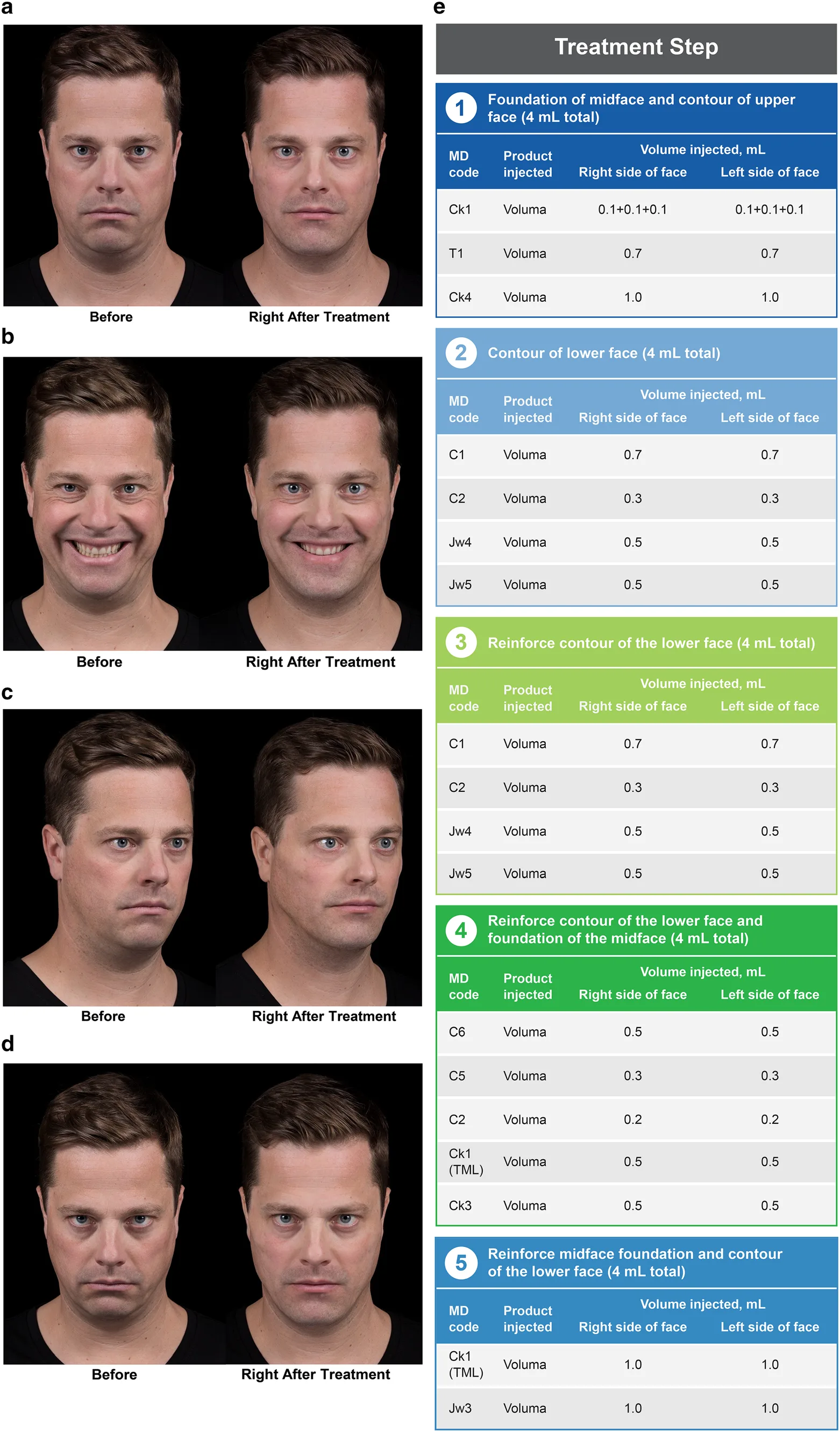
Fig 1. A codified full-face plan: panel (e) is a five-step "Treatment Step" table, each step headed "4 mL total", listing the MD code (Ck1, T1, Ck4, C1, C2, Jw4, Jw5, C6, C5, Ck3, Jw3), the product (Voluma) and the volume injected on each side in millilitres; panels (a)–(d) are the same male patient before and right after treatment in frontal, smiling and three-quarter views. Read the columns: five steps of 4 mL sum to roughly 20 mL of filler in one documented plan, which is exactly why this school, in inexperienced hands, is the highest-consumption one. (de Maio, 2020, p 18) [1][MEDLIB].
> Fuentes: de Maio 2020, MD Codes methodological approach [MEDLIB Aesthetic_Medicine/02_Rellenos_Fillers].
The MD Codes contribution is not the map, it is the question. It moves the consultation from "which line do we fill" to "which emotional message do we soften", and it gives the injector a notation precise enough that a plan can be handed to another clinician and reproduced. The indirect-effect logic (formalised later as myomodulation: filler placed to change the resting balance of muscle vectors rather than to add bulk) is the same idea applied to movement, and it is the intellectually strongest part of the system [3].
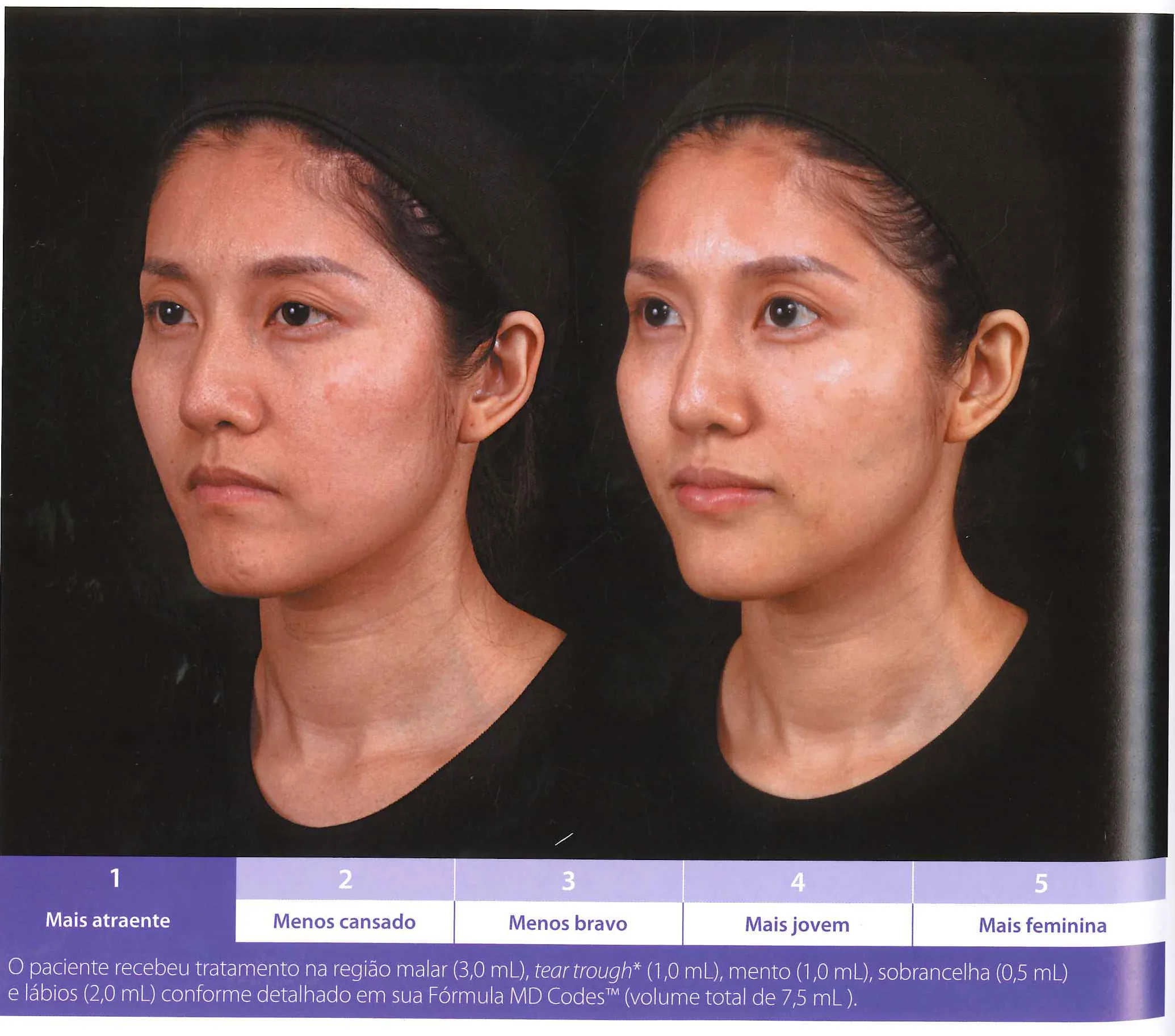
Fig 2. The emotional-attribute grid that is the core innovation: the same patient in three-quarter view before and after, scored not by millimetres but by five perceived messages (more attractive, less tired, less angry, younger, more feminine). The printed formula documents malar 3.0 mL, tear trough 1.0 mL, chin 1.0 mL, brow 0.5 mL and lips 2.0 mL, total 7.5 mL. The figure is the school in one image: the endpoint is a perceived attribute, and the dose is a codified volume. (livro de MDcodes, p 139) [2][MEDLIB].
> Fuentes: MD Codes atlas, emotional-attribute scale [MEDLIB Aesthetic_Medicine/02_Rellenos_Fillers/livro_de_MDcodes]. Fig 2 is referenced in the prose because it documents the attribute-targeting logic panel by panel, not for decoration.
What to watch.
- The template can replace the diagnosis. Applying Ck1–Ck5 without first separating volume loss from descent (B1.3) is precisely how the over-anteriorised malar of the overfilled face is built [21]. The algorithm assumes the problem is volume.
- It is a filler grammar. The vocabulary barely contains energy devices, threads or surgery, so it tends to answer non-volume problems (descent, skin laxity) with product [1].
- Course volumes are generous ⚠. Fig 1 documents a 20 mL plan; the taught "active numbers" bias upward, and in low-experience hands MD Codes consumes the most product of any school here [21].
- Sponsorship is explicit. The system is tied to Allergan and its filler range is the taught product; that is a conflict to disclose, not to hide [25].
Discrepancy that changes the gesture: MD Codes plans by attribute and code (top-down from the desired message); the restraint school plans by cumulative-volume ceiling (bottom-up from a budget). Decide by the patient's filler history: a naïve face tolerates the code-driven plan; a face with an unknown or large prior volume needs the ceiling first [21][22].
Trampa clásica: copying the "active numbers" as if they were doses. They are minimums for visibility in an average tissue, not targets; stacking minimums across a full-face plan is how a reasonable-looking session reaches 7 to 20 mL. Signature: the injector can name every code placed but has never summed the millilitres [1][21].
Proportion, structure, and dermis: Swift, Liew, van Eijk
These three schools disagree on the single most consequential question in the field: what layer do you treat first? Swift argues from proportion at the surface, Liew from the skeleton upward, van Eijk from the dermis alone. The disagreement is real and it changes the needle.
BeautiPHIcation (Swift): proportion and restraint
Consensus. Map the face against the golden ratio (φ ≈ 1.618) with a caliper and a proportion mask, then treat light and shadow rather than isolated structures: a youthful face carries a characteristic pattern of highlights and transitions that ageing flattens [4][10]. The school is the most explicit advocate of restraint: less product, placed better. It pioneered structured male-face work and the compass as a consultation instrument [4].
What it adds is more than its theory justifies. The restraint discipline is a valuable counterweight in a field biased toward excess. It teaches the injector to judge relationships, not points, so a correction is assessed by the resulting proportion. The light-and-shadow idea is clinically useful: it explains why a small deposit at the correct point shifts perception more than a large misplaced volume, and why ageing reads first in the oblique view [10][11].
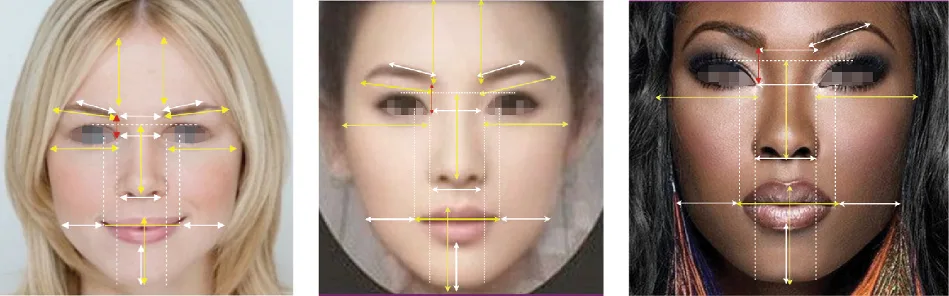
Fig 3. The φ method and its problem in one figure: identical golden-ratio proportion lines and vector arrows (referenced to the intercanthal distance) laid over a Caucasian, an East-Asian and a Black face. The overlay is reproducible, but the canon it encodes was derived from a narrow population, which is why the same mask fits three faces only by ignoring what actually differs between them. (Jones, 2019, p 50) [10][MEDLIB].
> Fuentes: Jones 2019, Injectable Fillers [MEDLIB Aesthetic_Medicine/02_Rellenos_Fillers].
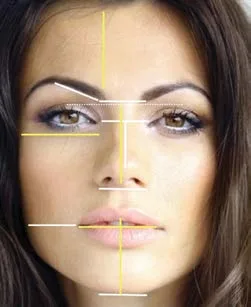
Fig 4. The proportion mask in use: horizontal thirds and vertical fifths with φ intervals projected onto one face, the assessment step that precedes any injection in this school. It is a discipline for looking, not a measurement of beauty. (Benedetto, 2018, p 71) [11][MEDLIB].
> Fuentes: Benedetto 2018, Botulinum Toxins in Clinical Aesthetic Practice [MEDLIB Aesthetic_Medicine/01_Toxina_Botulinica].
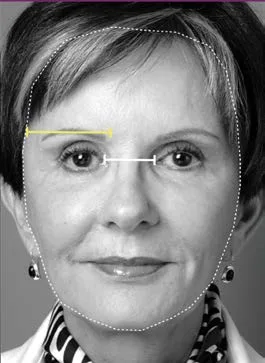
Fig 5. The looking discipline before the syringe: a mature female face outlined with a dotted facial contour and two horizontal reference lines (brow and inter-eye level), the proportional read that this school insists precedes any deposit. The figure documents that the first act of BeautiPHIcation is measurement of relationships, not injection. (Benedetto, 2018, p 71) [11][MEDLIB].
> Fuentes: Benedetto 2018, Botulinum Toxins in Clinical Aesthetic Practice [MEDLIB Aesthetic_Medicine/01_Toxina_Botulinica]. Fig 5 is referenced here because it shows the assessment gesture, not a result.
Discrepancy that matters (is φ real?) ⚠ The theoretical base is weak, and the honest injector should know it. The attractiveness literature supports averageness (a population-average composite is rated more attractive than most of its constituents) [5] and symmetry and sexual dimorphism [6], not φ. Marquardt's φ mask fails outside the fashion-model population it was built on [7], and the neoclassical canons validate poorly across ethnic groups [8][9]. Resolution: the method works through the restraint it enforces, not through its geometry. Defending φ as evidence is the trap; using the mask as a looking discipline is legitimate. A mask built on a Caucasian model applied literally to another face reproduces the ethnic-canon error of B1.6 and B6 [8].
Trampa clásica: presenting φ to a patient (or a colleague) as the scientific reason the result will be beautiful. Signature: the injector cannot cite a single attractiveness study but quotes 1.618 with confidence [7].
The shaped face (Liew): foundation first
Consensus. Rebuild the deep support before touching the surface. The sequence is pyriform rim, anterior maxilla, deep-medial cheek and SOOF, mandible and chin, with a high-G′ cohesive gel placed supraperiosteally; only then are contour and surface addressed [12][13]. The second half of the school is the profiloplasty lens inherited from orthodontics and maxillofacial surgery: assess the profile, not only the frontal view (nasolabial angle, chin projection, mentocervical angle, jawline) [12].
What it adds. The profile is the view the patient does not control and where ageing is most legible, so it is the honest audit of a plan. The foundation-first sequence avoids the most expensive error in the field: chasing a surface line that is actually a support deficit, so the line returns and the surface now bulges [13]. The school is influential in the Asian face, where the strategy is often to project the midface and chin rather than widen them, and it gives the chin and jaw a natural place that midface-centric schools under-treat [12].
Discrepancy that matters (deep-first vs surface-first) ⚠ This is the axis of the whole block. Foundation/deep-first (Liew; the "deep injections first" tradition) rebuilds skeletal support before anything else. Dermis/surface-first (van Eijk, below; intradermal microdroplet and skin-quality work) treats the envelope with minimal volume. Decide by the dominant lesion: structural volume loss with descent → deep-first; preserved structure with skin and dynamic-line change → surface-first. Modern multilayer technique deliberately reconciles the two, but the order still matters because deep support changes the surface geometry you would otherwise treat [13].
What to watch. The school demands solid deep anatomy and reliable bone contact, and it carries the highest exposure to the deep vascular danger zones [14][29]. An overbuilt high-G′ foundation is the hardest error to reverse: it weighs, it migrates, and it alters the contour persistently; MRI shows this material outlasting the injector's assumption of clearance [23].
Trampa clásica: using deep structural support as the answer to a descent problem. Support does not lift a ptotic mid-cheek, it loads it. Signature: the malar is projected forward, the nasolabial fold is heavier at review, and the patient looks wider, not lifted [21].
The Fern pattern (van Eijk): the dermis as target
Consensus. The conceptual opposite of everything above. Instead of replacing lost volume, treat the dermis: intradermal microdroplets of low-crosslink NASHA deposited in a branched pattern, like the veins of a fern, laid perpendicular to the expression lines at roughly 2 mm spacing, with no volumising bolus and no toxin [15].
What it adds. It treats dynamic lines and dermal quality in zones where neither volume nor toxin performs well: perioral, cheek, neck, pretragal. It acts on elasticity and dermal quality rather than on volume, which makes it the conceptual bridge to skinboosters, mesotherapy and biostimulation, where the dermis is the target and volume is not the goal (see F1) [15][16]. It has the lowest face-deforming risk of any school here, because the plane is dermal and the total material is minimal. The geometry is the technique: the branched pattern distributes tension in two directions and the perpendicular deposit is what flattens the line; copying the product without the pattern does not reproduce the effect [15].
What to watch. The intradermal plane is narrow and the technique is demanding: too superficial gives a visible papule and a Tyndall cast, too deep does nothing. The result is subtle and delayed, so it is a poor fit for a patient who expects immediate change, and the use is off-IFU for most of the products employed ⚠ [15].
Trampa clásica: buying the NASHA and skipping the branched, perpendicular pattern, then concluding "microdroplets do not work". The pattern and the perpendicularity are the intervention; the product is the least important part [15].
Other reference schools and the restraint movement
Other reference schools
| Reference (author) | Characteristic contribution | Corpus status |
|---|---|---|
| Raj Acquilla | High-precision, plane-first injection aesthetic; a leading eye and tear-trough injector; UK key opinion leader and masterclass trainer; the "sculpted result" lineage | [MATERIAL GAP]: not corroborated in the own corpus (a scope-declared corpus-acquisition gap); external and reputational sources only |
| Dario Bertossi | The maxillofacial-surgeon lens: real surgical anatomy, the nose and the lower third, and an explicit position on where non-surgical treatment must stop | [C] |
| Kate Goldie | Biology before geometry: tissue quality and the biological response to product; one of the earliest voices against filler as the single answer | [C] |
These are correctives more than rival maps. Acquilla anchors the technical high end, the plane-first precision aesthetic; the claim here is flagged [MATERIAL GAP] because the retrieval returned no own-corpus document for it (facet other-schools, top score 0.44, the corpus-acquisition gap named in the scope contract), so it rests on external reputation, not on a grounded source. Bertossi imports the surgeon's anatomy and, more importantly, the surgeon's willingness to call a problem surgical rather than injectable, which is the honest limit of this entire chapter [14]. Goldie's "biology before geometry" prefigures the restraint movement: the tissue's biological response, not the geometric plan, sets the true ceiling on what should be injected [19].
The restraint / un-filling movement
The most important current of the decade, and the only one that did not grow from a manufacturer-sponsored training circuit [25].
Thesis. Filler was used for years as the answer to problems that are not volume problems, and the aggregate result is a recognisable iatrogenic phenotype, Facial Overfilled Syndrome (FOS), that the public now identifies and rejects [21]. The correction is not more technique; it is less product and a different category of tool [22].
The FOS phenotype, to recognise in your own chair [21][22]: - Over-anteriorised, wide, high malar that erases the malar-to-palpebral transition. - A flattened Ogee curve from excess, not deficit: the double curve disappears. - A face wider at rest and wider still on smiling (the "pillow face"); the transverse facial septum along zygomaticus major restrains the smile against the mass. - An altered smile: the cheek rises as a single block and narrows the palpebral aperture. - A puffy periorbita with intermittent, chronic oedema. - An everted upper lip projected past the E-line in profile. - The patient reports the face has changed, not that it looks rejuvenated.
The four mechanisms, none of them a single mistake [21][22][23]: 1. Unaccounted cumulative volume across many reasonable sessions: the arithmetic nobody performed. 2. Treating descent with volume (B1.3), which loads a ptotic envelope instead of supporting it. 3. The injector's own perception bias: the eye habituates to what it makes, and the reference point drifts session by session. 4. Underestimated residual product: high-crosslink HA persists longer and larger than assumed; on MRI, mid-face filler is still detectable years after injection, so the impression that "it is gone" precedes real clearance [23].
The response the movement proposes: - Biostimulation and skin quality ahead of volume: CaHA, PLLA, polynucleotides, skinboosters, energy devices (see A4, F1). - Diagnostic dissolution: in the overfilled patient, dissolve and wait, to see the real face before deciding anything. This is a therapeutic step, not a defeat [22]. - A cumulative-volume audit per patient and per year (B5.4, B5.6). - "Saying no" as a clinical intervention rather than lost revenue.
Discrepancy that matters (prejuvenation) ⚠ That early, low-dose treatment of a young patient prevents ageing is not demonstrated; the recent evidence appraisal treats prejuvenation as a commercially driven construct and flags the lifelong cumulative-volume and iatrogenic-overfill risk it creates [24]. The restraint argument is arithmetic, not moral: a patient who starts filler at 22 at 1 mL per year carries, by 40, an accumulated volume that no one would have approved in a single sitting [21][24]. Decide by trajectory, not by the single session: a preventive plan is only defensible if the cumulative ceiling is written down and defended.
Its own excess ⚠. The movement over-corrects too: indiscriminate mass dissolution as a trend, and "filler-free" as a brand identity. Dissolving is a procedure with consequences; hyaluronidase degrades endogenous HA as well, and the immediate result can be worse than baseline (see J3).
The 2024–2025 cultural wave [FRONTIER, web/currency, external lane]. A mainstream "un-filling" shift is visible in public rejection of the pillow look, celebrity dissolving, growing MRI-longevity awareness, and demand moving to biostimulators and microdosing. Currency caveat, stated because it changes the conclusion: aggregate statistics still show soft-tissue filler procedures roughly flat to slightly up year on year (on the order of 5.3 million procedures, about +1%), so this is a how-shift (less volume, more biostimulation, more microdosing) and not an abandonment of injectables [28]. This signal is external and web-derived; the own corpus predates it, which is declared in the currency block and in Coverage vs UPO.
Trampa clásica: adopting the aesthetics of restraint (dissolving, "less is more" language) while still never summing the millilitres. Restraint without the cumulative-volume audit is a slogan; the audit is the only part that actually prevents FOS [21][22].
B5.2 · Applicable regulatory framework (Spain and EU)
A "school" is a teaching framework, not a legal object, but everything a school teaches you to do is regulated: the device you inject, the way you use it relative to its licence, the money that funded the course, and how you advertise the result. Four instruments govern the practice of all of them, and each shifts a burden onto the injector that the framework itself is silent about. Product-level regulatory status and brand availability in Spain are covered in A6; this block is about the regulation of using the schools, which is a different angle.
| Norm (cite) | Scope | What it requires of the injector |
|---|---|---|
| Regulation (EU) 2017/745 (MDR), Annex XVI [26] | Dermal/facial fillers are regulated as medical devices without an intended medical purpose | CE-marked product only; the device must meet the general safety and performance requirements even without a medical claim |
| Commission Implementing Regulation (EU) 2022/2346 [27] | Common specifications for the Annex XVI groups (fillers included), in force since 2023 | Documented risk management, clinical evaluation of safety and performance, qualified user, defined patient information, post-market surveillance |
| Ley 34/1988 General de Publicidad + RD 1907/1996 [33] | Advertising of products/services with a claimed health purpose (Spain) | No misleading claims; before/after and testimonial advertising constrained; autonomic sanitary-advertising authorisation on top |
| EFPIA / Farmaindustria transparency codes [25] | Transfers of value from manufacturers to healthcare professionals | Disclosure of the funding behind training, key-opinion-leader and consultancy relationships |
1. The filler is a regulated device, the school is not. Before the MDR, a dermal filler with no medical claim sat in a regulatory grey zone. Annex XVI closed it: a defined list of products without an intended medical purpose (which explicitly includes substances and items for facial or dermal filling by injection) is now regulated as if it were a medical device, so the product must carry a CE mark and satisfy the general safety and performance requirements even though the manufacturer makes no medical claim [26]. Since the 2022 common specifications the manufacturer must additionally hold a documented benefit-risk analysis, a clinical evaluation of safety and performance for the specific product and its stated technique, a qualified-user requirement, defined patient information and post-market surveillance [27]. None of this validates a school. MD Codes, BeautiPHIcation and the rest are methods layered on top of a licensed device; the regulation covers the syringe, not the philosophy. That distinction is the whole reason the schools are graded [C]/[D] in this atlas: the device is evidence-regulated, the framework for using it is expert opinion [1][4].
The practical reading for the clinic: the product you inject must be a CE-marked Annex XVI device with an accessible clinical evaluation, and the technique the school teaches is never covered by that CE mark. The mark travels with the gel, not with the plan.
2. Off-IFU technique moves the whole burden to you. Several schools operate outside the manufacturer's instructions for use (IFU). The Fern pattern injects a NASHA product intradermally in a pattern and plane the label does not describe [15]; the MD Codes "active numbers" and full-face plans place volumes and depths an individual product licence may not cover [1]; deep supraperiosteal structural placement is technique-led, not label-led [12]. Off-IFU use is lawful in medical practice, but under the MDR framework it is the practitioner's professional responsibility, and the consequences are specific:
- The justification for the departure (why this plane, this volume, this indication) must exist and be documented; a course certificate is not that justification.
- The informed consent must name the off-label element, because consent obtained for the licensed use does not cover the off-label one.
- Product liability stays with the manufacturer only for defects in the device used as intended; the moment the use is off-label, the liability for the use is the injector's.
- Post-market vigilance obligations (reporting adverse events) still apply and are more, not less, important off-label.
A school that teaches an off-label technique does not transfer the liability with the slide, and the more elegant the framework, the easier it is to forget that.
3. Sponsorship is a conflict to disclose, not a secret to keep. MD Codes is tied to Allergan; most training circuits are tied to a specific filler range [25]. Under the EFPIA transparency framework and its Spanish implementation (Farmaindustria), transfers of value from a manufacturer to a healthcare professional (course fees, speaker honoraria, consultancy, travel, product) are disclosable. The structural consequence for this chapter is unavoidable: a training economy funded by product sales will not, on aggregate, teach less product, which is exactly why the only school that teaches restraint grew outside that economy [25][21]. Two disclosures follow from this:
- To the patient: which product and school you were trained on, and whether that training was manufacturer-funded, given routinely rather than on request.
- In advertising and public teaching: the funding relationship behind a "signature technique", because omitting it turns a disclosed bias into an undisclosed marketing claim, which is what the norms in point 4 target.
4. Advertising and KOL marketing are constrained in Spain. Ley 34/1988 (General de Publicidad) prohibits misleading advertising in general, and RD 1907/1996 constrains advertising of products and services with a claimed health purpose, including testimonial and before/after promotion [33]. On top of the national layer, the autonomous communities operate their own sanitary-advertising authorisation or registration regimes, so a clinic advertising an aesthetic "signature technique" is subject to a regional authorisation as well as the national prohibition on misleading health claims. School branding, "signature technique" marketing and influencer before/after content fall squarely inside this frame. A before/after that omits the volume injected, the number of sessions, the maintenance required or the fact that the technique is off-label is precisely the kind of incomplete claim these norms exist to catch. Photography for any of this is separately governed by data-protection law, which requires specific consent for storage and a distinct consent for external or promotional use.
5. Minors and prejuvenation sit on the indication line. Non-therapeutic aesthetic treatment of a young or under-age patient is where regulation, consent and the prejuvenation debate meet (B5.3, and the consent chapter). Because prejuvenation lacks demonstrated preventive benefit [24], a low-dose plan started early is defensible only with an explicit written cumulative-volume ceiling and a documented indication; without them it is an elective procedure marketed on an unproven claim, which is the weakest possible position under the advertising norms above [24][33]. The younger the patient and the more "preventive" the framing, the higher the documentation bar, not the lower.
A minimum regulatory file for any school-based plan: - CE-marked Annex XVI device, with the clinical evaluation accessible [26][27]. - Written indication tied to the B1.3 diagnosis, not to a template. - Off-IFU justification and a consent addendum naming the off-label element [15]. - Disclosed conflict of interest (product, school, funding) [25]. - Cumulative-volume record and an agreed ceiling (B5.4). - Data-protection-compliant photography consent, separate for clinical and promotional use.
6. One adverse event, four norms at once. A worked scenario shows how the instruments interlock. A patient develops a persistent, visible papule after an intradermal Fern treatment with a NASHA product used off-label. Under the MDR and its common specifications the device itself was a CE-marked Annex XVI filler, so the product is compliant [26][27]; under the off-IFU doctrine the intradermal plane was off-label, so the justification and the specific consent must already be in the file, and if the consent named only the licensed subdermal use, the injector is exposed [15]; under the advertising norms, if the treatment was sold on a before/after implying a licensed, risk-free result, that is a separate exposure [33]; under the vigilance obligation the event should be recorded and, if it meets the threshold, reported [27]. A single complication is judged against all four norms simultaneously, and the framework (Fern) supplied none of the cover.
7. The device dossier the clinic must be able to produce. For any injected product the clinic should be able to show the CE mark and Annex XVI classification, access to the clinical evaluation of safety and performance, batch and lot traceability, and the IFU against which any off-label use is measured [26][27]. This is not paperwork for its own sake: it is what turns "I used a good product correctly" from an assertion into a record. When a school teaches you to inject a particular branded product, the dossier for that product, not the school's certificate, is the document that matters if the treatment is questioned.
8. Product liability versus practitioner liability. The split is clean and worth stating plainly. The manufacturer answers for a defect in the device used as intended; the practitioner answers for the use, and the moment the use is off-label the practitioner owns the decision, the consent and the outcome [26]. A school cannot move that line, and a manufacturer-funded course does not indemnify the injector against an off-label choice the course itself taught. This is the legal shadow of the same point the whole chapter makes clinically: the framework is a tool you are responsible for, not an authority that assumes the responsibility.
9. Cross-border, remote and non-physician caveats. Training and products cross borders faster than the regulation harmonises in practice. A technique routine for a physician in one market may sit differently where non-physician injectors operate, and the Spanish physician-led model (B5.7) sets a higher anatomical and documentation baseline than some markets. Remote or "online consultation then inject" models do not remove the in-person examination and consent requirements, and a diagnosis made from a photograph cannot run the supine and manual-elevation tests that B5.3 makes load-bearing. None of this is a school's concern, which is exactly the gap this block exists to fill.
10. Record retention and the medico-legal timeline. The documents of B5.4 only protect the injector if they survive, and a filler complication can present years after treatment, precisely because the material persists that long [23]. The practical consequences: the consent, the ledger and the standardised photographs must be retained under the applicable clinical-records rules for a period measured in years, not months; they must survive staff turnover and system migrations, which is why the ledger belongs in the record system and not in a departing injector's notebook; and the cumulative total must be reconstructable from the individual session entries, because a summary that cannot be audited back to its sessions is worth little if the treatment is questioned. A file that cannot show what was injected, how much cumulatively, and that the off-label use was consented is the file that loses, regardless of how good the result looked on the day.
11. Cross-jurisdiction divergence. The device rules are EU-wide (MDR and its common specifications), but the practitioner rules, the advertising authorisation and the scope of who may inject vary by country and, within Spain, by autonomous community [26][27][33]. A technique or a marketing claim that is compliant in one jurisdiction is not automatically compliant in another, and post-Brexit the United Kingdom operates a separate device regime, so a product or claim moving across that border is re-assessed. The clinical point is small but real: the school travels freely, the regulation does not, and the injector, not the framework, carries the difference.
Discrepancy that matters: individualised full-face planning (MD Codes, pan-facial) and templated proportion planning both have to satisfy the same documented-consent and off-IFU-justification standard, so the "more individualised" school is not the more defensible one by default. What defends a plan legally is the written record (indication, product, cumulative volume, off-IFU justification, disclosed conflict), not the elegance of the framework [25][26].
Trampa clásica: treating a manufacturer's training certificate as if it were regulatory cover for the technique. The certificate documents that you attended; it does not license an off-IFU volume or depth, and it does not discharge the consent burden. Signature: an adverse event over an off-IFU plan with a consent form that never named the off-label use [15][26].
B5.3 · The procedure, step by step
The procedure of this chapter is not an injection technique, it is the decision that precedes technique: how to pick a framework for the patient in the chair. It runs diagnosis first, school second. Applying any template without this step is the single act that manufactures the overfilled face [21].
The decision table (build it before you open a syringe):
| Dominant finding (from B1.3) | It is not a… | Framework / tool to reach for | The restraint rule |
|---|---|---|---|
| Deep structural volume loss | surface problem | Liew foundation-first: deep supraperiosteal, high-G′, low volume [12][13] | plan the volume, then remove 20 to 30 % |
| Soft-tissue descent / ptosis | filler problem | energy, threads [17], deep-plane or surgical lift [18][32]; not filler | filler here adds weight, not lift |
| Skin quality / dynamic lines | volume problem | Fern, skinboosters, biostimulation, peel, laser (F1, A4) [15][16] | treat the dermis, not with a bolus |
| Documented or suspected prior overfill | new-treatment problem | diagnostic dissolution, then wait 2 to 4 weeks [22] | see the real face before deciding |
| Proportion / relationship issue | single-point problem | BeautiPHIcation as a looking discipline; light and shadow [4] | judge by relationships, not points |
The diagnostic manoeuvres that make step 1 objective. The dominant-lesion call is not a matter of opinion; there are bedside tests that separate the three axes, and they take under a minute each:
- Supine (decubitus) test. Lay the patient flat. Volume loss largely persists (the deficit is structural); descent partly corrects as gravity unloads the ptotic tissue toward the ears and orbit. If the mid-cheek "fills in" lying down, the problem was descent, and filler standing up will chase a shadow that is not a volume deficit [21].
- Manual elevation (lift) test. Lift the mid-face gently upward and laterally with two fingers. If the nasolabial fold and jawline improve, the case is a lift case (thread, energy or surgery), not a fill case [18].
- Skin pinch and recoil. Pinch and release; slow recoil and fine surface lines point to a skin-quality problem for the dermis (Fern, skinboosters), not a volume problem [15].
- Profile and three-quarter capture. The Ogee curve, chin projection, nasolabial and mentocervical angles read only off the profile and the oblique, which is where overfill and under-projection appear first [12][25].
- Volume reconciliation. Total the prior millilitres from the record. An unknown total is itself a finding and forces the conservative branch [21][22].
The eleven steps.
- Diagnose first (B1.3). Run the four manoeuvres above and name the dominant axis: volume loss, descent, or skin. Most faces are a mix; the dominant one selects the school, and naming it wrongly is the origin of most iatrogenic outcomes [21].
- Read the history and sum the volume. Total the millilitres already placed, by zone and by year. If no one has ever summed it, that absence is your first finding, and it changes the plan more than any single measurement [21][22].
- Assess the profile and the three-quarter view, not only the frontal. The Ogee curve and the projection decide more than frontal symmetry, and overfill is legible there first [12][25].
- If structural loss dominates, work foundation-first: deep supraperiosteal support with a high-G′ product, the least volume that restores the vector, bone contact confirmed [12][13]. Reassess whether the surface line even needs treatment once the foundation is restored, because it often does not.
- If descent dominates, do not fill. This is an energy, thread or surgical case (thread techniques [17], deep-plane and surgical rejuvenation [18][32]); filler loads a ptotic envelope and accelerates the pillow-face trajectory [21]. Say this out loud to the patient, because "we could add a little filler" is the path of least resistance and the wrong one.
- If skin change dominates, treat the dermis: Fern, skinboosters, biostimulation, resurfacing. Volume is the wrong tool for a quality problem, and the result is judged on texture and elasticity, not on contour [15][16].
- If there is prior excess, run diagnostic dissolution and re-assess at 2 to 4 weeks before planning anything new. Do not build on an unknown baseline; the dissolved face is the real starting point [22].
- Apply restraint at the syringe. Plan the volume, then subtract 20 to 30 %. It is added at review; removing it later costs far more than the saved millilitre, in both product and trust [4][22].
- Write the plan in phases, with the volume expected per phase and the cumulative total projected at twelve months (B5.4). A plan with no cumulative line is a plan with no ceiling [21].
- Photograph in three-quarter and profile, standardised, and store the running total beside the image. This is where excess and asymmetry are caught early [25].
- Re-evaluate at review, not on the day. Compare against the photograph from a year ago, not from a month ago; the perception bias only corrects against a distant reference point [21].
A worked case (how the steps run in one patient). A 47-year-old presents wanting "cheek filler because I look tired". Step 1: supine test shows the mid-cheek fills in lying flat, and the manual lift improves the nasolabial fold, so the dominant axis is descent, not volume loss; the tear-trough hollow that reads as "tired" is a descent shadow. Step 2: the record shows 6 mL already placed in the malar region across three years, never summed. Step 3: the profile shows a flattening Ogee, an early overfill sign. The correct plan is not more malar filler (step 5: descent is not filled), it is to stop adding malar volume, consider a lift-category treatment, treat the peri-orbital shadow conservatively if at all, and reconcile the cumulative total with the patient before anything else. The wrong plan (the "obvious" one) is another 2 mL of malar filler, which would deepen the descent shadow and push the running total toward FOS. The difference between the two plans is one minute of bedside testing and one summed column [21][25].
A second worked case (the structural-loss branch). A 58-year-old presents with a flattening mid-face and deepening nasolabial folds. Step 1: the supine test shows the deficit persists lying flat (structural loss, not descent), and the skin recoils briskly (skin quality is not the dominant axis). Step 2: the record is clean, 2 mL total over five years, well under any reasonable ceiling. Step 3: the profile shows a retruded mid-face and a shallow Ogee from deficit, the opposite of the first case. This is the branch where the structural school fits (step 4): deep supraperiosteal support on the anterior maxilla and deep-medial cheek with a high-G′ product, the least volume that restores the vector, bone contact confirmed, then a reassessment of whether the nasolabial fold even needs direct treatment once the foundation is restored (it usually softens on its own) [12][13]. Restraint still applies (step 8): plan the volume, remove 20 to 30 %, add the remainder at review. Two patients, opposite plans, and the only thing that separated them was one minute of bedside testing and one look at the profile [12][21].
The in-session decision: continue or re-book. Not every plan should be completed in one sitting, and the decision to stop is itself a skill:
| Situation | Continue in-session | Re-book |
|---|---|---|
| Volume record clean and low | reasonable to complete the phase | if the patient tires or tissue reacts |
| Volume record unknown or high | never | reconcile first, treat one axis, re-book [21] |
| Oedema or reactive tissue appearing | stop; do not chase symmetry over swelling | assess at 2 to 4 weeks [21] |
| Patient asking for "a bit more while I'm here" | this is the request that builds FOS; hold | review against the 12-month photo first [25] |
The pressure to "finish the face today" is commercial and social, not clinical. The ledger and the review visit exist precisely to move the hardest decisions off the treatment chair, where oedema and the patient's presence bias them.
A third worked case (the skin-quality branch). A 39-year-old presents unhappy with fine perioral and cheek lines and a "crepey" texture, asking for filler. Step 1: the supine test shows no volume deficit filling in, the manual lift does not change the complaint, and the skin pinch shows slow recoil with fine surface lines. The dominant axis is skin quality, not volume or descent. This is the Fern and skinbooster branch (step 6): intradermal microdroplets in the branched, perpendicular pattern for the dynamic perioral lines, or a skinbooster course for global dermal quality, with resurfacing considered in parallel [15][16]. Volume here would be the classic error: a lip or cheek bolus for a dermal problem gives a heavier face and leaves the texture untouched. The plan treats the dermis, and the result is judged on texture at review, not on contour on the day [15].
Reading the three-quarter view (the neglected examination). The oblique view is where the schools' disagreements become visible and where most errors first show, so it deserves its own routine. Look for: the Ogee curve (a single smooth S from the malar to the submalar; a flattening or a double bulge signals over- or under-treatment); the malar-to-palpebral transition (an over-anteriorised malar erases it, the earliest FOS sign); the anterior projection of the mid-face against the eye (structural deficit reads here, not frontally); and the jawline-to-neck transition (a load-bearing profile line the frontal view hides). None of these is measured in millimetres in the clinic; each is tracked against the patient's own standardised oblique photograph, which is why the photo protocol is part of the diagnostic procedure and not an afterthought [12][25].
Documenting the decision. The output of the procedure is a written decision, not just a treatment: the dominant axis named, the school chosen and why, the volume planned and the 20 to 30 % held back, the cumulative total after this phase, and the review date. A decision recorded this way can be defended, audited and handed to a colleague; a decision that lives only in the injector's head cannot, and it is the undocumented decision that drifts into the overfilled face [21][25].
Consensus: every school agrees the sequence is diagnosis → plan → treat → review; they disagree only on what to reach for once the dominant lesion is named. That is why the diagnosis, not the school, is the load-bearing step [1][12][15].
When the patient disagrees with the diagnosis. The commonest friction is the patient who has decided the answer is filler when the dominant axis is descent or skin. The procedure does not change, but the consultation does: show the supine and manual-elevation findings on their own face, explain that filler on descent adds weight and builds the look they are trying to avoid [21], and offer the correct category (lift, energy, dermal) as the treatment, not as a refusal. "I am not going to fill this, and here is why, and here is what will actually help" is a stronger clinical and commercial position than a reluctant syringe, because the reluctant syringe is the first millilitre of an overfilled face. Saying no, with the reasoning shown, is step 5 in practice [21][22].
Discrepancy that matters: MD Codes and pan-facial planning treat in a pre-committed full-face sequence; the restraint pathway treats the dominant lesion only and re-books. Decide by the reliability of the volume record: with a clean, low cumulative history the sequenced plan is efficient; with an unknown or high history, treat one axis and re-assess, because a full-face plan on a hidden baseline is how the ceiling is breached [21][22].
Trampa clásica: starting at step 4 (choosing the school) because the diagnosis "is obvious". The obvious diagnosis is usually "volume", because volume is what the injector is trained to place. Signature: a confident full-face plan written before anyone summed the prior millilitres or looked at the profile [21][25].
B5.4 · Templates and documents
The practical output of this chapter is a small set of documents that make restraint enforceable and off-IFU practice defensible. Copy them; the cells are placeholders, never pre-filled doses.
1. Phased treatment plan. The point of the table is the cumulative column: it is the only line that prevents the overfilled face, and no school ships it by default [21][22].
| Phase | Date | Zone / MD code | Product | Planned mL | Cumulative mL (this zone) | Cumulative mL (whole face, this year) | Indication (loss / descent / skin) |
|---|---|---|---|---|---|---|---|
| 1 | | |
| |
| |
`` | |||
| 2 | | |
| |
| |
`` | |||
| Review | +2 to 4 wk | assess only; do not add over oedema | none | 0.0 | carry forward | carry forward | compare to 12-month photo |
A worked skeleton makes the discipline concrete: a structural case might read Phase 1 deep malar mL (loss), cumulative ; Phase 2 chin and jawline ` mL` (loss), cumulative; Review at 3 weeks, no product, decision recorded. The running total is visible at every line, so no session can be justified without seeing what it adds to.
2. Cumulative-volume ledger and ceiling. One row per zone, carried across years, with an agreed annual and lifetime ceiling written before treatment starts.
| Zone | Lifetime total mL | This-year mL | Agreed annual ceiling | Agreed lifetime ceiling | Last imaging / dissolution |
|---|---|---|---|---|---|
| Malar | | |
| |
`` | ||
| Chin | | |
| |
`` | ||
| Lips | | |
| |
`` | ||
| Jaw | | |
| |
`` | ||
| Tear trough | | |
| |
`` | ||
| Temple | | |
| |
`` |
- Rule: when a zone approaches its ceiling, the next step is assessment or dissolution, not another aliquot [21][22].
- Rule: high-crosslink HA is assumed present for years after injection; do not treat a zone as "empty" on time alone, verify by imaging or accept the residual in the count [23].
- Rule: review the ledger aloud with the patient at least yearly, so the total is a shared number and not a clinic secret.
3. Off-IFU / off-label consent addendum. Required whenever the technique departs from the product licence: the Fern intradermal NASHA plane, structural volumes and depths, and pan-facial totals [15][26]. Minimum elements, as a fill-in skeleton:
- Product:
`, a CE-marked Annex XVI device; its licensed intended use is<...>`. - The off-label element:
, proposed because. - Responsibility: the justification for this off-label use and the associated responsibility rest with the treating physician, not with the manufacturer.
- Risks of the off-label use specifically: ``.
- Alternatives: including a licensed alternative, doing less, and doing nothing.
- Signatures and date, with a copy to the patient.
Structured patient-information and consent material for lip and perioral treatment in the corpus provides a usable model for the information half of this document [30].
4. Conflict-of-interest disclosure to the patient. One line, given routinely rather than on request: the product or school you were trained on, by whom, and whether that training was manufacturer-funded [25]. It reframes "signature technique" from a selling point into a disclosed bias, which is what the advertising and transparency norms increasingly expect (B5.2). A usable script: "The technique I use was developed by ; my training in it was by ``. I am telling you so you can weigh it."
5. Standardised photo protocol. Overfill is caught in the views the patient does not check [25].
- Views every session: frontal, both three-quarters, both profiles, and frontal on full smile.
- Fixed distance, framing, background and lighting; neutral expression plus animation.
- Store the running cumulative volume in the image metadata or filename, so the photo and the ledger cannot drift apart.
- Consent for photography and storage under data-protection rules; a separate, explicit consent for any external or marketing use.
6. Shared-decision-making note. Record that the schools were presented as options with trade-offs, not as a single recommended technique: what was proposed, what was declined, and the patient's stated priority (attribute, proportion, structure, skin, or restraint) [1][4]. This is the document that operationalises "choose per patient, not per guru".
7. Review-visit template. The review is where the plan is defended, so it needs its own record: the standardised photographs compared to the 12-month baseline (not the last visit); the summed volume since the baseline; the patient's own report ("changed" vs "rejuvenated"); and an explicit decision to add, to hold, or to dissolve, with the reason. A review with no comparison photo and no summed line is not a review, it is a sales appointment [21][25].
8. Dissolution-decision record. When diagnostic dissolution is considered, document the indication (suspected overfill, migration, an unknown baseline to reset), the consent to a procedure that also degrades endogenous HA and may look worse before it looks better (J3), and the plan to re-assess at 2 to 4 weeks before any new treatment [22].
9. A worked phased plan, filled. The abstract table only bites when it carries real running totals. A structural case over three phases might read: Phase 1, deep malar and anterior maxilla, planned mL, cumulative this zone , whole-face this year, indication loss; Phase 2 at six weeks, chin and jawline, planned <b> mL, cumulative jaw <b>, whole-face , indication *loss*; Phase 3 at twelve weeks, refinement only, planned ` mL`, whole-face; and a review at each phase with no product and an explicit decision. The single most important cell is the whole-face this year running total, because it is the number a patient and an auditor can both read at a glance, and it is the number no school's plan includes by default [21]. If that cell is missing, the plan is decorative.
10. A worked consent addendum. For the Fern example, the addendum reads, in substance: the product is , a CE-marked device licensed for subdermal correction of; the proposed use is intradermal microdroplet placement for dynamic lines and skin quality, which is off-label; this off-label use and its justification are the treating physician's responsibility, not the manufacturer's; the specific risks include visible papules, a bluish Tyndall discoloration if placed too superficially, and a subtle, delayed effect; the alternatives are a licensed subdermal product, energy-based skin treatment, or no treatment; the patient has had the chance to ask questions and consents to the off-label use specifically. The point is that the word intradermal and the word off-label appear in the document, because a consent that does not name the departure does not cover it [15][26].
11. The audit trail and its tooling. The ledger only prevents FOS if it survives across sessions and staff, so it belongs in the record system, not in the injector's memory. Whatever the tool (the clinic's electronic record, a structured spreadsheet, a dedicated app), three properties are non-negotiable: the cumulative total is computed automatically from the session rows so it cannot silently drift; the photograph and the total share a key so they cannot be separated; and the ceiling is a field that is set once and shown at every subsequent visit. A ledger that has to be re-summed by hand each time is a ledger that will eventually not be summed, which is the failure mode the whole document set exists to prevent [21][22].
12. School-and-product disclosure summary. A short, patient-facing sheet that records which frameworks and products were considered and why the chosen one was selected, alongside the conflict-of-interest disclosure (B5.2). It operationalises "choose per patient, not per guru" as a document the patient keeps: the alternatives were real, the choice was reasoned, and the injector's training bias was on the table. This is the paper form of the chapter's whole argument, and it is cheap insurance against the later complaint that "you just did your usual technique on me" [1][25].
13. Maintenance-versus-ceiling reconciliation. A recurring worksheet that sets the proposed maintenance schedule against the agreed cumulative ceiling and the imaging/persistence assumption, so the two cannot silently diverge. A "top up every six to twelve months" plan looks harmless per visit and, reconciled against the ceiling and the multi-year persistence of the product, may already be on a trajectory to breach it [21][23]. The reconciliation forces the question the per-visit view hides: does this maintenance cadence, continued, stay under the ceiling we agreed? If not, the cadence changes, not the ceiling.
The minimum viable ledger for a solo clinic. None of this requires expensive software. A solo practice can run the whole set on a single structured spreadsheet per patient: one tab of session rows that auto-sums the cumulative total, one field for the agreed ceiling shown at the top, and a linked folder of standardised photographs named with the date and the running total. The two properties that matter (the total is computed, not re-typed; the photo and the total share a key) are achievable with a formula and a naming convention. The failure mode to avoid is the free-text note, where the total lives only in prose and has to be re-added by hand each visit, because a total that must be re-summed is a total that will eventually not be summed [21][22]. The tool can be humble; the discipline cannot.
Feeding the ledger from the review. The review-visit record (document 7) is where the ledger is updated and the ceiling re-checked, so the two documents are designed to interlock: every review carries forward the running total, compares to the 12-month photograph, and either confirms the trajectory or triggers a hold or a dissolution decision (document 8). A review that does not update the ledger is a review that lets the total drift, which is the failure the whole set exists to prevent [21][25].
Consensus: whatever the school, the defensible file is the same core document set (phased plan with a cumulative line, ledger with a ceiling, off-IFU consent, COI disclosure, standardised photos, shared-decision note, review record, dissolution record, school-and-product disclosure, maintenance reconciliation). The framework changes the content of the plan, never the existence of the record [25][26].
Version the plan like a document. A phased plan changes as the face changes, so each revision is kept, not overwritten: the prior version shows what was intended, the current one what is now proposed, and the difference is itself clinical information (a plan that keeps growing is a warning). Treating the plan as a versioned document, with the reasons for each change recorded, is what lets a later review distinguish a considered adaptation from unplanned accumulation, and it mirrors the way this atlas versions its own chapters rather than silently overwriting them.
Data-protection specifics for the photograph set. Because the standardised photographs are the ruler for every longitudinal metric (B5.6) and part of the medico-legal file (B5.2), their handling is not incidental: consent for capture and clinical storage is one thing, and consent for any external, teaching or marketing use is a separate, explicit permission that can be refused without refusing treatment. The images carry the running total in their key, so they are identifiable clinical data and are retained and secured as such. A practice that photographs diligently but stores loosely has created a liability where it meant to create a safeguard.
Trampa clásica: a beautiful phased plan with no cumulative column and no ceiling. It reads as thorough and enforces nothing; the millilitres still accumulate unwatched. Signature: three tidy phases, and no single number for "total this year" [21].
B5.5 · Common errors and their cost
The errors of this field are not technical slips, they are framework errors: applying a school where it does not fit, or applying any school without the diagnosis. The cost column is what they actually charge, clinically and to the practice.
| Error | Why it happens | Cost | How to avoid |
|---|---|---|---|
| Belonging to a school | Identity and reassurance | Systematic mismatch: every patient gets one school's answer, so a fraction are treated wrong every time | Schools are tools; choose per patient, disclose the bias [1] |
| Template without diagnosis | It is what the course teaches | The overfilled face, then dissolution, lost trust and a longer road back than forward [21] | Run B1.3 first, always; name the dominant axis |
| Defending φ as evidence | It was taught as science | Credibility loss with informed patients and colleagues; a claim that cannot survive one question [7][8] | Use the mask as a looking discipline, not as proof |
| Never summing cumulative volume | Nobody asks for the total | FOS built silently; residual HA persists for years on MRI, so the change feels irreversible [21][23] | Ledger with a ceiling; sum every session (B5.4) |
| Treating descent with volume | Filler is the trained tool | Added weight, accelerated ptosis, a wider face; the opposite of the goal [21] | Supine and manual-elevation test; descent is not filled |
| Judging only frontally | It is the mirror view | Profile and Ogee excess missed until advanced and expensive to reverse [12][25] | Photograph three-quarter and profile every visit |
| Deciding a retouch over oedema | The patient is in the chair now | Overcorrection layered on swelling, discovered at the next visit [21] | Re-assess at review (2 to 4 weeks), never on the day |
| Applying a φ mask to any ethnicity | It is the tool in hand | A homogenised, "done" look; the ethnic-canon harm of B1.6 and B6 [8] | Canons are local; adapt or discard the mask |
| Copying Fern without the geometry | The product is copied, not the pattern | Papules and Tyndall, or no effect at all; wasted material [15] | The branched, perpendicular pattern is the technique |
| Dissolving as a trend | The restraint movement has its own excess | Endogenous HA degraded, a result worse than baseline, an avoidable procedure (J3) [22] | Dissolve on indication, not as identity |
| Trusting "it's gone" | It is what the surface suggests | Stacking new product on undisclosed residual, breaching the ceiling [23] | Verify before adding; assume years, not months |
| Off-IFU without a consent addendum | The certificate felt like cover | Legal exposure the moment an adverse event meets a consent form that never named the off-label use [15][26] | The off-IFU addendum of B5.4, every time |
| Chasing the surface line first | It is what the patient points at | A line that returns because its cause was a support deficit, plus a bulged surface [13] | Foundation before surface; treat the cause, not the sign |
| Full-face plan on a hidden baseline | It feels thorough | Accumulation nobody owns, because each session is defensible alone [1][21] | Reconcile the total first; treat one axis if the record is unknown |
The three most expensive, in order.
Never summing the volume is the costliest because it is silent and cumulative. There is no single bad session to point to; the face crosses into FOS across a dozen reasonable visits, and by the time it is visible the residual HA is years deep and dissolution is the only route back, with the loss of trust that a "reset" implies [21][22][23]. The fix costs one column in a table.
Treating descent with volume is expensive because it is self-reinforcing: the added weight worsens the descent, which reads as "needs more volume", which adds more weight [21]. The patient pays twice, once for the filler and once for the energy, thread or surgical correction that was the right first move [18].
Template without diagnosis is expensive because it is the common root of the other two: the school's algorithm assumes the problem is volume, so it fills, sums nothing, and treats descent as deficit [1][21]. Every downstream cost in this table traces back to skipping B1.3.
The rest of the table, one error at a time. Belonging to a school fails because it substitutes loyalty for diagnosis, so the mismatched fraction of patients is treated wrong systematically rather than occasionally [1]. Judging only frontally fails because the mirror view is the one the patient checks and the one that hides Ogee and profile excess, so the error is discovered late and reversed expensively [12][25]. Deciding a retouch over oedema fails because swelling flatters and misleads, so the "small top-up" is layered onto a result that was not yet settled [21]. Applying a φ mask to any ancestry fails because the canon was derived from a narrow population, so the literal mask homogenises the face toward a foreign ideal [8]. Copying Fern without its geometry fails because the branched perpendicular pattern is the active ingredient, so the product without the pattern gives papules or nothing [15]. Dissolving as a trend fails because hyaluronidase also degrades endogenous HA, so an un-indicated dissolution can leave a result worse than baseline (J3) [22]. Trusting "it's gone" fails because high-crosslink HA persists for years on MRI, so new product stacks on undisclosed residual [23]. Off-IFU without a consent addendum fails because the licensed-use consent does not cover the off-label act, so an adverse event lands on an unprotected file [15][26]. Chasing the surface line first fails because a line driven by a support deficit returns after treatment and the surface now bulges [13]. A full-face plan on a hidden baseline fails because every session is individually defensible while nobody owns the accumulating total [1][21].
How the errors compound. The dangerous property of this table is that its rows are not independent; they chain. Belonging to a school leads to applying its template without a diagnosis; the template assumes volume, so descent is treated with filler; the filler is never summed, so the total climbs; the injector's eye habituates, so each session looks justified; the residual is underestimated, so the next aliquot stacks on it; and the result is judged frontally, so the profile excess is missed until it is advanced. No single row is a disaster; the sequence is the overfilled face. This is why the defences are not error-specific fixes but a small set of habits (diagnose first, sum always, photograph the profile, review off-chair) that break the chain at several points at once [21][25].
The economics of reversal, which the sales model hides. Adding a millilitre is quick, billable and immediately satisfying; removing it is slow, unbillable in the patient's mind (they "already paid for" the filler), and carries its own risk, because hyaluronidase degrades endogenous HA and the dissolved face can look worse before it settles (J3) [22]. So the cost of an error is not symmetric with the cost of avoiding it: the 20 to 30 % restraint at the syringe (B5.3, step 8) is nearly free, while the correction of an overfilled face is a multi-visit, trust-eroding, partly irreversible project [21][23]. This asymmetry is the whole financial argument for restraint, and it runs opposite to the incentive of a per-syringe fee.
Near-miss versus harm. Most of these errors are near-misses for a long time before they are harm: the volume is accumulating, the descent is being loaded, the baseline is unknown, and nothing looks wrong yet. That latency is exactly why the defences are documentary (the ledger, the ceiling, the comparison photo) rather than reactive; by the time the harm is visible on the frontal view, the cheap intervention window has closed [21][25].
The first-good-result trap. The most seductive error on the list is not in the table because it disguises itself as success: the school that produced the patient's first good result becomes the school applied to every subsequent visit, long after the dominant lesion has changed [12]. The structural plan that restored a foundation keeps adding structure; the proportion plan that reached harmony keeps seeking a new region to balance; the volume plan that filled a real deficit keeps filling. Each session is defensible against the last, none against the baseline, and the sum is the overfilled face. The defence is to re-run the diagnosis at every visit as if the patient were new, not to trust the framework that worked before [21].
How to run an internal audit. A practice can catch these errors before a patient or a regulator does, with a periodic self-audit: pull a sample of long-term patients, sum their cumulative volume from the ledger, compare the current standardised photographs to the baseline (not the last visit), and flag any face trending toward the FOS phenotype [21][25]. The audit is uncomfortable precisely because the perception bias hides these cases from the injector who made them, which is why it should compare against the distant baseline and, ideally, involve a second reader. An audit that finds nothing every time is not reassuring; it usually means it is comparing against last month, where nothing ever looks wrong.
The reputational and regulatory cost, which outlasts the clinical one. An overfilled face is a walking advertisement against the practice, in exactly the era when the public has learned to recognise the phenotype and reject it [21][28]. A complication over an off-label technique with a consent form that never named the off-label use is a regulatory and civil exposure, not just a clinical one, because the burden of the off-IFU justification sat with the injector and the record cannot discharge it [15][26]. A before/after that oversold a licensed, risk-free result compounds the exposure under the advertising norms (B5.2) [33]. None of these costs appears on the day of treatment; all of them are seeded there and paid later, which is why the cheap defences (diagnose, sum, consent the off-label use, photograph the profile) are documentary and preventive rather than reactive.
Keep a near-miss log. The errors in this table are near-misses for a long time before they are harm, so the practice that records its near-misses (the descent it almost filled, the plan it almost executed on an unknown baseline, the "one more millilitre" it almost gave) learns from them before a patient pays. A near-miss log is uncomfortable because it documents the times the wrong instinct was overruled, but those are exactly the moments the perception bias was strongest, and reviewing them is how an injector calibrates against their own tendency rather than against a colleague's [21]. Harm-only records learn too late; near-miss records learn while the correction is still cheap.
The single habit that pre-empts most of the table. If a practice could adopt only one defence, it would be the summed cumulative volume with an agreed ceiling, because it sits upstream of the largest cluster of errors: it forces the diagnosis (you cannot sum toward a ceiling without knowing why each millilitre is going in), it exposes descent-treated-with-volume (the total climbs while the complaint persists), it defeats the perception drift (the number does not habituate as the eye does), and it corrects the "it's gone" intuition (the total does not fall just because the surface looks softer) [21][23]. No single habit fixes everything, but the summed ledger breaks the compounding chain at more points than any other, which is why it recurs in every block of this chapter [21][22].
The patient-side cost, stated plainly. The patient pays for the error three times: once for the filler that was the wrong tool, once for its correction (dissolution, and the energy or surgical treatment that was the right first move), and once in the months of an altered face and the erosion of trust in the process [18][22]. The dissolution itself is not free of harm, since hyaluronidase degrades endogenous HA and the dissolved face can look worse before it settles (J3) [22]. Framing the cost this way in the consultation is itself a clinical tool: a patient who understands that "a bit more today" can become a multi-visit correction later is a patient who helps enforce the ceiling rather than pushing against it.
Trampa clásica: reading this list as "other people's mistakes". The perception bias that drives most of them (the injector's eye habituating to its own work) is invisible from the inside by definition; the only defence is an external reference point, the year-old photograph and the summed ledger [21][25].
B5.6 · Metrics: what is measured and the reference value
Aesthetics measures two very different things: proportion (the schools' own numbers, several of them of weak validity) and dose accounting (the restraint school's numbers, which are the ones that actually protect the patient). Both are listed, with an explicit note on which reference values are validated and which are contested.
| Metric | What it measures | Reference value | Status |
|---|---|---|---|
| Golden ratio φ | Proportion target in BeautiPHIcation | 1.618 (the canon) | ⚠ disputed as a beauty predictor; a looking tool, not proof [7] |
| Facial thirds | Upper, middle, lower face height | Approximately equal thirds | ⚠ conventional; weak cross-cultural validity [8][9] |
| Facial fifths | Transverse face width | About five eye-widths across | ⚠ conventional; ancestry-dependent [8] |
| Intercanthal distance | The φ reference unit (Fig 3) | The patient's own, as the scaling unit | Descriptive; population norms vary by ancestry [8] |
| Ogee curve (three-quarter) | Malar-to-submalar convex-concave transition | A smooth single S; flattening signals over- or under-fill | Qualitative; read on the oblique [12][25] |
| Profile lip position (E-line) | Lip projection relative to nose-chin line | Lips lie just behind the line; projection past it is a sign of overfill | Conventional profile reference [21] |
| G′ (elastic modulus) | Product firmness for the plane | High-G′ for deep structural; low for dermal | Product-specific (see A3) [12] |
| Injection plane | Depth for the chosen school | Supraperiosteal (structural) vs intradermal (Fern) | Technique-defining [12][15] |
| Fern microdroplet spacing | Dermal deposit geometry | About 2 mm, perpendicular to the line | From the source technique [15] |
| Cumulative volume | Total filler per zone and per year | A written per-patient ceiling; no validated universal cutoff | The metric that prevents FOS [21][22] |
| HA persistence on MRI | Real residual over time | Detectable years after injection, beyond marketed duration | Reframes "it's gone" [23] |
| Review interval | When to judge the result | 2 to 4 weeks, over settled tissue | Standard, oedema-dependent [21] |
Proportion metrics: measure, but do not believe the number. The φ value 1.618, the roughly equal thirds, the five-eye-width transverse rule and the intercanthal reference are real, reproducible measurements, and Fig 3 and Fig 4 show them applied. But their reference status as predictors of attractiveness is contested: the attractiveness evidence favours averageness, symmetry and sexual dimorphism, and the canons validate poorly across ethnic groups [7][8][9]. So the metric is legitimate as a discipline for looking and for tracking a single face over time, and illegitimate as a claim that the target number equals beauty. Reporting a φ ratio to a patient as the reason a result will be beautiful is measuring the wrong thing precisely. The Spanish tradition reaches the same caution from the teaching side: the canon is a tool, not a target [34].
The profile metrics are qualitative but decisive. The Ogee curve and the lip's position relative to the nose-chin line are read off the three-quarter and profile views, not the frontal, and they are where over- and under-treatment show first: a flattening Ogee signals malar excess (or deficit), and a lip projected past the profile line is one of the recognised signs of the overfilled face [12][21][25]. These are not measured in millimetres in the clinic so much as tracked against the patient's own standardised photographs, which is why the photo protocol (B5.4) is itself a metric instrument.
Cumulative volume: the metric with no magic number, which is the point. There is no validated millilitre threshold at which a face becomes "overfilled"; FOS is a pattern (the phenotype of B5.1), not a cutoff [21]. The reference value is therefore not a universal number but a per-patient written ceiling, agreed before treatment and defended session by session (B5.4). Two things make the audit work: totalling every aliquot by zone and by year, and refusing to treat time alone as clearance. The arithmetic is the whole argument: a patient treated with a "reasonable" 1 to 2 mL per zone per year across a full face, over a decade, accumulates a total that no clinician would have injected in one sitting, and because the material persists (below), most of it is still present when the next aliquot is added [21][23]. This is why the restraint school's contribution is methodological rather than numeric, and why it is the only metric on this list that changes an outcome rather than describing one [22].
HA persistence: the number that corrects the intuition. Pooled MRI evidence shows mid-face hyaluronic-acid filler remains detectable years after injection, well past the duration marketed for the product [23]. The clinical reference value is a rule, not a figure: a previously treated zone is assumed to contain residual product until imaging or dissolution shows otherwise, so "it has worn off" is never the basis for adding more [23]. This single reframing is what turns the cumulative ledger from bookkeeping into safety, because it means the running total is closer to the amount actually present than the injector's memory suggests.
Technique metrics: plane, firmness, spacing. The plane is the school: supraperiosteal for structural support, intradermal for the Fern pattern, and the two are not interchangeable [12][15]. Product firmness (G′) is matched to the plane, high for deep support, low for dermal quality (the rheology detail lives in A3). The Fern deposit is geometric, roughly 2 mm apart and perpendicular to the line, because the geometry, not the volume, is the active ingredient [15].
Which metrics are validated, and which are convention. Validated as outcome-relevant: the cumulative-volume audit and the MRI-persistence rule, both of which change what you do next [21][23]. Convention, useful for looking but not proof: φ, the thirds and fifths, the canthal and E-line references, all of which the evidence treats as contested predictors of beauty [7][8][9]. An honest metrics practice tracks both but weights them correctly.
More proportion metrics, and the same caveat. Beyond thirds and fifths, the schools track the nasolabial angle (the nose-to-upper-lip transition), the mentocervical angle (chin to neck), the canthal tilt (the lateral canthus relative to the medial), the definition of the gonial angle and jawline, and the lip ratio of upper to lower vermilion (conventionally set near a golden proportion). Each has a conventional reference and, more usefully, a direction of change with ageing and treatment, but each is population-dependent and none is a validated predictor of attractiveness, so they are tracked against the patient's own baseline photographs rather than against a universal target [8][10][11][34]. The direction matters more than the absolute value: a mentocervical angle opening with age, a canthal tilt flattening, an Ogee losing its S-shape. Treat the trajectory, not the number, and never quote a degree or a ratio to a patient as the reason a result will be beautiful.
The instruments. Proportion metrics use a caliper or a photograph with an overlay (Fig 3, Fig 4); the cumulative-volume metric uses the ledger (B5.4); the persistence metric uses imaging, ultrasound in the clinic and MRI in study [23]. The most under-used instrument is the oldest and cheapest: the patient's own standardised photograph from a year ago, which is the only reference that corrects the injector's perception drift, and the reason the photo protocol is listed among the metrics and not only among the documents [25].
The cumulative arithmetic, worked. Take a patient on a "reasonable" schedule of 1 mL to the malar and 1 mL elsewhere per year. In year one it is unremarkable. By year eight the summed total is large, and because the mid-face material persists for years, most of the early volume is still present when the later volume is added, so the effective load is closer to the running sum than to the last session's dose [23]. The ledger makes this visible; memory systematically underestimates it, because memory discounts the "old" filler the MRI evidence says is still there. There is no validated millilitre at which this crosses into FOS, which is exactly why the defensible reference value is the written per-patient ceiling agreed in advance, not a universal cutoff [21][22]. The metric that has a firm number (φ = 1.618) is the one that does not predict the outcome; the metric that predicts the outcome (cumulative load) is the one with no universal number. Aesthetics measures precisely the wrong thing unless it inverts that emphasis.
Consensus: the only reference value on this list that is both validated and outcome-changing is the cumulative-volume ceiling you write down, and it is the one metric no school except restraint measures by default [21][22].
Ultrasound in the clinic: what it can and cannot measure. High-frequency ultrasound is increasingly used at the point of care, and it changes the persistence metric from an abstraction into something the injector can see: a hypoechoic deposit of residual hyaluronic acid in a previously treated plane, confirming that "it has worn off" is often false [23]. Its limits matter as much as its uses: it is operator-dependent, it can struggle to distinguish old filler from fibrosis, and it does not quantify a total volume, so it informs the "is this zone actually empty" question without replacing the ledger's arithmetic [23][29]. Used well, it is the clinic-level version of the MRI evidence: a way to stop stacking product on residual the injector had assumed was gone.
Photographic standardisation is itself a metric instrument. A proportion or a profile change is only measurable if the photographs are comparable, so fixed distance, framing, background, lighting and expression are not cosmetic niceties but the precondition for every longitudinal metric in this block [25]. An un-standardised before/after can manufacture or hide a change that is really a change in camera angle, which is why the photo protocol (B5.4) sits among the metrics: it is the ruler against which the Ogee, the profile lip position and the proportion ratios are actually read over time. Three-dimensional surface imaging, where available, extends this by capturing volume change directly, but it does not change the logic: it is another instrument for tracking the patient against their own baseline, not a source of a universal target.
Reliability, not just validity, limits the proportion metrics. Even setting aside whether φ predicts beauty, the proportion measurements have an inter-rater and intra-rater reliability problem: landmark placement (the exact canthus, the true subnasale, the chin point) varies between clinicians and between sessions, so a "measured" ratio carries a measurement error the confident decimal hides [8][9]. This is a second reason to track proportion against the patient's own serial photographs with consistent landmarks rather than against a universal target: the within-patient trend is more reliable than the absolute value, and the absolute value was not a validated target anyway. The cumulative-volume metric, by contrast, is a direct count with no landmark ambiguity, which is a further reason it is the sturdier number to lean on [21].
Measured versus validated, worked once more. The distinction is the practical heart of this block, so it is worth one explicit example. An injector can measure a patient's φ ratio to two decimals and a canthal tilt to the degree, and every one of those numbers is measured precisely; none of them is validated as a predictor of how attractive the result will be judged [7][8][9]. Meanwhile the number that does predict a bad outcome, the cumulative volume, is often not measured at all [21]. A metrics practice that spends its precision on the contested numbers and skips the decisive one is measuring diligently in the wrong place. The correction is not to abandon proportion (it is a useful looking discipline) but to weight the two correctly: track proportion against the patient's own baseline, and measure the cumulative load as if it were the vital sign it effectively is [21][23].
Trampa clásica: collecting the proportion metrics (φ ratios, thirds, fifths) meticulously while never recording the one number that matters, the running total. Precise measurement of the contested metric, and no measurement of the decisive one. Signature: a caliper in the drawer and no ledger in the file [7][21].
B5.7 · The Spanish particularity
Spain is not a passive importer of the Anglo school circuit. It has a physician-led model, an academic proportion tradition that predates and hedges the brand courses, and a homegrown full-face school. This matters because the imported default (MD Codes, manufacturer-funded) arrives into a system that already taught the same ideas more cautiously.
| Feature | Spain | The contrast |
|---|---|---|
| Practitioner model | Physician-led (aesthetic medicine as a doctors' field; SEME) | UK/US: non-physician injectors are common |
| Academic frame | UPO master (Sevilla): harmony and proportion (Anido), thirds (Arenas) [34] | Anglo circuits: brand and signature-technique courses |
| Homegrown full-face | Amselem "Abordaje Facial 3D" / Luminous Face, 5 light-activation points (2015) [35] | MD Codes (Allergan) as the imported default [1] |
| Language shelf | ES monographs surface material English queries miss [31] | English-only retrieval loses the Iberian and Latin literature |
| Local canon | Mediterranean and mixed norms are not the Caucasian neoclassical mask [8] | applying φ literally reproduces B6 harm |
| Regulation | Autonomic sanitary-advertising authorisation on top of national and EU MDR [26][33] | a two-layer advertising regime |
The UPO proportion tradition already contains its own critique. The Sevilla master teaches φ and the neoclassical canon, but Anido frames them explicitly as harmony, drawing the lineage from Vitruvius, Pacioli's De divina proportione and Dürer through to the aesthetic canon, and defining harmony not as the absence of contrast but as equilibrium between contrasts and relation between parts [34]. Crucially, he warns that the diagrams and templates "must be tied to a reflection on the perception of beauty" and are a practical rule to be applied with judgement, not a mechanical target [34]. That is the same conclusion the φ-validity evidence reaches from the other direction (B5.2, B5.6): the canon is a discipline for looking, not proof of beauty. Arenas teaches the face by thirds and the harmonic restoration of the middle third, where the malar prominences and the convex-to-concave transition of the mid-face are the objects of treatment [34]. The lane caveat is real: this is master-course material, largely undated, graded [D], and it ages faster than any other source here, so a number resting on a UPO slide alone is never_sufficient_alone.
Amselem's Full Face is the Spanish entry in the architecture debate. The "Abordaje Facial 3D" / Luminous Face approach organises the pan-facial plan around five light-activation points (PAL): supraciliary (PAL 1), orbito-malar (PAL 2), malar (PAL 3), pyriform (PAL 4) and perimental (PAL 5), each a point where restoring a light reflex lifts the perceived freshness of the face [35]. It is a light-and-shadow logic parallel to Swift's BeautiPHIcation, developed independently in Madrid around 2015, and it targets the same "tired, sad, extinguished" complaint that MD Codes addresses with its emotional attributes, which is a striking convergence between three schools that did not copy one another. Because it is a full-face method, the cumulative-volume caveat of B5.6 applies to it with full force: five activation points across a face, repeated over years, is exactly the pattern the ledger exists to watch. Graded [D] (course slides), it belongs in B5.8 as the Spanish full-face position, not as a validated protocol.
Spain also produces restraint-aligned primary work. Beut and Guisantes frame lip enhancement around the aesthetic subunits of the upper and lower lip, with the explicit aim of improving proportion and definition rather than enlarging, and they stress that aesthetic improvement is not equivalent to augmentation [36]. That is the restraint principle applied to the lip, and it carries a real evidence base rather than a course slide, a reminder that the Spanish contribution is not only the master-course tradition. It also disclosed its own conflicts of interest in print (consultancies for specific manufacturers), which is the transparency B5.2 asks for [36].
The physician-led model changes the safety baseline. Because injection in Spain is largely a physician field, with SEME (Sociedad Española de Medicina Estética) as the professional home, the anatomical training baseline is different from markets where non-physician injectors dominate, which is directly relevant to the deep-vascular exposure of the structural school (B5.5) [12][29]. It does not make the danger zones safer, and it does not license an untrained physician into deep supraperiosteal work, but it changes who is expected to know the anatomy. It also shapes the market: aesthetic medicine in Spain positions itself as a medical act, which raises the documentation and consent expectations of B5.2 and B5.4 above the "beauty service" framing common elsewhere.
The language shelf is a real retrieval advantage. Spanish-language monographs (the translated "Art of Combining", "Aumento de tejidos blandos", "Medicina estética: abordaje terapéutico") surface material that English-only queries miss, which is why the retrieval for this chapter was run in Spanish, English and Portuguese [31]. The Portuguese lane in particular surfaces the MD Codes atlas material (Fig 2), and the Spanish lane surfaces the UPO teaching that the English literature does not contain. Restricting retrieval to English would have made the Spanish tradition invisible and the chapter poorer for it.
The local canon is Mediterranean, not neoclassical. The Spanish and broader Mediterranean face is not the population from which the neoclassical canon or the Marquardt mask was derived, so applying either literally reproduces the ethnic-canon harm documented for other ancestries (B1.6, B6) [8]. The practical form of this in a Spanish clinic is resisting the imported "ideal" proportions in favour of the patient's own harmony, which is, again, exactly what Anido's tradition already taught [34].
The Spanish training landscape and SEME. Aesthetic medicine in Spain is organised as a physician field, with SEME (Sociedad Española de Medicina Estética) as the reference society and university masters, UPO in Sevilla among the most established, as the academic route, rather than the manufacturer-run weekend circuit that dominates some markets. The consequence is protective: the Spanish injector often meets proportion and anatomy in an academic frame (Anido, Arenas) before meeting a brand's "active numbers", which is the reverse of the imported order and front-loads exactly the diagnostic grounding B5.3 depends on [34].
The autonomic regulatory layer, in practice. On top of the national advertising and device rules, each autonomous community operates its own sanitary-advertising authorisation, so a clinic's "signature technique" marketing is subject to a regional consent as well as the national prohibition on misleading health claims (B5.2) [33]. A Spanish practice therefore carries a two-layer advertising-compliance burden that an imported school never mentions, and the burden falls on the clinic, not on the framework it adopted.
The Iberian-Latin axis and the Portuguese lane. The most influential imported system, MD Codes, is itself Latin in origin (de Maio), and the corpus surfaces its material most richly through the Portuguese lane (Fig 2), which is why the retrieval deliberately queried Portuguese alongside Spanish and English [1]. The Spanish-speaking and Portuguese-speaking aesthetic worlds are tightly coupled, so a Spanish clinician has access to a body of teaching, the MD Codes atlas in Portuguese and the Spanish monograph shelf, that an English-only reader does not [31]. That access is a retrieval and a clinical advantage, and ignoring it is how a topic that is well covered in Iberian and Latin sources can look thin through an English-only lens.
Spain versus the Anglo injector economy. The structural difference is who injects and how they were trained. Where non-physician injectors dominate and manufacturer courses are the main route, the "active numbers" arrive without the anatomical and proportional grounding the Spanish academic route front-loads. This does not make Spanish results automatically better, and it does not exempt a Spanish injector from the danger-zone anatomy of the structural school (B5.5) [12]. It changes the failure modes: the Spanish system's characteristic risk is an over-theorised proportion tradition applied too literally, the Anglo system's is an under-diagnosed template applied by volume. The overfilled face is reachable from both, by different routes [21].
Consensus: Spanish practice already holds the corrective (Anido's hedged proportion, restraint-aligned primary work) that the imported brand circuits omit; the particularity is that the antidote is domestic and older than the excess [34][36].
The Spanish patient's expectation is a clinical variable. The cultural preference in the Spanish and broader Mediterranean market leans toward naturalidad, a result that is not read as "done", which aligns the local patient's taste with the restraint school and against the over-anteriorised, pillowed look that the imported high-volume plans can produce [21]. This is not a stereotype to lean on but a variable to confirm in the consultation, because it changes the plan: a patient who explicitly does not want to look treated is a patient for whom the 20 to 30 % restraint (B5.3) and the cumulative ceiling (B5.6) are selling points, not compromises. Where the imported brand marketing sells visible change, the local expectation often rewards the invisible correction, and matching the plan to that expectation is part of the diagnosis [4][21].
Aesthetic medicine's status shapes the training. In Spain aesthetic medicine is practised by physicians but is not an official medical specialty, so its training runs through university masters (UPO among them), scientific-society continuing education (SEME) and, inevitably, manufacturer courses, rather than through a specialty residency [34]. This has two consequences relevant to the schools. First, the academic route front-loads proportion and anatomy before the brand "active numbers", which is protective (B5.3). Second, the absence of a specialty gate means the manufacturer circuit can fill the space, so the sponsorship bias of B5.2 operates with particular force, and the domestic academic tradition is the main counterweight to it. The particularity is that Spain has both the imported brand economy and a strong domestic academic tradition, and the quality of a given injector depends heavily on which one formed them.
The professional-oversight layer. Beyond the device and advertising norms, a Spanish clinician practises under the oversight of the provincial colegio de médicos and the general framework of medical professional conduct, which means an aesthetic complication is judged as a medical act, with the same duties of consent, competence and record-keeping as any other [26]. This raises the floor relative to markets where aesthetic procedures are delivered outside a medical-professional framework, and it is another reason the Spanish particularity is a higher documentation baseline, not a lighter one. A school adopted in this system inherits that baseline whether or not the course mentioned it.
Spain as an exporter of training. The Spanish and Latin masters do not only import; they export, with Spanish-language teaching (Amselem's Luminous Face, the UPO tradition) reaching the whole Ibero-American aesthetic world [35]. For a clinician in Barcelona this means the relevant literature and the relevant competing schools are not only the Anglo ones a English-language search returns, but a parallel Ibero-American body of teaching that the retrieval for this chapter deliberately captured through the Spanish and Portuguese lanes [31][35]. Ignoring it would misjudge both what the local patient has been exposed to and what the local training actually teaches.
Trampa clásica: importing MD Codes wholesale as "the modern way" while treating the UPO proportion tradition as outdated. The tradition's central warning (the canon is a tool, not a target) is exactly what the imported system, applied by its active numbers, forgets [34][1].
B5.8 · Alternatives of organization
Once the diagnosis is made and the school chosen, one decision remains: how to organise the plan itself. The schools split into two architectures, restraint-by-pattern and individualise-by-sequence, and the practical resolution is not to pick a side but to add the one thing neither guarantees, the summed volume.
| Architecture | What it is | Virtue | Risk |
|---|---|---|---|
| 8-point lift (Swift) | ~8 fixed small deposits: lateral and medial malar, submalar, nasolabial fold, oral commissure, marionette, jawline, prejowl | Restraint, low total volume, reproducible fixed vector | Assumes one ageing pattern; ignores the atypical face |
| Full-face / pan-facial (MD Codes; Amselem Full Face) | Subunits treated in an individualised, staged sequence over months [1][35] | Individualisation and a temporal plan | Accumulation if the running total is never summed [21] |
| Written pan-facial protocol (AART-HIT style) | A pre-committed 12 to 24 month written plan | The plan exists on paper and can be audited | Commercial origin; the plan can become a sales schedule |
| Lateral-to-medial ordering (Casabona) | Treat the lateral face first; the medial need often shrinks | Less total volume for the same result | Requires discipline to stop after the lateral step |
The two architectures. The 8-point lift trades individualisation for restraint: eight small, fixed deposits restore vectors with a low total volume, and its reproducibility is its strength [4]. Its weakness is the assumption of a single ageing pattern, so it under-serves the atypical face. The full-face / pan-facial plan (MD Codes, Amselem's Luminous Face) trades restraint for individualisation: subunits are treated in sequence along a plan, which is more tailored but carries the accumulation risk that is this chapter's central hazard, because twelve reasonable sessions sum to a face nobody decided [1][21][35]. The lateral-to-medial ordering is the most useful technical finding of the debate: treating the lateral face first frequently shrinks the medial requirement, so the same result is reached with less total product, but only if the injector stops after the lateral step rather than adding the medial one anyway.
> The practical resolution is not to choose a camp, it is to count. Record the cumulative volume per patient and per year. The overfilled face is almost never the product of one excessive session; it is the sum of twenty prudent sessions that nobody added up [21][22].
What to keep from each school, and what to discard (the operative summary of the chapter):
| From | Take | Discard |
|---|---|---|
| MD Codes | The emotional-attribute question; the point vocabulary; the indirect effect [1][3] | The course "active numbers" as doses; the template without a diagnosis |
| BeautiPHIcation | The restraint; light and shadow; judging by relationships [4] | φ as theoretical justification; the mask applied literally |
| Liew / structural | Foundation before surface; always read the profile [12] | The temptation to solve everything with deep support |
| van Eijk / Fern | That the dermis is a target in itself; the geometry of the deposit [15] | Expecting volumetric change from it |
| Restraint (B5.6) | The cumulative-volume audit; dissolution as diagnosis; saying no [22] | "Filler-free" as an identity |
| Amselem / Full Face | The written pan-facial map and the light-point logic [35] | Any full-face plan without a summed total |
| AART-HIT | The written 12 to 24 month plan [MODELO] | Its purely commercial framing |
The personal framework this atlas proposes, in five rules:
- Diagnosis before school. Separate loss, descent and skin (B1.3). The school is chosen after and because of that [21].
- Foundation → contour → surface → skin. Liew's sequence as the default order, because deep support changes the surface geometry you would otherwise treat [12][13].
- The MD Codes question in the consultation, the BeautiPHIcation restraint in the syringe [1][4].
- Count the cumulative volume, per patient and per year, and review it aloud with the patient. It is the only structural defence against B5.6, and no school includes it by default [21][22].
- Re-evaluate at review, not in the session. The real result appears at 2 to 4 weeks; decisions made over oedema are made blind [21].
Combining schools in one patient, over time. The chapter's thesis becomes operational here: a single patient often needs different schools in sequence. A first session on a proportion-driven, restraint-first plan (Swift's discipline: less product, judged by relationships) establishes a conservative baseline; a structural session later (Liew's foundation-first) addresses a deep deficit the first session deliberately left; a dermal course (van Eijk's Fern, or skinboosters) treats the skin quality neither of the first two touched; and the restraint audit runs across all of them, summing the total and holding the ceiling. Nobody "belongs" to a school in this patient; the schools are sequenced by the dominant lesion at each visit, and the ledger is the thread that keeps the sequence honest [1][4][12][15][21].
When to switch schools. The trigger to change framework is a change in the dominant lesion, not dissatisfaction with the last result. A structural plan that has restored the foundation should hand off to a surface or skin approach, not add more structure; a proportion plan that has reached harmony should stop, not seek a new region to "balance"; a dermal course that has improved skin quality does not become a volume plan because the patient now notices a deeper deficit, it hands off to the structural branch with the total carried forward [12][13][15]. The commonest failure is not switching: staying in the school that produced the first good result until it produces the overfilled face.
The pan-facial written protocols in detail. The full-face schools differ in how committed the written plan is. MD Codes sequences subunits by emotional attribute over sessions [1]; Amselem's Luminous Face maps five light-activation points across the face [35]; the AART-HIT style commits a longer written plan across roughly 12 to 24 months [MODELO]. The virtue they share is that the plan exists on paper and can be audited; the risk they share is that a pre-committed plan can become a sales schedule, executed because it was written rather than because each step is still indicated. The safeguard is the one the restraint school adds: the written plan is re-checked against the diagnosis and the summed total at every step, and any step can be cancelled without penalty [21].
Why the personal framework is five rules and not a sixth school. The synthesis this atlas proposes is deliberately not another named method, because a named method is what the chapter argues against. The five rules are drawn one from each school's best contribution and one from the restraint audit, and they are portable across patients precisely because they are not a template [1][4][12][21][22]. A sixth school would compete to be true; these rules compete only to be useful, which is the whole point of the chapter.
Consensus: every school can produce a good result and every school can produce the overfilled face; what separates the two outcomes is the diagnosis at the front and the summed ledger throughout, neither of which belongs to any single school [19][21].
The default when the architecture is unclear. When the diagnosis is mixed and the right architecture is genuinely ambiguous, the safe default is the most restrained option: treat the single clearest dominant lesion, keep the total low, and re-book rather than commit to a full-face sequence [21][22]. Ambiguity is a reason to do less and see more, not a reason to plan comprehensively, because a comprehensive plan on an uncertain diagnosis maximises exactly the accumulation risk the chapter warns against. Restraint is not only a style, it is the correct response to uncertainty: the deferred phase can always be added at review, and the un-injected millilitre is the one that never has to be dissolved [4][22].
The written plan is a hypothesis, not a contract. The virtue of every pan-facial architecture is that it commits the plan to paper; the trap is treating that paper as a commitment to execute rather than a hypothesis to test. A written 12 to 24 month plan should be revisited at each step against the diagnosis, the profile and the summed total, and any phase can be cancelled, deferred or replaced when the face at review does not match the face the plan assumed [21]. The distinction is the difference between a plan that serves the patient and a plan that serves the schedule: the first is audited and mutable, the second is executed because it was written. Restraint at the level of architecture is the willingness to abandon a good plan when the patient stops matching it.
A decision aid for choosing the architecture. The architecture is chosen after the school, by the patient's reliability of follow-up and volume record, not by fashion:
| If the patient… | Prefer | Because |
|---|---|---|
| is filler-naïve with a single clear deficit | 8-point or a targeted single-school plan | restraint and reproducibility fit a clean face; low total volume [4] |
| has a complex, multi-axis ageing pattern and a reliable record | pan-facial sequenced plan with a written ceiling | individualisation is worth the accumulation risk only when the total is genuinely tracked [1][21] |
| has an unknown or high prior volume | neither yet | reconcile the total, treat one axis, re-book; a full-face plan on a hidden baseline is the FOS route [21][22] |
| is volume-anxious or "un-filling" motivated | lateral-to-medial, minimal, stop-early | the ordering trick spares volume, and the patient's own restraint is an ally |
A second combining example, over years. A 44-year-old is treated first with a restrained 8-point-style plan for early mid-face flattening (Swift's discipline: low total, judged by proportion). Three years later the profile shows a genuine chin and jawline deficit that the frontal-focused first plan left, so the second phase switches to the structural school for the lower third (Liew: deep support, high-G′, profile-led), with the cumulative total carried forward and re-checked against the ceiling. A dermal course (Fern or skinboosters) is added for perioral skin quality that neither prior plan addressed. Across the decade the patient has been treated by three schools, in the order the dominant lesion changed, and the single document that made the sequence safe is the ledger that summed all of it [4][12][15][21]. No school owns this patient; the diagnosis at each visit does.
Documenting which school did what, and why it matters over a lifetime. When a patient is treated by different schools across years, the record must say not only what was injected but under which framework and for which dominant lesion, because the next injector (often not the first) needs to know why a plane was chosen and a total accumulated [21]. A ledger that records "malar, 1 mL" is thinner than one that records "malar, 1 mL, structural foundation for deficit, cumulative 4 mL, ceiling 6 mL": the second lets a later clinician continue the reasoning rather than guess it, and it is the difference between a coherent decade of care and a series of disconnected sessions that sum, unwatched, into the overfilled face. Over a lifetime the organising document is not any school's plan; it is the annotated ledger that outlives them all [21][22].
Why "take and discard" is the operative skill. The take/discard grid above is not a summary, it is the method: a competent injector holds all the schools as a toolkit and takes from each the part that survives scrutiny (the emotional-attribute question, the restraint, the profile lens, the dermal target, the cumulative audit) while discarding the part that does not (the active numbers as doses, φ as proof, deep support as a universal answer, the "filler-free" identity). The schools compete to contribute a tool; none wins the patient. That is the difference between using the schools and belonging to one [1][4][12][15][22].
Trampa clásica: treating "individualised full-face" as automatically safer than "fixed 8-point" because it sounds more tailored. Individualisation without a cumulative ceiling is more prone to accumulation, not less, because every session is justified on its own merits and nobody owns the total [1][21].
Coverage vs UPO
Retrieved from Aesthetic_Medicine/UPO Sorted (top score 0.72; the master teaches facial valuation and full-face, so this theme overlaps its M2 module more than the theme's slide count suggested). UPO material is graded [C]/[D], mostly undated, and never_sufficient_alone.
| UPO topic (module) | Status in this chapter | What the atlas adds |
|---|---|---|
| Valoración facial: φ, armonía, canon, simetría (Anido) [34] | Covered and extended (B5.2, B5.6) | The evidence-side critique of φ (averageness, dimorphism, cross-cultural failure) [5][7][8] |
| Restauración por tercios; tercio medio (Arenas) [34] | Covered (B5.3, structural school) | Folded into the deep-first vs surface-first axis and the diagnosis-first rule [12][13] |
| Full Face / Luminous Face, 5 PAL (Amselem 2015) [35] | Covered (B5.7, B5.8) | Placed in the architecture debate with the accumulation caveat [1][21] |
| Lip proportion and subunits (Beut) [36] | Covered (B5.4, restraint) | Framed as restraint applied to the lip ("improve proportion, not enlarge") |
| MD Codes materials (corpus) [1][2] | Covered critically (schools spine) | The sponsorship and cumulative-volume critique UPO does not attach |
What UPO does NOT cover, and the chapter had to add (each a closed theme, not a gap): - The φ-attractiveness critique. UPO teaches φ and hedges it philosophically (Anido) but does not cite the attractiveness evidence that averageness and sexual dimorphism, not φ, predict perceived beauty [5][6][7]. - Facial Overfilled Syndrome as a named phenotype and its four mechanisms [21][22]. - The un-filling movement and the prejuvenation debate (2024–2025), absent from the corpus and supplied by the external lane [24][28]. - The cumulative-volume audit as a method, with a written per-patient ceiling [21][22]. - The Fern / intradermal school (van Eijk), which the UPO material does not contain [15]. - The regulatory and conflict-of-interest frame (MDR Annex XVI, off-IFU liability, sponsorship transparency, Spanish advertising law) [25][26][27][33]. - MRI evidence of multi-year HA persistence, which reframes "it has worn off" [23]. - The schools treated as competing philosophies with an explicit "take / discard" from each, rather than taught one at a time [19].
One-sentence primers that are complete because they are covered elsewhere (link, do not re-teach): the danger-zone anatomy behind the structural school's risk (A1, danger zones); HA rheology and G′ behind product choice (A3); hyaluronidase pharmacology behind diagnostic dissolution (J3); ethnic canons behind the φ-mask caution (B1.6, B6); mesotherapy and skinboosters behind the Fern bridge (F1); biostimulators behind the restraint pivot (A4).
Self-assessment
Ten active-recall questions built only from facts stated above. No new claims.
- Why is every school in this chapter graded [C]/[D] and never [A]/[B]?
Answer
Because the endpoint (a face judged more attractive) is subjective and no randomized trial adjudicates taste, so each school is an expert teaching framework, not evidence. This does not invalidate them; it dictates how they are cited and combined (B5.1).- What is the core innovation of MD Codes, beyond codifying named points?
Answer
Treating the *emotional attribute* (less tired, sad, angry) rather than the anatomical defect, with a patient-verifiable success criterion. The codified points are the notation; the attribute-targeting is the idea (Fig 2).- What does the 20 mL plan in Fig 1 illustrate about MD Codes?
Answer
That the course "active numbers" are generous and, stacked across a full-face plan, reach large totals, which is why the school is the highest-consumption one in inexperienced hands. The active numbers are minimums for visibility, not doses.- Is φ a validated predictor of facial attractiveness?
Answer
No. The evidence favours averageness, symmetry and sexual dimorphism; the Marquardt φ mask fails outside its fashion-model population and the neoclassical canons validate poorly across ethnic groups. BeautiPHIcation works through the restraint it enforces, not through its mathematics (B5.2, B5.6).- Deep-first (Liew) vs surface-first (van Eijk): how do you decide?
Answer
By the dominant lesion. Structural volume loss with descent means foundation/deep-first. Preserved structure with skin and dynamic-line change means dermis/surface-first. Modern multilayer reconciles the two, but the order still matters because deep support changes the surface geometry.- What is the active ingredient of the Fern pattern?
Answer
The geometry: a branched pattern laid perpendicular to the expression line at about 2 mm spacing. Copying the NASHA product without the pattern does not reproduce the effect.- Name the four mechanisms that produce Facial Overfilled Syndrome.
Answer
(1) Unaccounted cumulative volume across many reasonable sessions; (2) treating descent with volume; (3) the injector's own perception bias, the eye habituating to its work; (4) underestimated residual product, since high-crosslink HA persists for years on MRI.- What is the one reference value on the metrics list that changes outcomes rather than describing them?
Answer
The written per-patient cumulative-volume ceiling. There is no validated universal millilitre cutoff for "overfilled"; the metric that protects the patient is the audit, agreed before treatment and defended session by session (B5.6).- When do you re-assess a result, and against which photograph?
Answer
At review, 2 to 4 weeks out, over settled tissue, and compared against the photograph from a year ago, not from a month ago, because the perception bias only corrects against a distant reference point (B5.3).- Why is "individualised full-face" not automatically safer than a fixed 8-point plan?
Answer
Because individualisation without a cumulative ceiling is *more* prone to accumulation: every session is justified on its own merits and nobody owns the total. What defends a plan is the summed ledger, not the elegance of the framework (B5.8).What's new and trends
Dated changes over roughly the last two years, each tagged with a maturity class. Every reference here is already used above; this section synthesises, it introduces nothing new.
| Period | What changed | Maturity | Effect on the schools |
|---|---|---|---|
| 2024–2025 | Mainstream "un-filling" / filler-fatigue wave; demand shifts to biostimulation and microdosing, while filler procedure volume stays roughly flat (~+1%) [28] | clinically actionable now | Promotes the restraint school from contrarian to default framing; a how-shift, not abandonment |
| 2024 | Pooled MRI evidence (33 studies) documents multi-year HA persistence in the mid-face [23] | clinically actionable now | Hardens the cumulative-volume audit; "it has worn off" is no longer defensible |
| 2025–2026 | Facial Overfilled Syndrome formalised as a named phenotype, with narrative reviews and enzymatic-management protocols [21][22] | clinically actionable now | Moves FOS from anecdote to described syndrome with a management pathway |
| 2024 | International consensus to select fillers by gel science rather than brand [20] | promising but not validated | Nudges practice from brand loyalty toward property-based product choice |
| 2025 | Filler-guideline critiques (individualisation vs template; facial-rotation asymmetry) [25] | promising but not validated | Reinforces diagnosis-before-school over any fixed template |
| ongoing | Cadaveric systematic work on filler-embolism mechanisms [29] | preclinical/speculative | Sharpens the danger-zone caution of the deep structural school |
| 2025 | Prejuvenation promoted as preventive early treatment, appraised as commercially driven and unproven [24] | unsupported commercial claim | Shifts the burden to a written cumulative ceiling; not an evidence-based advance |
What did NOT change, and why the older references still stand. The founding frameworks are stable and remain the state of the art: MD Codes (2020), BeautiPHIcation (2011), the Fern Pattern (2007) and the Asian-beauty structural consensus (2015) have not been superseded, because for a subjective aesthetic endpoint no randomized trial has replaced the expert framework, and none is on the horizon [1][4][12][15]. The attractiveness science that undercuts φ is old but unrefuted: averageness, symmetry and sexual dimorphism as the real predictors, and the cross-cultural failure of the neoclassical canon, rest on work from 2005–2011 that later research has extended rather than overturned [5][6][7][8]. The Spanish proportion tradition (Anido, Arenas) is likewise unchanged, and its central caution (the canon is a tool, not a target) reads as current [34]. The genuinely new element is not a new school; it is the shift in the centre of gravity toward restraint, driven by MRI-longevity data and public taste, not by a new technique [23][28].
Unexplored directions (AI speculation)
> Speculation, not guidance. Every item below is AI-generated hypothesis tagged [IA-ESPEC]. It is not evidence, not a recommendation, and it contains no dose, no product and no actionable protocol. Each states the cited anchor it extends, the proposal, the expected effect, the main confounder, and what would settle it. A proposal with no falsifier is an opinion, so each ends with a test.
-
[IA-ESPEC]Quantifying the injector's own drift. Anchor: perception bias, the eye habituating to its own work, is one of the four FOS mechanisms [21]. Proposal: a calibration instrument that measures an individual injector's volume-drift over time from their own longitudinal before/after series, benchmarked against peers. Expected effect: injectors shown their own drift reduce their per-patient annual volume toward the peer norm. Confounder: case-mix differences (a practice with more structural-loss patients legitimately uses more volume), which must be adjusted for before any drift is attributed to bias. What would settle it: a prospective study relating per-injector summed volume to a case-mix-adjusted peer norm, and testing whether feedback reduces FOS incidence. -
[IA-ESPEC]Imaging-gated re-treatment. Anchor: MRI shows mid-face HA persisting for years, so time is not clearance [23]. Proposal: a low-cost "is the tank actually empty" check (for example ultrasound) before re-treating any previously injected zone. Expected effect: imaging-gated re-treatment lowers cumulative volume versus time-based re-treatment. Confounder: operator-dependent ultrasound interpretation and the difficulty of distinguishing residual filler from fibrosis, which could bias the "empty" call. What would settle it: a trial comparing imaging-gated against time-based re-treatment on cumulative volume and FOS rate, with blinded image reading. -
[IA-ESPEC]Ancestry-matched targets instead of φ. Anchor: averageness and sexual dimorphism, not φ, predict attractiveness, and the neoclassical canon fails cross-culturally [5][7][8]. Proposal: replace the single φ mask with a population-specific averageness and dimorphism target derived per ancestry. Expected effect: ancestry-matched targets raise patient-rated naturalness and satisfaction over the φ mask. Confounder: rater ancestry and cultural exposure shape "attractiveness" judgements, so the rating panel composition could drive the result. What would settle it: perceptual studies with ancestry-stratified rater panels testing whether ancestry-matched targets outperform φ on patient-rated outcomes. -
[IA-ESPEC]Decision support for school selection. Anchor: the framework is chosen per patient by the dominant lesion, not by loyalty [12][21]. Proposal: a support model that maps a standardised photographic or 3D assessment to a school recommendation, surfacing when the case is "not a filler case". Expected effect: model-assisted selection reduces the rate of descent treated with volume. Confounder: automation bias, where the injector defers to the model and stops running the bedside tests, could shift rather than reduce error. What would settle it: a comparison of model-guided versus injector-chosen framework selection on outcome and complication rates, tracking whether the manoeuvres are still performed. -
[IA-ESPEC]Deriving the missing ceiling. Anchor: the cumulative-volume audit has no validated numeric cutoff, only a per-patient agreed ceiling [21][22]. Proposal: derive an evidence-based per-region ceiling from linked imaging and outcome data, so the audit gains a reference value it currently lacks. Expected effect: a data-derived ceiling predicts FOS onset better than clinician judgement alone. Confounder: tissue and skeletal variation between patients means any single ceiling may over- or under-fit individuals, so a population cutoff could mislead at the extremes. What would settle it: a registry linking summed per-region volume to the onset of the FOS phenotype, modelled with patient-level covariates. -
[IA-ESPEC]Ordering as a volume-sparing strategy. Anchor: lateral-to-medial ordering frequently shrinks the medial requirement (B5.8). Proposal: test whether a strict lateral-first, stop-and-reassess discipline lowers lifetime cumulative volume across a cohort rather than in a single session. Expected effect: lateral-first ordering reduces two-year cumulative volume for an equivalent rated result. Confounder: injector experience and patient selection differ between those who adopt the discipline and those who do not, confounding any observed volume saving. What would settle it: a randomised comparison of ordering strategies on total volume at two years, with a rated-outcome non-inferiority arm.
Safety
The safety profile of a school is not one complication, it is a pattern of risk that the framework raises or lowers. Two dominate: the acute deep-vascular risk of the structural school, and the slow iatrogenic risk (FOS) that any high-volume school can produce. Both are managed by the same discipline this chapter argues for: diagnosis first, restraint at the syringe, and a summed ledger.
| Risk | Which school raises it | Mitigation (detail lives in the linked chapter) |
|---|---|---|
| Vascular occlusion / embolism | Structural / deep supraperiosteal (Liew); any deep bolus | Danger-zone anatomy, slow low-pressure delivery, cannula where indicated, immediate occlusion protocol (A1, danger zones, J-series) [29] |
| Facial Overfilled Syndrome | Full-face / pan-facial; generous MD Codes volumes | Cumulative-volume ceiling; diagnosis before school; review over settled tissue [21][22] |
| Tyndall / visible papule | Fern (too superficial); superficial HA anywhere | Correct intradermal depth; dissolve if visible (J3) [15] |
| Iatrogenic worsening from dissolution | Restraint movement's own excess | Dissolve on indication, not as fashion; hyaluronidase also degrades endogenous HA (J3) [22] |
| Off-IFU liability | Fern, structural, pan-facial totals | The off-IFU consent addendum of B5.4; the injector holds the justification [15][26] |
| Ethnic-canon harm | φ mask applied literally | Local canons; adapt or discard the mask (B1.6, B6) [8] |
Acute vascular risk is the school-specific emergency. The deep supraperiosteal placement that defines the structural school raises exposure to the deep vascular danger zones, and cadaveric work continues to map the mechanisms by which filler enters a vessel and embolises [29]. The management (recognition, immediate high-dose hyaluronidase for an HA occlusion, escalation pathways) is a J-series and danger-zone topic; this chapter's contribution is only to name which framework concentrates the exposure. No dose is stated here on purpose: a resuscitation or occlusion dose is retrieved from its own chapter, never carried from a schools chapter, and never from a UPO slide, which is never_sufficient_alone.
The slow complication is the one this chapter is really about. FOS is iatrogenic, cumulative and, because high-crosslink HA persists for years on MRI, effectively hard to reverse once established [21][23]. Its prevention is not a drug or a device, it is the method: separate descent from volume loss before treating (descent is not filled), write a per-patient cumulative ceiling, and re-assess over settled tissue rather than over oedema [21][22]. Diagnostic dissolution is a legitimate reset in the already-overfilled face, but it is a procedure with consequences, since hyaluronidase degrades endogenous HA and the immediate result can be worse than baseline (J3) [22].
Consent and competence. Off-IFU technique (Fern intradermal, structural volumes and depths, pan-facial totals) moves the justification and the liability to the injector, so the specific off-label consent of B5.4 is not optional [15][26]. Prejuvenation and treatment of young patients sit on the indication line and are defensible only with a written ceiling and a documented indication [24]. The physician-led Spanish model changes who is expected to know the danger-zone anatomy, but it does not lower the anatomical demand of the structural school [12].
The single safety rule that spans every school: if you cannot state the patient's summed prior volume, you are not ready to add more. The commonest serious harm in this field is not an embolus, it is the face that crossed into FOS because nobody was counting [21][22].
References
Numbered in order of appearance. [A–D] tags mark the source kind; the number marks which source. PMID/DOI are links.
- de Maio M, et al. MD Codes™: A Methodological Approach to Facial Aesthetic Treatment with Injectable Hyaluronic Acid Fillers. Aesthetic Plast Surg. 2020.
[B]· PMID 32445044 · DOI 10.1007/s00266-020-01762-7 - de Maio M. MD Codes atlas (Portuguese-language reference materials / "livro de MDcodes"; MD Codes: Unlocking the Code).
[MEDLIB][D]·Aesthetic_Medicine/02_Rellenos_Fillers - Coimbra DD, et al. Myomodulation with Facial Fillers: A Comprehensive Technical Guide and Retrospective Case Series. Aesthetic Plast Surg. 2022.
[B]· PMID 36443415 · DOI 10.1007/s00266-022-03193-y - Swift A, Remington K. BeautiPHIcation: a global approach to facial beauty. Clin Plast Surg. 2011.
[C] - Rhodes G. The evolutionary psychology of facial beauty. Annu Rev Psychol. 2006.
[B]· PMID 16318594 · DOI 10.1146/annurev.psych.57.102904.190208 - Little AC, Jones BC, DeBruine LM. Facial attractiveness: evolutionary based research. Philos Trans R Soc Lond B Biol Sci. 2011.
[B]· PMID 21536551 · DOI 10.1098/rstb.2010.0404 - Holland E. Marquardt's Phi mask: pitfalls of relying on fashion models and the golden ratio to describe a beautiful face. Aesthetic Plast Surg. 2008.
[B]· PMID 18175168 · DOI 10.1007/s00266-007-9080-z - Farkas LG, et al. International anthropometric study of facial morphology in various ethnic groups/races. J Craniofac Surg. 2005.
[B]· PMID 16077306 · DOI 10.1097/01.scs.0000171847.58031.9e - Al-Sebaei MO. The validity of three neo-classical facial canons in young adults originating from the Arabian Peninsula. Head Face Med. 2015.
[B]· PMID 25889948 · DOI 10.1186/s13005-015-0064-y - Jones DH (ed). Injectable Fillers: Principles and Practice. Wiley-Blackwell. 2019.
[C][MEDLIB] - Benedetto AV (ed). Botulinum Toxins in Clinical Aesthetic Practice, 3rd ed, vol 1. 2018.
[C][MEDLIB] - Liew S, et al. Consensus on Changing Trends, Attitudes, and Concepts of Asian Beauty. Aesthetic Plast Surg. 2015.
[B]· PMID 26408389 · DOI 10.1007/s00266-015-0562-0 - Azizzadeh B, et al (eds). Master Techniques in Facial Rejuvenation. 2018.
[C][MEDLIB] - Pirayesh A, Cartier H, Dallara JM, et al. Aesthetic Facial Anatomy Essentials for Injections. 2020.
[C][MEDLIB] - van Eijk T, Braun M. A novel method to inject hyaluronic acid: the Fern Pattern Technique. J Drugs Dermatol. 2007.
[B]· PMID 17763611 - Carruthers J, Carruthers A (eds). Soft Tissue Augmentation, 4th ed (Procedures in Cosmetic Dermatology). 2018.
[C][MEDLIB] - Kang H, et al. Vertical Lifting: a new optimal thread lifting technique for Asians. Dermatol Surg. 2017.
[C][MEDLIB] - Jacono AA. The Park Avenue Face. 2019.
[C][MEDLIB] - Few JW, et al. The Art of Combining Surgical and Nonsurgical Techniques in Aesthetic Medicine ("El Arte de Combinar Técnicas Quirúrgicas y No Quirúrgicas"). 2018.
[C][MEDLIB] - Metelitsa AI, et al. Simplifying the injector's armamentarium: an international consensus regarding the use of gel science to differentiate hyaluronic acid fillers. J Cosmet Dermatol. 2024.
[B]· PMID 38318685 · DOI 10.1111/jocd.16207 - Zhou X, et al. Facial Overfilled Syndrome: A Narrative Clinical Review. Clin Cosmet Investig Dermatol. 2026.
[B]· PMID 41948082 · DOI 10.2147/CCID.S600459 - Castelanich D, et al. Enzymatic Management of Facial Overfilled Syndrome: A Case Series and Narrative Review. J Cosmet Dermatol. 2025.
[B]· PMID 40781937 · DOI 10.1111/jocd.70377 - Master M. Hyaluronic Acid Filler Longevity in the Mid-face: A Review of 33 Magnetic Resonance Imaging Studies. Plast Reconstr Surg Glob Open. 2024.
[B]· PMID 39015357 · DOI 10.1097/GOX.0000000000005934 - Marinelli E, et al. Proactive Aesthetic Strategies: Evaluating the Preventive Role of Botulinum Toxin in Facial Aging. Muscles. 2025.
[B]· PMID 40843918 · DOI 10.3390/muscles4030031 - Koppert S, et al. Challenges with Conventional Dermal Filler Guidelines: Considering Multi-Axes Facial Rotation Asymmetry Patterns. Arch Plast Surg. 2025.
[B]· PMID 40386004 · DOI 10.1055/a-2545-1758 - Regulation (EU) 2017/745 on medical devices (MDR), Annex XVI (products without an intended medical purpose; dermal/facial fillers). European Union, 2017.
[A]· EUR-Lex 32017R0745 - Commission Implementing Regulation (EU) 2022/2346 laying down common specifications for the groups of products without an intended medical purpose listed in Annex XVI to Regulation (EU) 2017/745. 2022.
[A]· EUR-Lex 32022R2346 - American Society of Plastic Surgeons. Plastic Surgery Statistics Report, 2023. ASPS, 2024.
[A]· plasticsurgery.org/statistics - Azizmanesh M, et al. Mechanisms of fat and soft tissue filler embolism following aesthetic injections: a cadaveric systematic review. JPRAS Open. 2025.
[B]· PMID 41631193 · DOI 10.1016/j.jpra.2025.08.006 - Lips: 45 Injection Techniques for Esthetic Lip Treatment. Quintessence.
[C][MEDLIB] - Vidurrizaga Esparza I (ed). Medicina estética: abordaje terapéutico, 1ª ed.
[C][MEDLIB] - Erian A, Shiffman MA (eds). Advanced Surgical Facial Rejuvenation. 2012.
[C][MEDLIB] - Ley 34/1988, de 11 de noviembre, General de Publicidad; RD 1907/1996 sobre publicidad y promoción comercial de productos, actividades o servicios con pretendida finalidad sanitaria. BOE, Spain.
[A] - Anido J; Arenas Escribano D. Valoración facial (proporción áurea, armonía, canon, simetría); restauración por tercios. Máster de Medicina Estética, Universidad Pablo de Olavide (Sevilla).
[MEDLIB][D]·UPO Sorted/M2_Tratamientos_Faciales - Amselem M. Abordaje Facial 3D / Full Face (Luminous Face): los 5 Puntos de Activación de Luz (PAL). 2015. Máster UPO.
[MEDLIB][D]·UPO Sorted/M2_Tratamientos_Faciales - Beut J, Guisantes E, et al. Establishing the aesthetic subunits and a stepwise approach to lip enhancement. Plast Reconstr Surg. 2016.
[B][MEDLIB]· DOI 10.1097/PRS.0000000000002568
Verification
Verification: 2026-08-23.
Evidence status (the chapter's central claim): none of the schools described is [A] or [B] evidence. All are [C]/[D] expert teaching frameworks, most spread through manufacturer-sponsored training, because the aesthetic endpoint is subjective and no trial adjudicates it. They are cited as frameworks; none alone grounds a dose, a volume or a threshold in this atlas.
Declared conflicts of interest (named in the body): MD Codes ↔ Allergan; BeautiPHIcation and much of the training circuit ↔ specific manufacturers. Flagged because it explains a structural bias: no school except restraint proposes treating less with less product.
Corpus lane [MEDLIB] and provenance. Retrieval ran per subchapter (evaluation/runs/B5.1–B5.7.jsonl, 7 files, --all-facets --k 8 --figure-k 6, doctor medlib: usable), plus a UPO-scoped search (collection_prefixes=["Aesthetic_Medicine/UPO Sorted"], top 0.72). Corpus was strong for MD Codes, φ/BeautiPHIcation and Fern-adjacent material (top scores 0.69–0.82) and thin for the structural school (median 0.52), the other trendsetters (median 0.44, with Raj Acquilla a corpus-acquisition gap flagged [MATERIAL GAP]) and the restraint/prejuvenation facet (median 0.56); those were filled from the external lane and cited with PMID/DOI. Queries were run in Spanish, English and Portuguese. Recency: external references span 2005–2026; corpus books 2007–2020; UPO master material is undated [D] and never_sufficient_alone.
⚠ flags carried in the text: the validity of φ as a predictor of attractiveness; the generous volumes taught in courses; off-IFU use in the Fern pattern; the prejuvenation debate, printed as open and unresolved; and the ASPS procedure-volume figure (external, approximate, currency signal).
Template mapping (declared per the coverage-over-counts rule). Two numbering systems meet in this chapter and are reconciled deliberately. The curriculum and the scope contract number B5.1–B5.7 by school; the brief's generic PRACTICA template numbers its blocks by practice function (regulation, procedure, templates, errors, metrics, Spanish particularity, organization). The chapter satisfies both: the standard 30-second interface box opens the chapter; ## B5.1 is the consolidated school-by-school catalogue (aligning with the curriculum's school numbering and holding all the schools together so the between-school discrepancies are never averaged, as the exhaustiveness contract requires); and ## B5.2–## B5.8 are the practice blocks in the brief's order. All 20 scope-admissible concepts (14 CORE, 4 CONTROVERSY, 1 corpus-acquisition gap, 1 frontier) are covered; no new subchapter or chapter was needed, as every school fits inside B5.
Figures: 5, each opened with Read before captioning (see _images/B5/figure-pick-receipt.json): the MD Codes five-step plan with volumes (Fig 1) and the emotional-attribute scale (Fig 2), the golden ratio across three ancestries (Fig 3) and the φ proportion mask (Fig 4), which is referenced in prose beside the φ-validity critique. A sixth candidate (a journal logo, p1_003) was opened and discarded as non-content.
Salvage: the retired Spanish version (docs/salvage/B5.prev.md) was mined whole; the cross-language salvage diff is run at close, and every language-neutral fact (MD Codes point notation, the 8-point deposit list, the take/discard grid, the five personal-framework rules, the φ caution) is carried forward.
Load-bearing cross-reference: B1.3 (separating volume loss, descent and skin) is the diagnosis on which this entire chapter depends; without it, any school applied is a template.
Navigate: Prev B4 · Next B6 · Domain B (Patient Assessment & Consultation)