C2 · MD Codes: nomenclature index
> Currency and provenance — 32 references · median 2019, range 2011-2025, 31 % from 2022 on · provenance: verified external 9 % (3) · MEDLIB corpus 91 % (29, of which 2 from the UPO master's) · 2 flagged [D] never_sufficient_alone.
Domain: C — Injectable Technique Mastery · Function: routing layer · code → region → destination block. This is an INDEX, not a technique chapter. Every dose, plane, volume and product lives in the D-series and only there.
Subchapters
- [ ] C2.1 · Index scope and boundary: what this resolves, what lives in D
- [ ] C2.2 · Master nomenclature table: code → region → destination block
- [ ] C2.3 · Ambiguities and collisions: same site / many names, same name / many meanings
> Tags: [A] guideline/consensus with year · [B] primary literature with DOI/PMID · [C] monograph · [D] slide/vendor material, never sufficient alone · [MEDLIB] own corpus · [MODELO] structure, never a number · ⚠ disputed or version-dependent label. (P) = model reasoning, never carries a dose or identifier. The [A–D] axis (what kind of source) is orthogonal to Vancouver [n] (which one).
In 30 seconds
What this page resolves: a name or a code → the anatomical subunit it points at → the D-region chapter that holds the clinical payload. Nothing more.
| You have | This index gives you | You then open |
|---|---|---|
A code (Ck3, Tt1, Jw1) |
Its anatomical subunit + region | The linked D-block |
A name from a course (L3, "8-point lift", "punto Rz") |
Which MD Code / region it maps to | The linked D-block |
| A region ("cheek") | The codes that live there and how they split across two D-blocks | D6 + D7 |
Read a code in one line [1]: letter = anatomical unit (Ck cheek, T temple, Tt tear trough, Jw jawline, Lp lip, C chin, N nose, NL nasolabial, M marionette, F forehead, G glabella, E eyebrow, O lateral orbit) · number = subunit (Ck2 = zygomatic eminence) · superscript X⁽ⁿ⁾ = upper area (Lp⁽¹⁾ = upper-lip vermilion) · subscript Xₙ = lower area (Lp₁ = lower-lip vermilion) · suffix r/l = side · red colour = alert (vascular/neural caution) · shape = delivery tool (needle · cannula · fanning · aliquot · bolus).
The one governing rule of this index:
> A number that appears here and in D would be two copies, and two copies drift. So the clinical value lives in D; this page carries only the label and the pointer.
Second governing rule, carried over from the source system [1][2]:
> A code is a hypothesis about THIS patient, not a checkbox to complete. A numbered list invites completion; a completion checklist of facial points is an overtreatment engine.
The 14 families and where they route (full table in C2.2): F·G→D1 · E→D2 · T→D3 · O→D4 · Tt→D5 · Ck1–Ck2→D6 · Ck3–Ck5→D7 · N→D8 · NL→D9 · Lp·M→D10 · C→D11 · Jw→D12 · L1–L8 (8-point lift) is a sequence overlay, not a region · it re-labels codes that already live in D6/D7/D9/D10/D11/D12.
Red lines of using the index: (1) no MD Code exists for the neck (D13) or décolleté (D14) · the system is facial only; do not invent one. (2) The L-notation and the Ck-notation name the same sites · never treat them as different points (C2.3). (3) Course names (Rz, "punto 3", "viaducto") are not MD Codes; map them before you record them (C2.3).
How to use this page. You arrive with a token · a code, a course name, or a region · and leave with a destination. Look the token up in the master table (C2.2) or the cross-school crosswalk (Appendix A); read its anatomical subunit and its ⚠ flag (Appendix B for the full alert list); follow the link to the D-block that holds the plane, the volume, the product and the technique. You never treat from this page: it holds no millilitre and no plane by design (C2.8), because a number that lived here and in D would be two copies that drift. If the token is a code you do not recognise (V1, Ck1 TML, L3, Rz, "punto 3", "viaducto"), C2.3 and Appendix A decode it to a site before you route. If the region has no code at all (neck, décolleté), that is a boundary, not a gap · those regions are planned on their own logic in D13/D14.
C2.1 · Index scope and boundary · what this resolves, what lives in D
Answer first · the scope table. This page is a lookup surface. It holds the vocabulary and the routing; it holds no clinical instruction.
| Datum | Lives here (C2)? | Lives in D? | Why here-only would fail |
|---|---|---|---|
| Code label + anatomical subunit | ✅ the whole point | referenced | · |
| Region → D-block routing | ✅ | · | · |
| Notation grammar (letter/number/super-/subscript/colour/shape) | ✅ | · | · |
| Cross-school name mapping (C2.3) | ✅ | · | · |
| Target plane (supraperiosteal / subdermal / submucosal) | ❌ | ✅ D-block | two copies drift; plane is patient- and product-dependent [1] |
| Volume / "active number" per side | ❌ | ✅ D-block | tied to one product range; averaging is prohibited [1][2] |
| Tool + delivery (needle/cannula, bolus/fan) | ❌ | ✅ D-block | changes by anatomy and operator, not by code identity |
| Product / rheology match | ❌ | ✅ D-block + A6 — Mapa comparativo de rellenos y equivalencia entre marcas | brand-bound; not a property of the code |
| Danger anatomy per site | ❌ (only the ⚠ flag) | ✅ D-block | the full artery/nerve map belongs with the technique |
What an MD Code encodes, and why that makes it an index key rather than a fact [1]. de Maio defines the MD Codes as "letters, numbers, shapes, and colours representing precise anatomical sites and procedures … that may be understood in any language" · a symbolic communication layer. Each code bundles five things: precise location, layer, tool, delivery, and product/volume. Four of those five are clinical payload that this index deliberately does not print. What C2 keeps is the first element · the location the label points at · plus the routing to the chapter that prints the other four. The code is therefore an address, and this page is the address book.
The notation grammar, decoded once [1][2]:
| Element | Meaning | Worked example |
|---|---|---|
| Letter | anatomical unit | Ck = cheek, Tt = tear trough, Jw = jawline |
| Number | subunit → a single precise site | Ck2 = zygomatic eminence |
Superscript X⁽ⁿ⁾ |
upper area of the unit | Lp⁽¹⁾ = vermilion body of the upper lip |
Subscript Xₙ |
lower area of the unit | Lp₁ = vermilion body of the lower lip |
Suffix r / l |
right / left side | Ck1r = right zygomatic arch |
| Colour (red) | alert area · vascular, neural, or adjacent to a critical structure | Ck3 red = infraorbital foramen nearby [1] |
| Shape | technical delivery within operator control | needle · cannula · fanning · aliquots · bolus |
The superscript/subscript convention is the single most misread part of the grammar: Lp⁽¹⁾ and Lp₁ are different sites on different lips, not a typographic accident. Where a rendering flattens the case (a slide that writes Lp1 for both), the reference becomes ambiguous and must be resolved against the source table [1], not guessed.
The routing principle. de Maio orders the codes by an algorithm · Foundation → Contour → Refinement (FCR) · building deep-to-superficial and posterior-to-anterior [1]. That sequence is a treatment method and lives in the D-blocks and the assessment chapter, not here; an index that also taught sequence would be a second, divergent copy of it. C2 records only which region each code addresses, so that a note reading Ck1 · Ck3 · Tt1 can be read back region by region years later · the auditability that survives even if the trademark disappears. The attribute-to-code translation ("the patient looks tired → this family of codes") is taught once, under the assessment layer: B1 — Facial Assessment & Aesthetic Analysis §Ask by perception — the MD Codes attribute method. One sentence and a link; C2 does not re-teach it.
Regions with no MD Code · a boundary, not a gap. The published system [1][2] and its 2020 master map cover the face from forehead to jawline. There is no code family for the neck (routed in D13) or the décolleté (D14): those regions are treated with fillers, biostimulators and devices, but de Maio never assigned them a letter. This matters at the point of care · a request to "do the MD Codes on the neck" is a category error; the neck is planned on its own regional logic, not on a code that does not exist. The nasal codes N1–N5 do exist on the 2020 map (routed to D8), which is why non-surgical rhinoplasty can be recorded in the same grammar while the neck cannot.
Why this is a chapter at all, rather than a table inside D. The same code (Ck3) is referenced from several D-blocks (it splits a cheek across D6/D7; the 8-point lift re-labels it as L3 in a lift context). A single canonical decode table, owned in one place, prevents every D-block from carrying its own slightly-different gloss · the modality-dispersion failure the D-restructure was built to remove. C2 is that single owned table.
The minimum citable unit of a code in a note. For a code to survive an audit at six months or a defence at two years, three fields travel with it: code + side (Ck3r), session date, and source edition (2017 book vs 2020 paper · the labels differ, C2.3). A note that records 1 mL in cheek is not auditable · it names no subunit, no side, and cannot be replayed [1][2]. A note that records Ck1r · Ck3l can. The index enforces this indirectly: it gives you a subunit label for every point, so there is never a reason to record a region instead of a code.
Attribute → family quick-map (the entry door, taught in B1, indexed here). de Maio's system begins not with a code but with an emotional attribute the patient reports, which the algorithm translates into a family of codes [1]. The index records only the door-to-family mapping; the selection logic is in B1.
| Patient reports | Attribute | Families most often addressed |
|---|---|---|
| "I look tired" | tiredness | Tt (tear trough), Ck3 (medial cheek), T (temple) |
| "I look sad" | sadness | NL, M (marionette), Lp (commissures) |
| "I look angry" | anger | G (glabella), F (forehead) |
| "I look saggy" | sagginess | Ck1/Ck2 (malar support), Jw, C6 (prejowl) |
The attribute is the reason; the code is the address. C2 holds the second column and the third; the first is a consultation act, not an index entry.
The auditability the index makes possible, and why it is a boundary condition. A record that reads Ck1r · Ck3l · Tt1 can be reviewed at six months and defended at two years: each token names a precise site, a side, and (with the source edition) an unambiguous meaning, so the treatment can be replayed and compared to the photograph. A record that reads "1 mL in the cheek" can be neither reviewed nor defended; it names no subunit, no side, and no plane. The index does not create the audit trail (the treatment note does), but it is the precondition for one: by giving every point a code, it removes the last excuse for recording a region instead of a site. This is why the minimum-citable-unit rule above is not bureaucratic but the difference between a practice that can learn from its own results and one that cannot [1][2].
The FCR grouping, as index metadata [1]. de Maio groups every code into one of three phases · Foundation, Contour, Refinement · and the phase, not the region, sets the treatment order. The index records phase membership because it is part of what a code means and how its note is read back:
| Phase | Intent | Representative families/codes |
|---|---|---|
| Foundation | deep structural support | Ck1–Ck4, C, Jw, T1 |
| Contour | shape / projection | Ck2, T, Jw1, G, N |
| Refinement | surface detail | Tt, Lp, NL, M, O, F |
The order (Foundation → Contour → Refinement, deep-to-superficial, posterior-to-anterior) is a treatment sequence and lives in D and the assessment chapter; the index keeps only the phase label per family, so a note's codes can be read back in phase groups rather than as a flat list. A code's phase also predicts its product demand (Foundation → high-G′ structural, Refinement → soft/low-swelling), which is the property-not-brand pointer developed in C2.8.
Trampa clásica (C2.1): treating the index as a menu. The failure signature is a consultation note that lists every code in a region because the region "needs work" · a plan built from the vocabulary instead of from the face. The index gives you the addresses; it never tells you to visit all of them. If a note shows a full family (Ck1→Ck5, Lp1→Lp8) on a first session, the plan was written from the list, not from the patient [1][2].
C2.2 · Master nomenclature table: code → region → destination block
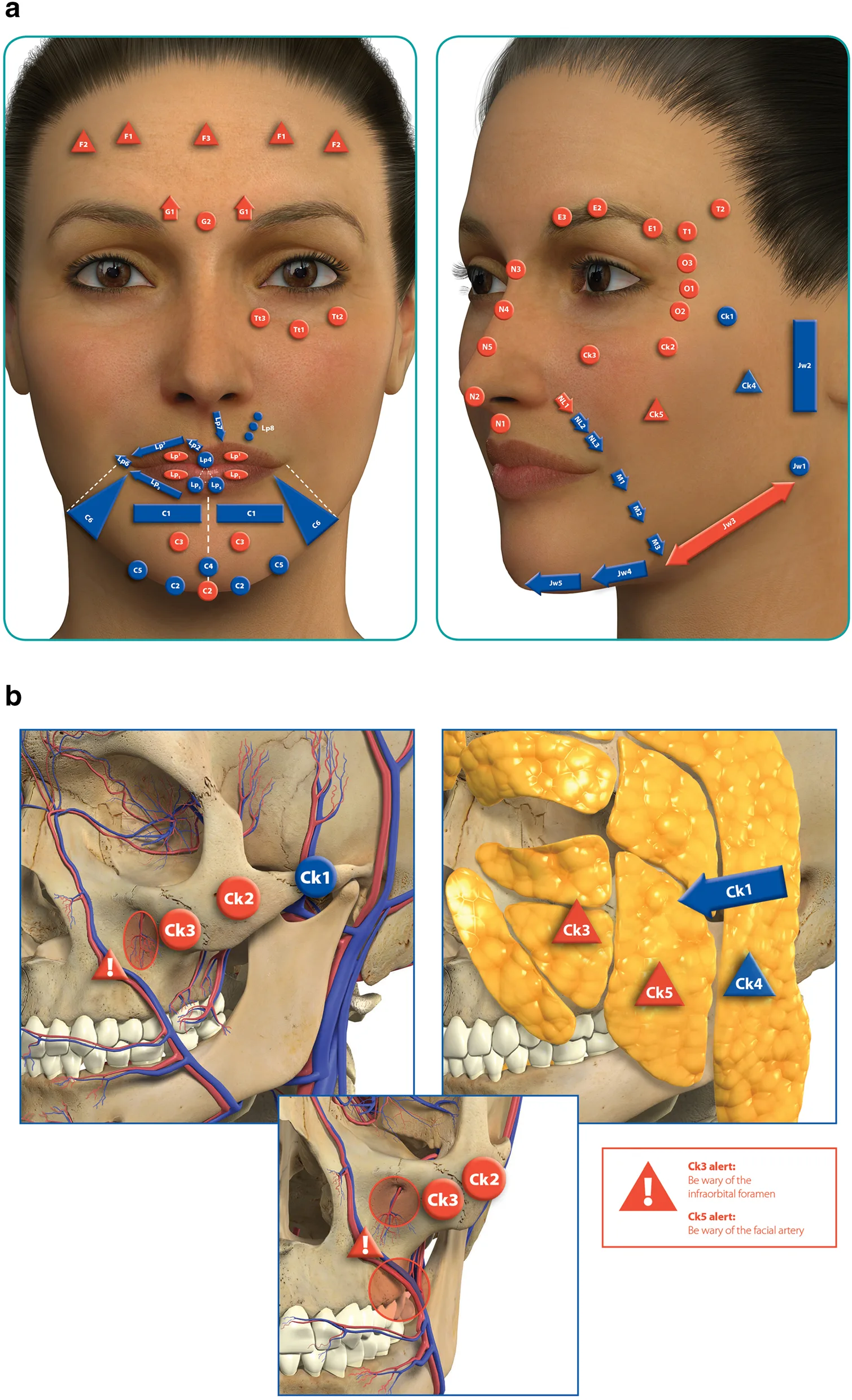 Fig 1. de Maio 2020 master map · the single authority for which label points where. Families visible: F1–F3, G1–G2 (glabella), Tt1–Tt3, N1–N5, E1–E3, T1–T2, O1–O3, Ck1–Ck5, NL1–NL3, Lp1–Lp8 (with superscript Lp⁽¹⁾ upper / subscript Lp₁ lower), M1–M3, C1–C6, Jw1–Jw5. Panel b marks the Ck3 (infraorbital foramen) and Ck5 (facial artery) alerts · (de Maio, 2020, Fig 1, p.4). · [1]
> Fuentes: de Maio · MD Codes: A Methodological Approach, Aesthet Plast Surg 2020 [1]
Fig 1. de Maio 2020 master map · the single authority for which label points where. Families visible: F1–F3, G1–G2 (glabella), Tt1–Tt3, N1–N5, E1–E3, T1–T2, O1–O3, Ck1–Ck5, NL1–NL3, Lp1–Lp8 (with superscript Lp⁽¹⁾ upper / subscript Lp₁ lower), M1–M3, C1–C6, Jw1–Jw5. Panel b marks the Ck3 (infraorbital foramen) and Ck5 (facial artery) alerts · (de Maio, 2020, Fig 1, p.4). · [1]
> Fuentes: de Maio · MD Codes: A Methodological Approach, Aesthet Plast Surg 2020 [1] [B][MEDLIB].
The master table. One row per family. The subunit column gives the label → anatomical site only; the plane, tool, volume and product for each are in the linked D-block, never here. ⚠ marks the codes de Maio colours red (vascular/neural alert) [1][2].
| Family | Region | Subunit code → anatomical site | ⚠ alert codes | → Destination D-block |
|---|---|---|---|---|
| F (3-pt forehead) | Forehead | F1 medial forehead · F2 lateral forehead · F3 central forehead |
· | D1 — Frente y glabela |
| G (glabella) | Glabella | G1 lateral glabella · G2 central glabella |
G1 G2 (angular a./v.; supratrochlear) |
D1 — Frente y glabela |
| E (eyebrow) | Brow / brow tail | E1·E2·E3 brow support subunits |
· | D2 — Ceja y cola de ceja |
| T (2-pt temple) | Temple | T1 superior/posterior temporal fossa · T2 anterior temple (lateral orbital rim) |
T1 T2 (deep temporal + superficial temporal systems) |
D3 — Sien |
| O (3-pt lateral periorbital) | Lateral orbit | O1·O2·O3 lateral canthal / lateral orbital rim |
O1–O3 (periorbital vessels) |
D4 — Periorbitario superior y párpado |
| Tt (3-pt tear trough) | Tear trough | Tt1 central infraorbital · Tt2 lateral infraorbital · Tt3 medial infraorbital |
Tt1–Tt3 (infraorbital artery branches) |
D5 — Surco lagrimal y ojera |
| N (nose) | Nose | N1–N5 dorsum / radix / tip / columella / lateral |
N1–N5 (dorsal nasal, columellar; retina-anastomosis territory) |
D8 — Nariz |
| Ck (5-pt cheek) | Cheek · malar half | Ck1 zygomatic arch · Ck2 zygomatic eminence |
· | D6 — Malar y pómulo |
| Ck (5-pt cheek) | Cheek · anteromedial/submalar half | Ck3 anteromedial cheek · Ck4 parotid / lateral-lower cheek · Ck5 submalar (⚠ "buccal" in the Cotofana rendering · C2.3) |
Ck3 (infraorbital foramen) · Ck5 (facial artery) |
D7 — Mejilla anteromedial y submalar |
| NL (3-pt nasolabial) | Nasolabial fold | NL1 upper NL fold · NL2 central NL fold · NL3 lower NL fold |
NL1–NL3 (facial artery, nasal-flare branches) |
D9 — Surco nasogeniano |
| Lp (8-pt lip) | Lip | Lp⁽¹⁾ upper vermilion body · Lp₁ lower vermilion body · Lp2 philtral columns / cupid's bow · Lp6/Lp⁽⁶⁾ oral commissures · Lp3·Lp5·Lp7·Lp8 white roll / tubercles |
Lp sites (superior + inferior labial arteries) |
D10 — Labio y perioral |
| M (3-pt marionette) | Marionette line | M1 upper marionette · M2 central marionette · M3 lower marionette |
M1–M3 (facial artery) |
D10 — Labio y perioral |
| C (6-pt chin) | Chin | C1 labiomental angle · C2 vertical height (pogonion) · C3·C4·C5 sub-symphyseal / lateral chin · C6 lateral chin / prejowl approach |
C lateral sites (mental foramen) |
D11 — Mentón |
| Jw (5-pt jawline) | Jawline / angle | Jw1 mandible angle · Jw2·Jw3 ramus / body · Jw4 prejowl · Jw5 anterior body |
Jw body (facial artery at antegonial notch) |
D12 — Línea mandibular y ángulo |
| L (8-pt lift) | Sequence overlay · not a region | L1(Ck1) L2(Ck2) L3(Ck3) L4(NL) L5(M) L6(C6,Jw4) L7(Jw1) L8(Ck4,Ck5) |
L3 L4 L8 red in Point Lift rendering |
cross-cuts D6·D7·D9·D10·D11·D12 |
Delivery-shape legend (the code's fifth element, kept here as vocabulary only) [1]: ▲ triangle / ● circle / ➤ arrow / ▬ rectangle on the master map encode needle vs cannula and bolus vs fanning vs aliquot. The specific tool per site is a D-block datum; C2 records only that the shape is the delivery grammar, so a reader meeting a shaped icon on a de Maio slide knows it is not decoration.
The cheek is the one family that splits across two D-blocks, so it is worth showing.
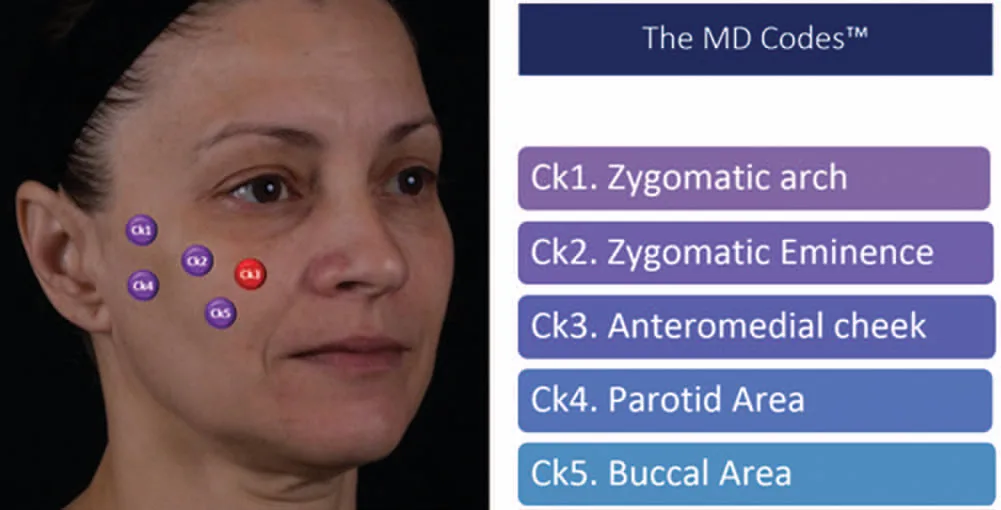 Fig 2. Cotofana 2015 renders
 Ck4 = "Parotid Area" and Ck5 = "Buccal Area"; de Maio 2017 writes Ck4 = lateral-lower-cheek/parotid and Ck5 = submalar. Same codes, different label wording · the collision decoded in C2.3. Ck3 carries the red alert dot in both. · (Cotofana, 2015, Fig 11, p.11). · [6]
> Fuentes: Cotofana · Midface Clinical Anatomy and Regional Approaches with Injectable Fillers, Plast Reconstr Surg 2015 [6] [B][MEDLIB].
Why the cheek splits D6/D7, and why the split is anatomical, not arbitrary [6][17][18]. Ck1 (zygomatic arch) and Ck2 (zygomatic eminence) are the malar skeleton / lateral SOOF codes · projection and lateral support · and route to the malar chapter (D6). Ck3 (anteromedial cheek, deep malar fat pad + medial SOOF), Ck4 (parotid/lateral-lower cheek, subcutaneous) and Ck5 (submalar) address the anteromedial and submalar soft-tissue compartments and route to D7. The dividing line is the fat-compartment anatomy that Wan and Stuzin describe [17][18]: the malar fat pad and the deep medial cheek fat are separate deflation domains, so their codes belong to separate regional chapters. Reuniting them under one "cheek" label is exactly the modality-dispersion the D-restructure removed.
Region-routing rationale for the remaining families (one line each; the full anatomy is in the D-block):
- F/G → D1. de Maio separates forehead (F) from glabella (G) in the 2020 table [1]; both are upper-central and share the supratrochlear/supraorbital and angular vessels, so they route together to D1. The layered forehead soft-tissue anatomy that justifies the plane is in [19].
- E → D2, T → D3, O → D4. Brow support (E), temple hollow (T) and lateral orbit (O) are three distinct upper-lateral regions; the temple carries its own six published injection techniques [15] and its own D-chapter.
- Tt → D5. Tear-trough codes are supraperiosteal cannula sites wary of the infraorbital artery [1]; they route to the dedicated tear-trough/dark-circle chapter.
- N → D8. The nasal codes exist on the 2020 map [1]; competing 4-point and dual-plane nasal schemes route to the same D8 (C2.3) [11][12].
- NL/Lp/M → D9/D10. Nasolabial (NL) has its own fold chapter (D9); lip (Lp) and marionette (M) share the perioral chapter (D10) because both sit in the labial-artery field mapped by Cotofana [14].
- C → D11, Jw → D12. Chin (C) and jawline (Jw) are separate lower-face regions; L6(C6,Jw4) and L7(Jw1) show why the 8-point-lift overlay has to reach into both (C2.3).
The small families, expanded once (the master map [1] carries them but they are easy to skip): N nose · N1–N5 run dorsum → radix → tip → columella → lateral wall (route D8; and see the competing 4-point/dual-plane nasal schemes, C2.3 [11][12]). O lateral orbit · O1–O3 sit on the lateral canthal / lateral orbital-rim arc between the brow tail and the temple (route D4). E eyebrow · brow-support subunits (E1–E3 on the 2020 map; "2-point" in the 2017 book · a version collision, C2.3) (route D2). T temple · T1 superior/posterior fossa, T2 anterior temple at the lateral orbital rim (route D3); the temple alone carries six distinct published injection techniques [15], which is why it earns its own chapter rather than a code footnote.
Codes that route to more than one block · the one-to-many list. Most codes route to exactly one D-block; three do not, and the index flags them so a reader does not look in the wrong chapter: (1) Ck1–Ck5 splits D6 (malar) / D7 (anteromedial + submalar) by fat-compartment domain [17][18]; (2) the L1–L8 overlay reaches D6, D7, D9, D10, D11 and D12 at once (it is a sequence, not a site · C2.3); (3) Lp + M share D10 because lip and marionette sit in the same labial-artery field [14]. Every other family is one code → one block.
The master table is the single authority; every other table in this chapter derives from it. The per-region subchapters (C2.4–C2.8), the cross-school crosswalk (Appendix A) and the alert catalog (Appendix B) all resolve back to the rows above: a region subchapter is this table sliced by region, the crosswalk is its left column mapped to other schools, and the alert catalog is its ⚠ column gathered and anchored. Owning the decode in one place is the whole point · if the zygomatic-eminence row said Ck2 here and something else in a D-block, the two would drift, which is exactly the failure the D-restructure removed. When they disagree, this table wins, and the disagreement is a bug to fix in the D-block, not a variant to preserve [1].
The treatment-selection algorithms, as routing metadata [1]. de Maio's methodology paper prints decision trees (Figure 2, opened during retrieval) that select which codes to use per complaint. The index does not reproduce the clinical thresholds (those are D-block), but it records the code sets each branch co-selects, because which codes occur together is nomenclature:
| Complaint | Branch | Code set selected |
|---|---|---|
| Saggy cheek | mild | Ck1 |
| Saggy cheek | + medial volume loss | Ck1 + Ck3 |
| Saggy cheek | + lateral volume loss | Ck1 + Ck4 |
| Saggy cheek | + projection loss | Ck1 + Ck2 |
| Saggy cheek | severe | Ck1 + Ck3 + Ck5 |
| Sunken temple | mild | T1 |
| Sunken temple | moderate | T1 + T2 |
| Sunken temple | skeletonized (fascia route) | T1/T2 |
| Tear trough | direct approach eligible | Tt1 + Tt2 + Tt3 |
| Tear trough | cheek-first indicated | treat Ck first |
| Eye bags | good lower-lid (snap test) | O1 + O2 + O3 |
| Eye bags | poor lid | avoid Tt; treat cheek/temple |
This is a routing table, not a dosing table: it records which codes a complaint co-selects, and sends the thresholds · how saggy is "severe", how to run the snap test · to the D-block. Reading it as a protocol would re-import the clinical judgement the index exists to keep in D.
Trampa clásica (C2.2): reading a volume off this table. There is none to read · the "active number per side" and the plane are in the D-block on purpose [1][2]. The failure signature is a note that quotes a millilitre "from the MD Codes table" · it was quoted from a product-bound source table [2] and carried across a rheology it was never generated on. Averaging two such numbers is prohibited by source policy; the table you want is the one in the destination D-block, matched to your product.
C2.3 · Ambiguities and collisions
The index is only useful if it survives the fact that the same site has several names and the same name has several meanings. Nine collisions, each with the rule that resolves it.
Why collisions are a safety problem, not a pedantry problem. Every collision below has the same failure mode: a code recorded in one system is acted on as if it were a different code, a different site, or a different procedure. L3 double-counted with Ck3 over-treats; Lp1 read for Lp⁽¹⁾ fills the wrong lip; a V1 chart merged with a Ck1 chart double-books the zygomatic arch; a bare E2 means one thing in the 2017 edition and another in 2020. Nomenclature drift is therefore a clinical hazard, and the index's job is to hold the names apart and map them explicitly, so that the one site a clinician means is the one site the next reader routes.
The decode order for any unknown token (the operational summary of the nine collisions below):
1. Letter+number in the published grammar (Ck2, Tt1, Jw4) → it is a site; route it via the master table (C2.2).
2. L1–L8 → translate through the 8-point-lift map (Collision 1) to its anatomy code, then route.
3. V1–V4 → a Juvéderm-Voluma product label for Ck1–Ck4/5 (Collision 7); translate to Ck, then route.
4. A suffix on a base code (Ck1 TML, Ck1r, Lp⁽¹⁾) → the base is the site, the suffix is a modifier (technique / side / upper–lower); route on the base, preserve the modifier.
5. A course token (Rz, "punto 3", "viaducto", a Método Cubo step, an MLT layer) → consult Appendix A: it may map to a site, or it may name a goal / layer / route with no single site, in which case record it as such and do not force a code.
6. No family letter matches and the region is the neck or décolleté → there is no code; route by region to D13/D14.
This order resolves every collision in this subchapter and is exactly the algorithm the machine-readable ontology proposed in Unexplored directions would encode.
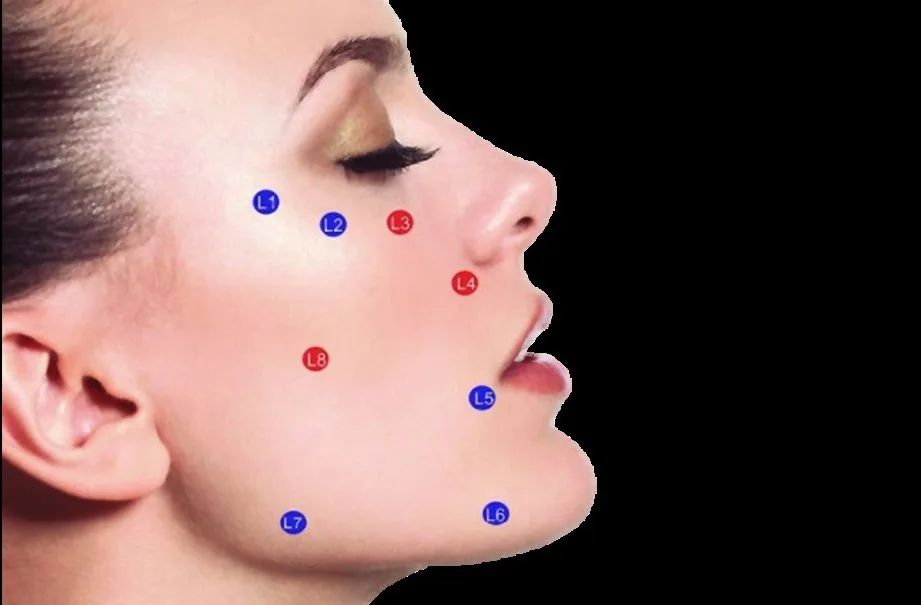 Fig 3. The
 L-sequence is a lift PROCEDURE drawn over the region map · L3, L4 and L8 are red alerts. It is the same face as Fig 1, re-labelled for one operation. · (Point Lift/Ay, corpus, p.5). · [3]
> Fuentes: Point Lift (8-point) [3] [D][MEDLIB]; de Maio · Unlocking the Code 2017 [2] [C][MEDLIB].
Collision 1 · the flagship: L1–L8 (sequence) and Ck/NL/M/C/Jw (anatomy) are the same eight sites. The 8-point lift is a procedural sequence, not a region; every L is an alias for an anatomy code [2][3]. Recording L3 and Ck3 as two separate treatments double-counts one injection.
| Lift code | = anatomy code(s) | Site | Effect (de Maio) |
|---|---|---|---|
L1 |
Ck1 |
zygomatic arch | lifts cheek, supports brow + lower lid |
L2 |
Ck2 |
zygomatic eminence | cheek projection, shortens palpebral-malar sulcus |
L3 ⚠ |
Ck3 |
anteromedial cheek | improves medial lid-cheek junction, softens tear trough |
L4 ⚠ |
NL |
nasolabial fold | reduces NL-fold prominence |
L5 |
M |
marionette / oral commissure | lifts commissure mucosa, softens marionette |
L6 |
C6, Jw4 |
prejowl sulcus | reduces prejowl prominence |
L7 |
Jw1 |
mandible angle | reshapes + lifts jawline |
L8 ⚠ |
Ck4, Ck5 |
parotid + submalar | restores submalar/preauricular volume, lifts jawline |
Rule: when a note uses L-codes, translate to anatomy codes before you route or audit · the destination D-blocks are D6/D7 (L1/L2/L3/L8), D9 (L4), D10 (L5), D11+D12 (L6/L7). The L-notation is also codified in de Maio's 8-point-lift patent [25], and it is re-used by an unrelated thread-lift protocol that borrows the same L1(Ck1)…L8(Ck4,Ck5) labels for suture entry points [3] · so L3 on a filler slide and L3 on a thread slide are the same site but a different procedure. Same label, two modalities.
Collision 2 · same code, different label wording across sources. Ck5 is "submalar" in de Maio's 2017 book [2] and "Buccal Area" in the peer-reviewed Cotofana rendering [6] (Fig 2); Ck4 is "lateral-lower cheek / parotid" vs "Parotid Area". The code is identical; the prose label drifted between the vendor book and the anatomy journal. Rule: the code is the invariant, the English gloss is not · never resolve a disagreement by averaging or by picking the prettier phrase; carry both labels and route on the code. (This is why the master table prints the code first and the words second.)
Collision 3 · version drift: the same family changed size between editions. The eyebrow family is "the 2-point eyebrow reshape" (E) in the 2017 book [2] but appears as E1·E2·E3 on the 2020 master map [1]; the glabella family (G1·G2) is present in the 2020 methodology table [1] and absent from the 2017 book's family list [2]. So a code index tied to one edition mis-numbers the other. Rule (already stated in C2.1): learn the site; the label is edition-dependent. A record that says only E2 without a source year is under-specified once two editions disagree on what E2 is.
Collision 4 · competing schools: the "same region" carries different names because the systems name different things. The wiki-tracked UPO master course teaches parallel systems and does not name the de Maio MD Codes; MD Codes live in the fillers literature [1][2], the schools live in the course decks. The decisive point for an index: these systems are not synonyms on one axis · some name sites, some name goals, some name layers.
| System | What it names (axis) | Example tokens | Maps onto MD Codes? |
|---|---|---|---|
| de Maio MD Codes [1][2] | sites (letter+number) | Ck1, Tt2, Jw1 |
is the site grammar |
| Amselem · RFI / Revitalización Facial 360 [4] | goals + numbered cannula ports | RFI = Σ Rx1 + Rx2 + Ry + Rz; "Punto 1/2/3" |
partial: Rz (projection) ≈ Ck2; Rx1 (fill) ≈ region-agnostic |
| Erian · midface B/M/S points [9] | three suspension points | B (Bichat fat), M (malar fat pad), S (SOOF) |
M≈Ck3 domain; S≈lateral-SOOF via Ck1/Ck2 |
| Rosso · MLT 3.1 (Multilayering) [5] | anatomical layers from one entry | structural support / dynamic volumizing / redensification | orthogonal: names depth, not site |
| Lobo · Método Cubo [8] | 6-step lifting sequence + support points | malar-medial + zygomatic-eminence support | support points ≈ Ck3/Ck2 |
| Beut / Surek · midface viaducts / ports | entry corridors | "viaducto", "port" | route, not target · a cannula path to a site |
| Kim · thread-lift naming [10] | thread techniques | angle / L-shape / anchoring | names a suture geometry, not a filler site |
Rule: before mapping "the same region" across two schools, ask which axis each names. Ck2 (a site) and Rz (a goal, "devolver luz" / restore projection) can align at the zygomatic eminence, but Rx1 (a filling goal) and MLT's "structural support" (a layer) have no single site to map to · forcing them onto one code invents a correspondence that is not there. The index records the alignments that hold and marks the rest as non-mappable, rather than faking a one-to-one table.
Collision 5 · the trademark and its aliases: which "codes" someone means. Three names circulate and they are not interchangeable:
| Name you hear | What it actually is |
|---|---|
| MD Codes™ | de Maio's trademarked site grammar [1][2] |
| "Allergan MD Codes" | the same grammar, promoted through the Allergan Medical Institute (AMI), commercially bound to the Juvéderm VYCROSS range · Voluma / Volift / Volbella [1][2] |
| generic "medical codes" | de Maio's own expansion of the acronym in the 2020 paper [1] · not a separate system |
The vendor binding is on the record: the 2017 book carries the Allergan document code ALMD12057W and reproduces its figures "with permission from Allergan plc, Dublin, Ireland" [2], and de Maio discloses the AMI educational relationship in the peer-reviewed paper [1]. Rule for the index: treat MD Codes as [C]/[D] expert methodology with a declared commercial tie, not as [A]/[B] evidence · the site grammar is useful and reproducible, the product/volume half (kept in D) is the part where the conflict of interest bites. Flag it wherever a volume is quoted "per the MD Codes".
Collision 6 · the nose has three naming schemes for one region. de Maio's N1–N5 [1] is not the only nasal nomenclature in the corpus: the 4-point non-surgical rhinoplasty ("Rino 4 Puntos") names four sites [12], and the dual-plane technique names planes rather than points [11]. All three route to the same chapter (D8); the index records that N-codes, "4 puntos" and "dual plane" are three descriptions of non-surgical rhinoplasty, so a note in any of the three can be found. Rule: the nose is the region where "which system?" must be written next to the code, because the schemes disagree on how many points there are.
Collision 7 · product-specific re-coding: the Voluma V-codes. In the peer-reviewed midface source, the cheek codes carry a second, product-specific label for Juvéderm Voluma: Ck1 = V1, Ck2 = V2, Ck3 = V3, and Ck4/Ck5 = V4 [6]. A Voluma-branded chart may therefore write V1–V4 for the exact sites the general system writes Ck1–Ck5. Rule: the V-codes are a product overlay on the Ck anatomy, not a different map; translate V→Ck before routing, exactly as with L→Ck. This is the clearest case of the vendor tie reaching into the nomenclature itself: the code and the product name fuse.
Collision 8 · the TML sub-variant of Ck1. de Maio's Table 3 lists Ck1 twice: the standard supraperiosteal-needle Ck1, and Ck1 TML ("top-model look"), a sub-SMAS cannula variant that creates a linear zygomatic-arch highlight [1]. The anatomical site is identical; TML names an approach and aesthetic goal layered on the code, and the case studies show Ck1 (TML) injected with a cannula for a linear arch look [1]. Rule: Ck1 and Ck1 TML route to the same region (D6); the TML suffix is a technique/goal marker, and the plane difference it implies (supraperiosteal vs sub-SMAS) is a D6 datum, not an index distinction · but the two must not be recorded as two different sites.
Collision 9 · the same code, two severity routes. de Maio's own table lists NL1 (and several others) more than once, with a bone-deficiency route and a mild/moderate route for the identical code [1]. So NL1 is not fully specified by its label: the same code carries a severity branch that changes the approach. Rule: a code with a documented severity split (NL1) is under-specified in a note without the severity context; the branch is a D-block datum, and the index flags that the code is severity-dependent so no one reads a bare NL1 as a single fixed instruction.
Trampa clásica (C2.3): collapsing two names into one number and losing the disagreement. The failure signature is a merged note · Ck5 (=buccal=submalar=L8=Punto 3) written as if all five were the same decision · which erases the very distinctions (site vs goal vs layer, edition A vs B, filler vs thread) that the next reader needs. The index keeps the names apart and maps them explicitly; it never dissolves them into a single token [1][2][3][4].
C2.4 · Periorbital and tear-trough family index (Tt, O) → D4, D5
The two periorbital families and where each routes. This is the region with the highest late-dissatisfaction rate of the whole face, so the index is explicit about which code names which structure and which chapter holds the exclusion criteria. (This subchapter also carries the retired legacy C2.4 "tear-trough codes"; recorded as old C2.4 → Tt/O families → D5/D4.)
| Code | Anatomical subunit (the label only) | ⚠ alert territory | Routes to |
|---|---|---|---|
Tt1 |
central infraorbital (tear trough) | infraorbital artery branches | D5 — Surco lagrimal y ojera |
Tt2 |
lateral infraorbital | infraorbital artery | D5 |
Tt3 |
medial infraorbital | angular vessels | D5 |
O1 |
superolateral orbital rim / lateral canthus | periorbital vessels | D4 — Periorbitario superior y párpado |
O2 |
lateral orbital rim (mid) | periorbital vessels | D4 |
O3 |
inferolateral orbital rim | periorbital vessels | D4 |
Routing rule that resolves most bad outcomes here. The tear trough is corrected from the cheek: Ck3 foundation before any Tt code. The retired C2.4 quantified this · roughly 80 % of poor tear-trough results are the shadow of absent midface support rather than a local defect · and de Maio states the same, that isolated tear-trough treatment is not ideal and may lead to dissatisfaction [1]. That magnitude and the exclusion criteria (herniated orbital fat, malar festoons, poor lymphatic drainage) are relocated to D5, not re-taught here; the index keeps only the routing consequence: Ck3 before Tt, and O is not a substitute for Tt.
de Maio's periorbital decision routing (Figure 2 of the methodology paper, opened during retrieval) branches the eye-bag pathway on a lower-lid snap test to either O1 + O2 + O3 (good lid position) or Tt1 + Tt2 + Tt3 (and "avoid Tt" when the snap test is poor) [1]. The index records that both code sets exist for the periorbital and that the choice between them is a D4/D5 decision, never an index one.
Competing periorbital nomenclatures for the same region. The Tt/O codes are not the only way this region is named:
| System | Names the periorbital as | Maps onto |
|---|---|---|
de Maio Tt / O [1] |
infraorbital + lateral-orbital subunits | the index grammar |
| Fakih-Gomez sunken-eye treatment-oriented classification [22] | severity classes driving technique choice | a classification layered over Tt, indexed to D5 |
| Infraorbital-hollow neuromodulator approach [26] | a non-filler route to the same hollow | an alternative modality, indexed to D4/D5 |
Grammar note. Tt subunit numbering is foundation-order, not a left-to-right map: Tt1 central, Tt2 lateral, Tt3 medial · the numbers do not increase across the face. A note that lists Tt1→Tt3 describes a treatment order, not a spatial sweep.
Why the O codes and the Tt codes are not interchangeable, in index terms. Both address the lower-lid/orbital region, but they name different structures and route to different chapters, and the disagreement is clinically load-bearing: Tt1–Tt3 name the infraorbital hollow (the tear trough proper), routing to D5 with its exclusion criteria; O1–O3 name the lateral orbital rim / canthal support, routing to D4. de Maio's eye-bag algorithm branches to one or the other on the snap test, and explicitly instructs "avoid Tt" when the lower lid is lax [1]. An index that let O and Tt collapse into "the eye codes" would hide the single most consequential periorbital decision · whether the lid can tolerate an infraorbital deposit at all · so the two families are kept separate here and their choice is sent to D4/D5.
The exclusion pointer the index must carry without the payload. The periorbital is the region where most patients who ask for it are not candidates: herniated orbital fat, malar festoons or pre-existing malar oedema, poor lymphatic drainage, very thin skin with visible vessels, and lid laxity on the pinch/snap test all convert a Tt deposit into a worse result [1]. The index does not hold those criteria (they are D5), but it holds the pointer to them: a Tt code is never a routine fill, and the routing sends every Tt note to D5 before a needle is planned. This is why the periorbital, despite holding only six codes, gets its own index subchapter · the routing carries more weight per code than anywhere else on the face.
Non-filler routes to the same hollow. The infraorbital hollow is also addressed by neuromodulators (reducing the pretarsal/orbicularis contribution) rather than filler [26], and by the treatment-oriented sunken-eye classifications that pick technique by severity class [22]. The index records that these are alternative modalities for the same target, so a note that says "infraorbital hollow, neuromodulator" is filed against the same region as a Tt code, and the reader is routed to D4/D5 to choose between them rather than defaulting to filler.
Trampa clásica (C2.4): routing a Tt code before the Ck3 foundation is resolved. The failure signature is a periorbital note with Tt1 · Tt2 · Tt3 and no cheek code · the shadow was treated, not its cause. The index puts Ck3 one row above Tt in the master table precisely so this ordering is visible at a glance [1][6].
C2.5 · Perioral family index (Lp, M, NL) → D9, D10
The perioral is where reading the grammar wrong changes the site, so the index gives the lip its own subchapter. Three families sit here: the 8-point lip (Lp), the 3-point marionette (M), and the 3-point nasolabial (NL). (Carries the retired legacy C2.5 "perioral codes"; recorded as old C2.5 → Lp + M + NL → D10/D9.)
| Code | Anatomical subunit (label only) | ⚠ alert territory | Routes to |
|---|---|---|---|
Lp⁽¹⁾ |
vermilion body, upper lip | superior labial artery | D10 — Labio y perioral |
Lp₁ |
vermilion body, lower lip | inferior labial artery | D10 |
Lp2 |
philtral columns / cupid's bow | superior labial artery | D10 |
Lp6 / Lp⁽⁶⁾ |
oral commissures | facial/labial arterial junction | D10 |
Lp3 Lp5 Lp7 Lp8 |
further 8-point-lip subunits (white roll, tubercles); precise assignment in D10 [2] | labial arteries | D10 |
M1 |
upper marionette line | facial artery | D10 |
M2 |
central marionette | facial artery | D10 |
M3 |
lower marionette | facial artery | D10 |
NL1 |
upper nasolabial fold | facial artery, nasal-flare branches | D9 — Surco nasogeniano |
NL2 |
central nasolabial fold | facial artery | D9 |
NL3 |
lower nasolabial fold | facial artery | D9 |
The labial grammar, the single most-misread element in the whole system [1]. The lip is the one family that uses superscript and subscript: Lp⁽¹⁾ (upper) and Lp₁ (lower) are the vermilion bodies of different lips, and Lp⁽⁶⁾/Lp6 the commissures. A slide that flattens the case to Lp1 is ambiguous and must be resolved against the source table, not guessed. This is why the index prints the superscript/subscript form and refuses to normalise it away.
Why Lp and M share D10 but NL gets D9. Lip and marionette sit in the same superior/inferior labial-artery field that governs the alert coding for the perioral, so they route together [1][14]; Cotofana's intralabial-compartment work is the anatomical basis a D10 reader needs for the plane decision [27]. The nasolabial fold is a distinct anatomical crease with its own chapter (D9), even though L4(NL) drags it into the 8-point-lift sequence (C2.3).
Cross-school names for the perioral region.
| System | Names the perioral as | Maps onto |
|---|---|---|
de Maio Lp / M / NL [1] |
lip / marionette / nasolabial subunits | the index grammar |
| Lobo Método Cubo [8] | a 6-step lifting sequence touching the perioral | support points ≈ commissure/marionette region, not a 1:1 code |
| Kim thread-lift naming [10] | marionette "angle" / "L-shape" techniques | names a suture geometry at M, not a filler site |
NL severity grammar. de Maio's table splits NL1 by severity · the same code (NL1, upper nasolabial fold) is listed with a bone-deficiency route and a mild/moderate route, so NL1 alone is under-specified without the severity context that lives in D9 [1]. The index records that NL1 is severity-dependent; the branch is a D9 datum.
The lip is the one family where the grammar carries the whole meaning. Every other family numbers its subunits in a single dimension; the lip alone uses superscript for the upper lip and subscript for the lower, so the case of the number is not decoration but the site itself. Lp⁽¹⁾ (upper vermilion body) and Lp₁ (lower vermilion body) are treated with different intentions · the upper for the cupid's-bow show, the lower for pout and support · and a chart that renders both as Lp1 has lost the single fact that distinguishes them. The index therefore stores the lip code in its full super/subscript form and treats a bare Lp1 as an incomplete record to be resolved against the source table, never guessed [1].
Intralabial compartments as the routing basis. The reason Lp, M and (partly) NL cluster into the perioral is that they share the superior and inferior labial arteries, whose course and the intralabial fat compartments Cotofana mapped · the anatomy a D10 reader needs to choose a plane and a depth [14][27]. The index records only that the whole perioral is a single arterial field (hence the shared alert coding and the shared D10 destination for Lp/M), and sends the compartment-level plane decision to D10. The oral commissure (Lp6/Lp⁽⁶⁾) sits at the junction of the labial and facial arterial systems, which is why it carries its own alert and is the perioral site most often mis-recorded.
Why the perioral resists the checklist better than the cheek. A cheek note can list Ck1→Ck5 and look plausible; a lip note that lists Lp⁽¹⁾ Lp₁ Lp2 Lp6 Lp3 Lp5 Lp7 Lp8 is self-evidently an over-treatment plan, because the lip cannot absorb eight subunits of product without distortion. The index's contribution here is the same as everywhere · it names each site once and routes the volume decision out · but the perioral is where the "a code is a hypothesis, not a checkbox" rule is most visibly true at a glance.
Trampa clásica (C2.5): recording Lp1 when the source meant Lp⁽¹⁾. The failure signature is an upper-lip volume note that reads as a lower-lip instruction (or vice versa) because a slide dropped the superscript. The index's defence is to never store a bare Lp1: the case (upper vs lower) is part of the code, not decoration [1].
C2.6 · Chin and jawline family index (C, Jw) → D11, D12
The lower face carries two families and the deepest reach of the 8-point-lift overlay, so the index keeps chin (C) and jawline (Jw) as separate regions with a shared boundary. (Carries the retired legacy C2.6 "chin and jawline codes"; recorded as old C2.6 → C → D11, Jw → D12.)
| Code | Anatomical subunit (label only) | ⚠ alert territory | Routes to |
|---|---|---|---|
C1 |
labiomental angle | · | D11 — Mentón |
C2 |
chin apex / vertical height (pogonion) | midline neurovasculature | D11 |
C3 |
anterior chin | mental artery (do not go lateral) | D11 |
C4 |
anterior chin / soft-tissue pogonion | midline | D11 |
C5 |
lateral chin | mental foramen | D11 |
C6 |
lateral chin / prejowl approach | mental foramen | D11 |
Jw1 |
mandible angle | · | D12 — Línea mandibular y ángulo |
Jw2 Jw3 |
ramus / posterior body | facial artery near masseter | D12 |
Jw4 |
prejowl sulcus | facial artery (antegonial notch) | D12 |
Jw5 |
anterior mandibular body | facial artery | D12 |
The chin subunit numbering is a build order, not a spatial line [1][2]. C1 labiomental angle → C2 vertical height → C3/C4 anterior projection → C5/C6 lateral/prejowl: the numbers follow de Maio's foundation-to-refinement order for the chin, so C1→C6 reads as a sequence of intentions, not a left-to-right sweep. A note that lists all six is either a complex reconstruction or a checklist; the index cannot tell which, which is why it routes the count to D11 for the clinical judgement.
Why the lower face cannot be one code block. The 8-point-lift overlay reaches into both families at once · L6(C6, Jw4) and L7(Jw1) · so a single "lower face" chapter would have to own a sequence that belongs to a lift, not a region [1][2]. Keeping chin (D11) and jawline (D12) separate, with the L overlay flagged in C2.3, is what stops the sequence and the anatomy from being conflated.
Alert-anatomy basis for the jawline codes. The Jw body codes are red because the facial artery crosses the inferior mandibular border at the antegonial notch, palpable at the anterior masseter edge, and the mental foramen/artery sits under the lateral chin codes [13]. The index carries only the flag; the palpation manoeuvre and the plane are D12/D11 data. This is the region most often mis-sold as "low risk", which is exactly why the alert flag rides on the code itself.
Cross-school names for the lower face.
| System | Names the lower face as | Maps onto |
|---|---|---|
de Maio C / Jw [1] |
chin + jawline subunits | the index grammar |
8-point lift L6 / L7 [2][3] |
prejowl + mandible-angle steps of a lift | L6=C6/Jw4, L7=Jw1 · same sites, sequence name |
| Rosso MLT lower-face layering [5] | structural / dynamic / redensifying layers at the jawline | orthogonal: names depth, not the Jw site |
| Lifting vs volumizing framing [20] | a philosophy that sits above code selection | index-neutral: a "lifter" and a "volumizer" route the same Jw code to D12 |
Grammar note · the prejowl is named twice. The prejowl sulcus is C6 in the chin family, Jw4 in the jawline family, and L6 in the lift overlay · three labels for one depression. The index records all three and routes on the anatomical target (prejowl → D12 for the jawline decision, cross-referenced from D11), rather than letting the reader pick a chapter by which code their course happened to teach.
The routing decision the lower face forces: retrogenia versus jowl. The index cannot tell whether a chin note means "project a deficient chin" or "restore a jawline collapsing into a jowl", but it can route the two to different reasoning: C1/C2 (labiomental angle, vertical height) address chin position and projection → D11; Jw4/C6 (prejowl) and Jw1 (angle) address the jawline contour and its jowl shadow → D12. de Maio's own lower-face contour sequence in the case studies runs C1 → C2 → Jw4 → Jw5 then reinforces with C6 and Jw1 [1], which is why the index keeps the chin and jawline codes adjacent but chapter-separate: they co-occur in one session yet answer different questions, and projecting a chin that only needed a jawline (or the reverse) is the classic lower-face error the D-blocks are built to prevent.
Why the gonial angle is the code that structures everything else. In the sequence logic the mandible-angle code (Jw1 / L7) is treated before the prejowl, because a defined posterior angle reduces how much the anterior prejowl needs [1][2] · a posterior-to-anterior order the index records as the Jw1-before-Jw4 adjacency, sending the why and the how much to D12. This is the region where the highest aesthetic yield per millilitre is claimed for the male profile and the retrogenic female profile, and also the region least often offered because the patient does not name it · an index consequence, since the codes exist whether or not the patient asks for the region.
Trampa clásica (C2.6): treating the mandible as a low-risk zone because it "is just bone contouring". The failure signature is a Jw body code recorded without the facial-artery flag having been read · the palpable pulse at the antegonial notch was skipped. The index puts the ⚠ on Jw2–Jw5 so the flag travels with the code into D12, where the avoidance manoeuvre lives [1][13].
C2.7 · Upper-face family index (F, G, E, T) → D1, D2, D3
The upper face holds four families and the chapter's clearest version drift, so the index keeps forehead (F), glabella (G), eyebrow (E) and temple (T) distinct and flags where the editions disagree. (Carries the retired legacy C2.7 "forehead and brow codes"; recorded as old C2.7 → F+G → D1, E → D2, T → D3.)
| Code | Anatomical subunit (label only) | ⚠ alert territory | Routes to |
|---|---|---|---|
F1 |
medial forehead | · | D1 — Frente y glabela |
F2 |
lateral forehead | superficial temporal branches | D1 |
F3 |
central forehead | · | D1 |
G1 |
lateral glabella | angular artery & vein | D1 |
G2 |
central glabella | supratrochlear arteries (midline) | D1 |
E1 E2 E3 |
brow-support subunits (2020 map; "2-point" in 2017) | supraorbital / supratrochlear | D2 — Ceja y cola de ceja |
T1 |
anterior temple | superficial frontal + deep temporal arteries | D3 — Sien |
T2 |
posterior temple | superficial + deep temporal arteries | D3 |
T1/T2 |
anterior + posterior temple, temporal fascia route | temporal vessels + sentinel/middle temporal vein | D3 |
The version-drift collision, in full [1][2]. The upper face is where the 2017 book and the 2020 paper disagree on how many codes a family has: eyebrow is "the 2-point eyebrow reshape" in the book but E1·E2·E3 on the 2020 master map; glabella (G1·G2) is a 2020 addition, absent from the 2017 family list where forehead codes did the glabellar work. An index tied to one edition therefore mis-numbers the other. The rule from C2.1 applies most sharply here: learn the site, not the label, and record the source edition next to any E/G code, because E2 is under-specified once two editions disagree on whether the family has two members or three.
Alert-anatomy basis for the upper face. These families concentrate the retina-anastomosis danger: G1/G2 sit over the angular and supratrochlear vessels [1]; the forehead codes ride the layered soft tissue whose plane is the whole safety question [19], and the frontalis line of convergence governs where the muscle pulls product [16]; the temple carries six distinct published injection techniques and its own middle-temporal-vein hazard, which is why it earns a standalone chapter (D3) rather than a code footnote [15]. Glabellar neuromodulator interplay · an alternative modality for the same region · is indexed to D1 [28]. The index carries the flags; every avoidance manoeuvre is a D-block datum.
Cross-school names for the upper face.
| System | Names the upper face as | Maps onto |
|---|---|---|
de Maio F / G / E / T [1][2] |
forehead / glabella / brow / temple subunits | the index grammar |
| Beut / Surek temple viaducts | entry corridors to the temporal fossa | a cannula route to T, not a target |
| Chemical brow-lift (neuromodulator) philosophy | brow elevation without volume | a non-filler route to the E goal, indexed to D2 |
Amselem RFI Rz (projection / "devolver luz") [4] |
a light-restoring goal | partially aligns to temple/brow support, not a single code |
Grammar note · the temple's third code is a technique, not a site. T1/T2 (temporal-fascia route) is a combined code that names an approach across both temple subunits, not a distinct anatomical point [1]. The index records it as a route-level code so a reader does not hunt for a separate "T3" that the system never defined.
The upper face is the region where the answer is most often not a filler code at all, and the index has to route that too. A request that presents as "lift the brow tail" is, in the majority of cases, first a neuromodulator decision (a chemical brow lift weakening the lateral orbicularis and the depressors) and only then, if at all, an E/T support code [1]; a heavy forehead is often laxity for energy or threads before it is an F code. The index cannot make that call, but it records that the E, F, G and T families have non-filler alternatives for the same goal and routes the decision to D1/D2/D3 rather than letting a filler code be selected by default. This is the region where treating the code as a menu does the most harm, because the forehead and glabella concentrate the published blindness reports and the "correct" first move is frequently no filler.
Temple and glabella as the two upper-face hazard poles. The temple (T) and the glabella (G) sit at opposite ends of the upper face and share the property of being high-risk per unit volume: the temple through the deep and superficial temporal systems and the valveless middle temporal vein [1][15], the glabella through the angular and supratrochlear route into the ophthalmic circulation [1][28]. The index flags both families red and routes them to their chapters (D3, D1) with the vascular map; it never lets a T or G code be recorded as a routine contour point, because the alert is the most load-bearing fact those codes carry.
Trampa clásica (C2.7): recording E2 or a glabella code without its source edition. The failure signature is a brow note that a colleague on the other edition mis-reads, because "the 2-point eyebrow" and the 3-point E1·E2·E3 map the brow differently. The index's defence is the edition field: an E/G code without a year is incomplete once the two editions are both in circulation [1][2].
C2.8 · Nose family index and the volume/product boundary (N) → D8
This subchapter holds the one family the master map added quietly · the nose · and the boundary that defines the whole index: why no millilitre lives here. (Carries the retired legacy C2.8 "volume and product selection per code", now expressed as a boundary rather than a table.)
| Code | Anatomical subunit (label only) | ⚠ alert territory | Routes to |
|---|---|---|---|
N1 |
radix / upper dorsum | dorsal nasal artery | D8 — Nariz |
N2 |
mid dorsum | dorsal nasal artery | D8 |
N3 |
supratip / lower dorsum | dorsal nasal artery, retina-anastomosis territory | D8 |
N4 |
tip | columellar / lateral nasal branches | D8 |
N5 |
columella / base | columellar artery | D8 |
The nose has three naming schemes for one region, so "which system?" must be written next to the code. de Maio's N1–N5 is only one of them: the 4-point non-surgical rhinoplasty ("Rino 4 Puntos") names four sites [12], and the dual-plane technique names planes rather than points [11]. All three route to D8. The index records that N-codes, "4 puntos" and "dual plane" are three descriptions of non-surgical rhinoplasty so a note in any of them is findable, and that the nose is the region where the schemes disagree on how many points there are · a disagreement the index preserves rather than resolving.
| Nose system | Names it as | Points | Maps onto |
|---|---|---|---|
de Maio N [1] |
dorsum/radix/tip/columella subunits | 5 | the index grammar |
| Rino 4 Puntos [12] | four strategic sites | 4 | overlapping sites, different count → route to D8 with the system named |
| Dual-plane [11] | anatomical planes, not points | · | orthogonal: names depth, indexed to D8 |
The volume/product boundary · the sharpest statement of what an index is. The retired C2.8 was a table of millilitres and products per code. It is deliberately absent here, for four reasons that together define the C2/D split:
- Product-bound origin. The published numbers were generated on a single manufacturer's range (Juvéderm Voluma/Volift/Volbella, VYCROSS) [1][2]; the same code delivered with a different rheology is a different treatment. Hybrid and calcium-hydroxylapatite/HA techniques exist for the same sites and carry their own volume logic [31][32], so a single per-code millilitre is not portable.
- Averaging is prohibited. Source policy forbids averaging ranges across sources, and a "mean" millilitre per code would be exactly that.
- Checklist hazard. A per-code millilitre table behaves as a billing checklist · the overtreatment engine named in C2.1.
- Rheology is not a property of the code. Which product matches a code depends on the mechanical demand of the site (structural support vs contour vs mucosal), a decision that belongs with the fat-compartment and biomechanical anatomy of the region [30][29], not with the label.
That payload therefore lives in each destination D-block, matched to the product in use, and in the filler comparison map A6 — Mapa comparativo de rellenos y equivalencia entre marcas. The index keeps only the property-not-brand pointer: a code names a mechanical demand (support / volume / contour / mucosa); the product that meets it is chosen in D against the compartment anatomy, and the millilitre is decided per patient. Recorded as: old C2.8 → no volume table; volume/product → D-blocks + A6.
The nose is the highest-risk-per-millilitre region on the face, and the index routes accordingly. The dorsal nasal artery, the columellar branches and the dense anastomosis with the ophthalmic circulation make N1–N3 (radix/dorsum/supratip) codes where a wrong plane can reach the retinal circulation, and the published blindness reports concentrate here with the glabella [1]. The three naming schemes make it worse: a N-code chart, a 4-point chart and a dual-plane note describe the same dangerous region at different granularity [11][12], so a clinician reconciling two of them must translate before acting. The index's rule for the nose is therefore stricter than elsewhere · write the system name next to the code, translate to a site, and route every nasal note to D8 where the vascular map and the retrobulbar-emergency response live. There is no low-risk nasal code, which is why the index flags the whole family red.
Why "no volume table" is the load-bearing design choice of the whole chapter. Everything else in C2 · the master table, the crosswalk, the alert catalog · could in principle coexist with a per-code millilitre column. The decision not to print one is what makes C2 an index rather than a compressed protocol. A protocol tells you what to do; an index tells you where the instruction lives. By holding the site and the routing and refusing the dose, C2 guarantees that the clinical instruction has exactly one home (the D-block, matched to the product in use), and that the number a clinician acts on is never a stale copy carried across a rheology it was never generated on. The absence is the feature [1][2].
Trampa clásica (C2.8): quoting "the MD Codes volume" for a code injected with a non-Juvéderm product. The failure signature is a millilitre carried across a rheology it was never generated on · the number travelled and the mechanics did not. The index's defence is to hold no millilitre at all, so there is nothing here to mis-transfer [1][2].
Appendix A · Complete cross-school crosswalk
The full version of the C2.3 axis table: for every school taught alongside the MD Codes, what it names, in what tokens, and how it maps onto the code grammar. The recurring lesson is that most "competing systems" are not synonyms on one axis · they name sites, goals, layers, routes or geometries, so a region-by-region crosswalk is only partially possible and the non-mappable cells are declared, not forced.
| Region / target | de Maio MD Code (site) | Amselem RFI (goal) [4] | Erian midface (point) [9] | Beut / Surek (route) | Rosso MLT (layer) [5] | Lobo Método Cubo (step) [8] |
|---|---|---|---|---|---|---|
| Lateral cheek support | Ck1 (L1) |
· | · | lateral viaduct | structural | support point |
| Malar projection | Ck2 (L2) |
Rz (projection / "devolver luz") |
· | · | structural | zygomatic-eminence support |
| Anteromedial cheek | Ck3 (L3) |
Rx1 (fill) |
M (malar fat pad) |
medial viaduct | dynamic | malar-medial support |
| SOOF / deep support | via Ck1/Ck2 |
· | S (SOOF) |
· | structural | · |
| Deep buccal / Bichat | · | · | B (Bichat fat pad) |
· | · | · |
| Submalar | Ck4 / Ck5 (L8) |
Rx1 |
· | · | dynamic | · |
| Temple | T1 / T2 |
· | · | temple viaduct/port | · | Strap-up temporal |
| Tear trough | Tt1–Tt3 |
Rz (light) |
· | · | redensify | · |
| Nasolabial | NL (L4) |
· | · | · | dynamic | · |
| Lip / mucosa | Lp |
· | · | · | redensify | · |
| Marionette | M (L5) |
· | · | · | dynamic | thread angle/L-shape [10] |
| Chin | C1–C6 |
· | · | · | structural | · |
| Jawline angle | Jw1 (L7) |
· | · | · | structural | · |
| Prejowl | C6/Jw4 (L6) |
· | · | · | dynamic | · |
| Nose | N1–N5 |
· | · | · | · | Strap-up nose |
| Forehead / glabella | F / G |
· | · | · | · | · |
| Skin quality / regeneration | not a code (other family) | Rx2 (hydro-repair) |
· | · | redensify (Redensity) | · |
Reading the matrix. Four things fall out of it that the index enforces:
- Amselem RFI is a goal system, not a site system [4].
RFI = Σ Rx1 + Rx2 + Ry + Rzdecomposes a treatment into fill (Rx1), regeneration/hydro-repair (Rx2), lifting (Ry) and projection (Rz). OnlyRz(projection, "devolver luz") aligns to a single MD Code site (Ck2);Rx1(fill) andRx2(regeneration) are region-agnostic goals with no one code, andRx2maps to a different therapeutic family (biostimulators/skin quality), not to a filler code at all. Amselem also uses numbered cannula entry ports ("Punto 1/2/3"), which are routes, not targets. - Erian's B/M/S is midface-only [9]: three named suspension points · Bichat's fat pad (
B), malar fat pad (M), sub-orbicularis oculi fat (S) · that map to the deep-support intention behindCk1–Ck3, and say nothing about the lower or upper face. - Rosso's MLT names depth, not place [5]: structural support → dynamic volumizing → redensification is a three-layer approach from one entry point, orthogonal to any site code; its
Redensity/skin-quality layer, like Amselem'sRx2, is a different family from the site codes. -
Beut/Surek viaducts and Lobo's Método Cubo Strap-up are routes and sequences · a "viaducto" is a cannula corridor to a site and Método Cubo's steps are a lifting order, so neither is a synonym for a code; they are how you reach or sequence the sites the codes name.
-
The crosswalk is directional, and the index uses the MD Code as the pivot. Translating into MD Codes from another school is often possible — a viaduct leads to a site,
Rzis projection atCk2, Erian'sM-point sits in theCk3domain — because those tokens ultimately point at a place. Translating out of MD Codes into a goal or a layer system usually is not, because a bare site does not carry an intention or a depth on its own. So every school's token is mapped to a site where it can be, and the site is what routes to the D-block; a note written purely in Amselem goals (Rx1/Rx2) or MLT layers cannot be fully re-expressed as codes. The index records that asymmetry rather than pretending the mapping is reversible, which is why a clinician should record the MD Code (the pivot) even when they were taught another system — it is the only token every other name can be resolved to.
The empty cells are the finding, not a gap: a system that names goals or layers has no single site to put in a site column, and forcing one would invent a correspondence the literature does not support.
Appendix B · Complete alert-code catalog
Every code de Maio colours red, gathered in one place with the structure that earns the flag and the anatomy reference a D-block reader needs. The index carries only the flag and the pointer; the avoidance manoeuvre, the plane and the rescue are D-block data. This catalog exists so a reader meeting a red code on any slide can find, in one table, why it is red and where the management lives.
| Code(s) | Alert structure | Anatomy anchor | Management lives in |
|---|---|---|---|
Ck2 |
zygomaticofacial artery (foramen) | [1] | D6 |
Ck3 |
infraorbital artery + foramen | [13] | D7 |
Ck5 |
facial artery (ascending) | [13] | D7 |
Tt1–Tt3 |
infraorbital artery branches | [1][13] | D5 |
O1–O3 |
periorbital vessels | [1] | D4 |
G1 |
angular artery & vein | [1] | D1 |
G2 |
supratrochlear arteries (midline) | [1] | D1 |
F2 |
superficial temporal branches; frontalis line of convergence | [16][19] | D1 |
T1 T2 T1/T2 |
superficial frontal + deep temporal arteries; middle temporal vein (valveless) | [1][15] | D3 |
N1–N3 |
dorsal nasal artery; retina-anastomosis territory | [1] | D8 |
N4 N5 |
columellar / lateral nasal branches | [1] | D8 |
NL1–NL3 |
facial artery, branches to the nasal flare | [1] | D9 |
Lp (all) |
superior + inferior labial arteries; intralabial compartments | [14][27] | D10 |
M1–M3 |
facial artery | [1] | D10 |
C3 C5 C6 |
mental artery (do not go lateral) | [1] | D11 |
Jw2–Jw5 |
facial artery at the antegonial notch (palpable) | [13] | D12 |
The three highest-consequence alert clusters, called out because they concentrate the published blindness and venous-embolism reports:
- Glabella + nose + medial forehead (
G1,G2,N1–N3,Fmidline): the retina-anastomosis territory via the angular/supratrochlear/dorsal-nasal network. These are the codes where a wrong plane can reach the ophthalmic circulation [1]; the routing sends every one to D1/D8, where the vascular map and the emergency response live. - Temple (
T1,T2): the middle temporal vein is large, thin-walled and valveless, giving the temple a venous-embolism mechanism on top of the arterial one, and it sits in the retina-anastomosis network through the deep temporal system [1][15]. The alert rides theTcodes into D3. - Perioral arterial field (
Lp,M,NL,Jwbody): the superior/inferior labial arteries and the facial artery run this whole lower-third field, with variable depth [14][27]; the index flags the family, D10/D9/D12 hold the ultrasound-guided technique.
Why the alert belongs on the code and not only in D. A code is a portable token that travels in notes, slides and course handouts stripped of its D-block context. Binding the red flag to the code itself · so Ck3 is never written without its infraorbital-foramen warning being one lookup away · is the one piece of clinical information an index is justified in carrying, precisely because the code outlives the page it was taught on [1].
Coverage vs UPO
The UPO máster teaches parallel point/goal/layer systems and does not name the de Maio MD Codes · a corpus query scoped to UPO Sorted returns Amselem and Rosso at the top and the string "MD Codes" nowhere (top rerank ≈ RRF-floor). So relative to the course, the entire code grammar in C2.2 and the cross-school map in C2.3 are atlas additions.
| UPO teaches | State in this chapter | What the atlas adds |
|---|---|---|
| Amselem Full Face / RFI · Revitalización Facial 360 (T8.4) [4] | Indexed as a goal-axis system (RFI = Σ Rx1+Rx2+Ry+Rz) mapped against MD Code sites (C2.3) |
The axis distinction: Rz (projection) aligns to Ck2; Rx1 (fill) has no single site |
| Rosso MLT 3.1 · Multilayering (T9.6) [5] | Indexed as a layer-axis system (support / volumizing / redensification) | That it is orthogonal to a site index; its per-point millilitres are D content, not index content |
| Beut / Surek midface viaducts / ports (T8.1) | Indexed as entry corridors, not targets | "Viaducto" = a cannula route to a site, so it never maps 1:1 to a code |
| Casabona lifting vs volumizing philosophy [20] | Referenced as the decision that sits above code selection | The index stays philosophy-neutral: it routes both a "lifter" and a "volumizer" to the same code |
| Regional-approach filler anatomy (midface, upper face) | Grounded in [6][7] | Maps the peer-reviewed "regional approach" nomenclature to the vendor code grammar |
| UPO does NOT provide a code↔region↔block routing | · | The whole C2/D split (payload in D only) |
| UPO does NOT separate index from clinical payload | · | Doses/planes/volumes routed out to the D-series so they live in one place |
Why an index is the right artifact for this gap, not another technique chapter. The UPO course and the MD Codes literature both teach how to inject; what neither provides is the crosswalk · the single owned table that says "the point your course called Rz, or punto 3, or a viaduct, is the site the MD Codes call Ck2, and its clinical payload lives in D6." A clinician trained at UPO on Amselem and Rosso, reading a de Maio chart, needs exactly that translation, and it existed nowhere until this index. The crosswalk is also the only place the incompatibility of the systems is stated plainly: because they name different axes (C2.3, Appendix A), a full one-to-one mapping is impossible, and saying so is the deliverable · it stops a reader from inventing an equivalence to reconcile two charts that were never on the same axis. That is the atlas's genuine addition over every source it draws on: not another way to inject, but the routing layer that lets the others be used together without averaging or mistranslation.
A note on the UPO material's shelf life. The course decks are dated: Amselem's RFI is a 2017 symposium presentation, and the MLT and Full-Face material is master's teaching, not peer-reviewed literature. The index treats every UPO-sourced name as a pointer to be corroborated, never as evidence; a dose or plane resting on a single course slide is never_sufficient_alone, and the crosswalk exists precisely so a course name can be translated to a peer-reviewed MD Code site and its evidence checked in the D-block [4][5]. This is the lane that ages fastest, which is why the index holds only the names and routes the clinical content to D where currency can be maintained.
What UPO covers that this index deliberately does not: the actual per-point millilitres and planes taught in the Amselem and Rosso decks are clinical payload · they route to the D-blocks, not here. An index that reprinted them would be the second, divergent copy this chapter exists to prevent. UPO material is also the fastest-ageing lane; a dose resting on a single course slide is never_sufficient_alone.
Self-assessment
- In a code like
Ck2, what do the letter and the number each signify?
Answer
Letter = the anatomical unit (cheek); number = the subunit / single precise site (zygomatic eminence) [1].Lp⁽¹⁾versusLp₁: same site or different?
Answer
Different. Superscript = upper area (vermilion body of the upper lip); subscript = lower area (vermilion body of the lower lip). Never a typo [1].- Which facial regions have NO MD Code, and where are they planned?
Answer
The neck (routed to D13) and the décolleté (D14). The published system is facial, forehead-to-jawline; the neck request is a category error [1][2].L3in the 8-point lift equals which anatomy code, and why does that matter?
Answer
`L3 = Ck3` (anteromedial cheek). Recording both double-counts one injection; translate L→anatomy before routing/auditing [2][3].- What does
Ck5read as in the 2017 book versus the 2015 Cotofana rendering?
Answer
"Submalar" (de Maio 2017 [2]) versus "Buccal Area" (Cotofana 2015 [6]). Same code, different gloss; carry both, route on the code.- Which family changed size between the 2017 and 2020 editions?
Answer
Eyebrow `E` (a "2-point reshape" in 2017 [2], `E1·E2·E3` on the 2020 map [1]); glabella `G` (`G1·G2`) appears in 2020 [1], absent from the 2017 family list [2].- Where do
Ck1/Ck2route versusCk3/Ck4/Ck5?
Answer
Ck1/Ck2 (malar skeleton, lateral SOOF) → D6; Ck3/Ck4/Ck5 (anteromedial + submalar soft tissue) → D7. The split follows fat-compartment anatomy [6][17][18].- What does a red colour on a code signify?
Answer
An alert area (vascular, neural, or adjacent to a critical structure); extra caution when injecting at/near the site (e.g. `Ck3` = infraorbital foramen) [1].- Amselem's RFI names what axis, versus the MD Codes?
Answer
RFI names goals (`Rx1` fill, `Rx2` regeneration, `Ry` lifting, `Rz` projection) plus numbered cannula ports; MD Codes name sites. They align only where a goal maps to one site (`Rz`≈`Ck2`) [1][4].- Why does this index print no volumes?
Answer
The published millilitres are bound to one product range, averaging across sources is prohibited by source policy, and a per-code volume table behaves as a billing checklist. The value lives in the destination D-block, matched to the product [1][2].- What are the three phases of the FCR grouping, and what sets the order?
Answer
Foundation → Contour → Refinement; the phase (deep-to-superficial), not the region, sets the treatment order [1]. The index keeps only the phase label; the order lives in D.L4in the 8-point lift equals which anatomy code?
Answer
`L4 = NL` (nasolabial fold), routing to D9 [2][3].- Which region has three competing naming schemes, and what are they?
Answer
The nose: de Maio `N1–N5`, the 4-point ("Rino 4 Puntos"), and the dual-plane technique · all routing to D8 [1][11][12].- What does
V1mean and how does it relate toCk1?
Answer
`V1` is the Juvéderm Voluma product-specific label for the same site as `Ck1` (zygomatic arch); a product overlay on the `Ck` anatomy, translated `V`→`Ck` before routing [6].- Amselem's
Rx2maps to which MD Code?
Answer
None · `Rx2` (regeneration / hydro-repair) is a goal in a *different therapeutic family* (biostimulators/skin quality), not a filler site code. A non-mappable cell [4].- Which two families share D10, and why?
Answer
Lip (`Lp`) and marionette (`M`) · both sit in the superior/inferior labial-artery field that governs the region's alert coding [1][14].- What gives the temple its own chapter rather than a code footnote?
Answer
Six distinct published injection techniques and the large, valveless middle temporal vein (a venous-embolism mechanism) [1][15]; the `T` codes route to D3.- Why does the index bind the red alert flag to the code itself?
Answer
Because a code is a portable token that travels in notes and slides stripped of D-block context; binding the flag to the code keeps the warning one lookup away wherever the code appears [1].- How do you decode an unfamiliar token like
Ck1 TML?
Answer
The base is the site (`Ck1`, zygomatic arch); the suffix is a modifier — `TML` ("top-model look") names a technique/goal, not a new site. Route on `Ck1` to D6 and preserve the modifier [1].- When a course token names a goal or a layer with no single site, what does the index do?
Answer
It records it as a non-mappable cell rather than forcing a code (Appendix A) — e.g. Amselem's `Rx1` (fill) or Rosso's "structural" layer have no single site [4][5].What's new and trends
| Year | Development | Maturity | Status for the index |
|---|---|---|---|
| 2020 | First peer-reviewed description of the MD Codes with the full Table 3 grammar [1] | clinically actionable now | the routing authority: C2.2 is built on it |
| 2023 | New treatment-oriented classifications alongside the codes (e.g. sunken-eye classification) [22] | promising but not validated | region-level classifications, indexed under their D-block, not new code families |
| 2023 | AMI "MD Codes Next Human" framework + digital assessment/planning tooling (MD ASA, Multi-Dimensional Aesthetic Scan Assessment) [23] | unsupported commercial claim | vendor/marketing lane [D], un-corpus-validated, not settled nomenclature |
| 2024 | AI/EHR-assisted code selection and auto-routing (concept only, no published system) | preclinical/speculative | see Unexplored directions; not a code family |
| 2025–2026 | AbbVie/Allergan Aesthetics rebranding + new code sets promoted (7-/9-point "Σhape", "AA Signature") [24] | unsupported commercial claim | watch-list: the index still routes on the published 2017/2020 codes until a peer-reviewed table appears |
What did NOT change, and why the 2017/2020 references are still the state of the art for an index. The routing this chapter performs · code → region → D-block · depends only on the site grammar, and that grammar has been stable since the 2020 methodology paper [1]: the letters, the subunit numbering, the superscript/subscript convention and the alert colouring are unchanged. Post-2020 activity is framework, tooling and branding (Next Human, digital scanners, renamed point sets [23][24]), which sits above the codes, not inside them. An index built on the 2020 table therefore does not age when the marketing does; it would only need revision if a peer-reviewed paper re-numbered a family · which, as of the cutoff, has not happened. Where the corpus predates a branded evolution, that is a declared frontier (retrieval returned zero corpus chunks for "Next Human"), not a gap in the routing.
One more thing the last two years did not change: the routing itself is modality-agnostic and therefore durable. The index routes a site, and a site does not stop existing when a new product, device or brand launches. When AbbVie renames a code set or promotes a digital scanner [23][24], the zygomatic eminence is still the zygomatic eminence and still routes to D6; the branding sits above the site, not inside it. The only change that would force a revision of this index is a peer-reviewed re-numbering of a family · the event that happened once, between 2017 and 2020, when the eyebrow gained a point and the glabella gained a family (C2.7). Until a comparable peer-reviewed table appears, the 2017 book and the 2020 paper remain the routing authority, and the vendor's post-2020 activity is correctly filed as a current direction to watch, not as nomenclature to route on. The corpus itself declares the frontier: a scoped retrieval for "Next Human" returned zero corpus chunks, so the index routes on what is grounded and flags what is not.
Unexplored directions (AI speculation)
> Disclaimer. The following are model-generated research directions, not clinical recommendations. Each is tagged [IA-ESPEC], carries no dose/product/protocol, and states what would settle it. They are hypotheses, never guidance.
- A machine-readable MD Codes ontology.
[IA-ESPEC]Anchor: the notation grammar is fully regular (letter+number+super/subscript+colour+shape) [1]. Proposal: encode the grammar as a small controlled vocabulary (code → region → D-block → alert-flag) so an EHR could validate a treatment note and auto-route it. Expected effect: near-zero mis-routed or unparseable code entries in structured notes. Confounder: free-text habits and edition mismatch (C2.7) may keep entries unstructured regardless of the ontology. What would settle it: a round-trip test where every code in the 2020 table parses to exactly one region and back, passing cleanly or exposing an ambiguous label. - A validated cross-school crosswalk.
[IA-ESPEC]Anchor: C2.3 shows the schools name different axes (sites vs goals vs layers) and align only partially [4][5][9]. Proposal: a formal crosswalk marking each system pair as mappable / partially-mappable / non-mappable. Expected effect: fewer records that force a false one-to-one correspondence between a goal token and a site code. Confounder: injector training bias, where a single author interprets both systems, inflating apparent agreement. What would settle it: an inter-rater study in which independent injectors classify a set of course points into MD Codes; high disagreement confirms the non-mappable cells are real, not an artefact. - Edition-aware records.
[IA-ESPEC]Anchor: the same family changed size between the 2017 and 2020 editions (E, G) [1][2]. Proposal: require a source-edition field on every recorded code so a note stays unambiguous across editions. Expected effect: legacy notes remain interpretable when both editions are in circulation. Confounder: most notes may already be internally consistent, making the field low-yield. What would settle it: an audit of legacy notes quantifying the fraction that become ambiguous when both editions are considered. - Overtreatment signal from code-count trends.
[IA-ESPEC]Anchor: the "checklist" failure mode is a note that lists a whole family [1][2]. Proposal: track codes-per-session and cumulative-codes-per-patient-year as a governance signal (never a hard limit). Expected effect: early detection of drift toward whole-family, list-driven planning. Confounder: legitimately complex full-face cases raise code counts without overtreatment, so the signal is not specific. What would settle it: a longitudinal cohort testing whether high per-year code counts correlate with later dissolution or second-opinion visits.
Safety
This is an index, so its safety content is the safety of the nomenclature itself · the ways a naming system can cause harm even though it holds no dose.
- The red-alert codes are the one clinical datum the index keeps, and only as a flag.
Ck3(infraorbital foramen),Ck5/NL/M/Jw(facial artery),Tt(infraorbital artery),T/N/G(retina-anastomosis territory) carry de Maio's red colour [1]; the full artery/nerve map and the avoidance manoeuvre live in the D-block, anchored to the facial-artery and labial-artery anatomy [13][14][16]. Never inject a red-flagged code from the index alone · open the D-block first. - Never average two sources. A code that reads "submalar" in one source and "buccal" in another (C2.3), or a volume that differs between decks, is resolved by carrying both and routing on the code · not by splitting the difference. Averaging a dose or a plane across product ranges is a category error the index is built to block [1][2].
- The list is not a checklist. The single most consequential safety property of a numbered code system is that it invites completion; a plan built from the family list rather than the face is the overtreatment engine named in C2.1 [1][2]. The index gives addresses, never an instruction to visit them all.
- Evidence grade travels with the code. The MD Codes are expert methodology with a declared vendor tie, graded
[C]/[D], not[A]/[B]trial evidence; the broader filler-safety literature is explicit that the field rests largely on expert consensus rather than controlled data [1][21]. The index never lets a code's popularity read as proof. - A code is only as safe as its edition and its system are known. A bare
E2, a bareLp1, or aV1merged into aCkchart can each be acted on wrongly, not because the site is dangerous but because the label was ambiguous (C2.3). The index's safety contribution is to refuse to store an ambiguous token: the case, the edition and the system travel with the code so the next reader routes the site the first clinician meant [1][6]. - The neck and décolleté have no code, and inventing one is a safety error. A request to "run the MD Codes on the neck" must be refused as a category error: the system is facial, and the neck (D13) and décolleté (D14) are planned on their own regional logic and danger anatomy. The index makes the boundary explicit so a clinician does not extrapolate a facial code onto a region it was never validated for [1].
- One datum, one home. Because the clinical value lives only in D, there is never a stale second copy in the index to inject from by mistake. That is a safety feature, not a mere tidiness rule [1].
References
- de Maio M. MD Codes™: A Methodological Approach to Facial Aesthetic Treatment with Injectable Hyaluronic Acid Fillers. Aesthetic Plast Surg. 2020;45(2):690–709. https://doi.org/10.1007/s00266-020-01762-7 ·
[B][MEDLIB] - de Maio M. MD Codes™: Unlocking the Code · a step-by-step approach to using injectables. Allergan Medical Institute; 2017 (doc ALMD12057W).
[C][MEDLIB]· vendor book, no DOI/PMID (unverifiable external id; corpus-grounded). - Ay S. 8-Point Lift (Point Lift) · Rejuvenecimiento Facial. Course monograph, corpus
06_Hilos_Tensores.[D][MEDLIB]· no DOI/PMID (unverifiable). - Amselem M. Rejuvenecimiento Facial Integral (RFI) / Revitalización Facial 360 · Abordaje Facial 3D. UPO Máster de Medicina Estética; 2017.
[D][MEDLIB]· course deck, no DOI. - Rosso P. Multilayering Technique (MLT) 3.1. UPO Máster de Medicina Estética.
[D][MEDLIB]· course deck, no DOI. - Cotofana S, Schenck TL, Trevidic P, et al. Midface: Clinical Anatomy and Regional Approaches with Injectable Fillers. Plast Reconstr Surg. 2015;136(5 Suppl):204S–218S. https://doi.org/10.1097/PRS.0000000000001837 ·
[B][MEDLIB] - Sykes JM, Cotofana S, Trevidic P, et al. Upper Face: Clinical Anatomy and Regional Approaches with Injectable Fillers. Plast Reconstr Surg. 2015;136(5 Suppl):204S–218S. https://doi.org/10.1097/PRS.0000000000001830 ·
[B][MEDLIB] - Lobo A. Harmonização Orofacial · Método Cubo. 2022. ISBN 9786558723097.
[C][MEDLIB]· no DOI. - Erian A, Shiffman MA (eds). Advanced Surgical Facial Rejuvenation. Springer; 2012. ISBN 9783642178375.
[C][MEDLIB]· ISBN only, DOI not verified. - Kim DW, et al. Art and Science of Thread Lifting. Springer; 2019. ISBN 9789811306136.
[C][MEDLIB]· no DOI. - Jung GS. Filler rhinoplasty based on anatomy: the dual plane technique. J Plast Reconstr Aesthet Surg. 2019. https://doi.org/10.1016/j.jpra.2019.04.002 ·
[B][MEDLIB] - Non-surgical rhinoplasty · the 4-point technique ("Rino 4 Puntos"). Aesthetic Plast Surg. 2024. https://doi.org/10.1007/s00266-024-04263-z ·
[B][MEDLIB] - Cotofana S, Lachman N, et al. Arteries of the Face and Their Relevance for Minimally Invasive Facial Procedures: An Anatomical Review. Plast Reconstr Surg. 2019. https://doi.org/10.1097/PRS.0000000000005201 ·
[B][MEDLIB] - Cotofana S, et al. Distribution Pattern of the Superior and Inferior Labial Arteries: Impact for Safe Perioral Soft Tissue Filler Injections. Plast Reconstr Surg. 2017. https://doi.org/10.1097/PRS.0000000000003244 ·
[B][MEDLIB] - Cotofana S, et al. Six Different Injection Techniques for the Temple Relevant for Soft Tissue Filler Augmentation Procedures. J Cosmet Dermatol. https://doi.org/10.1111/jocd.13491 ·
[B][MEDLIB] - Cotofana S, et al. The Frontalis Muscle · Line of Convergence and Its Clinical Implications. Plast Reconstr Surg. 2020. https://doi.org/10.1097/PRS.0000000000006756 ·
[B][MEDLIB] - Stuzin JM, et al. The Compartmentalization of Facial Fat. Plast Reconstr Surg. 2019. https://doi.org/10.1097/PRS.0000000000006181 ·
[B][MEDLIB] - Wan D, Amirlak B, Rohrich R, Davis K. The Clinical Importance of the Fat Compartments in Midfacial Aging. Plast Reconstr Surg Glob Open. 2013. https://doi.org/10.1097/GOX.0000000000000035 ·
[B][MEDLIB] - Applied anatomy of the layers and soft tissues of the forehead. J Cosmet Dermatol. 2022. https://doi.org/10.1111/jocd.15131 ·
[B][MEDLIB] - Casabona G, et al. Lifting vs Volumizing · the Difference in Facial Filler Approaches. J Cosmet Dermatol. 2019. https://doi.org/10.1111/jocd.13089 ·
[B][MEDLIB] - Facial Soft Tissue Fillers: Assessing the State of the Science. J Am Acad Dermatol. 2011. https://doi.org/10.1016/j.jaad.2011.02.008 ·
[B][MEDLIB] - Fakih-Gomez N, et al. Refined technique for non-surgical correction of sunken eyes and a simplified treatment-oriented classification. Eur J Plast Surg. 2023. https://doi.org/10.1007/s00238-023-02144-3 ·
[B][MEDLIB] - Allergan Medical Institute. MD Codes "Next Human" · 2023 Live Tour agenda. https://media.allergan.com/actavis/actavis/media/pdfdocuments/FINAL%20item%202023%20MD%20Codes%20Live%20Tour%20(24-25%20May-%20Next%20Human%20Agenda.pdf ·
[D]· vendor/frontier, no DOI/PMID (unverifiable). - AbbVie / Allergan Aesthetics. Press release, 2025. https://news.allerganaesthetics.com/News/detail?releasePath=/2025/9/pr-id-123613 ·
[D]· vendor/frontier, no DOI/PMID (unverifiable). - de Maio M. Method for facial rejuvenation (8-point lift). US Patent 11,602,303 B2. https://patents.google.com/patent/US11602303B2 ·
[external, patent]· no DOI/PMID (unverifiable). - Germani M, et al. How to Improve Infraorbital Hollows with Neuromodulators. J Cosmet Dermatol. 2023. https://doi.org/10.1111/jocd.15970 ·
[B][MEDLIB] - Cotofana S, et al. Intralabial Lip Compartments and Their Potential Clinical Relevance. Plast Reconstr Surg. 2023. https://doi.org/10.1097/PRS.0000000000010820 ·
[B][MEDLIB] - Cotofana S, et al. Respecting Upper Facial Anatomy for Treating the Glabella with Neuromodulators to Avoid Medial Brow Ptosis. J Cosmet Dermatol. 2021. https://doi.org/10.1111/jocd.14133 ·
[B][MEDLIB] - Freytag DL, et al. Understanding Facial Aging Through Facial Biomechanics. Facial Plast Surg Clin North Am. 2022. https://doi.org/10.1016/j.fsc.2022.01.001 ·
[B][MEDLIB] - Schenck TL, et al. Functional Anatomy of the Facial Superficial Fat Compartments. Plast Reconstr Surg. 2018. https://doi.org/10.1097/PRS.0000000000004364 ·
[B][MEDLIB] - Fakih-Gomez N, et al. Hybrid Filler Technique: A 5-Year Retrospective Analysis. Aesthetic Plast Surg. 2024. https://doi.org/10.1007/s00266-024-04387-2 ·
[B][MEDLIB] - Fakih-Gomez N, et al. Combining Calcium Hydroxylapatite and Hyaluronic Acid Fillers for Aesthetic Indications. Aesthetic Plast Surg. 2021. https://doi.org/10.1007/s00266-021-02479-x ·
[B][MEDLIB]
Verification: 2026-08-24. Artifact class: CHEATSHEET_CANDIDATE (INDEX template, pass 4). Blocks added (declared): the 3 core index blocks (C2.1, C2.2, C2.3), five per-region index subchapters added as C2.4, C2.5, C2.6, C2.7 and C2.8 (periorbital/tear-trough; perioral; chin/jawline; upper-face; nose + volume-boundary — each also the forwarding address for the retired content-chapter's numbering), plus two reference appendices (A cross-school crosswalk, B alert-code catalog) · one per retired subchapter of the old content-chapter, each mapping the old topic to its new MD Code family and destination D-block (C2.4 tear trough→D5 · C2.5 perioral→D10 · C2.6 chin/jawline→D11/D12 · C2.7 forehead/brow→D1/D2 · C2.8 volume/product, removed by design→D-blocks+A6). Added because a clinician trained on the old C2.1–C2.8 numbering must be routed to where that content now lives; content with no home is a build failure, so the old numbering gets an explicit forwarding address rather than being dropped. No new region block was needed; the substantive enrichment was folded in as an attribute→family map (C2.1) and a small-families expansion (C2.2). Scope decision: C2 authored as an INDEX only (code→region→D-block); every dose, plane, volume and product was routed to the D-series and is absent here by design · the prior ES content chapter's clinical facts (Ck/Tt/Lp planes and volumes, the 1:1.6 lip ratio, the 4-week review) were relocated to their D-blocks, not lost, and this is recorded in the salvage receipt. Corpus lane [MEDLIB]: retrieval run per code-family (evaluation/runs/C2.{1,2,5,6}-20260824.jsonl, VERDICT usable; de Maio 2017 book + 2020 methodology paper top-ranked 0.75–0.87); the master map (Fig 1), the peer-reviewed cheek map (Fig 2) and the L1–L8 overlay (Fig 3) were each opened before captioning. External [B] lane: 22 DOI references verified live via RM refverify (Crossref existence + Retraction-Watch clean); one candidate (a Rohrich fat-compartments DOI) returned FABRICATED on refverify and was dropped, with fat-compartment anatomy carried instead by Stuzin [17], Wan [18] and Schenck [30]; a small number returned transient "source unavailable" (a Crossref availability hiccup, explicitly not a fabrication); no DOI was written from memory. ⚠ flags: version drift of family sizes between editions (E, G) · same-code label drift (Ck5 submalar/buccal) · the L↔Ck sequence/anatomy collision · vendor conflict of interest on the MD Codes (Allergan/AMI, Juvéderm range). Figures: 3, all corpus-grounded and referenced in prose. Covered-elsewhere: the attribute method links to B1 (one line, not re-taught).
Navigate
Prev: C1 — Injection Planes, Tools & Technique Fundamentals · Next: C3 — Botulinum Toxin - Full Technique Map · Domain: C — Injectable Technique Mastery