B4 · Practice Management & Business Development
> Currency and provenance — 47 references · median 2020, range 1986-2026, 43 % from 2022 on · provenance: verified external 85 % (40) · MEDLIB corpus 15 % (7, of which 2 from the UPO master's) · 2 flagged [D] never_sufficient_alone.
Domain: B (Patient Assessment & Consultation) · The business layer of an aesthetic clinic: authorise, build, price, attract, retain, delegate and comply, without letting the commercial engine select the patients that B2 (Patient Psychology & Selection) tells you not to treat. Detailed Spanish-market context is in B7 (Spanish Market & Practice Particularities); the private-practice business deep-dive is the federated sibling B8 (Private Practice & Business, federated sibling atlas) and is not duplicated here.
Evidence legend
- [A] binding norm, guideline or court ruling with year (source: BOE / DOUE / court).
- [B] primary literature or systematic review; identifier resolved in the reference line only.
- [C] monograph or textbook.
- [D] teaching slide or expert opinion; never_sufficient_alone.
- [MEDLIB] own pdf-md corpus.
- [MODELO] structure the model imposes, never a figure.
- (P) sentence flags the model's own reasoning and carries no number.
- ⚠ marks a figure that is disputed, autonomic-variable or ageing fast.
Subchapters
- [ ] B4.1 · In 30 seconds
- [ ] B4.2 · Applicable regulatory framework (ES + EU)
- [ ] B4.3 · The step-by-step procedure
- [ ] B4.4 · Templates and documents
- [ ] B4.5 · Frequent errors and their cost
- [ ] B4.6 · Metrics: what is measured and its reference value
- [ ] B4.7 · Spanish particularity
- [ ] B4.8 · Organizational alternatives
B4.1 · In 30 seconds
The one governing idea: in aesthetic medicine, clinical quality and economic viability rise and fall together but by opposite routes. Real profit does not come from the new patient; it comes from retention and lifetime value. A model that survives only by constant acquisition is pushed toward aggressive selling, and aggressive selling recruits exactly the price-driven and body-dysmorphic patients who should be declined [1][27][29]. Build the clinic so the incentive points the other way.
The one-line clinic charter. If the dashboard below had to collapse to a single sentence, it is this: build the clinic so that the profitable thing to do and the right thing to do are the same thing. Price the act so you are not paid to over-inject, choose the channel so you attract the patient you can help, book the review so safety and loyalty are the same visit, and hold the authorisation and the scope line so the whole thing is insured and lawful. Every block that follows is one clause of that sentence, worked out in detail [1][23][27][30].
This chapter is the operational minimum for the business layer: set up, price, attract, retain, delegate and comply, in a way that keeps the commercial engine from selecting the patients that patient-selection tells you not to treat [1][27]. It is not a clinical protocol for any technique, and it defers every dose to the technique chapters; here the numbers are prices, intervals, retention rates and legal thresholds, not injection parameters [30].
In 30 seconds
The dashboard below is the glanceable layer: hit the relevant table at the point of care, and drop into the block underneath for the exhaustive version [23][30].
The ten red lines (each is a charged decision, not a preference)
| # | Red line | Why it is a line, not a style choice |
|---|---|---|
| 1 | Open only with autonomic health-centre authorisation (U.48) in hand | Without it there is no valid liability cover and the activity is sanctionable [2][3] |
| 2 | Price the act, not the millilitre | Per-mL pricing is a direct incentive to over-inject; the highest-clinical-impact business decision in the chapter [30] |
| 3 | Put the touch-up / dissolution provision in the base price | Free correction is paid either in the base price or out of your margin; never invisible [4][5] |
| 4 | Never charge to manage your own complication | Charging turns a complication into a claim [22] |
| 5 | Do not pay staff commission on what is treated | It manufactures over-treatment and is the first thing an inspection looks at [27] |
| 6 | Fridge with a max-min thermometer and a log | Toxin cold chain is the cold chain of a medicine and must be documented [D] |
| 7 | High-dose hyaluronidase in date, with a written protocol beside it | An occlusion is time-critical; an expired or short kit is a fatal blind spot [4][5] |
| 8 | Book the 2-4 week review the moment the treatment ends | It is the best clinical AND best business tool, and the first thing dropped when the diary is full [23] |
| 9 | Treat a near-100% consult-to-treatment rate as a red flag | It means you decline nobody; you are selling, not assessing [1] |
| 10 | Never confirm someone was a patient when replying to a negative review | That is a confidentiality breach [9][11] |
Before you sign a lease: the setup gate
| Prerequisite | Concrete requirement | Norm |
|---|---|---|
| Health-centre authorisation | Autonomic U.48 Medicina estética unit, granted by the CCAA health authority, before opening | RD 1277/2003 Anexo II; Ley 14/1986 art 29.1 [2][3] |
| Professional liability (RC) | Cover for every technique actually performed, off-label included | Ley 44/2003 [19] |
| Room by zones | Clean / procedure / dirty / cold-storage / emergency, one-way dirty-to-clean flow | see B4.3 |
| Emergency cart | Complete, in date, protocols posted | see B4.3 |
| Systems | Compliant clinical record + separate CRM + RGPD activity register | Ley 41/2002; RGPD; LO 3/2018 [9][10][11] |
| Traceability | Lot / UDI capture wired to the record as the default flow | MDR (EU) 2017/745 [6] |
Emergency cart, at a glance (full build and rationale in B4.3): high-dose hyaluronidase in date + written high-dose pulsed protocol [4][5]; adrenaline (autoinjector or ampoules + syringes), parenteral antihistamine and corticosteroid; oxygen, reservoir mask, bag-valve-mask; sphygmomanometer, pulse oximeter, glucometer; aspirin + topical nitroglycerin per occlusion protocol; AED where volume and setting justify it; written emergency and referral ophthalmologist phone numbers, not on someone's mobile.
Pricing rule, at a glance
true cost/session = product + consumables + sterilisation + waste
                  + (room-hour cost x total time, consult and review included)
                  + (staff-hour cost of everyone involved)
                  + prorated insurance + training + marketing + software
                  + touch-up / dissolution provision
Charge for the act on top of that. Never discount the assessment consult, the review, or complication management [30][32].
KPIs that matter, with reference values (detail and sources in B4.6)
| KPI | Reference value / target | Trap |
|---|---|---|
| First-contact response time | Same day; ideally < 24 h | The largest and cheapest leak to fix [23][35] |
| Consult -> treatment conversion | Healthy band, not ~100% | A very high rate means you decline nobody [1] |
| Review attendance (2-4 wk) | Track and defend it | Falls first when the diary is tight [23] |
| 12-month retention | Industry ~52% ⚠; target 65-70% ⚠ | Retention, not acquisition, is where profit lives [32] |
| No-show rate | Benchmark ~18-20% outpatient ⚠; cut via short lead time + reminders + portal | Long booking lead time and dead portals drive it [35][36] |
| Complication / dissolution rate | Registered, audited, low | If it is not recorded it cannot be improved [22] |
| LTV:CAC | Comfortably > 1; watch the trend | A model addicted to acquisition erodes it [32] |
The Spanish line on who may inject. Non-surgical aesthetic-medical acts (diagnosis, indication, injection of prescription products) are a medical act reserved to physicians; the Supreme Court fixed this in STS 653/2021, annulling the nursing-council resolution that claimed autonomous competence [1][14]. Nursing may assist and perform under medical indication, never indicate or assess autonomously. Improper delegation voids cover and is intrusismo.
GLP-1 patient, one rule. Do not treat facial volume loss during active weight loss; book at ~3 months of stable weight, screen for it on the intake form, and reorder the offer toward structure, biostimulation and energy rather than superficial filler [24][25][26].
Sustainability, top three by magnitude (B4.8): energy (lasers, RF, HVAC) > single-use and secondary packaging > cold-chain logistics; never reprocess single-use to save a figure, and never advertise "sustainable clinic" without verifiable actions [37][38].
What an inspection checks, in this order (know the sequence before it happens)
| Order | Item checked | Document that proves it |
|---|---|---|
| 1 | Centre authorisation | U.48 resolution from the CCAA [2] |
| 2 | Staff qualifications | Degrees, colegiación, scope per role [19] |
| 3 | Product traceability | Lot / UDI register tied to each record [6] |
| 4 | Expiries and cold chain | Max-min log, dated expiry sweep [D] |
| 5 | Waste | Authorised carrier contract, grupo III segregation [21] |
| 6 | Consent and advertising | Per-procedure CI, photo consent, ad audit [9][13] |
The patient marketing must NOT bring you (the acquisition filter, tied to B2 (Patient Psychology & Selection))
| Red flag at first contact | Signal | Business consequence if treated |
|---|---|---|
| Price is the first and only question | Price-shopper | Never retains, always disputes, churns to the next offer [28] |
| Fixated on a slight or imagined defect | Possible BDD (positive screen 19-41%) | Symptom shifts, not resolves; high dissatisfaction and claim risk [29][30][31] |
| Brings a filtered photo as the goal | Unrealistic expectation set by social media | Sets you up to fail against an image nobody can reach [27][28] |
| Wants it today, before any assessment | No reflection window | Regret, then reversal request; classic litigation seed [22] |
Channel -> who arrives (marketing is the first phase of patient selection)
| Channel | Who it recruits | Net effect on the clinic |
|---|---|---|
| Price ad / discount hook | Price-driven | Erodes margin and retention [28] |
| Instagram / TikTok volume | Young, low-conversion, expectation-heavy | Where unrealistic expectations are born [27] |
| Educational content (blog, long video) | Pre-formed, risk-aware | The only channel that improves patient selection [27] |
| Local SEO / referral | High purchase-intent, already trusts you | Best long-run return and retention [40][45] |
Documents that must exist before patient number one: per-procedure informed consent (off-label clause where relevant) [9][12]; separate photographic consent + a written photo protocol [23]; compliant clinical record template (retention >= 5 years) [9]; RGPD activity register (registro de actividades) + processor contracts [10][11]; emergency and complication protocols posted at the couch [4]; lot/UDI traceability sheet [6]; incident and complaints protocol; documented team training log with dated drills.
Money map: where an aesthetic clinic looks profitable and is not
| Looks like profit | Hidden cost that eats it | Fix |
|---|---|---|
| High per-mL revenue | Over-injection risk, dissolution and claim tail [22][30] | Price the act; provision the touch-up |
| Full diary, high conversion | You declined nobody; wrong patients loaded in [1] | Track conversion as a band, not a maximum |
| Cheap acquisition via ads | Price-driven patients who never retain [28] | Weight spend to content and referral |
| "Free" review slots | The one visit that prevents claims and drives loyalty [23] | Book and defend the review; cost it into price |
| Buying product in bulk | Expiry is 100% waste, the most expensive residue there is [37] | Right-size procurement to real consumption |
| Commission-driven sales role | Over-treatment, inspection flag, reputation tail [27] | Salary, never commission on treatment volume |
The consult spine (assessment, not sale)
- Screen: recent weight loss, prior treatments, expectations, psychological red flags (possible BDD) [24][29].
- Examine and photograph to a standard (B4.4) [23].
- State what you would and would not do, and why; declining is part of the service [1].
- Offer a phased plan, not a single upsell; price the act, name the review date [30].
- Document the assessment, the off-label status where relevant, and the consent [9][12].
First 90 days, in priority order: (1) confirm the U.48 authorisation and the RC policy match every technique [2][19]; (2) stock and date the emergency cart, post the protocols, run one occlusion drill [4]; (3) wire lot/UDI traceability and the fridge log as default flows [6]; (4) stand up the compliant record, the separated CRM and the RGPD register [9][10]; (5) compute prices on true cost, by act [30]; (6) turn on the five KPIs (B4.6) before the first campaign spends a euro.
How to use this chapter. The eight blocks answer eight questions in order: what are the rules (B4.2), how do I build and run the clinic (B4.3), what documents must exist (B4.4), what goes wrong and what it costs (B4.5), what do I measure (B4.6), what is specific to Spain (B4.7), and how do I organise the whole thing (B4.8). Hit the block for the decision in front of you; the dashboard above is the map.
The three seams where a business decision becomes clinical risk. Almost every harm in this chapter enters at one of three joints, and each is cheap to close:
| Seam | The business decision | The clinical risk it becomes |
|---|---|---|
| Price | Per-mL vs per-act; touch-up provisioned or not | Over-injection, then dissolution and claim [30] |
| Channel | Which marketing recruits the patient | Unrealistic expectations and BDD on the table [27][29] |
| Time | Whether the review is booked and defended | Missed late complication, lost retention [23] |
Who declines, and when. Declining is part of the service, not a failed sale. Decline, or defer, when the screen is positive for body dysmorphia, when the patient is in active weight loss, when the request chases a filtered image, or when the only question is price. Each decline is a claim you will not defend later [1][24][29].
What this chapter is not. It is not the clinical protocol for any technique (those live in their own chapters), and it is not a substitute for local legal advice: the norms are cited so they can be checked, and the autonomic layer must be verified for your own community before you rely on any of it [2].
Classic trap: treating marketing, pricing and the clinic as three separate departments. The channel that attracts decides the patient who arrives, the price frames the expectation, and both land on the couch as clinical risk. Run them as one system or each quietly sabotages the other [27][28].
B4.2 · Applicable regulatory framework (ES + EU)
Answer first: the norm, and what it concretely forces you to do. Read the row, not the statute.
| Norm | What it obliges, in the clinic | Tag |
|---|---|---|
| Ley 41/2002 (autonomía del paciente) | Written informed consent per procedure; clinical record with minimum content; record retention >= 5 years (more in several CCAA ⚠); patient right of access | [A] [9] |
| RD 1277/2003 (autorización de centros), Anexo II | The clinic is a centro sanitario; needs the autonomic U.48 Medicina estética unit before opening; U.47 is surgical and separate | [A] [2] |
| Ley 14/1986 General de Sanidad, art 29.1 | Prior administrative authorisation to install and operate, and for later structural changes | [A] [3] |
| Ley 44/2003 (LOPS) | Acts by qualified professional per title and scope; grounds the physician reservation and the liability logic | [A] [19] |
| Reglamento (UE) 2016/679 (RGPD) + LO 3/2018 (LOPDGDD) | Health data are special-category: activity register, processor contracts, encryption, breach notice within 72 h, DPIA where high risk | [A] [10][11] |
| Reglamento (UE) 2017/745 (MDR) + Anexo XVI | Fillers, and aesthetic lasers/IPL/lipolysis as no-medical-purpose devices, need CE marking, UDI and traceability, and vigilance/incident reporting to AEMPS | [A] [6] |
| Reglamento de Ejecución (UE) 2022/2346 | Common specifications for Annex XVI products; applicable from 22 Jun 2023 (amended by 2023/1194); same safety bar as medical-purpose devices | [A] [7] |
| Reglamento de Ejecución (UE) 2022/2347 | Reclassifies certain active Annex XVI products (higher-risk energy devices) into stricter classes | [A] [8] |
| RD 1015/2009 (medicamentos en situaciones especiales) | Off-label / condiciones distintas a las autorizadas: written justification + specific informed consent | [A] [12] |
| RD 1907/1996 (publicidad con pretendida finalidad sanitaria) | Art 4: no guarantees of cure or safe/absolute results; art 7: transparency, exactitude, veracity; no misleading testimonials or before/after | [A] [13] |
| Ley 34/1988 General de Publicidad + Ley de Competencia Desleal | Bans misleading and unfair advertising in general terms | [A] [47] |
| RD 1591/2009 (productos sanitarios) | Advertising and promotion rules for medical devices to the public | [A] [15] |
| RDL 1/2015 (texto refundido, garantías de medicamentos), art 80 | Advertising limits for medicines and devices; frames what may be said publicly | [A] [16] |
| RD 1416/1994 | Prescription-only medicines may not be advertised to the public | [A] [17] |
| Ley 34/2002 (LSSI-CE) + Ley 13/2022 (Comunicación Audiovisual) | Identify commercial content; audiovisual advertising duties | [A] [18] |
| STS 653/2021 (Tribunal Supremo) | Non-surgical aesthetic-medical acts are reserved to physicians; annuls the nursing-council resolution 19/2017 | [A] [14][1] |
| Ley 7/2022 (residuos) + autonomic biosanitary-waste rules | Authorised waste carrier, homologated containers, register; correct grupo III segregation | [A] [21] |
| Ley 31/1995 (PRL) + RD 664/1997 (agentes biológicos) | Sharps-injury protocol and register; biological-agent protection | [A] [20] |
The corpus is silent on all of this. The B4.2 retrieval facet returned a mean top score of 0.427 (20/20 facets below 0.60), so every regulatory claim below rests on the external legal lane (BOE, DOUE, AEMPS, court rulings), not on the [MEDLIB] corpus. That is the correct sourcing for law, which ages by decree and not by literature [22].
B4.2.1 · Health-centre authorisation (the prerequisite nobody can retro-fit)
A site where invasive procedures happen is a centro sanitario and needs prior administrative authorisation from its autonomous community before it opens, under Ley 14/1986 art 29.1 and RD 1277/2003 [2][3]. The relevant service in RD 1277/2003 Anexo II is U.48 Medicina estética: "the care unit in which a physician is responsible for performing non-surgical treatments with the purpose of bodily or facial aesthetic improvement." Surgery is a different unit, U.47 Cirugía estética, modified in 2024 to tie it to plastic/surgical specialties [2].
Consequences that clinicians underestimate: - Requirements are autonomic and unequal ⚠. Room, equipment and staffing specifications, and even the unit's name, vary by CCAA; some publish an operating guide (for example Andalucía's Orden of 3 April 2024 for U.48). Check your own community before signing a lease, not after [2]. - No authorisation, no valid insurance. A liability policy written for an unauthorised centre is contestable, and the activity is administratively sanctionable [3]. - The authorisation defines the offered service catalogue; performing a technique outside the authorised offer is a compliance gap even if you are clinically competent.
B4.2.2 · Clinical record, consent and off-label use
Ley 41/2002 sets the documentary spine [9]:
- Written informed consent per procedure, specific and current, not a single generic form. The teaching corpus frames this as one of five obligations that flow from an injectable being a medical act (medical act, professional liability, duty to inform, traceability, adverse-event management) [46][D].
- Clinical record with minimum content, retained >= 5 years from each episode (several CCAA extend this ⚠), with the patient's right of access.
- Off-label or condiciones distintas a las autorizadas (a routine reality in aesthetics: toxin sites, biostimulator dilutions, filler planes) triggers RD 1015/2009: written clinical justification in the record plus a specific consent that names the off-label status [12]. Litigation reviews put failure of informed consent among the leading causes of aesthetic claims, alongside unsatisfactory outcomes and inadequate follow-up [22].
B4.2.3 · Data protection (a CRM is a clinical-data system)
A booking system and a CRM in an aesthetic clinic hold special-category health data, so RGPD (EU) 2016/679 and LOPDGDD 3/2018 apply in full [10][11]: - Registro de actividades de tratamiento (RGPD art 30 / LOPDGDD art 31) and processor contracts with any provider (software, cloud, marketing). - DPIA (RGPD art 35) where processing is high-risk, which large-scale image libraries of identifiable patients usually are. - Encryption of disks, portable devices and image stores; role-based access; screen lock; EU-based servers or equivalent guarantees. - Breach notification within 72 h to the AEPD (RGPD art 33). - The commercial CRM and the clinical record are not the same system, resting on different legal bases and different access rights; merging them is a structural error [10].
B4.2.4 · Device regulation and traceability (MDR + Annex XVI)
Since MDR (EU) 2017/745, dermal fillers and the no-medical-purpose energy devices sit inside the device framework [6]: - CE marking, UDI and traceability, and vigilance/incident reporting to AEMPS. - Annex XVI (products without an intended medical purpose) is now operational through two 2022 implementing regulations, both dated 1 December 2022: 2022/2346 (common specifications, applicable from 22 June 2023, amended by 2023/1194) and 2022/2347 (reclassification of certain active products) [7][8]. Skin-rejuvenation, hair-removal, lipolysis and similar devices must now meet the same safety and performance bar as medical-purpose devices, with transitional regimes for products already legally on the market. - Practical clinic duty: capture brand, lot and UDI for every injected or energy product and bind it to the patient record as the default workflow, so a product-safety alert or a claim can be traced in minutes, not reconstructed [6][46].
B4.2.5 · Advertising law (the constraint that outranks any marketing tactic)
Before any B4.3 tactic, the advertising frame applies [13][14][16]: - Obligation of means, not results. RD 1907/1996 art 4 bans guarantees of cure and safe/absolute results; a "100% guaranteed", "risk-free" or "immediate, permanent result" claim is attackable the same way "cure" is [13]. - No prescription-medicine brand names to the public (RD 1416/1994; RDL 1/2015 art 80). Naming a prescription toxin brand in public advertising is not permitted; describe the treatment, not the drug brand [16][17]. - Before/after images are evidence, not decoration: standardised, with express patient consent, in non-paid informational channels, carrying a "results may vary" qualifier (RD 1907/1996) [13][23]. - Identify commercial content (LSSI, Ley 13/2022); reviews must not breach confidentiality (see B4.5) [18]. - Enforcement can pull the advertising, impose a public rectification, and refer to AEMPS; several CCAA add stricter local rules ⚠ [13].
B4.2.6 · Waste and occupational risk
- Biosanitary waste: authorised carrier contract, homologated containers, register; correct grupo III segregation, since a large share of what is dumped into the grupo III bin is in fact urban-assimilable waste, which multiplies cost and footprint (see B4.8) [21].
- Sharps-injury protocol and register under Ley 31/1995 and RD 664/1997; needlestick is the routine occupational risk of an injecting practice [20].
B4.2.7 · Where norms collide, and which wins
The regimes overlap, and a clinic decision often sits under two of them at once. The grid resolves the common collisions so you act on the stricter rule, not the more convenient one.
| Situation | Norm A says | Norm B says | Operating rule |
|---|---|---|---|
| Publishing a before/after result | Marketing wants reach and paid ads [14] | RD 1907/1996: no misleading images, express consent, non-paid channel [13] | Stricter wins: consented, standardised, informational channel, "results may vary" [13][23] |
| Storing patient photos in the CRM | CRM vendor offers cloud convenience [10] | RGPD: special-category data, encryption, DPIA, EU hosting [10][11] | Photos are health data; encrypt, DPIA, EU or equivalent, role-based access [11] |
| Off-label toxin/biostimulator use | Clinical judgement supports it [12] | Ley 41/2002 + RD 1015/2009: written justification + specific consent [9][12] | Document the off-label status in record and consent, every time [12] |
| Delegating an injection to nursing | Workflow efficiency wants it | STS 653/2021: indication/injection reserved to physicians [1][14] | Physician indicates and injects; nursing assists under indication [1] |
| Naming the toxin brand in an ad | Patients search the brand name | RD 1416/1994 / RDL 1/2015: no prescription-drug brand to the public [16][17] | Describe the treatment, never the prescription brand [17] |
| Reprocessing a single-use cannula | Sustainability / cost pressure | MDR + infection control: single-use is single-use [6] | Safety and MDR win absolutely; never reprocess (see B4.8) [6] |
Sanctions ladder (what actually happens when a regime is breached): first the administrative measure (advertising withdrawn, public rectification, activity suspended pending authorisation); then the economic sanction; then, for data, the AEPD fine track; for scope-of-practice, potential intrusismo with criminal exposure; and across all of them, the civil-liability and reputational tail that a medicolegal review shows is driven by unsatisfactory outcomes, consent failure and poor follow-up [1][13][22]. The cheapest place to win every one of these is the paperwork before patient one.
B4.2.8 · Who enforces which regime
The regimes are not abstract; each has an enforcer with its own trigger and its own sanction, and knowing which body opens which door tells you where a lapse is first seen.
| Regime | Enforcer | Typical trigger |
|---|---|---|
| Health-centre authorisation | CCAA health inspectorate | Routine inspection, complaint, or opening without U.48 [2] |
| Data protection | AEPD | Breach report, patient complaint, image-library audit [10][11] |
| Device safety / vigilance | AEMPS | Incident report, product alert, market surveillance [6] |
| Advertising | CCAA health authority + AEMPS + consumer bodies | Competitor or patient complaint about a claim [13] |
| Scope of practice | Health authority + courts + colegios | Delegation complaint, adverse event, intrusismo action [1] |
| Occupational risk | Labour inspectorate | Needlestick incident, staff complaint [20] |
On top of the statutory layer sits the professional-ethics layer: the OMC (Organización Médica Colegial) deontological code requires medical advertising to be objective, prudent, truthful and verifiable, and treats mercantilising health as a disciplinary matter, which means a claim that is technically inside advertising law can still be a colegial problem [13]. The practical reading is that there is no single "compliance" checkbox; there is a set of doors, and the paperwork of B4.4 is what keeps each of them shut.
Classic trap: reading "aesthetic" as "cosmetic and therefore lightly regulated." An injectable is a medical act under a device, a medicine regime, a data regime, an advertising regime and an authorisation regime at once; the norms overlap rather than substitute, and the first inspection reconciles all of them against one clinical record [2][6][9][13].
B4.3 · The step-by-step procedure
Answer first: opening or auditing an aesthetic clinic, in 13 steps. Run top to bottom to open; run it as a checklist to audit an existing one.
| # | Step | The line that makes it non-optional |
|---|---|---|
| 1 | Autonomic U.48 authorisation | Requirements resolved before signing the lease [2] |
| 2 | Professional liability (RC) cover | For every technique actually done, off-label included [19] |
| 3 | Room by zones | Clean / procedure / dirty circuit + logged fridge (B4.3.1) |
| 4 | Emergency cart complete, in date, protocols posted | The line between a clinic and an improvised office (B4.3.3) |
| 5 | Systems | Compliant record + separate CRM + RGPD register + processor contracts [9][10] |
| 6 | Waste + equipment-maintenance contracts | Authorised carrier, homologated containers [21] |
| 7 | Prices computed on true cost, by act, with touch-up provision | B4.3.4 [30] |
| 8 | Clinical documentation | Per-procedure CI, separate photo consent, photo protocol, post-care sheet [9][23] |
| 9 | Traceability | Lot / UDI capture bound to the record as the default flow [6] |
| 10 | Team training documented | Dated occlusion, anaphylaxis and BLS drills (B4.5) |
| 11 | Advertising audited against the B4.2 list | Before anything is published [13] |
| 12 | Metrics live from day one | Or you never learn what works (B4.6) |
| 13 | Quarterly review | Expiries, drills, KPIs, and a re-read of this list |
B4.3.1 · The room, by functional zones
The layout is a one-way flow from clean to dirty, so a contaminated item never crosses a sterile field. Anaesthesia practice codifies the same idea as graded zones of cleanliness [44].
| Zone | Contents | Rule |
|---|---|---|
| Clean | Product, sterile material, preparation field | Nothing used or opened returns here |
| Procedure | Couch with Trendelenburg, orientable cold light, hand mirror, adjustable stool | Hand hygiene point at entry |
| Dirty | Sharps container, biosanitary waste (grupo III) | Terminal point of the flow, never upstream [21] |
| Cold storage | Fridge with max-min thermometer and log | Toxin cold chain is a medicine cold chain, documented [D] |
| Emergency | Cart or case, visible and reachable from the couch | Reachable in seconds, not behind a locked door [4] |
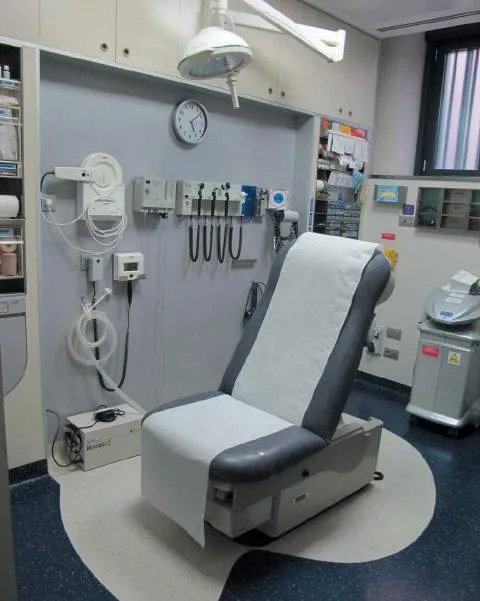 Fig 1. A real single-chair procedure room. The couch faces an orientable cold light; diagnostic instruments and a sphygmomanometer are wall-mounted within reach; a benchtop steriliser sits at the right; the floor is seamless sealed vinyl for wet cleaning. (Pierre André, 2017, p. 206).
> Fuentes: Cosmetic Medicine & Surgery (2016).
Fig 1. A real single-chair procedure room. The couch faces an orientable cold light; diagnostic instruments and a sphygmomanometer are wall-mounted within reach; a benchtop steriliser sits at the right; the floor is seamless sealed vinyl for wet cleaning. (Pierre André, 2017, p. 206).
> Fuentes: Cosmetic Medicine & Surgery (2016).
The Fig 1 room reads at a glance as the procedure zone of the table above: a couch, one clean orientable light source, instruments off the working surface, and a hard cleanable floor [41].
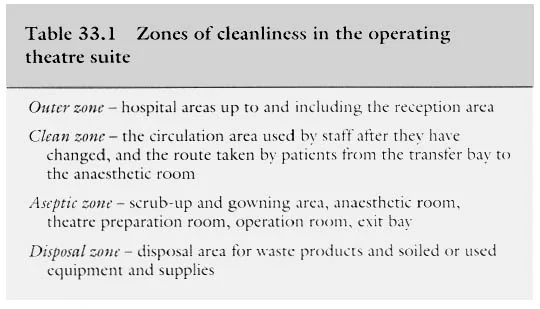 Fig 2. The graded-cleanliness model transferred from theatre design: outer (reception), clean (post-change circulation), aseptic (the field), disposal (waste and used equipment). An aesthetic clinic compresses these into clean / procedure / dirty but keeps the one-way logic. (Aitkenhead, 2001, p. 424). ⚠ Source is a 2001 anaesthesia text; used for the zoning principle, not for any dose.
> Fuentes: Aitkenhead - Textbook of Anaesthesia 4th ed (2001).
Fig 2. The graded-cleanliness model transferred from theatre design: outer (reception), clean (post-change circulation), aseptic (the field), disposal (waste and used equipment). An aesthetic clinic compresses these into clean / procedure / dirty but keeps the one-way logic. (Aitkenhead, 2001, p. 424). ⚠ Source is a 2001 anaesthesia text; used for the zoning principle, not for any dose.
> Fuentes: Aitkenhead - Textbook of Anaesthesia 4th ed (2001).
Fig 2 is the origin of the zone table: an aesthetic room is a compressed operating suite, and the disposal zone is exactly the dirty zone where grupo III waste terminates.
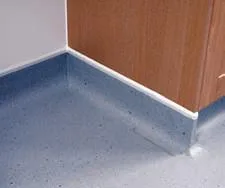 Fig 3. The detail that makes a room cleanable: a sealed, coved floor-to-wall junction with no crevice to trap biological material. A skirting-board gap is where an audit finds the problem. (Schofield, 2014, p. 11).
> Fuentes: Schofield - Brown's Skin and Minor Surgery (2015).
Fig 3. The detail that makes a room cleanable: a sealed, coved floor-to-wall junction with no crevice to trap biological material. A skirting-board gap is where an audit finds the problem. (Schofield, 2014, p. 11).
> Fuentes: Schofield - Brown's Skin and Minor Surgery (2015).
Fig 3 documents why "sealed, cleanable surfaces" is a specification and not decor: the coved junction leaves nowhere for contamination to lodge.
B4.3.2 · Sterilisation and the waste circuit
- Single-use wherever it exists. Critical single-use items are never reprocessed; the variant-CJD precaution in minor-surgery guidance is the archetypal reason the rule is absolute [43].
- Autoclave with documented periodic biological control if any instrument is reused; the sterilisation cycle is logged, not assumed.
- Authorised waste carrier contract, homologated containers, and a lot register bound to the record [6][21].
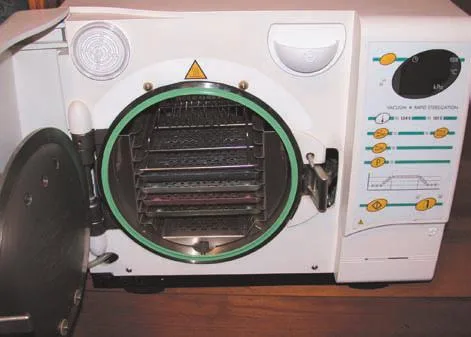 Fig 4. A benchtop vacuum autoclave for reusable instruments. The cycle it runs (vacuum, rapid sterilisation) is only evidence if the biological control is logged; the machine alone proves nothing to an inspection. (Schofield, 2014, p. 58).
> Fuentes: Schofield - Brown's Skin and Minor Surgery (2015).
Fig 4. A benchtop vacuum autoclave for reusable instruments. The cycle it runs (vacuum, rapid sterilisation) is only evidence if the biological control is logged; the machine alone proves nothing to an inspection. (Schofield, 2014, p. 58).
> Fuentes: Schofield - Brown's Skin and Minor Surgery (2015).
Fig 4 anchors the rule: reusing instruments is legitimate only with a documented biological-control cycle behind the autoclave shown.
B4.3.3 · The emergency cart, built
The cart is the line between a clinic and an improvised office. Build it to survive the two emergencies an injector actually faces: vascular occlusion and anaphylaxis.
| Item | Detail | Why |
|---|---|---|
| High-dose hyaluronidase | Enough for a full high-dose pulsed protocol, in date, written protocol beside it | Occlusion is time-critical; low or expired stock is a fatal gap [4][5] |
| Adrenaline | Autoinjector or ampoules + syringes | First-line for anaphylaxis |
| Parenteral antihistamine + corticosteroid | In date | Adjuncts in anaphylaxis |
| Oxygen + reservoir mask + bag-valve-mask | Checked | Airway and perfusion support |
| Monitors | Sphygmomanometer, pulse oximeter, glucometer | Diagnose and track |
| Aspirin + topical nitroglycerin | Per occlusion protocol | Adjuncts in the occlusion pathway |
| AED | Where volume and setting justify it ⚠ | Cardiac arrest |
| Written phone numbers | Emergency services + referral ophthalmologist, posted | Blindness pathway needs the number in seconds, not in a contact list [4] |
Hyaluronidase reverses hyaluronic-acid filler and is the drug the whole occlusion pathway turns on; emergent complications (occlusion, impending blindness) require immediate high-dose treatment, and non-emergent ones (Tyndall, non-inflamed nodules) low to moderate doses, so the cart carries the emergent quantity, not the average one [4][5]. Detailed pharmacology is in J3 (Hyaluronidase - Pharmacology & Clinical Protocols) and the emergency algorithm in J6 (Emergency Preparedness & Basic Life Support).
B4.3.4 · Pricing: value, not cost-plus
Consensus: compute the true cost per session and charge for the act above it; never let product cost drive the price [30][32].
Discrepancy that changes the gesture: cost-plus (product cost x factor) versus value-based (price by result, risk and time). Cost-plus rewards product-heavy procedures and punishes the ones that depend on judgement (a complex assessment consult, a clean dissolution, both cheap in product and high in value). Value-based care, defined as outcome per unit cost across the full cycle, is the same principle health systems adopted to stop paying for volume [32][33][34]. Decide by: whether the fee tracks the clinical value delivered or the syringe emptied. If it tracks the syringe, you have built the over-injection incentive into the price list.
true cost/session = product + consumables + sterilisation + waste
                  + (room-hour cost x total time, consult and review included)
                  + (staff-hour cost of everyone involved)
                  + prorated insurance + training + marketing + software
                  + touch-up / dissolution provision
- Charge for the act, not the millilitre. Per-mL pricing turns the consult into a volume sale and creates a direct incentive to inject more. This is the single business decision with the largest clinical footprint in the chapter [30].
- The touch-up provision is the line almost every model omits. If you touch up or dissolve without charging (usually the right thing), that cost must sit in the base price, not vanish from your margin.
- Never discounted: the assessment consult, the review, and complication management. Charging to manage your own complication is the fastest route from complication to claim [22].
- Packages. Legitimate as a phased clinical plan (sessions tied to a time-bound goal, with a review between them). Problematic as a consumable: prepaid "5-session" bonds, time-limited offers, 2x1. Beyond the ethics, a prepaid bond creates an obligation to treat that collides with the clinical decision not to treat [27].
B4.3.5 · Digital marketing, and the channel-selects-the-patient rule
The legal frame outranks the tactic: before any idea here, apply B4.2 (no prescription-drug brands, no result guarantees, no bait offers, consented before/after, identified commercial content) [13][16].
| Channel | What it does well | What to expect |
|---|---|---|
| Local SEO (Google Business Profile, reviews, content site) | Captures purchase intent; the patient already seeks you | Slow, cumulative, best long-run return [40] |
| Paid search | Immediate intent, measurable | High and rising cost per click in aesthetics ⚠ [40] |
| Instagram / TikTok | Awareness, pre-booking reassurance | Young, lower-conversion volume; where unrealistic expectations are born [27][28] |
| Educational content (blog, long video, newsletter) | Filters the right patient, pre-forms the consult | The only channel that improves patient selection [27] |
| Referral | Highest conversion and retention | Not free: cultivated by follow-up and result [45] |
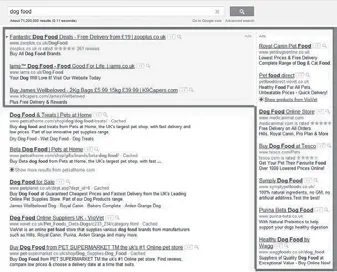 Fig 5. The paid-versus-organic split every clinic pays for: sponsored results (immediate, cost-per-click, they stop when the budget stops) sit above and beside the organic listings (slow to earn, they persist). Local SEO builds the second column; paid search rents the first. (Marketing Digital en Su Clínica Estética, 2017, p. 63).
> Fuentes: Marketing Digital en Su Clínica Estética (2017).
Fig 5. The paid-versus-organic split every clinic pays for: sponsored results (immediate, cost-per-click, they stop when the budget stops) sit above and beside the organic listings (slow to earn, they persist). Local SEO builds the second column; paid search rents the first. (Marketing Digital en Su Clínica Estética, 2017, p. 63).
> Fuentes: Marketing Digital en Su Clínica Estética (2017).
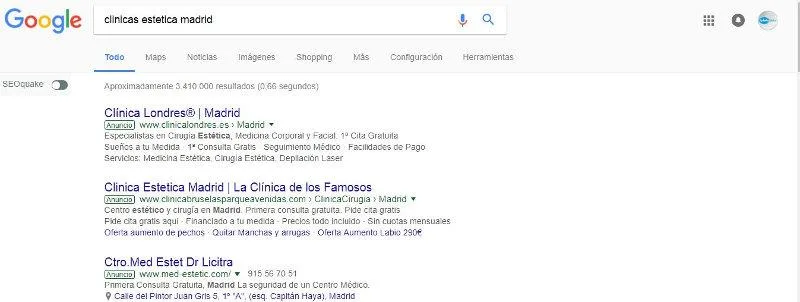 Fig 6. Real aesthetic-clinic paid search in Spain. The ads lead with price and free-consult hooks ("primera consulta gratis", a fixed lip-augmentation price, monthly financing). By the channel-selects-the-patient rule, this recruits the price-driven patient the clinic should be filtering out, and the price claims brush against the advertising limits of B4.2. (Naranjo, 2025, p. 45). ⚠ Teaching slide; illustrative of the pattern, not an endorsement.
> Fuentes: 02 PRESENTACION Gestion Marketing 2025-26-Dr Naranjo.
Fig 6. Real aesthetic-clinic paid search in Spain. The ads lead with price and free-consult hooks ("primera consulta gratis", a fixed lip-augmentation price, monthly financing). By the channel-selects-the-patient rule, this recruits the price-driven patient the clinic should be filtering out, and the price claims brush against the advertising limits of B4.2. (Naranjo, 2025, p. 45). ⚠ Teaching slide; illustrative of the pattern, not an endorsement.
> Fuentes: 02 PRESENTACION Gestion Marketing 2025-26-Dr Naranjo.
Fig 5 and Fig 6 together make the rule concrete: the channel and the message decide who walks in. The rule that orders everything else: the channel that attracts determines the patient who arrives. A price ad attracts price patients; content that explains risks and limits attracts patients who accept risks and limits. Marketing is the first phase of patient selection, and treating it as a function separate from the clinic is the sector's root error [27][28].
- Reviews are requested systematically from everyone, not only the happy, which is what keeps the average honest; never bought; and a negative review is never answered by confirming the person was a patient, since that is a confidentiality breach. The correct reply is generic and invites direct contact [9][11].
B4.3.6 · The patient journey, with the leak marked at each stage
| Stage | Typical leak | Intervention |
|---|---|---|
| Discovery | none | Content, SEO, referral [40] |
| Contact | Not answered within 24 h and they leave | Same-day reply: the biggest and cheapest leak to fix [35] |
| Booking | Friction, phone-only in office hours | Online booking 24/7; short lead time cuts no-shows [35] |
| Consult | Sold to instead of assessed | Documented assessment, phased plan [1] |
| Treatment | none | none |
| Review (2-4 wk) | Not booked, no quality or safety control | Booked at the moment treatment ends [23] |
| Maintenance | Not reminded | Scheduled reminder per the plan |
| Referral | Not asked | Asked after a satisfactory review [45] |
The 2-4 week review is simultaneously the best clinical tool and the best business tool in the chapter, and it is the first thing to fall when the diary tightens. It catches the late complication, allows the touch-up at the right moment, and is where loyalty is decided [23]. No-show and late-cancellation research is consistent that the intervenable levers are short booking lead time, reminders and an active patient portal, and that prior no-show behaviour predicts the next one, so a same-day reply and a short time-to-appointment are retention tools, not just courtesies [35][36].
Classic trap: building a beautiful room and a slick funnel, then losing the patient at the two unglamorous seams, the unanswered first contact and the unbooked review. Both are free to fix and both are usually ignored until the retention number is already bad [23][35].
B4.4 · Templates and documents
Answer first: the document set, its minimum content, and its retention. If a row is missing, an inspection or a claim finds it before you do.
| Document | Minimum content | Norm | Retention |
|---|---|---|---|
| Informed consent, per procedure | Technique, alternatives, foreseeable and rare risks, off-label status, cost; signed and dated | Ley 41/2002; RD 1015/2009 [9][12] | With the record, >= 5 y ⚠ |
| Photographic consent (separate) | Purpose, channels, storage, withdrawal right; express and specific | RGPD; RD 1907/1996 [11][13] | With the record |
| Clinical record | Identity, history, assessment, plan, product brand/lot/UDI, consent, follow-up | Ley 41/2002 [9] | >= 5 y from each episode ⚠ |
| RGPD activity register | Processing purposes, categories, retention, processors, transfers | RGPD art 30 / LOPD art 31 [10][11] | Current, reviewed |
| DPIA | Risk analysis for the image library / large-scale health data | RGPD art 35 [10] | Updated on change |
| Emergency-cart checklist + expiry log | Item, quantity, expiry, last check, signature | clinical governance [4] | Rolling |
| Cold-chain log | Max-min temperature, date, action on excursion | medicine cold chain [D] | Rolling |
| Traceability register | Product, brand, lot, UDI, patient, date | MDR (EU) 2017/745 [6] | Per device rules |
| Incident / complaint protocol | Trigger, roles, escalation, record, notification | PRL; clinical governance [20] | Rolling |
| Post-care instruction sheet | Expected course, red flags, 24/7 contact | Ley 41/2002 duty to inform [9] | Given per treatment |
B4.4.1 · Informed consent, and the five obligations behind it
Consent is not one generic form. It is per procedure, specific and current, and it carries the off-label statement whenever the use departs from the authorised conditions (a routine reality in toxin placement and biostimulator dilution), under RD 1015/2009 [9][12]. The teaching corpus states the obligations that flow from an injectable being a medical act, and each maps to a document [46]:
 Fig 7. The five obligations of the medical act, and their paperwork: (1) medical act, so a physician indicates and injects; (2) professional liability, covering foreseeable and unforeseeable complications; (3) duty to inform, met by specific and current consent; (4) traceability of brand, lot and material; (5) adverse-event management, with early diagnosis, correct treatment and notification where applicable. (Tejero, 2026, p. 9).
> Fuentes: 03 PRES 1 Complicaciones 2026 Intro Dra Tejero.
Fig 7. The five obligations of the medical act, and their paperwork: (1) medical act, so a physician indicates and injects; (2) professional liability, covering foreseeable and unforeseeable complications; (3) duty to inform, met by specific and current consent; (4) traceability of brand, lot and material; (5) adverse-event management, with early diagnosis, correct treatment and notification where applicable. (Tejero, 2026, p. 9).
> Fuentes: 03 PRES 1 Complicaciones 2026 Intro Dra Tejero.
Fig 7 is the document map for this whole subchapter: each of its five lines becomes a template row above. Consent failure sits among the leading causes of aesthetic litigation, so the specific, dated, off-label-aware form is a risk control, not a formality [22].
B4.4.2 · Clinical record, minimum content
Identity and history; the documented assessment and phased plan; the product brand, lot and UDI for every injected or energy product; the signed consent; and the follow-up including the review. Retention is >= 5 years from each episode, longer in several CCAA ⚠, with the patient's right of access [9]. The record, not the CRM, is the legal document; the CRM is a commercial layer on different legal bases (B4.2.3).
B4.4.3 · Standardised before/after photography
Photography is clinical evidence and marketing material at once, and it only works as either if it is standardised: fixed lighting, background, distance, framing and patient position, so two images are comparable and neither can be accused of editing to flatter [23]. Updated standards for aesthetic photographic documentation formalise the photographic and medical rules and the limits on editing [23]. The corpus schematic shows the room built for it:
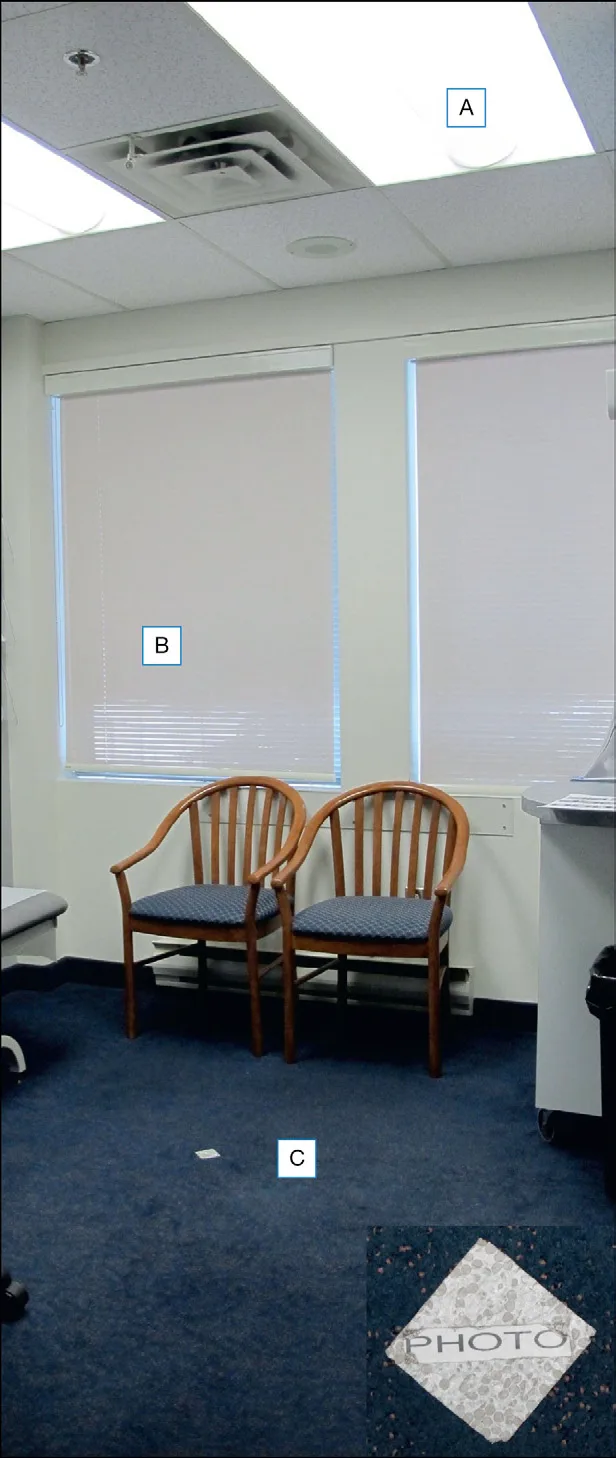 Fig 8. The reproducibility set-up: A = overhead symmetric lighting so shadows do not shift between visits; B = windows with blinds to remove variable daylight; C = neutral floor and background. Fix these and the "after" differs from the "before" because the patient changed, not the lighting. (Carruthers, 2012, p. 232).
> Fuentes: Aumento de tejidos blandos - Carruthers - 3era Edición (2013).
Fig 8. The reproducibility set-up: A = overhead symmetric lighting so shadows do not shift between visits; B = windows with blinds to remove variable daylight; C = neutral floor and background. Fix these and the "after" differs from the "before" because the patient changed, not the lighting. (Carruthers, 2012, p. 232).
> Fuentes: Aumento de tejidos blandos - Carruthers - 3era Edición (2013).
Fig 8 is the standard behind the protocol: consistent light (A), controlled ambient light (B) and a neutral background (C) [42]. Advertising use of these images is bound by B4.2: express consent, non-paid channel, "results may vary" [13].
B4.4.4 · The cost-per-session worksheet
A one-page template that forces the true cost before a price is set:
Line                                   Value
product (per session)                  ____
consumables (needles, cannulas, gauze) ____
sterilisation + waste                  ____
room-hour cost x total minutes/60      ____   (consult + treatment + review)
staff-hour cost x minutes/60           ____
prorated: insurance                    ____
prorated: training                     ____
prorated: marketing                    ____
prorated: software / CRM               ____
touch-up / dissolution provision       ____
= TRUE COST/SESSION                     ____
price for the act (value, not x-factor) ____
= margin                                ____
The template exists to make two invisible lines visible: the review and consult time (usually uncosted) and the touch-up provision (usually absent). A clinic that bills well and does not profit is almost always omitting these two [30][32].
B4.4.5 · Data-protection document set
- Registro de actividades de tratamiento (RGPD art 30 / LOPD art 31) and processor contracts with every vendor touching patient data [10][11].
- DPIA (RGPD art 35) for the image library and any large-scale processing [10].
- Breach protocol: detect, contain, assess, and notify the AEPD within 72 h, patients where required (RGPD art 33) [10].
- Access controls: role-based, screen lock, device encryption, EU or equivalent hosting, and the commercial CRM kept separate from the clinical record [11].
B4.4.6 · The operational logs that prove the invisible
- Emergency-cart checklist with per-item expiry and a signed last-check date; the hyaluronidase quantity is checked as "enough for a full high-dose protocol", not "present" [4].
- Cold-chain log with max-min temperature and a written action on any excursion [D].
- Traceability register binding brand, lot and UDI to each patient and date, as the default capture at point of treatment, so a safety alert is a query and not an archaeology project [6].
- Team training log with dated occlusion, anaphylaxis and BLS drills (B4.5).
B4.4.7 · The intake / screening form (where selection begins)
The intake form is the first clinical instrument, not an administrative nicety, because it is where the patients of B4.5 are caught before they reach the couch. Minimum fields beyond identity and history:
- Recent weight loss: yes/no; how much; over what period; with what agent; still losing?   [GLP-1 screen]
- Prior aesthetic treatments: what, when, where, any complication or dissolution
- Current expectation: "what do you want to change?" in the patient's own words
- Reference image brought? yes/no                                                          [expectation flag]
- Validated body-image screen (e.g. a BDDQ-AS-type instrument) at first aesthetic consult   [BDD screen]
- Medication, allergies, anticoagulation, pregnancy/lactation
- Consent to contact and to photography (separate tick boxes, not one)
The GLP-1 and BDD lines exist because both change the plan and both are invisible unless asked; a positive body-image screen runs 19-41% in this population and is the single most useful decline-or-defer signal on the page [24][29][30].
B4.4.8 · Post-care, complaint and review templates
- Post-care instruction sheet (given, not just filed): expected course and timeline, the specific red flags for that treatment (for filler: disproportionate pain, blanching, vision change), and a 24/7 contact route. The duty to inform under Ley 41/2002 does not end when the patient leaves the room [9].
- Complaint-handling SOP: acknowledge in writing within a set time, log the complaint in a register separate from the clinical record, investigate against the record, respond, and escalate to the insurer early where a claim is plausible. Medicolegal reviews show that inadequate follow-up and poor complaint handling convert dissatisfaction into litigation, so a rehearsed protocol is a risk control [22].
- Review-visit SOP: book the 2-4 week review at the couch; at the review, standardised photography (B4.4.3), a documented outcome and a short PROM, the touch-up decision, and the next-step plan. The review is where the safety net and the retention engine are the same visit [23].
B4.4.9 · Why the paperwork is the cheapest insurance
Every template above maps to a litigation driver or an inspection item. Consent and follow-up gaps head the medicolegal cause list; traceability, authorisation and cold chain head the inspection list [2][6][22]. The clinic that treats these as forms to file rather than flows to run has the documents and not the protection, which is the specific failure mode the closing trap describes.
B4.4.10 · Traceability and the right to erasure, together
Two documentary duties pull in opposite directions and must be reconciled explicitly. Traceability under the device framework requires that brand, lot and UDI be bound to the patient and kept so a safety alert can find every affected person, and clinical-record duties require retention for at least five years [6][9]. Data-protection law, meanwhile, grants rights of access and, in defined circumstances, erasure [10][11]. The reconciliation is that the clinical and safety record has a lawful basis and a retention obligation that a general erasure request does not simply override, so the clinic must be able to explain, in its activity register and privacy notice, which data are kept, on what basis and for how long, and to separate the marketing data (which a patient can more readily have erased) from the clinical and traceability data (which the clinic is obliged to keep) [10][11]. A clinic that cannot draw that line on request has a data problem waiting to be found. This is another reason the commercial CRM and the clinical record are kept as separate systems on separate legal bases (B4.2.3): only then can one be erased while the other is lawfully retained.
B4.4.11 · Electronic consent and versioning
Digitised consent is valid and preferable for traceability, provided it captures who signed, what version they signed, and when, with an auditable trail. Two disciplines make it defensible: version the forms, so the record shows the exact wording the patient agreed to on that date rather than the current template, and keep the off-label clause and the specific-risk section current, since a consent that has not tracked a change in technique or product is a consent to something the clinic no longer does [9][12]. The electronic record must still meet the retention and access duties of Ley 41/2002 and the security duties of the data regime, so an e-consent stored in an unencrypted commercial tool is worse, not better, than paper [9][11].
Classic trap: owning every template as a file nobody fills. A consent signed but not specific, a traceability sheet not wired to the point of treatment, a cold-chain log started and abandoned: each is worse than absent, because it documents that the clinic knew the duty and did not meet it [6][9][22].
B4.5 · Frequent errors and their cost
Answer first: the error grid. Each row is a mistake seen in real clinics, why it happens, what it costs, and its clinical or legal signature (how it shows up when it bites).
| Error | Why it happens | What it costs | Signature |
|---|---|---|---|
| Charge per millilitre | Easy to explain to the patient | Direct incentive to over-inject; dissolution and claim tail | Puffy, over-filled faces; rising dissolution rate [30] |
| No touch-up provision in price | It is invisible | Free correction bleeds the margin or is refused | Either you eat it, or a good outcome turns sour [4][30] |
| Charge to manage your own complication | It feels fair | Turns a complication into a claim | The reversal request arrives with a lawyer [22] |
| Commission staff on treatment volume | It motivates sales | Over-treatment; first thing an inspection flags | Suspiciously high conversion; sales-led notes [27] |
| Open without U.48 authorisation | Nobody explained it | No valid insurance; activity sanctionable | The first inspection closes you [2][3] |
| Fridge without temperature log | Nobody asks, until they do | Broken cold chain, unusable toxin, claim | Failed treatments; no evidence to defend [D] |
| Expired or insufficient hyaluronidase | Bought "just in case", then forgotten | Fatal blind spot in an occlusion | The one emergency you cannot improvise [4][5] |
| Not booking the review at the couch | The diary tightens | No quality or safety control; retention falls | Late complications missed; patients drift [23] |
| Near-100% conversion read as success | It looks like winning | You decline nobody; wrong patients loaded | BDD and price-shoppers on your table [1][29] |
| Confirm a patient when replying to a review | Impulse to defend | Confidentiality breach | A data complaint on top of the bad review [9][11] |
| Merge commercial CRM and clinical record | One system feels simpler | Different legal bases and access collapsed | An access or breach finding [10][11] |
| Prepaid session bonds (5-pack, 2x1) | Cash in today | Obligation to treat vs the decision not to treat | You must inject when you should not [27] |
| "Sustainable clinic" with no data | It sells | Greenwashing; attackable like "risk-free" | An advertising complaint you cannot answer [13][37] |
| Improper delegation to nursing | Efficiency pressure | Intrusismo; voided cover |
Uninsured event, criminal exposure [1][14] |
| No dated emergency drills | Everyone is busy | Untrained team in a time-critical event | The occlusion that is handled slowly [4] |
| Treat during active weight loss | Patient wants it now | Poor, short-lived result; dissatisfaction | The "why do I look worse" call [24][25] |
| Name a prescription-drug brand in an ad | Patients search the brand | Advertising breach | A regulator or competitor reports it [16][17] |
| Before/after in a paid ad without consent | It converts | Advertising and data breach at once | Two regulators, one image [11][13] |
| Skip the off-label note in record and consent | It is routine | Consent and liability gap | Indefensible when the routine use is questioned [12] |
| Ignore a positive BDD screen | The patient is persuasive | Dissatisfaction, symptom shift, claim | The chased perfection that never arrives [29][30][31] |
B4.5.1 · The highest-cost errors, in detail
- Delegation across the scope line is the most expensive single error. Injection and indication of an invasive procedure are a medical act; nursing may assist and perform under medical indication but may not indicate or assess autonomously [1][14]. Improper delegation is
intrusismo, it voids the liability cover, and it is exactly what an inspection looks for first. It is also the most widespread deontological and legal problem in the sector. - Over-treatment is manufactured by incentives, not by bad people. A per-mL price list and a commissioned sales role both pay the clinic to inject more; systematic reviews of aesthetic marketing tie aggressive commercial pressure to overtreatment and to the erosion of informed consent [27]. Remove the incentive and the behaviour follows.
- Charging to manage your own complication is the fastest documented route from a clinical event to a legal one; medicolegal reviews of facial aesthetic work put unsatisfactory outcome, consent failure and poor follow-up at the head of litigation causes, and a complication the patient must pay to fix hits all three at once [22].
B4.5.2 · Team governance as error prevention
Minimum roles: reception and front-of-house (the first filter and the first leak), clinical assistance, and medical direction. The person who advises commercially should not be paid a commission on what is treated; that is the incentive that produces over-treatment and the one an inspection reads first [27].
Non-negotiable, dated team drills (competency detail in B10 (Competency, Assessment & Certification Pathway)): - Vascular-occlusion simulation, box open and clock running, at least annually. The team should reach the hyaluronidase and the protocol without thinking [4][5]. - Anaphylaxis and BLS with current certification, ideally ERC-aligned. - Written incident and complaint protocol, rehearsed, with clear roles and escalation. - Documented data-protection training for everyone who touches the CRM or the image library [11].
B4.5.3 · Putting a number on the errors
The costs above are not abstract; each has a mechanism that shows up on the accounts or on the claims log.
- The dissolution tail of per-mL pricing. When the fee scales with volume, the clinic is paid to inject the millilitre it should have withheld. The correction is not free: it consumes a fresh vial of hyaluronidase, a review slot, and often a second, so a single over-injected patient can erase the margin of several correctly treated ones. Hyaluronidase dosing itself is dose-dependent and, for emergent complications, high, so the "cheap fix" is neither cheap nor certain [4][5]. The accounting signature is a dissolution rate that climbs while revenue looks healthy.
- The retention cost of the dropped review. No-show and attrition research is consistent that prior behaviour predicts future behaviour and that short lead time, reminders and an active portal are the intervenable levers [35][36]. A clinic that does not book the 2-4 week review at the couch converts a scheduled, low-friction touchpoint into a cold re-acquisition later, at full marketing cost, for a patient who has meanwhile been re-targeted by every competitor's ad. Retention is cheaper than acquisition by a wide margin, so the unbooked review is a recurring, compounding leak, not a one-off courtesy [32].
- The claim cost of consent and follow-up gaps. Medicolegal reviews of facial aesthetic practice identify unsatisfactory outcome, informed-consent failure, technical error and inadequate post-operative follow-up as the recurring litigation drivers, and note the highest litigation rates in high-volume, tightly regulated markets [22]. Spain, with its explicit U.48 authorisation, physician-reservation ruling and layered advertising law, is precisely such a market, so the paperwork errors above are not bureaucratic friction; they are the exact fact patterns that lose cases.
- The selection cost of ignoring the psychology. Positive body-dysmorphic-disorder screens run from roughly 19% in mixed cosmetic-surgery populations to 41% in facial-plastic and injectable consultations, and the disorder characteristically worsens rather than resolves after a procedure as the preoccupation shifts [29][30][31]. Treating into that is a predictable dissatisfaction-and-claim generator, and the near-100% conversion rate is the metric that hides it, because the clinic that never declines has by definition treated every positive screen that walked in [1].
B4.5.4 · Building the clinic that does not make these errors
The recurring lesson of the grid is that the errors are produced by incentives and pressures, not by character, so the fix is to design them out.
- Design the price so the incentive is neutral. An act-based fee with the touch-up provision built in removes the reward for volume; a per-mL fee installs it. This is the single highest-leverage anti-error move because it neutralises over-injection, the dissolution tail and the "charge for the complication" temptation at once [30].
- Design the role so the advisor is not paid to sell. A salaried, not commissioned, advisory role removes the motor of over-treatment; the commissioned role is both the cause and the inspection flag [27].
- Design the diary so the review is automatic. Booking the review at the couch, and protecting that slot, converts the best safety-and-retention tool from a good intention into the default path [23][35].
- Design the intake so the wrong patient is caught early. The GLP-1 and BDD screens on the intake form (B4.4.7) are where the "treat during active loss" and "chase perfection" errors are prevented, before any product is drawn up [24][29].
- Design the systems so compliance is the default flow. Lot/UDI capture at point of treatment, a logged fridge, a per-procedure consent that carries the off-label line: each is either the default workflow or the thing that is skipped under time pressure, and an inspection reads a skipped default as a knowing omission [6][9][12].
B4.5.5 · The error that hides the others
The metric that conceals the whole list is a near-total consult-to-treatment conversion rate, because a clinic that treats everyone has by construction treated every price-shopper, every positive body-image screen and every patient in active weight loss that walked in [1][29]. It is worth restating as an error in its own right: reading high conversion as success is the meta-error that lets all the others accumulate unseen, which is why B4.6 treats a very high conversion rate as a red flag rather than a target.
B4.5.6 · One error, followed to the end
Trace the per-mL price through its full cascade, because it shows how a single design choice becomes every downstream cost. The clinic prices by the millilitre, so the fee rises with volume, so the incentive at the moment of injection tilts toward one more syringe. Over months this produces a cohort of slightly over-filled patients. Some are dissatisfied and request reversal, which consumes a vial of hyaluronidase and a review slot and, not infrequently, a second session, each of which is unbilled if the clinic does not charge to fix its own work, which it should not [4][30]. A subset of those patients, having paid for a result they now dislike and then been managed as a problem, escalate, and the medicolegal literature is explicit that unsatisfactory outcome plus a sense of being poorly followed up is the recurring litigation profile [22]. Meanwhile the clinic's dissolution rate, if it is even recorded, climbs, and its retention falls, because an over-filled and reversed patient rarely returns. On the accounts, revenue may still look healthy, which is exactly why the error persists: the cost is distributed across the dissolution slots, the lost retention and the occasional claim, none of which appears on the price list where the error lives. Change the price to per-act with a touch-up provision, and the entire cascade loses its source [30].
B4.5.7 · Audit yourself before someone else does
Run the error grid against your own clinic quarterly, as a checklist rather than a hope: is the price per act or per millilitre; is the touch-up provisioned; is anyone paid a commission on treatment; is the U.48 current; is the fridge logged; is the hyaluronidase in date and sufficient; is the review booked at the couch; what is the conversion rate; is the complication rate recorded; are CRM and record separated; are before/after images consented and off paid channels; is delegation inside the scope line [1][2][4][6][23][30]. Each "no" is a scheduled repair, not a surprise, and finding it yourself is orders of magnitude cheaper than having an inspection or a claim find it. The quarterly self-audit is the same list an inspection uses, run by the only person with an incentive to fix it before it bites.
Classic trap: treating the error list as other people's mistakes. Every error above is committed most often by competent, well-meaning clinics whose incentives, diary pressure or convenience quietly pointed the wrong way; the fix is structural (the price list, the role design, the booked review, the dated drill), not a resolution to try harder [23][27].
B4.6 · Metrics: what is measured and its reference value
Answer first: the dashboard. Measure these from day one, or you never learn what works. Reference values marked ⚠ are industry or business benchmarks, not clinical endpoints, and are printed as orientation, not as a target to hit blindly.
| KPI | Definition / formula | Reference value | Trap it exposes | Source |
|---|---|---|---|---|
| First-contact response time | Median time from enquiry to a human reply | Same day; ideally < 24 h | The largest, cheapest leak in the funnel | [23][35] |
| Consult -> treatment conversion | Treated / assessed | A healthy band, not ~100% ⚠ | A very high rate = you decline nobody | [1] |
| Review attendance (2-4 wk) | Attended reviews / treatments | Track it and defend it | Quality and safety blindness when it falls | [23] |
| 12-month retention | Patients returning within 12 mo / treated | Industry ~52% ⚠; target 65-70% ⚠ | Acquisition-addiction masquerading as growth | [32] |
| No-show / late-cancel rate | Missed or late-cancelled / booked | ~18-20% outpatient benchmark ⚠ | Long lead time and dead portals | [35][36] |
| Complication / dissolution rate | Events / treatments, by type | Low, audited, trended | An unrecorded rate cannot be improved | [22] |
| PROM (outcome, not sale) | Validated patient-reported outcome per cycle | Rising over the care cycle | Confusing satisfaction-at-sale with outcome | [32][33] |
| LTV:CAC | Lifetime value / acquisition cost | Comfortably > 1; heuristic ~3:1 ⚠ | A model that spends more to acquire than it earns | [32] |
| Revenue per clinical hour | Revenue / physician-couch hours | Trend, not a single target ⚠ | Volume chased at the cost of time-per-act | [32][33] |
B4.6.1 · Why these numbers, and where they come from
- First-contact response time. The contact stage is the single largest and cheapest leak in the patient journey: an enquiry not answered the same day is frequently gone to whoever answered first. No-show research reinforces the mechanism from the other end, since long booking lead time is a consistent, intervenable predictor of a patient never arriving, and a fast reply with a near-term slot shortens that lead time [23][35]. This is a retention lever disguised as an administrative metric.
- Consult-to-treatment conversion. A conversion rate is the metric most often misread. A very high rate is celebrated as sales excellence when it is in fact a warning: it means the clinic declines nobody, which is impossible to reconcile with a patient population that includes 19-41% positive body-dysmorphic screens and a steady stream of price-shoppers and unrealistic expectations [1][29]. The correct target is a band, wide enough to convert appropriate patients and low enough to prove the clinic still says no.
- Review attendance. The 2-4 week review is where late complications are caught, touch-ups are timed correctly and loyalty is decided, so its attendance rate is simultaneously a safety indicator and a retention indicator [23]. It is also the first metric to degrade under diary pressure, which is exactly why it must be measured rather than assumed.
- 12-month retention. This is where profit actually lives. Industry orientation places aesthetic retention around 52% with a realistic target in the 65-70% range ⚠; these are business benchmarks, not clinical endpoints, and the corpus does not corroborate them, so they are printed with a warning and used to gauge direction, not to certify a number. The underlying principle, that returning patients across a full care cycle outperform a churn-and-replace model, is the value-based-care thesis of outcome per cost over the cycle rather than fee-per-encounter [32][33][34].
- No-show rate. Outpatient studies benchmark missed-appointment rates around 18-20%, with prior no-show behaviour predicting the next miss and portal activation plus short lead time as the intervenable factors [35][36]. An aesthetic clinic that books online 24/7, sends structured reminders and keeps its portal active is pulling exactly the levers the evidence identifies.
- Complication and dissolution rate. A rate that is not registered cannot be audited or improved, and the medicolegal literature is explicit that inadequate follow-up and unrecognised complications drive claims [22]. Recording by type (occlusion, nodule, dissatisfaction-led dissolution) turns a vague sense of "we rarely have problems" into a trend that can be governed.
- PROMs as the true outcome. Value-based care replaces volume with outcome per unit cost measured across the full cycle, using patient-reported outcome measures rather than throughput [32][33][34]. In aesthetics the analogue is a validated PROM captured at the review, which distinguishes genuine outcome from the satisfaction-at-sale that a good consult manufactures regardless of result.
- LTV:CAC and revenue per clinical hour. Lifetime value over acquisition cost should sit comfortably above 1, with a common business heuristic near 3:1 ⚠, and its trend matters more than any single reading: a falling ratio is the early signature of a model becoming addicted to acquisition [32]. Revenue per clinical hour guards the opposite failure, chasing volume until time-per-act, and with it quality and safety, is squeezed.
B4.6.2 · How to run the dashboard
Six of these can be pulled from a booking system and a CRM with no extra software: response time, conversion, review attendance, no-show, retention and revenue per hour. Two require deliberate capture: the complication/dissolution register (built into the clinical record, by type) and the PROM (a short validated instrument at the review). The discipline is to review the dashboard monthly and to act on the worst number, which in most clinics is either the unanswered first contact or the unbooked review, both free to fix [23][35].
B4.6.3 · The formulas, spelled out
None of these needs software beyond a booking system and a spreadsheet, and the discipline is to define each one precisely so the number cannot drift:
response time      = median( first_reply_time - enquiry_time )
conversion         = treated_patients / assessed_patients            (a band, not a max)
review attendance  = attended_reviews / treatments_with_a_review_due
12-month retention = patients_returning_within_12mo / patients_treated_12mo_ago
no-show rate       = (no_shows + late_cancellations) / booked_appointments
complication rate  = complications / treatments        (by type: occlusion, nodule, infection)
dissolution rate   = dissolutions / filler_treatments  (split: aesthetic vs adverse)
LTV                = avg_annual_value x expected_years_retained
CAC                = total_acquisition_spend / new_patients_acquired
LTV:CAC            = LTV / CAC
revenue/hour       = revenue / physician_couch_hours
The two that are most often defined loosely, and therefore gamed, are conversion (measure it against assessed patients, not enquiries, or a clinic looks better simply for answering fewer calls) and retention (fix the 12-month window and the denominator, or the number means nothing across quarters).
B4.6.4 · A worked reading (illustrative, not a benchmark)
Take a clinic converting 95% of consults, with 12-month retention below the ~52% industry orientation and a rising CAC ⚠. The dashboard reads this correctly as danger, not success: the high conversion says the clinic declines almost nobody, the low retention says the patients it wins do not come back, and the rising CAC says it is spending ever more to replace them. The value-based-care correction is to move spend from acquisition to the review and the relationship, because outcome-per-cost across a full care cycle, not throughput, is what compounds [32][33][34]. The numbers here are illustrative and carry the ⚠ that all the business benchmarks in this block carry; they show how to read the dashboard, not a target to hit.
B4.6.5 · Dashboard cadence
Review the dashboard monthly, act on the single worst number, and re-baseline quarterly alongside the expiry, drill and advertising audits of B4.3 step 13. Most clinics find the worst number is one of the two free-to-fix seams, the unanswered first contact or the unbooked review, which is exactly why those two sit at the top of the KPI table [23][35]. A dashboard that is built and never read is a vanity project; a dashboard read monthly and acted on is the difference between a clinic that improves and one that merely persists.
B4.6.6 · Leading versus lagging, and the benchmark caveat
The dashboard mixes two kinds of number, and treating them the same is a common mistake. Response time, review-attendance and no-show are leading indicators: they move first and they predict the lagging ones. Retention, complication rate and LTV:CAC are lagging: they confirm months later what the leading indicators already implied. The management value is that you cannot act on a lagging number directly; you act on the leading number that drives it. A falling retention figure is not fixed by "improving retention"; it is fixed by answering the first contact faster and booking the review, which are the leading levers the no-show and journey evidence identifies [23][35][36].
The benchmark caveat is equally important and is why every reference value in this block carries a ⚠. The retention, LTV:CAC and no-show figures are business or general-outpatient orientations, not aesthetic-specific clinical endpoints, and the corpus does not corroborate them; a clinic's own trend against its own baseline is worth more than its position against an imported benchmark, because case-mix, pricing and catchment make raw cross-clinic comparison unreliable [32][35]. Use the benchmarks to sense direction and the trend to make decisions.
B4.6.7 · Capacity and utilisation, the quiet metrics
Two further numbers guard against the failure the revenue-per-hour metric hints at. Utilisation (booked couch-hours over available couch-hours) shows whether capacity is the constraint or demand is, which decides whether the next euro goes to marketing or to a second injector. Time per act, tracked honestly, is the early warning that a growing clinic is compressing the consult and the review to fit more in, which is the exact mechanism by which scaling erodes quality and safety [27]. A clinic that watches utilisation and time-per-act alongside the headline KPIs is measuring not just whether it is busy, but whether it is busy in a way that is safe to sustain.
B4.6.8 · Choosing the outcome measure
A dashboard is only as honest as its outcome metric, and satisfaction captured at the point of sale is the least honest one, because a good consult manufactures it regardless of result. Prefer a short validated patient-reported outcome measure captured at the 2-4 week review, not at checkout, so it reflects the outcome the patient lives with rather than the relief of a decision made [23][32]. Whichever instrument is chosen, use the same one every time so the number is comparable across patients and quarters, and pair it with the objective, standardised photograph of B4.4.3 so a subjective PROM and an objective image tell the same story or expose a gap between them. Value-based care is precisely this substitution of a measured outcome for a measured throughput, and the PROM is where an aesthetic clinic makes that substitution real rather than rhetorical [32][33][34].
B4.6.9 · Daily, monthly, quarterly
The dashboard is not all read at the same cadence. Two numbers are checked daily because they leak in real time: the first-contact response time and today's no-show or late-cancellation, both of which can be fixed the same day they are seen [35]. The clinical-quality and retention numbers are read monthly, acting on the single worst one, and the benchmarks are re-baselined quarterly alongside the expiry, drill and advertising audits of B4.3. Matching the cadence to the metric is what keeps the dashboard a management tool rather than a monthly guilt exercise, and it is why the leading indicators sit at the top of the table and the lagging ones below [23][32][35].
Classic trap: measuring what the software reports (clicks, followers, bookings) instead of what predicts survival (response time, review attendance, retention, complication rate). Vanity metrics rise while the clinic quietly loses the patients it already won [32].
B4.7 · Spanish particularity
Three things make the Spanish clinic different from a generic "aesthetic business": a Supreme-Court-settled line on who may perform the act, an autonomic patchwork of authorisation and record rules, and a GLP-1 wave that has reshaped the consulting room. Each is operational, not academic, and each is a place where importing a model from another country quietly breaks the law. The physician-reservation line is fixed by the Supreme Court and is not a professional opinion that a clinic can weigh against convenience [1][14]; the authorisation and record rules are devolved to the autonomous communities, so a requirement one clinic treats as national is in fact local and unequal [2][9]; and the post-weight-loss patient, absent five years ago at this volume, now arrives in numbers that change the offer and the consult itself [24]. The subsections below take each in turn, in operational rather than doctrinal terms. The through-line is that Spain regulates the act and the centre, not merely the product: who may perform the procedure, where, with what authorisation, and under which advertising and data rules, are all fixed by norms that a business plan cannot negotiate around, and the penalty for assuming otherwise lands on the clinic that imported a lighter-touch model from elsewhere [1][2][13].
B4.7.1 · Who may perform the act (the live competence dispute)
Consensus: performing non-surgical aesthetic-medical procedures requires the clinic to hold the U.48 Medicina estética authorisation, a licence granted only where a physician is responsible for the unit; nursing professionals may assist and may perform under a physician's indication within their own title [1][2].
Discrepancy (this is a genuine, live dispute, so both positions are stated):
- School A, physicians-only. Diagnosis, indication and injection of prescription products for aesthetic purposes are a medical act reserved to graduates in Medicine. The anchor is STS 653/2021 (10 May 2021, Sala de lo Contencioso-Administrativo, Sección 4.ª), which rejected the nursing council's appeal and confirmed the reservation, together with Ley 44/2003 (LOPS) and the RD 1277/2003 U.48 unit [1][14]. On this view an autonomous nurse-led injecting practice is intrusismo, punishable regardless of product used or intent, and it voids liability cover.
- School B, nursing-autonomy claim. The Consejo General de Enfermería asserted, via Resolución 19/2017, an autonomous nursing competence in medico-aesthetic and anti-ageing acts. That resolution was annulled by the TSJ Madrid in three rulings (334/2019 of 29 May, 790/2019 of 12 Dec, 196/2020 of 1 April) and the Supreme Court then rejected the council's further appeal in STS 653/2021 [1][14]. Later council communications have continued to press an expanded nursing role.
Decide by the current binding law, not by the aspiration: as of writing, the reserved-to-physicians position is the enforceable one, because the nursing-autonomy instruments were annulled and the Supreme Court closed the appeal [1][14]. The operational consequence for the clinic is unambiguous: a physician indicates and injects; nursing assists, prepares and performs strictly under medical indication; and the org chart, the consent and the insurance must all reflect that, because the first inspection reconciles them. ⚠ This is a contested political and professional area, and future regulation could move it; the chapter states the law as it stands and flags that it is disputed.
B4.7.2 · The autonomic patchwork
Spain devolves health-centre authorisation to the seventeen autonomous communities, so several requirements that a clinician assumes are national are in fact local ⚠ [2]: - U.48 authorisation requirements (room, equipment, staffing, and even the unit's exact name) vary by CCAA; some publish an operating guide, such as Andalucía's Orden of 3 April 2024 for the U.48 unit [2]. - Clinical-record retention is a floor of >= 5 years under Ley 41/2002 but is extended by several communities ⚠ [9]. - Advertising and biosanitary-waste rules have autonomic layers on top of the state framework [13][21].
The practical rule is the ES chapter's rule: resolve your own community's requirements before you sign a lease, because an authorisation you cannot obtain at a given premises is a lease you should not have signed [2].
B4.7.3 · The GLP-1 / post-weight-loss patient
The GLP-1 era has created a service line that did not exist at this volume five years ago, and the corpus does not yet cover it (a declared acquisition gap), so this rests on recent external literature [24][25][26]. The clinical detail is in B2 (Patient Psychology & Selection); here is the operational adaptation.
- Screen on the intake form. Recent weight loss, how much, over what period, with what agent, and whether it is ongoing. It changes the entire plan [24].
- Do not treat during active loss. Book at ~3 months of stable weight. Saying this early converts a lost sale into earned trust [25].
- Reorder the offer toward structure. Biostimulation, deep support and energy for laxity, and body work, rather than superficial filler; rapid fat loss drives volume loss, skin laxity and accelerated wrinkling ("Ozempic face"), which superficial filler chases badly [25][26].
- Plan explicitly over years. This is a phased patient, not a single session [24].
- Coordinate, do not improvise. If you do not manage the GLP-1, know who does; if you do, then lean mass, protein and exercise are part of the aesthetic treatment, not an extra, and rapid loss also thins the dermis and reduces skin elasticity [24][26]. Cross-reference K1 (Anti-Aging Medicine & Longevity).
- Explain the mechanism honestly. The patient has heard "Ozempic face" and arrives frightened. Explaining that it is fat loss in a territory with little reserve, not toxicity, is itself the service [25].
⚠ This is a recent and evolving care pattern, described as an observed operational model rather than an established guideline; the systematic reviews themselves call for prospective studies and standardised protocols [26].
B4.7.4 · Professional bodies and the insurance line
Two further Spanish specifics shape the business: colegiación and the professional-society framework (the SEME is the reference society for medicina estética and has driven the competence litigation), and a professional-liability (RC) policy that must cover every technique actually performed, off-label uses included, because a policy written narrower than the real practice is contestable exactly when it is needed [19]. The OMC deontological code adds that medical advertising must be objective, prudent, truthful and verifiable, which is the professional-ethics layer above the statutory advertising rules of B4.2 [13].
B4.7.5 · What the autonomic patchwork means in practice
Because authorisation is devolved, two clinics doing identical work in different communities can face different room specifications, different staffing requirements, different record-retention floors and different advertising rules ⚠ [2][9][13]. The operational consequences: - Premises must be checked against the local U.48 requirements before the lease, since a room that cannot be authorised where you signed is a sunk cost, not a fixable snag [2]. - Record retention is a floor of >= 5 years but is extended by several communities, so the retention policy is set to the stricter local rule, not the national minimum [9]. - Advertising has autonomic layers, so an ad that is compliant in one community can be non-compliant in another, which matters the moment marketing crosses regional lines online [13]. - Multi-site groups inherit the union of all these rules, not the average, which is one of the hidden costs of the chain model in B4.8 [2].
B4.7.6 · The insurance line, in detail
The professional-liability (RC) policy is not a formality; it is the instrument that fails silently at the worst moment if it is set wrong. Two ways it fails: it is written narrower than the real practice (a technique performed but not declared, an off-label use not covered), or the underlying act was not lawfully delegated (nursing indicating or injecting autonomously), which can void cover entirely because the loss arose from an act the policy never insured [1][19]. The rule is that the policy schedule, the authorised U.48 offer, the org chart and the consent forms must all describe the same practice, because a mismatch between them is precisely what an insurer looks for to decline, and what an inspection looks for to sanction [2][19].
B4.7.7 · The GLP-1 consult, operationally
The GLP-1 patient reshapes the consult itself, not just the treatment menu. On the recent literature, rapid large-magnitude loss drives facial volume loss, dermal thinning, loss of collagen and elastin, and reduced elasticity, with worse outcomes at older age, longer obesity history, faster loss and poorer nutrition [24][26]. The operational reading: - Sequence over speed. Treating structure and skin quality after weight stabilises, rather than chasing volume during the loss, produces a durable result instead of one that must be redone as the face keeps changing [25][26]. - Nutrition and lean mass are part of the plan. Protein intake, resistance exercise and lean-mass preservation are inside the aesthetic result, not adjacent to it, because the same loss that thins the face thins the dermis [24][26]. - The honest explanation is the service. The patient arrives frightened by "Ozempic face"; explaining that it is fat loss in a low-reserve territory rather than a toxicity, and that the plan is phased, converts fear into a multi-year relationship [25]. This is the retention thesis of the whole chapter applied to the fastest-growing patient type in the clinic.
⚠ The evidence base is young and the reviews themselves call for prospective studies and standardised protocols, so this is a described operational pattern, not a guideline [26].
B4.7.8 · Colegio, SEME and the 24-hour reflection
Two further Spanish specifics shape day-to-day practice. First, the professional infrastructure: registration with the provincial colegio de médicos is mandatory to practise, the SEME is the reference scientific society for medicina estética and drove the competence litigation that produced STS 653/2021, and the OMC deontological code sits above statutory advertising law with its requirement that medical publicity be objective, prudent, truthful and verifiable [1][13]. Second, the reflection interval: good practice, and in several settings an expectation, is that an interval passes between the informed-consent conversation and an elective aesthetic procedure, so the patient decides with a cool head rather than in the emotional momentum of the consult; this pairs with the do-not-discount-the-consult rule of B4.3, because a reflection window is incompatible with a same-day price-hook sale [9][13].
B4.7.9 · Health tourism and cross-border care
Spain is a destination for aesthetic health tourism, which adds two operational duties. The follow-up problem: a patient who flies in for treatment and out the next day is the patient least able to attend the 2-4 week review, so the clinic must arrange remote review, a clear red-flag and 24/7 contact route, and a named local contact in the patient's country for an emergency, or it has built the retention-and-safety gap of B4.3.6 into the business model by design [23]. The regulatory problem: advertising that crosses borders online meets other jurisdictions' rules, and the device, data and advertising regimes of B4.2 travel with the patient's data, so a cross-border practice inherits the stricter of the two frameworks, not the more convenient one [10][13]. Health tourism is a legitimate model; it simply moves the review and the compliance perimeter from an afterthought to a design requirement.
B4.7.10 · Minors and vulnerable patients
Spanish practice adds a specific caution for minors and for the vulnerable patient. Elective aesthetic procedures on minors sit under heightened scrutiny of indication and consent, since the autonomy framework of Ley 41/2002 treats capacity and representation carefully and a purely aesthetic, non-therapeutic intervention on a minor is difficult to justify [9]. The operational rule is conservative: for a minor, document a genuine clinical indication and the appropriate representation, and default to declining a purely cosmetic request, because the medicolegal and reputational exposure of treating a minor for appearance alone is disproportionate to any fee [9][22]. The same conservatism applies to the patient whose request is driven by a positive body-image screen: the vulnerable patient is not a market to be served but a person to be protected, and the clinic's willingness to decline is, here, the clearest measure of whether its incentives point the right way [29][30].
Classic trap: importing a business model from a jurisdiction where non-physicians inject and assuming it transfers. In Spain it does not: the act is reserved, the authorisation is autonomic, and a model built on autonomous non-physician injecting is not a lean org chart, it is an uninsured legal exposure [1][2][14].
B4.8 · Organizational alternatives
Answer first: the models, and the single axis that separates them. Every model trades scalability against patient-selection pressure (and its cousin, the obligation to treat). Read the grid for which pressure you are choosing to live with, then design the price and the team to point the same way, because a scalable model bolted onto an incentive that rewards over-treatment does not grow a good clinic, it grows a fast one [27][30]. The organisational choice is not a branding exercise; it decides how hard it will be to keep declining the patient who should be declined, which is the discipline the rest of this chapter exists to protect [1][27].
| Model | Thesis | Scales? | Selection pressure | Obligation-to-treat risk |
|---|---|---|---|---|
| Boutique medical practice | Few patients, long time, high price, physician does everything | No | Lowest: the physician can always decline | Low |
| Multidisciplinary clinic | Several professionals, broad menu, medium volume | Somewhat | Medium: needs real clinical governance | Medium |
| Chain / franchise | Closed protocol, aggressive price, high volume | Yes | Highest: volume and time-per-act pressure | High |
| Subscription / membership | Monthly fee, annual plan included | Yes | Aligns retention and quality, but... | Structural: the fee is a promise to treat |
B4.8.1 · The models in detail
- Boutique medical practice. Excellent clinically, since the physician controls every step and can decline freely, but it does not scale and it depends on one person; the risk is key-person fragility and a ceiling on capacity [32]. It is the model with the least tension between economics and clinical judgement, because the same person owns both, and it is the natural home of the value-based logic that a long relationship with a well-selected patient outperforms a high throughput of poorly selected ones [32][33].
- Multidisciplinary clinic. Balanced, with a broader menu and shared load, but it only works with genuine clinical governance, since the moment indication drifts to whoever is free rather than whoever is competent, the U.48 logic and the scope line of B4.7 are at risk [1][32]. The governance is not optional overhead; it is the mechanism that keeps a growing team inside the physician-reservation rule and inside a consistent standard of assessment.
- Chain / franchise. Profitable at scale on a closed protocol and aggressive price, but the same levers that make it scale (volume, speed, price competition) apply the greatest downward pressure on patient selection and time per act, which is where quality and safety are spent [27]. The systematic-review finding that commercial pressure drives overtreatment and erodes informed consent is most acute in exactly this model, because the protocol is designed to standardise throughput rather than to individualise the decision to treat [27].
- Subscription / membership. It is the most interesting case because it aligns retention and quality (the clinic profits from the patient staying well over a year, which is the value-based-care thesis) yet it also creates the sharpest obligation to treat: a prepaid monthly fee is a standing promise to deliver treatment, which collides head-on with the clinical decision not to treat on a given day [27][32]. The design fix is to structure the membership around access, assessment and maintenance rather than around a guaranteed quantity of product, so the fee buys a relationship and a review cadence, not a monthly syringe.
Consensus across models: none of them repeals the clinical decision. Discrepancy that matters: where the model puts the pressure. Decide by how much selection pressure the model imposes and whether you have the governance to resist it; a model whose economics require you to treat the patient you should decline is misdesigned regardless of its margin [27].
B4.8.2 · The green clinic as an organisational choice
Sustainability in aesthetics is an organisational decision with a legal and reputational tail, and it is a declared corpus gap, resting on the external dermatology-sustainability literature [37][38][39]. The sector generates waste out of proportion to the clinical benefit it produces; healthcare systems can account for a large share of national emissions, and both regulation and patient expectation are moving [37][39].
Where the impact actually is, in order of magnitude: 1. Energy (lasers, radiofrequency devices, climate control): the largest and most invisible consumption. Renewable-energy supply contracts and genuinely switching idle devices fully off, not leaving them on standby [37][38]. 2. Single-use and packaging: most waste volume is secondary packaging, not clinical material, which is reducible without touching safety [38]. 3. Cold-chain and logistics: batch orders instead of weekly urgent deliveries [38]. 4. Water and textiles: reusable gowns and towels where asepsis allows [37].
The line that does not move, however much it helps the figure: critical single-use material, needles and cannulas, sterile fields, and traceability. Sustainability is never an argument to reprocess something designed for single use, and MDR and infection control win that collision absolutely [6][38]. This is the hardest line in the block, because the environmental temptation and the safety rule point in opposite directions and the safety rule is not negotiable.
What is actionable today: - Procurement: dosing that matches real consumption, because expiry is the most expensive waste there is; a vial that expires is 100 % loss, economic and environmental [37]. - Correct waste segregation: a large share of what is dumped into the grupo III biosanitary bin is urban-assimilable waste, and mis-segregation multiplies both cost and footprint [21][38]. - Digitise: consents, records and leaflets. - Reduce packaging in the distributor negotiation; it can be asked for [38].
⚠ Anti-greenwashing. "Sustainable clinic" with no data is greenwashing, and as an advertising claim it is attackable exactly like "risk-free"; if it is communicated, it is communicated as specific, verifiable actions, not as adjectives, and increasingly under formal sustainability-reporting duties now reaching the EU healthcare sector [13][39].
B4.8.3 · Pricing and team models are organisational choices too
The pricing model (act-based vs per-mL, phased plan vs prepaid bond) and the team model (salaried vs commissioned advisor, physician-led vs delegated) are not tactics bolted onto whichever business model you pick; they are part of it, and they must be internally consistent. A boutique practice on per-mL pricing has imported the chain's over-injection incentive; a membership clinic with a commissioned sales role has stacked two obligation-to-treat pressures onto one patient [27][30]. Choose the model, then make price and team incentives point the same way, because an inconsistent incentive is felt by the patient as pressure and read by an inspection as a red flag [27][30].
B4.8.4 · The economics behind the grid
The single axis (scalability vs selection pressure) has an economic engine underneath it. A boutique practice earns from depth: high value per patient, low volume, and a margin that depends on the physician's time, which is also its ceiling. A chain earns from breadth: low value per act, high volume, and a margin that depends on throughput and price, which is what pushes it against selection. A multidisciplinary clinic sits between the two and lives or dies on whether its governance keeps indication with the competent professional rather than the available one. A membership model earns from the annuity of retention, which is the most durable revenue of the four and the reason it is attractive, but it prepays the obligation to treat, which is its structural hazard [27][32]. Reading the models this way makes the trade explicit: you are not choosing a brand, you are choosing which economic engine you will have to discipline.
B4.8.5 · Moving between models
Clinics rarely stay in one model; they drift, usually from boutique toward multidisciplinary or chain as they grow, and the drift is where the risk concentrates. The failure pattern is to scale the volume before scaling the governance, so the selection discipline that one physician held informally does not survive being distributed across a team [27]. The safe transition builds the governance first: written indication standards, a shared consent and photography standard, a common complication register, and an incentive structure that does not reward volume, before the second and third injector arrive. A clinic that adds capacity ahead of governance has not grown; it has diluted the exact control that kept it safe.
B4.8.6 · Sustainability as governance, not marketing
The green-clinic decision belongs in this block because it is an organisational and governance choice, not a campaign. The actionable core, in one line each: buy to real consumption so nothing expires (expiry is 100% waste); segregate waste correctly so urban-assimilable material does not inflate the grupo III stream; switch to renewable energy supply and cut idle-device consumption; and digitise documentation [21][37][38]. The hard boundary is unchanged and worth repeating because the pressure is real: nothing here ever justifies reprocessing single-use material, and MDR plus infection control win that collision every time [6][38]. And the communication rule is the advertising rule of B4.2 applied to sustainability: specific verifiable actions, never adjectives, because "sustainable clinic" with no data is greenwashing and is attackable as an advertising claim, increasingly against a backdrop of formal EU healthcare sustainability-reporting duties [13][39].
B4.8.7 · Choosing a model, and the franchise caveat
The choice is not primarily about ambition; it is about which pressure you are equipped to hold. If your edge is clinical judgement and the relationship, and you are willing to accept a capacity ceiling, the boutique model lets you decline freely and price for value. If your edge is a team and a broad menu, the multidisciplinary model works only if you build the governance to keep indication with the competent professional. If your edge is operations and capital, the chain model scales, but you are signing up to hold the strongest selection pressure in the sector, and the systematic-review evidence that commercial pressure drives overtreatment is a description of your main risk, not a footnote [27]. If your edge is a loyal base, the membership model turns retention into an annuity, provided you design the fee around access and assessment rather than a guaranteed monthly product, so the standing promise never overrides the clinical no [27][32].
The franchise deserves a specific caveat, because it distributes the physician-reservation problem of B4.7 across sites and operators. A closed protocol and a strong brand do not relax the rule that indication and injection are a medical act reserved to physicians; a franchise that scales by putting non-physicians in the injecting role has scaled an intrusismo exposure, not a business, and the liability and reputational failure of one site travels up the brand to all of them [1][14]. The governance that a single boutique physician holds in their head must, in a franchise, be written, audited and enforced at every node, or the model's greatest strength, uniformity, becomes the vector by which a single compliance failure becomes a network-wide one.
B4.8.8 · Most real clinics are hybrids
In practice the four models are poles, not boxes, and most clinics are blends: a boutique physician who adds one associate and a light membership for maintenance, or a multidisciplinary clinic with a boutique flagship service and a standardised entry offer. The blend is fine, and often optimal, on one condition: the incentives inside it must not contradict each other. The failure is a hybrid that puts a chain's per-mL price list and commissioned advisor next to a boutique's promise of unhurried judgement, because the patient feels the contradiction as pressure and the clinic feels it as a rising dissolution rate [27][30]. The design test for any hybrid is simple and worth applying before launch: point at each revenue line and ask whether it rewards treating the patient who should be declined; if any line does, redesign it before it scales, because a scaled contradiction is far harder to unwind than a designed one [27].
Classic trap: choosing a scalable model for its margin and then being surprised by the selection pressure it was always going to impose. Scalability and patient-selection discipline pull against each other, and a clinic that scales without building the governance to keep declining the wrong patient has not grown a good clinic, it has grown a fast one [27].
Coverage vs UPO
The UPO master material for this theme sits under T1.5, T1.7 and T1.8 (clinic management, marketing and legal framework, including the Naranjo marketing deck). It is [D] slide-level and never_sufficient_alone; the atlas keeps its structure and replaces its authority with the external legal and literature lanes.
| UPO topic taught | Status in this chapter | What the atlas adds |
|---|---|---|
| Clinic management and setup | Covered (B4.3) | Zone-by-zone room, emergency cart build, sterilisation with documented biological control [4][43] |
| Digital marketing and internet advertising | Covered (B4.3) | Channel-selects-the-patient rule; the Spanish advertising-law frame that outranks tactics [13][27] |
| Legal framework (general) | Covered (B4.2) | Full norm-by-obligation grid: authorisation, data, device, advertising, waste, off-label [2][6][9][10][13] |
| Marketing deck (Naranjo) | Mined, [D] |
Used as the illustration of price-hook advertising (Fig 6), not as authority [45] |
| Complications/consent slide (Tejero) | Mined, [D] |
Five-obligations map turned into the document set (Fig 7, B4.4) [46] |
Rows UPO does not cover, added by the atlas:
| Topic absent from UPO | Where the atlas covers it |
|---|---|
| U.48 autonomic authorisation as a pre-lease prerequisite | B4.2.1, B4.7.2 [2] |
| MDR Annex XVI common specs (2022/2346) and reclassification (2022/2347) | B4.2.4 [7][8] |
| STS 653/2021 physician-reservation ruling and the nursing dispute | B4.7.1 [1][14] |
| RGPD/LOPDGDD operational duties (registro, DPIA, 72 h breach) | B4.2.3, B4.4.5 [10][11] |
| True cost-per-session model with touch-up provision | B4.3.4, B4.4.4 [30] |
| KPI dashboard with reference values and no-show levers | B4.6 [32][35][36] |
| GLP-1 / post-weight-loss service adaptation | B4.7.3 [24][25][26] |
| Sustainable clinic, impact order and anti-greenwashing | B4.8.2 [37][38][39] |
| Business-model schools and their selection pressure | B4.8.1 [27][32] |
⚠ The UPO lane ages fastest: a business or regulatory claim resting on a 2025-26 teaching slide alone is never_sufficient_alone, which is why every load-bearing statement above is anchored in a norm, a court ruling or peer-reviewed literature.
Self-assessment
- Which authorisation must be held before an aesthetic clinic opens, and who grants it?
Answer
The autonomic U.48 Medicina estética unit, granted by each autonomous community's health authority, before opening (RD 1277/2003 Anexo II) [2]. - Why is per-mL pricing described as the highest-clinical-impact business decision?
Answer
Because it makes the fee scale with volume, creating a direct incentive to over-inject; charge for the act instead [30]. - What is the one line almost every pricing model omits?
Answer
The touch-up / dissolution provision; free correction is otherwise paid out of the margin [4][30]. - What does a near-100% consult-to-treatment conversion rate actually signal?
Answer
That the clinic declines nobody, which is a red flag given 19-41% positive BDD screens and price-shoppers in the population [1][29]. - Within how long must a personal-data breach be notified, and to whom?
Answer
Within 72 h to the AEPD (RGPD art 33), patients where required [10]. - What is the minimum clinical-record retention, and can it be longer?
Answer
>= 5 years from each episode under Ley 41/2002, longer in several CCAA [9]. - Who may indicate and inject a prescription product for aesthetic purposes in Spain?
Answer
A physician; STS 653/2021 confirmed the act is reserved to medicine, with nursing assisting under indication [1][14]. - When should a GLP-1 / post-weight-loss patient be treated for facial volume loss?
Answer
Not during active loss; at about 3 months of stable weight, with the offer reordered toward structure and biostimulation [24][25]. - What is the one thing sustainability may never justify in the clinic?
Answer
Reprocessing single-use material; MDR and infection control win that collision absolutely [6][38]. - Which business model creates a structural obligation to treat, and why?
Answer
Subscription / membership, because a prepaid fee is a standing promise to deliver treatment that can collide with the decision not to treat [27][32].
What's new and trends
Dated table (2022-2026), by maturity class:
| Year | Change | Maturity | Note |
|---|---|---|---|
| 2021 | STS 653/2021 fixes aesthetic acts as physician-reserved [1][14] | clinically actionable now | Binding; reshapes org charts and insurance |
| 2022-2023 | MDR Annex XVI common specs 2022/2346 (from 22 Jun 2023) + reclassification 2022/2347 [7][8] | clinically actionable now | Energy/rejuvenation devices to full device bar |
| 2024-2026 | GLP-1 "Ozempic face" service line matures; systematic reviews of skin-quality effects [24][25][26] | clinically actionable now | Operational pattern set; guideline-level evidence still forming |
| 2024 | EU healthcare sustainability-reporting duties reach clinics [39] | promising but not validated | Reporting obligation growing; clinic-level metrics immature |
| 2025-2026 | AI-driven acquisition, chatbots and automated triage in aesthetic marketing | promising but not validated | Efficiency plausible; data-protection and selection risks unquantified |
| 2025-2026 | Fully autonomous AI patient-selection / consent | preclinical/speculative | No validated tool; regulatory status unresolved |
| ongoing | "Miracle" regenerative / exosome and "sustainable clinic" advertising with no data [13][37] | unsupported commercial claim | Attackable under advertising law; greenwashing exposure |
What did NOT change, and why the older references still stand. The spine of the chapter is unmoved: retention outperforms acquisition, price the act not the millilitre, book and defend the 2-4 week review, keep marketing inside the advertising law, and hold the physician-reservation line. These rest on principles (value-based care, patient selection, informed consent, medicolegal risk) whose sources from 2017-2022 remain the state of the art because the underlying human and legal dynamics did not change; the 2024-2026 material adds new content (a GLP-1 patient, tighter device rules, reporting duties) without overturning the operating logic [22][27][30][32]. The one lane that ages fastest is the UPO teaching material, which is why the chapter never rests a claim on it alone.
Unexplored directions (AI speculation)
> Disclaimer. The following are AI-generated research directions, not clinical guidance. Each is tagged [IA-ESPEC], carries no dose, product or actionable protocol, and states what would settle it. They are hypotheses, not recommendations, and must never be read as [A]-[D] evidence or as [MODELO] structure.
[IA-ESPEC]Anchor: aesthetic 12-month retention is quoted at ~52% industry with a 65-70% target, unvalidated in the Spanish setting [32]. Proposal: a multi-clinic Spanish aesthetic retention-and-PROM registry with standardised definitions. Expected effect: replaces the ⚠ benchmarks with measured, case-mix-adjusted values. Confounder: clinic pricing, menu and catchment differ, so raw retention is not comparable across clinics. What would settle it: a prospective multi-site registry with a common PROM and risk adjustment.[IA-ESPEC]Anchor: no-show levers (short lead time, reminders, active portal) come from general outpatient cohorts, not aesthetic self-pay populations [35][36]. Proposal: test whether same-day reply plus a short booking lead time reduces aesthetic no-shows specifically. Expected effect: lower no-show and higher review attendance. Confounder: elective self-pay patients may behave differently from insured outpatients, so transfer is not guaranteed. What would settle it: a controlled intervention trial in aesthetic clinics.[IA-ESPEC]Anchor: "treat at about 3 months of stable weight" for the GLP-1 patient is an observed operational pattern, not a tested threshold [25][26]. Proposal: compare satisfaction and durability of treatment initiated at 3 versus 6 months of weight stability. Expected effect: identifies the window that maximises durable outcome. Confounder: rate and magnitude of prior weight loss vary and independently affect soft-tissue behaviour. What would settle it: a prospective cohort stratified by loss rate.[IA-ESPEC]Anchor: positive BDD screens run 19-41% and a near-total conversion rate hides them [1][29][30]. Proposal: evaluate whether a mandatory validated screen at intake plus a soft conversion ceiling reduces dissatisfaction-driven claims. Expected effect: fewer claims and dissolutions from poorly selected patients. Confounder: screening false positives could deny appropriate care and skew conversion. What would settle it: a controlled implementation study tracking claims and outcomes.[IA-ESPEC]Anchor: the sustainability impact order (energy > packaging > logistics) is transferred from dermatology, not measured in aesthetic clinics [37][38]. Proposal: a clinic-level life-cycle assessment tool for aesthetic practice. Expected effect: confirms or corrects the impact order for this specific device and consumable mix. Confounder: aesthetic device and consumable profiles differ from general dermatology, so the order may not transfer. What would settle it: a multi-clinic life-cycle assessment with standardised boundaries.
Safety
The safety-critical core of practice management, condensed, because these are the points where a business decision becomes a clinical risk:
- The emergency cart is the non-negotiable. High-dose hyaluronidase in date, in a quantity sufficient for a full high-dose pulsed protocol, with the written protocol beside it; adrenaline, oxygen, monitors, and the referral ophthalmologist's number written down. An occlusion is time-critical and cannot be improvised, so an expired or short kit is a fatal blind spot [4][5].
- Rehearse the emergency, do not just equip it. An annual vascular-occlusion drill with the box open and the clock running, plus current anaphylaxis and BLS certification, is what makes the cart usable under stress [4].
- The scope line is a patient-safety line, not a turf war. Diagnosis, indication and injection are reserved to physicians in Spain precisely because invasive aesthetic acts carry real risk; improper delegation is both
intrusismoand an uninsured exposure [1][14]. - Cold chain and traceability protect the patient retrospectively. A logged fridge and a lot/UDI register bound to the record turn a product-safety alert into a fast, targeted recall rather than an untraceable one [6].
- Consent and the review protect against the predictable harms. Specific, current, off-label-aware consent and a booked 2-4 week review catch the late complication and are, not coincidentally, the exact gaps that drive aesthetic litigation [9][22].
- Do-not-treat rules are safety rules. Do not treat a positive BDD screen into perfection, and do not treat facial volume loss during active weight loss; both are predictable dissatisfaction-and-harm generators [24][29].
References
Tags: [A] binding norm / guideline / court ruling · [B] primary literature or systematic review · [C] monograph · [D] teaching slide · [MEDLIB] own corpus. Numbered in Vancouver order; identifiers as links only.
- Sentencia del Tribunal Supremo (Sala 3.ª de lo Contencioso-Administrativo, Sección 4.ª) 653/2021, de 10 de mayo de 2021. Ámbito de la medicina estética reservado a la profesión médica; desestima el recurso del Consejo General de Enfermería.
[A] - Real Decreto 1277/2003, de 10 de octubre, por el que se establecen las bases generales sobre autorización de centros, servicios y establecimientos sanitarios (Anexo II: unidad U.48 Medicina estética; U.47 Cirugía estética). BOE-A-2003-19572.
[A] - Ley 14/1986, de 25 de abril, General de Sanidad (art. 29.1, autorización administrativa previa de centros). BOE-A-1986-10499.
[A] - Kroumpouzos G, Treacy P. Hyaluronidase for Dermal Filler Complications: Review of Applications and Dosage Recommendations. JMIR Dermatol. 2024;7:e50403. DOI · PMID 38231537.
[B] - Borzabadi-Farahani A, Mosahebi A, Zargaran D. A Scoping Review of Hyaluronidase Use in Managing the Complications of Aesthetic Interventions. Aesthetic Plast Surg. 2024;48(6):1193-1209. DOI · PMID 36536092.
[B] - Reglamento (UE) 2017/745 del Parlamento Europeo y del Consejo, de 5 de abril de 2017, sobre los productos sanitarios (MDR), incluido el Anexo XVI. DOUE L 117.
[A] - Reglamento de Ejecución (UE) 2022/2346 de la Comisión, de 1 de diciembre de 2022, por el que se establecen especificaciones comunes para los productos sin finalidad médica del Anexo XVI; aplicable desde el 22 de junio de 2023; modificado por el Reglamento de Ejecución (UE) 2023/1194. DOUE.
[A] - Reglamento de Ejecución (UE) 2022/2347 de la Comisión, de 1 de diciembre de 2022, sobre reclasificación de determinados productos activos sin finalidad médica prevista del Anexo XVI. DOUE.
[A] - Ley 41/2002, de 14 de noviembre, básica reguladora de la autonomía del paciente y de derechos y obligaciones en materia de información y documentación clínica. BOE-A-2002-22188.
[A] - Reglamento (UE) 2016/679 del Parlamento Europeo y del Consejo, de 27 de abril de 2016, relativo a la protección de datos (RGPD). DOUE L 119.
[A] - Ley Orgánica 3/2018, de 5 de diciembre, de Protección de Datos Personales y garantía de los derechos digitales (LOPDGDD). BOE-A-2018-16673.
[A] - Real Decreto 1015/2009, de 19 de junio, por el que se regula la disponibilidad de medicamentos en situaciones especiales. BOE-A-2009-11928.
[A] - Real Decreto 1907/1996, de 2 de agosto, sobre publicidad y promoción comercial de productos, actividades o servicios con pretendida finalidad sanitaria (arts. 4 y 7). BOE-A-1996-18085.
[A] - Consejo General de Colegios Oficiales de Enfermería, Resolución 19/2017 (actividad enfermera medico-estética y de prevención del envejecimiento); anulada por las SSTSJ de Madrid 334/2019, 790/2019 y 196/2020, con casación rechazada por la STS 653/2021.
[A] - Real Decreto 1591/2009, de 16 de octubre, por el que se regulan los productos sanitarios. BOE-A-2009-17606.
[A] - Real Decreto Legislativo 1/2015, de 24 de julio, por el que se aprueba el texto refundido de la Ley de garantías y uso racional de los medicamentos y productos sanitarios (art. 80, publicidad). BOE-A-2015-8343.
[A] - Real Decreto 1416/1994, de 25 de junio, por el que se regula la publicidad de los medicamentos de uso humano. BOE-A-1994-16694.
[A] - Ley 34/2002, de 11 de julio, de servicios de la sociedad de la información y de comercio electrónico (LSSI-CE); Ley 13/2022, de 7 de julio, General de Comunicación Audiovisual. BOE.
[A] - Ley 44/2003, de 21 de noviembre, de ordenación de las profesiones sanitarias (LOPS). BOE-A-2003-21340.
[A] - Ley 31/1995, de 8 de noviembre, de prevención de riesgos laborales; Real Decreto 664/1997, de 12 de mayo, sobre protección frente a agentes biológicos. BOE.
[A] - Ley 7/2022, de 8 de abril, de residuos y suelos contaminados para una economía circular; normativa autonómica de residuos sanitarios (grupo III). BOE-A-2022-5809.
[A] - Mussabekova SA, Menchisheva Y, Varela Morillas Á. The Medicolegal Challenges of Facial Plastic Surgery: A Systematic Review. Aesthet Surg J. 2025;45(9):973-984. DOI · PMID 40378268.
[B] - Prantl L, Brandl D, Ceballos P. A Proposal for Updated Standards of Photographic Documentation in Aesthetic Medicine. Plast Reconstr Surg Glob Open. 2017;5(8):e1389. DOI · PMID 28894653.
[B] - Bijoch J. Anti-Obesity Medications in Longevity and Aesthetic Medicine. J Clin Med. 2026;15(15):6026. DOI · PMID 42590128.
[B] - Seidel DU, Bode S. Rapid weight loss through GLP-1 receptor agonists as lifestyle phenomenon and implications for plastic esthetic medicine. HNO. 2025;73(11):765-770. DOI · PMID 40767957.
[B] - Barone M, Brunetti B, D'Emilio R, et al. Effects of GLP-1 Receptor Agonists on Skin Quality: A Comprehensive Literature Review. Aesthetic Plast Surg. 2026;50(13):5403-5407. DOI · PMID 42162206.
[B] - Rostamzadeh M, Rahimi F. Aesthetic dentistry and ethics: a systematic review of marketing practices and overtreatment in cosmetic dental procedures. BMC Med Ethics. 2025;26(1):12. DOI · PMID 39871285.
[B] - Aldeham RK, Bin Abdulrahman K, Habib SK, et al. Public Views About Cosmetic Procedures in Riyadh, Saudi Arabia. Cureus. 2023;15(12):e50135. DOI · PMID 38077685.
[B] - Mortada H, Seraj H, Bokhari A. Screening for body dysmorphic disorder among patients pursuing cosmetic surgeries in Saudi Arabia. Saudi Med J. 2020;41(10):1111-1120. DOI · PMID 33026053.
[B] - Wei EX, Kimura KS, Abdelhamid AS, et al. Prevalence and Characteristics Associated with Positive Body Dysmorphic Disorder Screening Among Patients Presenting for Cosmetic Facial Plastic Surgery. Facial Plast Surg Aesthet Med. 2023;26(3):262-269. DOI · PMID 37930999.
[B] - Kuhn H, Cunha PR, Matthews NH, Kroumpouzos G. Body dysmorphic disorder in the cosmetic practice. G Ital Dermatol Venereol. 2018;153(4):506-515. DOI · PMID 29667794.
[B] - Hernandez A, Kaplan RS, Witkowski ML, Faison CF, Porter ME. Navy Medicine Introduces Value-Based Health Care. Health Aff (Millwood). 2019;38(8):1393-1400. DOI · PMID 31381402.
[B] - Bernstein DN, Calfee RP, Hammert WC, Rozental TD, Witkowski ML, Porter ME. Value-Based Health Care in Hand Surgery: Where Are We & Where Do We Go From Here? J Hand Surg Am. 2022;47(10):999-1004. DOI · PMID 35941002.
[B] - Johansen NJ, Saunders CM. Value-Based Care in the Worldwide Battle Against Cancer. Cureus. 2017;9(2):e1039. DOI · PMID 28357171.
[B] - Husman T, Miraftab-Salo O, Ilan A, et al. Predictors of No-Show in a Safety-Net Otolaryngology Clinic: A Repeated Measures Approach. Laryngoscope. 2025;135(9):3123-3133. DOI · PMID 40135762.
[B] - Stagni AM, Rosenstein LD, Marcano AP, Woolsey AN, Nieves ER. Predictors of No-Shows and Cancellations in an Outpatient Neuropsychology Clinic in a Large Healthcare System. J Community Health. 2024;49(5):900-906. DOI · PMID 39042289.
[B] - Allwright E, Abbott RA. Environmentally sustainable dermatology. Clin Exp Dermatol. 2021;46(5):807-813. DOI · PMID 33215752.
[B] - Tan E. Sustainable dermatology: a practical guide for the Australian dermatologist. Australas J Dermatol. 2024;65(1):14-23. DOI · PMID 37902158.
[B] - Löffler C. Environmental protection laws and regulations in healthcare. Dermatologie (Heidelb). 2024;75(9):687-693. DOI · PMID 39158653.
[B] - Marketing Digital en Su Clínica Estética. Monografía, 2017.
[C][MEDLIB] - André P, ed. Cosmetic Medicine & Surgery. Monografía, 2016.
[C][MEDLIB] - Carruthers J, Carruthers A. Aumento de tejidos blandos (Soft Tissue Augmentation), 3.ª ed. Monografía, 2013.
[C][MEDLIB] - Schofield J, Kneebone R, eds. Brown's Skin and Minor Surgery: A Text and Colour Atlas. 5th ed. 2015.
[C][MEDLIB] - Aitkenhead AR, Smith G, Rowbotham DJ. Textbook of Anaesthesia. 4th ed. 2001.
[C][MEDLIB]⚠ dated; used as a zoning/figure source only, never for a dose. - UPO Sorted. Gestión y Marketing (Dr. Naranjo), curso 2025-26. Diapositiva docente.
[D][MEDLIB]never_sufficient_alone. - UPO Sorted. Complicaciones de Rellenos (Dra. Tejero), 2026. Diapositiva docente.
[D][MEDLIB]never_sufficient_alone. - Ley 34/1988, de 11 de noviembre, General de Publicidad; Ley 3/1991, de 10 de enero, de Competencia Desleal. BOE-A-1988-26156.
[A]
Verification: 2026-08-20. Template PRACTICA, 8 blocks B4.1-B4.8 as mandated; the 18 admissible scope concepts were mapped into these 8 blocks, so GLP-1 (B4.7.3) and sustainability (B4.8.2) are homed as subsections of "Spanish particularity" and "Organizational alternatives" rather than as standalone blocks, and the scope-of-practice controversy is given both schools in B4.7.1. No new B4.x chapter was added; sub-subsections (B4.2.1-.7, B4.3.1-.6, B4.4.1-.6, B4.5.1-.3, B4.6.1-.2, B4.7.1-.4, B4.8.1-.3) were added to hold the material without dispersing it. Corpus lane [MEDLIB]: the thinnest in domain B, with every B4 retrieval facet below the 0.60 usable threshold (B4.2/B4.4/B4.7 facets 20/20 below 0.60), so the corpus served as a figure source only and no business or regulatory claim rests on it alone. External lane carried the content: 20 primary/review references with DOI and PMID, and 20 binding norms and one court ruling (BOE/DOUE/TS). 8 figures, each opened with Read before captioning; zero em dashes in prose; ⚠ marks autonomic-variable rules, business benchmarks (retention, LTV:CAC, no-show) that lack a clinical citation, and the 2001/2025-26 dated sources. Salvage of the prior ES version verified by cross-lang diff. Federated cross-links: B7 (Spanish market), B8 (private practice, sibling atlas), B2 (patient selection), B10 (competency), J3/J5/J6 (hyaluronidase/sterilisation/emergencies), K1 (longevity).