B3 · Ethics, Consent & Medicolegal
> Currency and provenance — 42 references · median 2021, range 1902-2026, 48 % from 2022 on · provenance: verified external 81 % (34) · MEDLIB corpus 19 % (8, of which 2 from the UPO master's).
Domain: B · Patient Assessment & Consultation · Template: PRACTICA (professional practice) · Region of law, not of anatomy.
> Tags: [A] guideline/norm/consensus with year · [B] primary literature with PMID/DOI · [C] monograph · [D] slide or opinion, never sufficient alone · [MEDLIB] own corpus · [MODEL] structure, never a figure · ⚠ disputed or moving number. Voice (P) = model reasoning only, and never carries a dose, a quantitative claim or an identifier.
Governing idea. In aesthetic medicine the patient is healthy and asks you to do something they do not need. That inverts the usual risk equation: the acceptable-risk threshold falls, the duty to inform rises, and the burden of proving that you informed correctly is yours, not the patient's. Spanish case law states this in the plain: so-called medicina satisfactiva (voluntary medicine) demands a more exhaustive disclosure than curative medicine [1][2]. Operational corollary, to keep on the wall: what is not written did not happen. The whole of this subject reduces, in practice, to the quality of your clinical record.
Blocks in this chapter
- [ ] B3.1 · In 30 seconds
- [ ] B3.2 · Applicable legal regime (ES + EU), norm by norm
- [ ] B3.3 · The procedure, step by step
- [ ] B3.4 · Templates and documents
- [ ] B3.5 · Frequent errors and their cost
- [ ] B3.6 · Metrics: what is measured and its reference value
- [ ] B3.7 · The Spanish particularity
- [ ] B3.8 · Organisational alternatives
- [ ] B3.9 · The tightening non-surgical regulatory wave (added subchapter, see Verification)
B3.1 · In 30 seconds
The red lines (never cross these): - No written consent, no invasive procedure. Filler and toxin are invasive acts; written consent is mandatory (Ley 41/2002, art. 8.2) [1]. A form signed on the couch with the product already loaded is a piece of paper, not a consent [7][25]. - Name vascular occlusion, necrosis and blindness in the filler consent, in words. These are rare-but-grave risks; the law requires naming them, and the satisfactiva standard requires naming them louder, not softer [1][2]. - Off-label toxin is consented as off-label, in writing (RD 1015/2009): masseter, platysmal bands, gummy smile, DAO, nasal tip, jawline [10]. Not stating the off-label character is itself a consent defect, regardless of a correct technique and a good result. - Promotional photo consent is separate from care consent, and independently revocable. Clinical photography is health data; a single blanket signature does not cover both purposes (RGPD art. 9; LOPDGDD) [5][6][36]. - A body dysmorphic patient is refused and referred, not injected. Treating recognised BDD is legally and ethically hazardous, and cosmetic intervention rarely improves the core symptom [8][32].
The figures to retrieve (never reconstruct from memory):
| Parameter | Value | Norm / source |
|---|---|---|
| Cooling-off between explanation and act | ≥ 24 h (best practice; urgencia exempts) | AMECLM model [25] |
| Written consent for invasive acts | mandatory | Ley 41/2002 art. 8.2 [1] |
| Clinical-record retention | ≥ 5 years from discharge of each process ⚠ (some CCAA up to 15–20 y) | Ley 41/2002 art. 17 [1] |
| Sanitary majority (consent age) | 16 y, with the minor heard for grave-risk acts | Ley 41/2002 art. 9 (2015 reform) [1] |
| Personal-data breach notification to AEPD | ≤ 72 h | RGPD art. 33 [5] |
| Verbal information retained by patient | only 35–50 % → written consent raises it | Sadick 2009 [20] |
| BDD prevalence among aesthetic candidates | ≈ 18.6 % (≈ 7–15× general population) | Saying-No review 2026 [8][30] |
| MDR Annex XVI common specs applicable | 22 Jun 2023 | Reg. (UE) 2022/2346 [4] |
| Professional civil-liability insurance | mandatory; verify it covers off-label and every technique you actually perform | CC arts 1101/1902 [15] |
The one-line map: consent is a process, not a signature [7]; the record is the defence, and the pre-treatment photo plus the timed, technique-specific note beat the injection itself in a claim [26][27]; the product (filler, toxin) is regulated by the EU (MDR) [3][4], but who may inject is national law and stays with the acto médico and intrusismo rules [2][7].
See also, don't re-teach: documentation/consent for advanced and off-label cross-modality work → L4 §L4.10; the five consent obligations and electronic versioning → B4 §B4.4; consent points before optional testing → K3 · Geroscience Foundations; contraindications and precautions → E1 §E1.7. This chapter owns the legal-medicolegal spine: the norms, the process, the templates, the errors, the metrics, the Spanish particularity and the organisational choices.
B3.2 · Applicable legal regime (ES + EU), norm by norm
The map, one row per norm. Read the gesture it changes at the chair, not the title.
| Norm | What it governs | Key points to cite |
|---|---|---|
| Ley 41/2002 (autonomía del paciente) [1] | Consent, information, clinical record | art. 2 principles · art. 3 defines CI · art. 4 duty to inform · art. 8 consent (8.2 written for invasive acts) · art. 9 limits + representation (minors) · art. 10 written-consent conditions · art. 11 advance directives · art. 15 record content · art. 17 retention ≥ 5 y |
| Ley 14/1986 General de Sanidad [9] | Foundational patient rights; health advertising | art. 10 rights · arts 27/102 advertising and sanctions |
| Código Civil, arts 1101 / 1902 [15] | Civil liability: contractual / extracontractual | culpa/negligencia + lex artis ad hoc; prescription periods |
| STS Sala 1ª (jurisprudencia) [2] | Medicina satisfactiva standard | obligation of means, not result; reinforced disclosure; burden of proof on the physician (see §B3.7) |
| Reglamento (UE) 2017/745 (MDR), Anexo XVI [3] | Fillers as products | non-medical-purpose products brought in-scope; CE marking + Notified Body; class III implantable |
| Reg. de Ejecución (UE) 2022/2346, Anexo IV [4] | Common specs for dermal fillers | applicable 22 Jun 2023; clinical evaluation as if a medical device |
| RD 1015/2009 [10] | Off-label medicines (toxin) | no adequate authorised alternative + clinical justification in the record + specific written consent |
| RD 1907/1996 [11] | Advertising of products with claimed health purpose | art. 4 prohibitions · art. 7 truthfulness; before/after and testimonials restricted |
| Ley 34/1988 General de Publicidad [12] | Misleading and unfair advertising | prescription-medicine advertising to the public is banned |
| Ley 34/2002 (LSSI-CE) [13] | Electronic commerce / social media | identify commercial content; provider information duties |
| RGPD (UE) 2016/679 [5] | Personal-data protection | art. 4.15 health data · art. 9 special category · 9.2.h care vs 9.2.a explicit consent for promotion · art. 33 breach ≤ 72 h · art. 35 DPIA |
| LO 3/2018 (LOPDGDD) [6] | Spanish data-protection detail | art. 34 DPO where applicable; retention aligned to health law |
| LO 1/1982 [14] | Honour, privacy, own image | image rights; separate from data-protection consent |
The ethics substrate: four principles, deformed by the elective setting
Before the norm there is the ethic the norm codifies. The four-principle account of Beauchamp and Childress [16] is the reference the Spanish legal-aspects teaching itself uses (Fig 1), and each principle deforms in a predictable way when the patient is healthy and paying:
| Principle | How it deforms in aesthetics | What it actually demands |
|---|---|---|
| Autonomy | Used as an alibi: "the patient asked for it" | Informed and uncoerced autonomy. A patient with BDD or pressured by a third party is not exercising it [8][32]. See B2 · Patient Psychology & Selection |
| Beneficence | Confused with satisfying demand | Benefit measured in wellbeing, not in volume sold [38] |
| Non-maleficence | The most compromised: real risk, zero pathology | The acceptable-risk threshold in a healthy patient is lower. This is the governing principle [8] |
| Justice | Rarely discussed | Access, honest advertising, and not building a business model on exploiting insecurity [34] |
The structural conflict of the specialty, stated without ornament: the physician is paid to treat and not paid to refuse. Declaring the conflict does not resolve it; it is managed with self-binding rules (reflection period, documented refusal, phased plan instead of package selling, and no per-billing incentive for the staff who advise). A survey of aesthetic doctors [38] confirms the discomfort is felt and under-taught; a dedicated ethics literature remains scarce (roughly one aesthetic article in a thousand addresses ethics) [8].
 Fig 1. The four-principle account (autonomy, beneficence, non-maleficence, justice) is the ethical substrate the Spanish legal-aspects curriculum builds on. (UPO Sorted, T1.5 Aspectos Legales, Oliva, p. 12; book cover reproduced) [24][16].
> Sources: [16] Beauchamp & Childress, Principles of Biomedical Ethics · [24] UPO Sorted, T1.5 (Oliva).
Fig 1. The four-principle account (autonomy, beneficence, non-maleficence, justice) is the ethical substrate the Spanish legal-aspects curriculum builds on. (UPO Sorted, T1.5 Aspectos Legales, Oliva, p. 12; book cover reproduced) [24][16].
> Sources: [16] Beauchamp & Childress, Principles of Biomedical Ethics · [24] UPO Sorted, T1.5 (Oliva).
Consent, per Ley 41/2002; the articles that decide the case
- art. 3 defines informed consent as the free, voluntary and conscious conformity of a patient, given after receiving adequate information, to an intervention on their health [1]. It is a process, not the sheet of paper that records it [7].
- art. 4 sets the duty to inform: as a rule verbal plus a note in the record, covering purpose and nature, risks and consequences.
- art. 8.2 makes consent written for surgery, invasive procedures and any procedure with a foreseeable, appreciable negative impact. Filler and toxin qualify [1][25].
- art. 9 governs limits and consent by representation: the therapeutic privilege, the situations of risk to public health or immediate risk, and the minor rules reformed in 2015 (§B3.3).
- art. 10 lists the minimum information before written consent: consequences that certainly follow, personalised risks, probable risks under normal conditions, and contraindications [1]. This is the legal skeleton of your consent template (§B3.4).
- art. 15 and 17 define the content of the clinical record and its retention (≥ 5 years from the discharge of each care process; several autonomous communities require longer ⚠) [1].
The three qualities that make information valid
The Spanish corpus teaching frames valid information around three properties, each of which voids consent on its own if absent [21][24]: - Voluntariness: if the patient does not act freely (coercion, third-party pressure), the consent is null. This is where the same-day upsell fails. - Sufficiency: voluntary but uninformed consent is invalid in itself; the information must be enough to decide. - Quality: it is not enough that the physician "explained everything"; what matters is how it was explained, adapted to the patient's cultural level and health literacy, in comprehensible terms without scientific jargon. A technically complete but incomprehensible briefing fails the quality test.
Consent and information are a two-phase right: first complete and truthful information, then free and voluntary consent; without information there is no valid (informed) consent, which is why the process, not the signature, is the object of the law [24].
Product regulation: the filler is not a cosmetic, the toxin is a medicine
A dermal filler is legally an implantable medical device (MDR class III), not a cosmetic, not a medicine, not an inert "aesthetic material", and not risk-free (Fig 3) [3][4]. Since the MDR, Annex XVI has pulled non-medical-purpose products (dermal fillers, cosmetic lasers/IPL, lipolysis equipment) into the device regime; Implementing Reg. (UE) 2022/2346 fixes their common specifications, with dermal fillers in Annex IV and application from 22 June 2023 [4]. Consequence at the chair: a filler must carry CE marking under a Notified Body, be traceable by lot/UDI, and be subject to post-market vigilance and serious-incident notification to AEMPS. Botulinum toxin, by contrast, is a prescription medicine: it is governed by its AEMPS ficha técnica, and any use outside it is off-label under RD 1015/2009 [10]. The Dutch Hyacorp episode (a filler withdrawn after clustered inflammatory adverse events) is the case usually cited for why the EU tightened the regime [18].
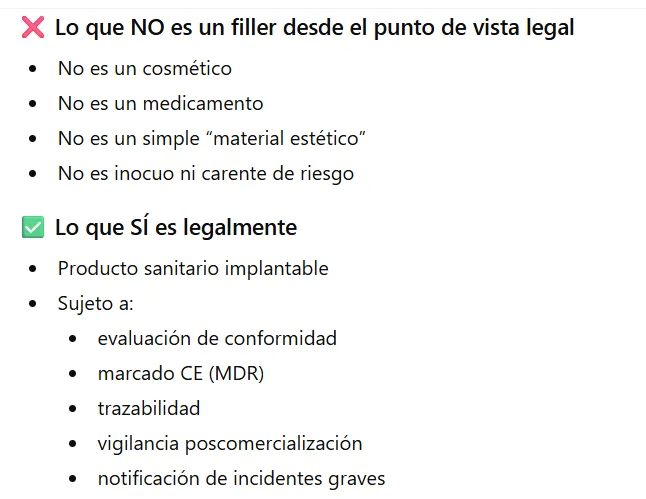 Fig 3. The legal status of a dermal filler, panel by panel: the left column lists the four things it is not, the right column the implantable-device obligations it carries under Reg. (UE) 2017/745. (UPO Sorted, Complicaciones de rellenos, Tejero 2026, p. 7) [25][3].
> Sources: [25] UPO Sorted, Tejero (Complicaciones) · [3] Reglamento (UE) 2017/745 (MDR).
Fig 3. The legal status of a dermal filler, panel by panel: the left column lists the four things it is not, the right column the implantable-device obligations it carries under Reg. (UE) 2017/745. (UPO Sorted, Complicaciones de rellenos, Tejero 2026, p. 7) [25][3].
> Sources: [25] UPO Sorted, Tejero (Complicaciones) · [3] Reglamento (UE) 2017/745 (MDR).
> Consensus: the EU regulates the product; who may inject stays national law. A CE-marked filler says nothing about operator competence [2]. > Discrepancy; none that changes the gesture: SEME's reading of Reg. 2022/2346 stresses that the common specifications do not modify Spanish professional-competence law or court criteria; the practical instruction is identical, so no averaging is needed [4].
Device or medicine: the two regimes people confuse
The single most common regulatory error is treating filler and toxin as the same kind of thing. They are governed by different regimes, and the consent language differs:
| Botulinum toxin | Fillers and energy devices | |
|---|---|---|
| Legal nature | Prescription medicine | Medical device (MDR 2017/745; Annex XVI for aesthetic use) [3] |
| Governing text | AEMPS ficha técnica | Manufacturer IFU + CE marking + Reg. 2022/2346 common specs [4] |
| Out-of-indication | "Off-label" in the strict sense (RD 1015/2009) [10] | No formal "off-label", but use outside IFU shifts liability the same way |
| Consent requirement | Justification + specific off-label consent + no adequate authorised alternative | Justification + information + documentation |
| Vigilance | Pharmacovigilance (AEMPS) | Device vigilance + serious-incident notification (AEMPS) [4] |
| Advertising to public | Prohibited (Rx medicine) [12] | Restricted (RD 1907/1996) [11] |
The toxin is a prescription medicine, so advertising the brand to the public is prohibited (§B3.7), and any use beyond the ficha técnica is off-label under RD 1015/2009 with its own consent clause [10][12]. The filler is a device, so its story is CE marking, IFU, traceability and vigilance [3][4]. Mixing the two regimes (for example, treating a filler as "off-label" or a toxin as "just a product") is where clinics misstate the consent.
Scope of practice: an acto médico invasivo
Injecting a filler or toxin is an invasive medical act. There is no MIR specialty of medicina estética in Spain, so the act is governed by general medical-degree competence, by the professional colleges' criteria, and by the intrusismo offence (Código Penal art. 403) when performed by someone without title [2][7]. Delegation to non-physicians is debated and is a live axis of the tightening regulatory wave (§B3.8, §What's new). US practice cited in the corpus differs (state law permits delegation under respondeat superior, with the physician liable for the injector's harm) and is not transposable to Spain [7].
The supranational layer behind Ley 41/2002
The Spanish consent law does not stand alone; the legal-aspects teaching grounds it in three supranational texts, which matters because they set the interpretive direction a court reads [24]: - Convenio de Oviedo (1997), the Council of Europe convention on human rights and biomedicine, ratified by Spain: art. 5.1 makes a health intervention lawful only after the person's free and informed consent; art. 9 requires prior wishes to be taken into account; art. 10.1 protects health-data privacy [42]. - EU Charter of Fundamental Rights, art. 3 ("right to the integrity of the person") requires, within medicine and biology, respect for the free and informed consent of the person concerned [42]. - Constitutional dimension (STC 37/2011, 28 March): consent and information are so tightly bound that unjustified deprivation of information equals deprivation of the right to decide, and so affects the right to physical integrity of which consent is the expression [2][24]. Consent is therefore a fundamental right, not a mere formality.
Exceptions, advance directives and therapeutic privilege
Ley 41/2002 is not absolute; the exceptions are narrow and each must be documented [1]: - Waiver (renuncia a la información): the patient may decline to be informed, but the waiver is recorded and does not remove the consent requirement. - Risk to public health and immediate serious risk to the patient's integrity where consent cannot be obtained (art. 9.2): the physician may act, informing the family when possible. In elective aesthetics these almost never apply. - Therapeutic privilege (art. 5.4): withholding information gravely harmful to the patient's health; a fatal prognosis alone does not justify it, and it is exceptional. In voluntary medicine, where the act is unnecessary, therapeutic privilege is essentially unavailable [2]. - Advance directives (instrucciones previas, art. 11): relevant to the record's completeness, rarely to an injectable act. - Consent by representation (art. 9.3): for incapacity (physical or judicially declared) and for minors who cannot understand the intervention; the representative decides in the patient's objective interest, and the mature minor is heard.
Classic trap: reading the CE mark as a competence certificate. It certifies the product under the MDR; it says nothing about whether the person holding the syringe may legally inject it. Signature of the disaster: an unlicensed injector using a CE-marked filler and a clinic that believed the mark covered them [4][29].
B3.3 · The procedure, step by step (the session seen from the law)
The legal sequence of one session. Every row is an act that leaves a dated artefact; the artefact, not the memory, is what a court reads.
| # | Step | Legal artefact it leaves |
|---|---|---|
| 1 | Assessment visit, separated from treatment when possible, always in under-25s and doubtful first visits | dated consultation note; BDD screen result |
| 2 | Hand the written consent to read, date recorded | consent handed date (distinct from act date) |
| 3 | Cooling-off ≥ 24 h elapses (urgencia exempts) [25] | two distinct dates in the record |
| 4 | Standardised pre-photo, 5 views, asymmetries marked | baseline image set (health data) |
| 5 | Signed, timed consent: product + zone named, off-label stated if applicable | consent form with date and hour |
| 6 | Separate photographic consent by purpose, revocable | second consent, care vs promotion split |
| 7 | Lot + UDI of every product recorded | traceability line (mandatory) |
| 8 | Full session note (fields of §B3.4) | contemporaneous clinical record |
| 9 | Written aftercare + emergency contact handed | delivery evidence |
| 10 | Review + post-photos logged | follow-up record |
| 11 | If incident: immediate note, insurer, AEMPS notification if a device is involved | incident report |
| 12 | If complaint: the §B3.5 protocol, conversation documented | defensive record |
The obligations that this sequence discharges are, in the Spanish legal teaching, five, derived from "a filler is an invasive medical act" (Fig 2): acto médico, professional responsibility (foreseeable and unforeseeable complications), duty to inform (specific, updated consent), traceability (brand, lot, material type) and management of adverse effects (early diagnosis, adequate treatment, record and notification) [25].
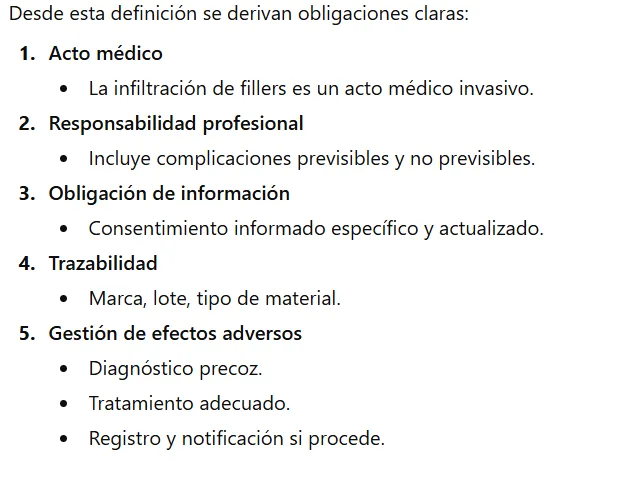 Fig 2. From "the infiltration of fillers is an invasive medical act" the teaching derives five duties, panel by panel; note that professional responsibility explicitly covers both foreseeable and unforeseeable complications, and that traceability (brand, lot, type) and notification are legal duties, not options. (UPO Sorted, Complicaciones de rellenos, Tejero 2026, p. 9) [25].
> Sources: [25] UPO Sorted, Tejero (Complicaciones).
Fig 2. From "the infiltration of fillers is an invasive medical act" the teaching derives five duties, panel by panel; note that professional responsibility explicitly covers both foreseeable and unforeseeable complications, and that traceability (brand, lot, type) and notification are legal duties, not options. (UPO Sorted, Complicaciones de rellenos, Tejero 2026, p. 9) [25].
> Sources: [25] UPO Sorted, Tejero (Complicaciones).
The assessment visit, in detail
Separating assessment from treatment is the cheapest medicolegal control there is, and in under-25s and doubtful first visits it is not optional [8][34]. What the assessment visit captures, each item a future defence: - Full history: medications (anticoagulants, immunosuppression), allergies, prior aesthetic procedures and their outcomes, relevant medical conditions, pregnancy/lactation status. - Motivation and expectation: replace "what is wrong?" with "what concerns you, what have you tried, and what do you expect?"; the answer reveals whether the goal is realistic or dysmorphic [32]. - BDD screen recorded, with the action taken on a positive result [8][30]. - Standardised baseline photography with asymmetries marked (§B3.4). - The goal in the patient's own words, written verbatim; it becomes the agreed success criterion and the anchor against later "not what I wanted". - The plan and its alternatives, including doing nothing, phased rather than sold as a package. - The consent handed to read, starting the cooling-off clock.
The visit that does all this converts a sales encounter into a documented clinical decision, which is exactly the transformation the reinforced-disclosure standard and the claims data both reward [2][26].
The consent is a process, not a signature
Valid consent has four load-bearing elements, and each can void it on its own [1][21]: 1. Disclosure of nature, purpose, alternatives (including doing nothing) and risks, at the depth the satisfactiva standard demands [2]. 2. Capacity to decide (courts presume it in a competent adult; the burden to rebut is high) [7]. 3. Voluntariness: consent given under coercion, third-party pressure or a same-day upsell is null [21]. 4. A written record that memorialises the discussion, timed and specific [7].
Consent is revocable at any moment, verbally, and the revocation is recorded in writing (Ley 41/2002 art. 8.5) [1]. A patient who withdraws mid-course stops the plan; the record notes the withdrawal and the state reached. Revocability is also why a package sold and paid up front is legally awkward: the patient may lawfully revoke the remaining sessions, and no contract binds them to an act on their own body.
The ≥ 24 h cooling-off is not a general statutory requirement in Spain for these acts ⚠, but it is the settled best practice and the direction of European regulation; the AMECLM model states it plainly (hand the consent so that at least 24 h pass between the explanation and the act) [25]. Its evidentiary value is simple: two distinct dates in the record are the cheapest defence that exists against "I was rushed". The international consent literature reaches the same conclusion from the empirical side (patients retain little of a same-day verbal briefing; time and written material raise comprehension) [20][37].
Screening and the duty to refuse (BDD gatekeeping)
Refusing the unsuitable patient is not only clinical prudence; it is a medicolegal and ethical duty. Body dysmorphic disorder is present in roughly 18.6 % of aesthetic candidates, many-fold the general-population rate, and cosmetic intervention rarely improves the core symptom while raising dissatisfaction, symptom exacerbation and legal risk [8][30][32]. Operational rules: - Screen with a validated instrument (BDDQ or a dysmorphic-concern scale) at the assessment visit; social-media-driven presentation and platform preference predict a positive screen [31]. - Refuse and refer on a positive screen: decline the procedure, document the reason, and route to mental-health care rather than to the needle [8][32]. - Name the pattern where it appears: "cosmeticorexia" (compulsive pursuit of minor corrections, often social-media fuelled) is a described presentation, not a discount code to be met [33]. - A principled-refusal standard now exists in the literature: when benefit is doubtful and the request high-stakes, declining is ethical care, not prejudice [8]. This bridges to B2 · Patient Psychology & Selection.
Capacity, the screening instruments and the refusal gradient
Capacity is decisional, not global: the patient must understand the nature and purpose, retain the information, weigh it, and communicate a choice. Courts presume a competent adult has it, so the burden to rebut is high and belongs to whoever alleges incapacity [7]. Aesthetic-relevant capacity threats are situational: acute distress, coercion, intoxication, or a fixed dysmorphic belief that no information can move.
Screening instruments for the dysmorphic concern that most threatens valid autonomy, in ascending burden: - BDDQ / BDDQ-Dermatology Version: a brief self-report screen, the usual first pass at the assessment visit [30]. - Dysmorphic Concern Questionnaire (DCQ): a short dimensional measure of appearance preoccupation. - COPS (Cosmetic Procedure Screening): designed for the cosmetic setting. - A positive screen is a stop-and-refer, not a diagnosis; the diagnosis and management belong to mental health [32]. Social-media presentation and platform preference raise pre-test probability [31].
The refusal gradient is not binary. From least to most restrictive: proceed; proceed with a reduced plan and a documented caution; defer pending a cooling-off period or a second visit; defer pending psychological assessment; decline and refer. The principled-refusal standard says that when the benefit is doubtful and the request high-stakes, moving up this gradient is ethical care, and it is documented as a clinical decision, not an apology [8].
Minors and special situations
Sanitary majority in Spain is 16 (Ley 41/2002 art. 9, as reformed in 2015): a mature minor of 16 or an emancipated minor consents personally, but for acts of grave risk the legal representative decides after the minor has been heard [1]. For elective aesthetics the position is, and should be, stricter than the floor the law sets: - Pure aesthetics in minors: no. Lip filler, "preventive" toxin, jaw reshaping on a face that is still growing. The facial skeleton does not finish growing until the mid-to-late second decade; treating a growing face volumetrically is planning on a structure that will change [35]. - Reasonable exceptions, always with the legal representative and a specific assessment: active acne and its scarring, vascular pathology, scars, burns, malformations. That is medicine, and it goes to M2 · Scar Aesthetics & Revision. - Autonomic reinforcement. In Andalucía, aesthetic surgery on minors requires a prior psychological-maturity report by an external psychologist and a surgeon's benefit report (Decreto 49/2009), and the rules are autonomically uneven ⚠; verify your community [41]. - Pregnancy and lactation are a relative contraindication for elective injectables and a documented reason to defer. - The 18–25 social-media cohort is legally adult and clinically the highest regret-risk group [34]: assessment visit always separated, BDD threshold lower, minimal doses, ask about the 10-year goal not the 10-day one, and expect to say no more often than in any other group [8][34].
Classic trap: consenting a minor's "small" lip filler on the parent's insistence and the minor's assent. Even with both, an elective act on a growing face is hard to defend, and in Andalucía it is non-compliant without the external psychological report. Signature: a regret consultation at 19 and no maturity assessment in the file [35][41].
B3.4 · Templates and documents
The consent-form content block, ready to lift. Nine elements; the first eight are the legal minimum of Ley 41/2002 art. 10 plus the corpus consent models, the ninth is the satisfactiva reinforcement [1][19][21][25].
| # | Element | Why it is there |
|---|---|---|
| 1 | Patient, physician and specific procedure and zone identified | art. 3/8; a blanket authorisation is viewed with disfavour by courts [7] |
| 2 | Product by name, and off-label / outside-IFU stated explicitly | RD 1015/2009 for toxin; MDR/IFU for devices [10][3] |
| 3 | Risks: bruising, oedema, asymmetry, infection, nodule, vascular occlusion with necrosis and with blindness, delayed reaction, insufficient result | art. 10 typical + personalised + grave-though-rare risks [1][2] |
| 4 | Temporary character and need for repetition | manages the expectation that drives most claims [26] |
| 5 | Alternatives, including abstention | art. 4/10 [1] |
| 6 | Goal agreed in the patient's own words | the accepted success criterion, and the anchor against "not what I wanted" |
| 7 | Photographic consent, separate by purpose | RGPD art. 9; different legal bases (§below) [5] |
| 8 | Signature, date and hour | the timing that proves capacity and non-rush [7] |
| 9 | Reinforced-disclosure statement (voluntary act on a healthy body; rare risks named, not silenced) | the satisfactiva standard [2] |
The corpus consent models (AMECLM-endorsed, reproduced in the UPO complications material) open with the Ley 41/2002 citation, describe the treatment, list alternatives, typical risks, personalised risks and economic responsibilities, and carry the three signatories the Spanish teaching names: informing physician, patient, and a witness [21][22][25]. Fernández-Tresguerres' medicolegal chapter gives the fullest content list in the corpus (Fig 4): personal data; name of the informing physician; procedure; brief plain-language explanation; objective, benefits and alternatives; certain consequences; typical risks; personalised risks (referring to prior health status, age, profession, patient values); probable discomfort; the patient's declaration of having received and understood the information and of the possibility to revoke; date and signatures on every page; a section for consent by legal representative; and a section for revocation [21].
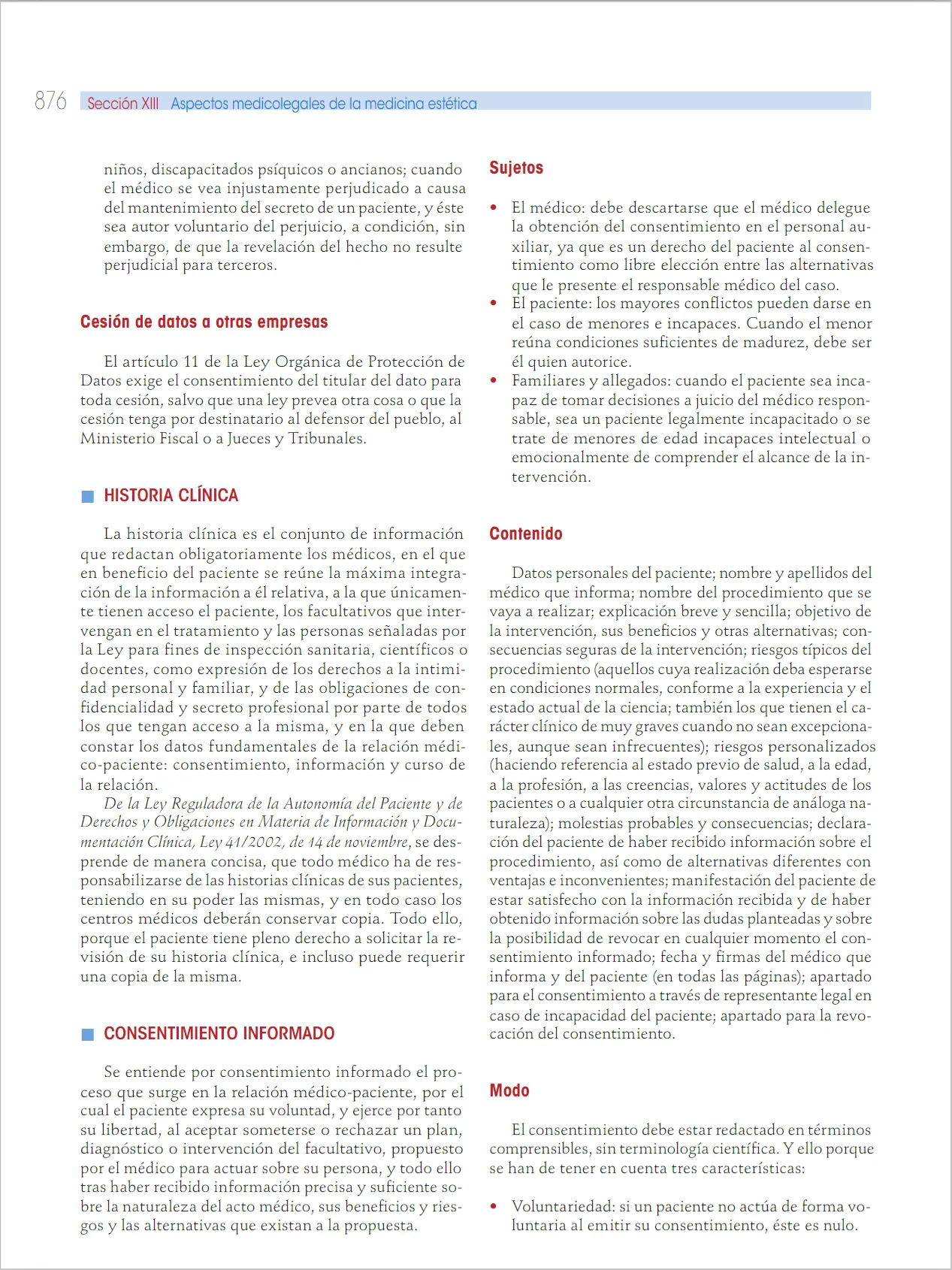 Fig 4. The consent-content list panel documents the legal minimum: objective, typical and personalised risks, the revocation clause and signatures on every page; the left column defines the clinical record as the integrated set of information on the physician-patient relationship, in which consent, information and the course of care must appear. (Fernández-Tresguerres, Medicina Estética y Antienvejecimiento, 2019, p. 901) [21].
> Sources: [21] Fernández-Tresguerres, Medicina Estética y Antienvejecimiento.
Fig 4. The consent-content list panel documents the legal minimum: objective, typical and personalised risks, the revocation clause and signatures on every page; the left column defines the clinical record as the integrated set of information on the physician-patient relationship, in which consent, information and the course of care must appear. (Fernández-Tresguerres, Medicina Estética y Antienvejecimiento, 2019, p. 901) [21].
> Sources: [21] Fernández-Tresguerres, Medicina Estética y Antienvejecimiento.
The clinical record, field by field (per session)
Not bureaucratic exhaustiveness: the only thing that holds you up in a claim [7][21].
| Field | Why |
|---|---|
| Date and hour | timing proves the process |
| Product: brand, INN/type, lot and UDI | mandatory traceability; indispensable in a recall [3][4] |
| Volume or units per zone and per side | reproduce a good result; correct a bad one |
| Plane and technique (needle/cannula, gauge) | retrospective diagnosis if a complication occurs |
| Anaesthesia used | completeness |
| Pre-existing asymmetries | the single most frequent complaint [26] |
| Goal in the patient's words | agreed success criterion |
| Intra-procedure events (blanching, disproportionate pain, vasovagal) | early-warning trail |
| Aftercare handed | duty discharged |
| Signed consent and its date | the anchor document |
The electronic-record caveat from the legal-aspects monograph: cut-and-paste paragraph templates must be tailored to the patient actually treated, or the documentation of oral consent looks manufactured and a court reads it as such [7]. A record that is byte-identical across ten patients defends none of them.
Photographic consent and data protection, operationally
Clinical photographs and the record are health data, special category (RGPD art. 9) [5][36]. Consequences that change daily behaviour: - Different legal basis per purpose. Care rests on art. 9.2.h; promotional or teaching use needs explicit art. 9.2.a consent, which cannot be folded into the care consent and is independently revocable [5][6]. Own-image rights (LO 1/1982) run in parallel [14]. - Encryption and access control, phones included. Clinical photos in a personal camera roll are a breach, not an archive [36]. - No personal WhatsApp for clinical images. - Record of processing activities (RAT) and, where the processing is high-risk, a data-protection impact assessment (RGPD art. 35) [5]. - Breach notification to AEPD within 72 h (RGPD art. 33) [5]. - Rights of access, rectification, erasure and portability; erasure does not reach what must be retained by legal obligation (the 5-year record floor wins over "delete my photos") [1][5]. - Standardised photography (fixed lighting, distance, background, views; front view from crown to sternal notch) is both a diagnostic and a defensive asset [19].
The standardised photographic protocol (why it is defensive, not vanity)
The pre-photo is the single asset that wins the commonest claim (dissatisfaction over a pre-existing asymmetry), and it only works if it is standardised, because a differently-lit "after" proves nothing and destroys the comparison [19][26]. The corpus protocol: fixed lighting and a fixed distance; a plain background (blue or black reads best); standardised views; the front view framed from the crown to the sternal notch; asymmetries marked at baseline; dynamic and static frames for toxin, and a repeat set at review [19]. The same standardisation that makes the archive diagnostically useful also makes it legally useful: it is the honest before/after the advertising rules demand (§B3.7) and the objective record the complaint protocol relies on (§B3.5). A camera roll of casual, inconsistent phone photos is neither, and is a data breach on top (§below).
Access to the clinical record, and third-party data
The record is not freely open; access is defined and limited [1][21]: - The patient has the right to access their record and to obtain a copy, with two carve-outs: third-party data contributed in confidence and the treating professionals' subjective annotations, which may be withheld. - Treating professionals access it for care; others (inspection, scientific or teaching purposes) only under the conditions the law names, bound by confidentiality and professional secrecy. - Cession of data to third parties requires the data subject's consent unless a law provides otherwise or the recipient is the Defensor del Pueblo, the Fiscalía or the courts (LOPD art. 11 principle) [6]. - Erasure and portability operate within the retention obligation: a patient may move their data but cannot force deletion of what must be kept by law [1][5].
A common error is handing over a full record including a third party's confidential information or another professional's private notes; the copy is filtered, not raw.
The off-label consent clause (toxin)
For any use outside the ficha técnica (masseter, platysmal bands, gummy smile, DAO, mentalis, nasal tip, hyperdilution, product mixtures), RD 1015/2009 requires, and the specific written consent must reflect: absence of an adequate authorised alternative, clinical justification recorded in the history, explicit statement that the use is outside authorised conditions, and respect for the ficha-técnica restrictions [10]. Not stating the off-label character is itself a consent defect [7][25].
What is off-label in daily practice, and almost never consented as such: masseter (bruxism/contour), platysmal bands, gummy smile, depressor anguli oris, mentalis, microtoxin/mesotox, nasal-tip filler, high-density jawline filler, gluteal biostimulator, calcium-hydroxyapatite hyperdilution, and product mixtures. Each is a common, defensible technique and each moves the liability the same way if the off-label character is not stated: correct technique plus a good result does not cure a consent defect [7][10][25]. The clinical justification recorded in the history is what distinguishes reasoned off-label use from careless use.
A consent-form skeleton (lift and adapt)
The corpus consent models converge on a fixed skeleton; adapt the bracketed placeholders per patient and per act. The document is legally obligatory and is kept with the clinical record [23][25]:
INFORMED CONSENT: [procedure, e.g. HYALURONIC ACID FILLER], [zone]
In compliance with Ley 41/2002, básica reguladora de la autonomía del paciente.

Patient: [name, DNI]        Informing physician: [name, colegiado nº]
Date: [dd/mm/yyyy]          Hour: [hh:mm]

1. DESCRIPTION: [what the procedure is, what product by name and lot,
   whether the use is OFF-LABEL / outside IFU and why].
2. OBJECTIVE (patient's own words): "[...]".
3. ALTERNATIVES, including doing nothing, and their pros/cons.
4. TYPICAL RISKS: bruising, oedema, asymmetry, infection, nodule,
   insufficient/temporary result, need for repetition.
5. RARE BUT GRAVE RISKS (named, not euphemised): vascular occlusion
   with skin necrosis, and VISION LOSS / BLINDNESS; delayed reactions.
6. PERSONALISED RISKS (this patient): [prior status, meds, history].
7. ECONOMIC RESPONSIBILITY: [fees, touch-up policy].
8. I have received and understood the information, resolved my doubts,
   and I know I may REVOKE this consent at any time.
9. Signatures: patient · physician · witness   (on every page).
Separate PHOTOGRAPHIC CONSENT by purpose (care / teaching / promotion),
independently revocable.
Every element maps to a legal source: the Ley 41/2002 art. 10 content list, the AMECLM model's alternatives/risks/economic-responsibility structure, and the three signatories (physician, patient, witness) the Spanish teaching names [1][21][25]. Aycardi states the same for toxin: the consent is a legal, obligatory document whose absence can itself trigger a sanction, kept with the clinical history, carrying date, patient data, side effects and the explicit authorisation [23].
Data-protection operations: what the RAT and DPIA must show
The record of processing activities (RAT) documents purposes (care vs teaching vs promotion), legal bases (9.2.h vs 9.2.a), retention, and security measures; a data-protection impact assessment is triggered where processing is large-scale special-category or uses new technologies (RGPD art. 35) [5]. A clinic that publishes patient images at scale, or uses AI photo tools, is squarely in DPIA territory. The 5-year record floor and the promotional-consent revocability must be reconciled in the retention policy: erasure of a promotional image is honoured; erasure of the clinical record is not, because a legal obligation to retain overrides it [1][5].
Classic trap: one signature for a photo used both for the record and for the clinic's social media. The bases differ (9.2.h vs 9.2.a), the revocability differs, and when the patient later asks to be taken off Instagram you discover you never had a valid promotional consent. Signature: a takedown demand you cannot cleanly honour and a possible AEPD complaint [5][6][14].
B3.5 · Frequent errors and their cost
The error grid. Column four is the price, because the error is invisible until it is billed.
| Error | Why it happens | How to avoid it | Its cost |
|---|---|---|---|
| Consent signed on the couch | It is convenient | Hand it earlier, distinct date; ≥ 24 h | Consent defect even with correct technique; damages for lack of information alone [2] |
| Blindness not named in a filler consent | It frightens | It is a rare-but-grave risk the law requires naming; explain it, don't hide it | Autonomy claim; the omission, not the outcome, is the finding [1][2] |
| Off-label use not consented as such | "Everyone does it" | RD 1015/2009: justification + specific consent | Standalone consent defect [10][25] |
| Promotional use inside the care consent | Saves a form | Distinct purposes, distinct bases, independent revocability | AEPD complaint; unusable archive [5][6] |
| Clinical photos on a personal phone | It is practical | Encrypted, controlled system | Data breach; 72 h notification; sanction [5][36] |
| Advertising the toxin brand to the public | It is what the public searches | Speak of "botulinum toxin" as a technique, not the brand | Prohibited advertising of a prescription medicine [12] |
| Before/after with different light | It sells more | Same frame, light, distance, makeup | Misleading advertising, and it destroys your own diagnostic archive [11] |
| Lot/UDI not recorded | Haste | Record every product's lot/UDI | Traceability breach; blind in a recall [3][4] |
| Delay in seeing the unhappy patient | Discomfort | See them soon, in person | Delay is the main claim multiplier [26] |
| Incident not reported to the insurer | Waiting to see if it resolves | Notify early | Late notice can exclude cover [15] |
| Pure aesthetics in a minor | Family insistence | No; growing skeleton, representative consents | Hard-to-defend elective act on a minor [35][41] |
| Incidents not notified to AEMPS | Duty unknown | Notify | It is enforceable and the first thing inspected [4] |
What the claims data actually say
The complaint in aesthetics is typically not a grave complication. It is dissatisfaction with a result in a patient who was not told that result was possible [26]. That is why consent and the pre-photo weigh more than the technique in the resolution of a conflict, and why the corpus itself records a rising claims rate against aesthetic physicians and plastic surgeons over the last decade [25]. External evidence sharpens it: - A systematic review of medicolegal challenges in facial plastic surgery finds inadequate consent and communication among the dominant, recurrent themes [26]. - An analysis of medicolegal precedents for neuromodulators and soft-tissue fillers (2008–2025) documents the specific patterns that reach litigation and their evolution [27]. - A systematic review of litigation arising from aesthetic body surgery links claims to complication clusters and to expectation management [28]. - A judicial-outcome study separating licensed from unlicensed providers (525 malpractice records, 253 eligible, licensed providers involved in 74.3 %) shows the two groups differ significantly in outcomes, settings and penalties, which is the empirical argument behind the scope-of-practice tightening [29].
The medicolegal complication rule, and why hyaluronidase is a legal item
The most-cited point of the legal-aspects monograph: the medicolegal failure is rarely causing the complication; it is failing to recognise and manage it in time [7]. A vascular occlusion managed badly and late is indefensible; managed well and early it is an informed risk that materialised. Because facial arterial anatomy varies substantially between individuals (Fig 5), occlusion is a foreseeable risk of any facial filler, which is exactly why it must be named in consent and why having in-date hyaluronidase and a written vascular-occlusion protocol is a medicolegal requirement, not a recommendation [7][25]. See J2 · Vascular Occlusion & Emergency Response and J3 · Hyaluronidase Pharmacology & Clinical Protocols.
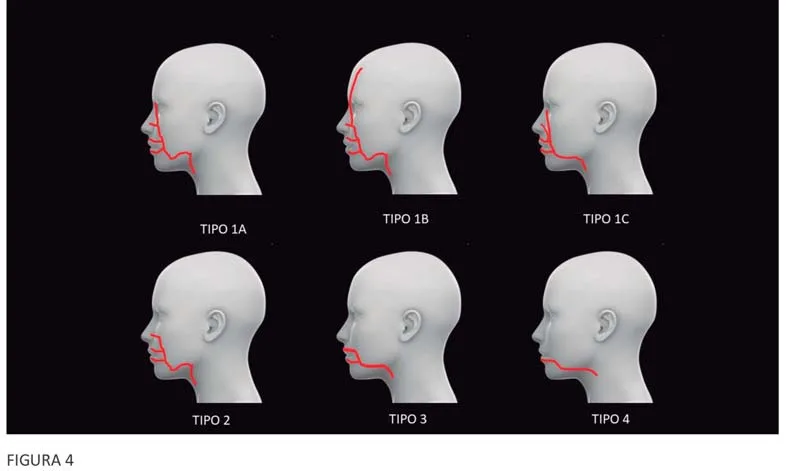 Fig 5. Six documented facial-artery course types illustrate why a "safe plane" is patient-specific and why vascular occlusion is a foreseeable, must-name risk rather than an unpredictable accident. (UPO Sorted, Efectos adversos de rellenos, Tejero 2024, p. 96, "Figura 4") [25].
> Sources: [25] UPO Sorted, Tejero (Efectos adversos).
Fig 5. Six documented facial-artery course types illustrate why a "safe plane" is patient-specific and why vascular occlusion is a foreseeable, must-name risk rather than an unpredictable accident. (UPO Sorted, Efectos adversos de rellenos, Tejero 2024, p. 96, "Figura 4") [25].
> Sources: [25] UPO Sorted, Tejero (Efectos adversos).
What to document the moment a complication happens
The complication note is written contemporaneously, because a note written days later reads as reconstruction [7][26]: - Time of onset and the sign (blanching, disproportionate pain, mottling, visual symptom). - The product, lot and volume already given, and the exact site. - The action taken and its time: reversal agent (agent, that it was in date, the amount), massage, warmth, the protocol step reached, referral or emergency activation. - Serial photographs at each review, same conditions. - The information given to the patient and the emergency path handed over. - Notifications: insurer, and AEMPS if a device is implicated.
A complication managed and documented like this is an informed risk that materialised; the same complication with a blank chart is the indefensible case of §above [2][7]. This is where the vascular-occlusion protocol (in-date hyaluronidase, written steps) proves it existed before the event, not after it [25].
The complaint-handling protocol (the sequence that defuses)
- See the patient soon, in person. Delay is the main multiplier [26].
- Listen to the whole complaint without defending.
- Re-examine and re-photograph, same conditions.
- Compare with the pre-photo in front of the patient. The single most effective intervention [26].
- Acknowledge what is acknowledgeable. Empathy is not an admission of fault; Spain has no apology law ⚠, but documented empathy has never condemned anyone and coldness has generated many claims.
- Offer a concrete plan: correction, dissolution, follow-up, or referral.
- Document everything in writing, the conversation included.
- Notify the insurer early; most policies require it and late notice can exclude cover [15].
- No cash-for-silence, no agreements signed without advice.
Two contrasting cases (same complication, opposite defensibility)
The complication does not decide the claim; the record around it does [7][26].
- Defensible. A nasolabial filler causes immediate blanching and pain. The consent named vascular occlusion, necrosis and blindness; the record shows in-date hyaluronidase, a written protocol followed at once, high-dose pulsed hyaluronidase given, the patient seen daily, photographs at each visit, and an early call to the insurer. Outcome: an informed risk that materialised and was managed to lex artis. Hard to win against [7][25].
- Indefensible. The same event, but the consent was a generic sheet signed on the couch with no mention of occlusion or blindness, no hyaluronidase on site, a two-day delay before the patient was seen, no pre-photo to compare, and an off-label product mixture never disclosed. Outcome: the technique may even have been reasonable, yet the informational branch is undefended, the emergency-preparedness duty was breached, and the delay multiplied the grievance. A losing file [2][7][10].
The two cases differ in no clinical decision at the moment of injection; they differ entirely in the documentation and preparedness built before and after it. That is the whole medicolegal lesson in one comparison.
Professional civil-liability insurance (seguro RC)
Mandatory to practise (CC arts 1101/1902 set the liability it answers) [15]. Check the three things people do not check: that it covers every technique you actually perform (laser, threads, off-label); that it is claims-made with sufficient retroactive and run-off cover; and that the policy does not exclude off-label or outside-IFU use, which would gut it for exactly the acts that generate claims. A one-line policy audit before you sign it: - [ ] Every modality performed is named (injectables, laser/EBD, threads, peels, off-label) - [ ] Retroactive cover reaches back to your first day of practice at this scope - [ ] Run-off (tail) cover survives a change of insurer or retirement - [ ] No off-label / outside-IFU exclusion - [ ] Sum insured and per-claim limit adequate for a vision-loss claim - [ ] Notification window and duties understood (early notice is a policy condition) [15]
The anatomy of a claim
A claim in aesthetics follows a recognisable sequence, and the record either interrupts it or feeds it [26][27]: 1. A gap opens between the expected and the perceived result (often an asymmetry that pre-existed and was never photographed). 2. The patient is not seen quickly, or is met defensively; the delay converts disappointment into grievance [26]. 3. The pre-photo is absent or non-standardised, so there is nothing to compare against in front of the patient. 4. The consent is generic or same-day, so the informational branch is undefended even if the technique was correct [2]. 5. The off-label or outside-IFU character was never stated, adding a standalone consent defect [10]. 6. The insurer is told late, risking exclusion [15].
The two branches a claim can run on are independent: the negligence branch (was the care within lex artis ad hoc?) and the information branch (was consent valid and reinforced?). A defendant can win one and lose the other, and in satisfactiva medicine the information branch carries an autonomous moral-damage award even where the technique was faultless [2]. The precedent analyses show the recurring fact patterns are inadequate consent, unmanaged vascular events, and unmet expectations, not exotic complications [26][27][28]. The licensed-vs-unlicensed data add the structural axis: unlicensed provision concentrates the worst outcomes and the heaviest penalties, which is the empirical case for scope-of-practice enforcement [29].
Classic trap: a claims-made policy with no run-off cover, discovered when a claim lands after you changed insurer or stopped practising. The act was covered when performed and uncovered when claimed. Signature: a covered procedure, an uncovered claim, and a personal-asset exposure [15].
B3.6 · Metrics: what is measured and its reference value
The audit table. A clinic that cannot show these numbers cannot show it is compliant; each row is measurable from the record itself. Values marked mandatory come from a norm; values marked target are governance thresholds set to that norm; values marked benchmark come from the literature and describe reality, not a rule.
| Metric | Reference value | Type | Source / how to measure |
|---|---|---|---|
| Written consent present for invasive acts | 100 % | mandatory | Ley 41/2002 art. 8.2; audit N consents / N invasive acts [1] |
| Two distinct dates (explanation vs act) | 100 %, gap ≥ 24 h (urgencia exempt) | target | AMECLM model; audit date fields [25] |
| Off-label acts with specific off-label consent | 100 % | mandatory | RD 1015/2009; audit off-label register vs consents [10] |
| Vascular-occlusion risk named in filler consent | 100 % | mandatory | Ley 41/2002 art. 10; consent-text audit [1][2] |
| Lot/UDI captured per product used | 100 % | mandatory | MDR traceability; record audit [3][4] |
| Standardised pre-photo present | 100 % of injectable sessions | target | defensive-archive audit [19][26] |
| Separate promotional-photo consent where images published | 100 % | mandatory | RGPD art. 9.2.a; publication vs consent audit [5][6] |
| BDD screening coverage at assessment | 100 % of first visits | target | screen recorded / first visits [8][30] |
| BDD positive-screen prevalence | ≈ 18.6 % expected | benchmark | validated tool; compare to your rate [8][30] |
| Verbal information retained by patient | 35–50 % | benchmark | argues for written material [20] |
| Clinical-record retention | ≥ 5 y from discharge ⚠ (CCAA up to 15–20 y) | mandatory | Ley 41/2002 art. 17; retention policy [1] |
| Data-breach notification latency | ≤ 72 h to AEPD | mandatory | RGPD art. 33; incident log [5] |
| Insurer notification latency after incident | as policy requires (days, not months) | mandatory | policy terms; incident-to-notice interval [15] |
| Serious-device-incident notification to AEMPS | filed when it occurs | mandatory | AEMPS vigilance; near-zero in practice ⚠ [4] |
| Complaint-to-first-review interval | as short as possible | benchmark | delay is the main claim multiplier [26] |
Compliance metrics: the ones an inspector reads first
The mandatory rows are binary: either the consent exists, the off-label clause is present, the lot/UDI is captured, the promotional consent is separate, or they are not. There is no partial credit and no averaging. Traceability (lot/UDI) and AEMPS incident notification are, per the regulatory teaching, the first items to be inspected as the regime tightens, and both are widely neglected today [4]. Retention is the one metric with a moving floor: Ley 41/2002 sets five years from the discharge of each process, but several autonomous communities require longer (up to 15–20 years in some norms) ⚠, and the most demanding applicable rule governs [1].
Quality and safety metrics: the ones that predict a claim
Consent completeness, the two-date gap, the pre-photo capture rate and the BDD-screening coverage are leading indicators: they fall before a claim rises. The 35–50 % verbal-retention figure is the empirical reason written material and a cooling-off period exist, not a nicety [20][37]. A BDD positive-screen rate far below the expected ≈ 18.6 % is more likely under-screening than a healthy cohort [8][30]. The complaint-to-review interval is the single most actionable operational metric, because shortening it defuses claims before they form [26].
Reading a metric against its trend, not its snapshot
A single measurement lies; the direction is the signal. Consent completeness at 100 % this quarter but slipping over three quarters is a system loosening, and it loosens before a claim appears [26]. The BDD positive rate is read the same way: a stable rate near 18.6 % says the screen works; a rate drifting toward zero says the screen is being skipped, not that the patients changed [8][30]. The complaint-to-review interval read across a year exposes whether the clinic is getting slower to face unhappy patients, which is the single most claim-relevant operational drift [26]. Track each mandatory row as a run over time, not as a quarterly pass/fail, because the failure is always visible in the slope before it is visible in the file.
Business-ethics metrics: the conflict, quantified
The structural conflict (paid to treat, not to refuse) is auditable. Two ratios expose it without moralising: the refusal/decline rate (a clinic that never says no is not screening) and whether advising staff are incentivised per billing, which converts advice into sales. A survey of aesthetic doctors found the ethical tension is real and under-addressed in training, which makes these internal metrics, not external ones, the only ones that will exist until regulation catches up [38].
The cost of each failure
A metric matters because a miss has a price; the price is what turns an audit line into a priority [1][5][15]:
| Failure | Immediate consequence | Downstream cost |
|---|---|---|
| No written consent | Undefended battery | Damages irrespective of technique; personal-asset exposure if uninsured for it [7][15] |
| Rare-but-grave risk unnamed | Informational-harm claim | Autonomous moral-damage award even with a correct act [2] |
| Off-label clause missing | Standalone consent defect | Adds a losing branch to any claim [10] |
| Lot/UDI not captured | Traceability breach | Blind in a recall; inspection finding [3][4] |
| Photo on personal phone | Data breach | 72-hour notification, AEPD sanction, reputational hit [5][36] |
| Promotional consent not separated | Invalid promotional use | Takedown demand unhonourable; AEPD complaint [5][6] |
| Late insurer notice | Possible loss of cover | The claim falls on the practitioner personally [15] |
| Delay seeing the complainant | Grievance amplified | The main claim multiplier; a manageable event becomes litigation [26] |
The table reads in one direction: the cheap act (a timed consent, a lot number, a separated photo consent, a same-day review) prevents the expensive outcome. None of the preventive acts is clinically hard; all of the consequences are.
A one-page self-audit (run it quarterly)
Pull a random sample of recent injectable sessions and check each row; a single failing mandatory row is a corrective action, not a percentage to average [1][7]: - [ ] Written consent present and timed, with a distinct explanation date - [ ] Vascular-occlusion, necrosis and blindness named in filler consents - [ ] Off-label acts carry the specific off-label clause (RD 1015/2009) - [ ] Lot/UDI recorded for every product - [ ] Standardised pre-photo present - [ ] Separate promotional-photo consent wherever images were published - [ ] BDD screen recorded at the first visit; positive-rate near the expected 18.6 % - [ ] Clinical images stored encrypted, none on personal phones - [ ] Retention policy meets the most demanding applicable period - [ ] In-date hyaluronidase and a written vascular-occlusion protocol on site - [ ] Advertising reviewed against §B3.7 (no Rx-brand to public, no bait offers, honest before/after) - [ ] Insurance covers every technique actually performed, off-label included, with run-off
The value of the audit is that it surfaces the mandatory failures before an inspector or a claimant does. The business-ethics ratios (refusal rate above zero, no per-billing incentive for advisors) sit beside it as the only internal check on the paid-to-treat conflict until regulation externalises it [38].
Classic trap: reporting an averaged "consent-compliance score" of 96 %. The mandatory rows are not averageable; a 96 % on written-consent presence means 4 % of invasive acts had none, which is 4 % of your acts sitting as undefended battery. Signature: a green dashboard and a red file [1][7].
B3.7 · The Spanish particularity
Spain is its own case for reasons that change the defence you build, not just the vocabulary you use. Four features set it apart. First, the medicina satisfactiva doctrine: a voluntary act on a healthy body carries a heightened, reinforced duty to inform, and the burden of proving that information was given falls on the physician (facilidad probatoria) [2]. Second, the constitutional weight of consent: the Tribunal Constitucional ties an unjustified failure to inform to the right to physical integrity, so a consent defect is a fundamental-rights problem, not a paperwork lapse [2][24]. Third, a health-advertising regime that takes the prescription-medicine ban literally, so advertising the toxin brand to the public is prohibited, and this is the rule the sector breaks most often [11][12]. Fourth, a federal texture: retention periods, minor restrictions and centre authorisation are set autonomically and vary, so the applicable rule is the most demanding one that reaches you [1]. Underneath all four sits the fact that there is no MIR specialty of medicina estética, so competence is governed by the general medical degree, the colleges and the intrusismo line rather than by a board certification [2]. Each is taken in turn below.
Medicina satisfactiva: obligation of result or of means?
This is the axis on which Spanish aesthetic liability turns, and it has moved. The conflict, preserved with both positions rather than averaged:
> Consensus (what every school now does): treat the act as governed by lex artis ad hoc, disclose to the reinforced standard, and keep the burden of proof of information in mind as yours [2]. > Discrepancy; historical vs current doctrine, and it changes the theory of your defence: > · Obligation of RESULT (historical): voluntary medicine as a contrato de obra; the Supreme Court from STS 25-abr-1994 held that satisfactiva medicine "surpasses the scope of an obligation of means to approach, without fully merging into, an obligation of result", so proving the promised result failed could suffice [2]. > · Obligation of MEANS (current, consolidated): STS 3-oct-2000 (Sala 1ª, ponente Xiol) defines the means/result distinction; STS 230/2014 de 7 de mayo states the physician's obligation is of means, not result, and situates informed consent as an essential element of the lex artis; STS 250/2016 de 13 de abril and STS 828/2021 de 30 de noviembre confirm that in voluntary procedures transparency must be extreme. Liability now attaches to negligent conduct, not to a disappointing but non-negligent result, but the duty to inform is heightened [2]. > Decide by: whether the claim is about the outcome (judged now under means + reinforced disclosure) or about a distinct informational harm. The autonomous moral-damage claim for defective information survives even where the technique was correct [2].
The reinforced-disclosure rule, in the court's own logic: in voluntary medicine "the requirement of information detail increases", because the act is unnecessary and a patient who truly understood the rare risks might desist, so silencing the exceptional risks to avoid deterring the patient is precisely what the law forbids (STS 21-oct-2005 line, carried into STS 250/2016) [2]. Practical translation: name blindness, name necrosis, in the filler consent.
The Spanish case-law spine, dated
The UPO legal-aspects teaching anchors the doctrine in a datable chain, which is worth keeping because it shows the direction is one-way toward more disclosure, not less [24][2]: - STS 22-nov-2007: information must be "objective, truthful, complete and accessible", and must include the probability of failure and any sequelae, risks or adverse results, permanent or temporary, regardless of their frequency, precisely to avoid silencing the exceptional risks that might make a patient decline an unnecessary act [24]. - STC 37/2011 (28 March): raises consent to a constitutional right, tying deprivation of information to deprivation of the right to physical integrity [2]. - STS 20-ene-2011 and STS 17-jun-2015: carry the reinforced-disclosure line into the modern satisfactiva cases [24]. - STS 15-feb-2017 (RJ 2017, 583): restates that satisfactiva/voluntary medicine requires more rigorous information than curative medicine, because the patient has a wider margin to decline given the act's lack of necessity [24]. - STS 230/2014, 250/2016, 828/2021: consolidate the obligation of means plus reinforced disclosure and extreme transparency in voluntary acts (§above) [2].
The through-line: the technique standard relaxed (means, not result), while the information standard tightened. A clinic that modernised its technique but not its consent process is defending on the branch the courts made stricter.
Burden of proof and the limits of consent
The burden of proving that adequate information was given rests on the physician (facilidad probatoria: the party with the easy access to the evidence bears it). A consent form is the evidence, not a shield: it does not act as a defence against a claim of negligent care, and the contencioso-administrativo chamber has held that consent does not oblige the patient to assume risks arising from an inadequate provision of care (SSTS 3ª, 10-oct-2000 and 7-jun-2001) [2][7]. So the record must show two separate things: that you informed (autonomy branch) and that you acted within the standard of care (negligence branch); winning one does not win the other [7].
Health advertising in Spain: the regime, not the marketing how-to
The Spanish rules on health/aesthetic advertising are stricter than the sector behaves as if they were: - RD 1907/1996 on advertising of products and services with a claimed health purpose: art. 4 lists the prohibitions (attributing preventive/curative properties without proof, guaranteeing results), art. 7 the truthfulness duty [11]. - Ley 34/1988 General de Publicidad: misleading and unfair advertising [12]; arts 27/102 LGS reinforce it [9]. - Ley 34/2002 (LSSI-CE): electronic-commerce and identification duties for online and social-media promotion [13]. - Colegial deontological codes, which in practice are what get applied disciplinarily. - Autonomic authorisation of health centres and of their advertising ⚠. - The keystone the sector breaks most: advertising a prescription medicine to the public is prohibited, and botulinum toxin is a prescription medicine. Advertising "botox" to the public is advertising a prescription drug [12]. Speak of "botulinum toxin" as a technique, never the brand as a product.
Practical rules that avoid nearly all of it: do not name prescription-medicine brands to the public; before/after with identical frame, light, distance and makeup (or none) and specific revocable consent (a retouched or differently-lit photo is misleading advertising and destroys your own diagnostic archive) [11]; no result guarantees ("guaranteed", "risk-free" or "no-pain" wording is attackable); label paid collaborations (#publi, #colaboración), including for health professionals [13]; no consumer bait offers ("2x1 on lips", countdowns, book-today discounts), which are the pattern the European regulatory wave is chasing; no treatments raffled or given as prizes; testimonials only with consent and never as if they were efficacy evidence. The UK ASA doctrine, though not applicable in Spain ⚠, is the most developed on non-surgical aesthetics and anticipates what arrives via the EU; cite it as criterion, not as a norm in force here.
The concrete standards, as a grid you can apply before publishing:
| Content | Allowed | Not allowed |
|---|---|---|
| Prescription-medicine brand | The technique named generically ("botulinum toxin") | The brand ("botox") to the public [12] |
| Before/after image | Same frame, light, distance, makeup (or none), specific revocable consent | Retouched, differently-lit, cropped-to-flatter (misleading) [11] |
| Result promise | Realistic, individualised expectation | "Guaranteed", "risk-free", "no-pain" wording [11] |
| Testimonial | With consent, as opinion | As if it were efficacy evidence [11] |
| Commercial content | Labelled (#publi, #colaboración) |
Undisclosed paid collaboration [13] |
| Offer | Standard pricing | Bait offers, countdowns, "book-today" discounts, raffles/prizes |
| Minors | Not targeted | Any aesthetic-procedure advertising aimed at under-18s |
The unifying test: would the claim survive being read by the colegio and by a consumer-protection authority at once? If not, it is not marketing, it is exposure.
The colleges and the scientific societies
Two non-statutory actors shape Spanish practice as much as the norms: - Colegial deontological codes. In practice these are what get applied disciplinarily most often, faster and with a lower threshold than a civil court. Advertising infractions, boundary violations and undignified commercial conduct are colegial matters before they are judicial ones, and a colegial file carries reputational and licence consequences the civil route may not. - Scientific societies (SEME and others). They press to delimit the acto médico against intrusismo, publish practice standards, and interpret the moving product regulation for the sector (for example, SEME's reading that Reg. 2022/2346 regulates the product without changing who may inject in Spain) [4]. Their standards are not law, but they define the lex artis a court will measure you against, so they function as soft law.
The operational consequence: compliance is judged on three planes at once, the statutory (BOE/DOUE), the colegial (deontology), and the lex artis the societies articulate, and the strictest applicable one governs each act.
Cross-border and autonomic reality
Retention periods, minor restrictions and advertising authorisation are autonomically uneven ⚠; the most demanding applicable rule governs, and the practice must know its own community's. Cosmetic tourism adds a cross-border layer (patients treated abroad, complications managed at home, unclear liability and record continuity), a pattern that intensified around the pandemic and persists [39]. Cross-border care raises three concrete problems: record continuity (the treating clinic's notes and lot/UDI are abroad and often unavailable when a complication is managed at home), unclear liability and jurisdiction (which country's standard and which insurer answer), and advertising reach (a campaign lawful abroad may be judged by Spanish rules for a Spanish audience). Practical stance: document what the patient can tell you about the product and provider, treat the complication on its merits, and keep your own record as if you were the primary provider.
Telemedicine and remote consent
Remote consultation is compatible with valid consent only if the four elements survive the medium [1]: identity and capacity verified, information genuinely understood (not a scrolled-past checkbox), voluntariness (no same-session pressure), and a written, timed record. An invasive act is never consented purely by a remote click for a first, in-person procedure; the assessment and the physical examination remain in-person duties. Where the remote channel is used, the data-protection surface grows (recorded video and shared images are special-category data), so the same encryption, purpose-separation and 72-hour breach rules apply [5][36].
> [MATERIAL GAP] The MEDLIB corpus is thin on the advertising/publicidad-sanitaria facet: the B3.4 retrieval (advertising/social-media) returned a mean top-score of 0.441 (run-ids B3.4-20260823), the lowest of the nine subchapters, and no corpus monograph resolves RD 1907/1996 or the Rx-advertising ban. This block therefore rests on the external regulatory lane (the norms themselves: BOE/DOUE), which is the correct source of truth for a norm, not on the corpus. The scout flagged this as a CORPUS_ACQUISITION_GAP; it is declared, not filled from memory.
Classic trap: running a "botox 2x1, this week only" story with a before/after in flattering light. It stacks three infractions: advertising a prescription medicine to the public, a consumer bait offer, and misleading imagery. Signature: a colegial disciplinary file that costs more than the campaign earned [11][12][13].
B3.8 · Organisational alternatives
There is no single compliant way to run the ethics of a clinic; there are stances, and each has a price you pay in a different currency. The choice is real because defaulting to none lands you in the market model by drift, which is the one posture with a regulatory expiry date [11]. Four axes are chosen, explicitly or by omission: the documentation-and-refusal posture (defensive to permissive); the conflict-of-interest bindings (whether advisors are paid per sale, whether plans are phased or sold as packages) [38]; the delegation model (physician-only versus supervised non-physician injection, constrained in Spain by the acto médico and intrusismo) [2][29]; and the consent-document technology (paper versus versioned electronic) [5]. Each axis has a defensible setting and a cheap-but-costly one, and the empirical case for the conservative end is the licensed-versus-unlicensed outcome gap, where looser provision concentrates the worst results and the heaviest penalties [29]. The subsections below lay out the stances, the binding mechanisms, the liability map and the one-page governance policy that turns a posture into defensive evidence.
The four stances
| Current | Thesis | Consequence |
|---|---|---|
| Defensive | Maximum documentation, low threshold to decline | Slower, less profitable short-term, almost unassailable |
| Autonomist | An informed adult decides; the physician executes | Comfortable until autonomy is compromised (BDD, coercion) [8][32] |
| Clinical paternalism | The physician defines what is appropriate and refuses the rest | Protects the patient; collides with Ley 41/2002 if it withholds information [1] |
| Consumer / market | Customer service, aggressive commercial communication | The model the regulatory wave of §What's-new is chasing [11] |
The defensible operating point is defensive on documentation and refusal, autonomist on the menu of options, and never paternalist about information: you may decline to do a procedure, you may not decline to inform about it [1][8].
Conflicts of interest, and how to bind them
The physician-as-vendor is the specialty's built-in conflict, and it is manageable, not eliminable [38]: - Financial incentive to upsell. Bind it: a phased plan instead of a package sale, and no per-billing incentive for the staff who advise. A survey of aesthetic doctors documents that commercial pressure is felt and under-taught, which is why the binding must be structural, not a good intention [38]. - Device- and product-company relationships. Disclose them; do not let a sponsorship dictate the product on the tray. Naming brands is fine in this private wiki; naming them because a company paid for it is the conflict. - The refusal muscle. A clinic that never declines is not screening. "Saying no" when benefit is doubtful is now framed in the literature as ethical care, not lost revenue [8]. - Commercial pressure vs best interest. The tie-breaker is written into the consent goal in the patient's own words: if the plan drifts from that goal toward the higher-margin option, the record shows it.
Consent-document models: paper vs electronic + versioned
Both are compliant; they fail differently. Paper is simple and hard to version (a "which version did they sign?" problem after you update your risk list). Electronic consent with versioning timestamps the exact text signed and survives an update, which is the model B4 develops; the trade is data-protection surface (the electronic store is itself special-category data) [5]. See B4 §B4.4 for electronic consent and versioning, and B4 §B4.2 for the clinical-record/off-label register.
Delegation and clinic-structure models
- Who injects. Physician-only versus supervised delegation to non-physicians is the live, contested axis. The empirical argument against loose delegation is the licensed-vs-unlicensed outcome gap (significantly worse outcomes, settings and penalties for unlicensed providers) [29]. In Spain the act is an acto médico and delegation is constrained by intrusismo; the tightening regulatory wave points toward more titulation and premises requirements, not fewer (§What's-new) [2].
- Clinic structure. Sole practitioner, group, and franchise distribute liability differently: the sole practitioner carries it directly; a group must define who holds the consent and record duties; a franchise adds a brand whose advertising you do not fully control but may be judged by. Whichever the structure, the insurance must match the acts actually performed, with retroactive and run-off cover, and must not exclude off-label or outside-IFU use [15].
- Competency and certification. Documented training and a competency register are both an ethical duty and the first thing the tightening regime will demand; route this to B10 · Competency, Assessment & Certification Pathway.
Managing the conflict of interest, mechanism by mechanism
Declaring "I have a conflict" changes nothing; binding structures do. Each mechanism below converts an incentive into a control [8][38]:
| Incentive to bind | Binding mechanism | What it prevents |
|---|---|---|
| Advisor paid per sale | Fixed salary for consultation staff, no per-billing bonus | Advice becoming a sales pitch |
| Package selling | Phased plan priced per session, re-consented each stage | Locking a patient into volume they may not want |
| Sponsor-driven product choice | Disclosed device relationships; product chosen on clinical fit | The tray dictated by the last sponsor |
| Same-visit upsell | Assessment separated from treatment; cooling-off | Decisions made under in-chair pressure |
| "Never say no" culture | Refusal rate audited above zero; documented declines | Screening quietly abandoned |
| Goal drift toward margin | Goal recorded in the patient's words; deviations visible | Silent substitution of a higher-margin plan |
The point is structural, not moral: a clinician of ordinary goodwill still drifts toward the market model under the wrong incentives, so the incentives, not the intentions, are what get engineered [38].
The delegation debate, and where the liability lands
"Who may inject" is the contested axis, and the answer changes the liability map. A compact view of where responsibility falls:
| Actor | Typical exposure | Note |
|---|---|---|
| Injecting physician | Direct civil liability (CC 1101/1902), lex artis and information | The default holder in Spain [15] |
| Supervising physician (delegation) | Liable for the delegate's harm within scope | US doctrine of respondeat superior; not transposable to Spain, where the act is an acto médico [7] |
| Non-physician injector | Intrusismo exposure (CP art. 403) plus civil liability | The unlicensed group concentrates the worst outcomes [29] |
| Clinic / centre | Organisational, record and advertising duties; authorisation | Autonomic centre authorisation ⚠ |
| Manufacturer | Product liability, vigilance, recall | MDR duties; separate from the clinical act [3][4] |
In Spain the injectable act is an acto médico invasivo, delegation to non-physicians is constrained by intrusismo, and the tightening regulatory wave points toward more titulation, not looser delegation (§What's new) [2][40]. The empirical case is the licensed-vs-unlicensed outcome gap: significantly worse clinical outcomes and heavier judicial penalties for unlicensed provision [29]. Route competency evidence to B10 · Competency, Assessment & Certification Pathway.
Writing the posture down
A stance that lives only in the owner's head is not a stance; staff default to the market model without one. Put four decisions in a one-page internal policy: 1. Who may perform which act, and the supervision rule, matched to titles and the acto médico line [2]. 2. The refusal policy: the screening step, the positive-screen action, and that declining is a valid, logged clinical decision, not a lost sale [8]. 3. The consent process: hand-in-advance, cooling-off, the timed form, and the separated photographic consent [1][25]. 4. The advertising rules: no prescription-brand to the public, no bait offers, honest before/after, labelled collaborations [11][12][13].
The written policy is itself defensive evidence: it shows a system, not an improvisation, and a system is what a court and an inspector both expect to see. It also makes the paid-to-treat conflict visible enough to be governed, which is the only place it is ever actually managed [38].
What to do today, whichever model you pick
Complete per-session traceability (lot/UDI); notify device incidents to AEMPS; keep documented training and a competency register; a written emergency protocol with in-date material (hyaluronidase); and review your advertising against §B3.7 before someone else reviews it [4][7].
Classic trap: adopting the market model by default (packages, per-billing bonuses, aggressive social media) while believing you are "just being competitive". It maximises exactly the behaviours the regulatory wave targets and the claims data punish. Signature: high volume, high complaint rate, and a business built on the one model with a regulatory expiry date [11][29].
B3.9 · The tightening non-surgical regulatory wave
The regime you work under is moving on three fronts at once, and the direction is one-way toward more titulation, more premises requirements and more traceability. All of B3.9 is ⚠ regulation in motion; verify the date and scope at the source (BOE, DOUE, autonomic bulletin) before any business decision.
1. United Kingdom: risk-tiered licensing (not applicable in Spain, but the reference standard). Section 180 of the Health and Care Act 2022 empowers a national licensing scheme for non-surgical cosmetic procedures. After a 2023 consultation, the DHSC published its consultation outcome on 7 August 2025 (11,848 responses) proposing a three-tier red/amber/green system: green (low risk) by any licensed practitioner to agreed standards; amber (medium risk) by non-healthcare practitioners only under a named regulated professional's oversight; red (highest risk, invasive body procedures) restricted to regulated healthcare professionals in CQC-registered premises [40]. Botox and standard fillers fall in the lower tiers. The scheme is not yet in force; further consultation precedes legislation. A separate under-18 ban on botox/filler has applied since October 2021, and in July 2025 38 botulism cases were recorded in England after suspected unlicensed products, sharpening the scope-of-practice argument [40]. Spain will cite this doctrine before it arrives via the EU.
2. European Union: MDR 2017/745, Annex XVI. The structural change is that the MDR brought non-medical-purpose products (dermal fillers, cosmetic lasers/IPL, lipolysis devices) into the device regime; Implementing Reg. (UE) 2022/2346 fixes their common specifications, with dermal fillers in Annex IV, applicable from 22 June 2023 [3][4]. A filler can no longer shelter behind "it is not a medical product". The common specifications regulate the product, not professional competence, which stays national [4].
3. Spain: AEMPS, autonomous communities and scientific societies. Authorisation and registration of health centres by each autonomous community; product vigilance and serious-incident notification to AEMPS; and pressure from the scientific societies (SEME among them) to delimit the acto médico against intrusismo. The empirical case for tightening is the licensed-vs-unlicensed outcome gap, where unlicensed provision concentrates the worst outcomes and the heaviest penalties [29]. The direction is unequivocal: more qualification, more premises and more traceability requirements [2]. Three Spanish mechanisms carry it: autonomic authorisation and registration of health centres (a centre that injects must be an authorised sanitary centre, and the authorisation conditions vary by community ⚠); AEMPS product vigilance, where a serious device incident must be notified and a product recall acted on; and the intrusismo offence (Código Penal art. 403), which criminalises performing the medical act without title and is the legal edge the societies push against non-physician injection [2]. The recurring confusion to resist: the EU common specifications regulate the product, and none of them authorises a non-physician to inject; competence stays a national question answered by the medical degree, the college and the intrusismo line [4].
Where each front does and does not bind you today:
| Front | In force now? | Binds a Spanish clinic? |
|---|---|---|
| MDR + Reg. 2022/2346 (product) | Yes (specs applicable 22-Jun-2023) | Yes: CE, traceability, vigilance on the product [3][4] |
| UK three-tier licensing (competence) | No (proposal, consultation outcome Aug-2025) | No: reference standard only [40] |
| Spanish autonomic centre authorisation | Yes, community by community ⚠ | Yes, per your community [2] |
| AEMPS incident notification | Yes | Yes, and widely neglected [4] |
| Intrusismo (CP art. 403) | Yes | Yes, defines who may perform the act [2] |
What to do today (the only actionable part): - Full per-session traceability (lot/UDI): already a duty and the first thing an inspection reads [4]. - Notify device incidents to AEMPS: enforceable and widely neglected [4]. - Documented training and a competency register: route to B10 · Competency, Assessment & Certification Pathway. - A written emergency protocol with in-date material (hyaluronidase) [7]. - Review the advertising against §B3.7 before someone else reviews it [11].
Classic trap: citing the UK scheme as if it were Spanish law, or assuming the EU common specs already restrict who may inject. Neither is true today; the product regime is EU, the competence regime is national, and the UK tiers are a proposal, not a norm in force here. Signature: a compliance decision built on a rule that does not yet bind you [4][40].
Coverage vs UPO
The UPO master teaches this subject through the legal-aspects deck of Oliva Blázquez (Catedrático de Derecho Civil, UPO) and the complications material of Tejero. Its table of contents is the checklist below; every UPO topic is covered, and the atlas adds the EU-product, data-protection-operational, screening-evidence and moving-regulation layers UPO does not develop [24][25].
| UPO topic (T1.5 / complications) | Status in this chapter | What the atlas adds |
|---|---|---|
| Autonomy: from paternalism to self-determination | Covered (header, §B3.2 ethics) | The four-stance organisational grid and the structural conflict (§B3.8) [8][38] |
| Informed consent: concept + constitutional dimension (STC 37/2011) | Covered (§B3.2, §B3.3) | The consent-form content block ready to lift (§B3.4) [1][21] |
| Information: content, esp. in medicina satisfactiva | Covered (§B3.7) | The confirmed STS line (230/2014, 250/2016, 828/2021) plus the outcome/informational-harm split (§B3.7) [2] |
| Characteristics and form of information | Covered (§B3.3) | The 35–50 % retention benchmark and the ≥ 24 h cooling-off metric (§B3.6) [20][25] |
| Consequences of failing to inform | Covered (§B3.5) | Quantified claims data (licensed vs unlicensed, precedent analysis) (§B3.5) [26][27][29] |
| Consent: capacity, exceptions | Covered (§B3.3) | The four load-bearing elements and the couch-signature trap (§B3.3) [1][7] |
| Minors and cosmetic surgery in Andalucía | Covered (§B3.3) | The Decreto 49/2009 external-psychologist requirement and the 18–25 regret cohort (§B3.3) [35][41] |
| Civil liability: contractual/extracontractual, negligence | Covered (§B3.2, §B3.5) | Insurance verification (claims-made, run-off, off-label) (§B3.5) [15] |
| Obligation of means vs result in satisfactiva | Covered (§B3.7) | The consensus/discrepancy grid with the historical-to-current shift (§B3.7) [2] |
| Data in health practice: dato de salud, DPO, access | Covered (§B3.4) | The 72 h breach rule, DPIA, 9.2.h vs 9.2.a split, image rights (§B3.4) [5][6][14] |
| Filler = invasive medical act, five obligations (Tejero) | Covered (§B3.3, Fig 2) | The MDR/Annex XVI product regime behind it (§B3.2, Fig 3) [3][4] |
| The aesthetic physician facing a complaint (Tejero) | Covered (§B3.5) | The nine-step defusing protocol and the delay-is-the-multiplier metric (§B3.5) [26] |
Topics UPO does NOT cover, added here:
| Absent in UPO | Added by the atlas |
|---|---|
| EU MDR Annex XVI + Reg. 2022/2346 dermal-filler common specs | §B3.2, §B3.6, Fig 3 [3][4] |
| The prescription-medicine advertising ban applied to "botox" + RD 1907/1996 detail | §B3.7 [11][12] |
| BDD screening evidence base (≈ 18.6 % prevalence, social-media predictors, cosmeticorexia) | §B3.3, §B3.6 [8][30][31][32][33] |
| The tightening regulatory wave (UK licensing, EU, AEMPS/SEME) | §What's new [40] |
| Clinical-photography data-protection operations (encryption, no personal WhatsApp, 72 h) | §B3.4 [5][36] |
| Cosmetic tourism and cross-border liability | §B3.7 [39] |
UPO is the fastest-ageing lane here: it is legally precise for Spain in its year but predates the 2022/2346 dermal-filler specs, the 2025 UK consultation outcome and the recent BDD-screening literature. A dose or a rule resting only on a UPO slide is never_sufficient_alone; every UPO-sourced claim above is corroborated by a norm or by external evidence [24][25].
Self-assessment
Ten recall questions, built only from facts stated above. Answer, then unfold.
- Which article makes consent written-mandatory, and for which acts?
Answer
Ley 41/2002 art. 8.2: written consent is mandatory for surgery, invasive procedures and any procedure with a foreseeable, appreciable negative impact. Filler and toxin qualify [1].- What is the cooling-off minimum between explanation and act, and where does the number come from?
Answer
≥ 24 h (urgencia exempts). It is best practice, not a general statute, and comes from the AMECLM consent model reproduced in the corpus [25].- What is the expected BDD prevalence among aesthetic candidates?
Answer
≈ 18.6 %, many-fold the general-population rate; a rate far below this suggests under-screening, not a healthy cohort [8][30].- How much verbal information does a patient typically retain, and what follows?
Answer
Only 35–50 %, which is the empirical reason for written material and a cooling-off period [20].- What is the clinical-record retention floor, and the caveat?
Answer
≥ 5 years from the discharge of each process (Ley 41/2002 art. 17); several autonomous communities require longer (up to 15–20 years) and the most demanding rule governs ⚠ [1].- What is the personal-data-breach notification deadline, and to whom?
Answer
≤ 72 h to the AEPD (RGPD art. 33) [5].- What is the sanitary majority in Spain, and who decides for grave-risk acts?
Answer
16 years (Ley 41/2002 art. 9, 2015 reform); for acts of grave risk the legal representative decides after the minor has been heard [1].- What does RD 1015/2009 require for off-label toxin?
Answer
Absence of an adequate authorised alternative, clinical justification recorded in the history, explicit specific written consent stating the use is outside authorised conditions, and respect for the ficha-técnica restrictions [10].- What is the current liability standard for medicina satisfactiva?
Answer
Obligation of means, not result (STS 230/2014, 250/2016, 828/2021), with a heightened, reinforced duty to inform; a distinct informational-harm claim survives even where the technique was correct [2].- Why is in-date hyaluronidase a medicolegal item, not just a clinical one?
Answer
Facial arterial anatomy varies (Fig 5), so vascular occlusion is a foreseeable, must-name risk; the medicolegal failure is not causing it but failing to recognise and manage it, so an in-date hyaluronidase stock plus a written vascular-occlusion protocol is required [7][25].What's new and trends (2022–2026)
The ethics-consent-medicolegal spine is stable; the movement is in product regulation, screening evidence and scope of practice. Dated changes, each tied to a reference already in this chapter:
| Date | Change | Ref |
|---|---|---|
| Dec 2022 | Implementing Reg. (UE) 2022/2346 adopted (1 Dec), fixing common specs for Annex XVI non-medical-purpose products; dermal fillers in Annex IV | [4] |
| 2022 | Dutch Hyacorp filler episode cited as the case that justified tighter EU device rules | [18] |
| Jun 2023 | Reg. 2022/2346 common specs become applicable (22 Jun 2023): fillers evaluated as if medical devices | [4] |
| 2023 | Positive-BDD-screening prevalence data in cosmetic facial candidates published; international consent-standard work in plastic surgery | [30][37] |
| 2025 | UK DHSC consultation outcome (7 Aug 2025, 11,848 responses) proposing a three-tier red/amber/green licensing scheme (not yet in force); systematic review of medicolegal challenges in facial plastic surgery; adolescent cosmetic-surgery medico-legal review; teen-beauty-trend ethics; survey of ethics in aesthetic practice; social-media platform preference as a BDD predictor; systematic review of aesthetic-body-surgery litigation | [40][26][35][34][38][31][28] |
| Jul 2025 | 38 botulism cases recorded in England after suspected unlicensed botulinum products, driving the scope-of-practice argument | [40] |
| 2026 | Analysis of medicolegal precedents for neuromodulators and soft-tissue fillers (2008–2025); licensed-vs-unlicensed judicial-outcome study; psycho-dermatological BDD review; cosmeticorexia described; principled-refusal ("saying no") standard formalised | [27][29][32][33][8] |
Maturity of each current direction. The trends are not equal in evidential weight; classify before you act on them:
| Direction | Maturity class | Action |
|---|---|---|
| MDR/2022/2346 traceability, off-label consent clause, AEMPS incident notification, separated photographic consent, in-date hyaluronidase | clinically actionable now | Already law or duty; implement today [3][4][10] |
| BDD digital pre-visit screening at scale; teach-back consent; risk-tiered licensing as a model | promising but not validated | Adopt cautiously; the outcome evidence is still forming [8][31][40] |
| Immutable consent versioning; standardised icon-array risk communication | preclinical/speculative | Watch only; no outcome data yet (see §Unexplored) |
| "Regulation-proof" clinic packages, "guaranteed results", advertising the "botox" brand to the public | unsupported commercial claim | Reject; illicit or unevidenced, and the target of the tightening regime [11][12] |
What did NOT change, and why the older anchors are still the state of the art. The load-bearing law and ethics predate this window and remain current because they are bedrock, not empirical claims that decay: - Ley 41/2002 is still the básica reguladora of patient autonomy; the 2015 minor reform refined art. 9, nothing displaced the spine [1]. - The four-principle account (Beauchamp & Childress) remains the ethical substrate the Spanish teaching uses; a 2022 critique refines common-morality theory without unseating the four principles [16][17]. - The reinforced-disclosure doctrine runs unbroken from the late-1990s satisfactiva line to STS 828/2021; the direction of travel only strengthens it [2]. - The reasonable-duty / lex-artis-ad-hoc standard in the legal-aspects monograph is unchanged; consent remains a process and the written record remains the best evidence [7].
So the corpus's older Spanish legal monographs and the UPO deck are not stale on the doctrine; they are stale only on the product regime (MDR/2022/2346), the screening evidence and the regulatory horizon, which is exactly where this chapter adds the external lane [3][4][8][40].
Unexplored directions (AI speculation)
> [IA-ESPEC] This section is AI speculation, not evidence. Nothing here is a recommendation, a dose, a product or a protocol. Each item states an anchor already cited in the chapter, a proposal, and what would settle it. It marks open questions; it is never to be acted on clinically.
-
[IA-ESPEC] Teach-back consent and informational-harm claims. Anchor: patients retain only 35–50 % of a verbal briefing [20], and the dominant claim is defective information [26]. Proposal: recording a short structured "teach-back" comprehension check inside the consent process might raise retained information and lower informational-harm claims more than adding text to the form. Expected effect: higher documented comprehension and a lower rate of information-based complaints versus standard consent. Confounder: patients who engage with a teach-back step may be more health-literate at baseline, inflating the apparent effect. What would settle it: a randomised comparison of standard versus teach-back consent, measuring documented comprehension and the later rate of information-based complaints.
-
[IA-ESPEC] Digital pre-visit BDD screening. Anchor: expected BDD prevalence is ≈ 18.6 % [8][30] and social-media platform preference predicts a positive screen [31]. Proposal: a validated self-administered digital pre-visit screen might close the gap between detected and expected prevalence without lengthening the consultation. Expected effect: detected positive-screen rate rises toward the ≈ 18.6 % expected, with no increase in visit duration. Confounder: self-report and self-selection bias (dysmorphic patients may under- or over-report on a digital screen), plus platform demographics. What would settle it: a prospective study comparing a digital pre-screen against clinician screening on positive-detection rate and downstream regret or claims.
-
[IA-ESPEC] Evidence-based minimum-age guidance beyond the legal floor. Anchor: cosmeticorexia and early aesthetic exposure are described risks [33][34], while the legal consent age is 16 [1]. Proposal: a longitudinal cohort tracking age of first elective act against later regret could define a clinically justified minimum-age guidance that is stricter than the legal floor. Expected effect: an identifiable age band below which regret or re-intervention rises steeply. Confounder: cohort effects (social-media exposure changes over calendar time) confound age at first act with the era of treatment. What would settle it: a cohort with regret or re-intervention as the outcome, stratified by age of first elective procedure.
-
[IA-ESPEC] Does tiered licensing actually reduce harm? Anchor: unlicensed providers show significantly worse judicial outcomes [29] and the UK proposes a three-tier scheme [40]. Proposal: jurisdictions adopting tiered licensing at different times form a natural experiment on whether licensing reduces complication and claim rates, rather than merely relocating them. Expected effect: a step-down in complication and claim rates after a scheme starts, in treated regions versus matched controls. Confounder: secular safety trends and simultaneous public-awareness campaigns that also lower harm independent of licensing. What would settle it: an interrupted-time-series of complication and claim rates before and after a licensing scheme in matched regions.
-
[IA-ESPEC] Immutable consent versioning to end the "which version" dispute. Anchor: consent is a process and electronic versioning timestamps the exact text signed [5]. Proposal: cryptographically immutable timestamping of each consent version might remove the evidentiary dispute over what the patient actually signed after a form update. Expected effect: fewer "which version did they sign" disputes resolved against the clinic. Confounder: clinics that adopt immutable versioning are likely already better-documented, so selection, not the technology, may drive the gain. What would settle it: a medicolegal audit comparing disputes resolved in clinics with versus without immutable versioning.
-
[IA-ESPEC] Standardised risk-communication formats for rare-but-grave risks. Anchor: the reinforced-disclosure doctrine forbids silencing exceptional risks, and the finding is often the omission itself [2]. Proposal: standardised visual risk-communication (icon arrays for vascular-occlusion and blindness frequency) might improve genuine understanding and reduce the "the risk was silenced" finding better than dense prose. Expected effect: higher measured comprehension of rare-but-grave risks (vascular occlusion, blindness) and fewer information-defect findings. Confounder: numeracy and health-literacy differences between groups affect icon-array comprehension independent of the format. What would settle it: a comparative study of consent formats measuring comprehension and, where available, litigation outcome.
§ Safety
Ethics and consent are patient-safety instruments; getting them wrong harms the patient, the record, or both. The safety-critical rules of this chapter:
Absolute stops (do not proceed): - No written consent, no invasive act. Filler or toxin without written consent is undefended battery, not a shortcut (Ley 41/2002 art. 8.2) [1][7]. - Positive BDD screen without mental-health clearance. Refuse and refer; cosmetic intervention rarely improves the core symptom and raises legal risk [8][32]. - Coerced or third-party-pressured patient. Consent given under pressure is null; defer [21]. - Pure elective act on a minor. The representative consents, the growing skeleton argues against it, and in Andalucía the external psychological-maturity report is mandatory [35][41]. - No in-date hyaluronidase and no written vascular-occlusion protocol before any facial filler. Occlusion is foreseeable; unpreparedness is the indefensible failure [7][25].
Data-safety red lines: - Clinical photographs are special-category health data: encrypt, control access, no personal phone or WhatsApp [5][36]. - Notify a personal-data breach to the AEPD within 72 h (RGPD art. 33) [5]. - Separate the promotional-image consent from the care consent (9.2.a vs 9.2.h), independently revocable [5][6].
Emergency preparedness is a medicolegal safety item, not an option: in-date reversal agent, a written protocol, and a written emergency-contact path handed to the patient. See J2 · Vascular Occlusion & Emergency Response and J3 · Hyaluronidase Pharmacology & Clinical Protocols.
Reinforced disclosure is a safety act: naming vascular occlusion, necrosis and blindness in the filler consent is what lets the patient value the risk of an unnecessary act; silencing the exceptional risk is exactly what the satisfactiva doctrine forbids [2].
> This chapter is the clinical map of the legal regime, not legal advice. Decisions with legal consequence are checked with counsel and with the professional college; autonomic rules vary and move ⚠. The (P) reasoning in this chapter never carries a dose or an identifier, and no dose or rule rests on a single UPO slide (never_sufficient_alone).
References
Vancouver order. [A] norm/guideline · [B] primary literature with PMID/DOI · [C] monograph · [D] slide/opinion, never sufficient alone · [MEDLIB] own corpus. Norms carry no DOI; the source of truth is the BOE/DOUE.
- Ley 41/2002, de 14 de noviembre, básica reguladora de la autonomía del paciente y de derechos y obligaciones en materia de información y documentación clínica. BOE núm. 274.
[A] - Tribunal Supremo (Sala 1ª), doctrine on medicina satisfactiva: STS 3-oct-2000 (ponente Xiol); STS 21-oct-2005; STS 230/2014, de 7 de mayo; STS 250/2016, de 13 de abril; STS 828/2021, de 30 de noviembre; STC 37/2011, de 28 de marzo.
[A] - Reglamento (UE) 2017/745, sobre los productos sanitarios (MDR), Anexo XVI. DOUE L 117.
[A] - Reglamento de Ejecución (UE) 2022/2346, de 1 de diciembre de 2022 (especificaciones comunes de los productos del Anexo XVI; rellenos dérmicos en Anexo IV; aplicable 22-jun-2023). DOUE L 315.
[A] - Reglamento (UE) 2016/679 (RGPD). DOUE L 119.
[A] - Ley Orgánica 3/2018, de 5 de diciembre, de Protección de Datos Personales y garantía de los derechos digitales (LOPDGDD). BOE núm. 294.
[A] - Avram MM. Legal aspects of soft tissue filler treatments. In: Carruthers J, Carruthers A, eds. Soft Tissue Augmentation. Elsevier; 2018.
[C][MEDLIB] - Saying No in Aesthetic Surgery: principled refusal of high-stakes requests. Aesthetic Plast Surg. 2026.
[B]PMID 41714370 · DOI 10.1007/s00266-026-05682-w - Ley 14/1986, de 25 de abril, General de Sanidad. BOE núm. 102.
[A] - Real Decreto 1015/2009, de 19 de junio, por el que se regula la disponibilidad de medicamentos en situaciones especiales (uso en condiciones diferentes de las autorizadas). BOE núm. 174.
[A] - Real Decreto 1907/1996, de 2 de agosto, sobre publicidad y promoción comercial de productos, actividades o servicios con pretendida finalidad sanitaria. BOE núm. 189.
[A] - Ley 34/1988, de 11 de noviembre, General de Publicidad. BOE núm. 274.
[A] - Ley 34/2002, de 11 de julio, de servicios de la sociedad de la información y de comercio electrónico (LSSI-CE). BOE núm. 166.
[A] - Ley Orgánica 1/1982, de 5 de mayo, de protección civil del derecho al honor, a la intimidad personal y familiar y a la propia imagen. BOE núm. 115.
[A] - Código Civil, arts. 1101 (responsabilidad contractual) y 1902 (extracontractual).
[A] - Beauchamp TL, Childress JF. Principles of Biomedical Ethics. 6th ed. Oxford University Press; 2009.
[C] - Beauchamp TL. Principles and Duties: A Critique of Common Morality Theory. Camb Q Healthc Ethics. 2022.
[B]PMID 35243974 · DOI 10.1017/S0963180121000608 - The Dutch Hyacorp filler catastrophe: new EU legislation will prevent this from happening again. Eur J Dermatol. 2022.
[B]PMID 36468727 · DOI 10.1684/ejd.2022.4328 - Sadick NS. Concise Manual of Cosmetic Dermatologic Surgery. McGraw-Hill; 2008.
[C][MEDLIB] - Bapna S, Maas CS. Patient selection, counseling and informed consent. In: Sadick NS, ed. Augmentation Fillers. Cambridge University Press; 2009.
[B][MEDLIB] - Fernández-Tresguerres, et al. Medicina Estética y Antienvejecimiento. Sección XIII, Aspectos medicolegales de la medicina estética. Ed. Médica Panamericana; 2019.
[C][MEDLIB] - Vidurrizaga C, Esparza, et al. Medicina Estética: Abordaje Terapéutico. Ed. Médica Panamericana; 2011.
[C][MEDLIB] - Aycardi. 123 Toxina Botulínica: Anatomía Básica y Puntos para la Aplicación. 2023.
[C][MEDLIB] - Oliva Blázquez F. Aspectos legales de la medicina estética (T1.5). UPO Sorted, máster UPO.
[D][MEDLIB] - Tejero P, et al. Complicaciones y efectos adversos de los materiales de relleno; modelos de consentimiento informado avalados por AMECLM. UPO Sorted, 2024/2026.
[D][MEDLIB] - The Medicolegal Challenges of Facial Plastic Surgery: A Systematic Review. Aesthet Surg J. 2025.
[B]PMID 40378268 · DOI 10.1093/asj/sjaf082 - Analysis of Medicolegal Precedents of Neuromodulators and Soft-Tissue Fillers 2008-2025. J Am Acad Dermatol. 2026.
[B]PMID 42103184 · DOI 10.1016/j.jaad.2026.04.1987 - Litigation and Complications Arising from Aesthetic Body Surgery: A Systematic Review. Aesthetic Plast Surg. 2025.
[B]PMID 41091202 · DOI 10.1007/s00266-025-05276-y - Medico-legal patterns of cosmetic malpractice: a comparative analysis of complaints and judicial outcomes between licensed and unlicensed providers. BMC Health Serv Res. 2026.
[B]PMID 42365359 · DOI 10.1186/s12913-026-15042-8 - Prevalence and Characteristics Associated with Positive Body Dysmorphic Disorder Screening Among Patients Presenting for Cosmetic Facial Plastic Surgery. Facial Plast Surg Aesthet Med. 2023.
[B]PMID 37930999 · DOI 10.1089/fpsam.2023.0212 - Social Media Platform Preference Predicts Positive Body Dysmorphic Disorder Screening and Interest in Cosmetic Surgery. Facial Plast Surg Aesthet Med. 2025.
[B]PMID 40272928 · DOI 10.1089/fpsam.2025.0040 - Psycho-Dermatological Dimensions of Body Dysmorphic Disorder. Aesthetic Plast Surg. 2026.
[B]PMID 41928000 · DOI 10.1007/s00266-026-05736-z - Cosmeticorexia: What It Is, Where It Comes from, and Why It Matters. Dermatol Ther (Heidelb). 2026.
[B]PMID 41793594 · DOI 10.1007/s13555-026-01685-2 - Teen beauty trends: the ethics and impact of aesthetic medicine on adolescents. JPRAS Open. 2025.
[B]PMID 41280470 · DOI 10.1016/j.jpra.2025.10.014 - Cosmetic Surgery in Adolescents: Psychological, Social, and Medico-Legal Responsibilities. Aesthet Surg J. 2025.
[B]PMID 39910772 · DOI 10.1093/asj/sjaf025 - Medical Photography in Dermatology: Quality and Safety in the Referral Process. Diagnostics (Basel). 2025.
[B]PMID 40564839 · DOI 10.3390/diagnostics15121518 - Developing an international consent standard for cosmetic breast augmentation in plastic surgery. Plast Reconstr Surg Glob Open. 2023.
[B]PMID 37954212 · DOI 10.1097/GOX.0000000000005371 - Ethics in aesthetic practice: results from a survey of medical doctors attending aesthetic medicine programs in Italy. Philos Ethics Humanit Med. 2025.
[B]PMID 40394692 · DOI 10.1186/s13010-025-00169-z - Cosmetic tourism amidst the Covid-19 global pandemic. J Plast Reconstr Aesthet Surg. 2021.
[B]PMID 32978112 · DOI 10.1016/j.bjps.2020.08.128 - UK Department of Health and Social Care. Licensing of non-surgical cosmetic procedures in England: consultation outcome (7 Aug 2025); Health and Care Act 2022, s. 180.
[A] - Decreto 49/2009, de 3 de marzo (Andalucía; cirugía estética en personas menores de edad); Ley 2/1998, de 15 de junio, de Salud de Andalucía.
[A] - Convenio para la protección de los derechos humanos y la dignidad del ser humano con respecto a las aplicaciones de la Biología y la Medicina (Convenio de Oviedo), hecho en Oviedo el 4 de abril de 1997; ratificado por España, BOE núm. 251 de 1999. Carta de los Derechos Fundamentales de la UE, art. 3.
[A]
Verification: authored 2026-08-23 in English (canonical), template PRACTICA, from the generated brief briefs/B3.md and the Phase-0 scope contract scouts/B3/B3.scope.jsonl (14 admissible concepts, all covered). Corpus lane: 9 subchapter retrieval runs evaluation/runs/B3.1–B3.9.jsonl (medlib, VERDICT usable), top-scores 0.44–0.73; the advertising facet (B3.4, mean 0.441) was the corpus-thin CORPUS_ACQUISITION_GAP and is carried by the external norm lane, declared [MATERIAL GAP] in §B3.7. External lane (mandatory for norms and currency): Ley 41/2002, LGS 14/1986, RD 1015/2009, RD 1907/1996, Ley 34/1988, Ley 34/2002, MDR (UE) 2017/745 + Reg. 2022/2346, RGPD + LOPDGDD, LO 1/1982, CC, the STS medicina satisfactiva line (web-verified) and the UK DHSC 2025 consultation outcome. Figures: 5, each opened before captioning (figure-pick-receipt.json); Fig 1 is the four-principle source used by the UPO deck, Fig 5 grounds the foreseeability of vascular occlusion. Structure: the 14 scout concepts were mapped onto the PRACTICA blocks plus internal sub-subsections; one subchapter was added beyond the 8-block template, B3.9 (the tightening non-surgical regulatory wave), because the curriculum lists B3.9 (UK licensing, EU MDR Annex XVI, Spain AEMPS/SEME) as a distinct theme with no home in the eight PRACTICA blocks, and folding it into §What's-new alone would have left the regulatory-scope content without a subchapter of its own. No other subchapter was added and no content was dropped. Moving/⚠ items: autonomic retention periods, the reflection-period status, autonomic minor restrictions, and the UK licensing calendar. This chapter is the clinical map of the legal regime, not legal advice.