B2 · Patient Psychology & Selection
> Currency and provenance — 37 references · median 2012, range 2002-2024, 16 % from 2022 on · provenance: verified external 70 % (26) · MEDLIB corpus 30 % (11) · 3 flagged [D] never_sufficient_alone.
Domain: B — Patient Assessment & Consultation · The chapter that prevents more harm than any other in the atlas. A technical complication has a treatment; the wrong patient does not. Wrong selection produces years of damage control, litigation and (documented in the psychiatric literature) risk to the operator.
> Evidence legend. [A] guideline/consensus/statute with year · [B] primary literature (identifiers in the reference list) · [C] monograph · [D] slide or expert opinion, never sufficient alone · [MEDLIB] author's own corpus · [MODEL] structure only, never a figure · ⚠ disputed or stale figure. Attribution in the body is Author year [n]; the numbered list resolves each reference in Vancouver order.
Throughout, the (P) marker denotes the model's own clinical reasoning rather than a sourced fact.
Subchapters
- [x] B2.1: In 30 seconds
- [x] B2.2: Applicable regulatory regime (ES and EU)
- [x] B2.3: The step-by-step patient-selection procedure
- [x] B2.4: Templates and documents
- [x] B2.5: Frequent errors and their cost
- [x] B2.6: Metrics: what is measured and the reference value
- [x] B2.7: Spanish particularity
- [x] B2.8: Organizational alternatives
B2.1 · In 30 seconds
The governing idea of B2. In aesthetic medicine, saying no is a clinical competence, and it is the least taught one. A technically flawless result in the wrong patient is a complete clinical failure [5]. The skill is not detecting the difficult patient (usually obvious) but having the script ready to decline without humiliating the person and without turning the refusal into a conflict [5]32. The whole chapter reduces to a single asymmetry: a technical complication has a defined treatment and a defined course, while a mis-selected patient has neither, and years of damage control follow. The aesthetic-practice literature is consistent that structured assessment and appropriate refusal are the competence, not an obstacle to it [9][32][34]. Everything below is the pre-built version of that judgement: the six-step gate, the validated instruments with their cut-offs, the absolute and relative red lines, and the reference numbers, arranged to be hit at the point of care on top and read exhaustively underneath. The single most useful habit this block encodes is to run the gate in order every first visit, because the step most often skipped ("why now?") is the one that carries the prognosis [9].
In 30 seconds
The governing idea (restated for the glance box). Saying no is the skill; the wrong patient has no technical fix. Run the gate below in order, screen on suspicion, and decide today [5]32.
The 6-step selection gate (run it in this order at every first consult):
| # | Step | The question / action | The signal that stops or delays you |
|---|---|---|---|
| 1 | Listen 3 min | Do not interrupt. The real motive appears on its own | Motive is about a third party, a relationship, a job, "Instagram" |
| 2 | "Why now?" | Highest-yield question of the whole consult | Recent loss, breakup, dismissal, diagnosis (< 3 months) |
| 3 | "What do you expect to change in your life?" | Separates intrinsic from extrinsic motivation | Answer is about the relationship / job / happiness, not the face |
| 4 | "Who else has an opinion on this?" | Detects delegated (external) motivation | Comes accompanied and does not speak; companion sets the goal |
| 5 | Screen for BDD | Apply a validated instrument if any red flag (step 1–4) | Positive screen (see cut-offs below) |
| 6 | Decide / refer today | State the decision and its reason the same day | Never "come back for assessment" as a way to avoid saying no |
Validated BDD screening instruments at a glance (choose ONE; apply on suspicion, not universally):
| Instrument | Items | Score range | Positive / refer rule | Metrics | Ref |
|---|---|---|---|---|---|
| BDDQ-AS (aesthetic-surgery version) | 7 | Q1 = yes AND Q2 = yes AND (Q3/4/5/6 ≥ 3 OR Q7 = yes) | Sens 89.6%, Spec 81.4%, Cronbach 0.83 | Lekakis 2016 [1] | |
| COPS (Cosmetic Procedure Screening) | 9 | 0–72 | Refer at ≥ 40 | ROC-derived cut-off | Veale 2012 [2] |
| DCQ (Dysmorphic Concern Questionnaire) | 7 | 0–21 | Cut-off ≥ 9 | Correctly classifies 96.4% BDD / 90.6% controls | Mancuso 2010 [3] |
| BDDQ-DV (dermatology version) | 7 | Preoccupation + distress/impairment | Validated in cosmetic dermatology | Picavet 2011 [11] |
Red lines (present the conflict, never average it):
| Absolute — do NOT treat | Postpone — not a definitive no |
|---|---|
| Active untreated BDD [1][6][10] | Recent life crisis (grief, breakup, job loss, diagnosis) |
| Impossible / identity expectation ("give me her face") | Event in < 2 weeks ("perfect for Saturday's wedding") |
| Third-party motivation (companion sets goals) | Pregnancy / lactation |
| Doctor-shopper with conflict history ("all incompetent") | Minor for purely aesthetic indication (see B2.7) |
| Veiled hostility / threat at first visit | Active weight loss on GLP-1, not yet at plateau (see B2.7) |
| Decompensated psychiatric disorder or active substance use | Correctable unrealistic expectation |
| Dissatisfaction with an objectively good result by another operator | |
| Refusal to sign consent or be photographed |
Prevalence at a glance (⚠ not averaged: instrument- and setting-dependent): BDD in the general population ~2%; in plastic-surgery seekers pooled ~15.0% (range 2.2–56.7%); in dermatology seekers pooled ~12.7% (range 4.5–35.2%) [4]; a single facial-surgery textbook estimate is 7–8% in US plastic-surgery seekers [6]; Carniol reports 12–20% [5]. The operative fact for the chair: BDD is 5–10× more common in your waiting room than on the street, and the aesthetic procedure improves BDD symptoms in only ~2% of cases [6].
Motivation, the one distinction that governs prognosis:
| Motivation | How it sounds | Prognosis |
|---|---|---|
| Intrinsic | "I want to look rested", "I don't recognise myself in the mirror" | Good. The patient sets the success criterion and it is reachable |
| Extrinsic | "My partner says…", "to win them back", "for the promotion", "because on Instagram…" | Poor. Success depends on a third party who is not in the room |
Three sentences to say at every first consult, and to write down that you said them (P): 1. "There is asymmetry in your face now, here and here. It will still be there afterwards, and you will probably notice it more because you will look at yourself more." 2. "This is temporary and must be repeated. If that does not fit you, better not to start." 3. "We will do less than we could today. Correcting upward is easy; the reverse is not." (0.5 mL first, review at 2 weeks, then decide.)
The postpone clock (how long each delay runs before you revisit):
| Postpone trigger | Typical interval before revisiting | Why |
|---|---|---|
| Recent grief / breakup / job loss / serious diagnosis | ~3 months, then reassess motivation | Crisis-driven motivation resolves or clarifies |
| Event within 2 weeks | After the event | Oedema/bruising need healing time |
| Pregnancy / lactation | Until after lactation | Safety, not psychology |
| Active GLP-1 / rapid weight loss | Weight stable ~3 months | Moving anatomical target (B2.7) |
| Correctable unrealistic expectation | Same or next visit, after teaching | Often fixable in one conversation |
A postpone is a delay with a stated return, not a soft refusal; say the interval and the reason out loud and write them down (P).
Green-light candidate (the positive counterpart to the red lines): an intrinsic, face-specific, modest goal stated in their own words; a stable "why now" with no crisis attached; tolerates "we do less today" and a two-week review; accepts temporariness and maintenance; hears pre-existing asymmetry without distress; makes the decision as their own. Stable, treated anxiety or depression does not disqualify; these are often excellent patients [9][24]. Most patients are green; the gate exists to catch the minority, not to pathologise the majority [34].
The 10 non-negotiable rules of patient selection (each expanded later in the chapter): 1. Saying no is a clinical skill; a flawless result in the wrong patient is a failure [5][32]. 2. "Why now?" is the highest-yield question of the consult; a crisis answer means postpone, not treat [9]. 3. Intrinsic (about the face) vs extrinsic (about a third party) motivation is the strongest prognostic axis [9][12]. 4. If the companion sets the goal, speak alone; if the goal changes, stop for today [9]. 5. Screen on suspicion, not universally, and act on a positive screen: refer, never proceed as if negative [4][10]. 6. A cosmetic procedure does not treat BDD and usually worsens it (improves ~2%) [6][10]. 7. BDD carries high suicidality; a screen-positive patient is a referral, not a declined booking [7][8]. 8. Do less today; correcting upward is easy, over-correction is not [31]. 9. Decide today and document the reason, especially a refusal; the record is the defence [15]. 10. Never average prevalence; quote the tool's own validated figure or the range [4].
Escalation ladder for the difficult refusal (least to most, use the lowest rung that works) (P): (1) reflect the motive and reframe the expectation; (2) offer a smaller, staged first step with a review; (3) offer a reflection period; (4) decline this indication while keeping the relationship ("not this, and here is what I can do"); (5) refer to mental health with a warm handoff; (6) full decline with documented reason. Most consults resolve on rungs 1–2; the gate exists for the minority that reach 5–6.
Point-of-care decision card (the whole gate as a text flow):
Listen 3 min → "Why now?"
  ├─ recent crisis / event < 2 weeks / pregnancy / active GLP-1 loss → POSTPONE (say why, set a return)
  └─ stable → "What changes in your life?"
       ├─ answer about relationship/job/identity → extrinsic → probe; if fixed → DECLINE/refer
       └─ answer about the face → "Who else has an opinion?"
            ├─ companion sets the goal → speak alone; goal changes → STOP for today
            └─ own decision → any red flag (millimetric complaint, target photo,
                 prior-op conflict, mirror-checking, concealment)?
                 ├─ yes → SCREEN (DCQ ≥9 / BDDQ-AS rule / COPS ≥40)
                 │        └─ positive → REFER (mental-health colleague), do not treat
                 └─ no  → TREAT: do less today (e.g. 0.5 mL), review 2 weeks, PROM baseline
Red flag → action map (the absolute stops, each with its one-line reason):
| Red flag | Action | Reason |
|---|---|---|
| Positive BDD screen / active BDD | Refer, do not treat | Improves ~2% after procedure; migrates; litigation cluster [6][10] |
| "Give me her/his face" | Decline | Impossible/identity expectation [9] |
| Companion controls the goal | Speak alone; if it changes, stop | Extrinsic motivation [9] |
| Doctor-shopper, all prior ops "incompetent" | Decline high-risk | Prior dissatisfaction predicts poor outcome [9] |
| Veiled threat / hostility | Decline | Safety and alliance already broken (P) |
| Decompensated psych illness / active substance use | Defer until stable | Capacity/voluntariness compromised [12] |
| Refuses consent or photographs | Stop | Removes the baseline that protects both [15] |
Quick decline scripts (the glanceable version; full set in B2.5): for the mild-defect case, "what you describe I see as milder than it worries you, so treating it probably will not relieve you; I'd rather get you the right help first, and my door stays open." For the impossible-target case, "that comes from bone I can't add with a syringe; here is what I can change." For the crisis case, "this will still be available in three months, and then the decision is truly yours."
Which instrument, when (choose one; do not stack them):
| If the practice is… | Use | Because |
|---|---|---|
| General aesthetic / injectables | DCQ (7 items, ≥ 9) | Shortest; best-evidenced for use outside psychiatry, with the BDDQ-DV [3][10][11] |
| Rhinoplasty / facial surgery | BDDQ-AS (7 items, rule-based) | Validated in aesthetic surgery, predicts post-op satisfaction [1] |
| Research / audit-grade screen | COPS (0–72, ≥ 40) | Continuous score, built in the cosmetic-procedure population [2] |
| Cosmetic dermatology | BDDQ-DV | Validated in the derm clinic [11] |
What each of the three questions decodes to (the prognostic key):
| Question | Green answer | Red answer | It predicts |
|---|---|---|---|
| "Why now?" | "I've thought about it for years" | "He left me two weeks ago" | Crisis-driven vs stable motivation [9] |
| "What changes in your life?" | About the face | About the relationship / job / happiness | Intrinsic vs extrinsic; the strongest axis [9][12] |
| "Who else has an opinion?" | "It's my decision" | Companion sets the goal | Autonomous vs delegated motivation [9] |
Documentation minimum (the four dated items that make the decision defensible): (1) goal in the patient's words, in quotes; (2) screen score + disposition; (3) the three mandatory sentences ticked as said; (4) baseline PROM if treating, or the refusal reason if not [15][18]. Everything else is optional; those four are not.
Why selection outranks technique. The cost asymmetry is the whole argument: a technical complication (a vascular occlusion, a nodule, a bruise) has a defined treatment and a defined course; a mis-selected patient has neither, and the "treatment" is years of damage control, refunds, complaints and, in the BDD subgroup, documented harassment and litigation [6][10]. The master-course teaching frames the consult as the first and cheapest safety gate of the whole pathway [37], and the aesthetic-practice literature makes the same point: assessment and appropriate refusal are the skill, not an obstacle to it [5][32][34]. Nothing downstream in the atlas repairs a selection error made here.
> Trampa clásica (classic trap): treating the BDD patient "just a little bit". It looks like a middle ground. It is the first step of an escalation. Signature: the preoccupation migrates to a new zone, satisfaction stays low, and this subgroup concentrates a disproportionate share of complaints, harassment and litigation [1][6][10].
Currency: external evidence-based lane is mandatory here (validated scales, prevalence, statute, social-media signal). The own corpus is thin on psychological selection (retrieval facet scores mostly < 0.60, heavy cross-subject contamination), so it grounds the aesthetic-practice framing while the numbered instruments and prevalence rest on external primary literature. See Coverage vs UPO and Verification.
B2.2 · Applicable regulatory regime (ES and EU)
Answer first. Aesthetic medicine is elective and non-therapeutic, so the law raises the bar on two things that psychology owns: capacity (can this person decide?) and voluntariness (is the decision their own?). Every selection decision in B2 is, legally, a capacity-and-voluntariness judgement documented contemporaneously.
The four-part capacity test (assess and record it; it is the operational core of Ley 41/2002 autonomy [15]):
| Capacity element | What you verify | How it fails in the aesthetic consult |
|---|---|---|
| Understand | Patient grasps the nature, aim and reversibility of the procedure | Believes filler is permanent, or that it "removes 10 years" |
| Retain | Holds the information long enough to weigh it | Cannot restate the plan after you explain it |
| Use / weigh | Balances benefit against risk and alternatives, including doing nothing | Fixates on one fantasised outcome; cannot consider "no treatment" |
| Express | Communicates a stable, consistent choice | Choice flips with the companion present vs absent |
An adult is presumed to have capacity; you assess it only when a red flag (fixation, third-party control, decompensated illness) raises doubt. Capacity is decision-specific and time-specific: the same person may consent to a 0.5 mL lip touch-up and lack capacity for a full-face restructuring the same day.
The Spanish statutory spine.
| Norm | Year | What it fixes for B2 | Tag |
|---|---|---|---|
| Ley 41/2002, básica reguladora de la autonomía del paciente | 2002 | Written informed consent for procedures with predictable risk; the four capacity elements; consent by representation; contemporaneous clinical record | [A] [15] |
| Ley 26/2015 (protección a la infancia y adolescencia) | 2015 | Modified art. 9.3–9.5 and added 9.6–9.7: for ≥ 16 or emancipated minors no consent by representation, BUT in grave risk to life/health (physician's judgement) the legal representative consents after hearing the minor | [A] [16] |
| Decreto 49/2009 (Andalucía) | 2009 | Only autonomous-community norm specific to cosmetic surgery in minors: mandatory pre-intervention psychological maturity exam, informe de madurez in the record, and a public registry (detailed in B2.7) |
[A] [17] |
| Autonomy laws by community (e.g. the Catalan patient-autonomy regime) | 2000– | Regional variation in whether the mature minor > 16 can self-consent to aesthetic acts (Catalonia: yes; Madrid / Basque: more restrictive) | [A] [17] |
The non-therapeutic amplifier. Because the intervention is not medically necessary, jurisprudence and deontology demand a reinforced disclosure: every foreseeable risk (not only the material ones), the temporary nature, the need for repetition, the realistic magnitude of change, and the explicit alternative of not treating. The consent conversation for a wrinkle is legally heavier than for an appendectomy, because the appendectomy has a therapeutic justification the aesthetic act lacks. The professional-college deontology (OMC) is stricter than the statute: for aesthetic surgery in anyone < 18 it recommends always obtaining parental consent even where the mature-minor rule would allow self-consent [36].
BDD as a medicolegal object, not only a clinical one. The DSM-5-TR criteria for body dysmorphic disorder [14] are the yardstick a court or insurer will apply:
- Preoccupation with one or more perceived defects, not observable or slight to others.
- Repetitive behaviours (mirror checking, comparison, camouflage, reassurance seeking) or mental acts in response.
- Clinically significant distress or functional impairment.
- Not better explained by an eating disorder (the "fat/weight" preoccupation is excluded, which matters for the GLP-1 population in B2.7).
Treating a patient who meets these criteria, without screening and without documented informed consent addressing the psychiatric risk, is where the elective-procedure lawsuit lives: the operator both failed to detect a recognised contraindication and delivered a non-therapeutic intervention that the literature says helps ~2% of such patients [6][10]. Screening plus a documented refusal or referral is the defensible position; Ribeiro's meta-analysis frames it as a duty to "adequately assess" and "arrange multidisciplinary care" [4].
Photographs are health data. Clinical images are special-category personal data under EU GDPR and the Spanish LOPDGDD. Consequences for B2: photography needs its own specific consent (separate from the treatment consent and from any marketing/before-after use), storage must be secured, and a patient's refusal to be photographed is a red line (from B2.1), because it removes the objective baseline that protects both parties in a later dispute. The medical device dimension (fillers/toxins under EU MDR, and the CE-marked-device requirement) sits in the product chapters; B2's regulatory duty is capacity, voluntariness, disclosure and record.
Voluntariness and undue influence. Voluntariness fails silently. The three classic vectors:
- Interpersonal (the companion who answers for the patient, the partner who "sent" them): resolved by the companion rule (speak alone; if the goal changes, the consult ends for today).
- Commercial (time-limited discount, package pressure, the clinic's own upsell): the offer that expires "today only" is coercive by design and contaminates consent; a genuine cooling-off / reflection period neutralises it.
- Internal urgency (event in days, acute crisis): the deadline the patient imposes on themselves is still a pressure on the decision, handled by the postpone rules of B2.1.
Cooling-off / reflection period. No Spanish statute mandates a fixed delay for minor aesthetic acts, but a documented reflection interval between consultation and first treatment is the single strongest voluntariness safeguard, and it is standard for anything irreversible or high-volume (P). Offer it routinely; make it mandatory whenever anything in steps 1–5 of the selection gate did not sit right.
Consensus: informed consent for an elective aesthetic act must be written, capacity-assessed, voluntary, reinforced in disclosure, and contemporaneously recorded, with a separate consent for imaging [12][13][15]. Discrepancy that changes the gesture: the mature-minor threshold. Ley 41/2002 as reformed permits ≥ 16 self-consent [15][16]; OMC deontology asks for parental consent in all minors [36]; and the community you practice in may resolve it either way [17]. Decide by: the patient's community of treatment plus, always, the physician's grave-risk judgement, which returns the decision to the legal representative regardless of age.
The disclosure standard, and why aesthetics sits at the top of it. Consent law has moved from the "reasonable doctor" standard (disclose what a prudent physician would) toward the "reasonable patient / material risk" standard (disclose what this patient would want to know). For a non-therapeutic act the bar is higher still, because there is no health benefit to weigh against the risk: the disclosure must cover the common-and-minor (bruising, swelling, asymmetry, need for repetition), the rare-and-serious (vascular occlusion, infection, nodules, for the relevant modality), the temporary nature and maintenance burden, the realistic magnitude of change, and explicitly the option of no treatment. The "therapeutic privilege" (withholding information that would harm a fragile patient) has essentially no place in elective aesthetics: if a patient is too fragile to hear the risks, that fragility is itself a selection flag, not a reason to disclose less (P)[12].
The record as evidence. In a dispute the clinical record is the primary evidence, and its value is ranked by contemporaneity: a note written during the consult outweighs one reconstructed later; the patient's own words in quotation marks outweigh a paraphrase; a ticked checklist of what was discussed outweighs a general "risks explained"; a scored, dated screen outweighs a filed blank form. The four-item documentation minimum from B2.1 exists precisely to produce this evidentiary trail without turning the consult into paperwork [15].
Three consents, not one (the separation that protects you).
| Consent | Covers | Why separate |
|---|---|---|
| Treatment | The procedure, its risks, alternatives, no-treatment option | The core capacity-and-disclosure act [15] |
| Imaging | Clinical photography for the record | Special-category health data (GDPR/LOPDGDD); refusal is a red line (B2.1) |
| Marketing / before-after | Any external or promotional use of images | A commercial use the patient can decline while still consenting to treatment; conflating it with the record consent invalidates both |
The device layer (EU MDR). Fillers and toxins are CE-marked medical devices/medicines; the operator's information duty includes the product used, its regulatory status, and any off-label use. B2's regulatory ownership is capacity, voluntariness, disclosure and record; the device-specific consent detail lives in the product chapters, but the psychological-selection consult is where a patient's inability to understand "this is a temporary device that must be repeated" first becomes visible as a capacity flag.
The cross-border / medical-tourism patient. A patient who flies in for a single visit compresses the whole selection gate into one session and removes the follow-up that catches a poor psychosocial trajectory. Voluntariness is also more exposed (sunk travel cost, a booked return flight acting as the "event in two weeks"). The safeguard is the same reflection-period logic, applied before travel where possible, and an explicit local follow-up plan; absent both, the compressed sequence is itself a reason to decline the high-risk case (P).
The sequence of a consent dispute, and where the record wins or loses it. A dispute is reconstructed backwards from a dissatisfied outcome: the questions asked are whether the patient had capacity, whether the disclosure was adequate for a non-therapeutic act, whether consent was voluntary, and whether it was contemporaneously recorded. The record either answers each question or leaves it open to the patient's account. A note stating capacity was assessed, the goal in the patient's words, the specific risks discussed (ticked), the reflection period offered, and dated signatures, answers all four; a generic "consent obtained" answers none and shifts the burden onto the operator's memory years later. The consent conversation and its record are therefore not bureaucracy but the primary risk-management tool of the elective act (P)[15].
Capacity in the intoxicated or acutely coerced patient. Capacity can be transiently absent: a patient who is intoxicated, acutely distressed, or under immediate interpersonal pressure lacks the "use/weigh" and "stable-choice" elements at that moment even if they possess them in general. The correct response is to defer the decision to a later, unpressured visit, not to obtain a signature while capacity is compromised; a signed form from an incapable patient is not consent 15.
A worked capacity vignette (P): a 24-year-old requests progressive lip volumisation to match a heavily edited self-image, cannot restate the plan after two explanations, fixates on one target photograph, and cannot consider "we do less today". Understand and use/weigh both fail; the choice is stable only while the fantasised image is affirmed. This is not a capacity present for the requested magnitude of change, regardless of chronological age or legal adulthood. The correct move is to treat capacity as decision-specific: offer a smaller, reversible first step with a reflection period, or decline, and document which.
> Trampa clásica: treating a self-consenting 16-to-17-year-old for a purely aesthetic indication on the strength of art. 9.4 alone, without parental involvement or a maturity report. Signature: defensible under one reading of the state law, indefensible under OMC deontology and under Andalusian law, and catastrophic if the result disappoints and a parent litigates. Involve the representative; document maturity.
B2.3 · The step-by-step patient-selection procedure
Answer first. The consultation is a structured psychological assessment wearing the clothes of an aesthetic consult. Run it as an ordered protocol so nothing gets skipped when the schedule is tight and the patient is charming.
The 13-step selection protocol (glanceable; each step justified below):
| # | Step | Instrument / gesture | Ref |
|---|---|---|---|
| 1 | Listen 3 minutes without interrupting | Open silence; the real motive surfaces | [5][12] |
| 2 | "Why now?" | Verbal probe (highest diagnostic yield) | [9][12] |
| 3 | "What do you expect to change in your life?" | Intrinsic vs extrinsic sort | [9][12] |
| 4 | Explore companions | If one speaks for the patient, ask for a few minutes alone | 5 |
| 5 | Apply a BDD screen on any red flag | BDDQ-AS / COPS / DCQ (B2.1 cut-offs) | [1][2][3] |
| 6 | Record psychiatric history and medication | Without psychiatrising a stable, treated patient | [12][24] |
| 7 | Mirror teaching | Show what you see and what can / cannot be done | 31 |
| 8 | Say the three mandatory sentences | And note that you said them | (P) |
| 9 | Write the goal in the patient's own words | In quotation marks, in the record | 15 |
| 10 | Consider a reflection period | Especially if anything did not fit | 15 |
| 11 | If declining, say so today and explain why | No stalling, no "come back to assess" | (P) |
| 12 | Document the refusal and its reason | Your best defence if they go elsewhere and it goes wrong | 15 |
| 13 | Baseline PROM if you will treat | Repeat at 3 months (B2.4, B2.6) | [18][19] |
Why the three questions carry the prognosis.
- "Why now?" The answer contains the prognosis more reliably than any scale. "I have thought about it for years" is intrinsic and stable; "he left me two weeks ago" is a life crisis that mandates a delay, not a refusal (B2.1). Honigman's review identifies motivation based on relationship issues as a predictor of poor psychosocial outcome [9].
- "What do you expect to change in your life?" An answer about the face is workable. An answer about the relationship, the job or happiness names a problem that filler does not solve. This is the operational test that separates intrinsic from extrinsic motivation, the single strongest prognostic axis [9][12].
- "Who else has an opinion?" Detects delegated motivation before it becomes a delegated complaint.
The companion rule. If the patient cannot state their own goal with the companion present, ask to speak alone. If the goal changes once the companion leaves, the consultation is over for today. Third-party motivation is a B2.1 red line because the success criterion sits with a person who is not the patient and will not be in the chair (P).
Psychiatric red flags and relative contraindications. Retrieval on the own corpus is thinnest exactly here (the contraindications_interactions facet ran at 0.406–0.570 across B2 subchapters, the weakest of all), so this table is anchored to external primary literature and the two aesthetic monographs that address it directly [4][5][6][9][10]:
| Finding | Status | Basis |
|---|---|---|
| Active untreated BDD | Contraindication (refer) | Improves in ~2% after procedure; concentrates dissatisfaction and litigation [6][10] |
| Impossible / identity expectation | Contraindication | Success criterion unreachable [9] |
| Third-party (external) motivation | Contraindication | Poor outcome predictor [9] |
| Decompensated mood / psychotic disorder | Contraindication while active | Capacity and voluntariness compromised [12] |
| Active problematic substance use | Contraindication while active | Capacity compromised; adherence poor [12] |
| Unstable mental state / unrealistic expectation / unreal fear | Relative contraindication for injectables | Listed as relative contraindication in the toxin monograph [25] |
| Stable, treated anxiety or depression | NOT a contraindication | Excellent patients if the procedure is not framed as the cure [9][24] |
| Minimal deformity with high preoccupation | Red flag | Poor-outcome predictor; overlaps BDD [9] |
| Previous unsatisfactory cosmetic surgery | Red flag | Poor-outcome predictor [9] |
| Young age, male sex | Statistical risk markers | Associated with poorer psychosocial outcome (context, not exclusion) [9] |
The BDD contraindication controversy (do not average; the disposition changes the gesture):
Consensus: a positive BDD screen requires action before any procedure, either refusal or mental-health referral; you never proceed as if the screen were negative [4][10][11]. Discrepancy: - School A (BDD = absolute contraindication): refer and do not treat any screen-positive patient; the procedure does not treat BDD and the medicolegal exposure is severe [6][10]. - School B (mild/relative): selected patients with mild dysmorphic concern may proceed with concurrent psychiatric support and explicit, documented, realistic goals; a blanket ban denies care to a large, heterogeneous group [10]. Decide by: severity (structured-interview-confirmed BDD vs a borderline screen), reality-testing, whether concurrent mental-health care is actually in place, and whether the requested change is anatomically real and modest. Absent all four, default to School A (P).
Suicidality: the reason BDD is not "just a difficult patient". In cohorts of diagnosed BDD, lifetime suicidal ideation reaches 78% and lifetime suicide attempts 27.5% [7]; prospectively, a mean 57.8% report suicidal ideation per year and 2.6% attempt per year, with a completed-suicide rate the authors describe as markedly high (0.3% per year) [8]. BDD frequently co-occurs with social phobia (~34–39% lifetime) [26], which raises impairment further. Two operational consequences: (1) a screen-positive patient is a mental-health referral, not merely a declined booking; (2) suicidal patients often conceal their BDD from the clinician [7], so the absence of volunteered psychiatric history does not lower the index of suspicion.
How to refer without offending (scripts; never "you have nothing" or "it's psychological") (P):
> "What you describe I see as much milder than it worries you, and that tells me treating it probably will not give you the relief you are looking for. I would rather not do something that will not serve you. I would like you to discuss this with a mental-health colleague I work with, and then we talk again if you want."
> For the doctor-shopper with a conflict history: "Tell me what was done and what you expected." Explore without criticising the previous operator. If the prior result is objectively good, that is a red flag about the patient, not an opportunity.
A referral is not a dismissal. Framing it as "I want you to get the right help first, and my door stays open" preserves the alliance and, if the patient later deteriorates, documents that you acted correctly [10][12].
In-consult behavioural signs of BDD (what to watch for while the patient talks, independent of any questionnaire):
| Sign | What it looks like | Why it matters |
|---|---|---|
| Disproportionate concern | Intense distress over a minimal or absent defect | Core BDD feature; the distress is real, the defect is not visible to you [14] |
| Photos of other people as the target | A celebrity or a filtered stranger, "make me this" | Identity/impossible expectation; the goal is not their own face [27] |
| Hyperdetailed, millimetric complaint | The defect measured in millimetres, described at length | Preoccupation signature; overlaps minimal-deformity poor-outcome marker [9] |
| History of multiple unsatisfactory procedures | Several prior operators, all "who didn't understand" | Doctor-shopping; previous dissatisfaction predicts poor outcome [9] |
| Mirror-checking or camouflage in the room | Checking, hiding, or adjusting the area during the consult | Repetitive behaviour, a DSM-5-TR criterion [14] |
| Anticipatory dissatisfaction | "This was done before and it didn't work" | Predicts the same outcome again; the problem is not the technique [10] |
| Concealment of psychiatric history | Volunteers nothing, deflects the history questions | Suicidal BDD patients often hide the disorder [7] |
Any one sign triggers a formal screen; two or more, in the absence of a screen, is enough to defer and refer on clinical grounds (P).
The silent and the time-pressured patient. Two consult dynamics distort the gate. The silent patient (answers in monosyllables, deflects the "why now") may be anxious, may be concealing psychiatric history, or may be there under someone else's push; slow down, use open questions, and do not mistake compliance for consent. The time-pressured patient (compresses the consult, wants to book today, resists any review) removes the very interval the gate needs; treat the imposed deadline as data, not as a constraint to accommodate. Neither is an automatic exclusion, but both lower the threshold to defer and to formalise screening (P).
Mirror-teaching, step by step (the technique that corrects expectation without argument 31): 1. Hand the patient the mirror; ask them to show you exactly what bothers them, in their own words. 2. Point out, on their face, the pre-existing asymmetry that is already there (and that they will notice more afterwards). 3. Show what the proposed treatment can and cannot change, on their anatomy, not on a photograph of someone else. 4. If they brought a target image, compare it feature by feature on their own face; name what comes from bone or from their proportions and cannot be added with a syringe. 5. State the realistic magnitude of change out loud, and write it down in their words.
The "do less today" principle. Start below what is technically possible: correcting upward at a second visit is easy and reversible in perception; over-correction is neither. This is both a technical safety rule and a selection tool, because the patient who cannot tolerate "we do 0.5 mL today and review in two weeks", and demands the maximum immediately, has revealed an urgency and an expectation profile that is itself a flag.
The good-candidate profile (the contrast that sharpens the red flags). A strong candidate states an intrinsic, face-specific, modest goal in their own words; gives a stable "why now" unlinked to a crisis; tolerates "we do less today"; accepts the temporariness and maintenance; hears the pre-existing asymmetry without distress; and makes the decision as their own. Stable, treated anxiety or depression does not disqualify them; these are often excellent patients who benefit, provided the procedure is not sold as the cure for the mood [9][24]. Most patients are good candidates; the gate exists to catch the minority in whom autonomy or expectation is compromised, not to pathologise the majority [34].
The referral, done properly. A mental-health referral for a screen-positive patient is only useful if it lands: a minimum referral note states the reason for referral (positive screen with score, or the specific red flags), the requested question (BDD assessment and capacity for elective aesthetic treatment), and the aesthetic goal as stated, with consent to share. Verbal "go see someone" referrals do not close the loop and leave the risk with you; the named-colleague relationship of B2.8 is what turns a referral into a handoff [10][12].
Documenting the alone-conversation. When the companion rule fires, record two facts: that you spoke with the patient alone, and whether the stated goal changed. A goal that changes once the companion leaves is a decisive selection datum and belongs in the record verbatim, because it is often the clearest evidence of compromised voluntariness you will get, and it protects you if the companion later disputes the decision (P).
The accompanied patient, resolved. A companion is neutral by default and useful for support. The rule fires only on control: if the patient cannot formulate their own goal with the companion present, ask to speak alone; if the goal changes once the companion leaves, the consult ends for today. Document that you spoke alone and what changed (P).
> Trampa clásica: stalling instead of deciding, "let's book a review to assess it", to avoid the discomfort of saying no today. Signature: it generates more conflict than a clear refusal, wastes a slot, and leaves the record ambiguous about whether you ever recognised the contraindication. Decide today; document the reason.
B2.4 · Templates and documents
Answer first. Four documents carry the whole of B2 in practice: (1) a contemporaneous consult record with the goal in the patient's words, (2) a BDD screen with score and disposition, (3) a baseline PROM, and (4) two consents (treatment and imaging). The rest is optional. If those four exist and are dated, the selection decision is defensible and measurable.
1. The contemporaneous consult record (minimum dataset).
| Field | Why it is in the record |
|---|---|
| Problem as the patient perceives it | The patient's own framing; the target you will be judged against |
| Problem as the operator perceives it | Documents the objective baseline (often milder than the complaint) |
| Motives, psychological and social status | The intrinsic/extrinsic sort, in writing |
| "Why now?" answer, verbatim | Highest-yield prognostic datum |
| Goal in the patient's own words, in quotes | Prevents later "that's not what I asked for" |
| The three mandatory sentences, ticked as said | Asymmetry, temporariness, do-less-today |
| Realistic outcome stated + unlikelihood of perfection | The reinforced disclosure of a non-therapeutic act |
| Screen result + disposition | BDD screen score, decision (treat / delay / refer) |
| Reflection period offered (Y/N) | Voluntariness safeguard |
This is not a modern invention. The pre-operative discussion sheet in Fig 1 (a facial-plastic practice, Papel & Kontis, reproduced in Truswell 2009 [22]) already itemises "problem as the patient perceives it", "motives, psychological and social status of patient", "problem as I perceive it", "the goals of improving and unlikelihood of perfection stressed", and "variability of healing from person to person", each initialled. The psychological selection dataset and the consent dataset are the same document.
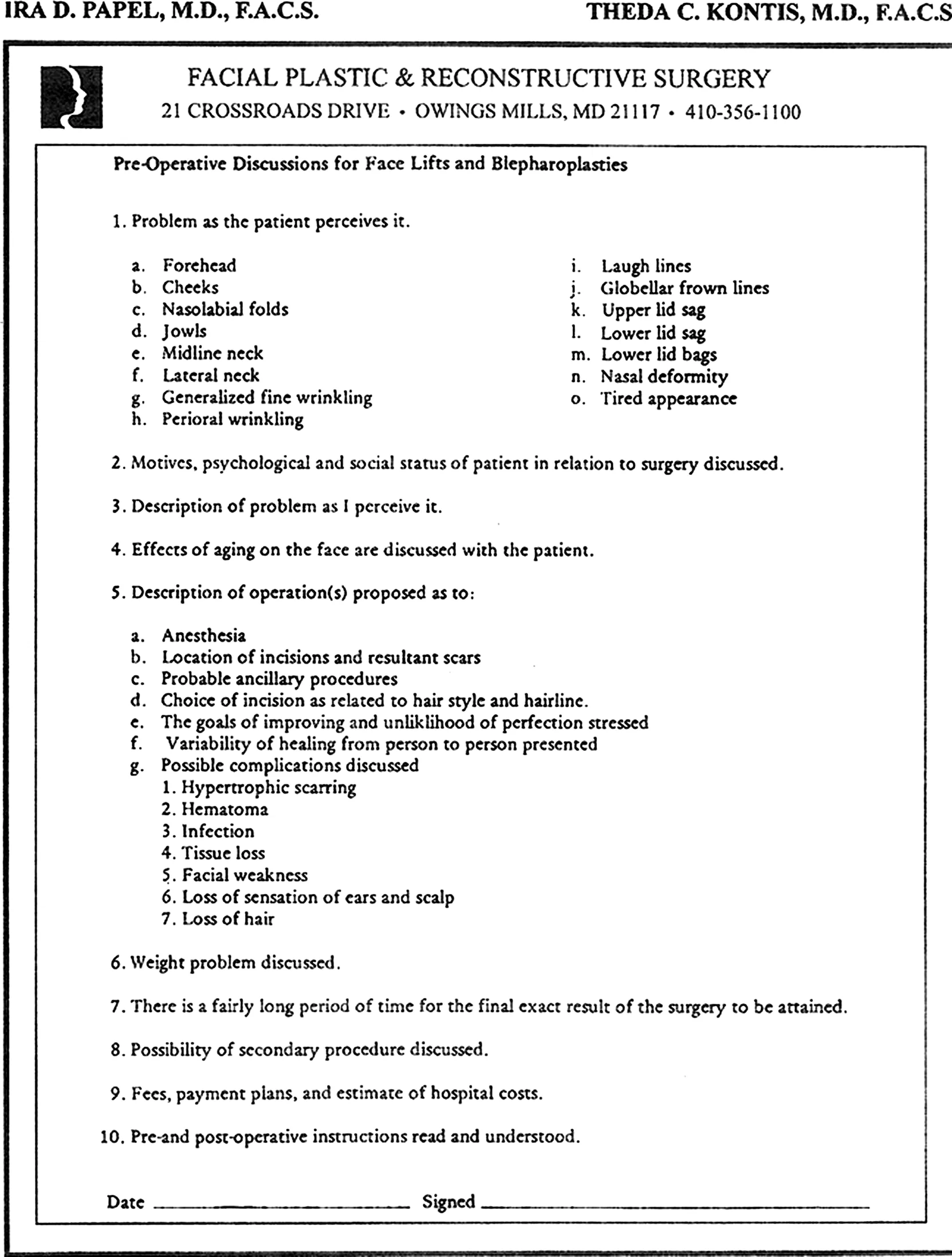 Fig 1. Documented pre-operative discussion sheet. Item 1 records the problem "as the patient perceives it"; item 2, "motives, psychological and social status of patient in relation to surgery"; item 3, the problem "as I perceive it"; item 5e stresses "the goals of improving and unlikelihood of perfection". (Truswell, Surgical Facial Rejuvenation, 2009, p. 22.)
> Sources: Truswell WH, Surgical Facial Rejuvenation, 2009 [MEDLIB] [22]. Figure resolved from own corpus via
Fig 1. Documented pre-operative discussion sheet. Item 1 records the problem "as the patient perceives it"; item 2, "motives, psychological and social status of patient in relation to surgery"; item 3, the problem "as I perceive it"; item 5e stresses "the goals of improving and unlikelihood of perfection". (Truswell, Surgical Facial Rejuvenation, 2009, p. 22.)
> Sources: Truswell WH, Surgical Facial Rejuvenation, 2009 [MEDLIB] [22]. Figure resolved from own corpus via figure_pick.py.
2. The BDD screens as usable instruments. Choose one and keep it as a one-page intake form. The instrument text is short enough to reproduce; the value is in the scoring rule, not the length.
BDDQ / BDDQ-AS structure (the aesthetic-surgery version, 7 items) [1][21]:
| Item | Content | Contributes to positive when |
|---|---|---|
| Q1 | Very concerned about the appearance of some body part you consider unattractive? | Yes (gate) |
| Q2 | Does this concern preoccupy you (hard to stop thinking about it)? | Yes (gate) |
| Q3 | Distress / torment caused (1 = none … 5 = extreme, disabling) | ≥ 3 |
| Q4 | Impairment in social / occupational / other functioning (1–5) | ≥ 3 |
| Q5 | Interference with social life (mapped to severity) | ≥ 3 |
| Q6 | Interference with school / work / role | ≥ 3 |
| Q7 | Things avoided because of the defect | Yes |
Positive screen = Q1 yes AND Q2 yes AND (any of Q3–Q6 ≥ 3 OR Q7 yes) [1][21]. Sensitivity 89.6%, specificity 81.4% in rhinoplasty candidates [1]. Fig 2 reproduces the questionnaire as administered.
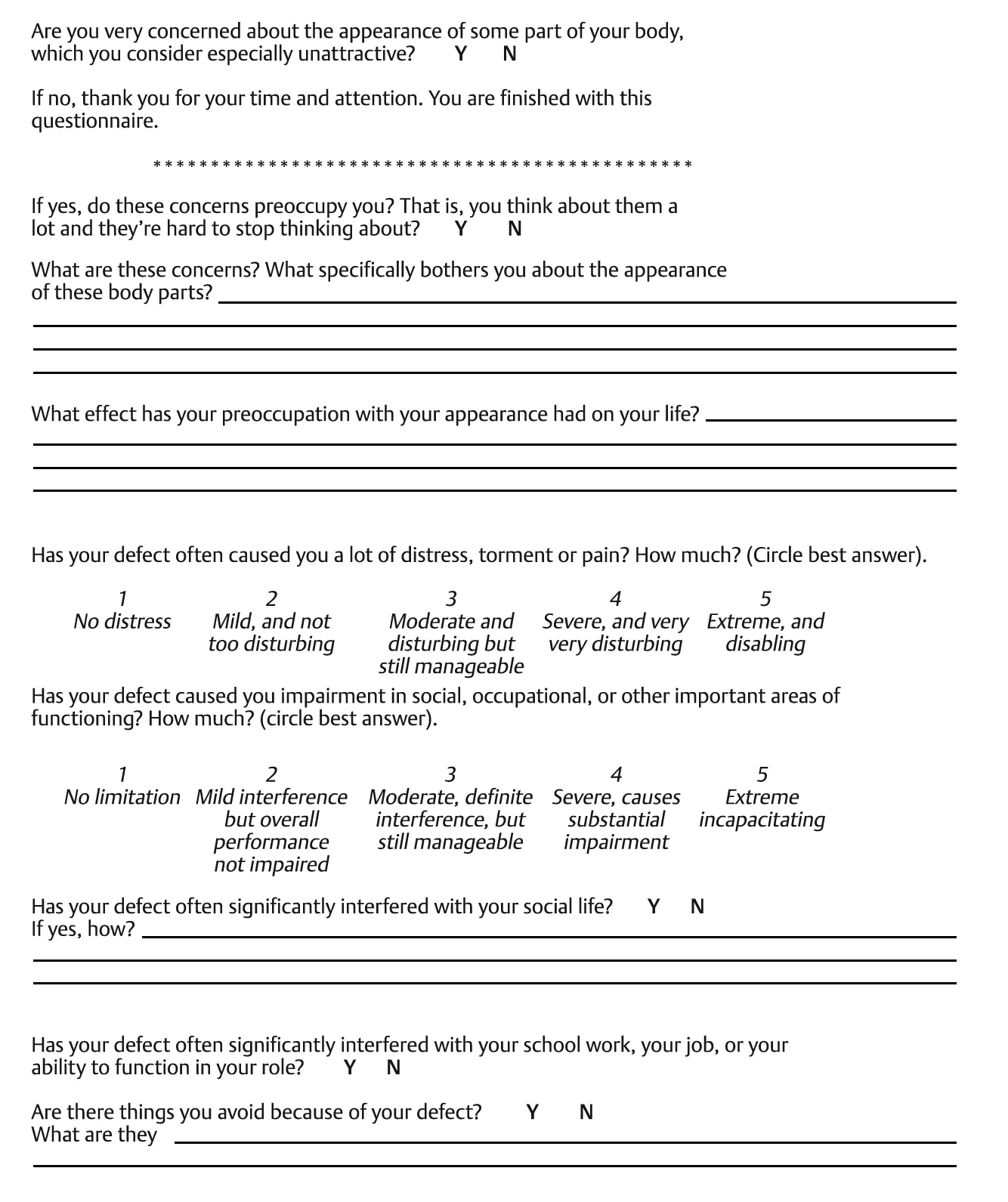 Fig 2. BDDQ intake form. Note the gate structure (concern, then preoccupation), the 1–5 distress scale (no distress to extreme/disabling), the 1–5 functional-impairment scale, and the avoidance item. Reproduced in a surgical consultation chapter. (Unger, Hair Transplantation, 2023, p. 142.)
> Sources: Unger WP, Hair Transplantation, 2023 [MEDLIB] [23]; scoring per Lekakis 2016 [1] and Abdelhamid 2023 [21]. Figure resolved from own corpus via
Fig 2. BDDQ intake form. Note the gate structure (concern, then preoccupation), the 1–5 distress scale (no distress to extreme/disabling), the 1–5 functional-impairment scale, and the avoidance item. Reproduced in a surgical consultation chapter. (Unger, Hair Transplantation, 2023, p. 142.)
> Sources: Unger WP, Hair Transplantation, 2023 [MEDLIB] [23]; scoring per Lekakis 2016 [1] and Abdelhamid 2023 [21]. Figure resolved from own corpus via figure_pick.py.
COPS (Cosmetic Procedure Screening Questionnaire): 9 items, 0–72, refer at ≥ 40; developed specifically for the cosmetic-procedure setting [2]. DCQ (Dysmorphic Concern Questionnaire): 7 items, 0–21, cut-off ≥ 9, which correctly classified 96.4% of BDD patients and 90.6% of controls in the validation sample [3]; it is the instrument with the best evidence for use outside psychiatry, alongside the BDDQ-DV [10][11]. BDDQ-DV (dermatology version): the derm-clinic analogue, validated for cosmetic dermatology [11]. The evidence-based review concludes that no single tool is yet the definitive general aesthetic screen, but the BDDQ/BDDQ-DV, DCQ and (for rhinoplasty) BDDQ-AS are the defensible choices [10].
What the screens are detecting. The instruments quantify a perception mismatch: the patient's distress is real, but the defect is slight or invisible to others. Fig 3 is the classic depiction, a person of normal build seeing a heavier, distorted reflection; the aesthetic corollary is the patient who measures a millimetric asymmetry that the operator cannot reproduce.
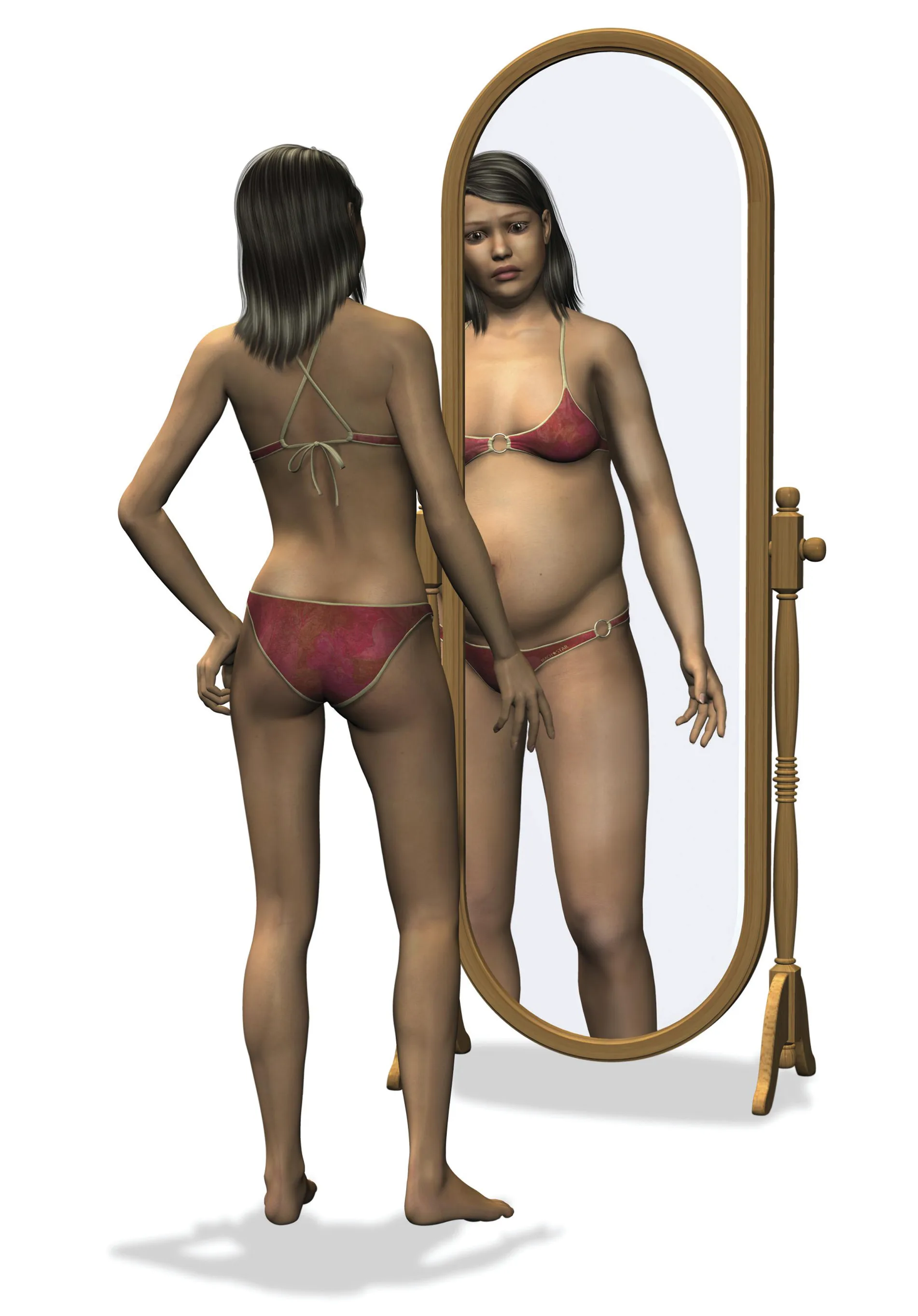 Fig 3. Depiction of body-image distortion (the perceived self does not match the observed self). The illustration accompanies a filler-practice chapter's note that "BDD is a contraindication". (Vermilion Dollar Lips, 2007, p. 29.)
> Sources: Vermilion Dollar Lips, 2007 [MEDLIB] [35]. Figure resolved from own corpus via
Fig 3. Depiction of body-image distortion (the perceived self does not match the observed self). The illustration accompanies a filler-practice chapter's note that "BDD is a contraindication". (Vermilion Dollar Lips, 2007, p. 29.)
> Sources: Vermilion Dollar Lips, 2007 [MEDLIB] [35]. Figure resolved from own corpus via figure_pick.py.
3. Validated patient-reported outcome measures (PROMs). These convert "I'm happy" into a comparable number before and after, and they do two things a photograph cannot: detect psychosocial improvement without large anatomical change (what the patient usually wants), and detect the absence of psychosocial improvement despite an excellent anatomical result (the signature of BDD and extrinsic motivation).
| PROM | Domain | Scoring | Best use in aesthetics | Ref |
|---|---|---|---|---|
| FACE-Q Aesthetics | > 40 independently scored scales/checklists (facial appearance overall and by area, psychological well-being, social function, satisfaction with decision/outcome, early life impact, adverse effects) | Rasch-transformed 0–100 per scale | The reference facial-aesthetics PROM suite | Klassen 2010/2015, Pusic 2013 [18][19][20] |
| BODY-Q | Body-contouring, weight-loss and body-image scales | 0–100 per scale | Post-weight-loss / body work (B2.7) | Q-Portfolio [18] |
| Skindex-29 / -16 | Skin-related quality of life (emotions, symptoms, functioning) | 0–100 | Skin-focused complaints | [10] |
| DLQI | Dermatology Life Quality Index | 0–30 | Quick derm QoL screen | [10] |
The FACE-Q was built to strict international PRO-development guidelines, with content from patient interviews and expert input, and psychometric confirmation by Rasch analysis (Person Separation Index ≥ 0.81) and traditional methods (Cronbach α ≥ 0.90) [18][20]; the Satisfaction-with-Facial-Appearance core scale is a 10-item validated measure [19]. Integration without dying of bureaucracy: administer one short scale (satisfaction with the treated area) before treatment and at 3 months. That alone gives you an own outcome series and flags the mismatch cases [18][19].
4. The two consents. A treatment consent (capacity-assessed, reinforced disclosure, per B2.2) and a separate imaging consent (clinical photography is special-category health data). A psychosocial intake questionnaire or "aesthetic interest questionnaire" can front-load steps 1–4 of the selection gate, but it never replaces the live conversation, because voluntariness and the companion dynamic are only visible in the room (P).
The DCQ item structure (7 items, each rated 0 = "not at all" to 3 = "much more than most people", total 0–21, cut-off ≥ 9 [3]): degree of concern about physical appearance; belief that a feature is misshapen/defective; belief that the body is malfunctioning; consultation of doctors about the concern; time and effort spent camouflaging; preoccupation relative to others; and distress about the perceived defect. The instrument measures dysmorphic concern on a continuum, which is why it screens well but does not by itself diagnose the disorder (B2.6).
The psychosocial intake questionnaire (the Grossbart & Sarwer tradition, front-loading steps 1–4 of the gate [12]): what specifically bothers you and since when; what do you expect to look like afterwards; what do you expect to change beyond your appearance; who suggested this and who else has an opinion; previous procedures and how they went; what "a good result" would mean; and any current mental-health treatment or medication. An "Aesthetic Interest Questionnaire" is the same instrument under a softer name; it primes the conversation but never substitutes for it, because voluntariness and the companion dynamic are only visible live.
FACE-Q, which scales to actually use in non-surgical aesthetics (the suite has > 40; you never administer all of them [18][20]):
| Scale (module) | What it captures | When to use it |
|---|---|---|
| Satisfaction with Facial Appearance (core) | Global facial satisfaction, 10 items | Baseline for any facial treatment [19] |
| Satisfaction with area (lips, cheeks, jawline, skin) | Region-specific satisfaction | Match to the treated zone |
| Psychological Well-being | Confidence, self-esteem impact | Detects psychosocial change without anatomical change [18] |
| Social Function | Social confidence, comfort | The extrinsic-motivation counter-check |
| Satisfaction with Decision / Outcome | Regret, decision quality | Post-treatment audit and the mismatch flag [18] |
| Appraisal of Aging Appearance | Perceived facial ageing | Sets a realistic "less tired, not younger" frame |
Standardised photography as a document. The clinical photograph is itself a selection instrument, not only a record: standardised, unfiltered, reproducible views (fixed distance, lighting and pose) give the objective baseline against which the patient's perceived defect and later satisfaction are measured. The patient who insists on filtered or flattering angles, or refuses standard views, is signalling the same perceptual mismatch the BDD screens detect. Store these under the separate imaging consent (B2.2), and never let the marketing before-after set substitute for the clinical baseline set (P).
Appearance-anxiety and dysmorphia scales beyond the BDD screens. Where a fuller picture is wanted, the Derriford Appearance Scale and the Sheehan Disability Scale (used as construct/impairment comparators in the BDDQ-AS validation [1]) and appearance-related quality-of-life measures extend the assessment; in routine practice they are research-grade and the brief screens plus a facial PROM suffice. The point is to have a validated number, not to collect all of them.
The Skindex and DLQI detail. Skindex-29/-16 scores three domains (emotions, symptoms, functioning), transformed 0–100, higher = worse skin-related quality of life; the DLQI is a 10-item, 0–30 instrument, higher = worse, quick enough for a derm-clinic intake [10]. Both are complements to a facial PROM when the complaint is skin-led (acne scarring, melasma, texture) rather than shape-led.
Digital intake and data retention. Whether the screens live on paper or in the EHR, two rules follow from B2.2: screening results are health data, retained and secured like any clinical record, and the imaging/marketing consents are stored separately so a later marketing-use dispute cannot contaminate the treatment record. A templated digital intake that auto-scores the DCQ and forces a disposition field is the most reliable defence against the blank-form trap below, because it will not file without a score and a decision (P).
The consent-form skeleton (a defensible aesthetic consent contains, at minimum): identity and capacity confirmation; the specific procedure and product; the aim in the patient's words; realistic outcome and explicit statement that perfection is not achievable; common minor and rare serious risks for the modality; temporariness and maintenance; the no-treatment alternative; the reflection period offered; and dated signatures. The imaging and marketing consents are separate documents (B2.2). A one-line "risks explained and understood" is not a consent; it is the absence of one dressed as its presence.
> Trampa clásica: filing a blank BDDQ "for the record" without scoring it or acting on it. Signature: a positive screen sits unscored in the chart, so the document that should protect you now proves you had the information and ignored it. Score it, write the disposition, act on it.
B2.5 · Frequent errors and their cost
Answer first. The costly errors in B2 are not technical. They are (1) accepting the wrong candidate, (2) failing to convert an unrealistic expectation into a realistic one before treating, and (3) not documenting either. Each has a predictable clinical signature and a predictable bill.
The unsuitable-patient archetypes. The classic mnemonic is SIMON (a teaching schema; its individual components are validated poor-outcome markers in Honigman's 37-study review [9], though the mnemonic itself is expert convention [MODEL]):
| Letter | Archetype | What it looks like | Evidence for the risk |
|---|---|---|---|
| S | Single (isolated, unsupported) | No stable support; procedure loaded with relationship hope | Relationship-based motivation predicts poor outcome [9] |
| I | Immature | Motivation and expectations not age-appropriate | Young age associated with poorer psychosocial outcome [9] |
| M | Male | Statistically higher dissatisfaction in cosmetic cohorts | Male sex a poor-outcome marker [9] |
| O | Overexpectant | Wants a magnitude of change the procedure cannot deliver | Unrealistic expectation is the strongest single modifiable risk [9] |
| N | Narcissistic | Entitlement, devaluation of prior operators | Personality pathology predicts poor outcome and litigation [9][12] |
Additional archetypes worth naming (P), each cross-referenced to a documented risk:
| Archetype | Signature in consult | Disposition |
|---|---|---|
| Doctor-shopper | Multiple prior operators, all "incompetent"; conflict history | Red line; previous unsatisfactory surgery predicts poor outcome [9] |
| Minimal-deformity, high-preoccupation | Millimetric complaint, hyper-detailed | Screen for BDD; poor-outcome marker [6][9] |
| The insatiable / "plastic-surgiholic" | Serial procedures, migrating dissatisfaction | Overlaps BDD and procedure addiction (B2.7) [10] |
| VIP / entitled | Demands special handling, out-of-hours, discretion beyond norm | Over-flattery and boundary erosion precede the complaint (P) |
| Objectively-good-result complainer | Dissatisfied with another operator's genuinely good work | Red line; the dissatisfaction is about the patient, not the work [9] |
| Companion-driven | Comes with someone who sets the goal | Red line; extrinsic motivation [9] |
Expectation management: the principle. Expectations are not corrected by arguing. They are corrected by teaching (with mirror, photo, the patient's own face) and by putting the agreement in writing [12]31. The intrinsic/extrinsic sort of B2.1 is the frame; the tools below are how you move a correctable extrinsic expectation toward a realistic intrinsic one, and how you detect the uncorrectable one that ends the consult.
Screening questions for motivation and expectation (the Grossbart & Sarwer tradition of psychosocial screening in the aesthetic consult [12]): what specifically bothers you and for how long; what do you expect to look like afterwards; what do you expect to change beyond appearance; how do those around you view this; have you had procedures before and how did they go; what would "a good result" mean to you. An answer set that stays on the face and on a modest, reachable change is green; an answer set that reaches into relationships, identity or a fantasised transformation is the flag.
Communication scripts (glanceable; deploy verbatim):
| Situation | Script |
|---|---|
| Photo of a celebrity | "Let's look at this photo together. What you like is the high cheekbone, and that comes from a bone you have differently. What I can improve in your face is X. Show me on your own photo what you would like." |
| "I want lips but natural" | "Let's define natural: invisible that you did anything, or subtle? We do 0.5 mL today, you live with it two weeks, and we decide about more." |
| "Take 10 years off me" | "This does not remove years, it changes the message. You will look less tired, not like a different person. If the goal is minus ten years, the route is different and probably surgical." |
| "I saw it on TikTok" | "Show me. Let's look at what was done, on which face, and what the video does not show." No contempt: the comparison is your best argument. |
| Price as the argument | "The price is X. If that is a problem, we do one phase less today rather than one phase worse." |
| Dissatisfied with another operator | "Tell me what was done and what you expected." Explore without criticising the colleague. If the result is objectively good, it is a red flag, not an opportunity. |
The filter era, the modern amplifier of unrealistic expectation. Filtered-selfie culture drives a specific, growing complaint: patients arrive with an edited image of themselves as the target ("Snapchat dysmorphia", coined in a facial-plastic viewpoint [27]). The signal is measurable: AAFPRS member surveys reported 72% of surgeons (2019) then 75% (2020) seeing patients seeking procedures to look better in selfies and edited photos, up sharply since the trend was first flagged in 2016 [29]. In a 2024 national survey (1,483 adults), BDD was present in 24.4%, and heavy daily use of Instagram/Snapchat (4–7 h) carried more BDD than light use (29% vs 19%), with BDD-positive individuals significantly more likely to accept cosmetic surgery [28]. Operational rule: when the reference image is a filtered version of the patient, treat it exactly like the celebrity-photo script, and lower the threshold to screen for BDD [27][28].
The classic errors and their cost (the exhaustive table):
| Error | Why it happens | The cost | How to avoid it |
|---|---|---|---|
| Treating a BDD patient "just a little" | Looks like a compromise | Escalation, migrating dissatisfaction, complaints, litigation, ~2% benefit [6][10] | Screen; refer; do not treat |
| Not asking "why now?" | Seems irrelevant | Misses the crisis-driven and extrinsic cases | Ask it every time; record the answer [9] |
| Accepting the companion's goal | The companion talks | Treating a non-patient's wish; guaranteed dissatisfaction | Speak alone; if the goal changes, stop [9] |
| Treating before an event in 2 weeks | Patient insists | Oedema and bruising do not negotiate; ruined event, angry patient | Postpone or decline |
| Promising "natural" without defining it | It is what the patient says they want | "That's not natural" dispute with no baseline | Define it, in writing, with a concrete volume |
| Not warning of pre-existing asymmetry | It is awkward | It becomes visible after and reads as your fault | Say it and note it [31] |
| Criticising the previous operator | Tempting and it sells | Converts a red-flag patient into your problem | Explore without judging [9] |
| Treating the face during active weight loss | The patient wants it now | Chasing a moving target; the patient pays twice | Wait for the plateau (~3 months stable), B2.7 |
| Stalling instead of declining | Avoids immediate conflict | More conflict later; ambiguous record | Clear refusal today, documented |
| Not documenting the refusal | Seems unnecessary | No defence if they go elsewhere and it goes wrong | Record refusal and reason [15] |
The three mandatory first-visit sentences, and why each prevents a specific complaint (P): 1. "There is asymmetry in your face now, here and here; it will still be there afterwards, and you will probably notice it more." Prevents the post-treatment "you made me asymmetric" complaint by moving the baseline into the record before treatment [31]. 2. "This is temporary and must be repeated; if that does not fit you, better not to start." Prevents the "nobody told me it wears off" complaint and filters the patient who wanted a permanent fix. 3. "We do less than we could today; correcting upward is easy, the reverse is not." Prevents the over-correction regret and tests tolerance of a staged plan.
Define "natural" before the first syringe. "Natural" is the most dangerous word in the consult because both parties use it and mean different things: the patient often means "invisible that I did anything", the operator often means "subtle but present". Resolve it explicitly: ask which one they mean, agree a concrete first volume (for example 0.5 mL), set a two-week review, and write the agreed definition in their words. A shared word without a shared definition is a complaint waiting for a review appointment.
The VIP and the over-flatterer, a boundary problem. The patient who arrives with excessive flattery ("you're the only one who understands this", "I only trust you"), demands out-of-hours access, or expects rules bent in their favour, is eroding boundaries before the first treatment, and boundary erosion reliably precedes the complaint when the result disappoints. The counter is not coldness but consistency: the same protocol, consult structure and documentation for everyone, stated plainly. A patient who cannot accept standard handling has told you how the relationship will end (P).
How filtered self-images actually distort the consult. The mechanism is not vanity, it is a shifted reference: the patient's internal target is no longer their face but an edited version of it, so any real result is measured against an unreachable digital baseline [27]. The consult pattern is specific: the target photo is of themselves, edited; the requested change is often geometrically impossible on real tissue (a jaw the app narrowed, eyes the app enlarged); and satisfaction with any real outcome is pre-empted. The 2024 survey quantifies the population effect: BDD in 24.4%, rising with heavy Instagram/Snapchat use (29% at 4–7 h/day vs 19% at under an hour), and BDD carrying higher acceptance of cosmetic surgery [28]. Handle the edited self-image with the celebrity-photo script and a lowered threshold to screen, because it sits on the same axis as the impossible-expectation red line [27][28].
The insatiable and the perfectionist, distinguished. Two look similar and diverge in management. The insatiable patient (the serial "tweaker") is never finished: each result resets the baseline and the next request follows within weeks, dissatisfaction migrating zone to zone; this overlaps BDD and procedure addiction and is a screen-and-refer pattern, not a volume opportunity [10]. The perfectionist with intact self-awareness, by contrast, wants a specific, reachable, high-standard result and can accept "we do less today"; they are demanding but treatable, and the discriminator is whether they can tolerate a staged plan and a realistic ceiling. Mislabelling the treatable perfectionist as insatiable loses a good patient; mislabelling the insatiable as a perfectionist starts an escalation (P).
The "just here for a consultation" browser. A patient who books only to be talked out of, or into, a procedure they are ambivalent about is an opportunity to do selection well: the reflection-period logic fits them naturally, and pushing conversion here is precisely how an ambivalent patient becomes a regretful one. Ambivalence is a reason to slow down, not to close (P).
The cost ledger (what the selection errors actually bill). The reason these are the expensive errors, not the technical ones:
| Error class | Immediate cost | Downstream cost |
|---|---|---|
| Treating a screen-positive BDD patient | Product + chair time | Refunds, serial revisions, complaints to the college, online reputation attacks, litigation, documented operator harassment [6][10] |
| Undefined "natural" / unmanaged expectation | A dissatisfied review visit | Free "fixes", loss of the patient, negative review with no written baseline to defend |
| No documented refusal | Nothing today | No defence if the patient is treated elsewhere and deteriorates [15] |
| Treating before a two-week event | An unhappy patient | Ruined event, refund demand, public complaint |
The antidote to almost all of them is the same pair: screen on suspicion, and stage the treatment (do less today, review, then decide), which converts an irreversible one-shot decision into a reversible sequence and buys the time that catches the mis-selected patient before the product is in [10][24].
> Trampa clásica: promising "natural" as a shared word without a shared definition. Signature: the patient meant "invisible", you meant "subtle but present", and at review the gap becomes a complaint with no written baseline to arbitrate it. Define "natural" with a number and a two-week review before the first syringe.
B2.6 · Metrics: what is measured and the reference value
Answer first. Four families of number govern B2: screening metrics (cut-off, sensitivity, specificity), prevalence reference values (setting-dependent, never a single figure), risk reference values (suicidality, comorbidity), and outcome metrics (PROM 0–100, measured before and at 3 months). Learn the reference value for each so a result is interpretable rather than decorative.
1. Screening instrument metrics (reference values).
| Instrument | Items | Cut-off / positive rule | Sensitivity | Specificity | Other reference metric | Ref |
|---|---|---|---|---|---|---|
| BDDQ-AS | 7 | Q1 & Q2 yes AND (Q3–6 ≥ 3 OR Q7 yes) | 89.6% | 81.4% | Cronbach α 0.83–0.84; predicts lower post-op satisfaction | [1][21] |
| COPS | 9 | ≥ 40 (of 0–72) | ROC-derived | ROC-derived | Developed in the cosmetic-procedure population | [2] |
| DCQ | 7 | ≥ 9 (of 0–21) | high | high | Correct classification 96.4% BDD / 90.6% controls | [3] |
| BDDQ-DV | 7 | preoccupation + distress/impairment | validated | validated | Best-evidenced derm-clinic tool with DCQ | [10][11] |
Interpretation caveat (P): these instruments screen, they do not diagnose. In a low-prevalence walk-in the positive predictive value falls, so a positive screen mandates a clinical interview or referral, not automatic exclusion; in the high-prevalence aesthetic clinic the same tool is far more informative. Apply on suspicion, confirm before you label.
2. Prevalence reference values (⚠ setting- and instrument-dependent; the figures are presented as a conflict, not averaged).
| Setting | Reference value | Range | Source |
|---|---|---|---|
| General population | ~2% | 1.7–2.9% typical | epidemiological consensus, cited across [4][5] |
| Plastic-surgery seekers (pooled meta-analysis, 33 studies) | 15.04% | 2.21–56.67% | Ribeiro 2017 [4] |
| Dermatology seekers (pooled) | 12.65% | 4.52–35.16% | Ribeiro 2017 [4] |
| US plastic-surgery seekers (textbook estimate) | 7–8% | n/a | Cheney 2015 [6] |
| Aesthetic population (single-textbook range) | 12–20% | n/a | Carniol 2010 [5] |
| Self-report survey high-end estimate | up to ~53% | instrument-inflated | discussed in [4][10] |
Why the range is so wide, and why it must not be collapsed to one number: self-report questionnaires over-call (they capture dysmorphic concern, not the disorder), structured clinical interviews under-call relative to them, and the setting (rhinoplasty vs general derm vs injectables) shifts the base rate. The safe teaching number is "5–10× the street rate", the safe operative number for a specific tool is the tool's own validated figure, and the safe move is to print the range [4][5][6][10]. The pooled patient profile in the meta-analysis: mean age 34.5 y and 74.4% women in plastic surgery, mean age 27.8 y and 76.1% women in dermatology [4]. Read as a corridor rather than a point: in cosmetic-patient series the figure clusters around 15 %, with individual cosmetic-surgery studies running from 7 % up to 19 %, against roughly 2 % in the general population, all inside Ribeiro's pooled range [4][5][6].
3. Risk reference values.
| Risk metric | Reference value | Source |
|---|---|---|
| Lifetime suicidal ideation in diagnosed BDD | 78.0% | Phillips 2005 [7] |
| Lifetime suicide attempts in BDD | 27.5% | Phillips 2005 [7] |
| Suicidal ideation, prospective (mean per year) | 57.8%/yr | Phillips & Menard 2006 [8] |
| Suicide attempts, prospective | 2.6%/yr | Phillips & Menard 2006 [8] |
| Completed suicide, prospective (preliminary, "markedly high") | 0.3%/yr | Phillips & Menard 2006 [8] |
| Comorbid lifetime social phobia in BDD | ~39% (current ~34%) | Coles 2006 [26] |
| BDD symptom improvement after a cosmetic procedure | ~2% | Cheney 2015 [6] |
| BDDQ-AS-positive vs negative after surgery | positive patients less satisfied | Lekakis 2016 [1] |
These are the numbers that reframe BDD from "difficult personality" to "psychiatric emergency risk". A completed-suicide signal has also been reported epidemiologically after cosmetic breast implantation, an association independent of the procedure itself and tied to the underlying psychopathology [13].
4. Outcome metrics (what a treated patient's number should look like).
| Metric | Reference value / property | Source |
|---|---|---|
| FACE-Q / BODY-Q scale scoring | Rasch-transformed 0–100 per independent scale | [18][19][20] |
| FACE-Q reliability (development) | Cronbach α ≥ 0.90; Person Separation Index ≥ 0.81 | [18][20] |
| FACE-Q core scale | 10-item Satisfaction-with-Facial-Appearance | [19] |
| Skindex-29/-16 | 0–100 (higher = worse QoL) | [10] |
| DLQI | 0–30 (higher = worse QoL) | [10] |
| Minimum useful protocol | one scale before + at 3 months | [18][19] |
The diagnostic value of PROMs in B2 is not the absolute score, it is the direction and the mismatch. A large positive delta on the psychosocial scale with a modest anatomical change is the good outcome; a flat or negative psychosocial delta despite an excellent anatomical result is the objective footprint of BDD or extrinsic motivation, and it is invisible to before/after photography [18][19]. This is why the metric belongs in selection, not only in audit.
5. Psychiatric comorbidity, with clinical signs (reference frame). The own corpus contributes here: Cosmetic Medicine & Surgery tabulates the presenting signs [24].
| Condition | Signs that point to it | Implication for treatment |
|---|---|---|
| Anxiety | "a worrier", trouble falling asleep, panic, jaw clenching, nocturnal bruxism, tremor, rapid blink, fidgeting, nail-biting [24] | Not a contraindication; more time, more explanation, higher vasovagal risk |
| Depression | Early-morning waking, other sleep disturbance, anhedonia [24] | Not a contraindication if stable/treated; contraindicated if the procedure is framed as the mood cure |
| OCD | Repetitive checking, symmetry preoccupation | Overlaps BDD; same caution |
| Eating disorder | Weight/shape preoccupation (excluded from BDD by DSM-5-TR) | Strong relative contraindication for body work; coordinate with the treating team |
| Borderline personality | Idealisation then devaluation | Charmed-then-hostile trajectory; scrupulous documentation |
| Psychosis / MSHP (monosymptomatic hypochondriacal psychosis) | Fixed, delusional appearance belief | Contraindication; psychiatric referral [24] |
| Active substance use | Intoxication, dependence markers | Contraindication while active |
Why a positive screen is not a diagnosis (the base-rate arithmetic). Take the BDDQ-AS at sensitivity 89.6% and specificity 81.4% [1]. In a rhinoplasty clinic with a base rate near 20%, of 1,000 patients ~179 true positives are caught and ~150 false positives are flagged, so a positive screen is right roughly 54% of the time. In a general injectables walk-in with a base rate near 5%, the same tool yields ~45 true positives against ~174 false positives, so a positive screen is right only ~21% of the time. The instrument did not change; the base rate did. Operationally: a positive screen is a trigger to interview or refer, never an automatic exclusion, and it is far more informative in the high-prevalence practice than in the low one (P). This is also why universal screening in a low-prevalence practice generates mostly false positives (B2.8).
PROM interpretation: the delta and the MCID, not the raw score. A FACE-Q scale runs 0–100 after Rasch transformation; the clinically meaningful unit is the change from baseline, interpreted against a minimal important difference rather than an absolute cut. Two footprints matter for selection: a large positive psychosocial delta with only a modest anatomical change (the good outcome the patient actually wanted) and a flat or negative psychosocial delta despite an excellent anatomical result (the objective signature of BDD or extrinsic motivation, invisible to a before/after photo) [18][19]. Floor and ceiling effects matter: a patient already at ceiling on satisfaction has nowhere to improve and may be seeking a change no scale will register, which is itself informative.
Predictive validity, the numbers that justify screening at all. BDDQ-AS-positive rhinoplasty patients were measurably less satisfied 12 months after surgery than screen-negative patients [1]; the screen therefore predicts the outcome it is meant to prevent. Layered onto this, Honigman's poor-outcome predictor set (young age, male sex, unrealistic expectations, minimal deformity, prior unsatisfactory surgery, relationship-based motivation, history of depression/anxiety/personality disorder, and BDD) functions as an informal risk score: the more predictors present, the lower the threshold to defer or refer [9]. None is an absolute exclusion in isolation; their accumulation is the signal.
Comorbidity reference frame, quantified where the data exist. Beyond the social-phobia figure (lifetime ~39%, current ~34% in BDD cohorts [26]), BDD carries high rates of major depression and obsessive-compulsive disorder, and the ideation/attempt figures above are driven partly by these comorbidities [7][26]. The clinic-facing point is not to diagnose these but to recognise their signs (B2.6 comorbidity table) and to understand that their presence raises both impairment and risk, which is why a stable, treated mood disorder is acceptable while a decompensated one is not.
Abstention is the correct behaviour, not a defect. The same logic that governs a retrieval gate governs a screen: when the evidence is thin, the right output is a hold, not a confident answer. A borderline screen in a low-prevalence walk-in should resolve to "assess further / refer", not to a binary treat-or-exclude, because the number does not carry enough signal to decide alone. A clinic whose screening concentrates its holds on the ambiguous cases is calibrated correctly; one that forces every result into a yes/no is over-reading its instruments (P).
Reliability and re-screening cadence. The instruments have adequate internal consistency (BDDQ-AS Cronbach α 0.83–0.84 [1]) and the DCQ demonstrated stable classification in validation [3], but a screen is a snapshot: a patient screened negative a year ago in a stable state may screen positive after a life change, a new social-media pattern, or rapid weight loss. Re-screen when the clinical picture shifts (a new escalating request, a migrated complaint, a crisis), not on a fixed calendar; the trigger is a change in the patient, not the passage of time (P).
Reference-value recap card (the numbers to carry).
| Quantity | Reference value | Ref |
|---|---|---|
| BDDQ-AS sensitivity / specificity | 89.6% / 81.4% | [1] |
| COPS referral cut-off | ≥ 40 (of 0–72) | [2] |
| DCQ cut-off | ≥ 9 (of 0–21) | [3] |
| BDD, general population | ~2% | [4][5] |
| BDD, plastic-surgery seekers (pooled) | 15.04% (2.21–56.67%) | [4] |
| BDD, dermatology seekers (pooled) | 12.65% | [4] |
| BDD symptom improvement after procedure | ~2% | [6] |
| BDD lifetime suicidal ideation / attempts | 78.0% / 27.5% | [7] |
| BDD prospective completed suicide | 0.3%/yr | [8] |
| FACE-Q scale range / reliability | 0–100 / α ≥ 0.90 | [18][20] |
| Minimal outcome protocol | 1 scale, baseline + 3 months | [19] |
The screening-to-confirmation flow (what a number triggers). A screen produces a probability, not a verdict: a positive DCQ (≥ 9) or BDDQ-AS-positive result triggers a structured clinical interview or a mental-health referral, which is where the disorder is confirmed or excluded; a negative screen with strong clinical red flags still triggers referral, because the screen's sensitivity is not perfect (a BDDQ-AS misses ~1 in 10) [1][3]. The number sets the pre-test probability for the next step; it does not replace it. This is the single most misused property of these instruments: a positive screen is read as a diagnosis and a negative screen as a clearance, when both are only inputs to a clinical judgement (P).
One more metric the consult owns: vasovagal risk. Anxious patients have a higher rate of vasovagal reactions during injectable procedures, which is a selection-relevant safety metric even though anxiety is not a contraindication: it changes positioning, pacing and the decision to treat supine, and it argues for more explanation and no surprises 24.
> Trampa clásica: averaging the prevalence figures into "about 10%" and treating that as a fact. Signature: a number that belongs to no instrument and no setting, defensible nowhere; a screen result then gets interpreted against a fictional base rate. Quote the tool's own figure, or quote the range.
B2.7 · Spanish particularity
Answer first. Three things make Spanish (and specifically Catalan) practice different from the anglophone literature: a statutory mature-minor threshold at 16 that collides with stricter deontology and one autonomous-community decree that mandates a psychologist's maturity report; a set of special populations the aesthetic clinic sees more of than the psychiatric literature assumes; and a new post-weight-loss (GLP-1) patient profile that arrives faster than the formal evidence.
1. Minors: the tightest knot in the chapter.
| Level | Rule | Practical effect |
|---|---|---|
| State statute (Ley 41/2002 art. 9.4, as reformed by Ley 26/2015) | ≥ 16 or emancipated: no consent by representation; the minor consents | On paper, a 16-year-old can self-consent to an aesthetic act [15][16] |
| State statute, grave-risk exception (art. 9.6–9.7) | If the physician judges grave risk to life or health, consent returns to the legal representative, after hearing the minor | The physician's risk judgement overrides the age rule [16] |
| Deontology (OMC, Comisión Central de Deontología) | Aesthetic surgery in anyone < 18: always obtain parental consent, even for the mature minor | The professional standard is stricter than the statute [36] |
| Andalusia (Decreto 49/2009) | Mandatory pre-intervention psychological maturity exam; the psychologist issues an informe de madurez filed in the record; a public registry of aesthetic interventions on minors |
The only autonomous community with a specific mechanism [17] |
| Catalonia (patient-autonomy regime) | Recognises the mature minor > 16 as capable of consenting to these acts (unlike Madrid/Basque interpretations) | Directly relevant to Barcelona practice [17] |
Operational synthesis for a Barcelona clinic (P): for a purely aesthetic indication in a minor, obtain the minor's consent, obtain parental consent regardless (OMC), document a maturity assessment on the Andalusian model even though it is not obligatory in Catalonia, and apply the grave-risk lens, which for an elective non-therapeutic procedure with an unstable adolescent body image is easy to justify as a reason to defer. The purely aesthetic intervention in a minor is best treated as almost always deferrable, and the paperwork should say why.
2. Special populations the aesthetic clinic actually sees.
| Population | Selection consideration | Disposition |
|---|---|---|
| Personality disorders (esp. borderline, narcissistic) | Idealisation-devaluation; high litigation risk; the "N" of SIMON | Scrupulous documentation; low threshold to decline [9][12] |
| Mood / psychotic disorders | Treat only if stable and never as the mood remedy; delusional appearance belief is a hard stop | Coordinate with treating clinician; MSHP contraindicates [24] |
| Substance use disorder | Capacity and adherence compromised while active | Contraindication while active |
| Cosmetic-procedure addiction ("plastic-surgiholic") | Serial procedures, migrating dissatisfaction, escalating demand | Overlaps BDD; treat as a screen-positive pattern, refer [10] |
| Transgender / gender-diverse patients | Facial aesthetic requests may be gender-affirming, not dysmorphic; distinguish a coherent gender goal from BDD | Affirming pathway, not a BDD label; coordinate with the gender-care team (P) |
| Older adults | Capacity is intact by default; screen for isolation-driven and grief-driven motivation | Standard gate; watch the "why now" after bereavement |
The transgender distinction matters because the screening instruments were built on cisgender cosmetic cohorts: a stable, self-aware desire to align facial features with gender identity is not the invisible-defect preoccupation the BDDQ detects, and mislabelling it as BDD is both a clinical and an ethical error (P).
3. The post-weight-loss (GLP-1 era) patient. Mass adoption of GLP-1 agonists (semaglutide, tirzepatide) has created a patient profile that did not exist at this volume five years ago, and it has changed the consult in measurable ways [MATERIAL GAP: formal literature still sparse relative to clinical volume; written as an observed pattern, not established guidance].
- Facial ("Ozempic face"): rapid loss of deep and superficial facial fat, with descent and laxity; a gaunt, aged look (hollow cheek, deepened groove, depressed temple, paradoxically lax jowl) despite metabolic improvement. Not a drug toxicity: it is rapid weight loss in a territory with little reserve, the same picture seen in rapid loss from any cause.
- Body: disproportionate skin laxity, loss of gluteal and breast volume, and (the clinically important part) loss of lean mass, not only fat.
- Management rules: 1. Do not treat during active loss. Filling a face that is still shrinking chases a moving target and the patient pays twice. Wait for the plateau: weight stable ~3 months. 2. Prioritise deep structural support and biostimulation over superficial filler; what was lost is foundation, not surface. 3. Laxity is not filled. Energy devices, threads or surgery (see B1.3). 4. Ask about lean mass and protein. Sarcopenia from rapid loss is a referral (see K1 — Anti-Aging Medicine & Longevity), not an aesthetic case. 5. The psychology is the forgotten part. Rapid loss desynchronises body image: thin patients who still see themselves as heavy, and patients who transfer body dissatisfaction onto the face. BDD screening is higher-yield in this profile than in any other, and the eating-disorder exclusion in the DSM-5-TR BDD criteria (B2.2) makes the differential with a re-activated eating disorder essential [14][28].
4. The Spanish clinic reality. Screening instruments are validated but rarely applied systematically; the pragmatic standard here is suspicion-directed screening plus a documented consult record, with formal screens reserved for red flags (the school this chapter recommends, B2.8). Corpus depth on psychological selection in Spanish sources is real but scattered across general aesthetic manuals (Pinto, the Rejuvenecimiento no quirúrgico texts) rather than concentrated in a selection chapter, which is one reason the practice runs ahead of the written protocol [MEDLIB].
The minor request, as a checklist (P): confirm the indication is purely aesthetic (not reconstructive or functional); apply the grave-risk lens (an elective act on an unstable adolescent body image is usually deferrable); if proceeding at all, obtain the minor's consent and parental consent regardless of the mature-minor rule [36]; document a maturity assessment on the Andalusian model even outside Andalusia [17]; and record why the timing is or is not appropriate. In practice this makes most purely aesthetic minor requests a documented deferral, which is the defensible default.
Why deontology outruns statute here, and why it matters in Barcelona. The state statute permits ≥ 16 self-consent [15][16], and the Catalan autonomy regime aligns with that permissive reading, unlike more restrictive interpretations elsewhere in Spain [17]. But the professional-college deontology asks for parental consent in all aesthetic minors [36], and following the stricter standard costs nothing and protects everything: it satisfies both readings simultaneously, and it acknowledges that an adolescent's body image is precisely the domain where autonomy is least reliable. For a Barcelona clinic operating under the permissive Catalan reading, the safe policy is to voluntarily adopt the stricter deontological and Andalusian safeguards.
Special populations, expanded management. - Personality disorders (borderline, narcissistic): expect an idealisation-then-devaluation arc (the charmed-then-hostile patient) and a raised litigation risk. Document scrupulously, keep boundaries firm, avoid out-of-protocol favours, and hold a low threshold to decline [9][12]. - Mood/psychotic disorders: treat only the stable and treated, and never frame the procedure as the remedy for the mood; a fixed, delusional appearance belief (MSHP) is a hard stop and a psychiatric referral [24]. - Substance use disorder: capacity and adherence are compromised while use is active; defer until stable. - Cosmetic-procedure addiction ("plastic-surgiholic"): serial procedures with migrating dissatisfaction and escalating demand; treat as a screen-positive pattern and refer, because the next procedure will not be the one that satisfies [10]. - Transgender/gender-diverse patients: distinguish a coherent, self-aware gender-affirming goal (align features with identity) from the invisible-defect preoccupation of BDD; the former is an affirming pathway coordinated with the gender-care team, not a BDD label, and the BDDQ (built on cisgender cohorts) can over-call here (P). - Older adults: capacity is intact by default; the selection watch-point is isolation- or grief-driven motivation surfacing on the "why now".
The GLP-1 body-image mechanism, and the eating-disorder differential. Rapid loss desynchronises the internal body map from the actual body: the patient who is now thin may still perceive themselves as heavy (a lag the brain has not updated), or may transfer long-standing body dissatisfaction onto the face now that the body has changed. Two consequences for selection: BDD screening yield is highest in this profile of any in the chapter, and the differential with a re-activated or emerging eating disorder is live, because the DSM-5-TR criteria explicitly exclude weight/shape preoccupation from BDD (B2.2) [14]. A patient whose preoccupation is about weight and shape, not a localized facial feature, is a mental-health referral, not an aesthetic case [14][28].
The male patient and muscle dysmorphia. Male aesthetic demand is rising, and men carry two selection-relevant features: a statistically higher post-procedure dissatisfaction (the "M" of SIMON [9]) and a distinct dysmorphic variant, muscle dysmorphia (preoccupation with insufficient muscularity), recognised as a BDD specifier in DSM-5-TR [14]. A man presenting for facial or body aesthetics whose real preoccupation is muscularity or a body-image concern the aesthetic procedure will not touch is the same mismatch the screens detect, redirected; the cross-domain link to the bodybuilding/muscle atlas is live here, and the differential with an eating or exercise disorder applies as it does in the GLP-1 population [14].
Pregnancy, lactation and the event-driven minor. Pregnancy and lactation are postpone conditions, not psychological contraindications, but they belong in the selection gate because the patient who conceals a pregnancy to be treated has revealed an urgency worth exploring, and the postpone is non-negotiable regardless of insistence (P). A specific Spanish/cultural pressure is the event-driven minor request (a quinceañera, a graduation, a summer before university): the deadline manufactures the same voluntariness pressure as the "wedding on Saturday", compounded by adolescent body-image instability, and it is the archetypal case for documented deferral rather than treatment [17].
The Spanish/Barcelona market reality. This is a fully private-pay field with no public-system gatekeeper, direct-to-consumer advertising, and a high volume of self-referred, social-media-driven patients, which shifts more of the selection burden onto the operator than in a referral-gated specialty. The Spanish-language corpus reflects the craft but disperses selection guidance across general manuals (Pinto's Manual Práctico [33] and the Rejuvenecimiento no quirúrgico texts) rather than concentrating it, so the written protocol lags the caseload [MEDLIB]. The practical implication: the operator is the only filter, and the documented consult record is the only external check.
> Trampa clásica: treating the freshly-thin GLP-1 face at the request of a delighted patient mid-loss. Signature: three months later the result looks over-corrected or insufficient because the substrate kept changing, and the patient who was thrilled is now dissatisfied with work that was technically fine on the day. Wait for the plateau; screen the body image.
B2.8 · Organizational alternatives
Answer first. There is no single correct way to organise psychological selection, but there are four defined strategies with explicit trade-offs, and three infrastructure decisions (who screens, where mental-health referral goes, whether there is a reflection period). Pick deliberately and write the policy down, because an undocumented policy is indistinguishable from no policy.
The four screening strategies (schools), with the trade-off that decides between them:
| Strategy | Thesis | Cost / risk | Verdict |
|---|---|---|---|
| Universal systematic screening | BDDQ/COPS + baseline PROM on every patient | Maximum rigour; friction, time, false positives in low-prevalence walk-ins; almost nobody sustains it | Defensible for high-risk practices (rhinoplasty, serial injectables); rarely maintained in general practice [10][11] |
| Suspicion-directed screening | Formal instrument only when a red flag appears (steps 1–4 of the gate) | Depends on the clinician's eye; a subtle case can slip | The real-world practice and the one this chapter recommends [4][10] |
| Staged consultation | Never treat at the first visit; mandatory interval | Filters impulsivity, lowers complaints; costs conversion | Strong for irreversible/high-volume work; the reflection-period infrastructure below |
| Informed consumerism | Informed adult, adult decision | Maximum autonomy; fails exactly where autonomy is compromised (BDD, coercion) | Unsafe as a sole policy; the autonomy premise breaks in the population B2 exists to catch |
Consensus: every strategy must include a positive-screen action pathway; a screen with nowhere to refer is theatre [4][10]. Discrepancy that changes the gesture: universal vs suspicion-directed screening. Decide by base rate and risk of the specific practice: a rhinoplasty or serial-filler service justifies universal screening [1][11]; a general aesthetic practice runs suspicion-directed screening with a low threshold to formalise (P).
Infrastructure decision 1: who administers the screen.
| Model | How it works | Fit |
|---|---|---|
| Front-desk intake form | BDDQ/DCQ on the intake pack, clinician scores and acts | Cheap, scalable; risk of the unscored form in the chart (B2.4 trap) |
| Clinician-administered | The operator runs the screen in the consult | Best signal (behaviour is visible); costs consult time |
| Embedded psychologist / liaison | In-house mental-health professional for maturity reports (Andalusian model) and screen-positive assessment | Gold standard; needs volume to justify; mandatory for minors on the Decreto 49/2009 model [17] |
Infrastructure decision 2: the referral pathway. The single most valuable organisational asset in B2 is a named mental-health colleague you actually work with, so that "I'd like you to discuss this with a colleague of mine" is a warm handoff, not a brush-off. Build it before you need it. A referral that lands nowhere converts a caught contraindication back into an untreated risk, and it wastes the goodwill the honest refusal bought you [10][12].
Infrastructure decision 3: the reflection period. A documented interval between consultation and first treatment is the strongest voluntariness safeguard (B2.2). Organisationally: make it the default for anything irreversible or high-volume, and mandatory whenever any step of the selection gate did not sit right. It costs conversion and prevents the impulsive-regret complaint; the staged-consultation school is simply this policy made universal.
Staff capability: motivational interviewing and shared decision-making. The consult skills B2 needs (eliciting the real motive, rolling with resistance, reframing an extrinsic expectation without confrontation) are the core of motivational interviewing [30]. Training the whole team, not only the operator, in MI and in shared-decision language changes the front-desk conversation, the mirror-teaching moment and the refusal script alike. This is a cross-domain transfer from the behaviour-change and pain-management literature into the aesthetic consult, and it is cheap: it is training, not equipment 30.
Outcome infrastructure. A minimal PROM system (one FACE-Q/BODY-Q scale before and at 3 months, B2.4/B2.6) turns the clinic's own experience into an audit-able series and surfaces the mismatch cases early [18][19]. Pair it with a standing rule that every declined patient is documented with the reason, so the practice can later show a pattern of appropriate refusal rather than a single defensive note (P).
Building the policy on a real template. Institutional standard-operating-procedure structure (activation criteria, roles, checklist order, escalation path) is a useful skeleton for writing the clinic's psychological-selection SOP: define what triggers a formal screen, who administers it, who scores it, what a positive result triggers, where the referral goes, and what gets recorded, then version it like any protocol [MODEL]. The atlas's own build treats the chapter as the unit and closes each with a documented decision trail; a clinic's selection policy should read the same way (P).
A worked organisational example (P): a two-operator Barcelona injectable practice. Intake pack carries the DCQ (7 items, self-scored by staff). Clinician runs the 6-step gate on every first visit and formalises with BDDQ-AS on any flag. A named clinical psychologist takes screen-positive referrals and any minor's maturity assessment. Default 7-day reflection period for first-time or high-volume plans. FACE-Q satisfaction scale before and at 3 months. Every refusal documented with reason. Total added cost: two one-page forms, one referral relationship and a diary rule. That configuration satisfies the statute, the deontology, the Andalusian precedent and the outcome-audit need simultaneously [15][17][18].
Which strategy fits which practice (the decision matrix).
| Practice type | Base rate | Recommended strategy | Screening default |
|---|---|---|---|
| Rhinoplasty / facial surgery | High | Universal + reflection period | BDDQ-AS every patient [1] |
| Serial injectables / "tweakments" | Moderate–high | Suspicion-directed, low threshold | DCQ on any flag [3] |
| General aesthetic / first-time | Low–moderate | Suspicion-directed | Formal screen on red flag only [4] |
| Post-weight-loss / GLP-1 clinic | Elevated body-image risk | Universal body-image screen | Screen + eating-disorder differential [28] |
| Minors (any) | n/a | Mandatory maturity assessment | Psychologist report (Andalusian model) [17] |
Building the referral network (the single highest-value infrastructure). Establish a named relationship with a clinical psychologist or psychiatrist familiar with BDD before you need it: agree how referrals are sent, expected turnaround, and how findings return to the record. The warm handoff ("a colleague I work with") preserves the therapeutic alliance that the honest refusal earned; a cold referral to a name off a list lands nowhere and converts a caught contraindication back into an untreated risk [10][12]. For a minors caseload, this relationship is not optional: it is what produces the maturity report.
Motivational-interviewing micro-skills transferred to the consult (OARS) [30]: Open questions ("what would a good result mean to you?") rather than closed ones; Affirmations that reinforce autonomy without endorsing an unrealistic goal; Reflective listening that names the underlying motive ("it sounds like this is really about feeling less tired"); and Summaries that hand the decision back to the patient. Rolling with resistance rather than arguing is the core move that lets you reframe an extrinsic expectation without a confrontation, and it is a cheap, trainable skill for the whole team, not equipment 30.
Reflection-period policy design. Make the interval the default for anything irreversible or high-volume, and mandatory whenever any step of the selection gate did not sit right. Specify its length in the clinic policy (a defined number of days), how it is documented, and what re-consent looks like at the return visit. The staged-consultation school is simply this policy made universal; even a suspicion-directed practice benefits from having the mechanism available for the borderline case.
The audit loop that closes the system. Two standing logs turn selection from a per-consult judgement into a practice-level competency: a refusal log (every declined patient with the reason) and a PROM series (one FACE-Q/BODY-Q scale before and at 3 months). Reviewed periodically, the refusal log demonstrates a pattern of appropriate declines (defensible) rather than a single defensive note, and the PROM series surfaces the mismatch cases and any drift in outcomes early [18]19.
Role allocation (who owns what).
| Role | Owns |
|---|---|
| Front desk | Distributes the intake screen; flags obvious red flags for the clinician |
| Operator | Runs the 6-step gate; formalises screening; makes and documents the decision |
| Embedded/linked psychologist | Screen-positive assessment; minors' maturity report; complex referrals |
| Practice lead | Maintains the referral relationship, the reflection-period policy, and the audit loop |
Packages, memberships and the incentive problem. Prepaid packages, memberships and loyalty schemes are organisational structures that quietly pressure selection: once a patient has paid for a course of treatments, declining or deferring a session collides with a commercial commitment, and the incentive tilts toward treating. Design around it: make any package refundable for unused sessions, keep the per-session selection gate live (a paid package does not pre-consent the next treatment), and never let a membership convert the reflection period into a formality. The commercial model must not be allowed to override the per-visit capacity-and-voluntariness check (P)[15].
Why the system is also the medico-legal defence. Each organisational element doubles as a defence: the intake screen documents that risk was assessed; the reflection period documents voluntariness; the refusal log documents a pattern of appropriate declines rather than an isolated defensive note; the PROM series documents outcomes objectively; and the named referral documents that a positive screen was acted on. A practice that can produce these on request has a fundamentally different medico-legal posture from one relying on the operator's memory of a conversation. The system is not overhead on top of good care; it is what makes good selection provable [10]15.
Minimum viable selection system for a solo clinic (what to build first if you build nothing else): one intake screen (the DCQ, auto-scored), the 6-step gate run verbally every first visit, one named mental-health referral contact, a default reflection period for high-volume or first-time plans, one PROM scale before and at 3 months, and a refusal log. That is two forms, one relationship, and two diary rules; it satisfies the statute, the deontology, the Andalusian precedent and the audit need at once [15][17][18]. Everything beyond it (embedded psychologist, universal screening) is scale-up, not prerequisite.
Onboarding and drift. Selection competence decays without maintenance: new staff inherit the forms but not the reasoning, and conversion pressure erodes the refusal habit over time. Two cheap countermeasures: induct every new clinician on the gate and the scripts (not just the forms), and review the refusal log and PROM series on a fixed cadence so the practice sees its own selection behaviour rather than assuming it 30.
Culture, not just protocol. A clinic where declining a patient is treated as good practice rather than a lost sale will sustain suspicion-directed screening; a clinic that measures only conversion will not, whatever its written policy says. The organisational choice that matters most is making the appropriate refusal a valued outcome, because every downstream safeguard depends on the operator being willing to say no [5][10].
> Trampa clásica: adopting "universal screening" as a written aspiration and abandoning it in week two, leaving a policy on paper that the practice does not follow. Signature: a chart full of blank or unscored intake forms, which is worse than suspicion-directed screening because it documents an intent the clinic did not honour. Choose the strategy you will actually sustain, and write only that one down.
Coverage vs UPO
UPO master material for this theme is 4 slides under T1.6 / G7 (never_sufficient_alone [D]). It teaches the consult-craft layer; it does not carry the validated instruments, the metrics, the statute or the recent evidence.
| UPO teaches | Status in this chapter | What the atlas adds |
|---|---|---|
| Motivational analysis: intrinsic vs extrinsic | Covered (B2.1, B2.3, B2.5) | The "why now / what changes in your life / who else" battery tied to Honigman's poor-outcome predictors [9] |
| BDD: prevalence ~7–15%, BDDQ screener | Covered (B2.1, B2.2, B2.4, B2.6) | Full instrument set with metrics (BDDQ-AS sens 89.6/spec 81.4 [1], COPS ≥40 [2], DCQ ≥9 [3]) and the pooled meta-analysis range 2.2–56.7% [4] |
| Red flags and absolute contraindications | Covered (B2.1, B2.3) | Evidence-graded red-flag table, the absolute-vs-relative BDD controversy adjudicated [10] |
| Managing unrealistic expectations: scripts | Covered (B2.5) | Verbatim scripts + the filter-era amplifier (Rajanala [27], Ateq [28], AAFPRS [29]) |
| Psychological comorbidities | Covered (B2.6) | Sign-based comorbidity table from the own corpus [24] with treatment implication |
| Standardised PROMs: FACE-Q, BODY-Q (marked NEW in UPO) | Covered (B2.4, B2.6) | Full FACE-Q development/validation trail [18][19][20] and the mismatch-detection use |
| Post-weight-loss / GLP-1 patient (marked NEW in UPO) | Covered (B2.7) | Facial/body/psychology pattern + plateau rule; flagged as pattern ahead of formal evidence |
| Not in UPO: Spanish/EU statutory regime | Added (B2.2, B2.7) | Ley 41/2002 [15], Ley 26/2015 [16], Decreto 49/2009 [17], OMC deontology [36], Catalan position |
| Not in UPO: suicidality reference values | Added (B2.3, B2.6) | Ideation 78% / attempts 27.5% [7]; prospective 57.8%/yr, completed 0.3%/yr [8] |
| Not in UPO: organisational strategy | Added (B2.8) | Four screening schools, infrastructure decisions, MI training [30] |
| Not in UPO: consent capacity as the legal core | Added (B2.2) | Four-part capacity test tied to autonomy statute [15] |
No UPO topic for this theme is left uncovered; the two UPO-flagged NEW topics (PROMs, GLP-1) are both built out. UPO is the fastest-ageing lane here: any figure resting on a single UPO slide is never_sufficient_alone and has been re-grounded on external primary literature.
Self-assessment
- What is the positive-screen rule for the BDDQ-AS, and its sensitivity and specificity?
Show answer
Positive = Q1 (concern) yes AND Q2 (preoccupation) yes AND (any of Q3–Q6 ≥ 3 OR Q7 yes). Sensitivity 89.6%, specificity 81.4% [1][21].- Give the referral/cut-off thresholds for COPS and DCQ.
Show answer
COPS: 9 items, 0–72, refer at ≥ 40 [2]. DCQ: 7 items, 0–21, cut-off ≥ 9 (classified 96.4% of BDD patients, 90.6% of controls) [3].- Why is BDD prevalence given as a range and not a single number?
Show answer
It is instrument- and setting-dependent: general population ~2%, plastic-surgery pooled 15.04% (range 2.21–56.67%), dermatology 12.65%, textbook 7–8%, self-report up to ~53%. Self-report over-calls, structured interview under-calls; the safe teaching figure is "5–10× the street rate" [4][5][6].- What is the single most quoted reason a cosmetic procedure is the wrong treatment for BDD?
Show answer
BDD symptoms improve in only ~2% of patients after a cosmetic procedure, and BDDQ-AS-positive patients are less satisfied after surgery; the preoccupation typically migrates [1][6][10].- State the suicidality reference values in diagnosed BDD.
Show answer
Lifetime ideation 78.0%, lifetime attempts 27.5% [7]; prospectively ideation 57.8%/yr, attempts 2.6%/yr, completed suicide 0.3%/yr [8].- What are the three questions that separate intrinsic from extrinsic motivation?
Show answer
"Why now?", "What do you expect to change in your life?", "Who else has an opinion on this?" An answer that stays on the face is intrinsic; one that reaches into relationships/job/identity is extrinsic [9][12].- Under Ley 41/2002 as reformed, at what age can a minor self-consent, and what overrides it?
Show answer
At ≥ 16 or if emancipated, no consent by representation. It is overridden when the physician judges grave risk to life/health (consent returns to the legal representative after hearing the minor), and OMC deontology asks for parental consent in all aesthetic minors [15][16][36].- What does Decreto 49/2009 (Andalucía) mandate for aesthetic surgery in minors?
Show answer
A pre-intervention psychological maturity exam, an `informe de madurez` filed in the record, and a public registry of aesthetic interventions on minors [17].- Why wait for a weight plateau before treating the GLP-1 face, and how long?
Show answer
Treating during active loss chases a moving target and the patient pays twice; wait for weight stable ~3 months, prioritise deep structural support/biostimulation, and screen body image (BDD yield is highest in this profile) [14][28].- Which screening strategy does the chapter recommend for a general aesthetic practice, and what must every strategy include?
Show answer
Suspicion-directed screening (formal instrument only on a red flag), with a low threshold to formalise. Every strategy must include a positive-screen action pathway (a named referral), or the screen is theatre [4][10].What's new and trends
| Year | Change | Maturity class | Anchor already in chapter |
|---|---|---|---|
| 2004 | Honigman review fixes the poor-outcome predictor set (young, male, unrealistic expectation, minimal deformity, relationship motivation, prior dissatisfaction, BDD) | clinically actionable now | [9] |
| 2005–06 | Phillips quantifies BDD suicidality prospectively (completed suicide "markedly high") | clinically actionable now | [7][8] |
| 2010–13 | Q-Portfolio PROMs (FACE-Q) developed and validated for facial aesthetics | clinically actionable now | [18][19][20] |
| 2010–12 | Modern brief screens validated for the aesthetic setting: DCQ, COPS | clinically actionable now | [2][3] |
| 2016 | BDDQ-AS validated specifically for aesthetic surgery, with predictive value on satisfaction | clinically actionable now | [1] |
| 2017 | Meta-analysis pools BDD prevalence in plastic surgery/dermatology (15.0% / 12.7%) | clinically actionable now | [4] |
| 2022 | DSM-5-TR retains BDD under obsessive-compulsive and related disorders (degree-of-conviction and muscle-dysmorphia specifiers) | clinically actionable now | [14] |
| 2023 | Evidence-based review consolidates the aesthetic BDD-screening tools; BDDQ-AS cross-culturally validated | clinically actionable now | [10][21] |
| 2018 | "Snapchat/selfie dysmorphia" named in the facial-plastic literature | promising but not validated | [27] |
| 2019–20 | AAFPRS surveys quantify selfie/photo-editing-driven demand (72% then 75% of surgeons) | promising but not validated | [29] |
| 2024 | National survey links heavy social-media use to BDD (24.4%) and to cosmetic-surgery acceptance | promising but not validated | [28] |
| 2022–25 | GLP-1 mass adoption creates a rapid-weight-loss aesthetic/body-image profile; psychology runs ahead of formal data | preclinical/speculative | [28] |
| ongoing | Marketing that a cosmetic procedure "treats" low self-esteem or BDD, or that a filtered look is achievable | unsupported commercial claim (refuted: ~2% BDD improvement) | [6][10] |
What did NOT change, and why the old references still stand. The clinical spine of patient selection is stable and pre-2020: the poor-outcome predictor set (Honigman 2004 [9]), the suicidality data (Phillips 2005/06 [7][8]), and the brief screens (DCQ 2010 [3], COPS 2012 [2], BDDQ-AS 2016 [1]) remain the state of the art because they were validation studies of stable constructs, not fashion. What has moved is the input to the consult (filtered self-images, GLP-1 bodies) and the quantification of demand (the survey data), not the selection logic. The correct reading: update the drivers you screen for, keep the instruments and the thresholds.
Unexplored directions (AI speculation)
> [IA-ESPEC] The following are model-generated hypotheses, not evidence and not recommendations. Each item names an anchor (a fact already cited in this chapter), a proposal, and what would settle it. None is a dose, a product or a protocol a reader could act on. They exist to mark where the chapter's own evidence runs out.
-
[IA-ESPEC] PROM-delta as a passive second screen. Anchor: BDDQ-AS-positive patients are less satisfied after surgery [1], and a flat psychosocial delta despite good anatomy is the objective footprint of BDD [18][19]. Proposal: a routinely captured pre/post FACE-Q psychosocial delta might function as a late, behaviour-independent flag for BDD missed at intake. Expected effect: a flat or negative psychosocial delta flags a meaningful fraction of intake-missed BDD before the next procedure. Confounder: transient post-procedure dissatisfaction from swelling and recovery can mimic a flat delta independently of BDD. What would settle it: a prospective cohort testing whether a flat/negative psychosocial delta predicts late dissatisfaction, complaints or repeat-procedure demand better than, or additively to, a baseline BDDQ-AS.
-
[IA-ESPEC] Reference-image provenance item. Anchor: filtered self-images drive requests [27] and heavy social-media use associates with BDD [28]. Proposal: a single intake item ("is your target image an edited or filtered version of yourself?") might add screening yield beyond the BDDQ in the filter-era population. Expected effect: the provenance item raises detection of filter-driven unrealistic expectation over the BDDQ alone. Confounder: social-desirability bias means patients under-report editing, and heavy social-media use co-varies with younger age. What would settle it: add the item to intake and measure incremental sensitivity/specificity against a structured BDD interview, controlling for the existing screen.
-
[IA-ESPEC] Body-image instruments in the GLP-1 population. Anchor: rapid weight loss desynchronises body image and the eating-disorder differential is live [14][28]. Proposal: instruments validated in eating disorders (not built for the aesthetic GLP-1 patient) might outperform the BDDQ for detecting body-image pathology in this specific group. Expected effect: an eating-disorder body-image scale detects more body-image pathology in the GLP-1 group than the face-oriented BDDQ. Confounder: rapid weight change itself transiently alters mood and body satisfaction, independent of any disorder. What would settle it: a head-to-head validation of an eating-disorder body-image scale vs the BDDQ against structured interview in a post-weight-loss aesthetic cohort.
-
[IA-ESPEC] Gender-adjusted screening. Anchor: a coherent gender-affirming facial goal is not the invisible-defect preoccupation the BDDQ detects (B2.7). Proposal: current BDDQ cut-offs may over-call in gender-diverse patients; an added intent item or an adjusted threshold could reduce false positives without losing true BDD. Expected effect: a gender-adjusted threshold lowers false positives without dropping true BDD in gender-diverse patients. Confounder: minority stress and co-occurring gender dysphoria can elevate BDDQ items for reasons unrelated to BDD. What would settle it: validate the BDDQ against structured interview in a gender-diverse aesthetic cohort, reporting specificity separately for gender-affirming goals.
-
[IA-ESPEC] Team motivational-interviewing as a complaint-reduction lever. Anchor: the consult skills B2 needs are the core of motivational interviewing, a cross-domain transfer [30]. Proposal: training the whole team (not only the operator) in MI might lower refusal-related conflict and complaint rates. Expected effect: whole-team MI training lowers refusal-related conflict and complaint rates versus usual care. Confounder: clinic case-mix and baseline complaint culture differ between sites, and MI-adopting clinics may self-select for other quality practices. What would settle it: a cluster comparison of complaint and refusal-conflict rates between MI-trained and usual-care clinics, with blinded outcome adjudication.
Safety
- This chapter is a screening-and-referral instrument, not a diagnostic one. No psychiatric statement here substitutes for a mental-health evaluation. The role described is to detect risk and route it, never to diagnose or to treat a psychiatric disorder with an aesthetic procedure [10][12].
- A positive BDD screen is a referral, not merely a declined booking. BDD carries lifetime suicidal ideation of 78% and attempts of 27.5% [7], with a prospectively measured completed-suicide signal [8]. Suicidal patients frequently conceal their BDD from the clinician [7], so absence of volunteered psychiatric history does not lower suspicion.
- The procedure does not treat BDD and usually worsens it. Symptom improvement after a cosmetic procedure is ~2% [6]; the preoccupation migrates and dissatisfaction persists [1][10]. "Just a little" treatment is the start of an escalation, not a compromise.
- Never dismiss. "You have nothing" or "it's psychological" is both clinically wrong and a rupture. Use the referral script (B2.3): milder-than-you-fear, unlikely-to-relieve, let's-get-the-right-help-first.
- Refusal to be photographed or to sign consent is a stop. It removes the objective baseline that protects both parties, and clinical images are special-category health data with their own consent (B2.2).
- Minors: default to defer. For a purely aesthetic indication, obtain parental consent regardless of the mature-minor rule (OMC [36]), document a maturity assessment (Decreto 49/2009 model [17]), and use the grave-risk lens (Ley 41/2002 as reformed [15][16]) to justify deferral of an elective act on an unstable adolescent body image.
- Crisis is a postpone, not a treat. Recent grief, breakup, dismissal or serious diagnosis, or an event within two weeks: delay and say why. Oedema and bruising do not negotiate with a deadline.
- Do not treat the actively-slimming GLP-1 face. Wait for a ~3-month weight plateau; screen body image, where BDD yield is highest [14][28].
- Do not average prevalence. Quote the tool's own validated figure or the range; a fabricated base rate makes every screen result uninterpretable [4].
- Document the decision, especially the refusal. A documented refusal with its reason is the operator's best protection and the patient's clearest signal; an undocumented one is indistinguishable from never having assessed at all [15].
- A disclosed suicidal patient is an urgent mental-health pathway, not a future consult slot. Know your referral route before you need it (B2.8) [8][10].
References
- Lekakis G, Picavet VA, Gabriëls L, Grietens J, Hellings PW. Body Dysmorphic Disorder in aesthetic rhinoplasty: validating a new screening tool. Laryngoscope. 2016;126(8):1739-45.
[B]PMID 27223322 · DOI 10.1002/lary.25963 - Veale D, Ellison N, Werner TG, Dodhia R, Serfaty MA, Clarke A. Development of a Cosmetic Procedure Screening Questionnaire (COPS) for Body Dysmorphic Disorder. J Plast Reconstr Aesthet Surg. 2012;65(4):530-2.
[B]PMID 22000332 · DOI 10.1016/j.bjps.2011.09.007 - Mancuso SG, Knoesen NP, Castle DJ. The Dysmorphic Concern Questionnaire: a screening measure for body dysmorphic disorder. Aust N Z J Psychiatry. 2010;44(6):535-42.
[B]PMID 20397781 · DOI 10.3109/00048671003596055 - Ribeiro RVE. Prevalence of Body Dysmorphic Disorder in Plastic Surgery and Dermatology Patients: A Systematic Review with Meta-Analysis. Aesthetic Plast Surg. 2017;41(4):964-70.
[B]PMID 28411353 · DOI 10.1007/s00266-017-0869-0 - Carniol PJ, Monheit GD, eds. Aesthetic Rejuvenation: Challenges and Solutions. 2010.
[MEDLIB][C] - Cheney ML, Hadlock TA, eds. Facial Plastic and Reconstructive Surgery. 2015.
[MEDLIB][C] - Phillips KA, Coles ME, Menard W, Yen S, Fay C, Weisberg RB. Suicidal ideation and suicide attempts in body dysmorphic disorder. J Clin Psychiatry. 2005;66(6):717-25.
[B]PMID 15960564 · DOI 10.4088/jcp.v66n0607 - Phillips KA, Menard W. Suicidality in body dysmorphic disorder: a prospective study. Am J Psychiatry. 2006;163(7):1280-2.
[B]PMID 16816236 · DOI 10.1176/ajp.2006.163.7.1280 - Honigman RJ, Phillips KA, Castle DJ. A review of psychosocial outcomes for patients seeking cosmetic surgery. Plast Reconstr Surg. 2004;113(4):1229-37.
[B]PMID 15083026 · DOI 10.1097/01.prs.0000110214.88868.ca - Pereira IN, Chattopadhyay R, Fitzpatrick S, Nguyen S, Hassan H. Evidence-based review: Screening body dysmorphic disorder in aesthetic clinical settings. J Cosmet Dermatol. 2023;22(7):1951-66.
[B]PMID 36847707 · DOI 10.1111/jocd.15685 - Picavet VA, Gabriëls L, Jorissen M, Hellings PW. Screening tools for body dysmorphic disorder in a cosmetic surgery setting. Laryngoscope. 2011;121(12):2535-41.
[B]PMID 22109751 · DOI 10.1002/lary.21728 - Sarwer DB, Crerand CE. Psychological issues in patient outcomes. Facial Plast Surg. 2002;18(2):125-33.
[B]PMID 12063660 · DOI 10.1055/s-2002-32203 - Crerand CE, Infield AL, Sarwer DB. Psychological considerations in cosmetic breast augmentation. Plast Surg Nurs. 2007;27(3):146-54.
[B]PMID 17901824 · DOI 10.1097/01.PSN.0000290284.49982.0c - American Psychiatric Association. Diagnostic and Statistical Manual of Mental Disorders, 5th ed, Text Revision (DSM-5-TR): body dysmorphic disorder. Washington, DC: APA; 2022.
[A] - Ley 41/2002, de 14 de noviembre, básica reguladora de la autonomía del paciente y de derechos y obligaciones en materia de información y documentación clínica. BOE núm. 274.
[A] - Ley 26/2015, de 28 de julio, de modificación del sistema de protección a la infancia y a la adolescencia (modifica el art. 9 de la Ley 41/2002). BOE núm. 180.
[A] - Decreto 49/2009, de 3 de marzo, de protección de las personas menores de edad que se someten a intervenciones de cirugía estética en Andalucía y de creación del Registro. BOJA núm. 53.
[A] - Klassen AF, Cano SJ, Schwitzer JA, Scott AM, Pusic AL. FACE-Q scales for health-related quality of life, early life impact, satisfaction with outcomes, and decision to have treatment: development and validation. Plast Reconstr Surg. 2015;135(2):375-86.
[B]PMID 25626785 · DOI 10.1097/PRS.0000000000000895 - Pusic AL, Klassen AF, Scott AM, Cano SJ. Development and psychometric evaluation of the FACE-Q satisfaction with appearance scale. Clin Plast Surg. 2013;40(2):249-60.
[B]PMID 23506765 · DOI 10.1016/j.cps.2012.12.001 - Klassen AF, Cano SJ, Scott A, Snell L, Pusic AL. Measuring patient-reported outcomes in facial aesthetic patients: development of the FACE-Q. Facial Plast Surg. 2010;26(4):303-9.
[B]PMID 20665408 · DOI 10.1055/s-0030-1262313 - Abdelhamid AS, Elzayat S, Amer MA, Elsherif HS, Lekakis G, Most SP. Arabic translation, cultural adaptation, and validation of the BDDQ-AS for rhinoplasty patients. J Otolaryngol Head Neck Surg. 2023;52(1):11.
[B]PMID 36759927 · DOI 10.1186/s40463-022-00613-6 - Truswell WH. Surgical Facial Rejuvenation. 2009.
[MEDLIB][C](Fig 1) - Unger WP, Shapiro R, eds. Hair Transplantation. 2023.
[MEDLIB][C](Fig 2) - Cosmetic Medicine & Surgery. 2016.
[MEDLIB][C] - Sommer B. La Toxina Botulínica en la Medicina Estética.
[MEDLIB][C] - Coles ME, Phillips KA, Menard W, Pagano ME, Fay C, Weisberg RB, Stout RL. Body dysmorphic disorder and social phobia: cross-sectional and prospective data. Depress Anxiety. 2006;23(1):26-33.
[B]PMID 16278832 · DOI 10.1002/da.20132 - Rajanala S, Maymone MBC, Vashi NA. Selfies: living in the era of filtered photographs. JAMA Facial Plast Surg. 2018;20(6):443-4.
[B]PMID 30073294 · DOI 10.1001/jamafacial.2018.0486 - Ateq K, Alhajji M, Alhusseini N. The association between use of social media and the development of body dysmorphic disorder and attitudes toward cosmetic surgeries: a national survey. Front Public Health. 2024;12:1324092.
[B]PMID 38525343 · DOI 10.3389/fpubh.2024.1324092 - American Academy of Facial Plastic and Reconstructive Surgery. AAFPRS Annual Membership Survey, 2019 and 2020 (selfie- and photo-editing-driven demand: 72% and 75% of surgeons).
[A][D] - Miller WR, Rollnick S. Motivational Interviewing: Helping People Change. 3rd ed. New York: Guilford Press; 2013.
[C] - Naini FB. Facial Aesthetics: Concepts and Clinical Diagnosis. 2011.
[MEDLIB][C] - Wong M, ed. Decision Making in Aesthetic Practice. 2022.
[MEDLIB][C] - Pinto R. Manual Práctico de Medicina Estética. 4ª ed. 2009.
[MEDLIB][C] - Haney B. Aesthetic Procedures: Nurse Practitioner's Guide to Cosmetic Dermatology. 2020.
[MEDLIB][C] - Vermilion Dollar Lips. 2007.
[MEDLIB][C](Fig 3) - Organización Médica Colegial de España, Comisión Central de Deontología. Posición deontológica sobre cirugía estética en menores (consentimiento parental).
[A][D] - Máster en Medicina Estética (UPO Sorted). Teaching slides, themes T1.6 / G7.
[D]never_sufficient_alone
Verification
Verification: EN-canonical chapter, streamed save-first; all 8 template blocks (B2.1–B2.8) and every gated closing section present and in order.
Date: 2026-08-20. Language: EN canonical (.en.md); ES twin via translate_wiki.py.
Retrieval: medrag corpus pass over B2.1–B2.7, --all-facets --k 8 --figure-k 6, artifacts evaluation/runs/B2.{1..7}.jsonl (7 files on disk). Facet top scores mostly below 0.60 with heavy cross-subject contamination (top raw hits included Bodybuilding, Pain and Hair-transplant texts), confirming the own corpus is thin on psychological selection: mechanism_foundations 0.465–0.590, contraindications_interactions 0.406–0.570 (the weakest facet), the strongest subchapter B2.2 mean 0.721. Silence demonstrated, not assumed.
External lane (mandatory here): validated instruments, prevalence, statute and social-media evidence are external primary literature (refs 1–4, 7–13, 18–21, 26–28), verified by PMID/DOI; the AAFPRS figures were verified against source (72%/75%, not the 79% carried in the scope draft) [29]; the Spanish regime verified against Ley 41/2002 as reformed by Ley 26/2015, and Decreto 49/2009 [15][16][17].
Own corpus [MEDLIB]: grounds the aesthetic-practice framing and several numbers on retrieved passages (Carniol 12–20% [5]; Cheney 7–8% and ~2% symptom improvement [6]; comorbidity signs from Cosmetic Medicine & Surgery [24]; injectable relative contraindications from Sommer [25]). Figures resolved on-disk via figure_pick.py and opened before captioning.
Figures (3, all opened with Read before captioning): Fig 1 pre-op discussion checklist (Truswell 2009 [22]); Fig 2 BDDQ intake form (Unger 2023 [23], scoring per Lekakis [1]/Abdelhamid [21]); Fig 3 body-image distortion (Vermilion Dollar Lips 2007 [35]). No Spanish-language dedicated psychology monograph surfaced above threshold; consultation/consent figures used instead.
⚠ Disputed figures printed as ranges, never averaged: BDD prevalence (general ~2%; plastic pooled 15.04%, range 2.21–56.67%; dermatology 12.65%; textbook 7–8%; Carniol 12–20%; self-report up to ~53%).
Salvage: prior ES version (B2 — Patient Psychology & Selection.es.md) mined whole; GLP-1 profile, FACE-Q/BODY-Q, motivational scripts and all numeric facts (0.5 mL, ~3-month plateau, 2-week event rule, prevalence range) carried forward. salvage_diff --cross-lang receipt at close.
Coverage/counts additions: no new subchapter beyond the 8-block template was required; the theme's regulatory and organisational scope fit B2.2/B2.7/B2.8. [MATERIAL GAP] declared for the GLP-1 psychology evidence (clinical volume ahead of formal literature).
No psychiatric statement here substitutes for a mental-health evaluation. The role described is screening and referral, not diagnosis.
Navigate
Prev: B1 — Facial Assessment & Aesthetic Analysis · Next: B3 — Ethics, Consent & Medicolegal · Domain: B — Patient Assessment & Consultation · See also: B9 — Evidence-Based Practice & Critical Appraisal, K1 — Anti-Aging Medicine & Longevity