B7 · Spanish Market & Practice Particularities
> Currency and provenance — 40 references · median 2022, range 1986-2026, 45 % from 2022 on · provenance: verified external 90 % (36) · MEDLIB corpus 10 % (4, of which 2 from the UPO master's).
> Tags: [A] guideline/consensus with year · [B] primary literature with PMID/DOI · [C] monograph · [D] slide or opinion, never sufficient alone · [MEDLIB] own corpus · [MODELO] structure, never a figure · ⚠ disputed or stale figure.
Scope. Everything else in domain B transfers to any country. This chapter does not. It holds what is specifically Spanish: what is on the shelf, who may legally do what, what the local patient asks for, how it is taxed, and how the norm is cited. The clinical technique lives in the region chapters (A, D, E, F, G); the deep medicolegal frame lives in B3 — Ethics, Consent & Medicolegal.en and the operations frame in B4 — Practice Management & Business Development.en. Here is the Spanish layer only.
The one idea that governs the chapter. Spain has no official medical specialty of aesthetic medicine. That single absence generates almost every feature of the market: training by university títulos propios instead of a MIR residency, a permanent turf fight over scope of practice, structural pressure from non-medical intrusismo, and the outsized weight of scientific societies as the de-facto standard setter [1][19][22].
Subchapters
- [x] B7.1 · In 30 seconds
- [x] B7.2 · Applicable regulatory framework (ES + EU norms cited)
- [x] B7.3 · The procedure, step by step
- [x] B7.4 · Templates and documents
- [x] B7.5 · Frequent errors and their cost
- [x] B7.6 · Metrics: what to measure and the reference value
- [x] B7.7 · The Spanish particularity
- [x] B7.8 · Organizational alternatives
- [x] B7.9 · Bilingual terminology crib (ES ↔ EN) · added subchapter, see Verification
B7.1 · In 30 seconds
| The two regulatory lanes (never merge them) | Botulinum toxin | Dermal filler / EBD |
|---|---|---|
| Legal nature | Medicine (prescription) | Medical device, Anexo XVI MDR |
| Regulator / source of truth | AEMPS · CIMA ficha técnica [6] | AEMPS market surveillance · MDR + RD 192/2023 [2][3] |
| Marking / control | Marketing authorisation, off-label via RD 1015/2009 [7] | CE mark, UDI, traceability, vigilance [2] |
| Who may indicate + inject | Physician (acto médico) [1] | Physician (acto médico) [1] |
- No official specialty. Any médico colegiado may legally practise aesthetic medicine; there is no MIR route. The consequence is not "lower bar" but the opposite: documented training is your competency defence, because the title does not certify it for you [1][19].
- Injecting is an acto médico. Botulinum toxin (a prescription medicine) and hyaluronic acid (an implantable device) may only be indicated and injected by a physician. Nursing assists and executes under medical indication; it does not indicate or assess autonomously. STS 653/2021 confirmed non-physicians cannot claim the field [1].
- Authorised centre, unit U.48. The clinic must be an authorised centro sanitario carrying the care unit U.48 "Medicina Estética" (RD 1277/2003), licensed by the Autonomous Community. U.47 is Cirugía Estética [5].
- Consent is Spanish law, not a form. Written, treatment-specific consent under Ley 41/2002, with explicit mention of any off-label or off-IFU use; historia clínica retained a minimum of 5 years [4].
- Fiscal red line. Aesthetic acts without therapeutic purpose bear 21% IVA; they are not VAT-exempt. Being a physician is not enough: the therapeutic purpose must be evidenced in the historia clínica. STJUE C-91/12 (PFC Clinic) and DGT ruling V0310-26 set the criterion [13][14][15].
- The market in one line. About 46.6% of the Spanish population had an aesthetic-medicine treatment in 2023 (SEME, n=1,501); the top five were IPL, HA fillers, mesotherapy, PRP and toxin; 44% did not know it must be a physician who treats them [22].
- Four public red lines. Never advertise "bótox" to the public (advertising of a prescription medicine) [8]. Never accept "natural" as a goal without millilitres on paper. Never inject product without CE, an identified distributor, an invoice and a recorded lot/UDI [2]. Never delegate the indication to non-medical staff [1].
The single number to hold: in Spain the binding constraint on opening is not a national statute but the Autonomous Community inspector, and the requirement that varies most across the 17 communities is the training an inspector accepts to run a U.48 unit [5][19]. ⚠ The precise requirement is set per community and changes; verify it with the Consejería de Sanidad of the community where you will open, not with this chapter.
Trampa clásica: treating "no specialty" as "no requirement". It is the reverse. Without a specialty, the burden of proving competence, indication and information falls entirely on your documentation, and that documentation is what an inspector, a tax auditor and a court will each read [1][13][40].
B7.2 · Applicable regulatory framework (the norm cited, ES and EU)
Answer first: the master norm table. Every row is a norm you can be inspected against. Read the lane before the article.
| Norm | Level | What it imposes on you | Lane |
|---|---|---|---|
| Ley 41/2002 de autonomía del paciente [4] | ES law | Written treatment-specific consent for invasive acts; minimum content and retention of the historia clínica (≥5 years; longer in several CCAA ⚠) | Consent / records |
| Reglamento (UE) 2017/745 (MDR) + Anexo XVI [2] | EU regulation | Fillers, aesthetic laser/IPL and lipolysis are devices/"products without a medical purpose": CE mark, UDI, traceability, post-market surveillance, incident reporting | Device |
| RD 192/2023 (BOE-A-2023-7416) [3] | ES decree | National adaptation of the MDR: competent authority, language regime, in-house manufacture, single-use reprocessing, market control; treats Anexo XVI products as prescription when used by professionals; derogates RD 1591/2009 | Device |
| RD 1015/2009 [7] | ES decree | Use of medicines outside authorised conditions (off-label): written justification and specific consent. Applies to most aesthetic toxin use beyond the glabella/canthus label | Medicine |
| Circular AEMPS 2/2010 [6] | AEMPS circular | Conditions of prescription, dispensing and use of type-A botulinum toxin with an aesthetic indication (updated by Circular 1/2023 ⚠) | Medicine |
| RD 1277/2003 (BOE-A-2003-19572) [5] | ES decree | Care-unit taxonomy: U.48 Medicina Estética (non-surgical), U.47 Cirugía Estética; the clinic must be authorised by the CCAA | Centre |
| RGPD (UE 2016/679) + LOPDGDD 3/2018 [11][12] | EU + ES | Health data are a special category: separate, purpose-specific photographic consent; DPO where required; register of processing | Data |
| RD 1907/1996 [8] · Ley 34/1988 [9] · Ley 13/2022 art 94 + RD 444/2024 [10] | ES laws | Health advertising: no guarantee of result/cure, prior sanitary authorisation, display of the registry number; ban on advertising prescription medicines to the public; influencer duties | Advertising |
| Ley 14/1986 General de Sanidad [18] · Código Penal art 403 [16] | ES laws | Administrative sanctioning regime; intrusismo (practising a titled profession without the title) is a criminal offence | Sanction |
The two lanes, and why merging them is the classic error
Spain runs aesthetic injectables down two separate legal pipes that share a needle and nothing else. Botulinum toxin is a medicine. Its truth lives in the ficha técnica on CIMA, its off-label use is governed by RD 1015/2009, and the AEMPS pipe that matters is medicines regulation (Circular AEMPS 2/2010) [6][7]. A dermal filler is a medical device. Its truth lives in the CE technical file and the manufacturer IFU, and the AEMPS pipe that matters is device market surveillance under the MDR and RD 192/2023 [2][3]. The ficha técnica concept does not exist for a filler; the CE certificate and UDI do not exist for the toxin. Kumbasar-Atay 2026 documents that this dual classification of the same clinical act (cosmetic vs medical use of toxin, filler and EBD) is exactly where regulatory oversight becomes inconsistent across jurisdictions [29].
Fig 1 shows the classification a Spanish clinician has to internalise: a filler is legally neither a cosmetic, nor a medicine, nor a "simple aesthetic material", nor harmless; it is an implantable medical device subject to conformity assessment, CE marking (MDR), traceability, post-market surveillance and serious-incident reporting.
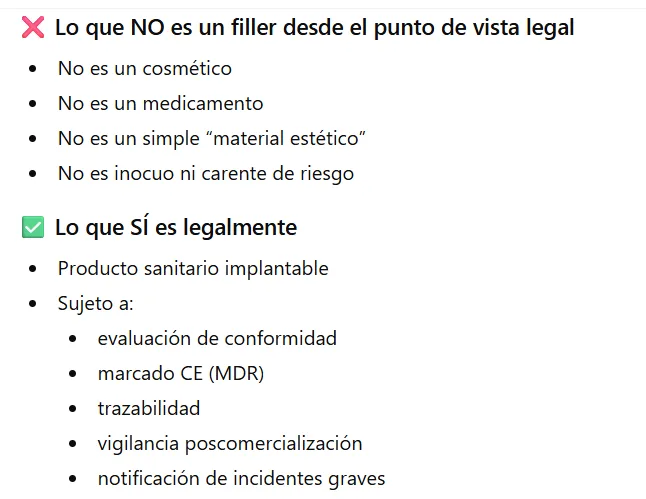
Fig 1. The device lane made explicit: a filler is an implantable medical device subject to conformity assessment, CE marking (MDR), traceability, post-market surveillance and serious-incident notification. (UPO Sorted, T10 Complicaciones de Rellenos, Dra Tejero, slide 7). [36]
> Fuentes: MEDLIB corpus, Aesthetic_Medicine/UPO Sorted/M2/T10_Complicaciones_Rellenos; regulatory frame per MDR Anexo XVI [2] and RD 192/2023 [3].
The device lane: MDR, Anexo XVI and RD 192/2023
Fillers, aesthetic energy-based devices and injectable lipolysis are captured by Anexo XVI of the MDR, the list of "products without an intended medical purpose" that the regulation nonetheless subjects to the full device regime [2]. That is the legal hook that made a purely cosmetic HA filler a regulated device across the EU. RD 192/2023 is the Spanish adaptation: it names the competent authority (AEMPS), fixes the language regime for labelling and IFU, regulates in-house manufacture and single-use reprocessing, and, relevant here, treats several Anexo XVI products as subject to prescription when applied by professionals [3]. It derogated the old RD 1591/2009, so a protocol that still cites 1591/2009 as its authority is out of date. The clinician's operational obligations from this lane are concrete: buy only CE-marked product from an identified distributor, record the lot and UDI per session, keep the traceability chain, know the AEMPS incident-notification route and use it. Post-market surveillance is not the manufacturer's problem alone; the user-side duty is to recognise and report a serious incident, and a device (a filler, an energy platform, a thread) that causes or could have caused a serious deterioration in health falls under that reporting duty [2][3]. The UDI is the spine of the whole system: it is what lets a specific lot be traced from the manufacturer through the distributor to the patient, and it is what a recall or a field-safety notice keys on, so a session record without the UDI has broken the chain at the one point the clinic controls [2]. RD 192/2023 also folds several Anexo XVI products into the prescription regime when applied by professionals, which reinforces that these are not consumer cosmetics a lay operator may apply; the device lane and the acto médico rule reinforce each other rather than pointing in different directions [1][3].
The medicine lane: toxin, ficha técnica and off-label
Botulinum toxin type A is a prescription medicine. Its authorised aesthetic indications in Spain are narrow (glabellar, and for some brands lateral canthal and forehead lines); everything beyond that is off-label and runs through RD 1015/2009, which requires written clinical justification and specific consent [7]. Circular AEMPS 2/2010 sets the conditions of prescription, dispensing and use for aesthetic type-A toxin, and has been complemented by Circular 1/2023 ⚠ [6]. Two hard facts from the ficha técnica that the circular protects: toxin units are not interconvertible between brands, and the cumulative dose across all indications should not exceed 400 U per 12 weeks for onabotulinumtoxinA-equivalent labelling [6]. Etrusco 2023 illustrates the same off-label logic in an adjacent field (gynaecology), where the indication expands faster than the label and the dose/site remain unstandardised [30]. Brand-to-molecule mapping and inter-brand equivalence are not repeated here: see A7 — Neurotoxin comparative map & brand equivalence.en for the full grid.
The advertising regime: the lane that opens the most files
Health advertising is where Spanish aesthetic clinics most often get sanctioned, and the norm is layered. RD 1907/1996 governs advertising of products, activities and services with a claimed health purpose: article 4 prohibits guarantees of cure or result, requires prior sanitary authorisation and the display of the registry number [8]. Ley 34/1988 General de Publicidad bans misleading advertising generally [9]. The prescription-medicine rule is categorical: advertising a prescription medicine to the public is prohibited, which is why "bótox" (a brand of a prescription medicine) cannot appear in public-facing communication even though the public searches for exactly that word [8]. Since 2024 the influencer layer is explicit: Ley 13/2022 General de Comunicación Audiovisual, article 94, plus RD 444/2024 (BOE-A-2024-8716), define "usuarios de especial relevancia" (income ≥300,000 €/yr and ≥1M followers on one platform, or 2M combined) who must register and carry the audiovisual-provider advertising duties, including identifying commercial content [10]. A clinic that pays such an account for a testimonial inherits that identification duty. Autonomous rules add a further layer (for example the Madrid advertising order) ⚠.
Data protection and the sanctioning regime
Health data are a special-category datum under the RGPD; a clinical photograph is health data. The operational rule is a separate, purpose-specific and revocable photographic consent (clinical record vs teaching vs marketing are three different consents), a lawful basis on file, and a DPO where the processing scale requires it [11][12]. The sanctioning backstop is administrative under Ley 14/1986 [18] and, at the extreme of non-medical practice, criminal under article 403 of the Código Penal (intrusismo) [16]. (P) In practice the two enforcement bodies you actually meet are the autonómica health inspector (centre, records, advertising) and the AEPD (data); the criminal route is reserved for the non-medical operator, not the licensed clinic.
Who may inject: the acto médico rule
Indication and injection of a prescription medicine, and of an implantable device, are a medical act. Nursing assists and executes under medical indication within its competencies; it does not indicate or assess autonomously. STS 653/2021 (10 May) rejected the Consejo General de Enfermería appeal and annulled its Resolution 19/2017, confirming (after three TSJ-Madrid rulings, 334/2019, 790/2019 and 196/2020) that non-surgical aesthetic treatments with toxin, HA, PRP and mesotherapy belong to physicians within their fields [1]. The nursing sector still argues a device/medicine split (that HA, being a device, is not reserved); the courts have not adopted it. Detail on scope and intrusismo is in §B7.7.
Where the norm actually varies: the autonomous layer and the AEPD
The single most under-appreciated feature of the Spanish frame is that the state norm is a floor and the Autonomous Community sets the operative detail. RD 1277/2003 fixes the taxonomy (U.48), but the technical requirements to authorise and inspect a U.48 unit, rooms, equipment, staffing, retention periods for the historia clínica, are set and enforced by the Consejería de Sanidad of each of the 17 communities, and they are not uniform [5][21]. Andalucía published an operating guide in 2024; other communities work from their own instructions or from the generic decree [21]. The practical consequence is that a protocol that is compliant in one community can be short of a requirement in another, and the retention period quoted as "5 years" is a national minimum that several communities extend ⚠ [4]. A second enforcement body deserves its own line: the AEPD (data-protection authority) is independent of the health inspector and reads the photographic-consent architecture, the register of processing and the data-processor contracts. A clinic can be fully authorised as a centre and still be exposed on data, because the two inspections are separate and test different documents [11][12].
(P) The operational takeaway is that "is this legal in Spain?" is almost always the wrong question; the right one is "is this compliant in my community, and does it survive both the health and the data inspection?" [5][11].
Trampa clásica: citing the toxin's CE mark or the filler's ficha técnica. Neither exists. A CE certificate for a toxin or a CIMA ficha técnica for a filler is a sign the operator has not understood which lane the product is in, and it is the first thing a competent inspector notices [2][6].
B7.3 · The procedure, step by step
There are two procedures a Spanish practitioner runs. Procedure A is opening and keeping a compliant practice. Procedure B is the per-session legal-clinical flow for one patient. Both are answered first as a checklist, then justified. The Spanish specificity in both is that the sequencing is legally load-bearing, not administrative: the centre authorisation gates the lease, the documented training gates the unit direction, and the emergency documentation gates the first HA injection [5][19][34]. In a market with a gatekeeping specialty, several of these steps are absorbed by the residency and the hospital; in Spain they are the individual practitioner's to build and to prove, which is why a checklist that reads as bureaucratic elsewhere is the substance of the competency defence here [1][19]. A step performed out of order is not a smaller version of the same compliance; it is a specific, foreseeable failure with its own cost, catalogued in the "why the order is the order" note below and in §B7.5. Read each procedure as a gate list where the gate, not the task, is the point.
Procedure A: standing up a compliant practice (ordered, gated)
| # | Step | Gate before the next step | Norm |
|---|---|---|---|
| 1 | Medical degree + colegiación in the province of practice | Cannot indicate or inject without it | acto médico [1] |
| 2 | Documented, current training, certificates archived | Inspectors of several CCAA require accredited training to run a U.48 | [19][5] |
| 3 | Professional liability (RC) insurance covering every technique actually performed, including off-label | A technique outside the policy is uninsured | [7] |
| 4 | Autonomous-community authorisation of the centre as U.48, before signing the lease | No treatment may be billed before authorisation | RD 1277/2003 [5] |
| 5 | Contracts: biosanitary waste, equipment maintenance, RGPD data processors | Required at inspection | [11][12] |
| 6 | Products CE-marked, identified distributor, invoice; lot/UDI logged per session | No traceability, no defence | MDR [2] |
| 7 | Consent per Ley 41/2002, explicit off-label/off-IFU mention | No invasive act without it | [4][7] |
| 8 | Separate, revocable photographic consent by purpose | Clinical ≠ teaching ≠ marketing | RGPD [11] |
| 9 | Emergency cart complete and in date: sufficient hyaluronidase, written vascular-occlusion and anaphylaxis protocol | No injecting HA without it | [34] |
| 10 | Advertising audited: no prescription-medicine brand, no result guarantee, registry number shown | Before publishing | [8][9] |
| 11 | AEMPS incident-notification route known and used | Device vigilance is enforced | [2][3] |
| 12 | Continuing education and emergency drills, documented | The competency defence in the absence of a specialty | [19] |
Why the order is the order
Steps 1 to 4 are sequential, not parallel. Authorisation of the centre (step 4) is the choke point: it precedes signing the lease, because the community can refuse a premises that does not meet the U.48 technical requirements, and a signed lease then becomes a liability. Andalucía formalised the U.48 operating requirements in an Orden of 3 April 2024 (BOJA 2024/68), the kind of guía de funcionamiento that turns the generic RD 1277/2003 taxonomy into an inspectable checklist of rooms, equipment and staff [5][21]. The Raúl Pinto Manual Práctico de Medicina Estética documents the same premise-plus-record logic that the modern guía de funcionamiento codifies [39]. Step 2 sits second on purpose: because there is no specialty, the accredited training is not a formality but the document the inspector reads to decide whether you may direct a U.48 unit at all [19].
The acto médico obligations that Procedure A operationalises
Fig 2 is the conceptual root of the whole checklist: from the single premise that an injectable is an invasive medical act, five obligations follow, and each maps to a step above. (1) Acto médico: filler infiltration is an invasive medical act (steps 1, 4). (2) Professional responsibility, covering foreseeable and unforeseeable complications (step 3, RC insurance). (3) Duty of information: specific, current, written consent (step 7). (4) Traceability: brand, lot, material type (step 6). (5) Adverse-event management: early diagnosis, correct treatment, recording and notification where applicable (steps 9, 11).
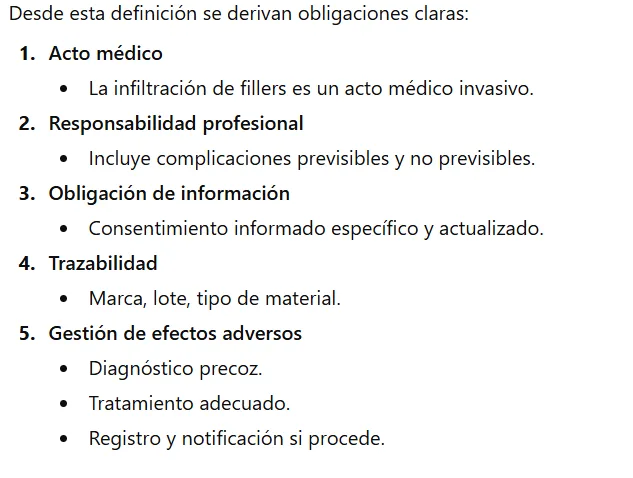
Fig 2. From "injecting is a medical act" derive five duties: acto médico, responsibility for foreseeable/unforeseeable complications, informed consent, traceability (brand, lot, material), and adverse-event management with recording and notification. (UPO Sorted, T10 Complicaciones de Rellenos, Dra Tejero, slide 9). [36]
> Fuentes: MEDLIB corpus, Aesthetic_Medicine/UPO Sorted/M2/T10_Complicaciones_Rellenos; obligations grounded in Ley 41/2002 [4], MDR traceability [2] and STS 653/2021 [1].
Procedure B: the per-session legal-clinical flow
| Phase | Act | The Spanish-specific control |
|---|---|---|
| Triage | Confirm the request is a medical act and that you (a physician) will indicate it | Never delegate the indication [1] |
| Consultation | Assessment, photographs, define the goal in millilitres/units, in writing | "Natural" is not a goal until it is quantified (§B7.7) |
| Reflection | Offer a reflection interval before treating, especially in medicina satisfactiva | The reinforced duty of information leans on it ⚠ [4] |
| Consent | Specific written consent; explicit off-label/off-IFU statement; separate photo consent | Ley 41/2002 [4] + RD 1015/2009 [7] + RGPD [11] |
| Treatment | CE product, aseptic technique, record lot/UDI, brand and volume per site | MDR traceability [2] |
| Safety net | Emergency cart in reach; hyaluronidase and the vascular-occlusion algorithm on the wall | [34] |
| Record | Close the historia clínica with indication, product, dose, and, if aesthetic-only, the fiscal note (21% IVA) | [4][13] |
| Follow-up | Scheduled review; adverse events managed and, where the device requires it, notified to AEMPS | [2] |
The reflection interval deserves a caveat. A fixed 24-hour cooling-off period is often quoted as if it were statutory; it is not written into Ley 41/2002 as a universal rule. It is a professional recommendation and, in medicina satisfactiva, an element of the reinforced duty of information that courts weigh; some autonomous or society models specify it. ⚠ Treat it as strongly advisable and document that it was offered, not as a national legal deadline [4].
Why the record is the deliverable, not the byproduct
In a system without a specialty and with a reinforced duty of information, the historia clínica is the single artefact that carries the practitioner through an inspection, a tax audit and a court, and it has to be written as if all three will read it, because they can. For an aesthetic-only act it records the indication and, where relevant, the note supporting the 21% IVA; for an off-label use it records the RD 1015/2009 justification and the specific consent; for any injectable it records brand, lot, UDI, dose and plane per site [4][7][13]. The reflection interval, offered and documented, sits here too: because a fixed statutory cooling-off period is not written into Ley 41/2002, its evidentiary value comes from the record showing it was offered, not from a calendar rule ⚠ [4]. The asymmetry to internalise is that the treatment takes minutes and the record outlives it by years; the prescription periods keep a contractual claim alive for up to five years, so a thin note written under agenda pressure is a liability that matures long after the clinical result has settled [17]. This is the operational meaning of "means, not result": the defence is not that the outcome was good but that the care and the information were diligent and documented [17][27].
Trampa clásica: signing the lease before the U.48 authorisation is granted, on the assumption that "the community always says yes." When the premises fail a technical requirement, the practitioner is left paying rent on a centre that cannot legally treat, and rushing a build-out under a lease clock is exactly how a room ends up non-compliant [5][21].
B7.4 · Templates and documents
Answer first: the document set. A Spanish U.48 clinic is, in inspection terms, its paperwork. The table lists every document that must exist, its mandatory fields, and the norm that owns it. The prose below specifies the two that most often fail: consent and advertising.
| Document | Mandatory fields | Owning norm |
|---|---|---|
| Treatment-specific informed consent | Patient ID; diagnosis/indication; technique; product and its legal nature; foreseeable and material rare risks (including vascular occlusion, blindness, nodules); alternatives incl. doing nothing; explicit off-label/off-IFU clause; expected result stated as an obligation of means, not result; revocability; date, two signatures | Ley 41/2002 [4] + RD 1015/2009 [7] |
| Photographic consent | Separate document; purpose enumerated and ticked (clinical record / teaching / marketing / social media), each revocable; storage and retention; right to withdraw | RGPD [11] + LOPDGDD [12] |
| Historia clínica | Anamnesis; assessment; photographs; indication; product brand + lot/UDI; dose/volume per site; adverse events; follow-up; if aesthetic-only, the note supporting 21% IVA | Ley 41/2002 [4] + MDR [2] + Ley 37/1992 [13] |
| Traceability log | Per session: brand, lot, UDI, expiry, volume, sites, batch of any hyaluronidase used | MDR [2][3] |
| Advertising compliance sheet | Registry number displayed; no guarantee of result; no prescription-medicine brand named; before/after images with disclaimers; influencer content flagged as advertising | RD 1907/1996 [8] + Ley 34/1988 [9] + Ley 13/2022 art 94 [10] |
| Emergency protocols (wall + folder) | Vascular-occlusion algorithm with hyaluronidase dosing; anaphylaxis algorithm; PDLLA/PLLA-specific delayed visual-loss pathway; emergency contacts | [34] |
| AEMPS incident report | Device identification; incident description; patient outcome; corrective action; submission proof | MDR vigilance [2][3] |
| RGPD register + processor contracts | Register of processing activities; DPO where required; data-processor contracts (imaging, EHR, marketing) | RGPD [11] + LOPDGDD [12] |
The consent document: what makes a Spanish one different
A Spanish aesthetic consent is not the US "risks, benefits, alternatives" form with a Spanish header. Three additions are load-bearing. First, the off-label clause. Because most aesthetic toxin use and much filler placement is outside the authorised indication or the manufacturer IFU, RD 1015/2009 requires the consent to state this explicitly and record the clinical justification [7]. A consent that is silent on off-label use is defective precisely where the litigation risk concentrates. Second, the medicina satisfactiva framing. Spanish jurisprudence historically flirted with treating satisfactive medicine as an obligation of result; the consolidated line now treats all medicine as an obligation of means unless a result is expressly promised (§B7.5), but the price of that doctrine is a reinforced duty of information [26][27]. The consent must therefore describe the realistic result as an aim pursued with due care, never as a guaranteed outcome, and must document the alternatives including abstention. Third, the material-risk disclosure has to name the rare-but-grave events specific to injectables: vascular occlusion, skin necrosis and blindness for fillers; the delayed visual-loss pathway for collagen-stimulating injectables such as PDLLA-HA is now the subject of a dedicated management consensus and should be named where such product is used [34]. Omitting a foreseeable grave risk is the single most cited consent failure in the medicolegal literature [27].
The advertising sheet: the highest-frequency sanction
RD 1907/1996 article 4 is short and strict: no guarantee of cure or result, prior sanitary authorisation of the advertisement where required, and display of the sanitary registry number [8]. Layered on top, the prescription-medicine ban means the public-facing name is always the molecule or the generic act, never the medicine brand [8]. The 2024 influencer regime adds an identification duty: paid or sponsored content by a "usuario de especial relevancia" must be flagged as advertising, and the clinic that commissions it shares the exposure [10]. A practical compliance sheet checks four things before anything is published: (1) registry number present; (2) no result guarantee, no "risk-free", no "definitive"; (3) no prescription-medicine brand; (4) any testimonial or influencer collaboration labelled. Before/after images are permitted but must be honest, comparable and consented for that purpose under the RGPD, since they are health data of the patient [11].
The emergency documentation is a treatment prerequisite, not an extra
Step 9 of Procedure A is a document as much as a cart. The wall protocol has to make the vascular-occlusion pathway executable by whoever is present: recognise (pain out of proportion, blanching, livedo, delayed capillary refill), stop, and deliver high-dose pulsed hyaluronidase along the ischaemic territory per the current algorithm, with the dose and the reconstitution written down so nobody calculates under stress. For collagen-stimulating injectables the delayed-onset visual pathway is distinct and now has an expert consensus algorithm [34]. The anaphylaxis protocol (intramuscular adrenaline first line, dose by weight, position, oxygen, call) belongs on the same wall. The clinical depth of these algorithms lives in the complications chapters (J1 — Vascular Occlusion & Emergencies.en); B7 only fixes that in Spain the written protocol and the in-date hyaluronidase are conditions of lawfully injecting HA, not optional polish [2][34].
The data documents the health inspector does not read
The RGPD layer is a parallel documentary universe with its own inspector (§B7.2). Three documents carry it. The register of processing activities lists every purpose for which the clinic holds health data (clinical record, billing, imaging, marketing, appointment reminders) with its lawful basis and retention; a clinic that cannot produce it is exposed regardless of how good its consents are [11][12]. The data-processor contracts bind every third party that touches patient data, the EHR vendor, the imaging or photo-storage provider, the marketing agency, the teleconsultation platform, and the absence of one turns a routine vendor relationship into an unlawful transfer of health data [11]. The DPO (data protection officer) is required where the scale or nature of processing meets the threshold, and health data processed at volume tends to. The photographic-consent architecture ties back here: because a clinical photograph is special-category health data, the purpose-separated, revocable consent of §B7.3 is not a courtesy but the lawful basis, and when a patient withdraws the marketing purpose the systems have to be able to honour that withdrawal without touching the clinical record [11][12]. (P) The recurring failure is treating data as an IT problem; in Spain it is a documentary and consent problem that an independent authority audits on its own schedule.
Trampa clásica: a single blanket "consent to treatment and use of my image" document. It fails twice: it is not treatment-specific (Ley 41/2002 wants one consent per procedure), and it fuses clinical, teaching and marketing image uses that the RGPD requires to be separate and separately revocable. When a patient later withdraws only the marketing use, the fused document cannot honour it, and that is a data-protection breach on file [4][11].
B7.5 · Frequent errors and their cost
Answer first: the error ledger, with the cost column made explicit because in Spain the cost is rarely the complication alone. It is the complication plus a tax, a sanction, an uninsured claim or a criminal file.
| Error | Why it happens | The cost |
|---|---|---|
| Advertising "bótox" | It is the word the public searches | Sanction: advertising a prescription medicine to the public [8] |
| Accepting "natural" as a goal without millilitres | It is what the patient says | Expectation claim; the reinforced duty of information is unmet [26] |
| Delegating the indication to non-medical staff | Agenda pressure | Invalidated cover; administrative sanction; intrusismo file for the operator [1][16] |
| Buying product without CE for price | Margin | No traceability, no vigilance, no insurance cover; civil and criminal exposure [2][23] |
| Injecting an illegal filler (silicone, biopolymer, PMMA) | Cheap, available on the grey market | ASIA, granuloma, hypercalcaemia, renal failure, death; the physician is the first civil responsible [23][24][25] |
| Billing an aesthetic-only act as VAT-exempt | Old habit that "a doctor's act is exempt" | Tax reassessment of the 21% plus penalty and interest [13][15] |
| No emergency cart / expired hyaluronidase | "It won't happen to me" | An occlusion becomes a necrosis or a blindness; indefensible [34] |
| Promising a result in writing or in marketing | Sales pressure | Converts an obligation of means into an obligation of result [17] |
| Not asking about procedures done abroad | The patient does not volunteer it | Managing a complication of an undocumented prior product [32] |
| Fusing clinical and marketing image consent | Convenience | Data-protection breach when the patient withdraws one use [11] |
The costliest confusion: obligation of means vs obligation of result
Consensus: Spanish jurisprudence has consolidated the rule that all medicine, curative or satisfactive, is an obligation of means: the physician owes diligent care to lex artis ad hoc, not a guaranteed outcome (STS 29 Jul 2007; STS 463/2013 of 28 June; STS 828/2021 of 30 November) [17].
Discrepancy: the classic and residual position tied medicina satisfactiva to an obligation of result (a contrato de obra; STS 13 Dec 1997), where the claimant need only show the promised result was not reached. It survives in one place that matters: the express exception. Decide by: whether a specific result was promised or guaranteed in writing or in advertising. If it was, the case is pulled back toward result liability; if it was not, means liability governs [17][27].
This is not academic, because it changes the gesture in the chair and at the desk. It dictates that consent and marketing describe the result as an aim pursued with care, never as a guarantee, and it is why the reinforced duty of information carries the weight: with result liability off the table, the failure that most reliably produces a losing case is a documented information gap, not a technical error alone. Mussabekova 2025, systematically reviewing facial-aesthetic litigation, found the leading causes to be unsatisfactory outcome, failure of informed consent, technical error and inadequate follow-up, in that order [27]. Zamani Noudadi 2026, reviewing 525 cosmetic malpractice records, showed statistically distinct outcome and penalty patterns between licensed and unlicensed providers, which is the empirical shape of the intrusismo problem [26].
The process cost, not just the verdict, is part of the ledger. A satisfactive-medicine claim in Spain turns first on the consent and the record, because with result liability off the table the claimant's most productive line is a defect in the information or the documentation, and the historia clínica is the principal proof for both sides [17][27]. The practical asymmetry is that the practitioner cannot reconstruct a diligent information process after the fact; either the specific consent, the off-label justification and the material-risk disclosure are in the file from the day of treatment, or they are not, and years may separate the act from the claim [7][17]. Zamani Noudadi 2026 quantifies the other axis of this cost: across 525 cosmetic malpractice records, licensed and unlicensed providers showed statistically different clinical outcomes, service settings and judicial penalties, which means the intrusismo problem is not only a market-share nuisance but a measurable divergence in harm and accountability [26]. The lesson the litigation data return is monotonous and therefore reliable: the cases that resolve badly for the practitioner cluster on consent and documentation failures far more than on isolated technical error [27].
The fiscal error: 21% IVA is the default, exemption is the exception
The tax lane is where a well-run clinic still loses money by inertia. Aesthetic acts without a therapeutic purpose are subject to 21% IVA; they are not exempt. The exemption of article 20.Uno.3.º of Ley 37/1992 covers only assistance directed at diagnosis, prevention or treatment of disease [13]. The European anchor is STJUE C-91/12 (PFC Clinic, 21 March 2013): cosmetic surgery and treatment fall under the health-care exemption only when their purpose is to diagnose, treat or cure disease, or to protect, maintain or restore health, and the patient's subjective valuation is not decisive [14]. Spanish doctrine applies it case by case: DGT binding ruling V0310-26 (12 February 2026) held that a dermatology consultation performed as a preliminary step to an aesthetic treatment is itself subject to 21%, because it lacks the therapeutic finality, while a blepharoplasty is exempt only where it corrects a visual-field limitation [15]. The operational consequence is a documentation duty: the therapeutic purpose has to be evidenced in the historia clínica, because being a physician does not carry the exemption; the clinical justification does [13][15]. The cost of getting it wrong is a reassessment of the 21% not charged, plus penalty and interest, on every act reclassified.
The grey-market error: the physician is the first responsible
Illegal injectable products are a live problem, not a historical one. Liquid silicone, biopolymers, PMMA and paraffin injected outside the norm produce iatrogenic alogenosis: a foreign-body modelling reaction that can precede ASIA syndrome (autoimmune/inflammatory syndrome induced by adjuvants), documented in a case series of gluteal biopolymer injection where every patient with the modelling reaction developed ASIA [24]. Ordinola Navarro 2022 catalogues the use of illegal foreign substances for cosmetic purposes and their spectrum of harm [23]. Brummund 2025 adds the endocrine-renal tail: biopolymer-induced granulomatous hypercalcaemia that, unrecognised, leads to renal failure, metastatic calcification and death, sometimes requiring surgical excision of the granulomatous tissue [25]. The Spanish legal frame is unforgiving to the injector: using a product without CE means no traceability, no vigilance and no insurance cover, and the physician who injects it is the first civil responsible, ahead of the distributor, because the medical act is the proximate cause [2][16]. Fig 4 shows the kind of adverse cutaneous reaction that follows a poorly selected or executed injectable, the clinical signature that opens the adverse-event file: erythematous, hypersensitivity-pattern reaction across the mid and lower face.
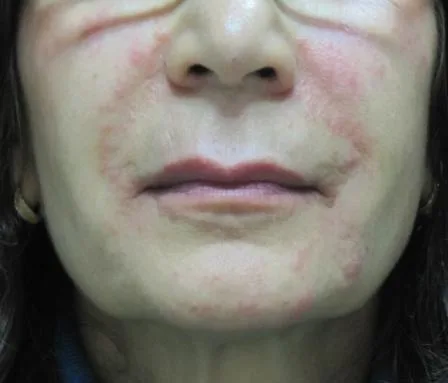
Fig 4. Adverse cutaneous reaction (erythema, hypersensitivity pattern, perioral and malar distribution) after an injectable; the clinical signature that triggers adverse-event recording and, for a device, AEMPS notification. (UPO Sorted, T10 Complicaciones de Rellenos, Dra Tejero, slide 80). [36]
> Fuentes: MEDLIB corpus, Aesthetic_Medicine/UPO Sorted/M2/T10_Complicaciones_Rellenos; grey-market harm spectrum per Ordinola 2022 [23], Montealegre 2021 [24] and Brummund 2025 [25].
⚠ A frequently quoted figure is a Barcelona criminal sentence for injecting non-CE liquid silicone. The exact prison term and civil award reported by the scout could not be independently verified for this chapter and are therefore not printed as fact; the citable point is the settled principle that injecting a non-CE product is both a civil and a criminal exposure for the physician [16][23]. [MATERIAL GAP] the precise Spanish criminal caselaw on illegal fillers was not retrievable from the corpus and needs a legal-database pass before a specific case is quoted.
The slower-burning costs: late nodules, biofilm and the insurance gap
Not every cost is acute. The delayed-onset nodule is the archetype of the slow cost: a firm, sometimes inflammatory lesion appearing weeks to months after a filler, where the differential runs from a low-grade biofilm to a type-IV hypersensitivity to a granulomatous reaction, and the management (watchful waiting, antibiotics, intralesional steroid, hyaluronidase, or excision) turns on that distinction [25][27]. The Spanish cost layer is that a late nodule in a patient whose record does not document the product brand, lot and plane is a nodule managed blind and defended blind, which is why the traceability log (§B7.4) is a clinical instrument, not only a regulatory one [2]. The insurance gap is the other quiet cost. Professional liability cover in Spain is written against the techniques declared; a technique performed but not declared, or performed off-label without the RD 1015/2009 documentation, can fall outside the policy exactly when it is needed, and the prescription periods (one year for extracontractual, up to five for contractual claims) mean the exposure sits open for years after the act [7][17]. A clinic that adds a technique, a new device, a new injectable class, without updating the policy has created an uninsured line of practice it does not know it is running until a claim lands [17][27].
The reputational and disciplinary cost of advertising
The highest-frequency file in this sector is not a complication at all; it is an advertising infraction, and its cost is disciplinary and reputational before it is financial. A "bótox" promotion, a "risk-free" or "definitive result" claim, or an unlabelled influencer testimonial can trigger a colegio disciplinary file and an autonómica sanction under RD 1907/1996 and Ley 34/1988, and the OMC deontology code is applied effectively in precisely this area [8][9][40]. Because the public searches for the brand and the guarantee, the commercial pressure runs against compliance, which is why the advertising-compliance sheet (§B7.4) exists as a gate before publication rather than a review after it [8][10].
Trampa clásica: the "it was a device, so the nurse could do it" defence after a grey-market or delegated injection goes wrong. It fails on both facts: the courts have not accepted the device/medicine split for scope of practice (§B7.7), and a non-CE product has no device status to begin with, so the argument disproves itself [1][2].
B7.6 · Metrics: what to measure and the reference value
Answer first: the metric board. Three families, market, clinical-quality and fiscal, each with a measurable and a reference value you can hold against your own numbers.
| Metric | What it measures | Reference value (source) | Source |
|---|---|---|---|
| Population penetration | Share of Spaniards who had an aesthetic-medicine treatment in the year | 46.6% in 2023 (press headline rounds to ~50% ⚠) | SEME 2023 [22] |
| Sex distribution of patients | Demand by sex | 69% women / 31% men | SEME 2023 [22] |
| Age polarisation | Where demand is growing | 16–25 rising (14→20%); >45 rising (28→38%); core women 35–54 | SEME 2023 [22] |
| Social-class skew | Perceived accessibility | 69% upper / upper-middle, 25% middle, 6% lower | SEME 2023 [22] |
| Top-5 treatments | The demand mix | IPL, HA fillers, mesotherapy, PRP, botulinum toxin | SEME 2023 [22] |
| Public misconception | Safety-relevant literacy | 44% did not know the treatment must be done by a physician | SEME 2023 [22] |
| Site-mix shift (benchmark) | Where injectable demand is going | Patients ≥40 now the majority (63.7% by 2024); orbital rim the most-treated site (22.6%) in a nationwide dataset | Tamura 2026 [31] |
| Consent completeness | % records with specific + off-label + photo consent | Target 100%; audit monthly | [4][7] |
| Traceability completeness | % sessions with lot/UDI logged | Target 100% | MDR [2] |
| Hyaluronidase readiness | Vials in date vs HA sessions/day | Never zero on an HA day | [34] |
| VAT correctness | % aesthetic-only acts billed at 21% | 100% unless therapeutic purpose documented | Ley 37/1992 [13] |
| Global benchmark | International procedure volume/direction | ISAPS annual survey (use as a trend reference, not a Spanish figure ⚠) | ISAPS [35] |
The market numbers, and the conflict kept, not averaged
The anchor dataset is the SEME 2023 study Percepción y Uso de la Medicina Estética en España (n=1,501), presented at the 39th SEME National Congress in Málaga in February 2024 [22]. It reports that 46.6% of the Spanish population had an aesthetic-medicine treatment in 2023. The society's own press headline rounds this to "50%", and a later SEME/Sigma Dos wave used a different sample base (n=2,469). ⚠ These figures do not contradict each other so much as measure slightly different things; the disciplined move is to quote 46.6% as the study value and note the ~50% headline and the alternative sample, not to average them into a fake single number. The demand profile is stable and specific: women predominate (69% vs 31% men) with a core of 35–54, but the spectrum is polarising at both ends, younger (16–25 up to 20%) and older (>45 up to 38%); the patient base skews to upper and upper-middle class (69%), which the report itself reads as a perceived-elitism signal [22]. The top-five treatment mix, IPL, HA fillers, mesotherapy, PRP and toxin, tells you the Spanish market leads with skin and light as much as with volume, which is not true of every reference market.
The single safety-relevant metric in that dataset is that 44% of people who underwent aesthetic procedures did not know the act must be performed by a physician [22]. That number is the demand-side face of the intrusismo problem (§B7.7): the market is not only supplied by non-medical operators, it is partly demanded by a public that does not know to ask for a doctor.
The demand profile has direct operational implications the raw percentages hide. The upper and upper-middle skew (69%) with a perceived-elitism signal means the market has an accessibility gap that the volume and chain models exploit precisely by competing on price, which is the economic engine behind the intrusismo demand of the 44% who do not know a physician is required [22]. The age polarisation (younger at 16 to 25, older beyond 45) splits the book into two clinical logics that a single price list and a single protocol cannot both serve well: the younger cohort arrives with a "preventive" frame and small localised requests, the older with multi-site rejuvenation, and the metric to watch is the ratio between them because it forecasts the product mix and the complication profile of the coming year [22][31]. The strong seasonality (pre-summer and pre-Christmas peaks) is a capacity and safety metric as much as a revenue one: the pre-summer peak overlaps the highest-risk window for energy and pigment work in the phototype IV segment (§B7.7), so a clinic that lets demand dictate timing rather than the other way round is booking its riskiest procedures into its busiest and least-margin-for-error weeks [31]. None of these is a vanity number; each maps to a decision about pricing tiers, protocol design and scheduling.
The benchmark that predicts where Spanish demand is going
Spanish longitudinal injectable data are thin, so a benchmark is useful with a caveat. Tamura 2026, a nationwide big-data analysis of 299,413 facial HA sessions, documents a demographic inversion: patients aged ≥40 became the majority (63.7% by 2024) and the orbital rim became the single most-treated site (22.6%), with younger patients favouring localised contouring and older patients multi-site rejuvenation [31]. ⚠ This is Japanese data; the direction (ageing patient base, migration toward periorbital and multi-site work) is a plausible read-across, the absolute percentages are not Spanish. The Fernández-Tresguerres monograph situates the same ageing-face demand physiologically, which is why the metric to watch locally is the age curve of your own book, not the national average [38].
What deliberately has no reference value here
Two numbers are deliberately not printed. Price bands are omitted: they vary by community, centre model and year, and a figure written into an atlas ages in a year and is cited for ten; the calculation method is in B4 — Practice Management & Business Development.en §B4.2 and does not expire. National activity counts (a frequently cited "hundreds of thousands of treatments and thousands of authorised U.48 centres in 2021") are not printed as fact: [MATERIAL GAP] the specific 2021 figures the scout carried (a precise treatment count and centre count) could not be verified against a primary source for this chapter, so the reference value is left open rather than asserted [22].
How to run the metric board without lying to yourself
The safety metrics are only useful if they are audited on a cadence the clinic actually keeps, and the trap is to measure what is easy (revenue, footfall, follower growth) and to leave the load-bearing numbers to memory. A workable cadence: a monthly record audit on a random sample, scoring consent completeness (specific plus off-label plus photographic), traceability completeness (lot and UDI logged), and the fiscal note on aesthetic-only acts; a per-shift check that hyaluronidase is in date and sufficient for the HA sessions booked; and a rolling register of adverse events and their AEMPS notifications where the device requires it [2][4][7]. The reference value for the first three is 100%, because unlike a clinical outcome these are documentary facts fully under the clinic's control, and a value below 100% is not noise but a specific missing document with a name [4]. The one metric to benchmark externally rather than target is the age curve of the book, read against the ageing-patient direction Tamura 2026 documents, because it predicts where the clinic's own demand and complication mix are heading [31]. The market-penetration and demand-mix numbers from SEME are a context to position against, not a target to move; a clinic does not set out to match a national 46.6% [22].
Trampa clásica: grading a facet or a clinic on coverage-style vanity metrics (followers, footfall) while the safety metrics (consent completeness, traceability, hyaluronidase readiness) sit unmeasured. The metrics that a court, an inspector and the AEMPS read are the second set, and they are the ones no dashboard shows by default [2][4].
B7.7 · The Spanish particularity
Answer first: the four things that make Spain Spain. (1) No official specialty, so scope of practice is contested and training is self-owned. (2) A live intrusismo front with case law behind the physicians. (3) A patient who leads with "naturalidad", skin and body, and is price-sensitive and seasonal. (4) A shelf tilted toward European and, increasingly, CE-marked Korean product, in a country that is both a destination and a source of aesthetic tourism. Each of the four is a departure from the reference markets, and each changes a concrete decision: the missing specialty raises the documentary burden rather than lowering it [1]; the intrusismo front means the competitor across the street may not be a physician and the patient often cannot tell [26]; the patient's stated preference for "naturalidad" is the leading generator of expectation conflict and has to be quantified in millilitres before any product is drawn up [33]; and the shelf's material diversity means the same syringe gesture delivers products with different planes, IFUs and complication profiles [37]. The subsections below take the four in turn: the governing fact, the scope war, the patient, the tourism flows and the shelf. The through-line is that the Spanish market is defined by an absence (the specialty) more than by any feature it added [1][22].
The governing fact and its cascade
There is no MIR specialty in aesthetic medicine, so the field is entered from general medicine plus títulos propios, and it is populated by two recognisable profiles: the long-standing general physician (often 45 to 60, with postgraduate diplomas) and the MIR-trained specialist from an adjacent field who adds a master's. From that single absence flow the training-by-master route (§B7.8), the scope fight below, the intrusismo pressure, and the relative power of the scientific societies as the de-facto standard setter [1][19][22]. Kumbasar-Atay 2026 frames the same structural gap internationally: where a procedure is simultaneously cosmetic and medical and no specialty owns it, regulation fragments and accountability blurs [29].
Intrusismo and scope of practice: who may inject
Consensus (courts): non-surgical aesthetic treatment with toxin, HA, PRP and mesotherapy is a medical act reserved to physicians within their fields. STS 653/2021 (10 May) annulled the Consejo General de Enfermería Resolution 19/2017 and confirmed the three preceding TSJ-Madrid rulings (334/2019, 790/2019, 196/2020) [1].
Discrepancy (professional bodies): the nursing sector distinguishes device from medicine, arguing that HA (a device) is not reserved and only the toxin and PRP (medicines) require a physician. Decide by: the courts have not adopted the split; the reserved act is the aesthetic indication and infiltration, not the molecule's regulatory class [1]. Odontólogos may act only within the bucco-dental field, not for facial aesthetic purposes; non-sanitary beauty centres that add a medical act are the sharpest friction point. Article 403 of the Código Penal makes practising a titled profession without the title a criminal offence [16]. The societies run this front publicly (SEME's #NOsintumedico, the Catalan COMB's #Mésqueuntítol), and the empirical stakes are real: Zamani Noudadi 2026 shows licensed and unlicensed providers produce statistically different harm and penalty patterns [26]. A 2024 ministerial move, Orden SND/1002/2024 (18 September), tried to narrow who may perform cirugía estética by amending Anexo II U.47, and was suspended as a precaution by the Audiencia Nacional (auto of 11 November 2024) ⚠; the turf is being fought at the regulatory level, not only in the clinic [20].
The Spanish patient: what actually changes the consultation
| Trait | What it means in the chair |
|---|---|
| "Naturalidad" as the dominant stated value | The most-heard word, and it means something different to each person; define it in millilitres in writing (perception of "natural" is itself adaptable, Goldie 2021 [33]) |
| Explicit rejection of the overfilled phenotype | Patients name it spontaneously ("I don't want to look like...") |
| Lips: the star demand, with tension | Highly requested and simultaneously where restraint is most asked for |
| Earlier "preventive" onset | Consultation from 25–30 with a prevention frame |
| High interest in regenerative | PN, PRP, exosomes and biostimulators very favourably received, ahead of the evidence for some ⚠ [37] |
| Marked seasonality | Pre-summer (April–June) and pre-Christmas peaks; downtime procedures concentrate in autumn-winter |
| Phototypes II–IV, IV frequent | Melasma and PIH are real concerns in the southern half and in resident Latin-American populations |
| Price sensitivity and active comparison | Oversupplied market; volume-selling pressure is high |
| Strong body component | Body contouring and cellulitis demand well above northern-Europe markets |
The regenerative preference deserves its own caution because it is where demand runs furthest ahead of evidence. Polynucleotides, PRP, exosomes and injectable biostimulators are received in Spain with an enthusiasm that, for several of them, outpaces the published support, and the marketing around exosomes in particular has drifted into claims that sit outside both the evidence and the device/medicine frame [29][37]. The consultation control is to consent the patient to the evidence status of the specific modality, not to the category's promise, and to keep the public communication clear of any result claim that RD 1907/1996 would treat as a prohibited guarantee [8]. The body-contouring and cellulitis demand, well above northern-European levels, carries the same discipline: high demand is not evidence of high efficacy, and the honest consultation separates what is asked for from what is supported.
Two of these change the plan, not just the tone. Sun. Real solar exposure is high and daily photoprotection adherence is low, so any plan involving energy, peels or depigmentation starts there, and the seasonality is a condition, not a suggestion: treating a phototype IV with light in June before the summer is a predictable pigment complication. The word "natural". It is the leading generator of expectation conflict in this market, and because the perception of what looks natural shifts with exposure (the adaptation Goldie 2021 demonstrates for lip fullness [33]), it has to be pinned to a number on the first visit or it will drift over a series of sessions and end in dissatisfaction despite technically correct work.
Aesthetic tourism in both directions
The flows run in two directions and both land in the Spanish consultation as a clinical unknown. Spain is a receiver, chiefly of patients from the United Kingdom, France and northern Europe, and a sender, chiefly toward Turkey for hair and surgery. Both flows arrive in the consultation the same way: as patients with poorly documented prior procedures, which is a clinical problem, not an anecdote, because managing a complication of an unknown prior product is managing blind. Al Alawi 2026, reviewing 191 patients treated for complications of surgery performed abroad, found wound infection, seroma and abscess dominating, with a substantial share needing reoperation or critical care [32]. The practical rule for a Spanish clinic is to ask explicitly about procedures done elsewhere, because the patient will not volunteer them, and to treat an undocumented prior filler as an unknown until proven otherwise.
The Spanish shelf and its sourcing rule
The market tilts toward European manufacturers more than the Anglo-Saxon markets do: Teoxane, Vivacy and IBSA carry more relative weight here, and Mesoestetic (Barcelona) is a national player of scale in cosmeceuticals, peels and mesotherapy with its own international distribution. Korean ranges are entering through commercial agreements with CE marking, which is the legitimate route; the criterion never changes, CE plus identified distributor plus invoice, and anything else is the grey market of §B7.5. The full brand-to-molecule grids are in A6 — Filler comparative map & brand equivalence.en and A7 — Neurotoxin comparative map & brand equivalence.en and are not repeated here. Fig 3 illustrates the physical reality behind "the shelf": an opaque, semisolid injectable (a collagen-stimulating or non-HA product) extruded from a syringe, a reminder that the shelf is not one gel but several material classes, each with its own IFU, plane and complication profile.
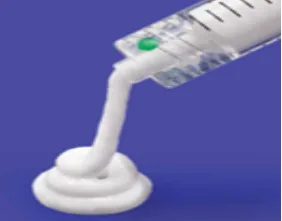
Fig 3. Not every syringe holds clear HA gel: an opaque semisolid injectable (a non-HA, collagen-stimulating class) has a distinct plane, IFU and complication profile. The shelf is several material classes, not one. (UPO Sorted, T8.1 Materiales de Relleno, Dr Arenas, slide 12). [37]
> Fuentes: MEDLIB corpus, Aesthetic_Medicine/UPO Sorted/M2/T8.1_Materiales_de_Relleno; sourcing rule per MDR CE requirement [2].
⚠ The effective availability of specific references within each range is a commercial decision that changes; verify it with the distributor, not with this chapter. The entry of newer toxins (for example letibotulinumtoxinA and prabotulinumtoxinA) has run behind their European authorisation in real Spanish availability.
Phototype, pigment and the seasonal condition
The Spanish patient population is predominantly Fitzpatrick II to IV, with IV frequent in the southern half and in the resident Latin-American population, and that single fact reorders the energy-and-pigment plan. Melasma and post-inflammatory hyperpigmentation (PIH) are not edge cases here; they are a baseline risk that any laser, IPL, peel or aggressive microneedling has to be planned around, because in a phototype IV the same energy that rejuvenates a II can seed a pigment complication [31]. The seasonality is therefore a clinical condition, not a marketing rhythm: the pre-summer demand peak (April to June) collides with the highest-risk window for pigment, so downtime and energy procedures are pushed to autumn and winter, and daily photoprotection is the non-negotiable first step of any pigment or energy plan in a population whose real solar exposure is high and whose adherence to daily SPF is low. The deep protocol lives in the pigment and energy chapters; the Spanish particularity B7 fixes is that the phototype distribution and the sun make photoprotection and seasonal timing a precondition of treatment, not an adjunct [31].
The dental and surgical scope edges
Two adjacent professions press on the aesthetic-medicine boundary and each has a defined edge. Odontólogos may act only within the bucco-dental field; a dentist injecting the perioral area for a strictly dental-functional purpose is within scope, while the same injection for a facial-aesthetic purpose is not, and the courts treat the aesthetic indication, not the anatomical proximity, as the reserved act [1]. Plastic and maxillofacial surgeons enter from the surgical side, where the tension is the reverse: the limits of the non-surgical are narrow and crossed daily, so the correction the surgical school offers is real, at the cost of a bias toward indicating surgery where a non-surgical option would serve [1][27]. The organizational reading is that the turf is not a single line but a set of profession-specific edges, each defined by the purpose of the act rather than by who holds a needle [1][16].
Trampa clásica: reading "no specialty" as "anyone can, so I can relax the paperwork". It is the intrusismo argument turned inward, and it fails the same way: the absence of a specialty raises the documentary burden on the physician, it does not lower it, and it is precisely the clinic that relaxes on consent and traceability that an inspector or a court cannot distinguish from the non-medical operator it is competing against [1][16].
B7.8 · Organizational alternatives
Answer first: two decisions have organizational alternatives in Spain, the centre model you operate and the training/certification route you build, and both are shaped by the same missing specialty. A third layer, the scientific societies and colegios, sets the de-facto standard the other two are measured against. The choice is not cosmetic: the centre model determines who carries the acto médico and the reinforced duty of information, and whether patient-selection tempo is set by a physician or by a protocol optimised for throughput [1][26]. The training route determines whether an autonómica inspector accepts you to direct a U.48 unit and whether your competency is defensible after an adverse event, because in the absence of a specialty the accredited título propio is the document that stands in for it [5][19]. Gaskell 2025 sets out, on patient-safety grounds, the tiered curriculum the Spanish system approximates informally, which is the yardstick against which any training route here should be judged [28]. The three subsections below take the centre models, the training routes and the society/colegio layer in turn, then close with the "schools" grid that maps the market's competing organizational theses [22].
Centre models that coexist
| Model | Traits | The structural tension |
|---|---|---|
| Solo medical practice | One physician, own agenda, medium-high price, high loyalty | Capacity-bound; the physician is the bottleneck |
| Polyvalent clinic | Aesthetic medicine + dermatology + nutrition + physiotherapy; the most common model | Coordination and shared responsibility for the U.48 unit |
| Chain / franchise | Closed protocol, intensive advertising, aggressive price, high volume | Pressure on patient selection and on time per act |
| Beauty centre with a physician | Non-sanitary aesthetics that adds a medical act | The scope-of-practice and intrusismo fault line [1][16] |
| Service inside a dental or surgical clinic | Growing; the route by which dentists and surgeons enter | Scope limited to each professional's field (bucco-dental for dentists) [1] |
The two rows that carry risk are the last two. A beauty centre with a physician is where the acto médico line is most often crossed, because the commercial logic of the premises (non-medical staff, high throughput) collides with the requirement that a physician indicate and inject. A service inside a dental clinic is legitimate only within the dentist's bucco-dental field; a dentist injecting the glabella for a wrinkle is outside scope [1]. The polyvalent clinic is the modal Spanish model and its live issue is governance: one authorised U.48 unit, one responsible medical director, and clear lines for who indicates what.
Training and certification: the alternatives to a specialty
Because there is no MIR specialty, the real itinerary is: medical degree, then a university título propio (master or experto) in aesthetic medicine, then manufacturer and technique courses, then congresses. The legal frame for these titles is the formación permanente regime of LO 2/2023 (Sistema Universitario) and RD 822/2021, which is why they are university qualifications and not mere certificates [19]. The named routes are the ~90-ECTS masters (UPO, UCM, UCAM, UB and others); several autonomous inspectors accept an accredited master as the training required to direct a U.48 unit [5][19]. Beyond the degree, the alternatives are: SEME endorsement or membership (and a future society register of aesthetic-medicine practitioners); international references used as external benchmarks (ECAMS/UEMS, AAAM); and continuing education documented as the competency defence. Gaskell 2025 argues, on patient-safety grounds, for exactly this to be formalised: a tiered foundational-intermediate-expert curriculum with standardised content (anatomy, injection technique, complication management, ethics, legal), accredited by professional bodies and backed by mandatory certification and continuing education [28]. The Spanish reality is the ungoverned version of that model, which is why documenting your own training is not optional (§B7.3, step 2). The international references worth naming as external benchmarks are the European Committee for Aesthetic Medicine and Surgery route under the UEMS umbrella (ECAMS/UEMS) and the American Academy of Aesthetic Medicine (AAAM); neither confers a Spanish title, but both give a defensible external standard against which a título propio can be positioned when an inspector or a court asks what "trained" means in the absence of a specialty [19][28]. The practical selection criterion for a training route is therefore not prestige but defensibility: a curriculum whose content, hours and assessment are documented, accredited and mapped to the U.48 requirements of the community where you will practise, because that is the paper an inspector reads and the paper a court reads, and in a field without a specialty they are reading it in place of a residency certificate [5][19].
Societies and colegios: the de-facto standard setter
Because no specialty and no single statute fully governs the field, the scientific societies carry disproportionate weight. SEME is the reference society; there are also laser, anti-ageing and adjacent-specialty societies (dermatology, plastic surgery, maxillofacial). Their real functions are training, the annual congress, a public position on intrusismo, and increasingly, regulatory interlocution. The colegios de médicos add mandatory colegiación and an enforced deontological code, and the article of that code that bites hardest in this sector is advertising, which is where most disciplinary files open [40]. The organizational consequence is that a Spanish practitioner answers to three normative sources at once: the statute (state and autonomous), the society standard, and the colegio's deontology, and they do not always say the same thing.
The schools, as an organizational grid
| Current in the Spanish market | Thesis | Tension |
|---|---|---|
| Classic medical / SEME | Medical act, accredited training, advertising restraint | Loses share to the volume model |
| Chain / volume | Accessible price, protocol, intensive marketing | Pressure on patient selection and time per act |
| Dermatological | Skin first: energy, topicals, pathology before volume | Excellent skin quality; can undertreat volume |
| Surgical | The limits of the non-surgical are narrow and crossed daily | Necessary correction; bias toward indicating surgery |
| Regenerative / integrative | Biostimulation, PN, longevity, systemic approach | Very well received in Spain; the one that most runs ahead of its evidence ⚠ [37] |
(P) The organizational choice is not really "which model" but "which of the three normative sources you optimise for". A clinic optimised for the volume model reads the statute as a floor and the society standard as marketing; a clinic optimised for the classic medical model reads the society standard as the real bar and the price as a consequence. The Spanish particularity is that both are legal, and the patient often cannot tell them apart, which is the demand-side reason the safety metrics of §B7.6 matter more here than in a market with a gatekeeping specialty [22][26].
Governance of the polyvalent clinic
The modal Spanish model, the polyvalent clinic, has an organizational failure mode that the solo practice does not: diffuse responsibility. One premises may hold aesthetic medicine, dermatology, nutrition and physiotherapy, but the U.48 authorisation attaches to a defined unit with a responsible medical director, and the lines of who indicates what, who owns the acto médico for each injectable, and who signs off the emergency readiness have to be explicit or they default to nobody [1][5]. When several physicians share rooms and a brand, the traceability log and the consent architecture have to be unit-wide and consistent, because an inspector reads the unit, not the individual practitioner, and a data breach or a missing lot record is attributed to the authorised unit [2][11]. The organizational choice inside the polyvalent model is therefore a governance choice: a single responsible director with written delegation and a shared documentary standard, or a set of co-located practices that look like one clinic to the patient and to the inspector but behave like several, which is the configuration that produces the "whose consent was that?" gap after an event [1][26].
Trampa clásica: choosing the chain/volume organizational model and importing its patient-selection tempo into a solo or polyvalent U.48 unit, where the physician personally carries the acto médico and the reinforced duty of information. The volume model externalises those to a protocol; the solo model cannot, and the mismatch surfaces as rushed consent and thin records the first time a case goes wrong [1][26].
B7.9 · Bilingual terminology crib (ES ↔ EN)
Added subchapter (declared in the Verification footer). The literature is English and the consultation is Spanish; the terms below are the ones that get mistranslated. This crib is normative for the rest of the atlas: the Spanish terms fixed here are the ones used in the other chapters [36][37].
Anatomy and structures
| Español | English |
|---|---|
| Surco nasogeniano | Nasolabial fold |
| Surco marioneta / línea de marioneta | Marionette line |
| Surco lagrimal / ojera | Tear trough |
| Surco palpebromalar | Palpebromalar groove / lid-cheek junction |
| Ligamento cigomático (de McGregor) | Zygomatic ligament (McGregor's patch) |
| Ligamento mandibular | Mandibular ligament |
| Bolsa de Bichat | Buccal fat pad |
| Comisura oral | Oral commissure |
| Filtro / columnas filtrales | Philtrum / philtral columns |
| Arco de Cupido | Cupid's bow |
| Borde bermellón | Vermilion border |
| Unión húmedo-seca | Wet-dry junction |
| Papada | Submental fat / double chin |
| Línea mandibular | Jawline |
| Papo / flacidez pre-mandibular | Jowl |
| Depresión pre-jowl | Prejowl sulcus |
| Bosaje supraciliar | Supraorbital ridge / brow ridge |
| Sien / fosa temporal | Temple / temporal fossa |
| Reborde piriforme | Piriform aperture |
| Periostio / supraperióstico | Periosteum / supraperiosteal |
Technique and product
| Español | English |
|---|---|
| Relleno | Filler |
| Ácido hialurónico reticulado | Cross-linked hyaluronic acid |
| Reticulación / grado de reticulación | Cross-linking / degree of modification (MoD) |
| Bioestimulador | Biostimulator |
| Hidratante dérmico / skinbooster | Skin booster |
| Bioremodelador | Bioremodelator |
| Cánula | Cannula |
| Aguja | Needle |
| Retroinyección / retrotrazado | Retrograde injection / linear threading |
| Abanico | Fanning |
| Cruzado / malla | Cross-hatching |
| Bolo | Bolus |
| Micropápulas / pápulas dérmicas | Microdroplets / dermal blebs |
| Punto de anclaje / contacto óseo | Bone contact / supraperiosteal depot |
| Aspiración | Aspiration |
| Sobrecorrección / infracorrección | Overcorrection / undercorrection |
| Hilos tensores | Thread lift / PDO threads |
| Toxina botulínica | Botulinum toxin (never "Botox" in public communication) |
| Unidades | Units |
| Dilución / reconstitución | Dilution / reconstitution |
Complications and emergency
| Español | English |
|---|---|
| Oclusión vascular | Vascular occlusion |
| Blanqueamiento / palidez | Blanching |
| Livedo reticular | Livedo reticularis / reticulate pattern |
| Relleno capilar | Capillary refill |
| Necrosis cutánea | Skin necrosis |
| Ceguera / amaurosis | Blindness / visual loss |
| Nódulo tardío | Delayed-onset nodule |
| Reacción granulomatosa | Granulomatous reaction |
| Biopelícula | Biofilm |
| Efecto Tyndall | Tyndall effect |
| Edema malar | Malar oedema / malar mounds |
| Hiperpigmentación postinflamatoria (HPI) | Post-inflammatory hyperpigmentation (PIH) |
| Ptosis palpebral | Eyelid ptosis / blepharoptosis |
| Ptosis de ceja | Brow ptosis |
| Hialuronidasa | Hyaluronidase |
| Anafilaxia | Anaphylaxis |
The four false friends to memorise: 1. "Nasolabial fold" is not "pliegue nasolabial" in ordinary Spanish use. Spanish says surco nasogeniano; "nasolabial" in Spanish tends to name the angle. A constant source of confusion when translating protocols. 2. "Jowl" has no clean equivalent. It is papo or, descriptively, pre-mandibular laxity. Writing papada is an error: the papada is submental. 3. "Blanching" is not dental "blanqueamiento". In a complication context it is ischaemic pallor, a translation error with clinical consequences. 4. "Bótox" is a brand, not a technique. Colloquial Spanish has lexicalised it, but writing or advertising "bótox" is advertising a prescription medicine (§B7.2, §B7.4). In the record and in public communication: toxina botulínica [8].
Trampa clásica: carrying an English protocol into a Spanish record verbatim and writing "pliegue nasolabial" for the fold or "blanqueamiento" for blanching. The first confuses the anatomy on the note; the second can bury an ischaemic-pallor warning under a word the reader parses as tooth-whitening [8].
Coverage vs UPO
The UPO master (UPO Sorted) teaches clinical technique and complications; it does not teach the Spanish market, its regulation or its economics. The table maps what UPO covers to what this chapter adds, then lists the topics UPO does not touch at all.
| UPO topic (what it teaches) | State in this chapter | What the atlas adds |
|---|---|---|
| Toxin as a prescription medicine (T8.2, Dr Fernández) | The medicine lane, cited | RD 1015/2009 off-label frame + Circular AEMPS 2/2010 [6][7] |
| Filler materials and classes (T8.1, Dr Arenas) | Referenced, Fig 3 | MDR Anexo XVI device classification + RD 192/2023 [2][3] |
| Complications and adverse events (T10, Dra Tejero) | Figs 1, 2, 4 | Acto médico obligations, AEMPS notification, medicolegal cost [1][27] |
| Duty of information / consent (T10) | Fig 2 | Ley 41/2002 + off-label clause + medicina satisfactiva doctrine [4][17] |
| Spanish regulatory framework (absent in UPO) | New block B7.2 | The full norm table [2][3][4][5] |
| Fiscal particularity / IVA (absent in UPO) | New | 21% vs exemption, STJUE C-91/12, DGT V0310-26 [13][14][15] |
| Intrusismo and scope-of-practice law (absent in UPO) | New | STS 653/2021 + Código Penal art 403 [1][16] |
| Market data / demand (absent in UPO) | New block B7.6 | SEME 2023 barometer, n=1,501 [22] |
| Advertising law (absent in UPO) | New | RD 1907/1996 + Ley 13/2022 art 94 + RD 444/2024 [8][10] |
| Training / certification routes (absent in UPO) | New block B7.8 | Títulos propios frame (LO 2/2023, RD 822/2021) [19][28] |
UPO material is valuable but ages fastest, and it is silent on the regulatory and economic layer that is exactly this chapter's subject; every slide-only datum here is treated as never_sufficient_alone and corroborated with a published norm [36][37].
Self-assessment
10 active-recall questions, answers folded, built only from facts already stated above.
- Which two lanes govern toxin vs filler, and who owns each?
Answer
Toxin is a medicine (AEMPS/CIMA ficha técnica, Circular AEMPS 2/2010, off-label via RD 1015/2009); filler is a medical device (MDR Anexo XVI, CE/UDI, RD 192/2023). Confusing them is the classic error [2][3][6][7].- What care unit must an aesthetic clinic carry, and under which decree?
Answer
Unit U.48 "Medicina Estética" (non-surgical); RD 1277/2003; authorised by the Autonomous Community. U.47 is Cirugía Estética [5].- What VAT applies to a purely aesthetic act, and what must you document to claim the exemption?
Answer
21% IVA; the exemption needs a documented therapeutic purpose in the historia clínica. STJUE C-91/12 and DGT V0310-26 set the criterion [13][14][15].- What did STS 653/2021 decide?
Answer
It rejected the Consejo General de Enfermería appeal and annulled its Resolution 19/2017, confirming aesthetic treatment (toxin, HA, PRP, mesotherapy) is reserved to physicians [1].- Which decree governs off-label toxin use, and what does it require?
Answer
RD 1015/2009: written clinical justification plus specific consent [7].- The 2024 influencer advertising rule cites which article and decree?
Answer
Ley 13/2022 General de Comunicación Audiovisual, article 94, developed by RD 444/2024 (income ≥300,000 €/yr and ≥1M followers on one platform) [10].- Name the five obligations that flow from "injecting is a medical act" (Fig 2).
Answer
Acto médico; professional responsibility; duty of information; traceability (brand, lot, material); adverse-event management [1][2][4].- What share of Spaniards had an aesthetic-medicine treatment in 2023, and what were the top five?
Answer
46.6% (press headline ~50%); IPL, HA fillers, mesotherapy, PRP, botulinum toxin [22].- Why is injecting a non-CE product a double exposure?
Answer
No traceability, vigilance or insurance (civil), plus criminal exposure; the injecting physician is the first civil responsible, ahead of the distributor [2][16][23].- Obligation of means vs result: what is the current rule and its exception?
Answer
All medicine, curative or satisfactive, is an obligation of means unless a specific result is expressly promised or guaranteed; the exception is the pacted result [17].What's new and trends (2023-2026)
| Change (year) | What it is | Maturity | Action for the clinic |
|---|---|---|---|
| RD 192/2023 (2023) | National adaptation of the MDR; derogates RD 1591/2009 | clinically actionable now | Cite RD 192/2023, not 1591/2009; log lot/UDI [3] |
| DGT ruling V0310-26 (2026) | Preliminary aesthetic-linked consultations taxed at 21%; exemption needs documented therapeutic finality | clinically actionable now | Document therapeutic purpose in the record [15] |
| RD 444/2024 (2024) | Influencer duties under Ley 13/2022 art 94; register and label commercial content | clinically actionable now | Flag paid testimonials as advertising [10] |
| Andalucía Orden of 3 Apr 2024 (2024) | U.48 operating guide turning RD 1277/2003 into an inspectable checklist | clinically actionable now | Match rooms/equipment to the guía [21] |
| Orden SND/1002/2024 (2024) | Ministerial narrowing of who may perform cirugía estética (U.47); suspended by the Audiencia Nacional | promising but not validated | Watch the appeal; do not assume the new scope [20] |
| Ageing patient base, periorbital shift (2026) | Nationwide data: patients ≥40 now the majority; orbital rim the top site (read-across, not Spanish) | promising but not validated | Track your own age curve [31] |
| Regenerative demand (PN, exosomes) | Received ahead of the evidence for several modalities | preclinical/speculative | Consent to the evidence status, not the hype [37] |
| "Exosome anti-ageing cure" marketing | Public-facing claims outrunning both evidence and the device/medicine frame | unsupported commercial claim | Do not advertise a result; RD 1907/1996 art 4 [8][29] |
What did not change, and why the old references still govern. The load-bearing principles are stable and older than the 2023-2026 churn above. The acto médico rule (STS 653/2021) has not moved: injecting is a physician's act regardless of the product's regulatory class [1]. The two-lane structure (medicine vs device) predates and survives RD 192/2023; the decree adapted the device lane, it did not merge the lanes [2][3]. Ley 41/2002 consent, from 2002, remains the consent statute, now read through the reinforced-information duty of medicina satisfactiva [4][17]. The IVA criterion is European and old: STJUE C-91/12 (2013) is still the doctrine the 2026 DGT ruling applies, not replaces [14][15]. And the sourcing rule (CE plus identified distributor plus invoice) has not softened; the grey-market harm literature it guards against is a continuing, not historical, problem [23][24][25]. The new norms are refinements on a frame whose foundations did not shift.
Unexplored directions (AI speculation)
> These are model-generated research directions, not evidence and not recommendations. Each is tagged [IA-ESPEC], anchored to a cited fact already in this chapter, and carries no dose, product or protocol a reader could act on.
[IA-ESPEC] Point-of-care disclosure against demand-side intrusismo.
Anchor: 44% of treated Spaniards did not know the act must be performed by a physician (SEME 2023) [22].
Proposal: test whether a mandatory, visible point-of-sale display of the U.48 registry number and an "acto médico" notice shifts demand away from non-medical settings.
Expected effect: a measurable fall in the share of patients treated outside a medical centre.
Confounder: price differences may drive the choice regardless of knowledge.
What would settle it: a controlled before/after across communities that adopt versus defer such a display mandate [5][22].
[IA-ESPEC] Structured therapeutic-indication capture as an audit predictor.
Anchor: VAT exemption turns on a documented therapeutic finality, judged case by case (DGT V0310-26; STJUE C-91/12) [15].
Proposal: test whether a structured historia clínica field for therapeutic indication predicts surviving a tax reclassification better than free-text notes.
Expected effect: fewer aesthetic acts reclassified on audit.
Confounder: auditor discretion and inter-community heterogeneity.
What would settle it: an audit-outcome cohort comparing structured versus free-text records [13][15].
[IA-ESPEC] A society registry to close the regenerative evidence gap.
Anchor: regenerative modalities are received ahead of their evidence in the Spanish market (§B7.7) [37].
Proposal: a scientific-society outcomes registry could quantify the exact gap between demand and evidence for PN, PRP and exosome procedures.
Expected effect: demand calibrated toward the modalities with real support.
Confounder: selection and publication bias in a voluntary registry.
What would settle it: a prospective multicentre registry with predefined endpoints and independent adjudication [22][37].
Safety
The safety-critical rules of Spanish practice, distilled. Never inject HA without in-date hyaluronidase and a written vascular-occlusion algorithm within reach; an occlusion recognised late becomes a necrosis or a blindness, and for collagen-stimulating injectables the delayed visual-loss pathway has its own consensus algorithm [34]. Never inject a non-CE product: it has no traceability, no vigilance and no insurance cover, and it carries the grey-market harm spectrum (ASIA, granuloma, hypercalcaemia, renal failure, death) with the injecting physician as first responsible [2][23][24][25]. Never delegate the indication to non-medical staff: it is an acto médico and delegation both invalidates cover and exposes the operator to an intrusismo file [1][16]. Keep anaphylaxis readiness on the same wall as the occlusion protocol. Notify device incidents to the AEMPS; vigilance is enforced, not optional [2][3]. Document off-label use explicitly in consent and record, because that is where the medicolegal risk concentrates and where the reinforced duty of information is judged [7][27]. In Spain the safety file and the legal file are the same file: the emergency cart, the consent, the traceability log and the record are what protect the patient and, in that order, the practitioner [4].
References
- STS (Sala 3ª) 653/2021, de 10 de mayo. Ámbito de la medicina estética reservado a la profesión médica; anula la Resolución 19/2017 del Consejo General de Enfermería (precedida por TSJ-Madrid 334/2019, 790/2019 y 196/2020). [A]
- Reglamento (UE) 2017/745 del Parlamento Europeo y del Consejo, de 5 de abril de 2017, sobre los productos sanitarios (MDR), Anexo XVI (productos sin finalidad médica). [A] EUR-Lex
- Real Decreto 192/2023, de 21 de marzo, por el que se regulan los productos sanitarios. 2023. [A] BOE-A-2023-7416
- Ley 41/2002, de 14 de noviembre, básica reguladora de la autonomía del paciente y de derechos y obligaciones en materia de información y documentación clínica. 2002. [A]
- Real Decreto 1277/2003, de 10 de octubre, bases generales sobre autorización de centros, servicios y establecimientos sanitarios (unidad asistencial U.48 Medicina Estética; U.47 Cirugía Estética). 2003. [A] BOE-A-2003-19572
- Circular AEMPS 2/2010 sobre condiciones de prescripción, dispensación y utilización de medicamentos con toxina botulínica tipo A con indicación estética (complementada por Circular 1/2023). 2010. [A]
- Real Decreto 1015/2009, de 19 de junio, por el que se regula la disponibilidad de medicamentos en situaciones especiales (uso en condiciones distintas de las autorizadas, off-label). 2009. [A]
- Real Decreto 1907/1996, de 2 de agosto, sobre publicidad y promoción comercial de productos, actividades o servicios con pretendida finalidad sanitaria (art 4). 1996. [A]
- Ley 34/1988, de 11 de noviembre, General de Publicidad. 1988. [A]
- Ley 13/2022, de 7 de julio, General de Comunicación Audiovisual (art 94, usuarios de especial relevancia); Real Decreto 444/2024, de 30 de abril. 2024. [A] BOE-A-2024-8716
- Reglamento (UE) 2016/679, de 27 de abril de 2016, Reglamento General de Protección de Datos (RGPD). 2016. [A]
- Ley Orgánica 3/2018, de 5 de diciembre, de Protección de Datos Personales y garantía de los derechos digitales (LOPDGDD). 2018. [A]
- Ley 37/1992, de 28 de diciembre, del Impuesto sobre el Valor Añadido, art 20.Uno.3º (exención de asistencia sanitaria con finalidad terapéutica). 1992. [A]
- STJUE de 21 de marzo de 2013, asunto C-91/12, Skatteverket v PFC Clinic AB (exención de IVA condicionada a la finalidad terapéutica). 2013. [A]
- Consulta Vinculante de la Dirección General de Tributos V0310-26, de 12 de febrero de 2026 (IVA en medicina estética; carga probatoria de la finalidad terapéutica en la historia clínica). 2026. [A]
- Ley Orgánica 10/1995, de 23 de noviembre, del Código Penal, art 403 (intrusismo profesional). 1995. [A]
- Línea jurisprudencial del Tribunal Supremo sobre obligación de medios en medicina satisfactiva: STS de 29 de julio de 2007; STS 463/2013, de 28 de junio; STS 828/2021, de 30 de noviembre. [A]
- Ley 14/1986, de 25 de abril, General de Sanidad (régimen sancionador). 1986. [A]
- Ley Orgánica 2/2023, de 22 de marzo, del Sistema Universitario; Real Decreto 822/2021 (formación permanente y títulos propios). 2023. [A]
- Orden SND/1002/2024, de 18 de septiembre, por la que se modifica el Anexo II del RD 1277/2003 (U.47 Cirugía Estética); suspendida cautelarmente por Auto de la Audiencia Nacional de 11 de noviembre de 2024. 2024. [A]
- Orden de la Junta de Andalucía de 3 de abril de 2024, Guía de Funcionamiento de la unidad asistencial U.48 Medicina Estética (BOJA 2024/68). 2024. [A]
- Sociedad Española de Medicina Estética (SEME). Percepción y Uso de la Medicina Estética en España 2023 (n=1,501; presentado en el 39º Congreso Nacional SEME, Málaga, febrero 2024). [A]
- Ordinola Navarro A, Lopez Luis BA, Trinidad Esparza CV, Vera-Lastra O. Use of illegal foreign substances for cosmetic purposes. Aesthetic Plast Surg. 2022. [B] PMID 36163552 · DOI 10.1007/s00266-022-03105-0
- Montealegre G, Uribe R, Martínez-Ceballos MA, Rojas-Villarraga A. ASIA syndrome following gluteal biopolymer injection: a case series. Toxicol Rep. 2021. [B] PMID 33552929 · DOI 10.1016/j.toxrep.2021.01.011
- Brummund D, Chang A, Salagdo C. Surgical management of biopolymer-induced granulomatous hypercalcemia. Eplasty. 2025. [B] PMID 40661092
- Zamani Noudadi M, Bahrami MA, Mohabati F, Kavosi Z. Medico-legal patterns of cosmetic malpractice: a comparative study of licensed and unlicensed providers. BMC Health Serv Res. 2026. [B] PMID 42365359 · DOI 10.1186/s12913-026-15042-8
- Mussabekova SA, Menchisheva Y, Morillas ÁV. The medico-legal challenges of facial plastic surgery: a systematic review. Aesthet Surg J. 2025. [B] PMID 40378268 · DOI 10.1093/asj/sjaf082
- Gaskell A, Brondstater K. The need for regulated training and certification for providers in aesthetic medicine. J Clin Aesthet Dermatol. 2025. [B] PMID 40842510
- Kumbasar-Atay E, Keskinbora KH. A comprehensive analysis of the blurring boundary between cosmetic and medical dermatologic practice. J Cosmet Dermatol. 2026. [B] PMID 41858135 · DOI 10.1111/jocd.70785
- Etrusco A, Buzzaccarini G. Use of botulinum toxin in aesthetic medicine and gynaecology. Prz Menopauzalny. 2023. [B] PMID 37829261 · DOI 10.5114/pm.2023.131457
- Tamura T, Tamura T, Okumura K, Teranishi H. From contouring to rejuvenation: a nationwide big-data analysis of facial hyaluronic acid injection demographics and site trends. J Clin Med. 2026. [B] PMID 41598830 · DOI 10.3390/jcm15020893
- Al Alawi K, Al Shaqsi S. Paying the price for beauty abroad: complications of aesthetic surgery performed overseas managed at a tertiary centre. 2026. [B] PMID 41809614
- Goldie K, Carbon CC. Aesthetic delusions: an investigation into perceptual adaptation and the perception of naturalness. 2021. [B] PMID 34511957
- Lau KHE, Yi KH. Consensus opinion on safe injection technique and management of PDLLA-HA-induced visual impairment. J Craniofac Surg. 2025. [B] PMID 41359890 · DOI 10.1097/scs.0000000000012271
- International Society of Aesthetic Plastic Surgery (ISAPS). International Survey on Aesthetic/Cosmetic Procedures (annual global reference; use as a trend, not a Spanish figure). [A]
- MEDLIB corpus. UPO Sorted, M2/T10 Complicaciones de Rellenos (Dra Tejero); source of figures 1, 2 and 4. [D] [MEDLIB]
- MEDLIB corpus. UPO Sorted, M2/T8.2 Toxina Botulínica (Dr Fernández) and M2/T8.1 Materiales de Relleno (Dr Arenas); source of figure 3. [D] [MEDLIB]
- Fernández-Tresguerres Hernández JA. Medicina Estética y Antienvejecimiento. [C] [MEDLIB]
- Pinto R. Manual Práctico de Medicina Estética, 4ª edición. 2009. [C] [MEDLIB]
- Consejo General de Colegios Oficiales de Médicos (OMC). Código de Deontología Médica (normas de publicidad médica y deber de información en medicina satisfactiva). [A]
Verification: Date 2026-08-24. Author: aesthetic-atlas chapter agent B7. Language: English canonical (.en.md); ES is a later translate_wiki.py layer. Corpus lane [MEDLIB]: thin for this theme by design; the retrieval pass (evaluation/runs/B7.1–B7.5.jsonl, run-id B7.*-20260824) returned median top scores of ~0.66 (B7.1) down to ~0.45 (B7.4), the expected floor for a regulatory/market chapter with no market or legal figures in the corpus; silence was demonstrated, not assumed. External lane is primary and mandatory here: AEMPS, MDR/EU regulation, Spanish statutes and BOE/DOUE/BOJA norms, STS/STJUE jurisprudence, DGT doctrine and the SEME barometer, each verified against its primary source. Added subchapter B7.9 (Bilingual terminology crib, ES↔EN): added because the English literature and the Spanish consultation force a translation layer that no B7.1–B7.8 block houses, and the glossary is normative for the rest of the atlas; it salvages the prior ES chapter's glossary in full. Figures: four, all from the MEDLIB corpus (UPO Sorted, Dra Tejero and Dr Arenas), each referenced in prose (Figs 1–4); the corpus holds no market or demographic charts, so figures are the regulatory/clinical slides genuinely on topic. ⚠ Marked as disputed or changeable: the 46.6% vs ~50% SEME headline (conflict kept, not averaged); the exact retention period and U.48 requirements by community; the effective availability of specific product references; the suspended status of Orden SND/1002/2024; the read-across of Japanese demographic data (Tamura). [MATERIAL GAP]: the precise Spanish criminal caselaw on illegal fillers (a specific Barcelona sentence and its award) and the 2021 national activity counts (treatments and authorised centres) could not be verified against a primary source and are declared, not printed as fact. Deliberately without figures: price bands and market shares (they age in a year and are cited for ten; the calculation method lives in B4). RM hook: any [rm-hook] WARN at close is reported, not acted upon.
Navigate
Prev: B6 — Ethnic, Racial & Cultural Considerations in Face & Body Reshaping.en · Next: B8 — Private Practice & Business — federated sibling atlas.en · Domain: B — Patient Assessment & Consultation