C4 · Named Techniques Compendium - the funny-names decoder
> Currency and provenance — 25 references · median 2019, range 2005-2025, 20 % from 2022 on · provenance: verified external 32 % (8) · MEDLIB corpus 68 % (17, of which 1 from the UPO master's).
Domain: C — Injectable Technique Mastery · Type: index / decoder (no clinical parameters live here)
> Evidence tags: [A] guideline/consensus with year · [B] primary literature with PMID/DOI · [C] monograph/textbook · [D] slide, course or opinion, never sufficient alone · [MEDLIB] own corpus · [MODELO] structure, never a number · [IA-ESPEC] AI speculation, never actionable · ⚠ disputed or stale datum.
> What this file is. A decoder, not a protocol. It translates every fantasy name a colleague, a course or a patient throws at you into the anatomy, the plane and the gesture underneath, then routes you to the region chapter (D-series) where the dose, plane and volume actually live. No dose, plane or volume is decided here by design: this is the index, and clinical parameters live in the region chapters and only there.
Subchapters (INDICE template - 3 blocks; C4.4 and C4.5 added, see Verification)
- [ ] C4.1 - In 30 seconds + the neutral injection-motion gesture vocabulary (what every name decodes to)
- [ ] C4.2 - Master decoder table + per-modality decode dossiers (toxin · filler frameworks · lips · thread/body · biostimulator · frontier)
- [ ] C4.3 - Ambiguities, collisions & attribution + critical-appraisal framework + nomenclature schools
In 30 seconds
The decoder in one box. Every named "technique" collapses into one of four categories. Read the name, place it in the grid, and you know in five seconds whether you are looking at a reproducible technique or at marketing.
| Category | What it is | Teachable? | Examples | Where the real content lives |
|---|---|---|---|---|
| Technical gesture | A way to move needle or cannula. Descriptive, neutral, reproducible | Yes (it is the base vocabulary) | Retrograde threading, fanning, serial puncture, microdroplet | C1 — Injection Planes, Tools & Technique Fundamentals |
| Anatomical pattern | A defined point-set with a stated target. Auditable | Yes | Nefertiti lift, chemical brow lift, MD Codes, masseter slimming | The D-region for that zone |
| Aesthetic / style | A desired result, not a procedure | No (it is a photo, not a protocol) | Russian lips, fox eyes, liquid facelift look | The D-region + expectation-setting |
| Commercial brand | A mark laid over something that already existed | No | Cinderella lift, "lunchtime lift", named packages | Nowhere clinical - ask what it includes |
The five-second social-media decode rules (memorise these, not the names):
- Any injectable name containing "lift" claims a mechanism it does not have. Injectables support, project and rebalance; they do not traction tissue upward. Liquid facelift, Cinderella lift, lunchtime lift all make the same false mechanical promise. This is the single most useful rule in the chapter.
- Animal, character or nationality name → seasonal aesthetic, not a procedure. Fox eyes, cat eyes, Russian/French/Italian lips, Barbie botox. Fashions have a half-life: what is asked today is dissolved in five years.
- A ™ or ® → a manufacturer's education programme. It can be good (MD Codes, One21), but it is cited
[C]/[D]and read knowing who pays for it. - "X without surgery" → the comparison to surgery is itself the claim, and it is the part that does not hold. The surgical operation exists, does something else and lasts something else.
- A number in the name (8 points, 21 points, 5 points) → the number is memorable, not optimal. Usually a good idea underneath and a sales rounding on top.
The six-question "useful or hype?" test (three bad answers = marketing):
| # | Question | What a bad answer looks like |
|---|---|---|
| 1 | Who named it, and who profits when it spreads? | A manufacturer or a course-seller, and nobody else benefits |
| 2 | Does the name describe a gesture/muscle, or an emotion/animal/nationality? | Emotion, animal or nationality |
| 3 | Is there a reproducible description (points, plane, product, exclusion criteria)? | You cannot write the protocol down |
| 4 | Is there PubMed-indexed primary literature under that name? | Zero hits, and that zero is a result |
| 5 | What does the name add over doing the same thing nameless? | Nothing but the label |
| 6 | Who publishes its complications? | Nobody yet - it is young, or promotional |
What does NOT live in this chapter. No doses. No planes. No injection volumes. No product-selection tables. Those are in the D-region chapters, and this index links you to them. If you came here for "how many units for a masseter", you are one hop away: this file tells you the masseter-slimming name decodes to intramuscular BoNT with a [B]-level dose threshold, and sends you to D8 — Lower Face, Jawline & Masseter for the number.
The clinical harm names actually do, because it is not only an aesthetic irritation:
- The patient walks in asking for a name instead of describing a problem. The consult starts from the product, not the diagnosis, which inverts B1 — Facial Assessment & Aesthetic Analysis.
- Training fragments into brands instead of anatomy. Certificates of techniques accumulate in place of competence (B10 — Competency, Assessment & Certification Pathway).
- A name lends the appearance of an evidence base. "The X technique" sounds studied. It usually is not.
- ⚠ The most dangerous: a name travels on social media stripped of its contraindications. The gesture is copied; patient selection, plane and exclusion criteria are left behind.
The counter-move, one sentence: translate the name to anatomy in front of the patient. "What you saw is called X; what it actually does is put support here and here; in your case what is in excess is this other thing." That educates, defuses the expectation and returns control of the consult to you.
How to answer "I want technique X" in four steps: (1) "Show me the photo or video" - argue an image, never a name. (2) Translate aloud: what is done there, in which plane, with which product, on which anatomy. (3) Contrast with her face: what is achievable, what is not, and why. (4) Rename the plan in anatomical terms and put it in writing - the patient leaves with a plan, not a label, which is also medicolegal protection (B3 — Ethics, Consent & Medicolegal).
Global verdict, no diplomacy: of the named techniques, the ones that survive scrutiny describe a muscle or a plane (Nefertiti, chemical brow lift, masseter, DAO, lip flip, traptox, One21 in its underlying idea). The ones that describe a result or a sensation are seasonal aesthetics, and treating them as procedures is the error. Neither category replaces the examination: the name is never the indication.
> Trampa clásica (block C4.1): treating the name as the indication because the patient asked in those words and it is convenient. Signature: a chart that reads "technique X" and a plan built before the face was examined. Fix: ask for the photo, translate to anatomy, write the anatomical plan.
C4.2 · Master decoder table - every name → what it is → where it lives
Answer first: the routing table. One row per name or per code. It carries no dose, plane or volume on purpose - the index sends you to the region chapter (D-series) or the technique chapter (C/E) where the clinical parameters live and are kept current. Origin names the person or brand only where the name is the datum (competing schools, a manufacturer, a coined eponym); otherwise it is a category. Tier is the source class for the name, not for the underlying anatomy.
| Name (as patients/courses say it) | What it actually is | Category | Origin | Tier | Verdict | Routes to |
|---|---|---|---|---|---|---|
| Nefertiti lift | BoNT to platysma pars mandibularis + upper lateral platysmal bands, releasing the downward pull on the jawline | Anatomical pattern | Levy 2007 [4] | [B] |
Worth it. Real, defined mechanism; strict selection | D8 — Lower Face, Jawline & Masseter · C3 — Botulinum Toxin - Full Technique Map |
| Masseter slimming / jaw slimming | Intramuscular BoNT to the masseter for lower-face narrowing | Anatomical pattern | Established practice | [B] |
Worth it - best-evidenced named toxin technique | D8 — Lower Face, Jawline & Masseter |
| Chemical brow lift | Selective BoNT to brow depressors, sparing frontalis | Anatomical pattern | Established, no owner | [C] |
Worth it. First line for lateral brow tail descent | D2 — Upper Face - Forehead, Glabella & Brow |
| DAO / "sad corner" | BoNT to depressor anguli oris | Anatomical pattern | Established | [C] |
Worth it with correct point. ⚠ Too medial = smile asymmetry | D5 — Perioral Region & Lips |
| Gummy smile | BoNT to LLSAN ± levators | Anatomical pattern | Established | [C] |
Worth it, strict selection. ⚠ Narrowest margin on the face | D5 — Perioral Region & Lips |
| Lip flip | Superficial BoNT to orbicularis oris for eversion (decode-anchor: 1-2 U/quadrant) | Anatomical pattern | Diffused practice | [C] |
Worth it, small/short effect. Excellent if the expectation is right | D5 — Perioral Region & Lips |
| Microbotox / mesobotox | Intradermal micro-aliquots of dilute BoNT for skin sheen, pores, fine banding | Anatomical pattern (grid) | Wu ~2001-02 [7] · ⚠ eponym disputed (see C4.3) | [B] |
Plausible, evolving evidence. Named-collision zone | C3 — Botulinum Toxin - Full Technique Map |
| Baby botox / microdroplets | Fractionated conventional-dose BoNT in more points, movement retained | Technical gesture + dose choice | Diffused practice | [C] |
Worth it. Good for first-timers/expressive faces; shorter duration | C3 — Botulinum Toxin - Full Technique Map |
| One21™ | Merz 21-point × 1 U upper-third map | Anatomical pattern (branded) | Merz | [C]/[D] |
Worth it with caveats. Idea sound; the map is a manufacturer's | D2 — Upper Face - Forehead, Glabella & Brow |
| Traptox / "Barbie botox" | BoNT to the superior trapezius for a longer neckline / sloped shoulder | Anatomical pattern | Viral label, real technique | [A]/[B] |
Worth it - viral name that now has primary literature [13] | E1 — Botulinum Toxin - Body & Hyperhidrosis |
| MD Codes™ | Coded facial injection-point framework over anatomy, with alert-area colouring | Anatomical pattern (branded) | de Maio / Allergan [17] | [B] |
Worth it as a checklist; read knowing who funds it | C2 — MD Codes Systematic Approach |
| 8-point lift | Structured mid/lower-face filler point sequence (MD Codes precursor) | Anatomical pattern | de Maio / Allergan | [C]/[D] |
Worth it with caveats. Sequence teaches; "8" is marketing and pushed volume | C2 — MD Codes Systematic Approach · D3 — Midface, Cheek & Tear Trough |
| Liquid facelift | Whole-face filler | Commercial brand | No author, market term | [D] |
Marketing. Not a lift, does not resemble one | (ask what it includes) |
| Fox eyes / cat eyes | Variable: makeup, brow-depressor BoNT, lateral filler support, and/or brow-tail threads | Aesthetic/style | Social media | [D] |
Marketing over a partly-correct idea. ⚠ Thread version concentrates complications | C3 — Botulinum Toxin - Full Technique Map · E3 — Thread Lifting - Face & Body |
| Russian lips | Vertical "tent-pole" columns from the base seeking height/eversion over projection | Aesthetic/style | Eastern-European school, viral | [D] |
An aesthetic, not a reproducible technique. ⚠ Many punctures, marked oedema | D5 — Perioral Region & Lips |
| French / Paris lips | Minimal volume, border and Cupid's-bow definition | Aesthetic/style | Market term | [D] |
Aesthetic. The goal (definition over volume) is clinically sensible | D5 — Perioral Region & Lips |
| Italian lips | Volume and projection, full lip | Aesthetic/style | Market term | [D] |
Aesthetic, no reproducible definition | D5 — Perioral Region & Lips |
| Butterfly lips | Philtrum/tubercle modelling pattern | Aesthetic/style | Variable by author | [D] |
A name over a reasonable anatomical pattern | D5 — Perioral Region & Lips |
| Cinderella lift | Whatever the selling clinic bundles (full-face filler+BoNT to a mini surgical lift) | Commercial brand | Market | [D] |
Marketing. Ask what it includes before opining | (ask what it includes) |
| Non-surgical BBL | Gluteal augmentation with large-volume HA or biostimulator (CaHA/PLLA) | Anatomical pattern (high-risk) | Market term | [C]/[D] |
Worth it with serious caveats. Screen for prior biopolymer | E2 — Body Fillers, Biostimulators & Skin Quality · J7 — Biopolymer & Permanent-Filler Complications |
| Cat-eye / fox thread pattern | Barbed threads to brow tail + temporal region | Anatomical pattern (thread) | Device-marketing | [D] |
Highest-complication zone of thread lifting | E3 — Thread Lifting - Face & Body |
| Neck / platysma thread vectors | Traction threads in a cervicomandibular direction | Anatomical pattern (thread) | Device-marketing | [D] |
Short effect, frequent complications; established laxity is not its indication | E3 — Thread Lifting - Face & Body |
| Sculptra / Radiesse / Ellansé / Bellafill | Brand names for biostimulators: PLLA / CaHA / PCL / PMMA | Commercial brand → molecule | Manufacturers | [C] |
Decode the mark to the molecule and its mechanism | E2 — Body Fillers, Biostimulators & Skin Quality |
| Skinboosters / mesotherapy | Low-particle HA or polycomponent intradermal delivery for skin quality | Category (brand→generic) | Category | [C] |
Legitimate category; the brand is not the mechanism | E2 — Body Fillers, Biostimulators & Skin Quality |
| Profhilo / Sunekos / polynucleotides (Rejuran, Nucleofill, Plinest) | 2020-25 branded injectable bioremodellers (stabilized HA / HA+amino acids / PDRN) | Category (brand→generic) | Manufacturers | [A]/[B] external |
Booming named category; corpus predates it (see gap) [20] | E2 — Body Fillers, Biostimulators & Skin Quality |
The rest of this block expands the four columns that need it: the neutral gesture vocabulary every name decodes to, and the per-modality dossiers (toxin, filler frameworks, lips, thread/body, biostimulator, frontier) that carry the origin, tier and verdict in full. The load-bearing numbers appear as decode-anchors with a pointer to the D-region for the complete protocol; the index never restates a full ladder.
C4.1 · Injection-motion techniques (the neutral gesture vocabulary the names decode TO)
These are not marketing. They are the reproducible descriptions, and the only vocabulary worth memorising, because every branded name reduces to one or a sequence of them. Fundamentals and risk in C1 — Injection Planes, Tools & Technique Fundamentals §C1.3; the terms below are decode targets, not protocols.
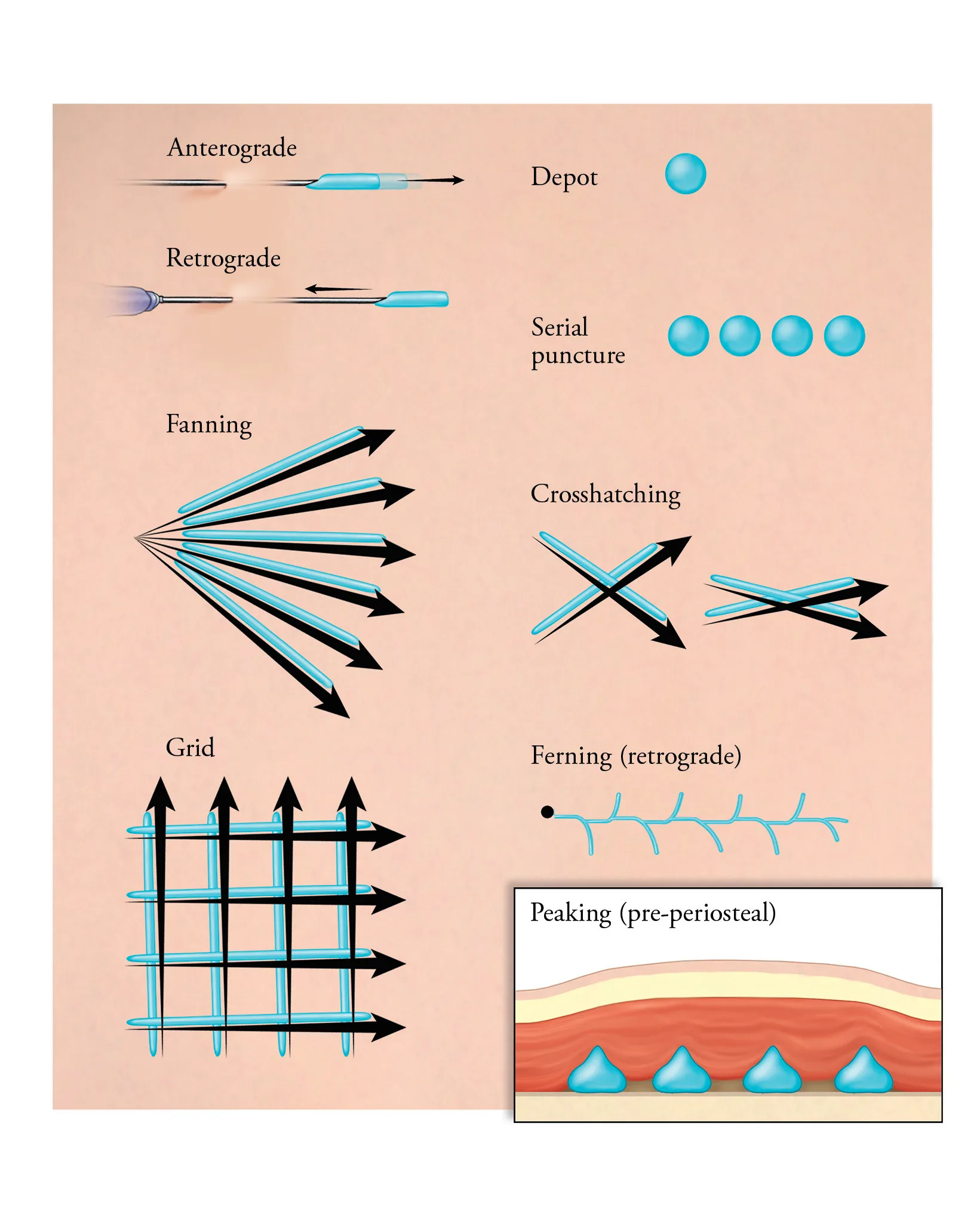 Fig 1. The neutral gesture vocabulary, labelled panel by panel: anterograde vs retrograde linear threading, depot, serial puncture, fanning, crosshatching, grid, ferning and pre-periosteal peaking - the reproducible motions that every branded name resolves to. - (Kontis 2019, p.119) [1]
> Fuentes: Kontis 2019 [1]
Fig 1. The neutral gesture vocabulary, labelled panel by panel: anterograde vs retrograde linear threading, depot, serial puncture, fanning, crosshatching, grid, ferning and pre-periosteal peaking - the reproducible motions that every branded name resolves to. - (Kontis 2019, p.119) [1]
> Fuentes: Kontis 2019 [1] [C][MEDLIB].
The Fig 1 panel is the decoder's Rosetta stone: when a course sells you a "technique", find its gesture here first. [MODELO] The risk column is a clinical-decision datum (allowed in an index); doses and products are not, and stay in the region chapters.
| Gesture | Description | Typical use | Relative risk |
|---|---|---|---|
| Bolus | Single static deposit at one point | Structural volume on bone | High. Maximum volume per point |
| Double / triple bolus | Two-three contiguous boluses, same plane | Broad bony surfaces | High; inherits bolus risk |
| Microbolus / microdroplet | Very small repeated deposits | Lower-risk alternative to bolus | Low, if per-point volume is truly small |
| Retrograde linear threading | Inject on withdrawal | Grooves, contours, lines | Low-medium |
| Anterograde threading | Inject on advance | ⚠ Almost no indication | High. Pushes product ahead of the tip |
| Fanning | Radial passes from one entry point | Broad surface, single entry | Medium |
| Crosshatching / grid | Two perpendicular series of passes | Surface support, body | Medium |
| Serial puncture | Small contiguous deposits | Vermilion border, fine lines | Low. Irregularity if spacing fails |
| Depot | Moderate volume in a deep plane | Biostimulators, body | Medium. Nodule if the plane rises |
| Tower / column | Vertical deposit while crossing planes on withdrawal | Chin, deep folds | Medium-high. Seeds product along the track |
| Fern (ferning) | Fine branched intradermal passes | Skinboosters, skin quality | Low |
| Nappage / micropápula (intentional) | Superficial intradermal blebs in a field | Skinboosters, bioremodelling | Low vascular, high visibility |
| Tenting | Vertical micro-pillars lifting a border | "Russian" lip height | Low-medium; oedema |
| Blanching (technical) | Very superficial intradermal deposit that whitens | Fine superficial lines, skinboosters | Low vascular, high visibility. ⚠ Do not confuse with ischemic blanching (see C4.3) |
Retrograde is the default because it fills the space the needle just vacated instead of pushing product ahead of the tip; anterograde is reserved and mostly a slip, not a plan [2]. Serial puncture and fanning trade bruising for placement precision; depot and tower trade precision for volume and carry the track-seeding penalty [2][3].
Toxin techniques with a name
Toxin names age better than filler names, and that is the central observation of this chapter: almost all of them describe a muscle and a functional effect, which is verifiable, while filler names describe a photographic result, which is not. A name that points at a muscle is an honest name; a name that points at an emotion or a nationality is not.
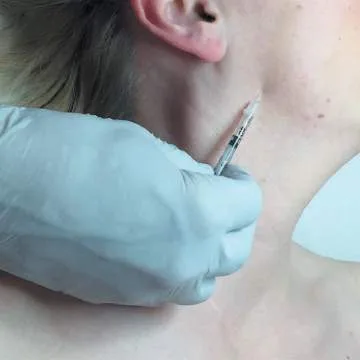 Fig 2. The Nefertiti lift in the chair: injection tracked along the inferior mandibular border and the lateral platysmal band, staying lateral to spare the depressor labii inferioris. - (Cosmetic Medicine & Surgery 2016, p.588) [24]
> Fuentes: Cosmetic Medicine & Surgery 2016 [24]
Fig 2. The Nefertiti lift in the chair: injection tracked along the inferior mandibular border and the lateral platysmal band, staying lateral to spare the depressor labii inferioris. - (Cosmetic Medicine & Surgery 2016, p.588) [24]
> Fuentes: Cosmetic Medicine & Surgery 2016 [24] [C][MEDLIB]; technique origin Levy 2007 [4] [B].
The Fig 2 photo shows the decode of "Nefertiti": it is not a lift in the surgical sense, it is a release of the platysmal down-pull so the levators redrape the jawline. The safety datum that must ride with the name is the DAO-palsy rule - do not inject anterior to the nasolabial vertical - and the point/side ceiling; both live in D8 — Lower Face, Jawline & Masseter.
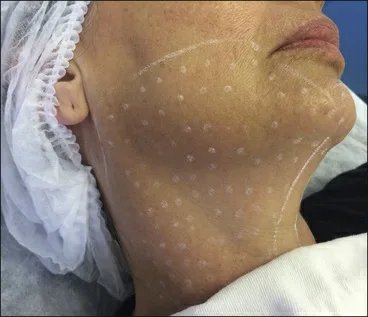 Fig 3. The microbotox/mesobotox grid: dozens of superficial micro-aliquots across the lower face and neck (jawline outlined), the pattern that separates a dermal-sheen technique from conventional intramuscular toxin. - (Carruthers 2010, p.196) [8]
> Fuentes: Carruthers 2010 [8]
Fig 3. The microbotox/mesobotox grid: dozens of superficial micro-aliquots across the lower face and neck (jawline outlined), the pattern that separates a dermal-sheen technique from conventional intramuscular toxin. - (Carruthers 2010, p.196) [8]
> Fuentes: Carruthers 2010 [8] [C][MEDLIB]; primary technique Wu 2015 [7] [B].
Fig 3 is why the microbotox/mesobotox naming collision matters clinically (adjudicated in C4.3): the gesture is a superficial micro-aliquot grid sparing muscle bulk, and the two names attach to the same gesture through two lineages.
| Name | What it is | Origin | Tier | Decode-anchor (full protocol → D) | Verdict |
|---|---|---|---|---|---|
| Nefertiti lift | BoNT to platysma pars mandibularis + lateral bands | Levy 2007 [4] | [B] |
Point-and-side ceiling; stay lateral; avoid anterior to nasolabial vertical → D8 — Lower Face, Jawline & Masseter | Worth it, strict selection |
| Masseter slimming | Intramuscular BoNT, deep, below trago-commissure line | Established [9][10] | [B] |
[B] dose-threshold for atrophy (Choe 2005 [9]) → D8 — Lower Face, Jawline & Masseter |
Worth it, best-evidenced |
| Baby botox | Fractionated conventional dose, more points | Diffused | [C] |
Movement retained, shorter duration → C3 — Botulinum Toxin - Full Technique Map | Worth it, expectation-set |
| Microbotox / mesobotox | Dilute intradermal micro-aliquot grid | Wu ~2001-02 [7] ⚠ | [B] |
Superficial grid, muscle-sparing → C3 — Botulinum Toxin - Full Technique Map | Plausible, growing evidence |
| One21™ | 21-point × 1 U upper-third map | Merz | [C]/[D] |
Manufacturer map → D2 — Upper Face - Forehead, Glabella & Brow | Sound idea, branded map |
| DAO | BoNT to depressor anguli oris | Established [6] | [C] |
Lateral point; ⚠ medial = asymmetry → D5 — Perioral Region & Lips | Worth it |
| Gummy smile | BoNT to LLSAN ± levators | Established [6] | [C] |
Narrowest facial margin → D5 — Perioral Region & Lips | Worth it, strict selection |
| Chemical brow lift | BoNT to brow depressors, sparing frontalis | Established | [C] |
First line for brow-tail descent → D2 — Upper Face - Forehead, Glabella & Brow | Worth it |
| Traptox / Barbie botox | BoNT to superior trapezius | Viral label, real technique [13] | [A]/[B] |
Disuse atrophy for neckline/shoulder slope → E1 — Botulinum Toxin - Body & Hyperhidrosis | Worth it, now literature-backed |
The masseter entry is the anchor of the whole chapter's "useful vs hype" argument: it is the one named toxin technique with a randomized dose-finding primary study under it. Choe 2005 [9] compared 10 / 20 / 30 U and concluded the effective dose sits above 20 U, with effect maintained past 9 months; Blitzer 2020 [10], Kim 2016 [11] and Whitcup 2021 [12] converge on the same deep-injection, spare-the-risorius geometry. Traptox is the newer proof that a viral name can earn evidence: a 2025 systematic review [13] and anatomical injection-site maps [14][15][16] now support the trapezius-contouring indication that "Barbie botox" markets.
Filler point-frameworks and "lifts"
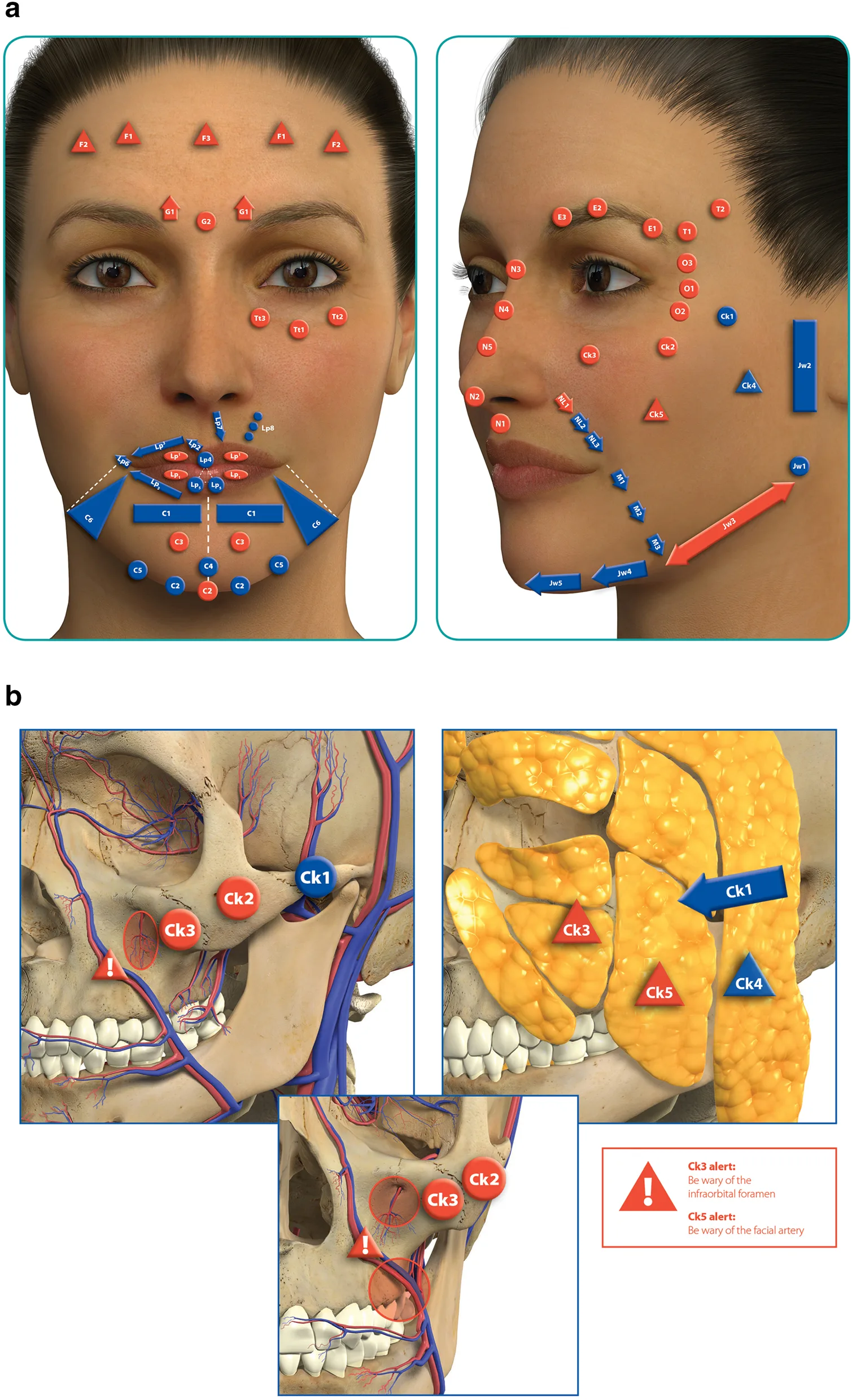 Fig 4. MD Codes decoded: (a) the coded point framework laid over the face, red = alert areas; (b) the same codes correlated to real anatomy, with the Ck3 alert flagging the infraorbital foramen and the Ck5 alert the facial artery - a branded methodology sitting on top of the danger-zone anatomy it must respect. - (de Maio 2020, p.4) [17]
> Fuentes: de Maio 2020 [17]
Fig 4. MD Codes decoded: (a) the coded point framework laid over the face, red = alert areas; (b) the same codes correlated to real anatomy, with the Ck3 alert flagging the infraorbital foramen and the Ck5 alert the facial artery - a branded methodology sitting on top of the danger-zone anatomy it must respect. - (de Maio 2020, p.4) [17]
> Fuentes: de Maio 2020 [17] [B][MEDLIB].
Fig 4 is the honest way to read a branded framework: MD Codes is a checklist and a shared language (letters = facial unit, numbers = subunit, red = alert area), not a new anatomy. Its value is auditability and communication between injectors; its risk is that the codes lend a novice the appearance of expertise while the red alert codes (Ck3 infraorbital foramen, Ck5 facial artery) are exactly the areas de Maio 2020 [17] says only experts should touch. The routing is to C2 — MD Codes Systematic Approach for the full code-to-equation system.
| Name | What it is | Origin | Tier | Verdict | Routes to |
|---|---|---|---|---|---|
| MD Codes™ | Coded point framework + injection "equations" over facial units | de Maio / Allergan [17] | [B] |
Worth it as a checklist and shared language; not a new anatomy | C2 — MD Codes Systematic Approach |
| 8-point lift | Structured mid/lower-face filler sequence (MD Codes precursor) | de Maio / Allergan | [C]/[D] |
Sequence teaches; "8" is a sales rounding that pushed volume | C2 — MD Codes Systematic Approach · D3 — Midface, Cheek & Tear Trough |
| Liquid facelift | Whole-face filler sold as a "lift" | Market term, no author | [D] |
Marketing. Injectables do not traction tissue upward | C2 — MD Codes Systematic Approach |
| Profhilo BAP (Bio Aesthetic Points) | Fixed 5-point-per-side map for stabilized-HA bioremodelling | Manufacturer (NAHYCO) | [A]/[B] external |
Real point-framework; corpus gap, external + recent (see C4.2 frontier) | E2 — Body Fillers, Biostimulators & Skin Quality |
The 8-point lift and MD Codes sit on the good end of branded frameworks precisely because you can write the protocol down: a code corresponds to a facial subunit, a delivery shape, a target depth and a minimal volume [17][18]. The word "lift" attached to a filler package sits on the bad end for the opposite reason - it claims a vector the product does not produce.
Lip aesthetics with a name
The "national lips" are the decoder's clearest teaching case: there is no published, reproducible technical description of Russian, French or Italian lips. Each school defines them differently, and what travels on social media is the photograph, not the protocol. When a patient asks for "Russian lips" you do not know what she saw. The only correct response is the photo → anatomy → written plan sequence.
| Name | What it is (the look) | Gesture underneath | Tier | Verdict |
|---|---|---|---|---|
| Russian lips | Height and eversion over projection; heart-shaped Cupid's bow | Vertical tenting/tent-pole columns from the base | [D] |
Aesthetic, not a technique. ⚠ Many punctures, notable oedema, teacher-dependent |
| French / Paris lips | Definition and border, minimal volume | Border serial puncture, restrained volume | [D] |
Aesthetic; the goal is clinically sensible |
| Italian lips | Full, projected lip | Volumizing horizontal deposits | [D] |
Aesthetic, no reproducible definition |
| Butterfly lips | Modelled philtrum and tubercles | Patterned tubercle shaping | [D] |
Name over a reasonable anatomical pattern |
| Keyhole / cherry / doll pouts | Central-tubercle projection looks | Central tenting | [D] |
Pure look-labels; ask for the photo |
The teachable core survives translation: thin lips need eversion (a vertical/tenting gesture), thick lips need shape not bulk (restraint and border work). That is the real decision, and it lives in D5 — Perioral Region & Lips; the nationality is decoration on top of it.
C4.4 · Body & thread named techniques
| Name | What it is | Tier | Verdict | Routes to |
|---|---|---|---|---|
| Non-surgical BBL | Gluteal augmentation with large-volume HA or biostimulator | [C]/[D] |
Worth it with serious caveats (see below) | E2 — Body Fillers, Biostimulators & Skin Quality · J7 — Biopolymer & Permanent-Filler Complications |
| Cat-eye / fox thread pattern | Barbed threads to brow tail + temporal | [D] |
Highest-complication zone of thread lifting | E3 — Thread Lifting - Face & Body |
| Neck / platysma thread vectors | Cervicomandibular traction threads | [D] |
Short effect, frequent complications | E3 — Thread Lifting - Face & Body |
| Mandibular thread vectors | Jawline/jowl traction threads | [D] |
Real but brief effect; better combined than alone | E3 — Thread Lifting - Face & Body |
| Device brands (Silhouette Soft, Mint, etc.) | Mono/cog/screw threads of PDO/PLLA/PCL | [C] |
Decode the brand to the thread class and its resorption profile | E3 — Thread Lifting - Face & Body |
Non-surgical BBL - the four warnings the name must carry. Detail in E2 — Body Fillers, Biostimulators & Skin Quality. 1. The name deliberately conflates two different procedures. The original Brazilian Butt Lift is autologous fat grafting, surgical, with a historic mortality tied to intramuscular fat injection. The injectable "non-surgical BBL" is a different thing, but inherits the depth rule: never intramuscular. 2. Volumes are enormous compared with the face, and cost, infection risk and difficulty of rescue scale with them. 3. ⚠ Ask, twice, whether anything was injected there before. The gluteus is the commonest site of biopolymers and unidentified product in the Spanish-speaking market, and injecting over biopolymer is a different-magnitude problem, and ultrasound morphology helps flag unnamed product before you add to it [19] → J7 — Biopolymer & Permanent-Filler Complications. 4. The evidence is thin and mostly own-series with short follow-up. It is consented as such.
Biostimulator and skinbooster: brand → active → mechanism
The decoder's cleanest job: separate the mark from the molecule. A biostimulator name is a brand over a polymer with a collagen-stimulation mechanism, and the mechanism, not the brand, decides plane, spacing and complication profile [19].
| Brand | Active | Mechanism | Note |
|---|---|---|---|
| Sculptra | PLLA (poly-L-lactic acid, ex-New-Fill) | Delayed neocollagenesis | Reconstitute + wait; nodule risk if plane too superficial |
| Radiesse | CaHA (calcium hydroxylapatite) | Immediate volume + collagen stimulation | Hyperechoic on ultrasound [19] |
| Ellansé | PCL (polycaprolactone) | Longer-lasting stimulation | Not HA-reversible |
| Artefill / Bellafill | PMMA (permanent) | Permanent implant | ⚠ Permanent = permanent problem; screen carefully |
| NCTF / polycomponent mesotherapy | Low-particle HA + cofactors | Hydration + skin quality | Category, not a single product |
The safety consequence of the decode: only HA is reversible with hyaluronidase [18][19]. When a patient cannot name what she received, ultrasound morphology separates hydrophilic (an-/hypo-echoic) from hydrophobic (hyper-echoic) product [19] - which is the difference between a reversible and an irreversible problem, and belongs to J7 — Biopolymer & Permanent-Filler Complications.
The 2020-2025 bioremodeller frontier (branded, corpus-thin)
[MATERIAL GAP] The own corpus mesotherapy/skinbooster shelf is 2007-2015 and predates this booming named category; the specific brands are grounded here on external, recent literature and the category is flagged so it is not filled from memory.
| Brand | Active | Mechanism | Tier |
|---|---|---|---|
| Profhilo | Stabilized HHA/LHA hybrid (NAHYCO thermal) | Bioremodelling, no BDDE crosslinker | [B] external |
| Sunekos | HA + amino acids | Extracellular-matrix stimulation | [B] external |
| Polynucleotides / PDRN (Rejuran, Nucleofill, Plinest, PhilArt) | Salmon/trout DNA fragments | Adenosine A2A-receptor activation, angiogenesis, anti-inflammatory | [A]/[B] external [20] |
Polynucleotides are the frontier's best-evidenced member: a 2025 systematic review [20] reports real, if early, gains in skin quality, elasticity and dermal thickness with a favourable safety profile, while being candid that most studies are small, short and unblinded. The routing is E2 — Body Fillers, Biostimulators & Skin Quality; the currency caveat is in What's new and trends.
> Trampa clásica (block C4.2): reading the biostimulator brand as the mechanism and injecting Sculptra/Radiesse/Ellansé at the same plane and spacing. Signature: superficial PLLA nodules, or an irreversible product injected as if it were HA. Fix: decode brand → active → mechanism first; only HA is hyaluronidase-reversible.
C4.3 · Ambiguities, collisions & attribution
Answer first: the collisions that change a decision. A name index earns its keep at the points where the same word means two things, or the same gesture wears two names, or two authorities disagree about who coined it (the mesobotox eponym, Wu vs Hertzog, is the worked example [6][7]). The grid below is the fast lookup; the safety-critical and controversy entries are expanded underneath, and neither number nor eponym is ever averaged.
| Collision | The two meanings / names | Why it matters at the chair | Adjudication |
|---|---|---|---|
| Blanching | Technical blanch (intentional superficial bleb) vs ischemic blanch (vascular occlusion) | One is a normal endpoint, the other is an emergency | Distinguish by spread/pattern/pain/refill (below); when in doubt, treat as occlusion → J2 — Vascular Occlusion & Emergency Response |
| Mesobotox = Microbotox | Same superficial dilute-toxin grid, two names | The eponym is disputed across lineages | Keep both attributions; same technique (below) |
| Microbotox ≠ baby botox | Intradermal dermal-sheen grid vs fractionated intramuscular dose | Different plane, different effect, different duration | Microbotox = skin/muscle-sparing; baby botox = movement-retaining |
| "Lift" on an injectable | Nefertiti "lift", liquid "facelift", Cinderella "lift" | Only one (Nefertiti) is a muscular release; the rest claim a false vector | Any injectable "lift" claims a mechanism it lacks (below) |
| National lips | Russian / French / Italian / Paris | No reproducible definition; each school differs | Ask for the photo; translate to eversion vs volume vs border |
| Fox eyes | Makeup / BoNT / filler / threads / canthopexy | Five procedures, one label, five risk profiles | Ask which route; thread version is highest-risk (below) |
| BBL | Surgical fat graft vs non-surgical injectable | Different procedure, shared depth rule | Never intramuscular either way (see C4.2) |
| Empty labels | Cinderella lift / liquid facelift / "lunchtime" | Whatever the seller bundles | Not decodable without asking what is included |
Blanching: technical endpoint vs ischemic emergency (the collision that cannot be missed)
[MODELO] The single most dangerous homonym in injectables. Technical blanching is an intentional white bleb, immediate, at the needle tip, in the intradermal plane - a normal endpoint of a superficial skinbooster or blanching technique. Ischemic blanching is the pallor of impending or established vascular occlusion. They share a word and nothing else.
| Feature | Technical blanch (normal) | Ischemic blanch (emergency) |
|---|---|---|
| Spread | Stays at the puncture point | Spreads beyond the point |
| Pattern | Field of blebs where you injected | Follows an arterial territory |
| Pain | Proportionate to a needle | Disproportionate, dusky |
| Capillary refill | Prompt | Delayed / sluggish |
| What to do | Nothing, expected | Stop, treat as occlusion → J2 — Vascular Occlusion & Emergency Response |
Confusing them in either direction is serious: either you panic without cause, or you dismiss an occlusion. The tie-breaker is spread and pattern - a technical blanch is where your needle was; an ischemic blanch draws the map of an artery.
Microbotox / mesobotox / baby botox and the attribution collision
Three names orbit the same idea and one genuine dispute lives among them. Microbotox and mesobotox are the same technique: multiple superficial micro-aliquots of highly dilute toxin, roughly 1 cm apart, to weaken superficial muscle fibres and dermal appendages for skin sheen, pore and oil control, while sparing muscle bulk (Fig 3). Baby botox is a different thing: fractionated conventional dose in more points to retain movement, with a shorter duration - it is a dose-and-point choice, not an intradermal grid.
Discrepancia (eponym, do not average): - Woffles Wu attribution - the anglophone/primary-literature consensus: "Mesobotox" was coined ~2001 in Singapore, then renamed "Microbotox" ~2002 for scientific accuracy of the droplet size; the landmark description is Wu 2015 [7]. The corpus itself labels the panel "Microbotox technique (Woffles)" [8]. - Hertzog attribution - the francophone/Spanish-course lineage: the UPO master material credits Hertzog (2004) with the "mesobotox" neologism [6].
Both are grounded; the index keeps both rather than picking a winner, because a reader trained in either lineage will hear "his" name and needs to know it maps to the same gesture. The clinical content (dilution, plane, indications) is in C3 — Botulinum Toxin - Full Technique Map; only the naming lives here.
The "lift" family: one false mechanism, many names
[MODELO] Gather every injectable name containing "lift" and one rule sorts them: injectables support, project and rebalance; they do not traction tissue upward.
- Nefertiti lift is the exception that proves the rule - it is not a traction lift, it is a release of the platysmal down-pull, so the name describes a real muscular effect even though the word "lift" is loose [4].
- Liquid facelift, Cinderella lift, "lunchtime lift" all make the same false mechanical promise. They are whole-face filler (or whatever is bundled), and calling them a facelift claims a vector the product does not produce.
The tell: a surgical facelift redrapes and excises; an injectable adds structure. When "lift" is attached to a product that adds structure, the word is doing marketing work.
Fox eyes: one label, five procedures, five risk profiles
The desired result (elevated brow tail, elongated eye) is reachable by routes with very different profiles, and the label hides which one is on offer: - BoNT to brow depressors (§C3.1): reversible, cheap, low risk. First line. - Lateral filler support at the temple / Ck1 (§C2.2-C2.3): indirect, real, moderate risk in a high-risk vascular zone. - Traction threads to the brow tail: immediate and visible, but the highest-complication route: dimpling, asymmetry, extrusion, pain and a duration far below expectation; much of the early effect is oedema → E3 — Thread Lifting - Face & Body. - Surgical canthopexy / brow-tail lift: a different operation, another consent, another surgeon.
The decode in the chair: ask which of these the patient saw, then price the risk of that route, not of the label.
C4.5 · Critical appraisal (useful or hype?) and the adoption protocol
The six-question test is in In 30 seconds; this is the operational half - how to adopt a named technique without becoming its unpaid marketing. The machinery is B9 — Evidence-Based Practice & Critical Appraisal §B9.2-B9.3 applied to names: masseter slimming passes all six questions because it has a randomized dose-finding trial under the name [9], while a look-label like Russian lips fails questions 3 and 4 (no reproducible protocol, no literature under the name).
- Write the protocol yourself: points, plane, product, dose, tool, exclusion criteria. If you cannot, the technique does not yet exist as a technique.
- Search PubMed for the name, and separately for the anatomical description without the name. The second term almost always returns more - and the gap between them is the marketing.
- Identify the promoter and the conflict of interest.
- Search the published complications. If none exist, search professional forums and second-opinion cases. Absence is not safety.
- Compare with what you already do: what problem does it solve that your current approach does not?
- Grade the risk zone (§B10.1) and do not debut it in a high-risk area.
- If you adopt it, start with three selected, documented patients reviewed at 4 weeks before it goes on the website.
- Photograph the result with the same standardized view you use for everything else, or you will not know whether it works.
- Chart it by anatomy, not by brand. In three years the name will mean nothing and the record must still be legible.
The nomenclature schools (genuine controversy, never averaged)
How to treat named techniques is a real disagreement, not a settled point. The four positions, with where each fails:
| School | Thesis | Where it fails |
|---|---|---|
| Pro-nomenclature | Eponyms/branded names make a technique teachable, auditable, communicable | True for anatomical point-systems (MD Codes pole); false for aesthetic names, which communicate a photo, not a protocol |
| Anti-nomenclature | Every name is marketing; only anatomy, planes and reproducible protocol exist | Correct at root, but the patient and the market speak in names; refusing to translate them leaves you out of the conversation |
| Pragmatic (this atlas) ✅ | Use the name to talk to patient and market; use anatomy to decide and to record | The position taken throughout this index |
| Fashion-driven | Deliver the look asked for, under the name asked for | Turns the consult into a catalogue and disables diagnosis |
The pragmatic stance is not a compromise between the other three: it is a division of labour. The name is a communication tool aimed outward (patient, marketing, referral); the anatomy is the decision-and-record tool aimed inward (plan, chart, audit). Averaging the pro- and anti- positions would produce exactly the failure mode this chapter warns against - a clinician who half-believes the names.
> Trampa clásica (block C4.3): treating a technical blanch and an ischemic blanch as the same sign because they share the word, or picking one microbotox eponym and dismissing the other lineage. Signature: a missed occlusion, or a communication failure with a colleague trained in the other school. Fix: adjudicate by spread/pattern for blanch; keep both eponyms for the same gesture.
Coverage vs UPO
The UPO master's minimally-invasive block (T8: T8.1 fillers, T8.2 toxin, T8.3 mesotherapy/microneedling) teaches the anatomical named techniques well and does not touch the branded/social layer, which is exactly the gap this index fills. [D] UPO slides are never_sufficient_alone; every dose they carry is cross-checked against a [B] primary source before it enters a region chapter.
| UPO teaches | State in this chapter | What the atlas adds |
|---|---|---|
| Nefertiti lift (Levy), 2-3 UI/point, max 15-20 UI/side, avoid anterior to nasolabial vertical [6] | Decoded (C4.2 toxin dossier, Fig 2) | Origin [B] verified (Levy 2007 [4]); routed to D8 — Lower Face, Jawline & Masseter; the "lift"-word false-mechanism analysis (C4.3) |
| Masseter slimming, 3 deep points, below trago-commissure line, Choe min 20 UI [6] | Decoded (C4.2), anchor of the "useful vs hype" argument | Choe 2005 upgraded from slide-mention to [B] primary (PMID/DOI) [9]; convergent geometry [10][11][12] |
| DAO, gummy smile toxin [6] | In the master table, routed to D5 | Margin-of-safety flags (gummy = narrowest facial margin) |
| Filler injection gestures: retrograde, fanning, multipuncture, bolus [corpus Arenas] | Full gesture vocabulary (C4.2, Fig 1) | Anterograde-is-almost-never-indicated rule; risk column per gesture [1][2] |
| Mesobotox as Hertzog 2004 neologism [6] | Adjudicated as an attribution collision (C4.3) | Kept alongside the Wu ~2001-02 / Microbotox lineage [7][8] instead of averaged |
| Permanent materials incl. PMMA/Artefill [corpus Arenas] | Brand→active decode (Bellafill/Artefill = PMMA) | Reversibility consequence: only HA is hyaluronidase-reversible [19] |
| Not covered by UPO: MD Codes / 8-point framework | New (C4.2, Fig 4) | de Maio 2020 [B] [17]; branded-framework-over-anatomy read |
| Not covered by UPO: Russian/French/Italian lips as named aesthetics | New (C4.2 lip dossier) | "No reproducible protocol" verdict; eversion-vs-volume decode |
| Not covered by UPO: fox eyes, cat eyes | New (C4.3) | Five-routes-one-label risk analysis |
| Not covered by UPO: traptox / Barbie botox | New (C4.2) | Viral-name-with-literature case; SR + anatomy maps [13][14][15][16] |
| Not covered by UPO: Profhilo/BAP, polynucleotides/PDRN | New (C4.2 frontier), flagged [MATERIAL GAP] |
2020-25 category the 2007-15 corpus predates [20] |
| Not covered by UPO: non-surgical BBL | New (C4.2) | Four-warning decode; biopolymer-screening rule |
| Not covered by UPO: how to appraise a named technique | New (C4.1 + C4.3) | Six-question test, nine-step adoption protocol, four nomenclature schools |
Self-assessment
Ten active-recall questions built only from facts already published above. No new claims.
- What are the four categories every named technique collapses into?
Answer
Technical gesture, anatomical pattern, aesthetic/style, commercial brand (C4.1 taxonomy). - Why does any injectable name containing "lift" claim a false mechanism, and what is the one exception?
Answer
Injectables support/project/rebalance, they do not traction tissue upward; the exception is the Nefertiti lift, which is a release of the platysmal down-pull, not a traction lift (C4.3). - Which named toxin technique is the best-evidenced, and what primary study anchors it?
Answer
Masseter slimming; Choe 2005 [9], a randomized 10/20/30 U dose-finding study concluding effective dose is above 20 U. - State the mesobotox/microbotox attribution collision without averaging it.
Answer
Wu ~2001 "Mesobotox" → ~2002 "Microbotox" (anglophone, Wu 2015 [7]) vs Hertzog 2004 "mesobotox" (francophone/Spanish-course, UPO Ordiz [6]); same superficial dilute-toxin grid. - How do you distinguish a technical blanch from an ischemic blanch?
Answer
Technical = at the puncture point, proportionate pain, prompt refill; ischemic = spreads beyond the point, follows an arterial territory, disproportionate pain, delayed refill → treat as occlusion. - A patient asks for "Russian lips". What is the correct first response and why?
Answer
Ask for the photo: there is no reproducible published protocol, so you do not know what she saw; then translate to eversion (tenting) vs volume vs border. - What does MD Codes actually add, and what is its risk?
Answer
A checklist and shared language over anatomy (letter = unit, number = subunit, red = alert area); risk is that it lends novices the appearance of expertise in the exact alert zones (Ck3 infraorbital foramen, Ck5 facial artery) reserved for experts [17]. - Decode Sculptra, Radiesse, Ellansé and Bellafill to molecule, and state the reversibility consequence.
Answer
PLLA, CaHA, PCL, PMMA respectively; only HA is reversible with hyaluronidase, so none of these is [19]. - Baby botox vs microbotox: what is the difference?
Answer
Baby botox = fractionated conventional dose in more points, movement retained, shorter duration; microbotox = dilute intradermal micro-aliquot grid for skin sheen, muscle-sparing. - Name three of the six "useful or hype?" questions.
Answer
Any three of: who named it and who profits; gesture/muscle vs emotion/animal/nationality; reproducible protocol; PubMed literature under the name; what it adds over doing it nameless; who publishes its complications.
What's new and trends
| Period | What changed | Maturity class | Cite |
|---|---|---|---|
| 2015-2020 | MD Codes formalised into a published methodology with alert-area anatomy; the branded-framework layer became teachable rather than only proprietary | clinically actionable now | de Maio 2020 [17] |
| 2022-2025 | Traptox / "Barbie botox" crossed from viral label to evidence: a systematic review and reproducible anatomical injection-site maps for the superior trapezius | promising but not validated (SR of small studies) | [13][14][15][16] |
| 2020-2025 | Injectable bioremodellers became a named category of their own (Profhilo/NAHYCO, Sunekos, polynucleotides/PDRN), distinct from fillers and skinboosters, with the first systematic review of polynucleotides | promising but not validated for polynucleotides; preclinical/speculative for microbial-derived PDRN | [20] |
| 2022-2025 | Social-media naming accelerated ("fox eyes", "cinderella", national lips), widening the gap between what patients ask for and what has a protocol - the reason this decoder exists | unsupported commercial claim |
What did NOT change, and why the older references still stand. The neutral gesture vocabulary (Fig 1) and the core toxin techniques (Nefertiti, masseter, DAO, gummy, chemical brow lift) are stable: Levy 2007 [4], Choe 2005 [9] and the textbook geometry [8][10][11] remain the state of the art because they describe muscles and planes, which do not go out of fashion. The chapter's central thesis is itself unchanged and, if anything, reinforced by the trend data: names that point at a muscle age well; names that point at a photo do not. The one lane that ages fastest is the UPO slide material on the frontier category (mesotherapy 2007-15), which is why the 2020-25 bioremodellers are flagged [MATERIAL GAP] and grounded on external, recent literature.
Unexplored directions (AI speculation)
> Disclaimer. Everything below is model speculation tagged [IA-ESPEC]. It is not evidence, not [A-D], not [MODELO] structure, and carries no dose, product or actionable protocol. Each item states the anchor (a cited fact already in this chapter), a proposal, and what would settle it. A proposal with no falsifier is an opinion, not a direction.
- [IA-ESPEC] A living "name → PubMed-hits" evidence ticker. Anchor: masseter slimming is the only named toxin technique here with a randomized dose-finding study [9], and traptox crossed from viral label to systematic review in 2025 [13]. Proposal: an automated index that tracks, per named technique, the count of primary literature published under that name, flagging when a viral label crosses a pre-set evidence threshold (as traptox did). Expected effect: names that acquire primary literature are retained and refined, while zero-literature names decay within a few product cycles. Confounder: marketing spend, not evidence, may drive both the literature and the adoption, so a rising count could be sponsorship rather than validation. What would settle it: a prospective comparison of literature-count trajectories against clinical adoption, testing whether the count predicts durability of the name.
- [IA-ESPEC] An eponym→gesture crosswalk to dissolve attribution collisions. Anchor: the mesobotox (Hertzog 2004 [6]) vs microbotox (Wu ~2001-02 [7]) collision maps two names to one gesture. Proposal: a controlled vocabulary that pins each eponym to a neutral gesture-plus-plane code, so a colleague trained in either lineage resolves to the same entry. Expected effect: a shared crosswalk raises agreement between injectors describing the same recorded gesture. Confounder: the two lineages may genuinely differ in dilution or plane, so apparent disagreement could be real technique variance rather than naming noise. What would settle it: an inter-rater study asking injectors from different training lineages to describe the same recorded technique, measuring whether a crosswalk raises agreement.
- [IA-ESPEC] Does teaching the code help or hurt danger-zone avoidance? Anchor: MD Codes red alert areas (Ck3 infraorbital foramen, Ck5 facial artery) are exactly the zones de Maio 2020 [17] reserves for experts. Proposal: test whether novices taught the code avoid danger zones better or worse than novices taught the nameless anatomy. Expected effect: a code checklist reduces omission errors but may increase over-confidence in alert zones. Confounder: the instructor's own skill and the fidelity of the simulator could dominate the outcome, masking any effect of the code itself. What would settle it: a randomized training study comparing code-first vs anatomy-first on simulated danger-zone error rates.
- [IA-ESPEC] Operationalising a "look-label" so it predicts the gesture. Anchor: national lips have no reproducible protocol and each school differs. Proposal: define one label (e.g. "Russian lips") by an objective vector - vertical tenting, an eversion-to-projection ratio - and test whether the label used by a provider predicts the technique actually performed. Expected effect: an operational definition makes the label predict the gesture; without one, "Russian lips" predicts nothing reproducible. Confounder: patient anatomy forces technique adaptation, so the same label may legitimately map to different gestures across faces. What would settle it: blinded video-coding of provider technique against the label they announced.
- [IA-ESPEC] A consent-time brand→active→reversibility prompt. Anchor: only HA is hyaluronidase-reversible, and biostimulator brands hide the molecule [19]. Proposal: a decode step embedded in the consent flow that forces brand → active → reversibility to be stated before any injection over unidentified product. Expected effect: a forced decode step lowers wrong-plane and inject-over-permanent errors. Confounder: a documentation prompt may change charting without changing behaviour, so recorded events could fall while real events do not. What would settle it: a before/after audit of wrong-plane and irreversibility-related adverse events after introducing the prompt.
§ Safety
An index does not inject, so its safety payload is the set of decode errors that are dangerous. Each is a translation failure with a clinical signature.
- ⚠ Never promise a "lift" with an injectable. Injectables support and project; they do not traction tissue upward. Promising a facelift-equivalent from filler is a consent failure. The Nefertiti lift is the one honest use of the word, and only because it is a muscular release, not traction [4][23].
- ⚠ Technical blanch vs ischemic blanch is an emergency-grade homonym. A blanch that spreads beyond the point, follows an arterial territory, hurts disproportionately or refills slowly is an occlusion until proven otherwise → stop and treat (J2 — Vascular Occlusion & Emergency Response).
- ⚠ Nefertiti carries a DAO-palsy rule. Stay lateral, and do not inject anterior to the vertical line through the nasolabial fold, or you weaken the depressor labii inferioris and get an asymmetric smile [5][21]. The point-and-side ceiling lives in D8 — Lower Face, Jawline & Masseter, not here.
- ⚠ Masseter injections are deep and geometry-bound. Deep to touch bone, at least 1 cm inside the anterior margin, below the trago-commissure line, or the toxin diffuses into the risorius and produces an asymmetric smile [5][23]. The gummy-smile technique (LLSAN) has the narrowest therapeutic margin on the face and the least room for a naming shortcut.
- ⚠ "Fox eyes" hides five procedures with five risk profiles. The thread route is the highest-complication zone of thread lifting; do not let the label pick the route (E3 — Thread Lifting - Face & Body).
- ⚠ "Non-surgical BBL" inherits the depth rule and a screening duty. Never intramuscular, and ask twice about prior gluteal injection - biopolymer is common in the market and changes everything (J7 — Biopolymer & Permanent-Filler Complications).
- ⚠ Decode the biostimulator brand before you inject. Sculptra/Radiesse/Ellansé/Bellafill are PLLA/CaHA/PCL/PMMA; only HA is hyaluronidase-reversible, and plane/spacing follow the molecule, not the mark [19].
- ⚠ Superficial-plane discipline for microbotox/mesobotox. The technique is defined by staying intradermal/immediately subdermal; dropping too deep converts a skin-quality technique into unintended muscle weakening [22].
[MODELO]Gesture choice carries its own risk gradient: bolus and anterograde threading are the high-risk end, microdroplet and serial puncture the low-risk end (with a bruising and beading penalty) [25]. This is a decision datum; the products and volumes are not, and stay in the region chapters.- The meta-safety rule, and the reason this file exists: a name travels on social media stripped of its contraindications.
(P)The single most protective habit is to refuse to adopt or perform any named technique on the name - write the protocol, screen the patient, chart the anatomy - because the name is never the indication and never the risk assessment.
References
Vancouver order. [A-D] = source class; the number = which one. External [A]/[B] verified via DOI/PubMed; corpus [C]/[D] [MEDLIB] are the own library (ISBN given, no external id, tagged as such). [D] UPO is never_sufficient_alone.
- Kontis TC. Cosmetic Injection Techniques: A Text and Video Guide to Neurotoxins and Fillers. 2nd ed. Thieme; 2019. ISBN 9781626234574.
[C][MEDLIB] - Towne WS, et al. Neurotoxins and Fillers in Facial Esthetic Surgery. Wiley-Blackwell; 2019. ISBN 9781119294283.
[C][MEDLIB] - Hong KH, Kim HJ, et al. The Art and Science of Filler Injection. Springer; 2020. ISBN 9789811306105.
[C][MEDLIB] - Levy PM. The 'Nefertiti lift': a new technique for specific re-contouring of the jawline. J Cosmet Laser Ther. 2007;9(4):249-252. DOI 10.1080/14764170701545657 · PMID 18236245
[B] - Benedetto AV. Botulinum Toxins in Clinical Aesthetic Practice. 3rd ed, Vol 2. CRC Press; 2018. ISBN 9781498716314.
[C][MEDLIB] - UPO Sorted (Villanueva V; Ordiz I; Arenas D). Máster en Medicina Estética, T8 Técnicas Mínimamente Invasivas (toxina avanzada; mesoterapia facial; materiales de relleno). Course material.
[D][MEDLIB]never_sufficient_alone - Wu WTL. Microbotox of the lower face and neck: evolution of a personal technique and its clinical effects. Plast Reconstr Surg. 2015;136(5 Suppl):92S-100S. DOI 10.1097/PRS.0000000000001827 · PMID 26441119
[B] - Carruthers J, Carruthers A. Botulinum Toxin. Procedures in Cosmetic Dermatology Series. 3rd ed. Saunders/Elsevier; 2010. ISBN 9781437723458.
[C][MEDLIB] - Choe SW, Cho WI, Lee CK, Seo SJ. Effects of botulinum toxin type A on contouring of the lower face. Dermatol Surg. 2005;31(5):502-507. DOI 10.1111/j.1524-4725.2005.31151.x · PMID 15962731
[B] - Blitzer A, Benson BE, Guss J, et al. Botulinum Neurotoxin for Head and Neck Disorders. 2nd ed. Thieme; 2020. ISBN 9781684200955.
[C][MEDLIB] - Kim HJ, Seo KK, Lee HK, Kim J. Clinical Anatomy of the Face for Filler and Botulinum Toxin Injection. Springer; 2016. ISBN 9789811002380.
[C][MEDLIB] - Whitcup SM, Hallett M, editors. Botulinum Toxin Therapy. Handb Exp Pharmacol 263. Springer; 2021. DOI 10.1007/164_2020_355
[C][MEDLIB] - Kapoor KM, Batra A, Kaur A, Kapoor A, Papadopoulos T. Efficacy and Safety of Botulinum Toxin Type A Injection for Trapezius Muscle Contouring: A Systematic Review. 2025. DOI 10.1177/30499240251320906
[A] - Lee KW, et al. Accessory nerve distribution for aesthetic botulinum toxin injections into the upper trapezius muscle: anatomical study and clinical trial. Surg Radiol Anat. 2018. DOI 10.1007/s00276-018-2059-4 · PMID 29946827
[B] - Ultrasonographic Analysis of Trapezius Muscle for Efficient Botulinum Toxin Type A Injection. Aesthetic Plast Surg. 2022. DOI 10.1007/s00266-022-03191-0 · PMID 36513879
[B] - Anatomical Considerations for the Injection of Botulinum Neurotoxin in Shoulder and Arm Contouring. Aesthet Surg J. 2023. DOI 10.1093/asj/sjad250 · PMID 37548270
[B] - de Maio M. MD Codes: A Methodological Approach to Facial Aesthetic Treatment with Injectable Hyaluronic Acid Fillers. Aesthetic Plast Surg. 2020;44(3):690-709. DOI 10.1007/s00266-020-01762-7
[B][MEDLIB] - Jones DH, Trindade de Almeida A, editors. Injectable Fillers: Principles and Practice. 2nd ed. Wiley-Blackwell; 2019. ISBN 9781119046967.
[C][MEDLIB] - van Loghem J. Soft Tissue Filler Complications. CRC Press; 2023. ISBN 9781032440460.
[C][MEDLIB] - Lampridou S, et al. The Effectiveness of Polynucleotides in Esthetic Medicine: A Systematic Review. J Cosmet Dermatol. 2025. DOI 10.1111/jocd.16721
[A] - Almeida FCF, et al. Botulinum Toxin for Facial Harmony. Quintessence; 2018. ISBN 9780867157871.
[C][MEDLIB] - Tonnard P, Verpaele A, Bensier S. Centrofacial Rejuvenation. Thieme; 2018. ISBN 9781626238848.
[C][MEDLIB] - Carruthers J, Carruthers A. Soft Tissue Augmentation. Procedures in Cosmetic Dermatology Series. 4th ed. Elsevier; 2018. ISBN 9780323476584.
[C][MEDLIB] - Sadick N, et al. Cosmetic Medicine & Surgery. CRC Press; 2016.
[C][MEDLIB] - Haney B. Aesthetic Procedures: Nurse Practitioner's Guide to Cosmetic Dermatology. Springer; 2020. ISBN 9783030199470.
[C][MEDLIB]
Verification: Index/decoder chapter (INDICE template), authored EN-canonical 2026-08-24. Corpus lane [MEDLIB]: retrieval pass on disk, evaluation/runs/C4.1-C4.5.jsonl (100 facet-tasks, global_top_score 0.766/0.695/0.731/0.602/0.500); the marketing-name facet (C4.5, 0.500) is thin by nature and declared, not filled from memory. Primary lane [B]: 10 externally verified identifiers written as DOI/PubMed links (Levy 2007 [4], Wu 2015 [7], Choe 2005 [9], Whitcup 2021 [12], Kapoor 2025 [13], trapezius anatomy [14][15][16], de Maio 2020 [17], Lampridou 2025 [20]). [MATERIAL GAP] declared: the 2020-25 bioremodeller frontier (Profhilo/BAP, polynucleotides) sits outside the 2007-15 corpus shelf and is grounded on external recent literature only. Attribution collision preserved, not averaged: mesobotox (Hertzog 2004, corpus Ordiz [6]) vs microbotox (Wu ~2001-02 [7][8]). Structure note (owner rule "coverage is the contract"): the INDICE template declares 3 blocks (C4.1/C4.2/C4.3); the theme required the neutral gesture vocabulary and six per-modality decode dossiers, folded as #### subsections inside C4.2, and the critical-appraisal framework + four nomenclature schools inside C4.3, so no named technique was dropped to fit the block count. Two curriculum subchapters are surfaced as added #### sections and declared here explicitly: C4.4 (Body & thread named techniques) folded inside C4.2, and C4.5 (Critical appraisal: useful or hype? + adoption protocol) folded inside C4.3 - added over the 3-block template because the named body/thread techniques and the appraisal machinery each needed a titled home rather than being dropped to fit the count. Salvage: every named technique, verdict, evidence tier, the blanch collision, the mesobotox attribution, the 6-question test, the 9-step adoption protocol and the 4 nomenclature schools from the retired .es.md are retained; the prior version's clinical doses were, by the 2026-08-09 region=chapter restructure, relocated to the D-region chapters this index routes to and are not restated here (a small number survive as decode-anchors where the number is the datum, e.g. Nefertiti max 15-20 UI/side, Choe >20 U). ⚠ marked: the "lift" false-mechanism family, the technical/ischemic blanch homonym, the Nefertiti DAO-palsy rule, the fox-eyes thread route, the non-surgical-BBL depth/biopolymer rule, biostimulator reversibility. Figures: 4, each opened before captioning and referenced in prose (Fig 1 gesture vocabulary, Fig 2 Nefertiti, Fig 3 microbotox grid, Fig 4 MD Codes anatomy). Cross-refs: C1, C2, C3, D2, D3, D5, D8, E1, E2, E3, J2, J7, B1, B3, B9, B10.