D13 · Cuello y unión cervicomandibular (neck and cervicomandibular junction)
> Currency and provenance — 63 references · median 2017, range 1980-2026, 22 % from 2022 on · provenance: verified external 75 % (47) · MEDLIB corpus 25 % (16, of which 2 from the UPO master's).
Chapter blocks: - [x] D13.1 In 30 seconds - [x] D13.2 Layered anatomy, skin to bone - [x] D13.3 Vessels, nerves and the danger zone - [x] D13.4 Regional ageing - [x] D13.5 Assessment - [x] D13.6 Goal and patient selection - [x] D13.7 Technique: the full grid - [x] D13.8 Toxin of the region - [x] D13.9 Combination and sequence - [x] D13.10 Region-specific complications
Domain: D — Region-by-Region - Face & Head · Third: lower · Unit: the region, not the modality. Sister chapters: D12 — Mandíbula y ángulo gonial (the bony jaw border that frames the neck), D5 — Mentón y prejowl (chin projection that opens the cervicomental angle), D14 — Escote (décolletage). Cross-cutting: C3 — Botulinum Toxin - Full Technique Map (platysma dosing), E1 — Facial & Submental Lipolysis, G5 — Radiofrequency & HIFU Devices, E3 — Thread Lifting - Face & Body, L2 — Combination Protocols & Layered Rejuvenation. Emergencies: J1 — Complications Overview, J2 — Vascular Occlusion & Emergency Response, J6 — Emergency Preparedness.
> Tags: [A] datasheet / guideline / dated consensus · [B] primary literature with PMID/DOI · [C] monograph · [D] slide or opinion, never sufficient alone · [MEDLIB] own corpus · [MODELO] structure, never a figure · (P) model reasoning (never carries a dose) · ⚠ disputed / stale number.
D13.1 · In 30 seconds
The one line: the neck is the region where the non-surgical ceiling is lowest and hardest, where every gram added pulls down on tissue that is already descending, and where the single most dangerous aesthetic-toxin complication of the whole body lives (dysphagia from deep or high-dose platysma injection); read the phenotype first, because the same complaint ("my neck") splits into fat, band, skin and skeleton, and only one of the four responds to any given needle [1][14][48].
Doses, volumes, planes and red lines of this region:
| Target | Agent | Dose / volume | Plane | Hard red line |
|---|---|---|---|---|
| Vertical platysmal bands | Ona/Inco BoNT-A | 2 U/point, 3-6 points/band, 1-1.5 cm apart, ≤15-20 U/band; total ≤30-40 U Ona/Inco (75-100 U Abo) per session [13][14][48][49] | Superficial, subdermal, pinch the band | ⚠ never below thyroid cartilage; never deep (dysphagia) |
| Nefertiti lift (jawline) | Ona/Inco BoNT-A | 2-3 U/point, 6-8 points/side, ≤20-25 U/side (40-50 U both sides) [12][48][49] | Superficial, 1.5-2 cm below mandibular border | ⚠ posterior to DAO lateral border, anterior to SCM; never cross anterior SCM |
| Microbotox / Mesobotox | Ona BoNT-A, hyperdilute | 28 U/mL per side, ~56 U both (≤74 U thick necks); >100 microdroplets [13] | Intradermal / immediate subdermal | ⚠ too high = lip asymmetry |
| Preplatysmal submental fat | Deoxycholic acid (ATX-101) | 2 mg/cm², 0.2 mL/point on 1-cm grid, ≤10 mL (100 mg, ≤50 points)/session, ≤6 sessions ≥4 wk apart [22][23][51] | Mid-subcutaneous, pinch | ⚠ no-treatment zone 1-1.5 cm below mandibular border (marginal mandibular nerve) |
| Necklace lines / skin quality | Hyperdilute CaHA · PLLA · PN · light HA | CaHA 1:2-1:4 saline subdermal; PLLA high dilution (7-24 mL) [40][41][42] | Subdermal / reticular dermis | ⚠ PLLA nodule risk in thin neck skin; HA in skin of colour = PIH risk |
| Skin laxity (no injectable) | MFU-V · monopolar/subdermal RF | device protocol; 1-2 sessions [36][39] | SMAS/platysma coagulation points | ⚠ ineffective if BMI ≥30 |
The four-way triage that decides everything (⚠ "my neck" is not a diagnosis):
| Dominant finding | What it is | The correct tool | What is WRONG here |
|---|---|---|---|
| Preplatysmal fat | pinchable, soft, between dermis and platysma | DCA · cryolipolysis · liposuction | toxin (does nothing), filler (adds weight) |
| Subplatysmal fat / SMG / digastric | firm, not pinchable, persists on platysma clench | surgery (lipectomy, submentoplasty) [7][51] | DCA (⚠ non-target lysis, no benefit) |
| Dynamic platysmal bands | vertical cords on teeth-clench, skin still good | BoNT-A [14][48] | filler, DCA (may worsen) |
| Skin/skeletal laxity, low hyoid, retrognathia | redundant skin, obtuse angle, weak chin | energy / threads / chin filler / neck lift [1][19] | any submental injectable (spends money, no result) |
The three red lines, memorised: (1) below the thyroid cartilage, no toxin, ever, at any dose [14][48][49][56]; (2) between the mandibular border and the submental crease, no deoxycholic acid, ever (marginal mandibular nerve) [51][58]; (3) a firm submental lump that does not pinch is not fat until proven otherwise (submandibular gland ptosis, adenopathy, goitre) [1][51].
Prose. The neck concentrates the specialty's hardest lessons. Volume is a liability, not an asset: the mandibular border and chin are the only sites where adding product helps, and they help by rebuilding the frame of the neck, not by filling the neck itself [1][12]. The soft tissue is thin, poor in adnexa and slow to heal, so resurfacing and biostimulator protocols validated on the face do not transfer [40][60]. And the platysma sits directly on the strap muscles of deglutition and neck posture, which is why a needle that is 3 mm too deep, or a total dose that is too generous, can convert a cosmetic session into weeks of dysphagia and an aspiration risk in an older patient [14][48][49]. Everything below is written to keep the reader on the correct side of those three red lines while still covering every technique that has a place here.
Onset and durability, so expectations are set at the first visit:
| Treatment | Onset | Durability | Course |
|---|---|---|---|
| Botulinum toxin (bands/Nefertiti) | 1-2 weeks | 3-5 months | repeat ~q3-4 months [14][49] |
| Deoxycholic acid | swelling days-weeks, contour over weeks | permanent fat loss | ≤6 sessions, ≥4 wk apart [23][51] |
| MFU-V / RF | gradual over 8-12 weeks | 6-12 months | 1-2 sessions [36][39] |
| Hyperdilute CaHA / PLLA | weeks (collagen) | months to ~18-24 months | staged q4-8 wk [40][41] |
| Threads | immediate lift, settles | 12-18 months | single, re-lift later [45] |
The three consent sentences that prevent most neck conflict: (1) "the swelling from the fat-dissolving injection is intense and visible for days to weeks, and it is expected, not a complication" [23][26]; (2) "toxin near the neck can, rarely, cause temporary difficulty swallowing, which is why we inject shallow and keep the dose low" [14][48]; (3) "if your chin is set back or your hyoid is low, there is a limit to how sharp the angle can get, and that limit is anatomical" [1]. Each maps to a red line above and to a block below.
Phenotype to first tool to ceiling (the 30-second triage, expanded): a young pinchable-fat neck with good skin has a high ceiling with DCA/liposuction alone; a dynamic-lateral-band neck with good skin does well with toxin; a crepe-skin neck needs energy and boosters and will disappoint on volume; a descended, skin-excess, gland-ptosis or low-hyoid neck has a low non-surgical ceiling and belongs to surgery or to honest counselling [1][7][22][36]. The single commonest reason a neck plan fails is not technique, it is treating the wrong one of these four phenotypes.
Trampa clásica: treating "the neck" as one problem. The commonest error of the whole region is running a single protocol (usually toxin, or usually DCA) on every neck, when the finding in front of you is skin, or gland, or hyoid, and the tool you reached for cannot touch it. Signature: a full-price session with zero visible change, or a fat-reduction that unmasks bands the patient did not have before [51][57].
D13.2 · Layered anatomy, skin to bone
The six layers of the anterior neck (constant order, this region):
1 SKIN          thin, few adnexa, poor reservoir; horizontal necklace lines etched here
2 DERMIS        thinner than face; telangiectasia, dyschromia with photoageing
3 SUPERFICIAL   preplatysmal fat  = the DCA / cryolipolysis / liposuction target
  FAT
4 SMAS =        PLATYSMA (superficial cervical fascia is the SMAS continuation) +
  PLATYSMA      its bands; toxin target; superficial cervical fascia envelops it
5 DEEP FAT      SUBPLATYSMAL fat (central/medial/lateral), anterior digastric,
                submandibular gland  = the SURGICAL plane, never an injectable target
6 PERIOSTEUM /  mandible (border/angle), hyoid; deep (investing) cervical fascia,
  BONE          strap muscles of deglutition BELOW the platysma
| Layer | Neck-specific fact | Clinical consequence |
|---|---|---|
| Skin | thinnest facial-region skin, few pilosebaceous units, low healing reserve [52][60] | conservative energy/laser parameters; necklace lines are dermal creases, not muscle |
| Preplatysmal fat | superficial, pinchable, between dermis and platysma [51][50] | the ONLY injectable-lipolysis / liposuction target |
| Platysma (SMAS) | sheet muscle, origin over upper chest/deltopectoral fascia, inserts into mandible (anterior third, bony), parotideomasseteric fascia, modiolus, DAO, skin [48][49] | it is a depressor: relaxing it lets facial levators redrape the jawline (Nefertiti rationale) |
| Platysma decussation | Type I ~75 % full submental interdigitation, Type II ~15 % partial, Type III ~10 % no decussation [5][48] | least decussation = highest medial fat-ptosis and band risk |
| Subplatysmal fat / digastric / SMG | deep to platysma, medial to mylohyoid, not pinchable [5][7][51] | firm submental fullness here is surgical, never DCA |
| Deep/investing fascia + straps | infrahyoid strap muscles of deglutition sit just deep to platysma [48][56] | a deep neck injection reaches them: dysphagia, dysphonia, neck weakness |
Consensus: every school agrees the injectable working space is layers 3-4 (preplatysmal fat and the platysma itself); layer 5 downward is a surgical province, and layer 6 is the forbidden zone for any needle carrying toxin or detergent [48][51][56][57].
Prose. The neck's defining anatomical trap is that the superficial cervical fascia is the SMAS continuation and carries the platysma, while the deep (investing) cervical fascia wraps the strap muscles; the two are separated by a plane that thins toward the mandibular angle, and the cervical branch of the facial nerve runs in exactly that inter-fascial plane (D13.3). The platysma is not confined to the neck: it occupies roughly the lower half of the cheek and its pars mandibularis interdigitates with the lip depressors, which is why "neck" toxin can weaken a smile if placed too high or too anteriorly [48][55]. Manstein's cadaver work is the anchor for the subplatysmal compartment: submental fat is distributed both superficial and deep to the platysma, and only the superficial (preplatysmal) portion is reachable with a subcutaneous needle [5]. The Fig D13-1 cross-section makes the single most useful distinction in the whole chapter visible: the yellow preplatysmal fat sitting on top of the platysma sheet, which is the layer the deoxycholic-acid needle must stay inside and the strap muscles must stay out of.
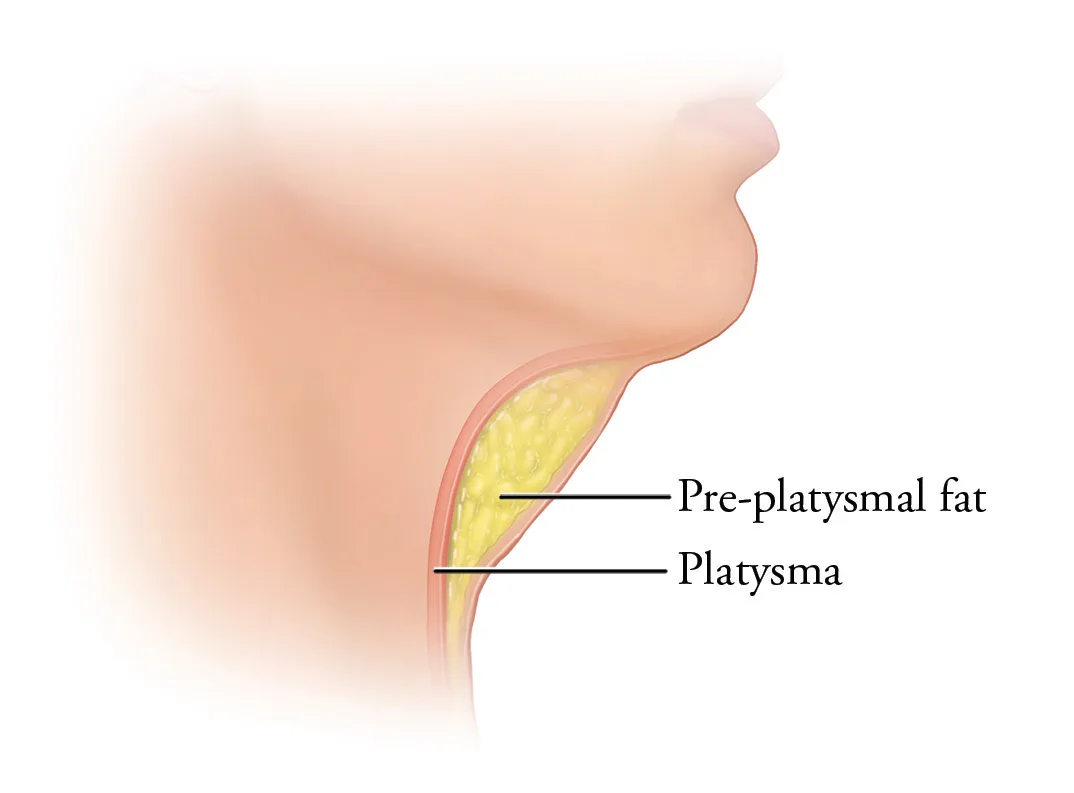 Fig D13-1. Pre-platysmal fat / platysma cross-section — (Kontis, 2019, p.217).
> Fuentes:
Fig D13-1. Pre-platysmal fat / platysma cross-section — (Kontis, 2019, p.217).
> Fuentes: [C][MEDLIB] Kontis, Cosmetic Injection Techniques [2019] [50]. Opened with Read before captioning; corpus caption ("on-label injection grid") did not match the rendered image, which is the labelled fat/muscle cross-section described here.
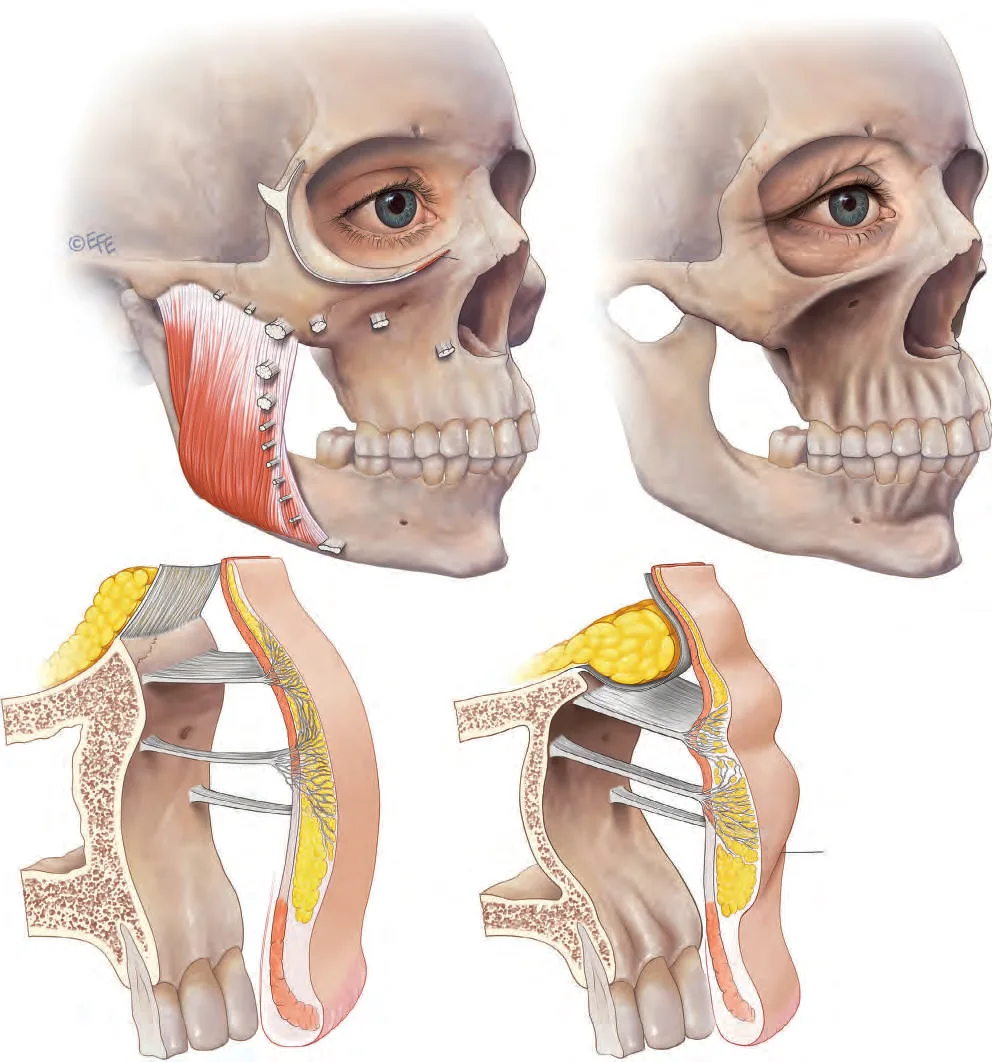 Fig D13-2. Linking of ageing changes through the tissue layers — (Standring / Gray's Anatomy, 2016, p.960).
> Fuentes:
Fig D13-2. Linking of ageing changes through the tissue layers — (Standring / Gray's Anatomy, 2016, p.960).
> Fuentes: [C][MEDLIB] Standring, Gray's Anatomy [2016] [52]. Opened with Read before captioning.
The platysma in detail (the muscle that runs the region). It is a broad, thin sheet arising from the superficial fascia over the upper chest and deltopectoral region, ascending superomedially over the anterior and lateral neck; it inserts partly into bone (the anterior third of the mandibular border), partly into the parotideomasseteric fascia, and blends into the modiolus, DAO, risorius and the overlying subcutaneous tissue, which is why it behaves as a lower-face depressor as much as a neck muscle [48][49][58]. Carruthers describes three functional components: pars labialis, pars mandibularis and pars modiolaris [49]. Its anterior fibres may cross the midline in variable decussation patterns, and where they do not, the medial edges become the visible vertical bands of ageing [5][48].
| Decussation type | Frequency | Submental interdigitation | Clinical consequence |
|---|---|---|---|
| Type I | ~75 % | full, ~2 cm below the chin | best midline support, lowest medial-band risk |
| Type II | ~15 % | partial | intermediate |
| Type III | ~10 % | none (complete separation) | highest medial fat-ptosis and vertical-band risk [5][48] |
Fascia, the two-sheet trap. The superficial cervical fascia is the SMAS continuation and invests the platysma; the deep (investing) cervical fascia wraps the strap muscles and the great vessels. The two are separated by a plane that thins toward the mandibular angle, and the cervical branch of the facial nerve runs in exactly that inter-fascial plane, which is why it is so exposed in that spot (D13.3) [48][54]. Everything the injector does happens in or superficial to the platysma; the moment a needle passes the deep fascia it is among the strap muscles and vessels [48][56].
The deep compartment (layer 5), the surgical province. Subplatysmal fat sits medial to the mylohyoid and lateral to the anterior belly of the digastric; a ptotic submandibular gland bulges below the mandibular border, and a hypertrophic anterior digastric adds a paramedian fullness. None of the three pinches, none is an injectable target, and each is separately addressed at neck lift (fat excision, gland reduction/plication, digastric management) [5][7]. Manstein's cadaver mapping is the anchor: submental fat exists both superficial and deep to the platysma, and only the superficial (preplatysmal) portion is reachable subcutaneously [5].
Trampa clásica: calling firm submental fullness "fat". Deep (subplatysmal) fat, a ptotic submandibular gland and a hypertrophic anterior digastric all live in layer 5 and do not pinch; a detergent or a cannula aimed there hits non-target tissue and never improves the contour. Signature: the lump persists (or worsens with oedema) after a full DCA course, because the fat that was targeted was never the fat that was seen [51][7].
D13.3 · Vessels, nerves and the danger zone
The neck danger grid (course · depth · what fails):
| Structure | Course in this region | Depth | Injury / what occludes | Frequency |
|---|---|---|---|---|
| Marginal mandibular n. (facial n.) | along / below mandibular border; may drop ≤4 cm below in the submandibular segment; most exposed ~2 cm posterior to oral commissure where platysma-SMAS thins; crosses facial vessels [8][10] | deep to platysma, superficial to facial vessels | lower-lip depressor palsy: asymmetric smile, cannot show lower teeth | rhytidectomy ~1-2 %; DCA transient paresis reported [22][30] |
| Cervical branch (facial n.) | inter-fascial plane at mandibular angle, adjacent to caudal masseteric ligaments; superficial to the marginal branch [9][54] | between superficial and deep cervical fascia | "pseudoparalysis": mimics marginal palsy BUT mentalis intact (lip still everts) | injured MORE often than marginal in neck surgery [9][10] |
| Great auricular n. | McKinney point ~6.5 cm below external auditory canal on the SCM belly; ascends toward ear lobule [11][53] | subcutaneous, over SCM | ear/lateral-neck numbness, painful neuroma | commonest sensory injury of lateral neck surgery |
| External + anterior jugular veins | anterior jugular near midline, external jugular over SCM; both deep to platysma [53] | subplatysmal | significant venous haemorrhage / haematoma (Zona 1, Zona 9) | vein injury dominates over arterial here |
| Facial artery + vein | cross the mandibular border at the antegonial notch (palpable pulse) [53][56] | at the border, deep | filler embolism if bolus at the border; haematoma | rare in neck, real at the junction |
Consensus: the neck's dominant danger is neural and venous, not arterial. Unlike the midface (where vascular occlusion and blindness rule), the neck injures nerves (marginal mandibular, cervical branch, great auricular) and thin-walled veins; the one arterial concern (facial artery filler embolism) lives at the mandibular border, i.e. at the junction, not in the neck proper [53][54][56]. Link to J2 — Vascular Occlusion & Emergency Response for the arterial pathway; the neck's own emergencies are nerve palsy and venous bleed.
The single most useful differentiator (⚠): marginal-mandibular palsy and cervical-branch pseudoparalysis look identical (a droopy, asymmetric lower lip on smiling), but the mentalis is innervated by the marginal branch, not the cervical branch. Ask the patient to evert the lower lip / pout: if the mentalis works (lip everts, chin puckers), the marginal branch is intact and the deficit is a cervical-branch pseudoparalysis, which recovers; if the mentalis is also out, the marginal branch itself is injured [9][10][54].
Prose. The marginal mandibular nerve is the classic casualty of the whole lower third, and the neck is where it is most exposed, because in the submandibular segment it can loop up to 4 cm below the mandibular border before turning up to reach the lip depressors [8]. This is the anatomical reason deoxycholic acid carries a mandatory no-treatment zone between the mandibular border and the submental crease (D13.7): the nerve, not the skin, sets that boundary [51]. The cervical branch is the under-recognised one: Daane and Owsley-era work showed it is injured more often than the marginal branch in facelift, and produces an identical-looking lip asymmetry that fools the clinician into diagnosing a marginal injury with a far worse prognosis [9][10]. The great auricular nerve is the sensory landmark of the lateral neck (McKinney point on the SCM belly); deep manipulation there, including aggressive cannula or thread work, risks a painful neuroma [11][53]. Venously, the anterior and external jugular veins run just deep to the platysma, so any deep midline instrument can produce a brisk venous bleed. The Fig D13-3 danger-zone table maps these one row per zone: Zona 1 (great auricular nerve + external jugular vein), Zona 3 (marginal ramus + facial artery/vein) and Zona 9 (anterior jugular + hypoglossal veins + marginal ramus) are the three that belong to this chapter. Fig D13-4 shows the cervical branch running low near the mandibular angle in cadaver dissection.
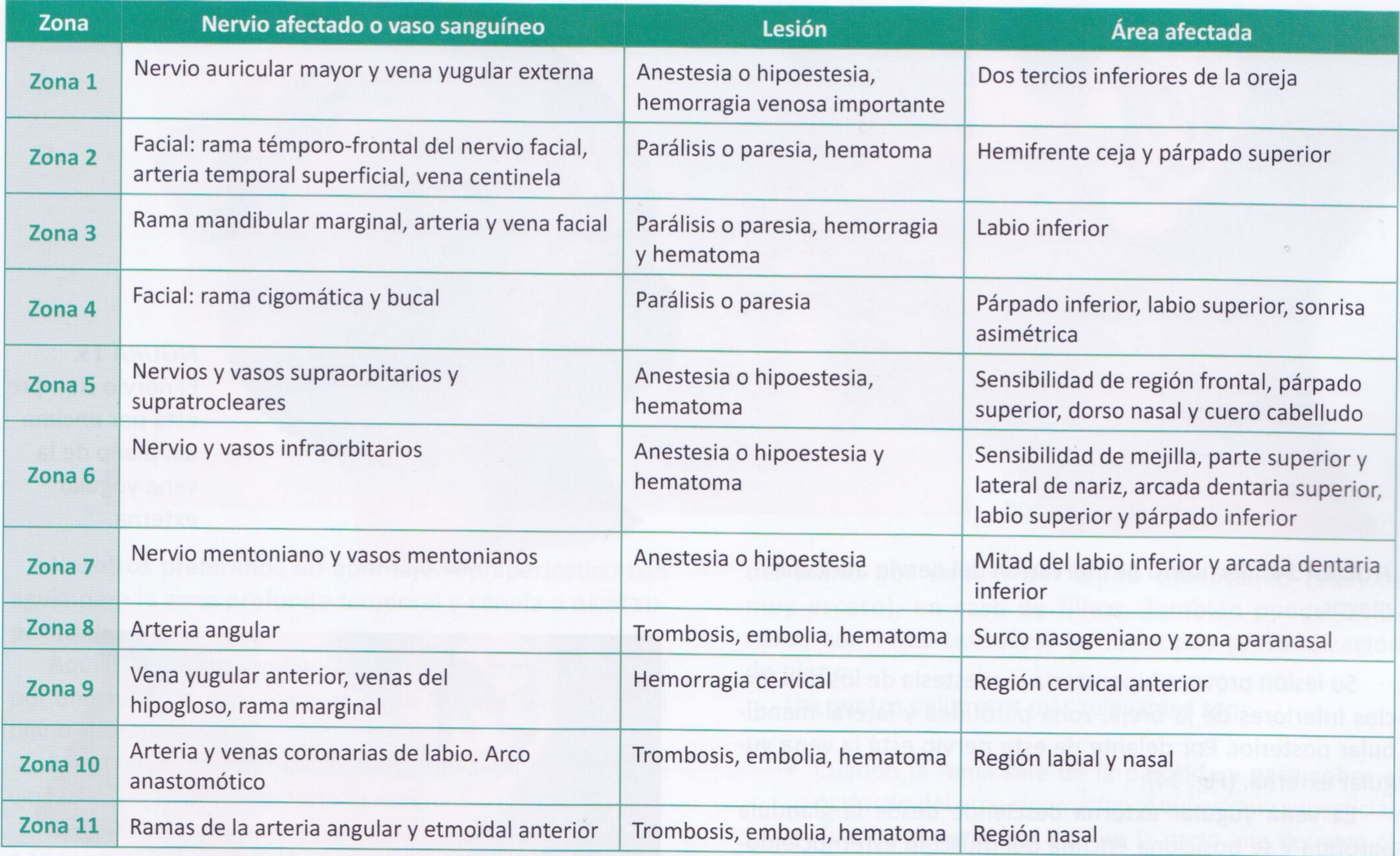 Fig D13-3. Zonas peligrosas — nervio y vaso por zona — (Zonas Peligrosas en Medicina Estética Facial, p.8).
> Fuentes:
Fig D13-3. Zonas peligrosas — nervio y vaso por zona — (Zonas Peligrosas en Medicina Estética Facial, p.8).
> Fuentes: [C][MEDLIB] Libro Zonas Peligrosas en Medicina y Cirugía Estética Facial [53]. Opened with Read before captioning; the ⚠ neck rows (1, 3, 9) transcribed directly from the opened table.
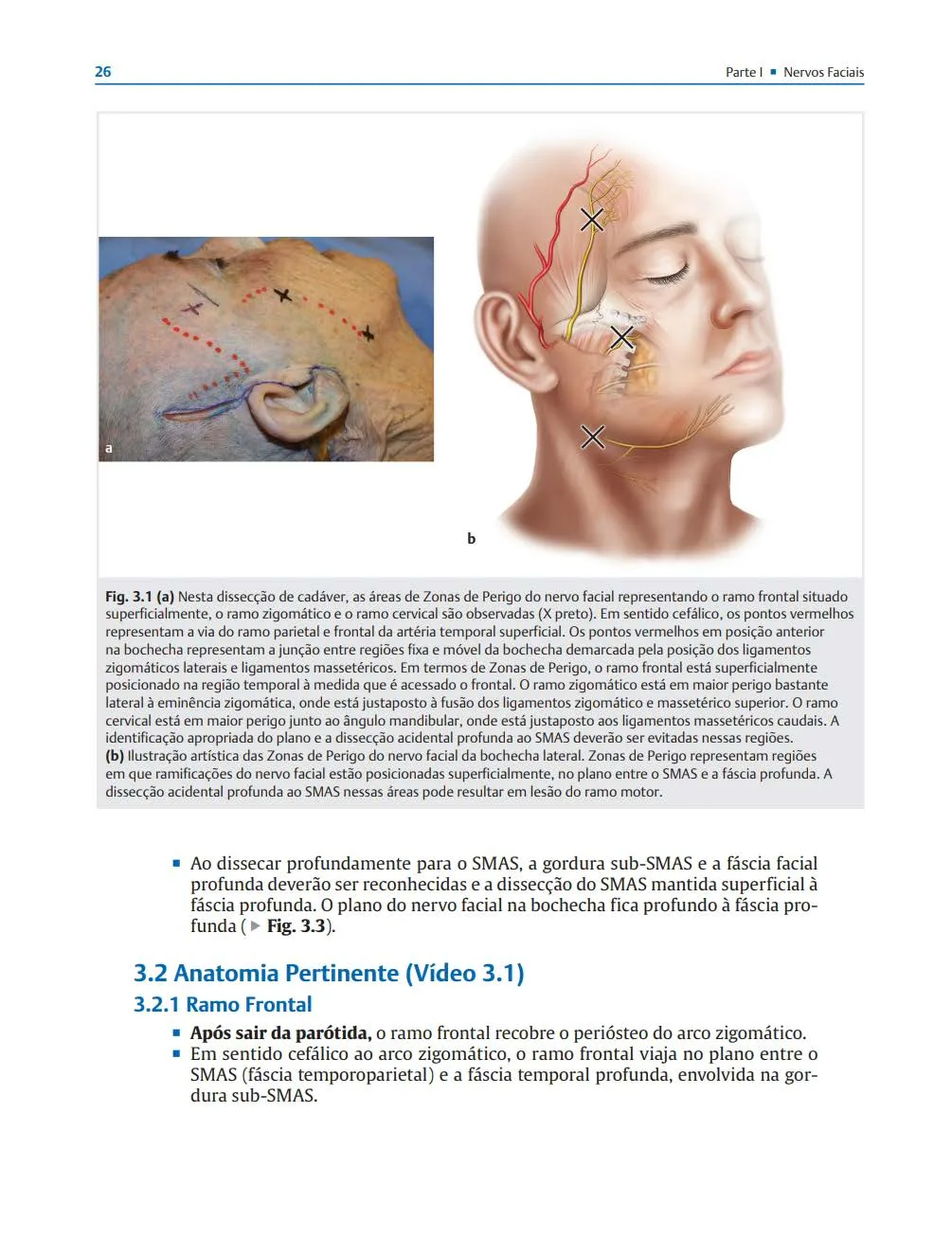 Fig D13-4. Zonas de perigo do nervo facial — (Rohrich, Zonas Faciais de Perigo, 2020, p.33).
> Fuentes:
Fig D13-4. Zonas de perigo do nervo facial — (Rohrich, Zonas Faciais de Perigo, 2020, p.33).
> Fuentes: [C][MEDLIB] Rohrich, Zonas Faciais de Perigo [2020] [54]. Opened with Read before captioning.
The great auricular nerve and the McKinney point. The largest ascending branch of the cervical plexus, it crosses the SCM belly roughly 6.5 cm below the external auditory canal (the McKinney point) and runs toward the ear lobule and lower two-thirds of the auricle; it is the commonest sensory nerve injured in lateral neck and facelift surgery, and deep cannula or thread manipulation over the SCM can produce lasting numbness or a painful neuroma [11][53]. It is the reason lateral-neck instrumentation stays superficial and deliberate rather than deep and blind.
Venous anatomy, the under-taught risk. The anterior jugular veins run near the midline and the external jugular over the SCM, both just deep to the platysma; a deep midline instrument (a cannula forced past the platysma, an over-deep thread pass) can open a thin-walled vein and produce a brisk haematoma, which the danger-zone atlas files as Zona 1 (external jugular) and Zona 9 (anterior jugular) [53]. Venous injury, not arterial, is the dominant bleeding risk of the neck proper.
The facial vessels at the junction. The facial artery and vein cross the mandibular border at the antegonial notch, where the pulse is palpable; this is the one arterial concern of the region, and it belongs to the junction (border filler), not to the neck itself. Palpating the pulse before any border deposit is a five-second habit that prevents an intra-arterial bolus [53][56]. For the full occlusion pathway see J2 — Vascular Occlusion & Emergency Response.
Depth-map summary (what lives at each depth, lateral neck): subcutaneous, the great auricular nerve over the SCM; deep to the platysma, the external and anterior jugular veins, the cervical branch of the facial nerve in the inter-fascial plane at the angle, and deeper still the strap muscles and carotid sheath. The injector's entire safe working volume is superficial to the platysma; the marginal mandibular nerve is the exception that reaches up into that plane at the border, which is why the border and the strip just below it are treated with extra care [48][54][56].
Trampa clásica: diagnosing a cervical-branch pseudoparalysis as a marginal-nerve injury (or vice versa) and either over-warning or under-warning the patient. Signature: an asymmetric lower lip after neck work with a preserved mentalis (chin still puckers), which is a recoverable cervical-branch lesion misread as a durable marginal palsy [9][54].
D13.4 · Regional ageing: what is lost, and in what order
The ageing cascade of the neck (top of the list ages first):
| # | Layer | What changes | Visible sign |
|---|---|---|---|
| 1 | Bone | mandibular resorption, gonial angle opens, ramus/body height falls, pogonion retrudes; hyoid position is constitutional (low/retropositioned = obtuse angle from the start) [4][52] | jaw border blurs, prejowl deepens, cervicomental angle opens |
| 2 | Retaining support | cervical/mandibular ligament and platysma-support attenuation [2][3][4] | platysma descends and/or bowstrings (see discrepancy) |
| 3 | Deep fat / glands | subplatysmal fat accumulation/descent (~30.7 %), submandibular gland ptosis, anterior digastric hypertrophy [5][7] | firm submental/submandibular fullness that will NOT pinch |
| 4 | Superficial fat | supraplatysmal fat descent (~44.7 %) and preplatysmal accumulation [5][50] | soft, pinchable submental fullness ("double chin") |
| 5 | Muscle | platysmal hypertrophy, medial separation/splaying, raised resting tone [3][4] | vertical bands on animation, "turkey gobbler / waddle" |
| 6 | Skin | dermal/subcutaneous atrophy, collagen and elastin loss, photoageing [40][52][60] | laxity, horizontal necklace lines, telangiectasia, dyschromia |
Discrepancy — the mechanism of platysmal ageing (this changes whether toxin/threads or surgery is rational):
Consensus: aged bands are worse on animation, the platysma is central to the deformity, and the skin/fat envelope decompensates around it [2][3][4].
- A · Muscle-descent / ligament-weakening (Stuzin): retaining-ligament failure lets the platysma descend and convert to an oblique banding contour, compounded by age-related hypertrophy [3]. Implication: re-support (surgery, threads) is rational; toxin only softens the dynamic component.
- B · Bowstringing in place (Lambros / Pelle-Ceravolo): the platysma does not descend; the band is bowstringing of a muscle that stays where it is, so a lateral skin-platysma displacement addresses it without a submental approach [2]. Implication: lateral re-tensioning, not vertical suspension.
- C · Hyperdynamic resting-tone (Carruthers): increased resting tone and persistent contraction, not weakness, drive senescent banding [4]. Implication: chemodenervation is disease-modifying, not merely cosmetic.
⚠ Do not average these. They point to different first-line tools. In the chair, the tie-breaker is the pinch-and-clench test: a band that is purely dynamic and a neck with good skin favour C (toxin first); a band with descent and skin excess favours A/B (surgery). See D13.6.
Prose. The order matters because it predicts which tool has a ceiling. Bone and deep support fail first and silently, so a neck can look "heavy" years before the skin gives way, and that heaviness is skeletal (retruded chin, low hyoid, open gonial angle), not fatty; injecting the submental fat of such a neck spends money on the wrong layer (D13.6) [1][4]. Fig D13-5 shows the skeletal half of this: the young versus aged profile with bone resorption retruding the lower face and opening the angle. Fat is a mid-cascade event, and it splits into a superficial component that descends and a deep component that is surgical. Muscle and skin decompensate last and most visibly, which is why patients present for "bands" and "crepe" after the deeper drivers are already advanced. Fig D13-6 renders the temporal sequence over three ages, with the fat compartments deflating and descending. The UPO master material teaches these bands as hypertrophying and becoming more evident with age, which aligns with the Carruthers resting-tone view and is the rationale the courses give for early toxin [62].
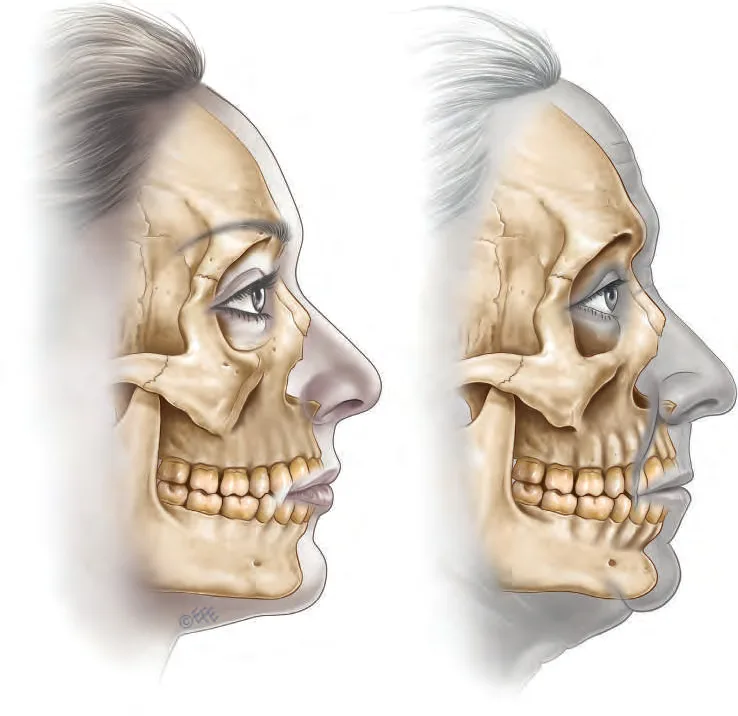 Fig D13-5. Skeletal ageing profile, young vs aged — (Standring / Gray's Anatomy, 2016, p.959).
> Fuentes:
Fig D13-5. Skeletal ageing profile, young vs aged — (Standring / Gray's Anatomy, 2016, p.959).
> Fuentes: [C][MEDLIB] Standring, Gray's Anatomy [2016] [52]. Opened with Read before captioning.
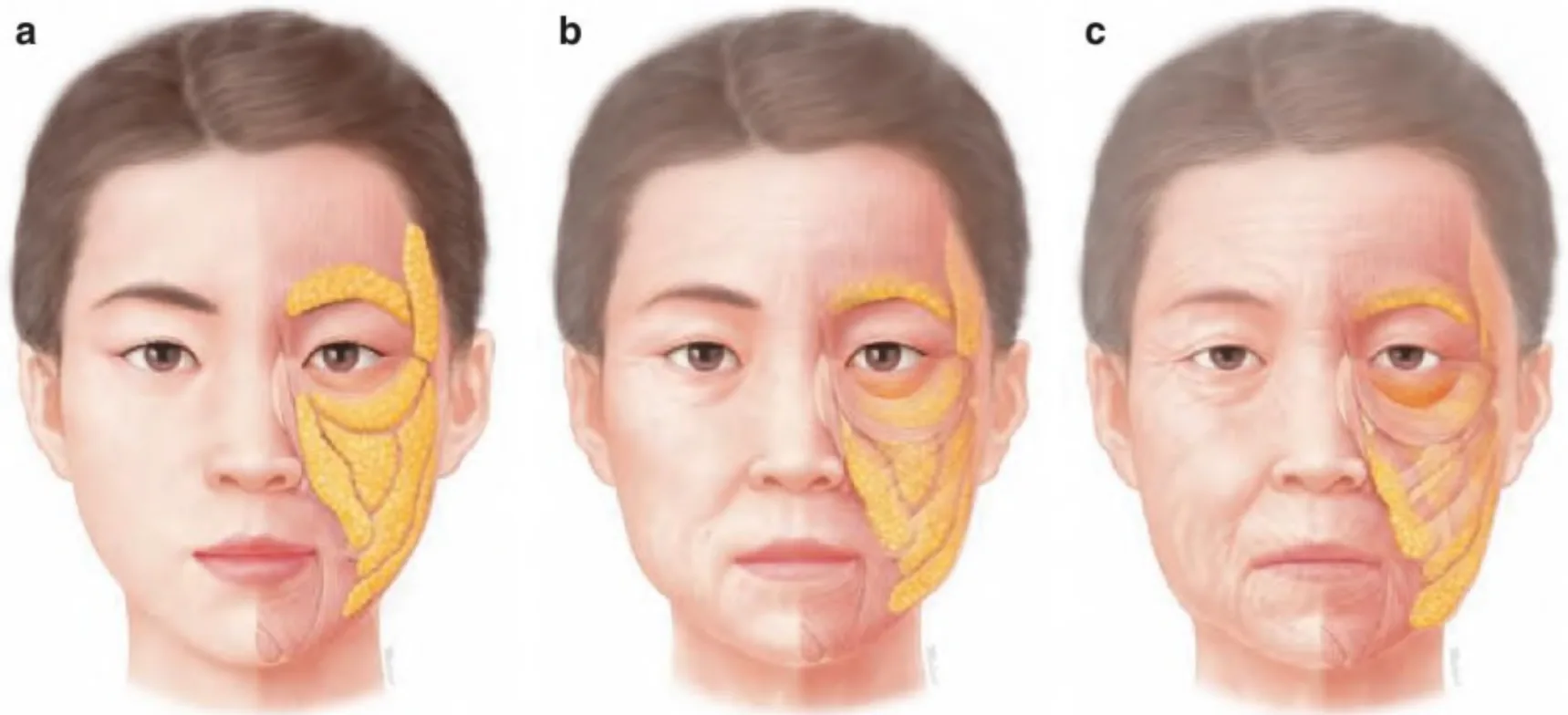 Fig D13-6. Progresión del envejecimiento por compartimentos grasos — (Anatomía Clínica de la Cara para Relleno y Toxina Botulínica, 2016, p.59).
> Fuentes:
Fig D13-6. Progresión del envejecimiento por compartimentos grasos — (Anatomía Clínica de la Cara para Relleno y Toxina Botulínica, 2016, p.59).
> Fuentes: [C][MEDLIB] Anatomía Clínica de la Cara para Relleno y Toxina Botulínica [2016] [55]. Opened with Read before captioning.
The fat numbers, split by compartment. The superficial (supraplatysmal) fat descends and accumulates on the order of ~44.7 %, while the deep (subplatysmal) fat contributes ~30.7 % of the ptotic change; the practical point is that the larger, more visible descent is the superficial compartment, which is exactly the pinchable, reachable one, while the deep compartment that makes a neck "surgical" is the smaller contributor to what the patient sees [5]. Least platysmal decussation predicts the greatest medial fat ptosis, tying the anatomy of D13.2 to the ageing pattern here [5][48].
The four visible ageing signs, each a different lesion (⚠ do not treat them alike):
| Sign | What it actually is | Responds to |
|---|---|---|
| Vertical platysmal bands | dynamic separation/splaying of the medial platysma edges, worse on animation | toxin (dynamic only); surgery if static with skin excess [3][14] |
| Horizontal necklace lines ("Venus rings") | dermal creases and cutaneous adhesions, NOT muscle folds | boosters/PN/microneedling; light HA; toxin does little [56][60] |
| Crepe skin / poor quality | dermal atrophy, collagen and elastin loss, photoageing | biostimulators, energy, fractional resurfacing [40][60] |
| Photodamage / poikiloderma | erythema, telangiectasia and mottled pigment on the lateral neck | vascular/pigment laser and IPL, conservative parameters [60] |
"Tech neck", the modern addition. Repeated downward gaze at phones and tablets adds an inferolateral horizontal ring, typically on the dominant-hand side, superimposed on the classic Venus rings; it is a dermal crease driven by a repetitive posture, so it responds to the necklace-line toolkit (boosters, microneedling, low-dose superficial toxin for the dynamic fraction), not to volume [56].
Why the discrepancy of D13.4 is not academic. If Stuzin is right (ligament failure, muscle descent), the durable fix re-supports the tissue and toxin is palliative; if Lambros/Pelle-Ceravolo are right (bowstringing in place), a lateral skin-platysma re-tension addresses it without a submental incision; if Carruthers is right (raised resting tone), early chemodenervation is disease-modifying and may slow band formation. In practice these coexist by phenotype, and the reason to hold all three is that the wrong single model sends a treatable dynamic-band neck to surgery, or a surgical descended neck to a toxin that cannot lift it [2][3][4].
Trampa clásica: treating the ageing neck from the outside in (skin first) when the cascade runs inside out. Signature: a tightened, resurfaced neck skin draped over an unaddressed low hyoid or retruded chin, which reads as "still heavy" because the skeletal frame that sets the angle was never touched [1][4].
D13.5 · Assessment: what is measured, photographed, tested dynamically, scanned
The assessment ladder (each rung changes the plan):
| Domain | What to record | Tool | Decision it drives |
|---|---|---|---|
| Angle | cervicomental angle (ideal 105-120°); submental-SCM angle ~90°; submental-neck angle ~90° (85-100°) [1][47] | profile photo, goniometry | obtuse angle from a low hyoid = poor ceiling; counsel before charging |
| Skeleton | chin projection (Frankfort perpendicular), gonial angle, hyoid height/position [1][4] | profile photo, palpation | retrognathia/low hyoid = refer or chin filler first (D13.6) |
| Fat, pinch test | pinchable (preplatysmal) vs firm-not-pinchable (subplatysmal/SMG) [51][5] | pinch, swallow test | pinchable = DCA/lipo candidate; firm = surgical |
| Bands, dynamic | teeth-clench / neck-strain: dynamic vs static bands; medial vs lateral [4][14] | animation, video | only dynamic bands respond to toxin; lateral bands favour Nefertiti |
| Skin | laxity (redundancy on release), necklace lines (dermal), photodamage, dyschromia [40][60] | pinch-and-release, standardised light | laxity = energy/threads/surgery, not filler |
| Glands / masses | submandibular gland, digastric, any undiagnosed lump [1][7] | bimanual palpation | firm non-pinchable lump = investigate/refer, never inject |
| Imaging | preplatysmal vs subplatysmal fat thickness, dermal thickness, platysma, vessels [47][61] | high-resolution ultrasound | resolves the pinch test objectively; maps vessels before energy/threads |
The two classifications worth carrying:
- Ellenbogen-Karlin, five visual criteria of the youthful neck [1]: (1) a distinct mandibular border with no jowl overhang, (2) a subhyoid depression, (3) a visible thyroid-cartilage bulge, (4) a visible anterior SCM border, (5) a cervicomental angle of 105-120°. Each lost criterion names a treatment target.
- Dedo classification (I-VI) of the ageing neck: I minimal deformity, II skin laxity/elastosis, III adipose (submental fat), IV platysmal banding, V skeletal retrognathia/microgenia, VI low hyoid. The Roman numeral maps almost one-to-one onto the tool: II-III are injectable/energy territory, IV is toxin ± surgery, V-VI are skeletal and cap what any soft-tissue treatment can achieve [1].
Consensus: the profile photograph is mandatory and non-negotiable; the neck is diagnosed in profile and treated from the front, which is exactly why it is diagnosed badly [1][47]. Every school photographs frontal, profile and profile-in-repose, and every school tests the bands on animation before injecting, because a static band injected as if dynamic wastes the dose and a dynamic band missed on a still photo is undertreated.
Prose. The pinch test and the swallow test together resolve the fat question the classifications cannot: pinch the submental skin, and if a soft fold lifts away it is preplatysmal fat (injectable/liposuction); ask the patient to swallow or tense, and if the fullness persists and hardens it is subplatysmal fat, a ptotic gland or a hypertrophic digastric, all surgical [5][51]. Ultrasound has moved this from art to measurement: high-resolution scanning distinguishes the preplatysmal from the subplatysmal compartment, quantifies dermal thickness (which predicts biostimulator suitability) and maps the jugular veins and facial vessels before energy or threads [47][61]. The single highest-yield step remains the profile, because the cervicomental angle integrates chin projection, hyoid position and submental fullness into one number, and an obtuse angle driven by a low hyoid is the one finding that caps every non-surgical result and must be spoken aloud before any fee is quoted [1]. Fig D13-7 is a working example of what to record in profile: a soft submental fullness blunting the cervicomental angle, the classic "read in profile" presentation. Fig D13-8 is the frontal counterpart in an older neck: vertical bands, horizontal necklace lines and skin laxity coexisting, each demanding a different tool.
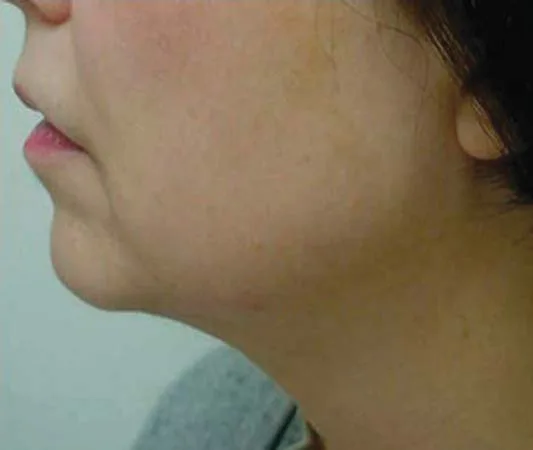 Fig D13-7. Perfil cervicomandibular, plenitud submentoniana — (Benedetto, Botulinum Toxins in Clinical Aesthetic Practice, 2018, p.186).
> Fuentes:
Fig D13-7. Perfil cervicomandibular, plenitud submentoniana — (Benedetto, Botulinum Toxins in Clinical Aesthetic Practice, 2018, p.186).
> Fuentes: [C][MEDLIB] Benedetto, Botulinum Toxins in Clinical Aesthetic Practice 3E Vol 2 [2018] [48]. Opened with Read before captioning; used as a profile-assessment photograph, not as the toxin-map its book caption names.
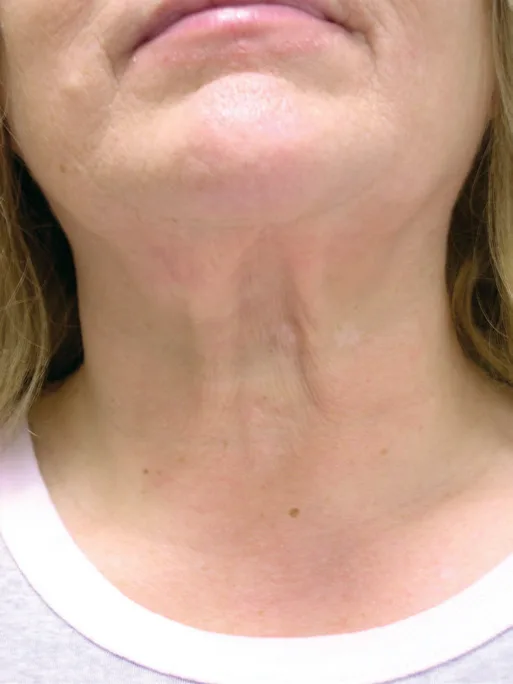 Fig D13-8. Cuello envejecido, visión frontal — (Azizzadeh, Master Techniques in Facial Rejuvenation, 2018, p.358).
> Fuentes:
Fig D13-8. Cuello envejecido, visión frontal — (Azizzadeh, Master Techniques in Facial Rejuvenation, 2018, p.358).
> Fuentes: [C][MEDLIB] Azizzadeh, Master Techniques in Facial Rejuvenation [2018] [57]. Opened with Read before captioning.
The angles worth measuring, with their targets:
| Angle | Youthful target | What an abnormal value tells you |
|---|---|---|
| Cervicomental angle | 105-120° [1] | obtuse = fat, low hyoid or retruded chin; the integrating number |
| Submental-SCM angle | ~90° [1] | defines the submental-to-neck transition |
| Submental-neck angle | ~90° (range 85-100°) | grades the crispness of the transition |
| Mandibular-cervical relationship | distinct border, no jowl overhang | a lost border is the earliest visible ageing sign |
The dynamic and manual tests, in order: (1) teeth-clench/neck-strain to reveal bands and grade them dynamic versus static and medial versus lateral; (2) the pinch test on the submental skin to separate preplatysmal fat (lifts as a soft fold) from laxity; (3) the swallow test, in which subplatysmal fat, a ptotic gland or a hypertrophic digastric stay firm and do not reduce; (4) bimanual palpation of the submandibular gland and any mass; (5) palpation of the facial-artery pulse at the antegonial notch before any border work; (6) masseter clench, because a wide lower face may be masseteric and change the whole plan (D12) [1][5][51].
What ultrasound adds (increasingly routine). High-resolution scanning resolves the pinch test objectively: it measures preplatysmal versus subplatysmal fat thickness, dermal thickness (which predicts booster/biostimulator suitability and resurfacing risk), platysma thickness and continuity, and it maps the jugular veins and facial vessels before energy or threads [47][61]. It converts "I think this is subplatysmal" into a measurement, which matters most in the borderline neck where the wrong call sends a surgical problem to a needle.
The borderline neck, where the tests disagree. When the pinch says "soft" but the swallow says "firm", or when the fullness is intermediate, the ultrasound is the tie-breaker: a thick preplatysmal layer over a thin subplatysmal one favours a trial of deoxycholic acid or liposuction, while a thin preplatysmal layer over a bulky subplatysmal compartment or a low-lying gland says surgical, and treating the second as the first is the region's classic false start [47][51][61]. Documenting which compartment was measured, and by how much, is what makes the next-session comparison meaningful.
Photography, standardised. Frontal at rest, frontal on neck-strain (to document dynamic bands), profile at rest and profile in neutral head position; consistent distance, lighting and Frankfort-horizontal alignment so the follow-up compares like with like. The profile is mandatory because the cervicomental angle, the chin projection and the hyoid position, the three findings that set the non-surgical ceiling, are invisible on the frontal view [1][47].
Trampa clásica: diagnosing the neck from the frontal photo alone. Signature: a plan built around bands and fat that misses a low hyoid or a retruded chin (both only visible in profile), so the treated neck improves on the frontal selfie and still looks "heavy" in every side view [1][47].
D13.6 · Goal and patient selection: who benefits, who does not, what is referred
The selection ladder (map the finding to the rung):
| Phenotype | Finding | First-line | Why |
|---|---|---|---|
| Young fatty neck | good skin tone, no banding, pinchable fat | DCA · cryolipolysis · liposuction alone [22][33][51] | fat is the only variable; skin will retract |
| Skin-quality neck | crepe, necklace lines, mild laxity, no fat | energy (MFU-V/RF) + biostimulator/booster [36][40] | tighten and thicken, do not add volume |
| Dynamic-band neck | lateral dynamic bands, good skin | BoNT-A (bands ± Nefertiti) [12][14] | chemodenervation of a dynamic depressor |
| Skeletal-frame neck | retruded chin, weak jaw border, open angle | chin/jaw filler or genioplasty FIRST [1] | rebuild the frame that defines the neck |
| Descended/lax neck | platysmal laxity/bands + lipodystrophy | submentoplasty / platysmaplasty [7][43][44] | re-support, not re-volumise |
| Redundant-skin neck | frank skin excess | neck lift with skin excision [7] | ⚠ no injectable removes skin |
Refer to surgery when (⚠ any one is usually enough): significant jowling (needs cervicofacial rhytidectomy), submandibular gland ptosis, prominent anterior digastric, marked skin excess or severe laxity, and a low hyoid or retrognathia (both cap the achievable cervicomental angle, so counsel expectations rather than promise a result) [1][7][43].
The injectable/energy candidate is narrow: mild-to-moderate change, good-to-fair skin quality, a pinchable preplatysmal fat pad for DCA, dynamic (not static) bands for toxin, and realistic expectations [1][14][22]. Absolute cautions: active nicotine use (flap necrosis if the plan ever becomes surgical), unrealistic expectations, BMI ≥30 (MFU-V is measurably less effective), and skin of colour for horizontal-line HA (post-inflammatory hyperpigmentation risk) [36][40].
Consensus: four findings are hard stops for the needle, agreed across surgical and non-surgical schools: a firm non-pinchable submental mass, frank skin redundancy, a ptotic submandibular gland, and a constitutionally low hyoid. None of them is improved by any injectable, and treating them as if fatty produces the region's signature waste (a full-fee session with no change) or harm (a fat reduction that unmasks bands) [1][7][51].
Prose. The most valuable sentence in the consultation is often "the treatment for that is the chin, not the neck," because a retruded pogonion or a low hyoid produces an obtuse cervicomental angle that reads as "a double chin," and projecting the chin (D5) opens the angle and improves the submental silhouette without touching the submental fat at all [1]. The second most valuable is "static bands will show more, not less, after we remove the fat": a neck whose bands are visible only on animation can develop static bands once the camouflaging fat is liposuctioned or dissolved, so the fat plan and the band plan must be sequenced deliberately (D13.9) [51][57]. Patient selection here is subtractive: the correct answer is frequently not an injectable, and the physician who can say so keeps the patient's trust and the practice's reputation.
The selection algorithm, spelled out. Start in profile and ask the skeletal question first: is the cervicomental angle obtuse because of a retruded chin or a low hyoid? If the chin is deficient (microgenia, normal occlusion), project it first (D5) and reassess, because that alone may open the angle; if the malocclusion is skeletal (retrognathia), refer to orthodontics/orthognathics and offer camouflage only with informed limits; if the hyoid is low, name the ceiling before anything else [1]. Next the fat question: does the submental fullness pinch and stay soft, or is it firm and fixed on swallow? Pinchable is a DCA/cryolipolysis/liposuction candidate; firm is surgical [5][51]. Then the band question: are the bands dynamic on clench and is the skin still good? Dynamic-with-good-skin is a toxin candidate; static-with-skin-excess is surgical [3][14]. Finally the skin question: is the dominant problem crepe, necklace lines and mild laxity? That is energy-plus-booster territory, never volume [40]. Four questions, asked in that order, resolve almost every neck into a plan and, as often, into a referral.
Contraindications and cautions (needle side):
| Class | Item | Why |
|---|---|---|
| Absolute (any injectable) | firm non-pinchable submental mass; frank skin excess; ptotic submandibular gland; low hyoid; undiagnosed neck lump | none is improved by an injectable; some (mass) demand work-up [1][7][51] |
| Absolute (DCA) | no palpable preplatysmal fat between dermis and platysma; injection in the sub-mandibular no-treatment strip | nothing to lyse; marginal-nerve risk [51][58] |
| Absolute (toxin) | injection below the thyroid cartilage or deep in the midline; dysphagia history | strap-muscle diffusion, aspiration risk [14][48] |
| Relative | BMI ≥30 (MFU-V less effective); active nicotine (surgical-plan flap risk); unrealistic expectations; skin of colour for horizontal-line HA (PIH) | efficacy or safety trade-off, consent and select carefully [36][40][43] |
| Relative (biostimulator) | thin neck skin, little subcutaneous reserve for PLLA | highest nodule-risk site; prefer non-particulate booster or energy [40][41] |
Who to refer, and to whom. Frank skin excess, established bands with redundant skin, a ptotic submandibular gland or a prominent digastric go to a facial-plastic/oculoplastic or maxillofacial surgeon for platysmaplasty, submentoplasty or a neck lift [7][43][44]. A skeletal Class II with a functional malocclusion (retrognathia, not simple microgenia) goes to orthodontics/orthognathic surgery, because filler only camouflages the profile without touching the cause [1]. A constitutionally low hyoid is nobody's easy fix: it caps the achievable cervicomental angle for surgeon and injector alike, so the honest move is to name the ceiling, not to refer the patient around it [1][4].
Expectations, spoken before the fee. The non-surgical neck buys a grade of improvement, not a transformation, and it buys it in a region where the ceiling is lower than the face; a patient expecting a surgical result from injectables and energy will read a good outcome as a failure. Three sentences belong in every neck consent conversation: what the treatment can and cannot move (fat, band, skin, skeleton), that staged sessions over months are the norm (D13.9), and that a low hyoid or a retruded chin, if present, sets a limit no needle can cross [1][47]. Photograph frontal and profile at baseline so the comparison is against a record, not a memory.
Trampa clásica: selling a submental-fat plan to a low-hyoid or retrognathic neck. Signature: a technically perfect DCA or liposuction result on a neck whose obtuse angle was skeletal from the start, so the "double chin" the patient complained about is unchanged and the physician is blamed for a result that was anatomically impossible [1].
D13.7 · Technique: the full grid
The complete option grid of the region (every row a real choice, not one technique):
| Target / goal | Product | Instrument | Plane | Movement | School / protocol | Volume / dose | Non-injectable alternative |
|---|---|---|---|---|---|---|---|
| Preplatysmal fat | Deoxycholic acid (ATX-101/Kybella/Belkyra), 10 mg/mL | 30-31 G ½-inch needle, 1 mL syringe | mid-subcutaneous (preplatysmal), pinch | serial puncture on a 1-cm grid | on-label REFINE / ATX-101 [22][23][51] | 2 mg/cm², 0.2 mL/point central (0.1 mL periphery), ≤10 mL/session, ≤50 points, ≤6 sessions ≥4 wk apart | cryolipolysis (CoolMini), submental liposuction |
| Skin quality / laxity | PLLA (poly-L-lactic acid) | 25 G cannula or 25-26 G needle | reticular dermis / subdermal | fanning / threading, serial puncture | Mazzuco non-facial protocol [41][42] | high dilution 7-24 mL water (+lidocaine); ~1.8 sessions mean; ⚠ neck nodule risk | MFU-V, fractional RF |
| Skin quality / laxity | Hyperdilute CaHA (Radiesse) | 25 G cannula | subdermal (submandibular) | retrograde fanning | de Almeida-style 1:2-1:4 dilution [36][40] | 1:2 to 1:4 saline/lidocaine; type III→I collagen | MFU-V (often combined) [36] |
| Etched horizontal necklace lines | light/cohesive HA (e.g. Belotero) | 30-32 G needle | superficial dermis, intradermal | linear retrograde / serial microdroplet | booster technique [40] | 1:1 lidocaine, microaliquots; ⚠ PIH risk in skin of colour | fractional laser/RF |
| Skin quality (frontier) | Polynucleotides / PDRN (salmon/trout DNA) | 30 G needle / multi-needle | intradermal | microdroplet / point grid | modern booster protocol [MATERIAL GAP] |
multiple sessions ~2-4 wk apart (neck protocol not corpus-grounded) [32] | microneedling ± exosome |
| Jaw-border frame (defines upper neck) | CaHA (structural) or high-G′ HA (Voluma/Lyft) | 25-27 G cannula or needle | supraperiosteal (angle/border), subcutaneous (contour) | bolus at angle/prejowl, retrograde linear along border | de Maio / Carruthers framing [12] | per D12; border support secondarily redrapes lax neck skin | genioplasty / implant for skeletal deficit |
| Skin laxity (no needle) | — | MFU-V transducers (1.5/3.0/4.5 mm) | SMAS / platysma coagulation | stacked thermal coagulation points | Ultherapy neck+submentum+décolletage [36][39] | 1-2 sessions; ⚠ BMI ≥30 less effective | — |
| Skin + fat laxity (no needle) | — | monopolar / temperature-controlled RF (transcutaneous + subdermal FaceTite/ThermiTight) | subdermal + SMAS | subdermal coagulation | single-session RF [36] | comparable efficacy to MFU-V in RCT | — |
| Descent / bands with skin excess | — | scalpel | subplatysmal / submental | corset platysmaplasty, lipectomy, skin excision | Feldman/Jacono corset, neck lift [7][43][44] | when skin/gland/hyoid is the problem | — |
| Mild-moderate laxity, jaw/neck | barbed threads (PDO / PLLA / PLLA-PCL COG) | blunt cannula, 31 G entry | subdermal | vertical/oblique suspension, anchored to mastoid/retro-auricular | Kang vertical lift [45] | works better AFTER neurotoxin; ⚠ severe flaccidity = surgery not threads | RF/MFU-V |
Deoxycholic acid, the dose ladder (the one injectable with a hard protocol, ⚠ read every number):
| Parameter | Value | Source of the boundary |
|---|---|---|
| Concentration | 10 mg/mL (fixed) | product [51] |
| Area-adjusted dose | 2 mg/cm² (2 mg/cm² > 1 mg/cm²; 4 mg/cm² = more AEs, no added benefit) | dose-finding [23][25][51] |
| Per-point volume | 0.2 mL central, 0.1 mL peripheral (off-label edge) | [51][58] |
| Grid | 1-cm spacing, temporary tattoo template | [51][58] |
| Volume calculation | (grid points within boundary) ÷ 5 = mL, since 0.2 mL/point | [51] |
| Ceiling per session | ≤10 mL = 100 mg = ≤50 injections | product [51] |
| Course | ≤6 sessions, ≥4 weeks (usually monthly) apart | [51][62][63] |
| No-treatment zone | ⚠ the strip between the inferior mandibular border and the submental crease (marginal mandibular nerve) | [51][58] |
| Boundaries of the field | submental crease (superior), caudal continuation of the labiomandibular fold (lateral), hyoid bone (inferior) | [51] |
| Needle / plane | 30-31 G ½-inch, perpendicular, mid-subcutaneous into pinched preplatysmal fat; ⚠ never intradermal (necrosis), never subplatysmal | [51][58] |
Consensus (DCA): every source agrees on the mechanism and the guardrails: deoxycholic acid is a non-selective cytolytic detergent that lyses any membrane it contacts, followed by a macrophage-mediated clearance and a fibroseptal thickening, so it must sit inside the preplatysmal fat and nowhere else [32][51][63]. FDA approval (2015) rests on 4 randomised double-blind placebo-controlled phase-3 trials across Europe, the US and Canada, with MRI confirmation in REFINE-1/-2, and the efficacy is consistent across the pooled reviews and meta-analyses [23][24][25][27][28][29][51]. Fig D13-9 shows the boundary marking on the patient, Fig D13-10 the three-panel technique (marginal-nerve zone, the dotted grid, the needle inside the preplatysmal fat), and Fig D13-11 the treatment zone kept above the thyroid notch.
Discrepancy — is the neck a suitable field for PLLA at all? - A · Suitable with caution (Mazzuco): PLLA rejuvenates neck and chest skin at high dilution with a low, controlled session count; the nodule risk is managed by dilution (up to 24 mL), cannula fanning and avoiding bolus deposits [41][42]. - B · Neck is unsuitable (nodule-risk school): the paucity of subcutaneous fat and adnexa makes the neck the highest-nodule-risk site for any particulate biostimulator, so some experts restrict PLLA to the décolletage and keep the neck to non-particulate boosters and energy [40]. ⚠ Do not average the dilution. The tie-breaker is dermal/subcutaneous thickness on ultrasound and operator experience; a thin neck with little subcutaneous reserve favours B.
Prose. The neck's technique menu is deliberately wide because the neck's problems are plural. For fat, deoxycholic acid is the only injectable with a hard, on-label protocol, and every one of its numbers is a safety boundary rather than a convenience: the 2 mg/cm² concentration is the trial-optimised dose, the 1-cm grid and 0.2 mL aliquot exist to keep the detergent in-plane, and the no-treatment zone below the mandible exists solely to spare the marginal mandibular nerve [23][51]. For skin quality, the working principle is the opposite of the face: thicken and tighten, never volumise, because volume in the neck adds weight to a descending envelope [40][60]. Hyperdilute CaHA and non-particulate boosters are the safer collagen stimulators here; PLLA is effective but carries the region's highest nodule risk and is the subject of the genuine school split above [40][41]. The one place volume belongs is the frame, the mandibular border and chin, because supporting the jaw line redrapes lax neck skin secondarily, which is the Carruthers rationale for treating the junction rather than the neck itself [12]. And the honest answer is often no needle: MFU-V and monopolar RF are the correct first move for a laxity-dominant neck, threads for mild descent (and they work better after the platysma has been relaxed with toxin), and surgery for skin excess, a ptotic gland or established bands [7][36][45]. Cryolipolysis (CoolMini) is a needle-free fat alternative but carries its own rare complication, paradoxical adipose hyperplasia, which can itself end in a neck lift (D13.10) [33][35].
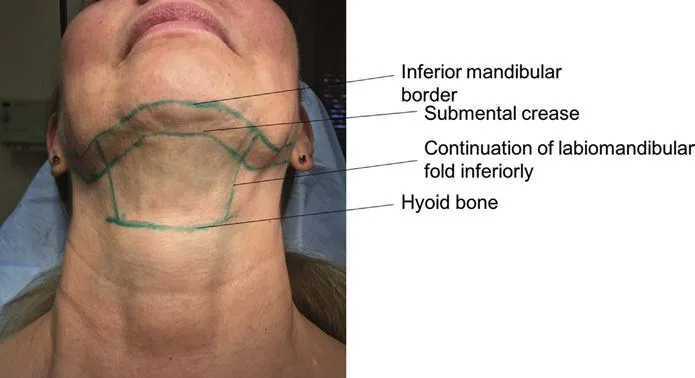 Fig D13-9. Límites del campo de tratamiento con ácido desoxicólico — (Advances in Cosmetic Surgery, 2018, p.20).
> Fuentes:
Fig D13-9. Límites del campo de tratamiento con ácido desoxicólico — (Advances in Cosmetic Surgery, 2018, p.20).
> Fuentes: [C][MEDLIB] Hurst & Dietert, Advances in Cosmetic Surgery [2018] [51]. Opened with Read before captioning.
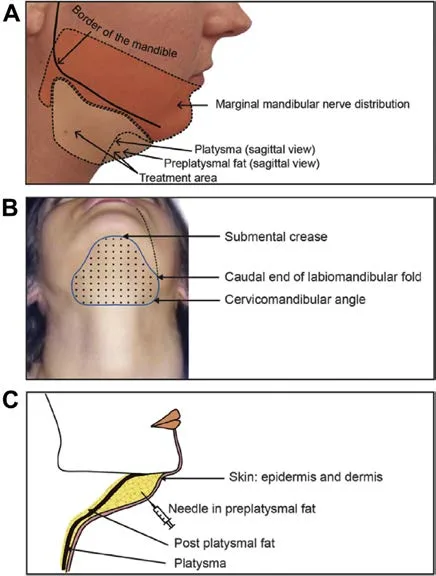 Fig D13-10. Puntos de referencia, cuadrícula de inyección y profundidad — (Advances in Cosmetic Surgery, 2018, p.21).
> Fuentes:
Fig D13-10. Puntos de referencia, cuadrícula de inyección y profundidad — (Advances in Cosmetic Surgery, 2018, p.21).
> Fuentes: [C][MEDLIB] Hurst & Dietert, Advances in Cosmetic Surgery [2018] [51]. Opened with Read before captioning; panels A-C document the technique the D13.7 prose describes.
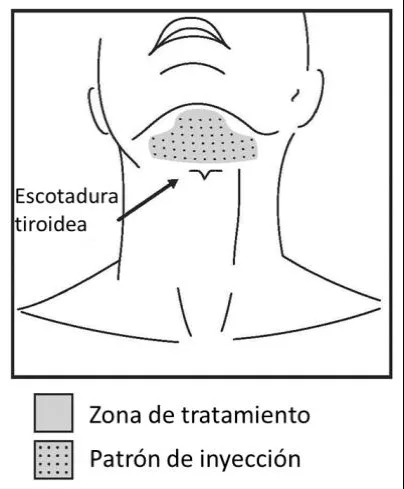 Fig D13-11. Zona de tratamiento y escotadura tiroidea — (UPO Sorted, Adipocitólisis Química Facial, Rodríguez, p.11).
> Fuentes:
Fig D13-11. Zona de tratamiento y escotadura tiroidea — (UPO Sorted, Adipocitólisis Química Facial, Rodríguez, p.11).
> Fuentes: [D][MEDLIB] UPO Sorted, Química Facial / Belkyra (Rodríguez) [63] — never_sufficient_alone. Opened with Read before captioning; corroborated by [51][58].
The skin-quality biostimulators, in detail (thicken, never volumise). Poly-L-lactic acid stimulates neocollagenesis in the reticular dermis and subcutis; the neck-and-chest experience (Mazzuco) uses a high dilution and a low mean session count, delivered by cannula fanning/threading or serial puncture, and every neck-PLLA protocol raises the dilution (into the 7-24 mL range) and forbids bolus deposits precisely because the neck's paucity of subcutaneous fat and adnexa makes it the highest-nodule-risk site of the face-and-neck [41][42]. Hyperdilute calcium hydroxylapatite (1:2 to 1:4 saline/lidocaine, subdermal in the submandibular region) biostimulates a type-III-to-type-I collagen shift and is the safer particulate option here, increasingly paired with MFU-V in a single defined protocol [36][40]. Light, cohesive HA (1:1 lidocaine, superficial dermis) etches out horizontal necklace lines in microaliquots, with a ⚠ post-inflammatory-hyperpigmentation caution in skin of colour [40]. Polynucleotides/PDRN are the frontier: the corpus grounds the generic highly-polymerised-DNA mechanism (fibroblast stimulation, ECM support) but not a neck-specific modern skin-booster protocol with dosing and session numbers, so that specific regimen is a declared [MATERIAL GAP] carried on the external lane rather than from the corpus [32]. Across all four, the governing rule is the same: the neck is thickened and tightened, never inflated, because volume in a descending envelope adds weight, not youth [40][60].
The junction filler, in detail (the one place volume belongs). The mandibular border and chin are the frame of the neck; supporting them redrapes lax neck skin secondarily, which is why the correct filler target for a "heavy" neck is often the jaw, not the submentum [12]. Product choice splits by what is needed: an incompressible, high-structure biostimulatory CaHA for angle/border definition, versus a highly elastic high-G′ HA (e.g. Voluma/Lyft class) for soft-tissue support along the body and prejowl [12]. Technique: a supraperiosteal bolus at the gonial angle and mandibular border, a cannula entry below the anterior masseter advanced toward the chin for the border and prejowl, aspiration or retrograde deposition over the palpable facial artery, and volume kept to what defines a line rather than what widens a jaw (over-widening a female angle masculinises the lower third, D12). The detail of jaw-angle and prejowl filling belongs to D12 — Mandíbula y ángulo gonial and D5 — Mentón y prejowl; here it is the junction that defines the upper neck.
The non-injectable menu, when the correct answer is not a needle. Microfocused ultrasound with visualisation (MFU-V, Ultherapy) delivers thermal coagulation points to the SMAS/platysma at controlled depths (typically 4.5, 3.0 and 1.5 mm transducers), is FDA-cleared to lift the neck, submentum and décolletage, and works in 1-2 sessions, but is measurably less effective at BMI ≥30; its skin-physiology safety profile is well characterised and it combines effectively with calcium hydroxylapatite [36][37][38][39]. Monopolar and temperature-controlled radiofrequency, both transcutaneous and minimally-invasive subdermal (FaceTite/ThermiTight-type), disrupt fat and tighten the SMAS in often a single session, with efficacy comparable to MFU-V in randomised comparison [36]. Fractional and microneedling RF address texture; vascular/pigment lasers and IPL address photodamage and poikiloderma with deliberately conservative neck parameters. Cryolipolysis (CoolMini-type applicators) is the needle-free fat-reduction alternative to DCA, effective for a discrete pinchable submental pad but carrying the paradoxical-adipose-hyperplasia risk of D13.10 [33][34][35]. Surgery, submental liposuction, corset platysmaplasty and neck lift, is the correct answer for subplatysmal fat, established bands with skin excess, gland ptosis or frank redundancy [7][43][44].
Threads, the middle option. Barbed absorbable threads (PDO mono/cog, PLLA, PLLA-PCL) are anchored under the mandible toward the mastoid or the retro-auricular fascia and lift mild-to-moderate laxity; the vertical-vector technique described in Asian series suits the jaw-neck junction, and threads consistently work better after the platysma has been relaxed with neurotoxin, because a contracting depressor fights the suspension [45]. For frank flaccidity the honest answer is surgery, not threads; over-reaching with threads on a lax neck buys puckering, extrusion and disappointment (D13.10) [45][46].
Trampa clásica: using formulated grey-market "lipolytics" (phosphatidylcholine + deoxycholate mixes) as if interchangeable with the approved 10 mg/mL deoxycholic acid. Their composition, concentration and quality control vary, and their complication profile is not the approved product's; a memorised grid applied to an unknown-concentration cytolytic next to the marginal mandibular nerve is exactly the wrong place to improvise. See M6 — Unconventional, Off-Label & Grey-Market Practice and B7 — Spanish Market & Practice Particularities [51].
D13.8 · Toxin of the region
Target muscle: the platysma (superficial, immediately subdermal). Antagonist NOT to touch: the facial levators (they are what redrape the jaw once the platysma is relaxed) and, ⚠ absolutely, the strap muscles of deglutition deep to the platysma.
The four platysma techniques, side by side:
| Technique | Target | Units/point | Points | Total/session | Depth | Safety distance |
|---|---|---|---|---|---|---|
| Vertical bands | dynamic band, pinched on clench | 2 U Ona/Inco (range 2-4) | 3-6/band, 1-1.5 cm apart | ≤15-20 U/band; ≤30-40 U Ona/Inco or 75-100 U Abo total [14][48][49] | superficial, subdermal, inside the pinch | ⚠ never below thyroid cartilage; never deep |
| Nefertiti lift | jawline: mandibular border + upper posterior band | 2-3 U Ona/Inco (2-4 Speywood) | 6-8/side, "T"-pattern | ≤20-25 U/side; 40-50 U both [12][48][56] | superficial | ⚠ start 1.5-2 cm below border; posterior to DAO lateral edge; anterior to SCM; never cross SCM |
| Microbotox / Mesobotox | superficial platysma fibres, whole neck skin | hyperdilute microdroplets | >100-200 droplets, 1 cm apart | Wu ~60-80 U; Tonnard 28 U/mL/side (~56 U, ≤74 U thick) [13] | intradermal / immediate subdermal | ⚠ too high on the neck = lip asymmetry |
| Horizontal necklace lines | dermal creases (Venus rings) | ~1 Speywood/2 cm; 2-4 U Ona segments | along each line, 2-3 mm above it | low; adjunct only | very superficial | less effective than for bands; safe in midline for lines only [56] |
Product interconversion (⚠ units are NOT interchangeable): 1:1; Abo ≈ 2.5:1 (Speywood units); daxibotulinumtoxinA and the platysma-approved onabotulinumtoxinA are product-specific, never cross-converted [14][20][48][49]. Reconstitution for neck work is typically 50-100 U/mL (Carruthers 1-2 mL/100 U vial) [49].
The band technique in detail: ask the patient to contract the neck (teeth-clench/strain), grasp the band between thumb and index finger, and inject superficially inside the pinched fold, advancing top to bottom. The pinch is the mechanism that keeps the needle out of the deep plane, not a comfort trick [48][49][60]. Only obvious vertical bands with good cervical elasticity and minimal submental fat are candidates; laxity and adiposity do not respond and may look worse [49]. Fig D13-12 shows the grasp-and-inject.
The Nefertiti lift (Levy 2007) in detail: relax the platysma's downward pull on the mandibular border so the facial levators redrape the jawline; it is a balance effect, not traction, and it is modest, real and limited [12][48]. Inject along the upper cervical border of the platysma just inferior to the mandible and over the lateral neck, beginning no higher than 1.5-2 cm below the border, posterior to the lateral border of the DAO and anterior to the SCM belly, never crossing the anterior SCM [48][56]. Fig D13-13 shows the along-the-jawline placement. ⚠ It works in patients with lateral bands and without excess laxity; injecting the central bands can worsen neck laxity, and offering a Nefertiti to a frankly lax neck promises what it cannot deliver [12][62].
Microbotox / Mesobotox (Wu 2015; Tonnard): uniformly spaced intradermal/subdermal microdroplets of highly diluted toxin weaken only the superficial platysma fibres and atrophy sweat/sebaceous glands, smoothing and tightening skin and sharpening the jaw without full muscle paralysis [13]. Wu's dilution: 100 U ona in 2.5 mL saline, then 20 U (0.5 mL) plus 0.5 mL 0.5 % lidocaine per 1-mL syringe; roughly 60-80 U for the whole neck across more than 200 microinjections. Tonnard: 28 U/mL per side, 30-31 G, droplets 1 cm apart, starting 2-3 fingers above the mandibular line and sweeping to the clavicle while avoiding the SCM.
The on-label change (2024, ⚠ the corpus predates it): onabotulinumtoxinA (BOTOX Cosmetic) received FDA approval in October 2024 for moderate-to-severe platysma prominence, the first BOTOX indication beyond the face, supported by phase-3 multicentre randomised placebo-controlled trials showing improved neck bands and, on patient-reported outcomes, improved jawline definition [15][16][18][19]. This converts the neck's decades of off-label platysma toxin (all the corpus and UPO carry) into an approved indication with dedicated phase-2/3 dosing evidence [17]. See D13.novedades.
Consensus: across every school, three rules hold: the plane is superficial, always; the total dose is kept conservative and raised between sessions, never within one; and no toxin is placed below the level of the thyroid cartilage or deep in the midline, because the strap muscles of deglutition sit directly there and diffusion to them causes dysphagia, dysphonia and neck weakness [14][48][49][56]. The systematic review of platysma-band toxin confirms efficacy and a low complication rate when these limits are respected, and localises the serious events to high total doses and deep placement [14].
Discrepancy — total dose per session. - A · Conservative cap (Carruthers / consensus): limit to 30-40 U Ona/Inco (75-100 U Abo) per cervical session, divided across bands, precisely to stay below the dysphagia threshold [49]. - B · Higher band-plus-Nefertiti loads (Benedetto/Levy): 40-50 U across both sides for a Nefertiti, plus band dosing, is described and effective in selected necks with good elasticity; the published typical total for platysmal-band treatment spans 20-60 U (a total, not a per-side figure) [48][49]. ⚠ Do not average. The higher loads belong only to elastic necks without deglutition risk and are escalated across sessions; the deciding variable is the patient's swallowing risk and neck bulk, not a single "correct" number. High cervical-dystonia-range doses (>200 U) are where the dangerous events cluster and have no place in aesthetics [14].
Prose. The neck is the region where botulinum toxin carries its single most dangerous aesthetic complication, and the anatomy explains why: the platysma is a thin sheet lying directly on the infrahyoid strap muscles, so depth and total dose, not injection count, are the risk variables [48][56]. Toxin-induced dysphagia is self-limited but can last weeks and is genuinely hazardous through aspiration in the older patient, which is why the conservative-cap school exists and why every technique above is superficial and pinch-controlled [14][49]. The therapeutic logic is a balance of depressors and elevators: the platysma pulls the jawline and oral commissures down, so relaxing its upper and lateral fibres lets the facial levators win and the contour lifts, which is the shared mechanism of the Nefertiti lift and of upper-platysma band treatment [12][48]. Horizontal necklace lines are the exception that proves the rule: they are dermal creases, not muscle folds, so toxin does little for them and the correct tools are boosters and microneedling (D13.7), with toxin reserved for the small dynamic component [56][60].
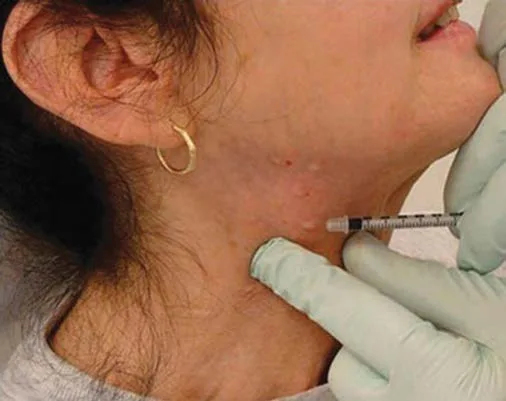 Fig D13-12. Inyección de banda platismal, técnica de pellizco — (Benedetto, Botulinum Toxins in Clinical Aesthetic Practice, 2018, p.185).
> Fuentes:
Fig D13-12. Inyección de banda platismal, técnica de pellizco — (Benedetto, Botulinum Toxins in Clinical Aesthetic Practice, 2018, p.185).
> Fuentes: [C][MEDLIB] Benedetto, Botulinum Toxins in Clinical Aesthetic Practice 3E Vol 2 [2018] [48]. Opened with Read before captioning.
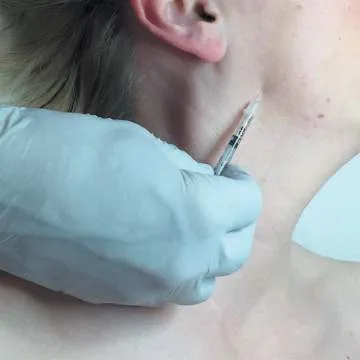 Fig D13-13. Lifting Nefertiti, inyección a lo largo del borde mandibular — (Cosmetic Medicine & Surgery, 2016, p.588).
> Fuentes:
Fig D13-13. Lifting Nefertiti, inyección a lo largo del borde mandibular — (Cosmetic Medicine & Surgery, 2016, p.588).
> Fuentes: [C][MEDLIB] Rowland Payne & Philipp-Dormston, Cosmetic Medicine & Surgery [2016] [56]. Opened with Read before captioning.
Horizontal necklace lines ("Venus rings"), the separate low-dose technique. These are dermal creases, not muscle folds, so toxin is a minor adjunct at best; the described technique places ~1 Speywood unit (or a small Ona/Inco aliquot) very superficially every ~2 cm along each line, 2-3 mm above the crease, and it is one of the few midline-safe neck injections because the dose is tiny and intradermal [56]. The dominant treatment for necklace lines is dermal: boosters, polynucleotides, microneedling and light cohesive HA (D13.7), with toxin reserved for a dynamic component. The "tech neck" inferolateral ring is treated the same way [56][60]. The full neck-neuromodulator map, platysma bands, horizontal necklace line, Nefertiti and the newer on-label platysma-prominence indication, is consolidated in recent office-based reviews [6].
Microbotox / Mesobotox, the protocol detail. Two named dilutions anchor the technique. Wu: 100 U ona in 2.5 mL saline, then 20 U (0.5 mL) plus 0.5 mL 0.5 % lidocaine drawn into a 1-mL syringe, delivering roughly 60-80 U across the whole neck in more than 200 intradermal/immediate-subdermal microdroplets, weakening only the superficial platysma fibres and atrophying sweat and sebaceous glands for a skin-smoothing, jaw-sharpening effect without paralysis [13]. Tonnard: 28 U/mL per side (~56 U both sides, up to ~74 U in thick necks), 30-31 G, droplets 1 cm apart, starting 2-3 fingers above the mandibular line and sweeping to the clavicle while avoiding the SCM. The trade-offs are that it is laborious, and that placing droplets too high risks the same lip asymmetry as any upper-neck toxin [13].
The on-label dosing frame (2024 onward). The phase-2 dose-ranging and phase-3 platysma-prominence programme established an approved onabotulinumtoxinA regimen for moderate-to-severe platysma prominence, distributed across the vertical bands and the upper platysma, with the efficacy and safety and the jawline-definition patient-reported outcomes reported in the pivotal trials [15][16][17][18]. The practical consequences for the injector are two: the platysma is now an approved BOTOX target rather than an off-label one, and the trial dosing gives a defensible reference range, but the drug-specific caveat is unchanged, units are not interconvertible between products and the superficial-plane, sub-thyroid-cartilage safety rules still govern [15][18][20]. The long-term open-label extension supports repeat treatment without new safety signals [19].
Product-specific reconstitution and ratios (⚠ carry these, not a single "unit"). For neck work, onabotulinum/incobotulinum are typically reconstituted at 50-100 U/mL (1-2 mL per 100 U vial), abobotulinum is dosed at roughly 2.5 Speywood units for each Ona/Inco unit, and daxibotulinumtoxinA is a distinct product whose units and duration are its own [20][48][49]. Mixing these up is the mechanism behind both under-dosing (no effect, patient loses faith) and, more dangerously, over-dosing toward the dysphagia threshold.
Trampa clásica: injecting the central platysmal band, or injecting deep to "reach" a band, in a neck with any laxity. Central-band injection can worsen the laxity it was meant to treat, and a deep injection diffuses to the strap muscles. Signature: a patient who returns with a looser-looking central neck, or with weeks of dysphagia and a weak neck on animation, after a session that felt routine [12][14][62].
D13.9 · Combination and sequence
The sequence that works (order matters as much as choice):
| Step | What | When / interval | Why this order |
|---|---|---|---|
| 1 | Rebuild the frame: chin/jaw-border filler if skeletal deficit | first, then reassess | the jaw border redrapes lax neck skin; may cut what the neck itself needs [1][12] |
| 2 | Fat reduction: DCA or cryolipolysis or liposuction | before band toxin | fat removal UNMASKS bands, so treat fat first, then re-look [51][57] |
| 3 | Skin tightening: MFU-V / RF | before any filler; ≥2-4 wk before toxin re-look | MFU-V unmasks dynamic bands → then offer neuromodulator [36][39] |
| 4 | Toxin: platysmal bands / Nefertiti | after fat and energy; ~1 wk before same-area filler | denervation stabilises the field for filler placement/longevity [12][49] |
| 5 | Skin quality: hyperdilute CaHA / PLLA / PN / light HA | q4-8 wk, staged sessions | thicken the envelope last, over a stabilised contour [40][41] |
Same-visit order (Carruthers, when combining in one appointment): filler first, then energy-based device, then BoNT-A last, with the patient sitting up, because lying down after a neck injection risks toxin spread to the deglutition muscles; BoNT + filler or BoNT + MFU-V are safe in one appointment when this order is kept [12][59].
Two unmasking rules that dictate sequence (⚠): - Fat removal unmasks bands. DCA, cryolipolysis and liposuction all remove the camouflaging fat and can reveal (or worsen) platysmal bands, so plan the band toxin after the fat is reduced and re-examined, never assume the pre-treatment band map is final [51][57]. - Energy unmasks bands. MFU-V tightening can make dynamic bands more visible, so counsel and offer a neuromodulator afterwards (order of 25-40 U Ona/Inco or 50-80 U Abo, divided) [36].
Consensus: the multi-tier ladder is shared: BoNT-A first-line for dynamic bands, then MFU-V/RF for laxity, then micro-aliquot HA/CaHA and boosters for necklace lines and skin quality, with fractional CO2/RF as the resurfacing adjunct [14][36][40]. Every school also agrees the neck is a combination region: each single modality disappoints, and the visible change comes from stacking a frame (filler), a fat reduction, an energy tightening and a chemodenervation in the right order [12][59].
Prose. The sequencing logic is causal, not stylistic. The frame comes first because supporting the jaw border can redrape the neck and change what is left to treat, so building it early avoids over-treating the neck itself [1][12]. Fat and energy come before band toxin because both unmask bands, and a band map drawn before them is obsolete after them [51]. Toxin roughly a week before same-area filler stabilises the muscular field and is reported to improve filler placement and longevity [12]. Boosters come last because they act on the skin envelope, which should sit over a finished contour, not a moving target. And the whole plan is staged over weeks, not stacked in one heroic session, both for the biostimulator intervals and, more importantly, to keep the cumulative toxin load below the deglutition threshold (D13.8). See L2 — Combination Protocols & Layered Rejuvenation for the cross-region layering framework.
Intervals, at a glance:
| Modality | Session interval | When to reassess | Onset / durability |
|---|---|---|---|
| Deoxycholic acid | ≥4 weeks (usually monthly) | after each session; final at 6-12 wk post-course | permanent fat loss after the course, ≤6 sessions [23][51] |
| Botulinum toxin (bands/Nefertiti) | not re-dosed within a session; next at ~12-16 wk | 1-2 weeks for effect | 3-5 months [14][49] |
| MFU-V / RF | 1-2 sessions, months apart | 8-12 wk (collagen remodelling) | 6-12 months [36][39] |
| PLLA / hyperdilute CaHA | q4-8 weeks, staged | 6-8 wk between | PLLA up to ~18-24 mo; CaHA collagen months [40][41] |
| Threads | single placement; re-lift 12-18 mo | 4-6 wk | 12-18 months, best after toxin [45] |
A worked combination sequence (moderate ageing neck, mild fat, dynamic lateral bands, crepe skin, good chin/hyoid): session 1, reduce the preplatysmal fat (DCA or a single cryolipolysis cycle) and re-examine the bands at review; session 2 (≥4 wk later), MFU-V for laxity plus platysmal-band and Nefertiti toxin with the patient sitting; session 3 (≥4 wk later), staged hyperdilute CaHA or a non-particulate booster for skin quality and any residual necklace lines, toxin refreshed on its own 12-16-week clock. The frame (chin/jaw filler) is placed first only if a skeletal deficit is present [1][12][36]. Each step is chosen because the previous one changed the field: fat off, then bands re-mapped and relaxed, then skin thickened over a finished contour.
A second worked sequence (laxity-dominant neck, minimal fat, no bands, good skeleton, BMI <28): here the fat step is skipped. Session 1, MFU-V or subdermal RF for the SMAS/platysma laxity; review at 8-12 weeks for the collagen response and re-examine for any dynamic bands the tightening unmasked, offering a neuromodulator then. Session 2, staged hyperdilute CaHA or a non-particulate booster for skin quality and necklace lines, with threads considered only if a mechanical lift is still wanted and the laxity is mild-moderate (and placed after any band toxin). No deoxycholic acid, because there is no pinchable pad to lyse; no filler in the neck, because volume would add weight to the very laxity being treated [36][40][45]. The contrast with the first scenario is the whole teaching point: same region, opposite starting phenotype, almost no overlap in the tools, and the sequence is dictated by which axis is failing.
A third short case (young fatty neck, excellent skin, no bands, good skeleton): DCA or a single cryolipolysis cycle alone, no toxin, no energy, no filler; the fat is the only variable and the young skin retracts on its own [22][33]. The temptation to "add a little toxin" or "a little skin booster" is exactly the over-treatment the region punishes.
Documentation of the programme. Because the neck is staged over months and layered across modalities, the record must carry, per session, the plane, product, lot, volume or units per side and the cumulative dose, plus the deoxycholic-acid field map, point count and session number; this is what lets the next session build on the last rather than repeat it, and it is what makes the cumulative-toxin-load check of D13.8 possible [1][51].
Why single-modality neck treatment disappoints. The neck fails on four axes at once (fat, muscle, skin, skeleton), so any one tool addresses at most one axis and leaves the others visible; the Carruthers combination principle, fillers for the frame plus lipolysis for the fat plus neuromodulator for the bands plus energy for the skin, is what actually shifts the region, and it is the reason the neck is a programme, not a procedure [12][59]. The ordering constraints above (frame first, fat and energy before band mapping, toxin sitting and last in a same-visit stack, boosters over a finished contour) are the causal spine of that programme, not a stylistic preference.
Trampa clásica: mapping and treating the platysmal bands before reducing the submental fat. Signature: a band pattern that looks complete at consultation, is treated, and then a second, previously hidden set of bands appears once the DCA or liposuction has removed the fat that was masking them, forcing an unplanned second toxin session and an unhappy patient [51][57].
D13.10 · Region-specific complications
Only the complications that are specific to THIS region (the generic ones live in J1-J8):
| Modality | Region-specific complication | Mechanism | Management / prevention |
|---|---|---|---|
| Toxin | dysphagia, dysphonia, dysarthria, neck weakness | diffusion to infrahyoid strap / peripharyngeal muscles from deep or high-dose platysma injection; severe cases need soft diet / rare NG tube | ⚠ superficial only, never below thyroid cartilage, conservative total dose; self-limited over weeks [14][48][49] |
| Toxin | asymmetric smile, lower-lip depressor weakness | superior-platysma / border spread to DAO and lip depressors | keep Nefertiti posterior to the DAO lateral border; small volumes [12][48] |
| Toxin | worsening of a flaccid neck | central-band injection in a lax neck | treat lateral, not central, bands; select good skin [12][62] |
| DCA | marginal mandibular nerve paresis (asymmetric smile) | injection in the no-treatment zone below the mandible | ⚠ respect the 1-1.5 cm no-treatment strip; usually transient [22][51] |
| DCA | skin ulceration / necrosis | intradermal or too-superficial injection | mid-subcutaneous plane, pinch technique [51][58] |
| DCA | oedema 87 %, bruising 72 %, pain 70 %, numbness | expected pharmacodynamic inflammation | written consent for the intense, visible swelling that lasts days-weeks (the #1 conflict) [23][26] |
| DCA | injection-site alopecia | beard-area follicular lysis, chiefly in men | warn male patients; localised [30] |
| DCA | submental abscess / non-target lysis | infection or off-target detergent | sterile technique; stay in preplatysmal fat [31] |
| Threads | puckering / dimpling, extrusion, foreign-body reaction, infection | over-tension, superficial pass, bacterial contamination | release/remove; ⚠ severe laxity is surgery, not threads [45][46] |
| Filler (junction) | facial-artery embolism, MMN compression, superficial nodule/Tyndall | bolus at the mandibular border over the vessel | aspirate/retrograde, cannula, correct depth; see J2 — Vascular Occlusion & Emergency Response [12] |
| Cryolipolysis | paradoxical adipose hyperplasia (PAH), atypical pain | delayed enlargement of the treated fat pad | ⚠ can require a deep-plane neck lift to correct [33][35] |
| All / surgery-adjacent | great auricular neuroma; iatrogenic bands unmasked by aggressive liposuction | deep manipulation over the SCM; over-resection with subdermal scarring | limit depth over McKinney point; conservative, even liposuction planes [11][57] |
Consensus: the neck's serious complications are almost all deep-plane events. Toxin dysphagia, DCA marginal-nerve paresis and DCA necrosis all come from leaving the correct plane (too deep for toxin/DCA-to-strap, too shallow for DCA-to-dermis, too low for DCA-to-nerve), which is why every technique in this chapter is defined first by its plane and its no-go zone and only then by its dose [14][48][51].
Prose. Toxin dysphagia is the complication that defines the region: it is uncommon when the plane is superficial and the dose conservative, and clustered at high total doses and deep placement, and it is potentially dangerous in the older patient through aspiration, so it is the one adverse event that must be actively consented and actively avoided rather than merely listed [14][49]. Deoxycholic acid's characteristic harms are two: the marginal-mandibular paresis from crossing into the no-treatment zone (usually transient, always avoidable), and the intense oedema that is a normal pharmacodynamic effect but becomes the leading source of patient conflict when it is not consented in writing beforehand [22][26]. Injection-site alopecia is the under-warned one, relevant to the bearded male neck [30]. Cryolipolysis contributes the region's most paradoxical complication, paradoxical adipose hyperplasia, which enlarges rather than reduces the treated pad and can itself end in surgery [33][35]. And the classic iatrogenic disaster is mechanical: aggressive submental liposuction that both scars the dermis and unmasks platysmal bands the patient did not present with (see Fig D13-8), converting a fat problem into a band-and-scar problem [57].
Red flags that change the tempo (⚠). Most neck complications are self-limited and managed by reassurance and time, but three demand a faster response: progressive dysphagia with drooling or a wet voice (aspiration risk, especially in the elderly, needs prompt assessment and airway/swallow vigilance); spreading erythema, fluctuance or fever after deoxycholic acid or threads (infection/abscess, needs drainage and antibiotics, and read the antibiotic regimen from a current source rather than the corpus); and any acute pallor, dusky mottling or disproportionate pain at the mandibular border after junction filler (vascular occlusion, treat immediately per J2 — Vascular Occlusion & Emergency Response). Everything else is watchful waiting with documentation and a review date [12][31].
Prognosis, told honestly. Cervical-branch pseudoparalysis and toxin dysphagia recover; a true marginal-mandibular transection at surgery may not, but the neck's injectable and energy work rarely transects anything, so the realistic conversation is "temporary, weeks to a few months" for the nerve events and "expected and settling" for the deoxycholic-acid oedema. The two that can end in surgery are the mechanical ones, cryolipolysis paradoxical adipose hyperplasia and aggressive-liposuction band-unmasking-with-scar, which is exactly why they belong in the consent for those specific procedures [30][33][35][57].
Managing toxin dysphagia (the one that matters). It is self-limited but can last weeks; management is supportive: a soft/modified diet, upright posture while eating, reassurance, and vigilance for aspiration in the older or frail patient, with a low threshold for speech-and-language assessment and, in the rare severe case, temporary enteral support. There is no antidote; prevention is the whole game, and prevention is the superficial plane, the conservative total dose, and never injecting below the thyroid cartilage or deep in the midline [14][48][56]. The same diffusion mechanism produces dysphonia, dysarthria and neck-flexion weakness, which are managed identically and resolve on the same timescale [14].
The deoxycholic-acid adverse-event profile, in numbers (consent with these):
| Event | Frequency (pivotal trials) | Course |
|---|---|---|
| Injection-site oedema | ~87 % | days to weeks, expected [23] |
| Bruising | ~72 % | days [23] |
| Pain | ~70 % | hours to days [23] |
| Numbness / paraesthesia | common | weeks, transient [23][26] |
| Marginal mandibular nerve paresis | uncommon | usually transient, weeks-months [22][51] |
| Injection-site alopecia | rare | beard-area men [30] |
| Ulceration / necrosis, abscess | rare | technique/infection-related [31][51] |
Filler-at-the-junction emergency. A bolus at the mandibular border can embolise the facial artery; treat as a vascular occlusion, not a bruise: stop, flood the field with hyaluronidase if the product is HA, warm-compress and reassess perfusion, and escalate along J2 — Vascular Occlusion & Emergency Response. Cannula, correct depth and retrograde/aspiration technique are the prevention [12].
Cryolipolysis paradoxical adipose hyperplasia. A delayed (weeks-to-months) firm enlargement of the treated pad rather than a reduction; it does not resolve spontaneously and is corrected surgically, sometimes by a deep-plane neck lift, so it is a complication to name in cryolipolysis consent even though it is rare [33][35].
Trampa clásica: consenting the deoxycholic-acid patient for "swelling" as a throwaway line. Signature: a patient who develops the expected marked, visible, days-to-weeks submental oedema, was not warned in writing, and experiences a normal drug effect as a complication, which is the single most common source of medico-legal conflict with this molecule [23][26].
Coverage vs UPO
Retrieved with collection_prefixes=["Aesthetic_Medicine/UPO Sorted"]. UPO carries the neck across two teaching units (T8.2 toxina avanzada, T8.4 adipocitólisis/química facial) and the T10 complications block; it is strong on the classic off-label platysma toxin and on deoxycholic acid, and silent on everything that changed after 2015-2018. UPO is the lane that ages fastest here: a neck dose resting only on a UPO slide is never_sufficient_alone.
| UPO teaches | State in this chapter | What the atlas adds |
|---|---|---|
| Platysmal bands: pinch, superficial, 2-4 U/point (Villanueva) [62] | D13.8, corroborated | total-dose caps, Abo ratio, systematic-review efficacy/safety [14][49] |
| Nefertiti lift: 2-3 U/point, ≤15-20 U/side, lateral not central bands, avoid anterior to nasolabial line (Villanueva) [62] | D13.8, corroborated | original Levy source, T-pattern, DAO/SCM boundaries, jawline-PRO evidence [12][18][48] |
| Adipocitólisis / deoxycholic acid: cytolytic, 1-cm spacing, ≤50 points/session, ≤6 sessions ≥4 wk, ≥1 cm below mandibular border (Rodríguez) [63] | D13.7, corroborated | area-adjusted 2 mg/cm² dosing logic, boundary anatomy, phase-3 evidence, no-treatment-zone rationale [23][25][51] |
| Belkyra mechanism and macrophage clearance (Rodríguez) [63] | D13.7, integrated | non-selective cytolysis → the safety rules that follow from it [32][51] |
| Complications of injectables (Tejero, T10) [MEDLIB] | D13.10, integrated | region-specific split (toxin dysphagia, DCA nerve/necrosis) vs generic |
| NOT in UPO: onabotulinumtoxinA on-label platysma (FDA 2024) | D13.8, D13.novedades | the regulatory change and its phase-3 evidence [15][16][18] |
| NOT in UPO: MFU-V / RF energy tightening of the neck | D13.7, D13.9 | device grid, sequence-before-filler, BMI caveat [36][39] |
| NOT in UPO: PLLA / hyperdilute CaHA / polynucleotide neck protocols | D13.7 | dilution grids, nodule-risk school split, frontier gap declared [40][41] |
| NOT in UPO: barbed thread lift of the neck/jawline | D13.7 | thread grid and the "after toxin" rule [45] |
| NOT in UPO: cryolipolysis + paradoxical adipose hyperplasia | D13.7, D13.10 | the needle-free fat alternative and its rare surgical complication [33][35] |
| NOT in UPO: the platysmal-ageing mechanism controversy | D13.4 | Stuzin vs Lambros/Pelle-Ceravolo vs Carruthers, and why it changes first-line [2][3][4] |
| NOT in UPO: ultrasound assessment of the neck | D13.5 | preplatysmal/subplatysmal discrimination, dermal thickness [47][61] |
| NOT in UPO: the cervical-branch vs marginal-nerve differentiator | D13.3 | mentalis-eversion test, pseudoparalysis prognosis [9][10] |
UPO topic absent from the chapter? None identified: every neck topic the master course teaches (bands, Nefertiti, microbotox, deoxycholic acid, complications) is covered and extended. The chapter's added subject matter is everything the corpus and UPO predate, which is most of the modern non-surgical neck.
Self-assessment
Ten active-recall questions, built only from facts already stated above. Answers folded.
1. A patient has soft, pinchable submental fullness, good skin, no bands. What is first-line, and what is explicitly wrong?
Show answer
First-line: deoxycholic acid, cryolipolysis or liposuction (the fat is the only variable and the skin will retract) [22][33][51]. Wrong: toxin (does nothing to fat) and filler (adds weight to a descending envelope) [1].2. State the deoxycholic-acid area-adjusted dose and the no-treatment zone.
Show answer
2 mg/cm², delivered as 0.2 mL aliquots on a 1-cm grid (10 mg/mL product), ≤10 mL/≤50 points per session, ≤6 sessions ≥4 weeks apart. No-treatment zone: the strip between the inferior mandibular border and the submental crease, to spare the marginal mandibular nerve [23][51][58].3. Why is the neck the most dangerous region for aesthetic botulinum toxin?
Show answer
The platysma is a thin sheet lying directly on the infrahyoid strap muscles of deglutition; a too-deep or too-high-dose injection diffuses to them, causing dysphagia (self-limited but lasting weeks, with aspiration risk in the elderly), dysphonia and neck weakness. Depth and total dose, not injection count, are the risk variables [14][48][56].4. Give the Nefertiti-lift dose and its four placement rules.
Show answer
2-3 U Ona/Inco per point, 6-8 points/side, ≤20-25 U/side (40-50 U both). Rules: superficial plane; begin 1.5-2 cm below the mandibular border; stay posterior to the lateral border of the DAO and anterior to the SCM belly; never cross the anterior SCM. Best in lateral (not central) bands without excess laxity [12][48].5. Lower-lip asymmetry after neck work: how do you tell a recoverable lesion from a worse one?
Show answer
Ask the patient to evert/pout the lower lip. The mentalis is innervated by the marginal mandibular branch, not the cervical branch. If the mentalis works (chin puckers), the deficit is a cervical-branch pseudoparalysis, which recovers; if the mentalis is also out, the marginal branch itself is injured [9][10][54].6. List the six-layer order of the anterior neck and name the injectable working plane.
Show answer
Skin, dermis, superficial (preplatysmal) fat, platysma (= SMAS), deep (subplatysmal) fat with digastric and submandibular gland, periosteum/bone with the deep fascia and strap muscles beneath. The injectable working plane is layers 3-4 (preplatysmal fat and the platysma); layer 5 down is surgical [48][51].7. Why must fat reduction precede band-toxin mapping?
Show answer
Removing the camouflaging fat (DCA, cryolipolysis, liposuction) unmasks or worsens platysmal bands, so a band map drawn before fat reduction is obsolete afterwards; treat fat first, re-examine, then map and treat the bands [51][57].8. Name the three mechanistic schools of platysmal ageing and the tool each favours.
Show answer
Muscle-descent / ligament-weakening (Stuzin) favours re-support (surgery/threads); bowstringing-in-place (Lambros/Pelle-Ceravolo) favours lateral re-tensioning; hyperdynamic resting-tone (Carruthers) favours chemodenervation as disease-modifying. Do not average them; the pinch-and-clench test is the tie-breaker [2][3][4].9. What changed for neck toxin in October 2024?
Show answer
OnabotulinumtoxinA (BOTOX Cosmetic) received FDA approval for moderate-to-severe platysma prominence, the first BOTOX indication beyond the face, on phase-3 randomised placebo-controlled evidence showing improved neck bands and patient-reported jawline definition. All corpus/UPO material predates it as off-label [15][16][18].10. A firm submental lump that does not pinch and persists on swallow: what is it NOT, and what do you do?
Show answer
It is NOT preplatysmal fat, so it is not a deoxycholic-acid or liposuction target. It may be subplatysmal fat, a ptotic submandibular gland, an enlarged digastric, adenopathy or a goitre. Investigate/refer; treat surgically if appropriate, never inject [1][7][51].What's new and trends (2023-2026)
| Year | Change | Evidence | Maturity | Where it lands |
|---|---|---|---|---|
| 2024 | onabotulinumtoxinA FDA-approved for platysma prominence (first BOTOX indication beyond the face) | phase-3 multicentre RCTs, Fabi and Shridharani [15][16] | clinically actionable now | D13.8: converts decades of off-label platysma toxin into an on-label indication |
| 2024-2026 | onabotulinumtoxinA platysma patient-reported jawline definition and psychosocial impact; long-term repeat-treatment safety | ASJ PRO study Ogilvie; phase-3 OLE Humphrey [18][19] | clinically actionable now | D13.8: the jawline benefit is now measured, not just claimed |
| 2020-2025 | daxibotulinumtoxinA as a potentially longer-duration neuromodulator; dedicated neck trial underway (not FDA-approved for platysma) | SAKURA duration data; emerging neck programme [20][21] | promising but not validated | D13.novedades: watch-list, units NOT interconvertible with ona |
| 2024 | MFU-V combined with hyperdilute CaHA for the lower face and submentum as a defined protocol | prospective series, Doyle [36] | clinically actionable now | D13.7, D13.9: energy-plus-biostimulator sequencing |
| 2024-2026 | hyperdilute CaHA for skin quality codified (technique, dilutions, indications) | clinical-applications review, Soza [40] | clinically actionable now | D13.7: the safer neck biostimulator vs PLLA |
| 2024 | ultrasound assessment of facial and neck ageing entering routine practice | imaging protocol, Nasreddine [47] | clinically actionable now | D13.5: objective preplatysmal/subplatysmal discrimination |
| 2025 | paradoxical adipose hyperplasia after submental cryolipolysis managed by deep-plane neck lift (documented pathway) | case report, Zimmerman [35] | clinically actionable now | D13.10: the needle-free fat alternative's rare surgical endpoint |
| 2022-2026 | neck-specific polynucleotide / PDRN skin-booster protocol (dosing, session count) | generic mechanism only in corpus; no neck-region trial [32] | preclinical/speculative | D13.7: declared [MATERIAL GAP], carried on the external lane |
| ongoing | "neck-tightening" energy devices and formulated grey-market "lipolytics" marketed beyond their evidence | no region-specific validation; composition/QC variable [51] | unsupported commercial claim | D13.7, Safety: named as caution, not endorsed |
What did NOT change, and why the older references still hold. The deoxycholic-acid protocol is unchanged since its 2015 approval: 2 mg/cm², the 1-cm grid, the 0.2 mL aliquot and the marginal-mandibular no-treatment zone are still exactly the trial-derived parameters, and the 2014-2018 REFINE and European phase-3 papers remain the primary evidence [22][23][24][51]. The Nefertiti lift is unchanged since Levy described it in 2007: the dose, the plane and the DAO/SCM boundaries are the same, and the 2024 on-label approval validated the indication (platysma prominence) rather than rewriting the technique [12][48]. The superficial-plane rule and the below-the-thyroid-cartilage prohibition are anatomical constants that no new product changes; a longer-acting toxin makes respecting them more important, not less, because a dysphagia that used to last weeks would last longer [14][20]. The platysma decussation typing (de Castro-era) and the marginal/cervical-nerve anatomy (Savary, Daane-Owsley era) are settled cadaveric facts [5][8][9]. The lane that ages fastest is the UPO master material, which teaches the platysma toxin as purely off-label and predates the whole 2024 regulatory shift; where a number here rests only on a UPO slide it is flagged never_sufficient_alone and corroborated against the primary literature [62][63].
A regulatory caveat for the Spanish/EU reader. The 2024 platysma approval is a US FDA action; the on-label status of a given toxin for platysma prominence in the EU and Spain may differ and must be checked against the current product authorisation before it is described to a patient as "approved" here. The deoxycholic-acid product's status has also varied by market over time. The practical rule is unchanged: the technique and the safety rules in this chapter are anatomy-driven and market-independent, but the words "approved" and "on-label" are jurisdiction-specific and are the reader's to verify locally, along with the grey-market lipolytic caution of D13.7 and B7 — Spanish Market & Practice Particularities [51][63].
Unexplored directions (AI speculation)
> ⚠ [IA-ESPEC] The items below are model-generated research directions, not clinical recommendations. Each states an anchor (a fact already cited in this chapter), a proposal, and what would settle it. None is a dose, a product or a protocol a reader may act on. They are tagged [IA-ESPEC] so they can never be mistaken for [A]-[D] evidence or [MODELO] structure.
-
[IA-ESPEC] Decussation typing as a pre-treatment triage. Anchor: the least-decussating platysma (Type III, ~10 %) carries the highest medial fat-ptosis and band risk [5][48]. Proposal: high-resolution ultrasound typing of submental decussation before treatment might pre-select which necks respond durably to injectable/energy work versus which are destined for surgery. Expected effect: Type III necks would show higher band recurrence and greater fat ptosis than Type I at equal treatment. Confounder: baseline skin quality, BMI and hyoid position co-vary with band severity and must be matched or modelled. What would settle it: a prospective cohort correlating ultrasound decussation type with band recurrence and fat-ptosis after a standardised non-surgical protocol.
-
[IA-ESPEC] Pre-emptive band prophylaxis before fat reduction. Anchor: fat removal (DCA, cryolipolysis, liposuction) unmasks or worsens platysmal bands [51][57]. Proposal: a low-dose band chemodenervation staged before fat reduction might prevent, rather than chase, the unmasked bands. Expected effect: pre-treated necks would show fewer newly visible bands after fat reduction than fat-reduction-alone controls. Confounder: toxin itself softens dynamic bands transiently, so the assessment must be timed to a comparable toxin state in both arms. What would settle it: a randomised comparison of fat reduction alone versus fat reduction preceded by band toxin, with band-visibility as the endpoint.
-
[IA-ESPEC] Objective jawline geometry versus patient-reported outcomes. Anchor: on-label platysma toxin improved patient-reported jawline definition [18]. Proposal: does platysma toxin measurably change the cervicomental angle on standardised three-dimensional imaging, or is the reported benefit chiefly perceptual? Expected effect: a measurable reduction in the cervicomental angle at peak toxin effect, or its absence despite improved patient-reported scores. Confounder: head position and soft-tissue swelling alter the measured angle, so imaging must be posture-standardised and timed away from acute oedema. What would settle it: paired 3-D goniometry before and at peak effect, correlated with the patient-reported scores.
-
[IA-ESPEC] Routine mentalis-eversion triage of post-procedure lip asymmetry. Anchor: the cervical branch is injured more often than the marginal, and its pseudoparalysis spares the mentalis and recovers [9][10]. Proposal: a documented mentalis-eversion test at the first sign of post-procedure lip asymmetry could triage prognosis and prevent unnecessary escalation. Expected effect: preserved mentalis at onset would predict faster, more complete recovery than absent mentalis. Confounder: injection technique and dose differ between operators and cases, so severity of the insult must be recorded alongside the mentalis sign. What would settle it: a prospective series recording mentalis function at onset against time-to-recovery.
-
[IA-ESPEC] Polynucleotides versus hyperdilute CaHA for necklace lines. Anchor: the corpus grounds the generic PDRN mechanism but not a neck-specific booster protocol, a declared
[MATERIAL GAP][32]. Proposal: a head-to-head of intradermal polynucleotides against hyperdilute CaHA for horizontal necklace lines and dermal thickness. Expected effect: one agent would show a greater dermal-thickness gain or line-grade improvement than the other, or equivalence within a defined margin. Confounder: sun exposure and skincare differ between neck sides over the study window, so photoprotection and topical regimen must be controlled. What would settle it: a split-neck randomised trial with ultrasound dermal-thickness and photographic line-grading endpoints. -
[IA-ESPEC] Hyoid position as a formal treatment-ceiling score. Anchor: a low or retropositioned hyoid gives an obtuse cervicomental angle from the start and caps every non-surgical result [1][4]. Proposal: a simple cephalometric/ultrasound hyoid-position index could be validated as a pre-treatment "achievable-angle" predictor and consent tool. Expected effect: a lower hyoid index would predict a smaller achievable angle change under a fixed protocol. Confounder: submental fat volume and chin projection independently limit the angle and co-vary with hyoid position, so both must be measured and adjusted for. What would settle it: a prospective study relating a hyoid-position metric to the measured angle change achieved by a fixed non-surgical protocol.
§ Safety
The three absolute red lines of the region (memorise before any needle): 1. No toxin below the level of the thyroid cartilage, and never deep in the midline, at any dose. The strap muscles of deglutition sit directly deep to the platysma; diffusion causes dysphagia, dysphonia and neck weakness, self-limited but lasting weeks and hazardous by aspiration in the older patient [14][48][49][56]. 2. No deoxycholic acid in the strip between the mandibular border and the submental crease. The marginal mandibular nerve, which can loop up to 4 cm below the border, sets that no-treatment zone; the boundary is the nerve, not the skin [8][51][58]. 3. A firm submental lump that does not pinch is not fat until proven otherwise. Subplatysmal fat, a ptotic submandibular gland, an enlarged digastric, adenopathy or a goitre all live there; investigate or refer, never inject [1][7][51].
Toxin dose discipline. Keep the plane superficial and pinch-controlled; keep the total cervical dose conservative (order of 30-40 U Ona/Inco or 75-100 U Abo per session) and escalate between sessions, never within one; the serious events cluster at high total doses (cervical-dystonia range >200 U) and deep placement [14][49]. Units are product-specific: 1:1, Abo ≈ 2.5:1, and daxibotulinumtoxinA and the platysma-approved onabotulinumtoxinA are never cross-converted [20][48]. Inject with the patient sitting; do not lay a neck-injected patient flat immediately (spread risk) [12].
Deoxycholic acid consent and technique. Consent in writing for the intense, visible submental oedema that lasts days to weeks; it is a normal pharmacodynamic effect and the leading source of medico-legal conflict when unspoken [23][26]. Stay mid-subcutaneous in pinched preplatysmal fat: intradermal placement causes ulceration and necrosis, subplatysmal placement risks non-target lysis and the no-treatment zone protects the nerve [51][58]. Warn bearded men of injection-site alopecia [30]. Never substitute a grey-market phosphatidylcholine/deoxycholate mix of unknown concentration for the approved 10 mg/mL product [51].
Vascular and emergency preparedness. The neck's arterial risk lives at the mandibular border (facial artery); a bolus there can embolise, so follow the vascular-occlusion pathway of J2 — Vascular Occlusion & Emergency Response (hyaluronidase for HA, escalation, imaging). Have the anaphylaxis and resuscitation readiness of J6 — Emergency Preparedness in the room, and read every reference-lane number against a current source, because the corpus resuscitation and regulatory material ages fast. Photograph and document plane, product, lot, volume per side and cumulative dose every session; for deoxycholic acid, record the marked field, the point count and the session number [1][51].
Patient-selection safety. The safest decision is often no injectable: refer frank skin excess, a ptotic gland, a prominent digastric, marked laxity, a low hyoid or retrognathia, and counsel the achievable-angle ceiling before quoting a fee [1][7]. Active nicotine use is a hard caution if the plan could ever become surgical (flap necrosis) [43]. Do not transfer facial resurfacing parameters to the neck: the skin is thin, adnexa-poor and slow to heal, and is the classic site of hypertrophic scar, permanent hypopigmentation and a demarcation line [40][60].
Room readiness and follow-up. Because the region's rare-but-real emergencies are vascular occlusion (junction filler) and airway-relevant dysphagia (toxin), the neck session shares the readiness of any facial injectable clinic: hyaluronidase on hand for HA occlusion, a written vascular-occlusion protocol, and the anaphylaxis and basic-resuscitation kit and drills of J6 — Emergency Preparedness, with the caveat that the corpus resuscitation lane is dated and the external guideline is the reference. Give every deoxycholic-acid and toxin patient explicit return precautions (progressive swallowing difficulty, spreading redness or fever, a wet or hoarse voice) and a review appointment, and photograph at every visit so the staged programme is judged against a record and not a memory [12][51].
The one-line safety summary. Stay superficial to the platysma with the needle, keep the toxin above the thyroid cartilage and below the dysphagia-threshold dose, keep the deoxycholic acid inside the preplatysmal fat and above the mandibular no-treatment strip, and treat any firm non-pinchable lump as a diagnosis to be made rather than a fat to be dissolved. Everything else in this chapter is detail on those four sentences [1][14][48][51].
References
- Ellenbogen R, Karlin JV. Visual criteria for success in restoring the youthful neck. Plast Reconstr Surg. 1980.
[A][https://doi.org/10.1097/00006534-198012000-00003](https://doi.org/10.1097/00006534-198012000-00003 - Pelle-Ceravolo M, Angelini M, Silvi E. Treatment of anterior neck aging without a submental approach: lateral skin-platysma displacement. Plast Reconstr Surg. 2017.
[B][https://doi.org/10.1097/prs.0000000000003030](https://doi.org/10.1097/prs.0000000000003030 - Stuzin JM. Discussion: treatment of anterior neck aging without a submental approach. Plast Reconstr Surg. 2017.
[B][https://doi.org/10.1097/prs.0000000000003031](https://doi.org/10.1097/prs.0000000000003031 - Guerrerosantos J. Managing platysma bands in the aging neck. Aesthet Surg J. 2008.
[B][https://doi.org/10.1016/j.asj.2007.12.006](https://doi.org/10.1016/j.asj.2007.12.006 - Manstein CH, et al. Distribution of submental fat in relationship to the platysma muscle. Plast Reconstr Surg. 1995.
[B][https://doi.org/10.1097/00006534-199509001-00057](https://doi.org/10.1097/00006534-199509001-00057 - Ghasemi M, et al. Neuromodulators in the neck: platysma bands, horizontal necklace line, Nefertiti lift. Office-Based Facial Cosmetic Surgery. 2025.
[A][https://doi.org/10.1007/978-3-031-85163-6_9](https://doi.org/10.1007/978-3-031-85163-6_9 - Baker DC. Face lift with submandibular gland and digastric muscle resection: radical neck rhytidectomy. Aesthet Surg J. 2006.
[B][https://doi.org/10.1016/j.asj.2005.12.001](https://doi.org/10.1016/j.asj.2005.12.001 - Savary V, et al. The mandibular marginal ramus of the facial nerve: an anatomic and clinical study. Surg Radiol Anat. 1997.
[B][https://doi.org/10.1007/s00276-997-0069-8](https://doi.org/10.1007/s00276-997-0069-8 - Dillon JR, et al. Avoiding facial nerve injury in rhytidectomy. Semin Plast Surg. 1999.
[B][https://doi.org/10.1055/s-2008-1080233](https://doi.org/10.1055/s-2008-1080233 - Arianpour K, et al. Management and outcomes of facial nerve injury following rhytidectomy: a systematic review. Maxillofac Plast Reconstr Surg. 2025.
[A][https://doi.org/10.1186/s40902-025-00494-5](https://doi.org/10.1186/s40902-025-00494-5 - Porche K, et al. The great auricular point: a landmark for safe sternocleidomastoid myotomy. Oper Neurosurg. 2025.
[B][https://doi.org/10.1227/ons.0000000000001871](https://doi.org/10.1227/ons.0000000000001871 - Levy PJ. The 'Nefertiti lift': a new technique for specific re-contouring of the jawline. J Cosmet Laser Ther. 2007.
[B][https://doi.org/10.1080/14764170701545657](https://doi.org/10.1080/14764170701545657 - Wu WTL. Microbotox of the lower face and neck: evolution of a personal technique and its clinical effects. Plast Reconstr Surg. 2015.
[B][https://doi.org/10.1097/prs.0000000000001827](https://doi.org/10.1097/prs.0000000000001827 - Sugrue CM, et al. Botulinum toxin treatment for mild to moderate platysma bands: a systematic review of efficacy, safety and injection technique. Aesthet Surg J. 2018.
[A][https://doi.org/10.1093/asj/sjy179](https://doi.org/10.1093/asj/sjy179 - Fabi SG, et al. OnabotulinumtoxinA for the treatment of platysma prominence: a phase 3 multicenter, randomized, double-blind, placebo-controlled study. J Am Acad Dermatol. 2024.
[A][https://doi.org/10.1016/j.jaad.2024.07.376](https://doi.org/10.1016/j.jaad.2024.07.376 - Shridharani SM, et al. Evaluating the safety and efficacy of onabotulinumtoxinA for platysma prominence: phase 3. J Am Acad Dermatol. 2024.
[A][https://doi.org/10.1016/j.jaad.2024.07.168](https://doi.org/10.1016/j.jaad.2024.07.168 - Rohrich RJ, et al. Phase 2 randomized, placebo-controlled, dose-ranging study of onabotulinumtoxinA for platysma prominence. J Am Acad Dermatol. 2021.
[B][https://doi.org/10.1016/j.jaad.2021.06.698](https://doi.org/10.1016/j.jaad.2021.06.698 - Ogilvie P, et al. Treatment satisfaction, improvements in jawline definition, and psychosocial impact with onabotulinumtoxinA for platysma prominence. Aesthet Surg J. 2026.
[A][https://doi.org/10.1093/asj/sjag078](https://doi.org/10.1093/asj/sjag078 - Humphrey S, et al. Patient-reported outcomes across repeat treatments for moderate-to-severe platysma prominence with onabotulinumtoxinA: phase 3 open-label extension. Br J Dermatol. 2025.
[A][https://doi.org/10.1093/bjd/ljaf085.220](https://doi.org/10.1093/bjd/ljaf085.220 - Carruthers JD, et al. DaxibotulinumtoxinA for injection for glabellar lines: results from SAKURA 1 and SAKURA 2. Plast Reconstr Surg. 2020.
[A][https://doi.org/10.1097/prs.0000000000006327](https://doi.org/10.1097/prs.0000000000006327 - Bertucci V, et al. DaxibotulinumtoxinA for injection: prolonged duration of response in glabellar lines. J Am Acad Dermatol. 2020.
[B][https://doi.org/10.1016/j.jaad.2019.06.1313](https://doi.org/10.1016/j.jaad.2019.06.1313 - REFINE-1: a multicenter, double-blind, randomized, placebo-controlled pivotal phase 3 study of ATX-101 (deoxycholic acid) for submental contouring. J Am Acad Dermatol. 2014.
[A][https://doi.org/10.1016/j.jaad.2014.01.082](https://doi.org/10.1016/j.jaad.2014.01.082 - Improvements in submental fat with ATX-101 (deoxycholic acid injection) maintained over time: 3-year follow-up from the phase 3 REFINE trials. J Am Acad Dermatol. 2018.
[A][https://doi.org/10.1016/j.jaad.2018.05.669](https://doi.org/10.1016/j.jaad.2018.05.669 - Ascher B, et al. Efficacy, patient-reported outcomes and safety profile of ATX-101 (deoxycholic acid): European phase 3. J Eur Acad Dermatol Venereol. 2014.
[A][https://doi.org/10.1111/jdv.12377](https://doi.org/10.1111/jdv.12377 - Rzany B, et al. Reduction of unwanted submental fat with ATX-101 (deoxycholic acid), a randomized controlled trial. Br J Dermatol. 2014.
[A][https://doi.org/10.1111/bjd.12695](https://doi.org/10.1111/bjd.12695 - Humphrey S, et al. Management of patient experience with ATX-101 (deoxycholic acid injection) for reduction of submental fat. Dermatol Surg. 2016.
[B][https://doi.org/10.1097/dss.0000000000000964](https://doi.org/10.1097/dss.0000000000000964 - Carruthers J, et al. Deoxycholic acid injection treatment for reduction of submental fat (special issue). Dermatol Surg. 2016.
[A][https://doi.org/10.1097/dss.0000000000000948](https://doi.org/10.1097/dss.0000000000000948 - Deeks ED. Deoxycholic acid: a review in submental fat contouring. Am J Clin Dermatol. 2016.
[A][https://doi.org/10.1007/s40257-016-0231-3](https://doi.org/10.1007/s40257-016-0231-3 - Grow JN, et al. Assessing the efficacy of deoxycholic acid for the treatment of submental fat. Aesthet Surg J. 2018.
[A][https://doi.org/10.1093/asj/sjy194](https://doi.org/10.1093/asj/sjy194 - Grady B, et al. Submental alopecia at deoxycholic acid injection site. Dermatol Surg. 2017.
[B][https://doi.org/10.1097/dss.0000000000001085](https://doi.org/10.1097/dss.0000000000001085 - Bhatti E, et al. Submental abscess after deoxycholic acid injection. Am J Ther. 2018.
[B][https://doi.org/10.1097/mjt.0000000000000514](https://doi.org/10.1097/mjt.0000000000000514 - Rotunda AM. Treatment of neck fat with injectable adipolytic therapy. In: Body Rejuvenation. 2010.
[C][https://doi.org/10.1007/978-1-4419-1093-6_4](https://doi.org/10.1007/978-1-4419-1093-6_4 - Kilmer SL, et al. Safety and efficacy of cryolipolysis for non-invasive reduction of submental fat. Lasers Surg Med. 2015.
[B][https://doi.org/10.1002/lsm.22440](https://doi.org/10.1002/lsm.22440 - Bernstein EF, et al. Safety and efficacy of bilateral submental cryolipolysis with quantified 3-dimensional imaging. JAMA Facial Plast Surg. 2017.
[B][https://doi.org/10.1001/jamafacial.2017.0102](https://doi.org/10.1001/jamafacial.2017.0102 - Zimmerman A, et al. Paradoxical adipose hyperplasia of the submental region after cryolipolysis treated with deep-plane neck lift. Aesthet Surg J Open Forum. 2025.
[B][https://doi.org/10.1093/asjof/ojaf008](https://doi.org/10.1093/asjof/ojaf008 - Doyle A, et al. Microfocused ultrasound with visualization and hyperdilute calcium hydroxylapatite of the lower face and submentum to treat skin laxity. Aesthet Surg J. 2024.
[A][https://doi.org/10.1093/asj/sjae226](https://doi.org/10.1093/asj/sjae226 - Casabona G, et al. Microfocused ultrasound with visualization and calcium hydroxylapatite for improving skin laxity and cellulite appearance. Plast Reconstr Surg Glob Open. 2017.
[B][https://doi.org/10.1097/gox.0000000000001388](https://doi.org/10.1097/gox.0000000000001388 - Kerscher M, et al. Skin physiology and safety of microfocused ultrasound with visualization for improving skin laxity. Clin Cosmet Investig Dermatol. 2019.
[B][https://doi.org/10.2147/ccid.s188586](https://doi.org/10.2147/ccid.s188586 - Oni G, et al. Evaluation of microfocused ultrasound with visualization for lifting and tightening of facial and neck skin laxity. J Am Acad Dermatol. 2014.
[B][https://doi.org/10.1016/j.jaad.2014.01.177](https://doi.org/10.1016/j.jaad.2014.01.177 - Soza F, et al. Hyperdilute calcium hydroxylapatite for skin quality and contour: clinical applications, technique and practical considerations. Dermatol Clin. 2026.
[A][https://doi.org/10.1016/j.det.2026.02.003](https://doi.org/10.1016/j.det.2026.02.003 - Mazzuco R, Hexsel D. Poly-L-lactic acid for neck and chest rejuvenation. Dermatol Surg. 2009.
[B][https://doi.org/10.1111/j.1524-4725.2009.01217.x](https://doi.org/10.1111/j.1524-4725.2009.01217.x - Mazzuco R, et al. Poly-L-lactic acid for nonfacial skin laxity. Dermatol Surg. 2020.
[B][https://doi.org/10.1097/dss.0000000000002390](https://doi.org/10.1097/dss.0000000000002390 - Paik AM, et al. Complete corset platysmaplasty: evolution of addressing the aging neck. Facial Plast Surg. 2014.
[B][https://doi.org/10.1055/s-0034-1383561](https://doi.org/10.1055/s-0034-1383561 - Jacono AA, et al. The effect of midline corset platysmaplasty on the degree of face-lift flap elevation. JAMA Facial Plast Surg. 2016.
[B][https://doi.org/10.1001/jamafacial.2015.2174](https://doi.org/10.1001/jamafacial.2015.2174 - Kim J. Procedure for neck lift with barbed threads. In: Non-Surgical Thread Procedures. 2023.
[C][https://doi.org/10.1007/978-3-031-36468-6_12](https://doi.org/10.1007/978-3-031-36468-6_12 - Surowiak P, et al. Barbed PDO thread face lift: a case study of bacterial complication. Plast Reconstr Surg Glob Open. 2022.
[B][https://doi.org/10.1097/gox.0000000000004157](https://doi.org/10.1097/gox.0000000000004157 - Nasreddine G, et al. Ultrasound assessment of facial and neck aging. J Med Ultrasound. 2024.
[B][https://doi.org/10.4103/jmu.jmu_175_23](https://doi.org/10.4103/jmu.jmu_175_23 - Benedetto AV. Cosmetic uses of botulinum toxin A in the lower face, neck and upper chest. In: Botulinum Toxins in Clinical Aesthetic Practice, 3E Vol 2 [2018].
[C][MEDLIB] - Carruthers J, Carruthers A. Platysma, Nefertiti lift and beyond. In: Botulinum Toxin (Procedures in Cosmetic Dermatology Series) [2010].
[C][MEDLIB] - Kontis TC, Lacombe VG. Submental fat reduction. In: Cosmetic Injection Techniques [2019].
[C][MEDLIB] - Hurst EA, Dietert JB. Nonsurgical treatment of submental fullness. In: Advances in Cosmetic Surgery [2018].
[C][MEDLIB] - Standring S (ed). Gray's Anatomy: The Anatomical Basis of Clinical Practice, 41st ed [2016].
[C][MEDLIB] - Zonas Peligrosas en Medicina y Cirugía Estética Facial (danger-zone atlas) [MEDLIB].
[C][MEDLIB] - Rohrich RJ, et al. Zonas Faciais de Perigo (Facial Danger Zones) [2020].
[C][MEDLIB] - Anatomía Clínica de la Cara para Relleno y Toxina Botulínica [2016].
[C][MEDLIB] - Rowland Payne CME, Philipp-Dormston WG. Cosmetic botulinum toxin treatment. In: Cosmetic Medicine & Surgery [2016].
[C][MEDLIB] - Azizzadeh B, Chung JH, Williams EF. Facial and cervical lipectomy. In: Master Techniques in Facial Rejuvenation [2018].
[C][MEDLIB] - López del Val LJ, et al. Toxina Botulínica: Aplicaciones terapéuticas [2010].
[C][MEDLIB] - Carruthers J, Trindade de Almeida AR. Perioral and mandibular framing. In: Soft Tissue Augmentation [2018].
[C][MEDLIB] - Draelos ZD. Treatment of the lower face and neck with botulinum toxin. In: Cosmetic Dermatology [2009].
[C][MEDLIB] - Malherbe C, et al. Ultrasound Protocol for Facial Aesthetics [2024].
[C][MEDLIB] - Villanueva (UPO Sorted, M2/T8.2). Toxina avanzada: platisma, Nefertiti, complicaciones.
[D][MEDLIB]never_sufficient_alone - Rodríguez (UPO Sorted, M2/T8.4). Adipocitólisis / química facial: Belkyra (deoxycholic acid).
[D][MEDLIB]never_sufficient_alone
Verification: Region chapter D13 (Cuello y unión cervicomandibular), lower third, pass 3, authored EN-canonical from the generated brief + Phase-0 scope contract (scouts/D13/D13.scope.jsonl, atlas.scope-contract.v1, 19 admissible cells: 16 CORE, 1 CONTROVERSY, 2 CORPUS_ACQUISITION_GAP). All 10 required blocks present (D13.1-D13.10) plus the gated closing sections. Corpus pass: 10 subchapter retrieval runs on disk (evaluation/runs/D13.1-D13.10.jsonl, medrag generic + aesthetic overlay, k 8 / figure-k 6, all exit 0; configuration.global_top_score peaked at 0.78 for D13.4 ageing and 0.72 for D13.10 danger-zone anatomy; the neck is thin inside Aesthetic_Medicine, as the brief warned, so the anatomy/danger/technique lanes are carried by the wide-scope Anatomy/Surgery corpus and by DOI-verified external primary literature). Figures: 13 region-specific figures, each opened with Read before captioning and copied to _images/D13/ (Kontis pre-platysmal-fat/platysma cross-section; Standring/Gray's ageing-through-layers and skeletal-profile; Zonas Peligrosas danger-zone table; Rohrich cervical-branch danger zones; Anatomía Clínica three-age progression; two Benedetto/Cosmetic-Med toxin-injection photos; three Advances/UPO deoxycholic-acid technique figures; Azizzadeh aged-neck frontal). Corpus captions were treated as raw material and rewritten from the opened image (three had book captions that did not match the rendered image and were re-captioned honestly). References: 63 total, of which 47 external are DOI-verified against Crossref + Retraction-Watch via the RM engine (tools/rm_hook.py run after-retrieve, refverify: 47/47 exist, 0 fabricated, 0 retracted); 16 corpus monographs/slides tagged [C]/[D]/[MEDLIB] (UPO refs 62-63 flagged never_sufficient_alone). Every DOI is written as a [https://doi.org/…](https://doi.org/…) URL so refverify's parser resolves it; no bare identifiers or DOIs in the body. **Salvage:** the genuinely-neck prior content isD6 — Lower Face - Chin, Jawline & Neck.es.md(D6.4 submental/DCA, D6.5 Nefertiti, D6.6 neck rejuvenation) andC3 — Botulinum Toxin - Full Technique Map.es.md(C3.5 platysma/Nefertiti); both were extracted intodocs/salvage/D13.prev.mdand every language-neutral fact (DCA grid, no-treatment zone, band/Nefertiti doses, dysphagia rule, five-problem neck map, thin-skin resurfacing caution) is integrated. The brief's third salvage pointer,D6 — Malar y pómulo.en.md, was **excluded**: it is the malar/cheekbone region (its D6.4-D6.6 are malar ageing/assessment/selection), a legacy-code substring artifact, not neck content. **Additions/why:** no extra subchapter was needed; the 10-block region template fit the neck, and the décolletage (D14), the bony jaw (D12) and chin (D5) were cross-linked rather than duplicated to avoid the modality-dispersion the D-restructure removed. **RM-hook** (refverify/orphan_check) runs again at close; deep style/antifab checks off by default (AA_RM_DEEP` unset).