D10 · Lip and Perioral
> Currency and provenance — 46 references · median 2019, range 2007-2025, 20 % from 2022 on · provenance: verified external 17 % (8) · MEDLIB corpus 83 % (38, of which 1 from the UPO master's) · 1 flagged [D] never_sufficient_alone.
Domain: D — Region-by-Region - Face & Head · Third: lower · Pass 3 (regions by third: WHERE it is injected).
This region owns the vermilion body, the vermilion-cutaneous border (white roll), the philtrum and Cupid's bow, the oral commissures and the cutaneous perioral field (radial "barcode" rhytids, upper lip skin length). It owns the lip-specific toxin targets (lip flip, gummy smile, depressor anguli oris, perioral orbicularis) that arrive from the retired toxin map C3.3/C3.4. The chin proper and mentalis belong to D11 — Chin & Mentolabial; the nasolabial fold to D9 — Nasolabial Fold; this chapter keeps only the marionette/oral-commissure interface with them.
Subchapters
- [ ] D10.1 · In 30 seconds: doses, volumes, planes and red lines of this region
- [ ] D10.2 · Layered anatomy, skin to bone (the lip breaks the 6-layer model; orbicularis oris, modiolus, intralabial compartments)
- [ ] D10.3 · Vessels, nerves and danger zone: superior/inferior labial artery course, depth, variants, what occludes → J2
- [ ] D10.4 · Ageing of the region, in order (bone/pyriform → deep fat/ligament → superficial fat → skin/vermilion)
- [ ] D10.5 · Assessment: proportions, subunits, dynamic exam, photography, ultrasound
- [ ] D10.6 · Goal and patient selection: who benefits, who does not, what is referred
- [ ] D10.7 · Technique, the full grid (product, instrument, plane, movement, school, volume, non-injectable)
- [ ] D10.8 · Toxin of the region: muscle, units/point, points, safety distances, antagonist spared
- [ ] D10.9 · Combination and sequence: what before, what after, at what interval → L2
- [ ] D10.10 · Region-specific complications (only the ones that happen here) → J1-J8
> Tags: [A] label / guideline / dated consensus · [B] primary literature with PMID/DOI · [C] monograph · [D] slide or opinion, never sufficient alone · [MEDLIB] own corpus · [MODELO] structure only · [IA-ESPEC] AI speculation, never actionable · (P) model reasoning, never a dose · ⚠ disputed/stale number.
Voices/schools: the lip has two operators who disagree at the chair, and the chapter keeps both. Structural/vertical ("Russian"/tenting) builds vertical columns of firmer high-G′ HA for height and a defined Cupid's bow; classic/volumetric horizontal threads soft cohesive HA along the vermilion for natural forward projection. On instrument, a blunt-cannula school favours a single commissure port in this high-risk field against a sharp-needle school that keeps needle precision at the white roll. Cross-links: injection fundamentals in C1 — Injection Planes, Tools & Technique Fundamentals, vascular emergency in J2 — Vascular Occlusion & Emergency Response, hyaluronidase in J3 — Hyaluronidase - Pharmacology & Clinical Protocols, chin/mentalis in D11 — Chin & Mentolabial, combination logic in L2 — Combination & Sequencing.
D10.1 · In 30 seconds
The region in one screen. Toxin doses in onabotulinumtoxinA (ona) units unless stated; abo (Dysport/Azzalure) is 1:2.5-1:3, never interchangeable unit-for-unit. Filler volumes stated as per lip vs total; verify before copying any figure.
| Axis | Number to leave the room with | Source |
|---|---|---|
| Safest filler plane | subcutaneous, paramedian (between skin and orbicularis oris); the artery is submucosal in 78.1%, so midline and submucosal boluses are the danger | [2] |
| Depth red line | inject < 3 mm from skin at the vermilion body; the labial trunks run deep (≥ 4 mm) and enter the lip ~1 cm from the commissure: never bolus the commissure | [12][18] |
| Volume, per lip | typical 0.5-1.0 mL/lip; conservative start, stage at 2 weeks; ceiling before "trout pout" is proportion, not a number | [8][16] |
| Volume, per point | retrograde thread; microbolus/point-blanch 0.01-0.02 mL/point; never a stationary bolus in the lip | [13][18] |
| Instrument | 27-30 G sharp needle (white-roll precision) OR 25-27 G cannula, single port lateral to the commissure (fewer vessel hits) | [9][13][17] |
| Product, red-lip volume | soft, cohesive, low-to-mid-G′ HA (hydration + projection) | [19] |
| Product, border/structure | firmer, higher-G′ HA for the white roll and vertical columns | [19] |
| Lip-optimised HA (current) | Restylane Kysse (XpresHAn, FDA 2020 for lips + upper perioral rhytids, age 21+), RHA 2/3, Revanesse Lips+ | [37] |
| Toxin, lip flip | 2-4 U total into central superficial orbicularis oris (1-2 U/quadrant, 2-4 points just above the vermilion); effect 6-8 weeks | [29] |
| Toxin, gummy smile | 1-2 U/side at the Yonsei point (LLSAN/LLS/zyg minor); start low, review at 2 weeks | [28] |
| Toxin, DAO | 2-5 U/side, deep, on the mandibular border lateral to the modiolus | [29] |
| Reversal ready | hyaluronidase in the room for every HA; impending necrosis ≥ 200-500 U, repeat hourly until capillary refill returns; high-dose pulsed within 72 h | [8][31][32] |
Red lines of the lip and perioral field (this region's specific killers, not generic prudence):
> ⚠ Vascular occlusion of the labial arteries is the local catastrophe, and blindness is possible from here. The superior and inferior labial arteries form a complete arterial ring around the vermilion and anastomose with the columellar/subalar branches and, through the facial-to-ophthalmic network, with the retinal circulation; an inferior labial artery running under the labiomental crease has caused blindness after chin/lower-lip injection [8]. Inject low pressure, small aliquots, retrograde, moving needle/cannula; keep HA-only and hyaluronidase in the room; any blanching, disproportionate pain, dusky livedo or visual symptom is a time-critical emergency, not a bruise. Protocol in J2 — Vascular Occlusion & Emergency Response and J3 — Hyaluronidase - Pharmacology & Clinical Protocols [31][32][33].
> ⚠ Never treat the oral commissure as a routine bolus site. The labial trunks enter the lip ~1 cm from the commissure at ≥ 4-5 mm depth; a bolus or a traumatic cannula pass here is where localized haematoma or intra-arterial filler produces necrosis [12][18]. Enter lateral to it and thread medially, superficially.
> ⚠ Filler migration above the white roll is the signature deformity, and it is often iatrogenic depth. 2025 high-frequency ultrasound shows the subcutaneous lip layer is < 1 mm, so most HA lands intramuscular, and a vertical/deep technique measurably migrates the product into a supravermilion "shelf" (moustache) [41][42]. Stay superficial in the vermilion, respect the border.
> ⚠ Aspiration does not make the lip safe. A negative aspirate is true-positive in only ~33% within one second and gives a false sense of security; technique (movement, low pressure, micro-aliquots, cannula) is the safety layer, not the plunger pull [38][40].
> ⚠ Herpes is a foreseeable complication, not bad luck. Up to 30% of adults harbour latent oral HSV-1; injection trauma reactivates it. Prophylax the patient with a cold-sore history (valaciclovir/aciclovir) before the needle, and defer if a lesion is visible [35].
Decision ladder (patient asking for "bigger lips"): 1) classify the request (hydration vs volume vs definition vs eversion, D10.6) → 2) measure proportion and the cutaneous upper-lip length (a > 20 mm long lip is a lift/resurfacing problem, not a filler one, D10.5) → 3) if perioral support is deficient, restore the framework (commissure, philtral columns) before inflating the body → 4) thread the vermilion superficially and paramedian, staged → 5) route barcode rhytids and a long lip to toxin/resurfacing/lift, not to more HA (D10.7).
At-a-glance card (what to reach for, per goal):
| If the goal is | Product | Instrument | Plane / movement |
|---|---|---|---|
| Hydration / fine lines | light or non-crosslinked HA skin-booster | 30-31 G needle | intradermal micro-droplets / mesh |
| Red-lip volume | soft, cohesive, low-mid-G′ HA (Kysse/Versa) | 25-27 G cannula or 27-30 G needle | vermilion body, retrograde thread, paramedian |
| Border / Cupid's-bow definition | firmer, higher-G′ HA | 30 G needle | white roll, superficial retrograde thread; vertical tenting |
| Downturned commissure | toxin (DAO) + small supportive HA | needle (toxin) + cannula (support) | DAO deep on mandibular border; support lateral to corner |
| Barcode rhytids / long lip | not filler: toxin + resurfacing / lift | per modality | see D10.7 |
Anaesthesia in one line: topical ~30 min, or an infraorbital + mental block (or lip ring block ~1.2 mL 2% lidocaine-epinephrine per lip), plus premixed HA-with-lidocaine; prophylax herpes if there is a history [9][15].
Classic trap (block-level): chasing volume the patient asks for while ignoring proportion, so the upper lip is filled to equal or exceed the lower, the Cupid's bow flattens into a "sausage", and product driven too deep migrates over the border. The lower lip should stay the larger of the two (~1:1.6), the border is threaded not bolused, and symmetry is judged at two weeks, not on the table [8][21].
D10.2 · Layered anatomy, skin to bone (this region only)
The lip is one of the two facial zones that break the standard six-layer model. Over the mobile vermilion there is no periosteum, almost no superficial fat, and the "SMAS" layer is a circular sphincter (orbicularis oris) rather than a flat fascia; the perioral cutaneous field around it does follow the six-layer stack. Read the two columns together.
| Standard layer | At the vermilion (free lip) | At the perioral cutaneous field |
|---|---|---|
| 1 skin | thin; hair, sebaceous and sweat glands to the vermilion border only | full skin with adnexa; radial rhytids form here |
| — vermilion | transitional keratinized epithelium, no hair/salivary glands, sebaceous glands in ~50% of adults; the "red" is thin epithelium over a rich capillary bed | (absent) |
| 2 dermis | thin, tightly bound to muscle | the dermal plane that resurfacing targets |
| 3 superficial fat | < 1 mm, often absent; almost no subcutaneous buffer | superficial fat compartments (Kruglikov perioral WAT) |
| 4 SMAS / muscle | orbicularis oris, a bilaminar sphincter (superficial + deep layers), pars peripheralis + pars marginalis | mimetic muscles converging on the modiolus |
| 5 deep fat / space | intralabial fat compartments (24 total; Cotofana) + submucosa | deep perioral fat, no discrete deep pad over the alveolus |
| 6 periosteum | none in the free lip; the base sits on the alveolar mucosa over maxilla/mandible | maxillary/mandibular alveolar bone (the resorbing platform) |
                    LIP / VERMILION (sagittal)                KEY REGIONAL DIVERGENCE
  1  SKIN            thin, adnexa to the border only           colour of the deep capillary bed
                                                               shows through; smoking lines start here
  -  VERMILION       keratinised, no hair/gland, ~50% sebac.   the injectable "red"; a rich sub-
                                                               epithelial capillary plexus, no fat buffer
  3  SUP. FAT        < 1 mm, frequently ABSENT                 no subcutaneous cushion: a superficial
                                                               bolus beads/Tyndalls at once
  4  SMAS = MUSCLE   ORBICULARIS ORIS (superficial + deep)     the "SMAS" is a SPHINCTER; the labial
                                                               artery darts between its two layers
  5  DEEP / SUBMUC.  24 intralabial compartments + submucosa   vertical septa parcel the volume; the
                                                               artery is submucosal in 78% of lips
  6  PERIOSTEUM      NONE (free lip) -> alveolar mucosa/bone    there is no bone to inject against in the
                                                               body of the lip; support is at the pyriform
  ----------------------------------------------------------------------------------------------------
  KEY REGIONAL FACT: from the border inward the lip is a THREE-element organ (skin/vermilion, muscle,
  mucosa) with the artery living at the muscle-mucosa interface. "Deep on bone" is meaningless in the
  free lip and dangerous near the base; safe volume is SUPERFICIAL and PARAMEDIAN, not deep and midline.
The vermilion, defined precisely (the injectable surface). The lip runs from the nasal base to the mentolabial sulcus; the external skin bears hair follicles, sebaceous and sweat glands, the inner surface is nonkeratinized labial mucosa with minor salivary glands, and the vermilion is the transitional zone between them: keratinized, with rete ridges more marked than adjacent skin, no hair follicles or salivary glands, and sebaceous glands present in about 50% of adults [10]. An intermediate zone between vermilion and wet mucosa lacks a stratum granulosum but carries a thick parakeratin layer [10]. The clinically named landmarks are the dry vermilion (outer), the wet-dry junction (the "wet line", where dry meets moist mucosa), the wet mucosa (inner), the white roll (vermilion-cutaneous border), the Cupid's bow and the philtral columns. Product placed posterior to the wet-dry junction adds volume and projection; product at the border adds definition [16].
The orbicularis oris is the "SMAS" of the lip, and it is a sphincter, not a sheet. It has a pars peripheralis (outer, receiving the converging mimetic muscles) and a pars marginalis (the specialized marginal band that everts the lip in speech and pursing), and it is arranged in superficial and deep laminae. This bilaminar structure matters directly: the labial artery is intramuscular between the two layers in 17.5% of lips [2], and low-dose toxin for a lip flip is aimed at the superficial fibres only, sparing the deep sphincter that maintains oral competence [29]. Around it, the perioral mimetic muscles (levator labii superioris, levator labii superioris alaeque nasi, zygomaticus major and minor, levator anguli oris, risorius, depressor anguli oris, depressor labii inferioris, mentalis, buccinator) converge on the modiolus, a dense fibromuscular knot ~1.5 cm lateral to the oral commissure where the facial artery is tethered by a muscular band from the buccinator [3].
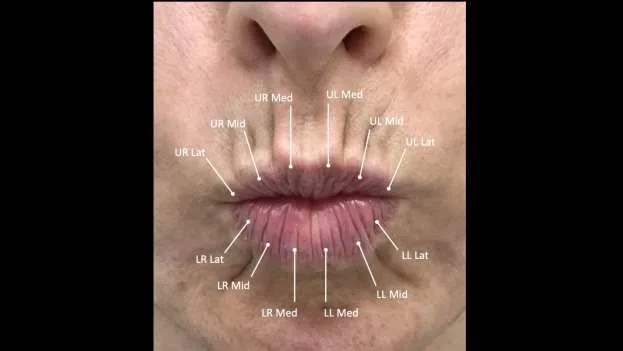 Fig 1. The lip is not one bag of volume: 24 septate compartments (12 anterior shown) parcel it, larger centrally and smaller toward the commissure, which is why compartment-respecting micro-aliquots preserve natural shape while a single large bolus balloons it — (Cotofana, 2023, p.107).
> Sources: Cotofana 2023, intralabial lip compartments [1].
Fig 1. The lip is not one bag of volume: 24 septate compartments (12 anterior shown) parcel it, larger centrally and smaller toward the commissure, which is why compartment-respecting micro-aliquots preserve natural shape while a single large bolus balloons it — (Cotofana, 2023, p.107).
> Sources: Cotofana 2023, intralabial lip compartments [1].
The intralabial compartments (why micro-aliquots beat a bolus). A cadaveric dye study (n=20, mixed ethnicity) established that the vermilion is not a homogeneous space: 6 anterior and 6 posterior compartments in each of the upper and lower lip, 24 in total, bounded by vertically oriented septa in consistent locations independent of gender or race [1]. Anterior compartments hold 0.30-0.39 cc, posterior compartments 0.44-0.52 cc, and the central compartments are the largest, tapering toward the commissure [1]. The clinical inference the authors draw, and this chapter adopts, is a compartment-respecting injection: small aliquots placed to fill compartments in proportion preserve the natural lip shape, whereas a large bolus overfills one compartment and distorts the contour (Fig 1) [1]. This is the anatomical grounding for the "many small deposits, not one big one" rule that also serves vascular safety.
The fat, such as it is. The lip has a superficial (subcutaneous) and a suborbicularis oris fat, but the subcutaneous layer over the vermilion is < 1 mm and often effectively absent, which is why there is no forgiving plane for a superficial deposit and why beading and Tyndall appear immediately if gel is placed too high [7][41]. The perioral region carries superficial fat compartments [4][5] that are the target of microfat grafting (1-2 cc per superficial compartment via a 22-gauge cannula in the corpus technique), a distinct WAT structure from the cheek that is not undermined at facelift and sits farthest from the lift vector, which is why it deflates and is addressed separately [7].
Why the red is red, and why it bruises and heals as it does. The vermilion's colour is not pigment but optics: a thin, translucent keratinized epithelium (rete ridges more marked than adjacent skin, no hair or salivary glands, sebaceous glands in ~50% of adults) sits over a dense subepithelial capillary plexus, so the blood shows through; the intermediate zone toward the wet mucosa lacks a stratum granulosum but carries a thick parakeratin layer [10]. That rich, superficial vascularity explains why the lip bruises and forms haematomas readily, why a superficial deposit is visible at once, and why a small intravascular volume has an immediate, vivid clinical signal (D10.10) [8][10]. The mucosal surface has good turgor when young and dries and thins with age (D10.4), which is the substrate the hydration and skin-booster goal addresses (D10.6).
Consensus (what every school agrees on). The safe operating picture of lip anatomy is stable across sources: the injectable surface is the vermilion; the "SMAS" is a bilaminar sphincter; the artery lives at the muscle-mucosa interface and is mostly submucosal; there is no periosteal backstop in the body of the lip; and the volume is compartmentalized [1][2][10]. Every technique decision in D10.7 follows from these five facts.
The two parts of the sphincter, and why they are dosed differently. The pars peripheralis is the outer ring that receives the converging mimetic muscles and drives gross lip movement; the pars marginalis is the specialized marginal band that everts the lip in speech and pursing and defines the vermilion contour [8][22]. A lip flip targets the superficial peripheral fibres to relax the inward roll without disabling the deep sphincter, and it deliberately spares the marginalis-driven competence that keeps the mouth sealed for bilabials and a straw (D10.8) [29]. This bilaminar, two-part organization is also why a border thread reads as "definition" (over the marginal band) while a body deposit reads as "volume" (in the peripheral bulk).
The modiolus, in more detail (the hub every perioral muscle answers to). The modiolus is a dense fibromuscular condensation ~1.5 cm lateral to the oral commissure where the orbicularis oris, buccinator, levator anguli oris, zygomaticus major, risorius, depressor anguli oris and platysma interlace, and where a muscular band from buccinator tethers the facial artery in a constant position between the buccinator (deep) and the modiolar platysma and converging superficial muscles [3]. Its descent with age turns the commissure down (D10.4), and its density is why a commissure injection is supported beside the knot, not into it.
The wet-dry line and the philtrum, named for the injector. The wet-dry junction ("wet line") is where the outer dry mucosa meets the moist inner mucosa; a thread placed just posterior to it adds volume and forward projection, while a thread at the white roll adds definition [16]. The philtrum is the midline depression bounded by the two raised philtral columns running to the columella, and the Cupid's bow is the paired paramedian elevation of the upper vermilion border; these are the fixed landmarks the technique in D10.7 sculpts to, and preserving their geometry is what separates a natural result from a "sausage" [8][22].
Classic trap: treating the lip like the cheek and aiming for a "deep, on-bone, safe" plane. In the free lip there is no bone and the deep plane is exactly where the labial artery runs submucosally; the safe deposit is superficial and paramedian in the subcutaneous/vermilion plane, and depth here means danger, not safety [2][12].
D10.3 · Vessels, nerves and danger zone → J2 — Vascular Occlusion & Emergency Response
The vessels of the lip, with origin, course, depth, plane and what fails if you hit them:
| Vessel | Origin | Where it is | Depth / plane | If occluded / injured |
|---|---|---|---|---|
| Superior labial artery (SLA) | facial artery, origin above the commissure in ~75% | along the upper lip between muscle and mucosa; more tortuous than ILA | mostly submucosal; deep to orbicularis; ext. diameter 1.5-1.8 mm, luminal ~0.85 mm at commissure narrowing to ~0.55 mm midline; ~4.5 mm from skin, ~2.6 mm from mucosa | upper lip / philtrum / columella / nasal tip ischemia; retrograde route toward the ophthalmic system (blindness) |
| Inferior labial artery (ILA) | facial artery or a common trunk with SLA, origin below/at commissure in ~40% | lower lip between muscle and mucosa; deep to depressor anguli oris | ext. diameter 1.2-1.6 mm; 4.7 mm deep at origin → 2.3 mm at midline; can run under the labiomental crease | lower lip / chin ischemia; documented blindness after chin/lower-lip filler via an ILA under the labiomental crease |
| Columellar / subalar / septal branches (from SLA) | superior labial artery | ascend to the nasal base, septum and tip | subcutaneous to deep at the base | nasal-tip necrosis; shared territory with the nose (D9) |
| Facial artery (at modiolus) | external carotid | ~1.5 cm posterior/lateral to the commissure | between buccinator (deep) and platysma/converging muscles (superficial) | commissure and perioral field; the trunk that feeds both labial arteries |
| Infraorbital / mental neurovascular bundles | maxillary system / facial | exit the infraorbital and mental foramina | at the foramen (deep, at bone) | sensory upper/lower lip; block sites for anaesthesia |
The single governing number: where the artery sits relative to the muscle. A 193-specimen multicentre cadaver study (Cotofana 2017) resolved the labial artery into three positions relative to orbicularis oris: submucosal 78.1% (between oral mucosa and muscle), intramuscular 17.5% (between the superficial and deep laminae), subcutaneous 2.1% (between skin and muscle) [2]. The plane changes along the vessel's course in 29% (SLA) and 32% (ILA) of lips, and the midline is the most variable location in both lips [2]. The clinical inference, adopted here, is that the safest deposit is subcutaneous and paramedian, and the midline and any submucosal/deep plane are the danger (Fig 2) [2]. A UPO teaching monograph cites an older figure of 58.5% submucosal; both agree that submucosal predominates and the paramedian subcutaneous plane is safer, so the discrepancy does not change the gesture [36].
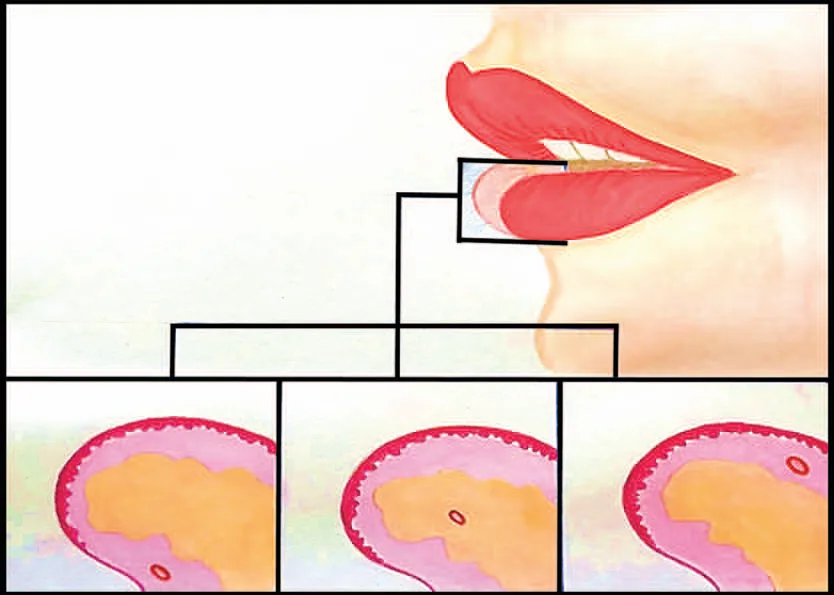 Fig 2. The panel-by-panel reason the lip is unforgiving: in 78% of lips the artery hugs the mucosal (deep) side, so a submucosal midline bolus is aimed at the vessel, while the subcutaneous paramedian plane (right panel, the 2% position) is the one the injector should occupy — (Cotofana, 2017, p.4).
> Sources: Cotofana 2017, distribution pattern of the labial arteries [2].
Fig 2. The panel-by-panel reason the lip is unforgiving: in 78% of lips the artery hugs the mucosal (deep) side, so a submucosal midline bolus is aimed at the vessel, while the subcutaneous paramedian plane (right panel, the 2% position) is the one the injector should occupy — (Cotofana, 2017, p.4).
> Sources: Cotofana 2017, distribution pattern of the labial arteries [2].
The arteries "dart like dolphins". Along the lip the SLA and ILA run submucosally and intramuscularly (Fig 3), weaving in and out of the muscle to anastomose with the contralateral artery in the midline, but they stay no deeper than ~4 mm beneath the vermilion at the level of the white-lip border, which is why perioral rhytid and border injections are performed superficially (dermal, subdermal, submucosal or superficial intramuscular), above the vessel [8]. A common trunk for SLA and ILA is found in ~11-30% of lips; when present the ILA may run along the vermilion-cutaneous junction, creating an uncertain danger zone along the border and at the commissure [8][9]. The lower lip is additionally supplied by horizontal and vertical labial branches and the mental artery, which is why clinically observed lower-lip vascular injury is less frequent than upper-lip injury despite similar anatomy [8].
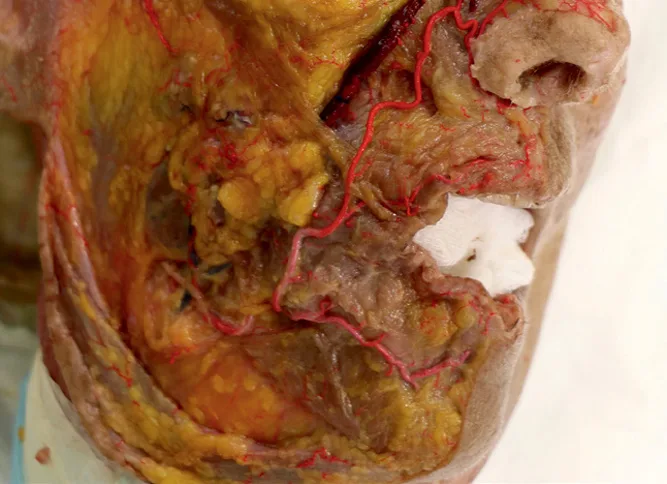 Fig 3. On dissection the labial arteries form a continuous ring feeding the vermilion from the mucosal side; the density of the anastomosis is why a small intra-arterial deposit can travel far, and why compression 1 cm above the commissure reduces the caliber during injection — (Jones, 2019, p.39).
> Sources: Jones 2019, injection anatomy [8].
Fig 3. On dissection the labial arteries form a continuous ring feeding the vermilion from the mucosal side; the density of the anastomosis is why a small intra-arterial deposit can travel far, and why compression 1 cm above the commissure reduces the caliber during injection — (Jones, 2019, p.39).
> Sources: Jones 2019, injection anatomy [8].
The danger zone, drawn as a rule, not a hope. A Spanish danger-zone monograph fixes the practical rule: the SLA leaves the facial artery ~1 cm from the commissure and slightly above it (~5 mm), at > 4-5 mm depth between mucosa and muscle, though in ~20% it exits below the commissure; the ILA origin is more variable but its depth is constant at ≥ 4 mm (Fig 4) [12]. The safety premise is therefore depth over location: inject < 3 mm from the skin and the coronary trunks are avoided regardless of their exact origin; for deep lip augmentation, a cannula dissects the plane without piercing the vessel [12]. This is the anatomical basis for "avoid the commissure, stay superficial, prefer a cannula in the high-risk field".
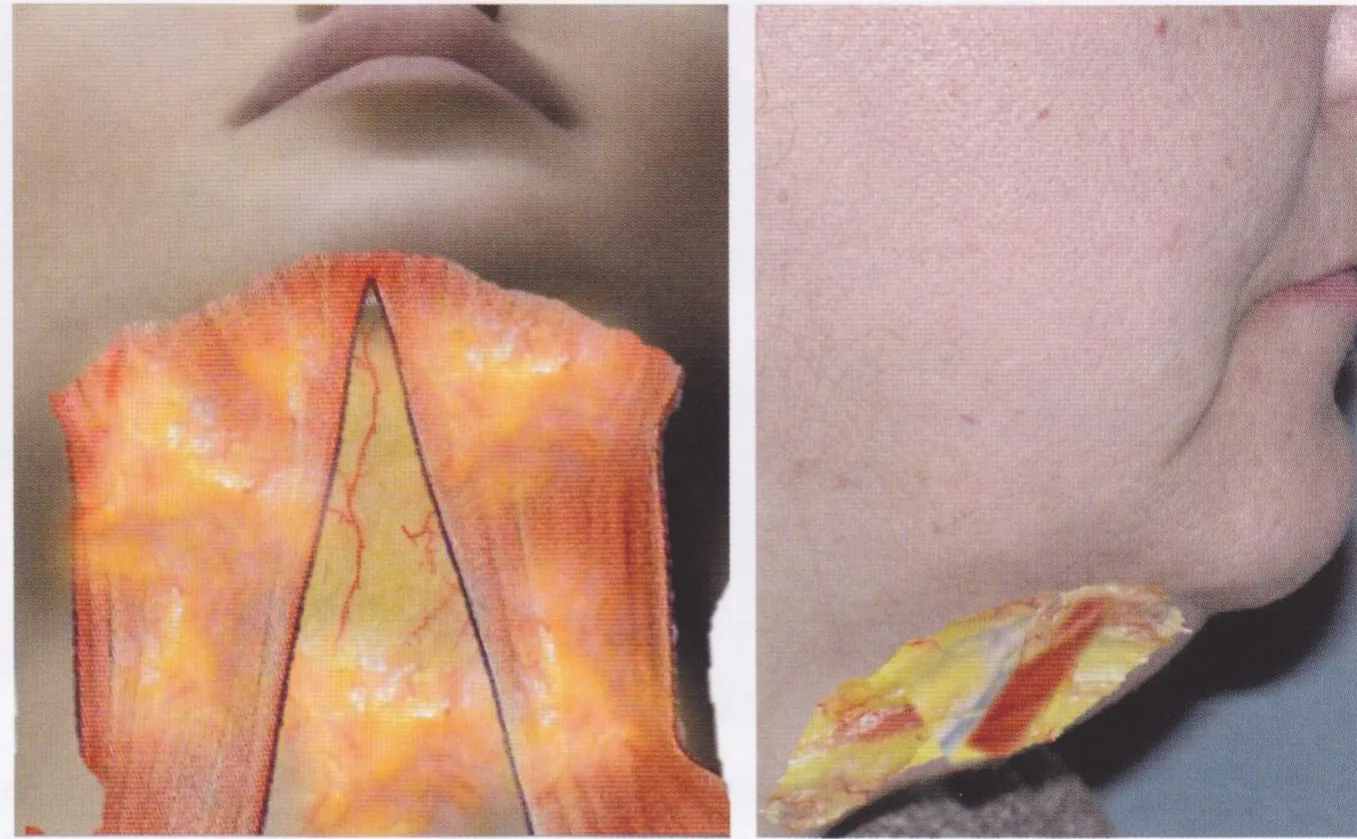 Fig 4. Fig 4 documents, region by region, why the commissure and the philtral midline are the two zones to fear: the labial trunks enter beside the commissure and send ascending philtral/columellar branches, so a midline or corner bolus can embolize toward the nasal tip and beyond — (García García / SEME, Zonas Peligrosas, p.25).
> Sources: García García, Zonas Peligrosas en Medicina y Cirugía Estética Facial [12].
Fig 4. Fig 4 documents, region by region, why the commissure and the philtral midline are the two zones to fear: the labial trunks enter beside the commissure and send ascending philtral/columellar branches, so a midline or corner bolus can embolize toward the nasal tip and beyond — (García García / SEME, Zonas Peligrosas, p.25).
> Sources: García García, Zonas Peligrosas en Medicina y Cirugía Estética Facial [12].
Nerves (for anaesthesia and for what a paresis means). Sensation of the upper lip is the infraorbital nerve (V2, exiting the infraorbital foramen ~1 cm below the orbital rim in the mid-pupillary line); the lower lip and chin are the mental nerve (V3, exiting the mental foramen, usually opposite the first/second lower premolar but variable) [9]. Both are the targets of the infraorbital and mental nerve blocks (intraoral or transcutaneous) used for lip filler and resurfacing anaesthesia; a lip ring block with lidocaine-epinephrine (e.g. ~1.2 mL 2% per lip) is the dental-style alternative [9][15]. Motor supply to the perioral muscles is the buccal and marginal mandibular branches of the facial nerve; these are not injected, but a marginal-mandibular paresis (from deep lateral spread of toxin) is the mechanism of an asymmetric lower-lip smile discussed in D10.8.
What occludes if you fail, mapped to the vessel. An SLA event blanches the upper lip, philtrum, columella and nasal tip and, worst case, embolizes retrograde to the ophthalmic circulation; an ILA event blanches the lower lip and chin; a columellar-branch event threatens the nasal tip (shared with the nose); and any of them can propagate to skin necrosis if not reperfused [8][12][31]. The recognition, hyaluronidase dosing and escalation live in D10.10 and in J2 — Vascular Occlusion & Emergency Response and J3 — Hyaluronidase - Pharmacology & Clinical Protocols.
The upper-lip vessel in depth-from-surface numbers (why "< 3 mm from skin" is the rule). Measured on the upper lip, the SLA lies about 4.5 mm from the skin, 2.6 mm from the oral mucosa and 5.6 mm from the inferior border of the upper lip, and the corpus recommends compressing ~1 cm above the oral commissure during injection to reduce its caliber and the risk of perforation [11]. The ILA branches from the facial artery at a highly variable distance, 0.5-4 cm from the commissure (mean 2-2.5 cm), running deep to the depressor anguli oris before penetrating orbicularis to lie along the lower-lip border [9]. At the labial network the facial artery averages ~2.3 mm and the facial vein lies deep and lateral to it [9]. The SLA also feeds the ascending philtral, columellar and subalar/septal branches that climb to a rich plexus at the nasal tip, which is why an upper-lip or philtral event can necrose the nasal tip [36].
The danger zone, mapped subunit by subunit:
| Subunit | Artery here | Rule |
|---|---|---|
| Vermilion body, paramedian | subcutaneous/submucosal, variable | thread < 3 mm, paramedian: the safest zone |
| Vermilion midline | the most variable position of all | avoid deep/submucosal midline boluses |
| Oral commissure (± 1 cm) | trunk entry, ≥ 4-5 mm deep | never bolus; enter lateral, thread medially |
| White roll / border | artery no deeper than ~4 mm below it | superficial thread, small volume |
| Philtral columns / Cupid's bow | ascending branches to the nose | mid-dermal drops; an embolus can reach the nasal tip |
| Labiomental crease (lower) | ILA may run here | lower-lip/chin injection: blindness reported |
The arterial ring is complete, which is why a small intravascular volume travels. The paired SLA and ILA anastomose across the midline with their contralateral partners and with the columellar, mental and labiomental arteries to form a continuous circle around the vermilion [8][11][36]. A distributing end-artery with a poor collateral, filled retrograde, carries the embolus to the most distal vulnerable territory, which is the anatomical reason a lip injection can blind through the facial-to-ophthalmic route and why reperfusion must flood the whole territory, not a point (D10.10) [8][32].
Classic trap: injecting the "safe" lower lip carelessly because upper-lip blindness gets the attention. The ILA runs under the labiomental crease in a subset of patients and has caused blindness after a lower-lip/chin injection; the lower lip is lower-risk, not no-risk, and the same superficial, paramedian, moving-needle discipline applies [8][12].
D10.4 · Ageing of the region, in order
The perioral unit ages from the platform up, and filling the vermilion is the last step, not the first. Three drivers act together: skeletal resorption, fat and ligament change, and dynamic muscular activity plus intrinsic/extrinsic skin ageing (Fig 5) [8][6]. Read the order top to bottom; the deficits accumulate in this sequence and are corrected in reverse.
| Order | Layer that changes | What happens at the lip/perioral field | Consequence you see |
|---|---|---|---|
| 1st | Bone (maxilla, pyriform aperture, alveolus, mandible) | pyriform and maxillary/alveolar resorption; loss of dental and skeletal projection | upper lip loses its projecting platform, retrudes and lengthens vertically |
| 2nd | Deep support / ligaments | perioral ligamentous laxity; the modiolus descends; the mandibular ligament fixes the marionette | oral commissure begins to turn down; marionette groove forms |
| 3rd | Deep fat | perioral deep fat loss and redistribution | deepening labiomandibular sulcus; loss of pout |
| 4th | Superficial fat | perioral superficial (subcutaneous) fat atrophy | thinning of the lip body; nasolabial and marionette deepen |
| 5th | Skin / vermilion | vermilion thins and inverts; border and Cupid's bow efface; philtral columns fade; radial "barcode" rhytids; dynamic orbicularis creasing | thin, ill-defined, wrinkled lip with a long cutaneous upper lip |
The youthful-to-aged parameter shift (the exam you actually do). A centrofacial-rejuvenation reference tabulates the change directly: the upper-to-lower vermilion height ratio stays roughly 1:1.6 (it is not the ratio that ages), but the upper lip projection falls from 1-2 mm anterior to level or posterior to the lower lip; the vermiliocutaneous border goes from well-defined and pouted to ill-defined; the Cupid's bow from distinct to faded; the nasal-base-to-vermilion contour from concave to straight or convex as the lip lengthens and the vermilion inverts; the philtral columns from distinct to faded; the mucosa from soft with good turgor to dry and atrophic; the skin from smooth to rough, pigmented and rhytid-bearing (the "barcode"); and the oral commissures from horizontal/upturned to downturned [20]. In profile, the specific sign is a change in upper-lip shape from concave to convex with lengthening of the vertical skin segment [20].
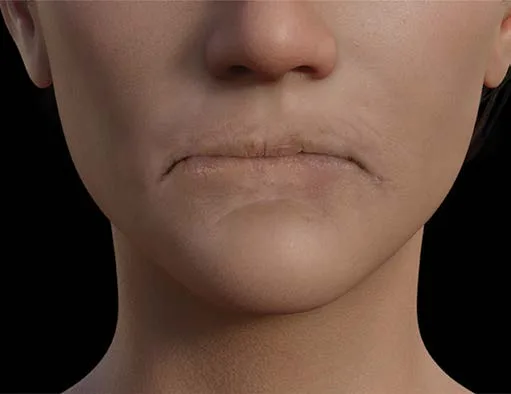 Fig 5. The composite deformity the sequence produces: not a small lip needing volume but a lengthened cutaneous lip, an effaced border and radial rhytids, which is why the correct answer is often a lift or resurfacing rather than more filler in the red — (Pirayesh, 2020, p.199).
> Sources: Pirayesh 2020, features of the aged lip [9].
Fig 5. The composite deformity the sequence produces: not a small lip needing volume but a lengthened cutaneous lip, an effaced border and radial rhytids, which is why the correct answer is often a lift or resurfacing rather than more filler in the red — (Pirayesh, 2020, p.199).
> Sources: Pirayesh 2020, features of the aged lip [9].
Skeletal resorption is the root cause the injector cannot see but must respect. The perioral bony platform (pyriform aperture margins, maxillary alveolus, mandibular symphysis) resorbs with age, and the soft-tissue envelope loses the skeletal support that held the lip forward and short [8][20]. This is why an isolated red-lip filler in an older patient looks unnatural: the vermilion is inflated while the platform behind it has receded and the cutaneous lip has lengthened, so the projection restored at the mucosa is not matched by support at the base. Restoring the pyriform/maxillary support and the perioral framework (a task shared with D9 and D11) precedes inflating the vermilion.
Marionette and commissure downturn are a ligament-plus-muscle problem, not a lip-volume one. Marionette (melomental) lines are formed superiorly by the cutaneous insertion of the depressor anguli oris and inferiorly by the mandibular ligament, over a zone of volume loss overlying the DAO and platysma [8]. The commissure turns down as the modiolus descends and the DAO pulls unopposed; this is why the correct lever for a downturned mouth is frequently toxin to the DAO plus support medial and under the fold, not filler in the lip body (D10.8, D10.9) [8][35-Sadick-Aug].
Dynamic ageing writes the barcode. Repetitive orbicularis oris activity etches the fine radial perioral rhytids ("smoker's" or "lipstick" lines) into thin, photodamaged, often smoking-related skin; the levator complex and zygomatics deepen the nasolabial fold [8][9]. These are cutaneous problems: filler softens the deeper grooves but does not erase the fine lines, which respond to toxin, resurfacing and a lift (D10.7). Smoking accelerates every arm of this (skin quality, vessel disease, healing) and is a recurring modifier in the corpus [9][20].
Vermilion inversion and the long cutaneous lip (the two measurements that reroute treatment). As the lip ages the red rolls inward (inverts) and the cutaneous upper lip lengthens; a cutaneous upper lip beyond roughly 20 mm is a lift/resurfacing problem, and inflating the red only worsens the imbalance by pushing a long, heavy lip further down [8][20]. The corpus surgical answer for the lengthened, inverted lip is a lip lift (which shortens the vertical skin height and everts the vermilion) with or without resurfacing, not more HA in the body [20]. This is the single most important ageing fact for patient selection in D10.6.
The perioral fat behaves unlike the cheek, and that shapes the ageing. The perioral region is a distinct white-adipose-tissue structure with superficial fat compartments, sitting farthest from the facelift stretch vector, not undermined at rhytidectomy, and surrounded by adherent muscles; over time it shows a gradual loss of lip volume and support, the lips thin, the subcutaneous fat atrophies, the nasolabial sulcus deepens and the labiomandibular (marionette) sulcus becomes prominent [7]. Because this compartment deflates rather than merely descends, the corrective lever is volume and support to the compartment and framework, not skin tightening, and it is treated separately from the cheek lift [7].
Why an isolated upper-lip filler looks wrong on an aged face. As the platform recedes and the cutaneous lip lengthens, adding volume only to the red reverses the natural upper:lower balance and over-projects an unsupported, lengthened lip [8][20]; the corpus rule is that patients requesting isolated upper-lip augmentation usually need the lower lip enhanced in proportion, and often a higher volume in the lower than the upper, or the result is unnatural [20]. The ageing sequence therefore dictates a proportion-led, framework-first correction, not a red-lip top-up.
Classic trap: reading every aged, thin lip as a volume deficit and filling the red. The dominant change is often skeletal recession plus cutaneous lengthening plus vermilion inversion; adding HA to the mucosa of a long, inverted lip produces a heavy, over-projected red on an unsupported, lengthened platform, the classic "did-something" aged-lip result. Measure the cutaneous lip and assess projection first [8][20].
D10.5 · Assessment: what is measured, photographed, tested dynamically, scanned
Four columns: measured · photographed · tested dynamically · scanned. The two measurements that reroute the plan are the upper:lower ratio and the cutaneous upper-lip length.
| Modality | What you record | Why it changes the plan |
|---|---|---|
| Measured (static) | upper:lower vermilion height ratio; cutaneous upper-lip length (subnasale to vermilion); incisor show at rest; Cupid's-bow definition; commissure angle; symmetry L vs R | ratio guides where volume goes; a > 20 mm cutaneous lip and a heavy, inverted red make the patient a lift/resurfacing, not a filler, candidate |
| Photographed | standardized frontal + lateral (profile) at rest and at maximal smile; before-and-after; document baseline asymmetry | profile shows projection (upper lip should be 1-2 mm anterior); asymmetry must be shown to the patient before the syringe is opened |
| Tested dynamically | full smile (gingival show, commissure vector), pucker/whistle, speech (bilabials), DAO and mentalis on grimace | separates a filler problem from a toxin problem (gummy smile, downturn, barcode); flags oral-competence risk |
| Scanned (ultrasound) | high-frequency US of lip layers and submucosal glands; prior-filler detection (anechoic HA); Doppler vascular mapping | finds old/migrated filler before you re-inject; maps the labial artery; confirms plane and depth |
Proportion, stated as numbers you can apply. The reference frame is the golden ratio (phi, 1:1.618): in a youthful Caucasian lip the upper:lower vermilion height is ~1:1.6 (the lower lip is roughly 50-60% larger), and the upper lip projects 1-2 mm anterior to the lower on profile [8][20]. The ratio is ethnicity-dependent: many African and Asian lips are genetically closer to 1:1, and imposing the Western 1:1.6 ideal on these patients produces dissatisfaction, so the target is the patient's proportional balance, not a fixed number [8]. Within the upper lip, phi recurs: the distance between the Cupid's-bow peaks is 0.618 of the columellar-base-to-mid-vermilion distance, and the peak-to-ipsilateral-commissure distance is 1.618× the peak-to-peak distance [8]. A surgical atlas gives the vermilion upper:lower ratio as 1:2 with the middle third the thickest, tapering to the commissures [22]. The single operational rule from all of this: keep the lower lip the larger of the two, preserve the Cupid's bow, and taper toward the corners; reversing the ratio is what creates the "trout pout" [8][21].
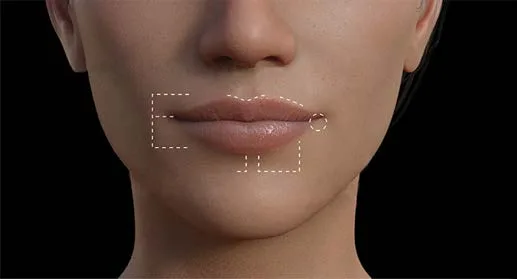 Fig 6. The mapping done before the first injection: subunit boxes force a proportion decision (where volume is deficient) and mark the commissure as the zone to enter beside, not through — (Pirayesh, 2020, p.199).
> Sources: Pirayesh 2020, features and dimensions of attractive lips [9].
Fig 6. The mapping done before the first injection: subunit boxes force a proportion decision (where volume is deficient) and mark the commissure as the zone to enter beside, not through — (Pirayesh, 2020, p.199).
> Sources: Pirayesh 2020, features and dimensions of attractive lips [9].
The aesthetic subunits (the checklist you run at the mirror). Upper lip: Cupid's bow (two paramedian peaks), the central vermilion tubercle, the vermilion-cutaneous junction / white roll, and the philtral columns running to the columella [8]. The lip should show balanced upper/lower volume, a pronounced Cupid's bow, a defined vermilion border, left-right symmetry, corners that curve gently upward, and central fullness tapering to the commissures [9]. Each subunit maps to a technique in D10.7 (Fig 6): the border to threading the white roll, the peaks to vertical tenting, the body to compartment-respecting deposits, the commissure to a supported upturn.
The dynamic exam is where you catch the toxin cases the static photo misses. Ask the patient to give a full smile: excessive gingival display defines a gummy smile (D10.8) and is classified by whether it is anterior, posterior, mixed or asymmetric, because only the levator-hyperactivity component responds to toxin, not a short clinical crown or vertical maxillary excess [28]. Watch the commissure vector on smile and the DAO/mentalis on a grimace to plan a downturn correction; ask for bilabial sounds and a pucker to gauge oral competence before any lip-flip or perioral toxin, since these are the functions a mis-dosed sphincter impairs [29]. A lengthening test and a manual lip-eversion/stretch assessment separate a volume deficit from a skin-length or vermilion-inversion problem [20].
Photography and the two-week rule. Standardized frontal and lateral views at rest and at maximal smile are mandatory, both to plan (profile projection, gingival show) and to protect (documented baseline asymmetry, which "must be relayed to the patient prior to commencement") [9][15]. Because localized swelling develops during injection, symmetry is not judged on the table: the corpus rule is to assess and re-touch at a one-to-two-week review, not at the moment of treatment [14][8].
Ultrasound is moving from optional to standard, and the lip is a strong indication. High-frequency US resolves the lip layers, submucosal glands and any prior/migrated filler (HA is anechoic, CaHA/PMMA hyperechoic), and Doppler maps the labial artery before injection and locates an occlusion during a complication [31][42][33]. A 2025 sonoanatomy pictorial review formalizes the lip US planes for injectors, and a 2025 cross-sectional US study (n=126) documents that treated lips show measurably thickened connective-tissue and submucosal layers and that the subcutaneous layer averages < 1 mm, so re-injection without imaging is often blind to where the last product sits [41][42]. For a re-treatment, a migration complaint, or a high-risk anatomy, scan before you inject.
The numbers you actually write on the assessment sheet.
| Measurement | Youthful / target | Aged / flag |
|---|---|---|
| Upper:lower vermilion height | ~1:1.6 (ethnicity-adjusted, to 1:1) | ratio reversed by prior filler = dissolve first |
| Vermilion upper:lower (surgical) | ~1:2, middle third thickest, tapering to corners | uniform thickness = over-filled |
| Upper-lip projection (profile) | 1-2 mm anterior to lower | level/posterior = deflation + recession |
| Cutaneous upper-lip length | proportionate | > ~20 mm = lift/resurfacing case |
| Nasal-base-to-vermilion contour | concave | straight/convex = lengthened, inverted lip |
| Incisor show at rest | a few mm | absent = retruded/aged; excess = check for gummy smile |
| Cupid's-bow peak-to-peak | 0.618× columella-base-to-mid-vermilion | flattened "sausage" = over-filled |
The manual tests that decide the plan at the chair. A lip-eversion/stretch manoeuvre separates a volume deficit (the red everts and fills) from a skin-length or inversion problem (the lip stays long and thin), routing the second to a lift rather than a syringe [20]. A cheek-lift / support test shows how much of the perioral descent is framework versus lip, and a dynamic smile exposes the gummy-smile and downturn components the static photo hides (D10.6, D10.8). Firm surface tension improves the uniformity of filler flow, so the lip is stretched during injection; a lax, un-stretched lip fills unevenly [35].
What ultrasound adds beyond the photograph. High-frequency US measures the layer thicknesses and submucosal gland dimensions, and treated lips show thickened connective-tissue and submucosal layers with a subcutaneous layer averaging < 1 mm, so a re-treatment plan that ignores the prior product's plane is guessing [41][42]. It also finds and characterizes old filler (HA anechoic, CaHA/PMMA hyperechoic) and, on Doppler, maps the labial artery and later distinguishes normal pulsatile flow from the oscillating back-and-forth flow of an obstructed vessel with a hypoechoic HA deposit downstream [31]. For any lip that has had prior work, or any migration complaint, imaging precedes the needle.
Classic trap: treating "make them bigger" as the brief and skipping the two measurements. If the cutaneous upper lip is long and the vermilion already inverted, or the ratio is already reversed from prior filler, more HA deepens the deformity; the assessment (ratio, cutaneous length, prior-filler US) is what converts a request for volume into the correct plan, which is sometimes dissolve, lift or resurface rather than fill [20][41].
D10.6 · Goal and patient selection: who benefits, who does not, what is referred
First separate the four goals, because they need different products, planes and sometimes different modalities entirely.
| Goal | What the patient actually wants | Primary lever |
|---|---|---|
| Hydration / quality | softer, less dry, fine-line smoothing | light/soft or non-crosslinked HA skin-booster, subdermal, low volume [8] |
| Volume | a fuller red lip | soft cohesive HA in the vermilion body, compartment-respecting [1][8] |
| Definition | a crisper border, a defined Cupid's bow | firmer HA threaded at the white roll / vertical tenting [16][19] |
| Eversion / show | more visible red without added bulk | low-dose lip-flip toxin ± subtle border filler [29] |
Who benefits (the good candidate). Genetically thin lips, age-related deflation with preserved lip length, poor or lost vermilion-border definition, a mild asymmetry, or a patient seeking proportional harmony rather than sheer size, with realistic expectations and no active contraindication [8][9]. In significant ageing, the corpus lesson is that restoring perioral support (framework, commissures, philtral columns) matters more than filling the lip itself and often improves fine lines and proportion at once; the lip body is the finish, not the start [8].
Who does not benefit / defer (the wrong candidate for filler).
| Finding | Why not | Do instead |
|---|---|---|
| Cutaneous upper lip > ~20 mm, heavy inverted red | filler lengthens and weighs down an already long lip | surgical lip lift ± resurfacing (D10.4) [20] |
| Reversed ratio / migrated filler from prior work | more HA compounds distortion | dissolve and rebuild with hyaluronidase first [8][41] |
| Unrealistic expectations / body-dysmorphic features | no volume satisfies them; dissatisfaction and over-treatment follow | decline, counsel, screen |
| Active herpes labialis / visible lesion | injection reactivates and spreads HSV | defer; prophylax if a history exists (D10.10) [35] |
| Permanent/semipermanent filler in situ | not reversible; nodule/granuloma risk with layering | image, avoid re-layering, refer [14] |
| Vertical maxillary excess / short clinical crown gummy smile | toxin will not fix a skeletal/dental cause | orthognathic / dental referral [28] |
| Bleeding diathesis / anticoagulation, salicylates, vitamin E | the lip bruises and haematomas readily | optimize timing; warn; consider cannula [9] |
| Pregnancy / breastfeeding | no safety data; elective | defer (relative) |
Gender and ethnicity change the target, not just the dose. Male lips are generally thinner with less eversion desired; over-everting a male lip feminizes it. Many African and Asian patients have a genetically fuller lip and a ratio nearer 1:1, and they frequently do not aspire to the Western 1:1.6 ideal, so imposing it produces dissatisfaction; the target is the individual's proportional balance [8][22]. Ethnic lip morphology also carries a higher baseline pigmentation and, in higher phototypes, a greater post-inflammatory hyperpigmentation risk after any trauma or resurfacing, which shifts the perioral-line plan away from aggressive ablation (D10.7) [25].
What is referred, and to whom. A long, inverted cutaneous lip and a request to "shorten the space under my nose" go to a lip-lift surgeon [20]. Gingival display from vertical maxillary excess or a short clinical crown goes to orthognathic surgery or restorative dentistry, because only the levator-hyperactivity component answers to toxin [28]. Lip incompetence, malocclusion, or a functional speech/eating concern goes to the relevant surgical/dental service before any aesthetic injection. Festoons and lower-face laxity are surgical, shared with the neighbouring regions.
The 2024-2025 shift: "less is more", and the dissolving wave. The dominant current demand is natural, subtle enhancement, not maximal volume; the overfilled "duck/Russian" look and single-session overfilling are out of favour, and searches for dissolving filler are at record highs, driven by concern over migration and stacked overfilling [46][41]. Two operational consequences follow, both evidence-aligned: (1) prefer a conservative, staged, one-syringe-or-less plan with a two-week reassessment, since overfilling in one session is what stiffens and distorts the lip; (2) when a patient presents with old, migrated or over-stacked filler, the correct first step is often to dissolve and let the lip return to baseline before rebuilding naturally, rather than layering more product onto a distorted base [8][41]. This is not merely fashion: the 2025 ultrasound data showing routine intramuscular placement and measurable migration give the "restraint and reassess" posture an anatomical rationale [41][42].
Consent, specific to the lip. State explicitly: swelling and bruising are common and can last 10-14 days; symmetry is judged at review, not on the table; migration above the border can occur and may need dissolving; a cold-sore outbreak is possible (prophylaxis if history); and vascular occlusion, though rare, can cause necrosis and, exceptionally, vision loss [8][14][35]. Photograph and disclose baseline asymmetry first [9].
The severe-ageing patient needs a plan, not a syringe. In significant ageing with photodamage, no single modality restores the perioral unit; the corpus endpoint is a combined plan across framework support, red-lip volume, toxin for the depressors and dynamic lines, and resurfacing or a lift for the skin and length [8][20]. Tailoring to individual anatomy, ethnic background and personal goals is what optimizes the outcome, and the selection conversation is where that plan, and its sequence (D10.9), is set [8].
The dissolve-and-rebuild pathway, made explicit. A patient presenting with old, migrated or over-stacked filler is not a candidate for more product on day one. The pathway is: image the prior filler on ultrasound → dissolve with hyaluronidase → let the lip return toward baseline → reassess proportion and length → rebuild conservatively (one syringe or less, staged), or decline if the underlying problem is length/inversion rather than volume [8][41]. This is the operational face of the 2024-2025 "reset to natural" demand, and it is anatomy-backed by the ultrasound migration data, not merely a fashion preference [41][42].
Who benefits, sharpened. The best candidates are the young, structurally normal lip seeking subtle enhancement or hydration, the genetically thin lip, the early-ageing lip with preserved length and a deflating body, and the mild asymmetry; each has a clear volume or definition deficit that a conservative, proportion-respecting technique corrects predictably [8][9]. The moment the deficit is length, inversion, skeletal recession, or a psychological driver, the patient benefits from a different tool or from no injectable at all, and saying so is the treatment [20].
Classic trap: accepting "just make them bigger" from a patient whose real problem is a long, inverted, unsupported lip, or who already has migrated filler. The result is a heavier distortion and an unhappy patient; the selection step (measure the lip, image prior filler, match the goal to the right modality) is what prevents it, and the right answer is sometimes dissolve, lift or resurface, not fill [20][41].
D10.7 · Technique, the full grid (product, instrument, plane, movement, school, volume, non-injectable)
The region is not closed with one technique; it is closed with the full grid. Every axis is enumerated below, then applied point by point.
| Axis | The full set for the lip/perioral field |
|---|---|
| Product | soft low-G′ HA (volume/hydration) · firm high-G′ HA (border/structure) · non-crosslinked/light HA skin-booster · polynucleotides · autologous micro/nanofat (± PRP) · avoid CaHA/PLLA/PCL/PMMA and all permanents in the lip body |
| Instrument | 27-31 G sharp needle (0.5 in, border precision) · 25-27 G cannula (25-38 mm, single commissure port via Nokor) · with or without ultrasound guidance |
| Plane | subcutaneous (paramedian, safest) · vermilion body over orbicularis · submucosal (deep, artery zone: avoid at midline) · mid-dermal (philtral columns, border) · intradermal (skin-booster) |
| Movement | retrograde linear thread · anterograde thread (pushes vessels ahead) · serial puncture / droplet · fanning · cross-hatching · vertical tenting/tower · microbolus with point-blanch |
| School | structural/vertical "Russian"/tenting (high-G′ columns) · classic/volumetric horizontal (soft-HA threading) · cannula-first high-risk-zone school · needle-precision white-roll school |
| Volume | 0.01-0.02 mL/point (blanch) · 0.2-1.5 mL/technique-unit · 0.5-1.0 mL/lip typical · stage rather than exceed proportion |
| Toxin | lip flip, gummy smile, DAO, perioral rhytids: full map in D10.8 |
| Non-injectable | fractional/ablative CO2 · full-field/fractional Er:YAG · dermabrasion · TCA-Jessner / croton-oil peel · microneedling · surgical lip lift for the long lip |
Point by point (subunit → plane, entry, direction, instrument, volume, retouch):
| Target | Plane / entry | Direction / movement | Instrument | Volume | Retouch rule |
|---|---|---|---|---|---|
| Vermilion body (start here) | subcutaneous/vermilion, enter from the mucosal side at 45° | retrograde or anterograde linear thread, redirect each pass for even fill | 27-30 G needle or 25-27 G cannula | 4-5 threads; ~0.2-0.5 mL/lip per pass to 0.5-1.0 mL total | assess at 2 wk, not on table |
| Vermilion-cutaneous border / white roll | superficial, mid-dermis just below the border | retrograde linear thread along the roll; syringe parallel to the lip long axis | 30-31 G needle bent ~45°, or cannula | ~0.1-0.3 mL/side, small | over-fill here migrates over the border |
| Cupid's bow / peaks | mid-dermal, vertical | vertical injection into the upper-lip quadrants; tenting for height | 30 G needle | drops per peak | preserve, do not flatten, the peaks |
| Philtral columns | mid-dermal | short vertical retrograde threads | 30 G needle | drops per column | defines, do not bulk |
| Oral commissure | subcutaneous, lateral to the corner (never through it) | supportive deposit to upturn; enter beside the modiolus | cannula preferred | small, supportive | corner = artery entry: high-risk |
| Perioral radial rhytids | intradermal/subdermal | serial micro-droplets or a skin-booster mesh; or defer to resurfacing/toxin | 30-31 G needle | micro-aliquots | fine lines answer to toxin/laser, not bulk HA |
Product, enumerated (what to use, what never to use in the lip):
| Product | Role in the lip/perioral field | Note |
|---|---|---|
| Soft, cohesive, low-to-mid-G′ HA | red-lip volume, hydration, natural projection | first line; integrates with mobile tissue |
| Firm, high-G′ HA | white-roll definition, vertical structural columns | the "Russian"/tenting product; migrates if too deep |
| Restylane Kysse (XpresHAn/OBT) | FDA 2020 for lips + upper perioral rhytids; flexible, ~170% swelling, moderate cohesivity | lip-specific on-label HA [37] |
| RHA 2 / RHA 3 / RHA Redensity (resilient HA) | dynamic-zone lips and perioral lines; Redensity for fine perioral rhytids | adapts to movement; RHA-3-vs-Restylane-L lip trials ongoing [37] |
| Revanesse Lips+ / Versa | hydrating red-lip volume; uniform-sphere HA | Lips+ FDA 2020 for lips [37] |
| Non-crosslinked / light HA skin-booster | hydration and fine-line quality, subdermal, low volume | for the "quality" goal, not projection [8] |
| Polynucleotides | regenerative skin quality (perioral) | adjunct; corpus evidence thin for the lip specifically [MATERIAL GAP] |
| Autologous micro/nanofat (± PRP) | volume + skin quality; SNIF for vertical rhytids | 40-50% resorption in the lip, the highest of the face: over-correct or stage [7][20] |
| CaHA (normal or hyperdilute), PLLA, PCL, PMMA | not in the lip body | migration, nodules, granuloma, non-reversible; semipermanent/permanent are a durable-complication risk [14][16][31] |
Consensus (what every school does the same). Start at the vermilion body or border, thread rather than bolus, stay superficial and paramedian, keep aliquots small, avoid the commissure, and judge symmetry at a two-week review [8][13][14][16]. Boluses are avoided not for aesthetics but for safety: "always perform these injections via a linear retrograde technique, as boluses within the lip can cause not only unsightly lumps but also an increased risk of vascular occlusion and avascular necrosis" [18]. Semipermanent and permanent fillers are not used in the lip [14][16].
Discrepancy 1 (changes the gesture): structural/vertical vs classic/horizontal.
**Consensus:** thread superficially, small aliquots, respect proportion and the border [8][13]
**Discrepancy:**
  A (structural/vertical "Russian"/tenting): vertical columns of FIRM, high-G′ HA for height,
     a defined Cupid's bow and less lateral spillage; more technique-sensitive and, per 2025
     ultrasound, more prone to DEEP intramuscular deposition and measurable migration [41][42]
  B (classic/volumetric horizontal): linear threading + serial puncture with SOFT cohesive HA
     for natural forward projection; more forgiving of placement, less height [8][13]
  decide by: does the patient need HEIGHT and border (A) or PROJECTION and softness (B); in a
  migration-prone or novice setting, B is the safer default. Never average the two into a
  "firm gel placed horizontally", which gets the worst of both.
Discrepancy 2 (changes the gesture): cannula vs needle.
**Consensus:** minimize vessel trauma, know the depth, keep moving, low pressure [9][17]
**Discrepancy:**
  A (blunt cannula, 25-27 G, single commissure port): fewer intra-arterial events, less
     bruising, one entry, favoured in this high-risk field [9][17]
  B (sharp needle, 27-31 G): superior white-roll and Cupid's-bow precision; the defined-border
     technique [14][18]
  caveat both sides accept: a cannula is NOT risk-free; an advanced cannula still traumatizes and
     can enter a vessel, so "cannula" is not a substitute for anatomy and low pressure [17]
  decide by: high-risk deep body / commissure -> cannula; crisp superficial border -> needle.
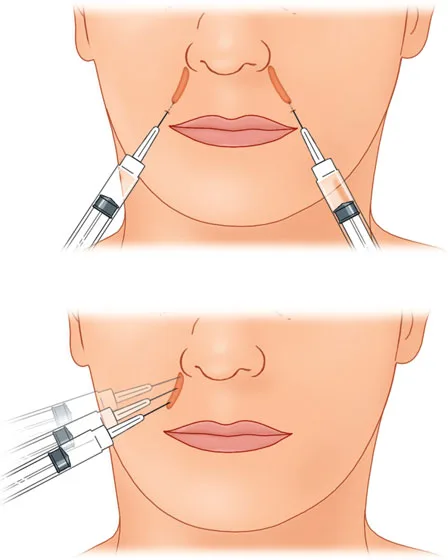 Fig 7. The two workhorse movements contrasted: serial puncture/linear threading (top) places discrete controlled deposits, fanning (bottom) covers an area from one entry; the choice trades entries and bruising against placement control — (Sadick, Concise Manual, p.53).
> Sources: Sadick 2008, injection techniques (linear threading / serial puncture / fanning) [14].
Fig 7. The two workhorse movements contrasted: serial puncture/linear threading (top) places discrete controlled deposits, fanning (bottom) covers an area from one entry; the choice trades entries and bruising against placement control — (Sadick, Concise Manual, p.53).
> Sources: Sadick 2008, injection techniques (linear threading / serial puncture / fanning) [14].
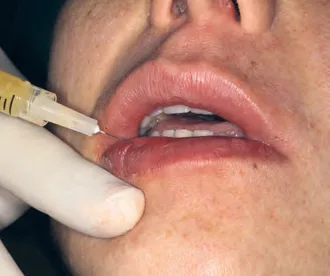 Fig 8. The mucosal-side, everted-lip approach in practice: entering from the wet mucosa and threading toward the wet-dry junction adds projection while keeping the entry away from the visible surface and reducing surface bruising — (Garg, Dermal Fillers for Dental Professionals, p.171).
> Sources: Garg 2021, lower-lip step-by-step [15].
Fig 8. The mucosal-side, everted-lip approach in practice: entering from the wet mucosa and threading toward the wet-dry junction adds projection while keeping the entry away from the visible surface and reducing surface bruising — (Garg, Dermal Fillers for Dental Professionals, p.171).
> Sources: Garg 2021, lower-lip step-by-step [15].
Volume, quantified. Typical lip augmentation uses 0.5-1.0 mL per lip, lasting 4-6 months (longer with repeat sessions or concomitant perioral toxin) [8][16]; a lip-technique atlas synoptic table maps 0.2-1.5 mL to specific techniques and needle gauges (27-30 G), with a point-blanch aliquot of 0.01-0.02 mL [13]; the cannula moderate-augmentation technique uses 0.5-1.0 mL total through a single 27 G blunt cannula entered via a >25 G Nokor prick ~5 mm from the commissure [17]. The ceiling is proportion, not a number: stop when the lower lip stays the larger and the Cupid's bow is preserved, and stage the rest [8][21].
The non-injectable ladder (when the correct answer is not a filler). Radial perioral rhytids, a long or heavily photodamaged cutaneous lip, and "lipstick bleed" respond to resurfacing and surgery, not to more HA:
| Modality | Parameters / role (corpus) | Best for |
|---|---|---|
| Fully ablative CO2 | gold standard for deep rhytids/elastosis; second and third passes drive collagen remodelling; most downtime | deep perioral rhytids, severe elastosis [23][26] |
| Fractional CO2 | e.g. DeepFX 20 mJ, 300 Hz, 15-20% density, then ActiveFX 125 mJ, 100 Hz; blend to untreated skin | moderate rhytids with less downtime [24] |
| Full-field / fractional Er:YAG | whole-lip spot 5 mm at 1000 mJ (fluence 6.25 J/cm²), 10-12 Hz, 3-4 layers, 50% overlap; "cold" ablation, less depigmentation; better for phototype III+ | superficial-to-medium rhytids, darker skin (Fig 9) [20][26][27][43] |
| Dermabrasion | mechanical ablation, older method | historical/alternative [20] |
| TCA-Jessner or croton-oil peel | medium-to-deep chemical resurfacing; croton-oil for deep peel | field photoageing, combine with focal laser [20][25] |
| Microneedling ± RF | collagen induction, mild | mild texture/lines, low downtime |
| Surgical lip lift | shortens the cutaneous lip, everts the vermilion (± SNIF fat, ± Er:YAG) | the > 20 mm long, inverted lip (D10.4) [20] |
Peri-resurfacing rules from the corpus: pretreat with tretinoin 0.1% for 4-6 weeks (± hydroquinone 4% for PIH risk), give HSV prophylaxis (aciclovir ≥ 800 mg/day from 2 days pre until re-epithelialization), continue prophylactic antivirals/antibiotics 10-14 days, and maintain strict sun avoidance for up to a year; ablative resurfacing of dynamic rhytids is only temporary unless combined with toxin or filler [20][25].
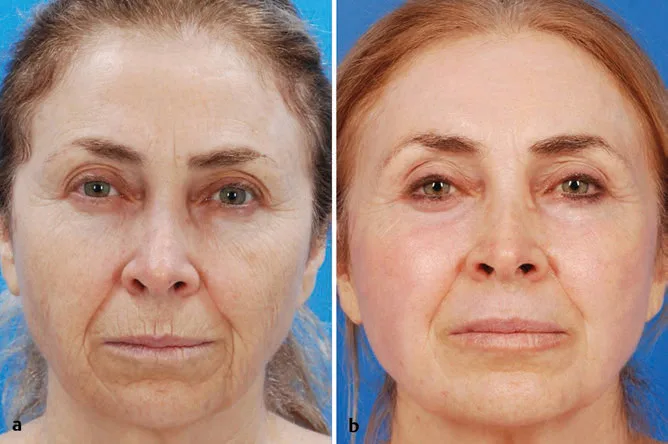 Fig 9. The result filler cannot give for fine barcode lines: full-field Er:YAG resurfacing (a→b) effaces the radial perioral rhytids by remodelling the skin itself, which is why the long, photodamaged, wrinkled lip is a resurfacing case, not a volume case — (Connell, Aesthetic Rejuvenation of the Face and Neck, p.46).
> Sources: Connell 2016, full-field Er:YAG resurfacing of perioral rhytids [16].
Fig 9. The result filler cannot give for fine barcode lines: full-field Er:YAG resurfacing (a→b) effaces the radial perioral rhytids by remodelling the skin itself, which is why the long, photodamaged, wrinkled lip is a resurfacing case, not a volume case — (Connell, Aesthetic Rejuvenation of the Face and Neck, p.46).
> Sources: Connell 2016, full-field Er:YAG resurfacing of perioral rhytids [16].
Rheology, applied to the current lip products. G′ is, in effect, firmness under compression: higher-G′ gels lift and define (thicker skin, a sharp border, a vertical column), lower-G′ cohesive gels integrate softly for red-lip volume; cohesivity governs how the gel flows and holds together after placement [19]. Mapped to the lip-optimised brands: Restylane Kysse (XpresHAn/OBT) is engineered for flexibility with movement, with a ~170% swelling capacity and a moderate cohesivity (Gavard-Sundaram score 2), and is a touch firmer on placement then softens as it settles; RHA 2/3 (resilient HA) adapt to dynamic movement, with RHA Redensity the finer gel for superficial perioral lines; Revanesse Lips+/Versa are the same uniform-spherical-particle HA, soft and hydrating, boxed differently [37]. All current formulations carry lidocaine [37]. The exhaustiveness rule stands: match G′ and cohesivity to the goal, never one product to every lip.
The movements, enumerated with their rationale (Fig 7, Fig 8). Retrograde linear threading deposits on withdrawal and is the default for safety and even fill; anterograde threading extrudes ahead of the tip so the flowing gel pushes vessels aside, a proposed intravascular-avoidance benefit [9]. Serial puncture places discrete beads along the border; fanning covers an area from one entry (fewer punctures, useful with a cannula); cross-hatching builds a lattice for volume; vertical tenting/tower stacks firm gel for height and a defined bow; micro-bolus with point-blanch places 0.01-0.02 mL controlled drops [13][14]. A two-session approach is recommended to optimise a large correction rather than overfilling once, and the operator changes the needle frequently because a blunted needle traumatizes and pains [13].
Marionette and commissure filler, the corpus technique. For the melomental groove, mix a firmer gel (or CaHA in the corpus example) with lidocaine and use a 28-30 G needle at the lower angle of the triangular fold with a retrograde tunnelling linear thread, feathering the triangle with serial puncture; keep the deposit under and medial to the fold because a lateral injection deepens it, and mould/massage to avoid nodules [35]. The commissure itself is supported from lateral to the corner, never through it (the artery entry), often with a cannula.
Anaesthesia and preparation. Topical anaesthetic ~30 minutes before, or an infraorbital and mental nerve block (intraoral or transcutaneous), or a lip ring block (~1.2 mL 2% lidocaine-epinephrine per lip; corners ~0.2 mL); a premixed HA-with-lidocaine reduces pain during placement [9][15]. Screen for and pause bruising-promoting agents (NSAIDs, aspirin, vitamin E, anticoagulants), take frontal and lateral before-photos, prescribe antiviral prophylaxis for a herpes history, and do not treat over a visible cold sore [9][15].
Energy adjuncts short of ablation. For perioral skin quality without ablative downtime, IPL improves texture, pore size and fine lines (better still combined with perioral toxin), and radiofrequency and high-intensity focused ultrasound soften fine lines by dermal heating and work in combination with toxin and filler [8]. Microneedling (± RF) is the low-downtime collagen-induction option for mild texture. These sit between "filler" and "ablative resurfacing" on the non-injectable ladder.
Classic trap: answering every lip request with a syringe of HA. Fine radial rhytids, a long cutaneous lip and lipstick bleed are skin and length problems that HA cannot fix and can worsen; the grid above forces the correct modality (resurfacing, lift, toxin) into view, and the exhaustiveness rule is that a technique block listing only "threading with HA" has not closed the region [16][20][24].
D10.8 · Toxin of the region: muscle, units/point, points, safety distances, antagonist spared
The lower third is where toxin produces the most functional complications, because the muscles are small, adjacent and control oral competence, speech and the smile. All perioral aesthetic toxin is off-label. Doses are onabotulinumtoxinA (ona); abobotulinumtoxinA (Dysport/Azzalure) is ~2.5-3× the unit count and never swapped one-for-one; incobotulinumtoxinA (Xeomin/Bocouture) is ~1:1 with ona. [29][30]
| Target (muscle) | Dose (ona) | Points | Plane | Antagonist / neighbour NOT to hit | Safety |
|---|---|---|---|---|---|
| Lip flip (superficial orbicularis oris, upper) | 2-4 U total (1-2 U/quadrant) | 2-4, just above the vermilion, central | very superficial | the deep orbicularis (oral competence) and pars marginalis | effect 6-8 wk; warns bilabials, straw, wind instruments |
| Perioral vertical rhytids ("lipstick lines", orbicularis oris) | ≤ 2 U per site, ~1 U each | 2-4 symmetric, superficial | superficial | deep orbicularis; keep total low | high side-effect visibility; filler/laser often better |
| Gummy smile (LLSAN + LLS + zyg minor) | 1-2 U/side | 1/side at the Yonsei point (or Suber 3-point triangle) | superficial | the lateral levators (zyg major, LAO, risorius) in central cases | narrowest therapeutic margin of the face; start low |
| Depressor septi nasi (smile-related tip droop) | 1-2 U | 1 at the columella base | intramuscular | orbicularis oris fibres | adjunct to the gummy-smile plan |
| Depressor anguli oris (DAO) (downturn/marionette) | 2-5 U/side | 1/side, on the mandibular border, lateral and posterior to the modiolus | deep | the depressor labii inferioris (medial/above) | anterior/high point = asymmetric lower lip on speech, 8-12 wk |
| Mentalis (pebble chin, overlaps D11 — Chin & Mentolabial) | 4-8 U total | 1 central-low or 2 low points | deep, near bone, low chin | the inferior orbicularis oris if placed too high | high point weakens lip; keep low |
Lip flip: expectation before dose. Low-dose toxin into the central superficial orbicularis oris relaxes the sphincter's pull on the upper lip so it rolls outward, showing slightly more vermilion without adding volume; the effect is subtle and lasts 6-8 weeks, less than filler [29]. The dose is small precisely to spare the deep sphincter that maintains competence [29][44]: excess produces trouble with bilabial sounds, drinking through a straw and whistling, so voice professionals and wind instrumentalists are excluded and every patient is warned in writing [29]. Because perioral orbicularis activity constantly remobilizes the toxin, touch-ups here are needed every 2-3 months, more often than elsewhere [8].
Perioral vertical rhytids: the lowest-dose, highest-visibility use. Transverse and vertical upper-lip lines get no more than 2 U per site, and the deep orbicularis fibres are deliberately spared; overdose or deep placement produces lip incompetence and asymmetry [29]. In thin, atrophic, elderly lips these lines often will not answer to toxin at all (the skin creases with the least movement), and the corpus verdict is that a filler or resurfacing is frequently the better tool, with toxin as a low-dose adjunct only [29].
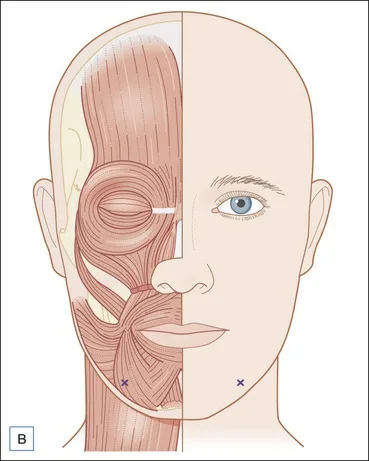 Fig 10. The muscle map that dictates every perioral toxin point: the DAO sits lateral on the mandibular border, the depressor labii inferioris medial and above it, and the mentalis low and central, which is exactly why a DAO point must be lateral-and-low to spare the lip depressor — (Benedetto, Botulinum Toxins in Clinical Aesthetic Practice, muscle map).
> Sources: Benedetto, perioral muscle anatomy and injection points [29].
Fig 10. The muscle map that dictates every perioral toxin point: the DAO sits lateral on the mandibular border, the depressor labii inferioris medial and above it, and the mentalis low and central, which is exactly why a DAO point must be lateral-and-low to spare the lip depressor — (Benedetto, Botulinum Toxins in Clinical Aesthetic Practice, muscle map).
> Sources: Benedetto, perioral muscle anatomy and injection points [29].
Gummy smile: the narrowest margin on the face, and it earns its own paragraph. Excessive gingival display from levator hyperactivity (not from vertical maxillary excess or a short clinical crown, which do not answer to toxin) is treated at the Yonsei point: the intersection of a line 1-1.5 cm lateral to the most lateral aspect of the ala nasi and a line ~3 cm up from the oral commissure, where the LLSAN, LLS and zygomaticus minor converge on a small triangle, so a single 1-2 U low-volume deposit weakens all three (Fig 11) [28]. An alternative is the Suber inverted-triangle three-point pattern 2 mm lateral to the alar-facial groove [28]. Classify first (anterior, posterior, mixed, asymmetric); for a central/canine gummy smile, spare the lateral levators (zygomaticus major, levator anguli oris, risorius) or the smile becomes flat or asymmetric [28]. Overdose produces a long, immobile, flattened upper lip for weeks, one of the most distressing toxin complications because it alters daily social expression; therefore start at the lowest dose and review at two weeks ("you can add, you cannot remove") [28][29].
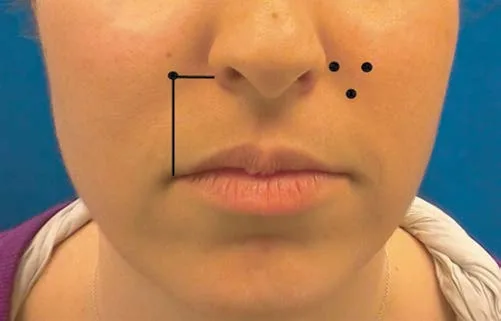 Fig 11. The single high-value point located: marks lateral to the ala nasi target the levator convergence so 1-2 U weakens the central elevators without touching the lateral smile muscles, the difference between a natural correction and a flat smile — (Benedetto, Yonsei/Suber gummy-smile points, p.140).
> Sources: Benedetto 2018, gummy-smile injection points (Hwang "Yonsei point"; Suber) [28].
Fig 11. The single high-value point located: marks lateral to the ala nasi target the levator convergence so 1-2 U weakens the central elevators without touching the lateral smile muscles, the difference between a natural correction and a flat smile — (Benedetto, Yonsei/Suber gummy-smile points, p.140).
> Sources: Benedetto 2018, gummy-smile injection points (Hwang "Yonsei point"; Suber) [28].
DAO: how to find it without weakening the lip depressor. Ask the patient to frown or tense the neck and palpate the contracting band on the mandibular border; the DAO is lateral to the modiolus, the depressor labii inferioris medial and above (Fig 10). The point is on the mandibular border, in the vertical dropped from the commissure or slightly behind it, deep, at 2-5 U/side [29]. A point too medial or too high weakens the depressor labii inferioris and leaves an asymmetric smile lasting 8-12 weeks, the lower-third complication that generates the most second opinions [29]. DAO relaxation is frequently paired with a supportive filler under the commissure to lift a downturned mouth (D10.9) [8].
Mentalis and the chin overlap. Mentalis toxin for the "pebble/peau-d'orange" chin is 4-8 U total, deep and low near the bone; a high point reaches the inferior orbicularis oris and weakens the lower lip [29]. The chin proper is D11 — Chin & Mentolabial; it appears here only because a mentalis overdose degrades lip function and because chin support and lip projection are planned together.
The golden rule of the lower third. In this zone, start at the minimum dose of the range and review at two weeks; the cost of under-dosing is one extra visit, the cost of over-dosing is a patient who cannot speak, eat or smile normally for three months [29]. Use concentrated, low-volume reconstitution to limit diffusion, and reconstitute in saline (bacteriostatic is less painful) [29].
The toxin products, and why the unit is not portable. Four type-A neurotoxins are in common use, and their units are not interchangeable:
| Product (brand) | Toxin | Maker | Ratio vs ona |
|---|---|---|---|
| Botox / Vistabel | onabotulinumtoxinA | Allergan | 1:1 (reference) |
| Dysport / Azzalure | abobotulinumtoxinA | Ipsen | ~1:2.5-1:3 |
| Xeomin / Bocouture | incobotulinumtoxinA | Merz | ~1:1 |
| Jeuveau | prabotulinumtoxinA | Evolus | ~1:1 |
Reconstitute in saline; bacteriostatic saline is less painful than preservative-free; use a concentrated, low-volume dilution in the perioral field to limit diffusion into the neighbouring muscles that carry the functional cost [18][29]. Because the perioral zone has the least therapeutic margin and the highest functional stakes, the two-week review is treated as mandatory, and dosing is titrated up between visits, never within one session [18][29].
The indirect versus direct levators (why a central gummy smile spares the sides). The upper lip is elevated directly by the LLSAN, LLS and zygomaticus minor, and indirectly by muscles that pass through the modiolus first, the zygomaticus major, levator anguli oris, lateral orbicularis oris and risorius [28]. A central/canine gummy smile is corrected by weakening only the central elevators (the Yonsei convergence), leaving the lateral indirect levators free so the smile stays symmetric; weakening the lateral group flattens or unbalances the smile [28]. An EMG can improve needle accuracy where the target is ambiguous, given the tight, codependent muscle grouping [29].
Transverse and vertical upper-lip lines: toxin's limit here. A low dose of ona (≤ 2 U/site) into the superficial orbicularis softens dynamic perioral creasing, but a deep, transverse upper-lip wrinkle usually needs filler to efface fully, especially after a levator treatment has lengthened and flattened the lip; in thin, atrophic, sun-damaged lips over 60 the rhytid may not respond to toxin at all because atrophic skin creases with the least movement [29]. This is the anatomical reason the barcode field is a combined toxin-plus-filler-plus-resurfacing problem (D10.7, D10.9), not a toxin monotherapy.
Depressor septi and the smile-linked nasal tip. When a hyperkinetic depressor septi nasi pulls the nasal tip down on smiling and contributes to the gummy appearance, 1-2 U at the columella base lifts the tip and, by lowering the central upper lip, also softens a horizontal upper-lip crease; it is an adjunct to, not a substitute for, the levator plan [28].
Classic trap: promising a gummy-smile fix to a patient whose display is from vertical maxillary excess or a short clinical crown. Only the levator-hyperactivity component answers to toxin; injecting the rest wastes the visit, risks a long immobile lip, and the correct route is orthognathic/dental referral (D10.6). The second classic trap is a DAO point placed too medial/high, weakening the lip depressor into an asymmetric smile [28][29].
D10.9 · Combination and sequence: what before, what after, at what interval → L2 — Combination & Sequencing
The perioral unit is rarely one modality. Sequence it from the platform outward, and let the modality with the slowest feedback go first.
| Order | Step | When | Why this order |
|---|---|---|---|
| 1 | Framework / support (pyriform, maxillary, commissure, philtral columns; shared with D9/D11) | first session or first in the session | restore the platform before inflating the red; support improves fine lines and proportion more than red-lip volume [8] |
| 2 | Toxin: DAO / gummy smile / depressor septi | 2 weeks before filler, or same session | relaxing the depressors lets a commissure filler lift; unmasks the true resting position; 2-week peak informs the filler plan [8][28] |
| 3 | Vermilion body then border filler | after framework/toxin | body for projection, border for definition; stage at 2 weeks [13][16] |
| 4 | Lip flip (low-dose orbicularis) | with, or just after, subtle border volume | eversion + small volume reads more natural than either alone; keep the total tiny [29] |
| 5 | Resurfacing (CO2 / Er:YAG / peel) for barcode lines | separated from filler (own session, own healing) | ablative heat and oedema over fresh HA is avoided; combine resurfacing with toxin/filler for the best global result but not in the same fresh field [25][20] |
| 6 | Autologous fat / SNIF | staged, own session, over-correct | 40-50% lip resorption means a planned touch-up at 4-6 months, not same-day topping [7][20] |
Toxin before filler is the default pairing, and it does more than relax lines. Pre-treating the perioral depressors and, where indicated, the levators lets the subsequent filler work with the muscle rather than against it; a commissure or marionette filler lifts better once the DAO is relaxed, and perioral toxin measurably extends lip-filler longevity by reducing the constant mechanical churn on the gel [8][16]. When combined in one visit, toxin is placed first; when the resting position matters to the filler plan, the corpus preference is to treat toxin, review at two weeks, then fill [8][28].
Lip flip plus subtle volume: the natural-result pairing. A low-dose lip flip everts the upper lip and shows more red without volume, and a small amount of border/body filler adds the projection the flip cannot; together, at low doses, they read more natural than a large filler alone, which is the direction the 2024-2025 "less-is-more" demand points (D10.6) [29][46]. The caution is additive weakening: a full lip-flip dose plus aggressive perioral rhytid toxin can tip into oral incompetence, so the combined orbicularis load is kept small [29].
Resurfacing is sequenced apart from filler, and it wants toxin alongside. Ablative or fractional resurfacing of the barcode lines is planned as its own session with its own healing and HSV prophylaxis, not layered over fresh HA where heat and oedema would disturb the gel; but because ablative correction of dynamic rhytids is only temporary, the durable plan pairs resurfacing with toxin (to stop re-creasing) and sometimes filler (to support deeper grooves) across sequenced visits [25][20][25]. A lip lift, when indicated, is the surgical anchor of this sequence and is combined with SNIF and Er:YAG in the corpus centrofacial protocol [20].
Intervals, consolidated. Toxin peaks and is reviewed at 2 weeks; lip filler is assessed and re-touched at 1-2 weeks (swelling settles by 10-14 days); autologous fat is staged at 4-6 months for its resorption; resurfacing is separated from filler by a healing interval with antiviral cover; and re-treatment of any prior/migrated filler is preceded by ultrasound and, if needed, dissolving-then-rebuild rather than same-visit layering [8][14][20][41]. Full cross-modality logic and the wider face sequencing live in L2 — Combination & Sequencing.
What not to stack. Do not resurface ablatively over fresh lip filler in the same field; do not combine a maximal lip flip with maximal perioral-rhytid toxin (oral incompetence); do not layer new HA onto migrated/over-stacked old filler without imaging and, usually, dissolving first; and do not add fat and HA to the same lip in the same visit expecting a stable endpoint given fat's resorption [25][29][41][20].
The strategic shift the sequence encodes. The old maxim "toxin for the upper face, filler for the lower face" has given way to global lower-face restoration: the perioral unit (lip, commissures, nasolabial and marionette folds, chin) is planned together, restoring contour and support rather than chasing single lines [35]. In the aged, deflated perioral field the corpus lesson is explicit that renewing support in the structures around the mouth matters more than filling the lip itself and often improves fine lines and proportion at once [8]. The sequence above operationalizes that: framework and depressor balance first, red-lip finish last.
Autologous fat and PRP within the sequence. Micro/nanofat grafting to the perioral superficial compartments is staged as its own procedure with planned over-correction for the 40-50% lip resorption, and PRP is sometimes co-delivered to aid graft survival and skin quality; because fat and HA reach a different endpoint (living graft vs resorbable gel), they are not stacked in the same lip in the same visit expecting a stable result [7][20]. A lip lift, when the cutaneous lip is long, anchors the whole sequence and is combined in the corpus protocol with SNIF fat grafting of the vertical rhytids and Er:YAG resurfacing [20].
Intervals restated as a schedule. Toxin: review and top-up at 2 weeks. Lip filler: reassess and refine at 1-2 weeks once swelling settles by 10-14 days. Autologous fat: touch-up at 4-6 months. Resurfacing: separated from fresh filler by a healing interval under antiviral cover. Re-treatment of prior/migrated filler: image first, dissolve if needed, rebuild at a later visit [8][14][20][41].
Classic trap: filling the lip first and treating the downturned commissure or gummy smile afterwards. Filler placed before the depressors are relaxed sits against a muscle still pulling the corner down, so the lift is wasted and the result looks static; relax the depressors (or plan them), restore the framework, and finish with the red, not the reverse [8][28].
D10.10 · Region-specific complications → J1 — Injectable Complications Overview · J2 — Vascular Occlusion & Emergency Response
Only the complications that are specific to the lip and perioral field. The generic ones live in J1-J8; these are the ones this region produces.
| Complication | Recognition (here) | Mechanism (here) | First move |
|---|---|---|---|
| Labial-artery occlusion / necrosis | blanching, pain out of proportion, dusky livedo reticularis, delayed capillary refill, later scab | intra-arterial HA in SLA/ILA; commissure/midline/deep injection | flood with hyaluronidase, hourly, until refill returns [31][32] |
| Vision loss (rare, possible from here) | sudden visual change, ocular pain, ophthalmoplegia | retrograde embolus via facial→ophthalmic (ILA under labiomental crease) | ophthalmic emergency; retrobulbar hyaluronidase per J2 — Vascular Occlusion & Emergency Response [8] |
| Filler migration above the border | supravermilion "shelf"/moustache, blurred border | deep/intramuscular placement, vertical technique, overfilling | image; hyaluronidase the migrated gel, rebuild superficially [41][42] |
| Tyndall effect | bluish nodule/line at the border | HA placed too superficially in thin dermis | hyaluronidase; place deeper next time [34] |
| Nodules (early / delayed inflammatory / biofilm) | palpable lump, sometimes tender/red, may be late | product bolus, low-grade infection/biofilm, permanent fillers | HA: hyaluronidase ± antibiotic/steroid; biofilm workup [8][31] |
| HSV reactivation | grouped vesicles/ulcer 1-3 days post, painful | injection trauma reactivates latent HSV-1 | antiviral treatment dose; prophylax at-risk patients pre-procedure [35] |
| Haematoma / prolonged swelling | bruise, boggy fullness to 10-14 days | dense vermilion vascularity; the lip bruises readily | ice, arnica; assess symmetry only after settling [8] |
| Toxin: oral incompetence / asymmetric smile | straw/whistle/bilabial trouble; lopsided smile | over-dose or deep orbicularis / medial DAO | time; dose-map correction (D10.8) [29] |
Vascular occlusion of the lip: the protocol, quantified. Diagnosis is clinical: blanching, disproportionate pain, a dusky mottled livedo pattern, and delayed capillary refill; a lip/columella event can present as blanching and livedo without pain within 30 minutes (Fig 12) [31]. It is urgent but not a split-second emergency: soft tissue resists ischemia and success is common if treatment is completed within about 72 hours of onset [32]. Treatment is to flood the ischemic territory with hyaluronidase and repeat, because the enzyme is continuously degraded and the goal is to keep the whole block of tissue "wet enough" to hydrolyze the intravascular HA [32]. Concrete dosing from the corpus:
- DeLorenzi high-dose pulsed: hyaluronidase 150 iu/cc, roughly 3 cc for half an upper lip (titrated to the tissue volume involved, not the surface area), repeated hourly until reperfusion [32].
- van Loghem: a minimum of 200 U, up to 1500 U reported; a practical regimen of 500 U in 1 mL 2% lidocaine per 5×5 cm of affected skin, hourly until capillary refill normalizes; add warm compresses and aspirin, consider LMWH, pentoxifylline, hyperbaric oxygen [31].
- Jones/Beleznay: impending necrosis gets a minimum of 500 U, retreated every 60-90 minutes until skin colour and capillary refill return; hyaluronidase (Hylenex/Vitrase) is interchangeable and degrades even integrated filler [8].
- Fabi 2025: ultrasound-guided intravascular hyaluronidase needs less enzyme and less time; hyaluronidase also releases endogenous nitric oxide to relieve vasospasm, and it is mixed with plain lidocaine without epinephrine to promote vasodilation [33].
Reperfusion shows as immediate pink reactive hyperemia; keep hyaluronidase in the room for every HA lip treatment, and if any visual symptom appears, escalate to the retrobulbar protocol and ophthalmology at once, per J2 — Vascular Occlusion & Emergency Response and J3 — Hyaluronidase - Pharmacology & Clinical Protocols [31][33].
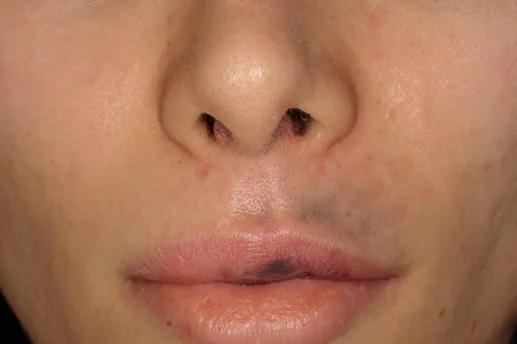 Fig 12. The face of a lip occlusion, not a bruise: a dusky reticulated violaceous patch in the SLA territory hours after injection is the trigger to flood with hyaluronidase, not to wait and watch — (Jones, Injectable Fillers, vascular occlusion after HA to the lips, p.174).
> Sources: Jones 2019, vascular occlusion 1.5 days after HA filler to lips [8].
Fig 12. The face of a lip occlusion, not a bruise: a dusky reticulated violaceous patch in the SLA territory hours after injection is the trigger to flood with hyaluronidase, not to wait and watch — (Jones, Injectable Fillers, vascular occlusion after HA to the lips, p.174).
> Sources: Jones 2019, vascular occlusion 1.5 days after HA filler to lips [8].
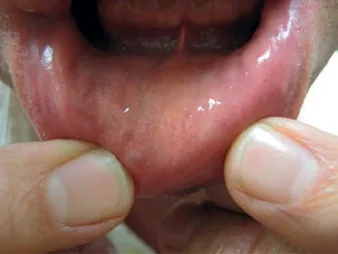 Fig 13. A palpable lip nodule on eversion: most HA nodules resolve with hyaluronidase, which is why every lip complication work-up starts by imaging and dissolving before considering a granulomatous or biofilm cause — (Jones/Beleznay, lip nodule after HA filler, p.208).
> Sources: Jones 2019, lip nodule from HA filler [8].
Fig 13. A palpable lip nodule on eversion: most HA nodules resolve with hyaluronidase, which is why every lip complication work-up starts by imaging and dissolving before considering a granulomatous or biofilm cause — (Jones/Beleznay, lip nodule after HA filler, p.208).
> Sources: Jones 2019, lip nodule from HA filler [8].
Migration is the lip's signature deformity, and 2025 imaging reframed it as depth. High-frequency ultrasound of 126 lips shows the subcutaneous layer averages < 1 mm, so most HA lands intramuscular, and a vertical/deep technique is associated with deeper deposition, hypervascularity and measurable migration into a supravermilion shelf [41][42]. The lesson is preventive: stay superficial and paramedian, use small aliquots, respect the border, and image before re-treating; established migration is dissolved and rebuilt, not layered over [41][8]. Overfilling and the vertical school raise the migration risk, which is the anatomical grounding for the "less-is-more" posture in D10.6.
Tyndall and permanent-filler nodules. A superficial HA deposit in the thin lip dermis scatters light to a bluish nodule (Tyndall); the fix is hyaluronidase and deeper placement next time [34]. Permanent and semipermanent fillers in the lip (silicone/PAAG/PMMA) produce migration, chronic granulomatous nodules and siliconomas that are not reversible with hyaluronidase, which is why they are not used in the lip in the first place [31][14].
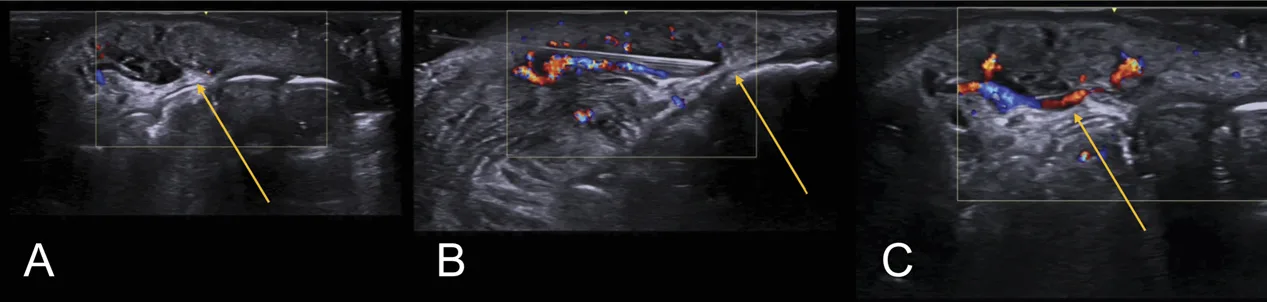 Fig 14. Why ultrasound is changing occlusion management: the deposit is localized (A), the enzyme is delivered into the exact vessel (B), and reperfusion is confirmed in real time (C), needing far less hyaluronidase than blind flooding — (Fabi, Prevention and Management of Dermal Filler Complications, p.3).
> Sources: Fabi 2025, ultrasound-guided treatment of lower-lip vascular occlusion [33].
Fig 14. Why ultrasound is changing occlusion management: the deposit is localized (A), the enzyme is delivered into the exact vessel (B), and reperfusion is confirmed in real time (C), needing far less hyaluronidase than blind flooding — (Fabi, Prevention and Management of Dermal Filler Complications, p.3).
> Sources: Fabi 2025, ultrasound-guided treatment of lower-lip vascular occlusion [33].
Herpes is foreseeable and preventable. Up to 30% of adults carry latent oral HSV-1, and injection trauma reactivates it; several series show aciclovir/valaciclovir prophylaxis reduces reactivation after procedures (best evidenced for resurfacing), so a patient with a cold-sore history is pre-treated and a visible lesion defers treatment [35][14]. A post-injection painful grouped-vesicle eruption is HSV until proven otherwise; do not mistake it for an inflammatory nodule [35].
Aspiration does not de-risk the lip (the controversy, kept whole).
**Consensus:** technique is the safety layer: constant needle movement, low extrusion pressure,
  micro-aliquots, cannula in high-risk zones, superficial paramedian plane, anatomical knowledge
  [31][33][40]
**Discrepancy:**
  A (aspiration is a recommended pre-injection safety step, especially in facial danger zones): a
     positive aspirate warns of intravascular placement and is worth the second [some authors]
  B (aspiration is unreliable and must not be relied on): true-positive in only ~33% within 1 s,
     with 128/340 false negatives after 10 s; result depends on needle bore, length and gel
     rheology (G′, cohesivity); a negative gives false security [38][40]; blood-aspiration test
     reliable in only ~53% of syringe/needle combinations [39]
  decide by: do not substitute a plunger pull for technique. A negative aspirate NEVER licenses a
  bolus; the moving-needle, low-pressure, micro-aliquot method stands whether or not you aspirate.
Swelling, quantified, so it is not mistaken for a complication. Common injection-site reactions (erythema, oedema, pain, bruising) typically resolve within one to two weeks; significant lip swelling settles within 1-2 days, but subtle swelling can persist for up to 10-14 days, so no adjustment is made and no symmetry judgment is passed until it resolves [8][31]. A boggy, disproportionate or delayed swelling, by contrast, prompts a work-up (malposition, hydrophilic over-fill, inflammatory nodule, angioedema), not reassurance [8][31].
Bruising, haematoma and swelling. The lip is particularly prone to hematoma and injury; significant swelling settles by 1-2 days but subtle swelling can persist 10-14 days, so no adjustment is made until it resolves [8]. Screen for anticoagulants, antiplatelets and vitamin E; a cannula and low pressure reduce bruising [9].
Hyaluronidase, the practical pharmacology. Sources of hyaluronidase (recombinant Hylenex, ovine Vitrase) are interchangeable at manufacturer concentrations, and degradation is dose-dependent; the enzyme dissolves even tissue-integrated filler whether given at four days or four weeks, and more is needed for a highly cross-linked gel (Juvederm) than for Restylane [8]. Reported allergy is ~1 per 1000, with a theoretical bee/wasp venom cross-reactivity, so a skin test is advised before non-emergent use in that history but is skipped in a vascular emergency given the urgency [8]. Reconstitute with plain lidocaine without epinephrine to add local vasodilation and, per the roundtable, exploit the enzyme's nitric-oxide release to relieve vasospasm [33]. Topical nitroglycerin and systemic vasodilators are not unanimously recommended and are used case by case [33].
The needle-aspiration-butterfly (flash) technique for a known intra-arterial event. Where the occluded facial/labial artery can be entered directly, a corpus roundtable describes priming a butterfly, penetrating the dermis, applying negative tension until a flash confirms the lumen, and then injecting all the hyaluronidase into the vessel; 27-30 G needles are acceptable although the flash may not be seen, and the chin, nose, lips, marionette and nasolabial territories have been treated this way [33]. Ultrasound-guided intravascular delivery is the refinement (Fig 14), needing less enzyme and less time [33].
Delayed inflammatory nodules and biofilm (the late, confusing presentation). Beyond early bolus lumps, HA lips can develop delayed inflammatory or granulomatous nodules weeks to months later (Fig 13), sometimes triggered by an immune stimulus or a low-grade biofilm; the work-up images the deposit, dissolves HA, and considers antibiotics and/or intralesional steroid and a biofilm cause rather than reflexively steroiding a possible infection [8][31]. The differential of a tender lip swelling includes HSV (grouped vesicles, D10.10 above) and, with permanent products, a foreign-body granuloma, so the history of what was injected drives management [31][35].
Permanent-filler complications, if the lip already has them. Silicone, polyacrylamide (PAAG), polyalkylimide and PMMA in the lip produce migration, chronic granulomatous nodules, late siliconomas and, for PMMA, granulomas 1-10 years out, none reversible with hyaluronidase; the safe move is to not layer HA over them, image, and refer [31][14]. This is the mechanistic reason the whole grid in D10.7 excludes permanents from the lip.
Classic trap: treating an evolving occlusion as a bruise and "watching it overnight". The lip's dense anastomosis makes early dusky livedo and disproportionate pain an occlusion until proven otherwise; the correct move is to flood with hyaluronidase within the 72-hour window, hourly, not to reassure and wait, and never to reassure a lip complaint on the strength of a negative aspiration [31][32][40].
Coverage vs UPO
Three columns: what the UPO master teaches, its status in this chapter, and what the atlas adds. UPO material is valuable and ages fastest; a dose or product resting on a single UPO slide is never_sufficient_alone.
| UPO teaches (source) | Status here | What the atlas adds |
|---|---|---|
| Fillers are volumizing implants for lips/cheeks/chin; HA is the workhorse (Tejero [36]) | ✅ D10.7 | the rheology map (soft-low-G′ vs firm-high-G′), the current lip-specific brand map (Kysse/RHA/Versa), the "avoid CaHA/PLLA/PMMA in the lip" rule |
| Labial-artery anatomy: SLA external ~1.5 mm, luminal 0.85→0.55 mm; submucosal plane most frequent (Tejero [36]) | ✅ D10.3 | the quantified three-position split (78.1/17.5/2.1%), the "paramedian subcutaneous is safest" rule, the depth-over-location premise, the blindness-from-lip mechanism |
| Adverse effects of fillers: vascular, nodules, migration (Tejero [36]) | ✅ D10.10 | the quantified hyaluronidase protocol (200-1500 U, 500 U/5×5 cm, DeLorenzi 3 cc/half-lip), US-guided dosing, the 2025 migration-is-depth evidence |
| Lower-third toxin: mentalis, DAO, lip flip, doses and points (C3.4 map, UPO-derived) | ✅ D10.8 | the antagonist-spared column, the Yonsei-point gummy-smile map, the safety-margin ranking, the ona/abo/inco conversion caveat |
| Toxin for the gummy smile targeting hyperfunctional upper-lip levators (C3.3 map; Berry [30]) | ✅ D10.8 | the Yonsei point coordinates, the classify-first rule, the central-vs-lateral levator sparing, orthognathic/dental referral |
What UPO does NOT cover (atlas-only, and why it matters): - The 24-compartment intralabial anatomy (Cotofana 2023 [1]): explains why micro-aliquots preserve shape and a bolus balloons the lip. Post-dates the master material. - Structural/vertical ("Russian") vs classic/horizontal school, and the cannula-vs-needle controversy, both kept unaveraged [13][17][18]. New ground. - 2025 high-frequency ultrasound: subcutaneous lip layer < 1 mm, routine intramuscular placement, vertical-technique migration [41][42]. Post-dates the master material. - The "less-is-more"/dissolving shift and the dissolve-before-rebuild posture [46]. Post-dates the master material. - The non-injectable resurfacing ladder (fractional/ablative CO2, full-field Er:YAG parameters, croton-oil peel) and the surgical lip lift for the long lip [16][20][24]. New ground. - The aspiration controversy with its sensitivity data (33%/53%) and the technique-not-plunger conclusion [38][39][40]. New ground. - HSV prophylaxis framed as a foreseeable, preventable perioral complication [35]. New ground.
The one place the atlas nuances UPO. UPO teaches that the labial artery is "most frequently submucosal" and infers a safer plane [36]; the atlas keeps that but sharpens it with the quantified 78.1% submucosal / 17.5% intramuscular / 2.1% subcutaneous split and the finding that the midline is the most variable location, so the safe deposit is specifically subcutaneous and paramedian, and depth at the midline is the danger, not merely "avoid the artery" [2].
Self-assessment
Ten active-recall questions built only from facts already in this chapter. Answers fold open.
- Why is "deep, on bone, safe" wrong in the body of the lip?
answer
The free lip has no periosteum, and the labial artery is submucosal (deep) in 78.1% of lips; the safe deposit is superficial and paramedian, so depth here is danger (D10.2, D10.3) [2]. - How many intralabial compartments are there, and what is the injection lesson?
answer
24 (6 anterior + 6 posterior per lip); anterior 0.30-0.39 cc, posterior 0.44-0.52 cc; inject compartment-respecting micro-aliquots to preserve shape rather than one bolus (D10.2) [1]. - Give the three positions of the labial artery relative to orbicularis oris and their frequencies.
answer
Submucosal 78.1%, intramuscular 17.5%, subcutaneous 2.1%; the midline is the most variable, so paramedian subcutaneous is safest (D10.3) [2]. - Why is the oral commissure a specific danger zone?
answer
The labial trunks enter the lip ~1 cm from the commissure at ≥ 4-5 mm depth; a bolus or traumatic pass there causes haematoma or intra-arterial filler and necrosis (D10.3) [12]. - In what order does the perioral region age?
answer
Bone/pyriform resorption first, then deep support/ligament and deep fat, then superficial fat, then skin/vermilion (thinning, inversion, barcode rhytids, commissure downturn) (D10.4) [8][20]. - What single measurement makes a patient a lift/resurfacing case rather than a filler case?
answer
A cutaneous upper lip > ~20 mm with a heavy, inverted red: filler lengthens it further; the answer is a lip lift ± resurfacing (D10.4, D10.6) [20]. - State the lip-flip dose, plane and the function it must spare.
answer
2-4 U total (1-2 U/quadrant) into the superficial central orbicularis oris; spare the deep sphincter to preserve oral competence; effect 6-8 weeks (D10.8) [29]. - Locate the Yonsei point and give the gummy-smile dose.
answer
Intersection of a line 1-1.5 cm lateral to the ala nasi and one ~3 cm up from the commissure; 1-2 U/side into LLSAN/LLS/zyg minor; start low, review at 2 weeks (D10.8) [28]. - What does aspiration actually achieve before a lip injection?
answer
Little: true-positive in only ~33% within 1 s with frequent false negatives; a negative never licenses a bolus; technique (movement, low pressure, micro-aliquots) is the safety layer (D10.10) [38][40]. - A dusky violaceous upper lip with disproportionate pain 2 h after HA: what is it and what is the first move?
answer
Labial-artery occlusion; flood with hyaluronidase (≥ 200-500 U, hourly, DeLorenzi ~3 cc/half-lip) within the 72-hour window until capillary refill returns, not watch-and-wait (D10.10) [31][32].
What's new and trends
What changed in roughly the last two to five years:
| Year | Change | Maturity | Consequence |
|---|---|---|---|
| 2020 | Restylane Kysse FDA-approved for lips + upper perioral rhytids (XpresHAn/OBT, flexible, ~170% swelling); Revanesse Lips+ for lips [37] | clinically actionable now | first lip-on-label HA designed for movement; the current lip-specific brand map |
| 2023 | 24-compartment intralabial anatomy described (Cotofana) [1] | clinically actionable now | grounds compartment-respecting micro-aliquot injection over the single bolus |
| 2024-2025 | "Less-is-more" / natural lip and the dissolving wave; overfilled and single-session overfilling out of favour [46] | cultural + clinical shift | conservative, staged, one-syringe-or-less; dissolve-and-rebuild the distorted lip |
| 2025 | High-frequency ultrasound of 126 lips: subcutaneous layer < 1 mm, routine intramuscular placement, vertical-technique migration and hypervascularity [41][42] | clinically actionable now | anatomical rationale for superficial, small-aliquot technique and for imaging before re-treatment |
| 2025 | Ultrasound-guided hyaluronidase for occlusion: less enzyme, less time; NO-mediated vasospasm relief [33] | clinically actionable now | US moves from optional to advantageous in the complication pathway |
| 2020-2026 | Aspiration debate consolidates toward "do not rely on it" (33%/53% reliability) [38][39][40] | consensus-shifting | technique, not the plunger, is the safety layer |
| ongoing | RHA-3-vs-Restylane-L and other lip-specific comparative trials [37] | promising but not validated | on-label lip evidence is catching up to off-label practice |
| ongoing | Polynucleotide / regenerative claims for perioral skin quality beyond hydration [45] | preclinical/speculative | dermal action is plausible; a lip-specific benefit is not established |
| ongoing | Lip filler marketed as a permanent "lip lift in a syringe" or a one-session transformation [46] | unsupported commercial claim | no filler shortens a long cutaneous lip or reverses inversion; that is surgery [20] |
What did NOT change, and why the older references are still state of the art. The anatomy that grounds every technique here is stable: the labial-artery three-position distribution (Cotofana 2017 [2]), the arterial ring and its facial-to-ophthalmic anastomoses (Jones [8], García García [12]), and the modiolus/muscle map (Cotofana [3]) are reinforced, not revised, by newer imaging. The reversal frame for an occlusion, DeLorenzi's high-dose pulsed hyaluronidase (2017), remains the reference protocol [32], now sharpened by ultrasound guidance rather than replaced. The golden-ratio proportion and the youthful-versus-aged parameter table (Jones [8], Tonnard [20]) still govern selection and target-setting. The resurfacing answer for barcode rhytids (CO2 gold standard for deep lines, Er:YAG for superficial and darker skin) is unchanged in principle [16][20][26]. The lower-third toxin doses and the Yonsei point are stable (Benedetto [28][29]). The lane that ages fastest is the UPO product-and-dose material; its anatomy and complication content is durable, its brand/dose content is not, which is exactly why a single UPO slide is never sufficient alone.
Unexplored directions (AI speculation)
> Disclaimer. The following are AI-generated research directions, not clinical recommendations. Each is tagged [IA-ESPEC], is not evidence, and must never be acted on clinically. Each states an anchor (a cited fact already in this chapter), a proposal, and what would settle it. None carries a dose, a product choice, or a protocol.
[IA-ESPEC]Compartment-guided injection may reduce migration. Anchor: the lip has 24 septate compartments [1], and vertical/deep technique measurably migrates filler on ultrasound [41]. Proposal: mapping and respecting compartment boundaries during injection may reduce supravermilion migration versus free threading. Expected effect: less measured migration and fewer "shelf" deformities in the compartment-guided arm. Confounder: injector experience and total volume vary and drive migration independently. What would settle it: an RCT comparing compartment-mapped versus conventional lip injection with ultrasound-measured migration at 3-6 months.[IA-ESPEC]Routine pre-injection Doppler may lower occlusion here. Anchor: ultrasound already locates the labial artery and the occluding deposit at the bedside [33][42]. Proposal: mandatory pre-injection Doppler mapping of the SLA/ILA could reduce intra-arterial events in this dense-anastomosis field. Expected effect: fewer occlusions in the guided arm. Confounder: operator experience and case mix differ between adopting and landmark practices. What would settle it: a prospective registry comparing ultrasound-guided with landmark-only lip injection for occlusion rate.[IA-ESPEC]An eversion-first, minimal-volume default may meet demand while sparing migration. Anchor: the subcutaneous lip layer is < 1 mm so deep filler migrates [41], while a low-dose lip flip everts the lip without volume [29]. Proposal: a lip-flip-plus-micro-volume strategy may satisfy the "natural" demand with less injected HA and less migration than a volumetric approach. Expected effect: comparable satisfaction with less migration and less product. Confounder: toxin duration is short and patient goals vary. What would settle it: a split-cohort trial of flip-plus-micro-volume versus volumetric filler with ultrasound migration and satisfaction endpoints.[IA-ESPEC]Real-time ultrasound needle-tip confirmation may replace aspiration. Anchor: aspiration is true-positive in only ~33% [38], while ultrasound resolves the vessel lumen and needle tip [33]. Proposal: bedside ultrasound confirmation of extravascular tip position may outperform the plunger pull for detecting intravascular placement. Expected effect: fewer intravascular deposits than with aspiration alone. Confounder: ultrasound skill and equipment access limit generalizability. What would settle it: a paired study of aspiration versus ultrasound tip-confirmation against a lumen gold standard.[IA-ESPEC]Compartment volumes may predict the individualized proportion target better than a fixed ratio. Anchor: the compartments are consistent across race and gender but larger centrally [1], while the ideal upper:lower ratio is ethnicity-dependent (1:1.6 to 1:1) [8]. Proposal: measuring a patient's baseline compartment volumes on ultrasound may predict their natural proportional target better than imposing a fixed 1:1.6. Expected effect: higher perceived-natural outcomes when the target is compartment-derived rather than ratio-imposed. Confounder: cultural preference and photographic bias affect "natural" scoring. What would settle it: a cohort correlating ultrasound compartment volumes with perceived natural proportion across ethnic groups.
Safety
The region's non-negotiable safety rules, consolidated. The lip and perioral field is a high-risk, largely off-label injectable zone: a dense labial-artery ring, a subcutaneous plane under 1 mm, and anastomoses that reach the ophthalmic circulation [2][8][41]. Every treatment obeys the same discipline.
Vascular occlusion and vision loss (the catastrophe). Prevent with low injection pressure, aliquots ≤ 0.01-0.02 mL to 0.5 mL threads, retrograde moving needle/cannula, a subcutaneous paramedian plane, and avoidance of the commissure and midline submucosal plane; keep HA-only and hyaluronidase in the room [2][12][31]. Recognition is clinical (blanching, disproportionate pain, dusky livedo, delayed refill); treat within the 72-hour window by flooding with hyaluronidase (≥ 200-500 U, hourly until refill returns; DeLorenzi ~3 cc of 150 iu/cc per half upper lip) and escalate any visual symptom to retrobulbar hyaluronidase and ophthalmology at once, per J2 — Vascular Occlusion & Emergency Response and J3 — Hyaluronidase - Pharmacology & Clinical Protocols [31][32][33].
Depth and the commissure (the local rules). Inject < 3 mm from the skin at the vermilion body; the labial trunks run deep (≥ 4 mm) and enter ~1 cm from the commissure, so never bolus the commissure and never drive product deep at the midline where the artery is submucosal in 78% of lips [2][12]. Prefer a cannula for deep body/commissure work, a needle for the superficial border, and remember a cannula still traumatizes when advanced [17].
Product safety. Use reversible HA; do not use CaHA, PLLA, PCL, PMMA or any permanent/semipermanent filler in the lip body (migration, non-reversible granuloma, siliconoma) [14][31]. Match rheology to goal (soft-low-G′ for volume, firm-high-G′ for border) and keep the total conservative and staged [19].
Toxin safety. All perioral toxin is off-label and low-dose. Spare the deep orbicularis (oral competence) on a lip flip, spare the depressor labii inferioris on a DAO point (asymmetric smile lasts 8-12 weeks), and spare the lateral levators on a central gummy smile (flat/asymmetric smile) [28][29]. The gummy smile has the narrowest therapeutic margin on the face: start at the lowest dose, use concentrated low volume, and review at two weeks; overdose leaves a long immobile upper lip for weeks [28]. Warn wind instrumentalists and voice professionals before any lip flip [29].
Infection and herpes. Up to 30% of adults carry latent HSV-1; injection trauma reactivates it. Prophylax the cold-sore-history patient (aciclovir/valaciclovir) and defer a visible lesion; before resurfacing, antiviral cover is mandatory [35][20]. Treat a post-procedure grouped-vesicle eruption as HSV, not as an inflammatory nodule [35].
Migration and the "less-is-more" safety posture. Because the subcutaneous layer is < 1 mm and most HA lands intramuscular, overfilling and vertical/deep technique migrate the product over the border; stay superficial and paramedian, use small aliquots, respect proportion, and image before re-treating a lip that has had prior filler [41][42]. Dissolve and rebuild a migrated/over-stacked lip rather than layering [8][41].
Aspiration and consent. A negative aspiration does not make the injection safe (true-positive ~33%); rely on technique, not the plunger [38][40]. Consent must state: swelling/bruising common for 10-14 days; symmetry judged at review; migration possible and may need dissolving; a cold-sore outbreak possible; and vascular occlusion, though rare, can cause necrosis and, exceptionally, vision loss [8][14][35][31].
References
- Cotofana S, et al. Intralabial Lip Compartments and Their Potential Clinical Relevance. Plast Reconstr Surg. 2023.
[MEDLIB][B]DOI 10.1097/PRS.0000000000010820 - Cotofana S, et al. Distribution Pattern of the Superior and Inferior Labial Arteries: Impact for Safe Upper and Lower Lip Augmentation. Plast Reconstr Surg. 2017;139(5):1075-1082.
[MEDLIB][B]DOI 10.1097/PRS.0000000000003244 - Cotofana S, et al. Arteries of the Face and Their Relevance for Minimally Invasive Facial Procedures: An Anatomical Review. Plast Reconstr Surg. 2019.
[MEDLIB][B]DOI 10.1097/PRS.0000000000005201 - Cotofana S, Lachman N. Anatomy of the Facial Fat Compartments and their Relevance in Aesthetic Surgery. J Dtsch Dermatol Ges. 2019.
[MEDLIB][B]DOI 10.1111/ddg.13737 - Schenck TL, et al. Functional Anatomy of the Facial Superficial Fat Compartments. Plast Reconstr Surg. 2018.
[MEDLIB][B]DOI 10.1097/PRS.0000000000004364 - Cotofana S, et al. Anatomy of the Aging Face: A Review. Facial Plast Surg. 2016.
[MEDLIB][B]DOI 10.1055/s-0036-1582234 - Kruglikov I, Trujillo O, Cotofana S, et al. The Facial Adipose Tissue: A Revision. Facial Plast Surg. 2016.
[MEDLIB][B]DOI 10.1055/s-0036-1596046 - Swift A, Humphrey S, Beleznay K, et al. The Lips; and Avoidance and Management of Complications. In: Jones D, Swift A, eds. Injectable Fillers: Principles and Practice. 2nd ed. Wiley; 2019. ISBN 9781119046967.
[MEDLIB][C] - Pirayesh A, Cartier H, Achauer A, et al. Aesthetic Facial Anatomy Essentials for Injections. CRC Press; 2020.
[MEDLIB][C] - Draelos ZD, ed. Cosmetic Dermatology: Products and Procedures. Wiley-Blackwell; 2009.
[MEDLIB][C] - Cavalcante Flavio S, ed. Dermal Fillers for Facial Harmony. Quintessence; 2019.
[MEDLIB][C] - García García J. Zonas Peligrosas en Medicina y Cirugía Estética Facial. SEME (Sociedad Española de Medicina Estética).
[MEDLIB][C] - Lips: 45 Injection Techniques for Esthetic Lip Treatment. KVM/Quintessence; ISBN 9781786981097.
[MEDLIB][C] - Sadick NS, Lawrence N, Moy R, eds. Concise Manual of Cosmetic Dermatologic Surgery. McGraw-Hill; 2008. ISBN 9780071593281.
[MEDLIB][C] - Garg S. Dermal Fillers for Dental Professionals. Quintessence; 2021. ISBN 9780867158304.
[MEDLIB][C] - Connell BF, et al. Aesthetic Rejuvenation of the Face and Neck. Thieme; 2016. ISBN 9781626230897.
[MEDLIB][C] - Sattler G, Sommer B. Illustrated Guide to Injectable Fillers (Quintessenz). Quintessence.
[MEDLIB][C] - Parker E. Fundamentals for Cosmetic Practice. CRC Press; 2022. ISBN 9781032057163.
[MEDLIB][C] - Kontis TC, Lacombe V, eds. Cosmetic Injection Techniques. 2nd ed. Thieme; 2019. ISBN 9781626234574.
[MEDLIB][C] - Tonnard PL, Verpaele AM, Jewell ML. Centrofacial Rejuvenation. Thieme; 2018. ISBN 9781626238848.
[MEDLIB][C] - Jacono A. The Park Avenue Face. Post Hill Press; 2019. ISBN 9781948836234.
[MEDLIB][C] - Liu K, ed. Atlas of Lip and Nose Plastic and Cosmetic Surgery. Springer; 2021. ISBN 9789811619106.
[MEDLIB][C] - Truswell WH. Lasers and Light, Peels and Abrasions: Skin Resurfacing. Thieme; 2016.
[MEDLIB][C] - Few JW, ed. The Art of Combining Surgical and Nonsurgical Techniques in Aesthetic Medicine. Thieme; 2018. ISBN 9781626237698.
[MEDLIB][C] - Tannous Z, Avram MM, Avram MR, et al. Color Atlas of Cosmetic Dermatology. 2nd ed. McGraw-Hill; 2011. ISBN 9780071639750.
[MEDLIB][C] - Wang K, Saedi N. Surgical Lasers: Ablative and Fractional Devices. In: Cosmetic Medicine & Surgery. CRC Press; 2016.
[MEDLIB][C] - Alcolea JM. Láseres ablativos fraccionales en patología dermoestética. Med Estética. 2024.
[MEDLIB][B](journal internal id MEDICINAESTETICA.080.07; no Crossref DOI, unverifiable) - Benedetto AV. Botulinum Toxins in Clinical Aesthetic Practice. 3rd ed, Vol 2. CRC Press; 2018. ISBN 9781498716314.
[MEDLIB][C] - Benedetto AV. Botulinum Toxins in Clinical Aesthetic Practice. 2nd ed. Informa Healthcare; 2011. ISBN 9781841845098.
[MEDLIB][C] - Berry M. Botulinum Toxin in Clinical Practice. Springer; 2021. ISBN 9783030806705.
[MEDLIB][C] - van Loghem J, ed. Soft Tissue Filler Complications: Prevention and Management. CRC Press; 2023. ISBN 9781032440460.
[MEDLIB][C] - DeLorenzi C. New High Dose Pulsed Hyaluronidase Protocol for Hyaluronic Acid Filler Vascular Adverse Events. Aesthet Surg J. 2017;37(7):814-825.
[MEDLIB][B]DOI 10.1093/asj/sjw251 - Fabi SG, Desyatnikova S, Dayan SH. Prevention and Management of Dermal Filler Complications: A Review. Facial Plast Surg Aesthet Med. 2025.
[MEDLIB][A]DOI 10.1089/fpsam.2024.0020 - Niamtu J. Vermilion Dollar Lips. 2007. ISBN 9780979719608.
[MEDLIB][C] - Sadick NS, ed. Augmentation Fillers. Cambridge University Press; 2008. ISBN 9780521881128.
[MEDLIB][C] - Tejero P. Efectos Adversos de los Materiales de Relleno Inyectables. UPO Sorted, Máster de Medicina Estética. 2024.
[MEDLIB][D](never_sufficient_alone) - Galderma. FDA approval of Restylane Kysse (XpresHAn) for lips and upper perioral rhytids; product map (RHA collection, Revanesse Lips+/Versa). 2020.
[A]galderma.com news (regulatory/manufacturer source, no DOI) - Van Loghem JAJ, Fouché JJ, Thuis J. Sensitivity of aspiration as a safety test before injection of soft tissue fillers. J Cosmet Dermatol. 2018;17(1):39-46.
[B]DOI 10.1111/jocd.12437 - Casabona G. Blood Aspiration Test for Cosmetic Fillers to Prevent Accidental Intravascular Injection in the Face. Dermatol Surg. 2015;41(7):841-847.
[B]PMID 26079591 - Goodman GJ, Magnusson MR, Callan P, et al. (van Loghem J, ed.). Neither Positive Nor Negative Aspiration Before Filler Injection Should Be Relied Upon as a Safety Maneuver. Aesthet Surg J. 2021;41(3):NP134-NP136.
[B]DOI 10.1093/asj/sjaa215 - Ultrasound Evaluation of Lip Anatomy and Filler Placement: A Cross-Sectional Study of Injection Accuracy, Migration, and Demographic Variation. 2025.
[B]PMID 41494527 - Wu WTL, et al. Lip Sonoanatomy and Relevance to Aesthetic Filler Injections: A Pictorial Review. J Cosmet Dermatol. 2025.
[B]DOI 10.1111/jocd.70164 - Treatment of periorbital and perioral wrinkles with fractional Er:YAG laser: effects of age, smoking, and Glogau stage. J Cosmet Dermatol. 2021;20(9):2800-2804.
[B]DOI 10.1111/jocd.13984 - Carruthers J, Carruthers A. Botulinum Toxin (Procedures in Cosmetic Dermatology Series). 4th ed. Elsevier.
[MEDLIB][C] - Fabbrocini G, et al, eds. Nonsurgical Lip and Eye Rejuvenation Techniques. Springer; 2016. ISBN 9783319232690.
[MEDLIB][C] - Lip filler trends 2025: the shift to natural lips and the dissolving wave (clinical-observation / practice reports). 2025.
[D](commercial/observational,never_sufficient_alone)
Verification: Retrieval = MEDLIB RAG (medrag retrieval_program, 10 sub-runs evaluation/runs/D10.1-D10.10.jsonl, VERDICT usable) scoped narrow+Anatomy per facet, plus external lane (WebSearch) for the corpus-gap facets (current lip-optimised products, the 2024-2025 natural/dissolving shift, 2025 lip ultrasound, aspiration sensitivity). Every DOI verified via the RM refverify seam at close (Crossref existence + Retraction-Watch); DOI-less items ([9][10][11][12][17][23][26][27][36][37][44][46]) tagged as monographs/regulatory/observational, never_sufficient_alone where applicable. Subchapters: kept at 10 as the template mandates; no subchapter added (the theme divides cleanly into the fixed blocks). Region boundary: the chin/mentalis toxin appears only as a lip-competence caveat and is cross-linked to D11 — Chin & Mentolabial, not duplicated; nasolabial to D9 — Nasolabial Fold. Salvage: C3.3/C3.4 (perioral/gummy toxin) integrated into D10.8 (doses preserved: lip flip 2-4 U, DAO 2-5 U/side, mentalis 4-8 U, gummy 1-2 U/side, 8-12 wk asymmetry, 6-8 wk flip); D5.1-D5.5 belong to the tear-trough region (D5) and are out-of-region for the lip, justified in the salvage receipt. Figures: 14 opened with Read before captioning; figure_pick receipt on disk. Material gaps declared: polynucleotides for the lip specifically (thin corpus); Alcolea journal DOI not Crossref-registered.