E2 · Body Fillers, Biostimulators & Skin Quality
> Currency and provenance — 42 references · median 2018, range 2009-2026, 26 % from 2022 on · provenance: verified external 36 % (15) · MEDLIB corpus 64 % (27, of which 7 from the UPO master's) · 7 flagged [D] never_sufficient_alone.
Domain: E — Body Contouring & Aesthetics · Substance family: resorbable collagen biostimulators (PLLA, CaHA, PCL), high-G′ body HA, and skin-quality injectables (bioremodeling HA, skin boosters, polynucleotides) applied off the face: buttocks, hands, neck, décolletage (links D14 — Escote (Décolletage).en), arms, abdomen, knees, thighs.
Subchapters
- [x] E2.1 — In 30 seconds
- [x] E2.2 — Chemistry and manufacture
- [x] E2.3 — Measurable properties (G′, viscosity, particle, concentration)
- [x] E2.4 — Mechanism and chronology of effect
- [x] E2.5 — Brand map
- [x] E2.6 — Indication by region and plane
- [x] E2.7 — Dose and volume
- [x] E2.8 — Reversibility and managing the excess
- [x] E2.9 — Adverse effects proper to the substance
- [x] E2.10 — Alternatives
- [x] E2.11 — Body skin-quality agents (added; see Verification)
> Tags: [A] IFU/approval with jurisdiction+year · [B] primary literature with verified DOI/PMID · [C] monograph/textbook · [D] slide or expert opinion · [MEDLIB] own corpus · [MODELO] structure, never a figure · [IA-ESPEC] AI speculation, never actionable · ⚠ disputed number or safety red line · (P) model reasoning (never carries a dose).
E2.1 · In 30 seconds
What it is, where it goes, how much, how long, the red line. E2 covers the resorbable body substances: CaHA (Radiesse, 30% microspheres 25–45 µm) [2], PLLA (Sculptra 367.5 mg/vial; Lanluma for body) [3], PCL (Ellansé, 1–4 yr by chain length) [9], and the skin-quality HAs (Profhilo, boosters, polynucleotides) [18]. They go off the face (buttock, hand, neck, décolletage, arms, abdomen, knees) in the subcutaneous or diffuse subdermal plane, never intramuscular in the buttock [3]. Durations run 12–18 months (CaHA) to ~2 years (PLLA) to 1–4 years (PCL) [8][9][23]. The red line that governs the whole chapter: subcutaneous only in the buttock, nothing permanent in the body, and laxity is surgery not injection [3][22][24].
The four body-biostimulator/filler substances, one line each:
| Substance | What it is | Immediate effect | Result window | Duration | Reversible? |
|---|---|---|---|---|---|
| PLLA (Sculptra 367.5 mg/vial; Lanluma body) | poly-L-lactic acid microspheres 40–63 µm + CMC + mannitol, lyophilised [3][11] | None (carrier is water) | 4–6 wk, builds over sessions | ~2 yr [23] | ❌ no antidote |
| CaHA (Radiesse) | 30% CaHA microspheres 25–45 µm + 70% CMC gel [2][7][10] | Yes, gel volume | immediate + 4–6 wk neocollagenesis | 12–18 mo [8] | ❌ (no dissolver; hyaluronidase only as diffusion factor) [27] |
| PCL (Ellansé S/M/L/E) | polycaprolactone microspheres + CMC gel [9] | Yes, gel volume | immediate + weeks | 1 / 2 / 3 / 4 yr by chain length [9] | ❌ no antidote |
| Skin-quality HA (Profhilo, skin boosters, PN) | bioremodeling H-HA+L-HA / non-crosslinked HA / polynucleotides [18][19][20] | hydration | ~4 wk collagen/elastin | months, needs maintenance | HA-based partly by hyaluronidase |
Doses that matter (body): - PLLA gluteal: reconstitute > 7 mL/vial, ≥ 24 h before use, bacteriostatic water; usually 1 session + touch-up [6][23]. Novel high-dose body PLLA (GANA X 630 mg) used for upper-gluteus recontouring [26]. - CaHA dilution ladder: 1:1 = volumize + biostimulate (hands); 1:2 / 1:4 / 1:6 = neck / décolletage / arms for texture, no volume [2][12]. Ladder by skin thickness: 1:2 normal, 1:4 thin, 1:6 atrophic [12]. - CaHA hand: ~1.3 mL per hand, subcutis, 3D fanning, ~0.05 mL/pass, then massage [15]; FDA lidocaine mix 3 mL syringe ↔ 0.3 mL 2% lidocaine [10].
Red lines (repeat these at every body consult): 1. ⚠ Gluteal augmentation carries the highest mortality in aesthetics (fat/product to the intramuscular plane → gluteal-vein embolism). Subcutaneous only, cannula tip palpable, never intramuscular [3]. 2. ⚠ Laxity is not treated with injectables. You can thicken and improve skin quality; you cannot remove excess skin without removing skin. Redundant skin = surgery. 3. ⚠ Nothing permanent in the body. No PMMA, no polyacrylamide, no silicone, no "biopolymer". The body is where these produced the worst complication series [22]. Ask every patient what was injected before, where, and by whom. See J7 — Biopolymer & Permanent-Filler Complications.en. 4. ⚠ No filler into breast parenchyma. Interferes with palpation, mammography and cancer screening; produces nodules and biopsy-forcing findings. 5. ⚠ Biostimulators are not reversible. In thin-skin body sites (neck, arms, abdomen) that irreversibility outweighs the cost saving. If undecided between a reversible and an irreversible product in a delicate area, choose the reversible one.
Candidate at a glance:
| Good candidate | Wrong candidate (refer / decline) |
|---|---|
| Hip-dip, focal gluteal depression, dorsal-hand volume loss | Wants large gluteal projection cheaply (fat graft/implant) |
| Crepey neck/décolleté/arm skin, mild laxity | Redundant skin (surgery), rectus diastasis (surgery), breast ptosis (mastopexy) |
| Stable weight for months | Weight still falling (GLP-1/bariatric) |
| Accepts a delayed, staged, irreversible result | Wants same-day, reversible, one-session change in thin skin |
| Discloses prior injections | Unknown prior permanent/biopolymer (work up first) |
> ⚠ Currency flag: brand approvals, indications and labelling change by jurisdiction and year. Every regulatory claim here defers to the IFU of the product you hold, in your country, on the day of use. The flagship body-PLLA brand Lanluma (Sinclair) and the novel high-dose body PLLA products are [MATERIAL GAP] in the corpus and are sourced externally [26].
E2.2 · Chemistry and manufacture: structure, origin, cross-linking/polymerisation, sterilisation
The substance grid (what each one actually is):
| Property | PLLA (Sculptra) | CaHA (Radiesse) | PCL (Ellansé) | Bioremodeling HA (Profhilo) |
|---|---|---|---|---|
| Active | poly-L-lactic acid microspheres [3] | Ca₁₀(PO₄)₆(OH)₂ microspheres [7] | polycaprolactone microspheres [9] | H-HA + L-HA hybrid [18][19] |
| Particle size | 40–63 µm [3] (2–50 µm reported for New-Fill lot [4]) | 25–45 µm [2][10] | microspheres (size not specified in corpus) | n/a (soluble) |
| Concentration/load | 367.5 mg/vial, fixed [23] | 30% microspheres / 70% gel [2][10] | microspheres in CMC gel [9] | H-HA 1100–1400 kDa + L-HA 80–100 kDa [19] |
| Carrier | sodium CMC + mannitol, lyophilised → reconstitute [3] | aqueous gel: 1.3% Na-CMC, 6.4% glycerin, 36.6% sterile water [3] | aqueous CMC gel [9] | thermally stabilised, NO carrier gel |
| Origin | synthetic (α-hydroxy/lactic-acid family) [4] | synthetic bioceramic, identical to bone/tooth mineral [2] | synthetic bioresorbable polymer [9] | biofermented HA (Streptococcus) [42] |
| "Cross-link" / stabilisation | none (polymer as-supplied) | none (particle suspension) | none (polymer chain length tuned) | NAHYCO thermal hybrid, NO BDDE cross-linker [19] |
| Degradation | hydrolysis → CO₂ + water [3] | enzymatic → Ca²⁺ + phosphate ions [2][10] | ester-bond hydrolysis [9] | hyaluronidase / native turnover |
| Radiology | radiolucent | radiopaque (visible on X-ray/CT) [2][7] | white, opaque on injection | none |
PLLA (poly-L-lactic acid). Synthetic α-hydroxy-acid polymer, discovered 1954 in France [4]. Supplied lyophilised: microspheres of PLLA with sodium carboxymethylcellulose and non-pyrogenic mannitol, reconstituted with sterile (or bacteriostatic) water into a methylcellulose-carrier hydrogel [3]. Microspheres are metabolised by hydrolysis to CO₂ and water, driving a foreign-body reaction that activates dermal fibroblasts and type-I collagen ingrowth [3]. The product injected is not standardised: because reconstitution volume, hydration time and added lidocaine/epinephrine are operator-chosen, the package insert does not reflect current use [4]. This variability is the single biggest driver of the nodule literature (E2.8).
CaHA (calcium hydroxylapatite). A milky-white suspension of two components: an aqueous gel carrier (water, glycerin, sodium carboxymethylcellulose) and the matrix particle [2]. Smooth CaHA microspheres, chemical formula Ca₁₀(PO₄)₆(OH)₂, identical to the primary mineral of bone and teeth, so it is non-antigenic and needs no skin test [2][7]. Radiesse is 30% microspheres 25–45 µm / 70% carrier [2][7][10]. Once injected the gel is absorbed and the microspheres form a scaffold for fibroplasia; they are radiopaque (frosted-glass appearance on imaging) but do not stimulate ossification and cause no giant-cell response [2]. Radiesse+ / Radiesse(+) carries integrated 0.3% lidocaine (CE-marked in Europe 2016) and is the most viscoelastic of the injectable presentations [5][10]. Coaptite is a large-particle CaHA variant (originally for urology/laryngoplasty) [16].
PCL (polycaprolactone), Ellansé. CE-marked as a biodegradable collagen stimulator: PCL microspheres in an aqueous CMC gel [9]. Its defining feature is tuneable duration by polymer chain length: Ellansé-S / M / L / E give expected in-vivo longevity of 1 / 2 / 3 / 4 years respectively [9]. PCL biodegrades by hydrolysis of ester linkages, fully eliminated from the body [9]. Like CaHA it is white and opaque, useful for disguising underlying structures without a Tyndall effect, but is non-reversible [17].
Bioremodeling and skin-quality HA (see E2.11). Profhilo (IBSA) is a stabilised hybrid cooperative complex of high- (1100–1400 kDa) and low- (80–100 kDa) molecular-weight HA, produced by the NAHYCO thermal process without any chemical cross-linker (no BDDE) [18][19]. This is the chemical difference from a classic filler: no cross-linking, so no volumising scaffold, and the hybrid resists enzymatic degradation despite the absence of chemical modification [19]. NASHA revitalisers (non-animal stabilised HA) are minimally modified (< 1%) for isovolemic degradation (each molecule binds progressively more water, keeping the same size/shape) and stimulate type-I collagen with MMP inhibition [20][42]. Polynucleotides / PDRN (salmon/trout DNA) support fibroblast activity and renewal, ATP energy metabolism and act as physiological mediators (cAMP) and coenzyme precursors (NAD, FAD, CoA) [21].
Sterilisation and preparation rules that carry safety: - CaHA/PLLA/PCL are all supplied sterile in sealed syringes/vials; dilution or reconstitution is done immediately before use, in a sterile field, connecting a Luer-Lock diluent syringe through a female transfer adapter [5]. Consensus explicitly ties nodule risk to non-sterile or delayed mixing [5][12]. - Storage: CaHA at room temperature (15–32 °C); PLLA lyophilised at room temperature [10]. - CaHA is radiopaque: warn the patient it can appear on dental/radiographic imaging [2].
Consensus: all four families work by controlled resorbable-material fibroplasia (CaHA/PLLA/PCL) or receptor-mediated bioremodeling (HA), not by permanent bulk [2][3][9][18]. Discrepancy: none clinically relevant at the chemistry level; schools diverge on dilution, not on what the molecule is (see E2.7).
Manufacturing, step by step, and where quality is lost. The shared five-step biostimulator manufacturing primer is in A5 §manufacturing and the class-level material science in A4; the body-relevant additions: - CaHA microsphere geometry is the manufacturing datum that governs safety. Smooth, regular spheres of 25–45 µm are large enough to resist immediate phagocytosis (so they persist as a scaffold) yet small enough to pass a 25–27 G needle [2][7]. A wider or irregular size distribution raises both clumping and inflammatory risk; this is why lot-to-lot particle control, not the bulk formula, is the quality-critical step [2]. - The carrier-to-particle ratio is fixed at manufacture (30:70) but the effective ratio is set in the room by dilution (E2.7). Manufacturing sets the ceiling; reconstitution sets the delivered product. The single largest source of variance in PLLA outcomes is therefore not the vial but the operator's water volume and hydration time [4]. - PLLA is lyophilised because the polymer is unstable in suspension; it must be reconstituted and, by most modern protocols, hydrated well ahead of use (overnight to ≥ 24 h) so the microspheres are fully wetted and do not aggregate on injection [4][6]. A short hydration time is a manufacturing-adjacent error that surfaces clinically as a nodule. - NASHA and bioremodeling HA are biofermented (Streptococcus fermentation replaced rooster-comb extraction), then either minimally stabilised (< 1% modification, NASHA) or thermally hybridised without any chemical cross-linker (NAHYCO, Profhilo) [19][42]. The absence of BDDE in Profhilo is a deliberate manufacturing choice: no cross-linker means no volumising scaffold and a cleaner degradation profile, at the cost of no volume [19]. - Sterilisation and field discipline are covered in J5 — Infection, Biofilm & Sterilization.en; the substance-specific rule is that the dilution step is where sterility is most often broken (multiple syringe transfers), and consensus mandates a sterile mixing environment for exactly this reason [5][12].
Product-chemistry details that change a body decision: - Radiesse GRAS carrier: the CMC gel carries FDA "Generally Recognized As Safe" status; CaHA has been used in medicine (laryngoplasty, urology) for over 20 years, which is the basis of its no-skin-test claim [10][2]. - Radiesse presentations: 3 mL, 1.5 mL, 0.8 mL and 0.3 mL syringes; needles 27 G 1¼" or 28 G ¾"; cannulas > 27 G; storage 15–32 °C [10]. Correction ratio implant-to-tissue is 1:1 [16]. - Radiesse+ carries powdered lidocaine integrated into the product, making it the most viscoelastic of the injectable materials and removing the mixing step [MODELO][5]. - PLLA (New-Fill/Sculptra) technical form: lyophilised powder of PLLA microspheres + sodium carmellose + mannitol; deep dermal or deeper to avoid lumpiness, more superficial only if diluted; indicated historically for thick (male) skin and hand remodeling [4]. - PCL degradation chemistry: polycaprolactone is a bioresorbable polyester whose ester bonds hydrolyse; the chain length is engineered to set the hydrolysis rate, giving the 1/2/3/4-year Ellansé versions, and the breakdown products are fully eliminated [9]. This is the only product in the group where duration is a manufactured property, not a tissue-response variable. - HA chemistry for the body-quality agents: HA is a native glycosaminoglycan (lubricant, cell-migration and immune-surveillance roles) that is biofermented for injectables; it is degraded by free radicals/reactive oxygen and by hyaluronidases [42]. Stabilisation is what buys duration: NASHA cross-links < 1% for isovolemic degradation (each molecule binds progressively more water at constant size/shape) [42]; Profhilo's NAHYCO thermal hybrid stabilises without any BDDE, trading volume for a clean, cross-linker-free degradation and enzyme resistance [19]. - Polynucleotide/PDRN structure: fragments of purified DNA (salmon/trout origin) that act as nucleic-acid and coenzyme (NAD/FAD/CoA) precursors, cAMP mediators and fibroblast-renewal signals; they are not fillers and carry no volume, and the body-specific evidence is thinner than the facial/meso data (overlap with F2) [21].
Substance-origin summary (one line each): PLLA and PCL are synthetic bioresorbable polyesters; CaHA is a synthetic bioceramic identical to bone mineral; bioremodeling/booster HA and polynucleotides are biofermented/biological. All are resorbable; none is permanent, which is the entire point of the family and the reason the permanent blacklist (E2.5) is categorically excluded from the body.
> Trampa clásica: treating PLLA as a filler you can "top up" like HA. It is a lyophilised biostimulator whose delivered product is operator-reconstituted; under-hydration and inadequate dilution are baked-in nodule causes, not injection accidents [4][6].
E2.3 · Measurable properties, per-brand numbers: G′, viscosity, particle caliber, concentration
Why rheology decides the body use. On the body the choice is driven by two axes: lifting capacity (needs high G′ and viscosity, to move a large-volume defect) and spread for biostimulation (needs low concentration, achieved by dilution). CaHA sits at the stiff/high-lift end; diluted CaHA and bioremodeling HA sit at the spread end. The same molecule crosses the axis by dilution (E2.7), which is why one product covers both a hip-dip and a crepey neck.
| Product | G′ (elastic modulus) | Viscosity | Particle | Concentration | Lifting role |
|---|---|---|---|---|---|
| CaHA Radiesse | Highest of the group (measured > all HA families at 0.7 Hz) [16] | Highest vs HA [10][16] | 25–45 µm microspheres [2] | 30% solid / 70% gel [2] | large-volume body loss, deep support |
| CaHA Radiesse+lidocaine 0.3% | slightly below plain CaHA [16] | slightly below plain [16] | 25–45 µm | 30% + 0.3% lidocaine | same, more comfortable |
| HA body/volume (e.g. SubQ, Voluma-class) | high (below CaHA) [16] | high (below CaHA) [16] | soluble | product-specific | reversible body volume |
| PLLA (reconstituted) | fluid suspension, not a gel G′ | low after hydration [4] | 40–63 µm [3] | 367.5 mg diluted in 5–14+ mL [17][23] | no immediate lift; delayed collagen |
| Bioremodeling HA (Profhilo) | elevated rheology, cooperative complex [19] | flows, then stabilises | soluble | H-HA+L-HA hybrid [19] | none (skin quality) |
The per-brand facts the corpus resolves: - CaHA has higher viscosity and higher G′ (elasticity) than every HA family tested (Radiesse vs Restylane, Perlane, Restylane SubQ, Juvéderm Voluma/Ultra Plus/Ultra), measured at 0.7 Hz [10][16]. Viscosity and elasticity together determine a filler's capacity to provide volume and lift [10]; this is exactly why CaHA is chosen where a large body defect must be held up, and why its white radiopaque body disguises tendons/veins without a Tyndall risk [17]. - Particle caliber: CaHA microspheres 25–45 µm are large enough to resist immediate phagocytosis but small enough to inject through a 25–27 G needle [2]; larger (25–125 µm) figures appear in older lots [2]. PLLA microspheres 40–63 µm [3]. - Concentration is a lever, not a constant: CaHA is 30% solid as supplied, but dilution drops the effective microsphere concentration and converts the product from volumiser to biostimulator (E2.7) [2][12]. A 1:2 hyperdilution measurably increases microsphere dispersion and decreases concentration versus 1:1, improving fibroblast contact [5].
⚠ Do not read a rheology chart as a body dosing chart. G′ tells you lift capacity, not how much to inject or how deep. A high-G′ product placed too superficially in thin body skin is the classic nodule (E2.9).
Consensus: CaHA is the high-G′, high-viscosity workhorse for large-volume body support; dilution trades lift for spread and skin quality [10][12][16]. Discrepancy: none on the numbers; schools differ on the dilution ratio that best balances dispersion vs sedimentation (E2.7) [5][12].
Rheology terms, defined for the body decision: - G′ (elastic/storage modulus): the gel's resistance to deformation, its "hardness". High G′ resists compression and provides lift and projection; it is the property CaHA maxes out [16]. On the body, high G′ is what holds a large deep defect; in thin body skin it is what makes a superficial deposit palpable. - G″ (viscous/loss modulus) and tan δ = G″/G′: tan δ describes how fluid versus elastic the gel is; a low tan δ (elastic-dominant) spreads less and lifts more [16]. CaHA is elastic-dominant, so it stays where placed, which is desirable deep and dangerous superficial. - Complex viscosity: resistance to flow; CaHA's is the highest measured against the HA families, again at 0.7 Hz [16]. High viscosity means more extrusion force (hence 27 G needles) and less lateral migration. - Cohesivity: how strongly the gel holds together; a cohesive bolus resists dispersion (good for a defined deep depot, bad if you need diffuse spread), which is why body skin-quality use reduces effective cohesivity by dilution.
The measured per-brand chart (Sundaram-type rheology data the corpus carries): CaHA (Radiesse) shows the highest G′ and highest complex viscosity of the panel; the HA products cluster by generic family below it (Restylane, Perlane, Restylane SubQ, Juvéderm Voluma, Ultra Plus, Ultra), all measured at 0.7 Hz; adding 0.3% lidocaine lowers Radiesse's G′ and viscosity slightly [16]. Tan δ is computed as G″/G′ per product [16]. The clinical translation is a single rule: pick the highest-G′ product the plane can hide, then dilute to the goal.
Gauges and extrusion, per product (a measurable property that reaches the hand): - CaHA undiluted: 27 G 1¼" or 28 G ¾" needle, or > 27 G cannula [10]; hand CaHA often a 25–27 G 1.25" needle [15]. - Diluted/hyperdilute CaHA: 3–10 mL counter-syringe for mixing, larger for higher dilutions; injected through fine cannula for diffuse subdermal spread [5][12]. - PLLA reconstituted: injected through 25–26 G needle or cannula; fluidity is set by water volume (E2.7) [4].
Cohesivity and injectability, translated to the body decision. Cohesivity (how strongly the gel holds together) and viscosity together set extrusion force and lateral spread: a cohesive, viscous CaHA bolus stays as a defined depot (good for a deep gluteal defect, bad if diffuse spread is the goal), which is why body skin-quality use deliberately lowers effective cohesivity and viscosity by dilution [5][16]. The same property that makes CaHA excellent for large deep support (high G′, high viscosity, high cohesivity) makes it unforgiving superficially, where a cohesive depot cannot disperse and becomes palpable [7][16]. The bioremodeling HA sits at the opposite corner: high water-binding, flows and then stabilises, no cohesive depot and no volume [19].
A single rheology-to-plane rule for the body: the stiffer and more cohesive the product, the deeper and more diluted it must go on the body; the softer and more fluid, the more superficial and diffuse. CaHA undiluted belongs deep; CaHA 1:4–1:6 belongs diffuse subdermal; a booster/bioremodeling HA belongs intradermal. Mismatching the rheology to the plane is the mechanism of the thin-skin nodule (E2.9) [7][12][16].
Concentration as the third lever (recap with numbers): CaHA is 30% solid as supplied but the delivered microsphere concentration falls with dilution; a 1:2 mix disperses more and concentrates less than 1:1, improving fibroblast contact but raising sedimentation risk if over-diluted in saline [5][33]. PLLA's "concentration" is the fixed 367.5 mg spread over 5–40 mL depending on target, so the delivered density per mL falls as the reconstitution volume rises, which is exactly the nodule-reducing lever [4][23].
Consensus: CaHA is the high-G′, high-viscosity workhorse for large-volume body support; dilution trades lift for spread and skin quality [10][12][16]. Discrepancy: none on the numbers; schools differ on the dilution ratio that best balances dispersion vs sedimentation (E2.7) [5][12].
> Trampa clásica: copying a facial G′ preference to the body without accounting for skin thickness. The gluteal dermis tolerates high-G′ deep support; the dorsal-hand and neck dermis (1–2 mm cover) does not, and the same product must be diluted there.
E2.4 · Mechanism and chronology of effect: onset, peak, plateau, degradation, what accelerates it
The two clocks, side by side. CaHA and PCL run a dual clock (immediate carrier-gel volume, then neocollagenesis); PLLA runs a single delayed clock (no immediate effect). Knowing which clock a product runs is what you promise the patient on day one.
| Phase | PLLA | CaHA | PCL | Bioremodeling HA |
|---|---|---|---|---|
| Immediate (day 0) | none (water resorbs) [3] | gel-matrix volume, 1:1 lift [10] | gel volume | hydration only |
| Carrier resorption | days | macrophages clear gel in 3–4 mo [10] | weeks–months | n/a |
| Onset of collagen | subclinical inflammation → fibroplasia | fibroblasts around microspheres, type III at 4 mo [2][5] | fibroplasia around PCL | fibroblast/keratinocyte stimulation ~4 wk [18] |
| Clinical result | 4–6 wk, builds over 3–4 sessions | immediate, then reinforced 4–6 wk | immediate + weeks | ~4 wk, cumulative |
| Peak/plateau | months, ~2 yr durable [23] | type I replaces type III by 9 mo [2][5] | 1–4 yr by chain length [9] | months |
| Degradation | full metabolisation of microspheres ~9 mo, effect outlasts it [23] | scaffold degrades 12–18 mo [8][10] | ester hydrolysis over the rated years [9] | native HA turnover |
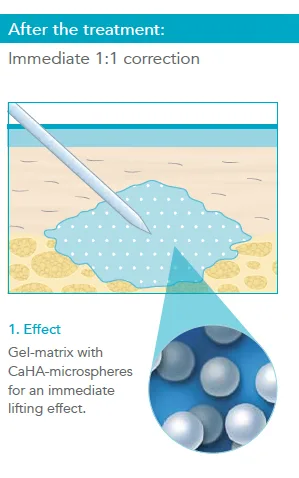 Fig 1. CaHA dual effect (immediate): needle depositing the gel-microsphere matrix in the subdermal plane for same-day 1:1 volume correction. — (Arenas, UPO, p.6)
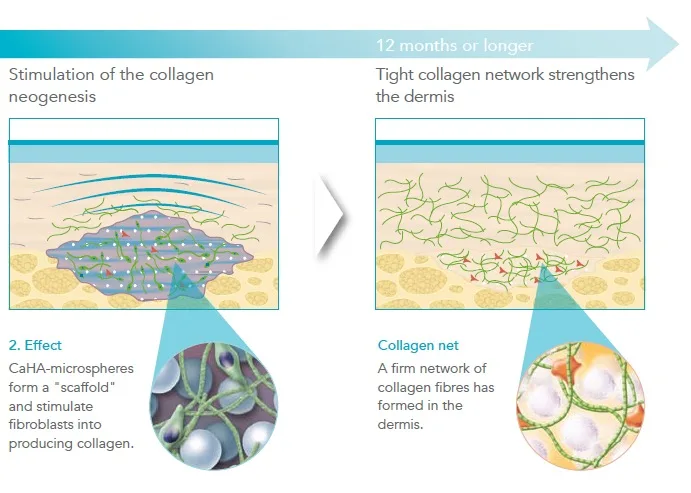 Fig 2. CaHA dual effect (delayed neocollagenesis): microsphere scaffold recruits fibroblasts; a tight collagen network strengthens the dermis over 12 months or longer. — (Arenas, UPO, p.7)
The biology, resolved by the corpus (Fig 1–2 document it panel by panel): - CaHA. Immediate correction from the elastic gel matrix (1:1 tissue-to-implant) [10]; macrophages disperse the carrier gel in 3–4 months while fibroblasts lay collagen around the microspheres [10]. Biopsy data: type III collagen significantly higher at 4 months, then replaced by type I by 9 months, with neoangiogenesis at 4 and 9 months [2][5]. Six-month biopsies show elastic fibers increased 30–80% and proteoglycans 12–77% [2]. This validates the observed skin-quality gain, not just the volume; Fig 2 shows the mature collagen network that this histology represents [2]. Diluted CaHA in neck/décolleté skin stimulates collagen and elastin with increased neovascularisation, raising dermal thickness and elasticity [5]. - PLLA. No immediate volume: a subclinical inflammatory response, encapsulation and fibroplasia produce gradual correction; the clinical effect appears at 4–6 weeks and builds over the treatment course, with results durable to roughly 2 years even after the microspheres are fully metabolised (~9 months) [3][23]. Treatment response wanes with age; optimal outcomes are seen under 60 years [4]. - PCL. Immediate gel volume, then sustained fibroplasia; the chain length sets the clock (1/2/3/4 yr for S/M/L/E) [9]. - Bioremodeling HA. L-HA binds receptors and stimulates fibroblast + keratinocyte proliferation (deep hydration, elastin, collagen I/III in fibroblasts and IV/VII in keratinocytes); H-HA provides a water-binding dermal scaffold; full effect ~4 weeks [18].
What accelerates or slows it: patient collagen metabolism (slow responders show early CaHA volume loss, the rationale for CaHA:CPM-HA hybrids, E2.5) [33]; age (< 60 for PLLA) [4]; combination with energy devices (microfocused ultrasound, RF, fractional laser), which is being studied for synergistic neocollagenesis [6]. Massage disperses PLLA/CaHA and is part of the mechanism, not aftercare (E2.6).
Combining a biostimulator with energy (timing the two stimuli). CaHA/PLLA and energy devices both recruit fibroblasts, so combining them targets the same collagen pool; the corpus describes microfocused ultrasound + CaHA and RF/fractional laser + biostimulator as combination protocols under study for additive neocollagenesis on neck/décolleté and body [6]. The practical sequencing rule is to avoid delivering both maximal insults to the same site on the same day (compounded inflammation and edema) and to space the device and the injectable so each fibroblast wave matures, rather than stacking them; the goal is additive stimulus, not additive trauma [6]. This matters on the body because the same thin-skin sites that need dilution (neck, arm) are also the sites where a device plus an under-diluted bolus compound into a nodule (E2.9).
Reading the "settling" window for the patient. Between day 0 and the mature result there is a predictable trough for CaHA/PCL (carrier gel resorbs, 3–4 months for CaHA) that a patient can misread as loss of effect; tell them the collagen rebuild follows, so a 2-month review showing less volume than day 0 is the expected mid-course, not a failure [10][33]. For PLLA the mirror problem is the flat early course: nothing on day 0, onset at 4–6 weeks, built over 3–4 sessions [3][23]. Both are consent conversations, not technique adjustments.
Durability across the family, ranked (the number that sets the follow-up interval): PCL is the longest and is chosen (Ellansé S/M/L/E = 1/2/3/4 years) [9]; PLLA lasts ~2 years with the collagen outlasting the ~9-month microsphere metabolisation [23]; CaHA scaffold degrades at 12–18 months, longer in static sites (up to ~18–24 mo) than mobile ones (~14–15 mo) [8][16]; body/skin-quality HA is the shortest (months) and needs maintenance [17][18]. The clinical use of the ranking: a patient who wants the fewest visits and accepts the longest commitment-to-an-error is a PCL/PLLA candidate; a first-time or delicate-site patient who wants retrievability accepts the shorter, reversible HA. On the body, where volumes and cost are large, the durability choice is also an economic one, but it is made on reversibility and site, not on price, because a cheap irreversible product in the wrong plane is the most expensive outcome (E2.8) [MODELO].
Consensus: CaHA/PCL give day-0 volume plus delayed collagen; PLLA gives delayed collagen only; all are gone or fading by 12–24 months and require the patient to be told the calendar in advance [2][3][9][23]. Discrepancy: early CaHA volume loss in slow collagen-metabolisers. School A: accept and touch up. School B: premix CaHA with CPM-HA to bridge the gap (E2.5) [33]. Decide by: how fast the patient's tissue historically responds.
How much collagen, how much volume (the historical dose-response the body inherits). The clearest human volume data come from HIV facial lipoatrophy, the biostimulator's original registered use and the closest analogue to large body deficits: 30 patients treated with subdermal/supramuscular CaHA received an average initial volume 9.5 mL (both sides), rising to 16.1 mL per patient at 12 months; 80% reached "very much improved" at 3 months and 60% at 6 months, and lower volumes gave lower improvement [1]. The lesson transfers to the body: sufficient volume, staged, is required for a large deficit, and under-dosing reads as non-response, not as a product failure [1]. Histology anchors the time course: at 1 month microspherules sit at the dermal-subcuticular junction with a slight histiocyte increase; by 6 months microspheres are undergoing histiocytic catabolism into smaller calcium particles [2]; picrosirius-red confirms type III then type I collagen deposition around CaHA [7].
What the two clocks mean for consent and scheduling: - CaHA/PCL patients see something on day 0, then a dip as the carrier gel resorbs (3–4 months for CaHA), then a rebuild as collagen matures; warn about the interim "settling" so a 2-month review is not read as failure [10][33]. - PLLA patients see nothing on day 0 and must be told the 4–6-week onset and the 3–4-session course explicitly; the collagen laid down is host tissue and outlasts the microspheres (~2 years despite ~9-month metabolisation) [3][23]. - Energy synergy: microfocused ultrasound, RF and fractional laser are being combined with CaHA/PLLA for additive neocollagenesis, timed so the device and the injectable stimulate the same fibroblast pool [6].
Consensus: CaHA/PCL give day-0 volume plus delayed collagen; PLLA gives delayed collagen only; all are gone or fading by 12–24 months and require the patient to be told the calendar in advance [2][3][9][23]. Discrepancy: early CaHA volume loss in slow collagen-metabolisers. School A: accept and touch up. School B: premix CaHA with CPM-HA to bridge the gap (E2.5) [33]. Decide by: how fast the patient's tissue historically responds.
> Trampa clásica: promising an immediate result with PLLA. It has none on day 0; the disappointed same-day patient is a PLLA-specific failure of consent, not of technique. State the 4–6-week calendar before the first injection [3][23].
E2.5 · Brand map: name, maker, concentration, cross-linking, label indication, registration
The body-relevant brand grid. Facial equivalence between brands is mapped in A6; this table is the subset that matters when the target is a body region and the volume is large.
| Brand | Maker | Substance | Load / composition | Body-relevant indication | Registration note |
|---|---|---|---|---|---|
| Radiesse | Merz | CaHA | 30% microspheres 25–45 µm / 70% CMC gel [2][10] | FDA hands (dorsum) + facial folds + HIV lipoatrophy; only filler FDA-approved for the hands [6][17] | FDA facial 2006; hand indication US; label varies by country [2] |
| Radiesse+ / Radiesse(+) | Merz | CaHA + lidocaine | 30% CaHA + integrated 0.3% lidocaine [5][10] | as Radiesse, more comfortable; most viscoelastic [5] | CE lidocaine 2016 (EU); FDA lidocaine mix 2009 [5][10] |
| Sculptra / Sculptra Aesthetic | Galderma (formerly Sanofi-Aventis/Dermik) | PLLA | 367.5 mg/vial + Na-CMC + mannitol, lyophilised [3][23] | HIV lipoatrophy, facial volume; off-label body/gluteal biostimulation [6][23] | facial approvals; body use off-label [6] |
| Lanluma V / Lanluma X | Sinclair | PLLA (body-marketed) | V 210 mg (facial/off-facial) · X 630 mg (buttocks/hips/arms/thighs), reconstituted ~40 mL sterile water [MATERIAL GAP] | flagship body PLLA (buttocks, hips, arms, thighs) | CE-marked Feb 2021 · [MATERIAL GAP] in corpus, external [MATERIAL GAP] |
| Ellansé (S/M/L/E) | Sinclair | PCL | PCL microspheres + CMC gel [9] | biodegradable collagen stimulator; hands and body contour [9][17] | CE-marked; four durations 1/2/3/4 yr [9] |
| GANA X | (body PLLA) | PLLA 630 mg | high-dose amorphous/crystalline PLLA [26] | upper-gluteus recontouring, hip-dip, cellulite dimples [26] | 2024 post-market body evidence, external [26] |
| HArmonyCa | Allergan/AbbVie | CaHA : CPM-HA hybrid | premixed CaHA with cohesive-polydensified-matrix HA [33] | dual biostimulator; reduces early CaHA volume loss; facial-leaning, marginal to body E2 [33] | 5-yr retrospective, 2112 patients, complication rate 0.24% [33] |
| Profhilo | IBSA | bioremodeling HA | H-HA 1100–1400 kDa + L-HA 80–100 kDa, NAHYCO, no BDDE [18][19] | skin quality: crepey neck, décolleté, arms, knees [17][18] | injectable skincare, not a volumiser [18] |
| Restylane Skinboosters / Vital | Galderma | non-crosslinked/NASHA HA | stabilised HA revitaliser [17][20] | intradermal skin quality, dorsal hands [17][20] | skin-booster indication |
| Teosyal Redensity I | Teoxane | non-crosslinked HA + actives | HA + amino acids/vitamins/antioxidants [17] | skin quality, hands, décolleté [17] | skin-booster indication |
Reading the map: - CaHA (Radiesse/Radiesse+) is the only product in the group with a hand indication on-label in the US and the highest G′, so it is the default body volumiser/biostimulator where large support is needed [6][10][17]. - PLLA splits into the facial-registered Sculptra (used off-label on the body) and the body-marketed Lanluma (V 210 mg facial-scale, X 630 mg for the large surfaces of buttocks/hips/arms/thighs, reconstituted in ~40 mL) [MATERIAL GAP]. The corpus predates Lanluma and the high-dose body PLLA products; that is a declared acquisition gap, filled from external post-2022 evidence [26][MATERIAL GAP]. - PCL (Ellansé) is the only one that lets you choose the duration at the point of purchase (S/M/L/E) [9]. - HArmonyCa is a hybrid answer to early CaHA volume loss (premixed CaHA:CPM-HA); its evidence base is facial, and it is listed here as adjacent, not core body [33].
Consensus: for large-volume body support choose high-G′ CaHA or a body-scale PLLA; for skin quality choose diluted CaHA or a bioremodeling/booster HA [6][10][17]. Discrepancy: Sculptra (facial label, off-label body) vs Lanluma (body label) for gluteal/limb use. Decide by: available registration in your jurisdiction and the surface area to be covered (Lanluma X reconstitutes to a far larger volume) [MATERIAL GAP][23].
Registration and history that inform the body choice: - CaHA registration path: EU 2004; US 2006 for oromaxillofacial defects, facial wrinkles/folds and HIV lipoatrophy; originally approved for vocal-cord augmentation and radiographic soft-tissue marking, adopted off-label for facial contouring first [2][7][10]. The hand (dorsum) indication is a US on-label use and the first filler trial for hand rejuvenation was Busso's CaHA work [8]. - PLLA registration path: originally New-Fill in Europe, then Sculptra for HIV lipoatrophy, then facial aesthetic use; body and gluteal use remains off-label for Sculptra, while Lanluma is the body-registered sibling [6][23][MATERIAL GAP]. - The permanent-product blacklist (never in the body): PMMA microspheres in bovine collagen (Artecoll/Artefill) or in HA (Dermalive/Dermadeep); polyacrylamide/"hydrogel"; liquid silicone; paraffin (historical). These produced the domain's worst late-granuloma and infection series and have no salvage [22][28]. The body's large volumes and product cost are exactly the pressure that pushes patients toward them, which is why the refusal must be explicit at consult (E2.10, J7 — Biopolymer & Permanent-Filler Complications.en). - Body HA (Macrolane-type): a stabilised HA marketed for body volume (buttocks, calves); largely withdrawn from breast use over imaging interference, but its gluteal technique (deep subcutaneous, small aliquots, fibrous-band release with cannula) survives as a reversible body-volume option [6].
HArmonyCa in one paragraph (adjacent, not core body). A premixed CaHA : CPM-HA hybrid designed so the HA component bridges the early CaHA volume loss (HA decomposes slowly and evenly while CaHA's biostimulation matures) and is easier to administer than CaHA alone [33]. A 5-year retrospective of 2112 patients reported a complication rate of 0.24% (n = 5, 4 nodules); a foaming technique further reduced non-inflammatory nodules (0 of 1579 foamed vs 4 of 533 non-foamed) [33]. The evidence base is facial; it is listed for completeness because the hybrid concept (bridge early loss, tailor concentration) is exactly the body problem, but body data are marginal [33].
The permanent-product catalogue you will meet in a body consult (recognise, never use):
| Product class | Trade names (historical) | Body-specific problem |
|---|---|---|
| PMMA in bovine collagen | Artecoll, Artefill (Bellafill) | permanent; late granulomas that do NOT respond to steroid; excision only [28] |
| PMMA in HA | Dermalive, Dermadeep | permanent particulate; late foreign-body granuloma [22][28] |
| Polyacrylamide / "hydrogel" | Aquamid, Bio-Alcamid, Formacryl, Argiform | gluteal/breast catastrophes: migration, infection, biofilm, life-threatening sepsis [22] |
| Liquid silicone | (industrial/illicit) | siliconomas, chronic inflammation, migration; the grey-market gluteal disaster [4] |
| Paraffin / oils | (historical) | paraffinomas; the original cautionary tale [4] |
Every one of these has no salvage and produced the domain's worst series; the body's large volumes and legal-product cost are exactly the pressure toward them [22][28]. ⚠ Ask every body patient what was injected before, where and by whom, because unknown permanent product changes the entire management of any later nodule (E2.9) and is the reason to biopsy/culture before immunosuppression [MODELO][41]. See J7 — Biopolymer & Permanent-Filler Complications.en and M6 — Unconventional, Off-Label & Grey-Market Practice.en.
Legitimate reversible body-volume options (the safe end of the map): stabilised body HA (Macrolane-type, deep subcutaneous, reversible with hyaluronidase) for hip-dip and modest gluteal volume, and high-G′ facial-volume HA families used off-label on the body where reversibility is the priority [6]. The trade-off is duration and cost versus the irreversible biostimulators; in a delicate or first-time body case, reversibility wins (E2.8).
> Trampa clásica: quoting a brand's approval as if it were global. Radiesse's hand indication, Lanluma's body indication and every lidocaine-mix status differ by country and year. The IFU you hold on the day of use is the only authority [2][5].
E2.6 · Indication by region and by plane: which product, which plane, why. Link to D
The body-region grid (product × plane × why). This is the core clinical map. Facial planes are in the D-series; here every row is a body region, and the plane rule is stricter because the body scars worse and pigments more than the face (same rule as D14 §décolleté).
| Region | First-line substance | Plane | Volume/behaviour | ⚠ Plane red line |
|---|---|---|---|---|
| Buttock / gluteal | body HA (reversible) or PLLA; GANA X 630 mg body PLLA [23][26] | subcutaneous only | large volume, staged | ⚠ never intramuscular/submuscular (gluteal-vein embolism) [3] |
| Hip dip (trochanteric depression) | body HA or PLLA [23] | subcutaneous | modest volume, high silhouette payoff | subcutaneous, cannula palpable |
| Dorsum of hand | CaHA (on-label), HA, PCL; PLLA out of favour [6][17] | subcutis, above tendons | 1.3 mL/hand, fanning [15] | ⚠ above tendon plane, off the veins [6] |
| Neck | diluted/hyperdilute CaHA (1:2–1:6), bioremodeling HA [12][18] | subdermal, diffuse | texture not volume | ⚠ thin skin, never deep; see D14 |
| Décolletage | hyperdilute CaHA, PLLA (16 mL/vial), Profhilo [6][12][18] | subdermal | texture; PLLA for rhytides | ⚠ décolleté scars badly; see D14 |
| Inner arms | hyperdilute CaHA (1:6), bioremodeling HA [12] | subdermal diffuse | skin quality; low ceiling if redundant skin | irreversible in thin skin |
| Abdomen | hyperdilute CaHA, skin boosters [11][12] | subdermal | distinguish lax skin vs fat vs diastasis | diastasis is surgical |
| Knees / inner thighs | hyperdilute CaHA, bioremodeling HA [12] | subdermal | modest result, often high satisfaction | thin skin |
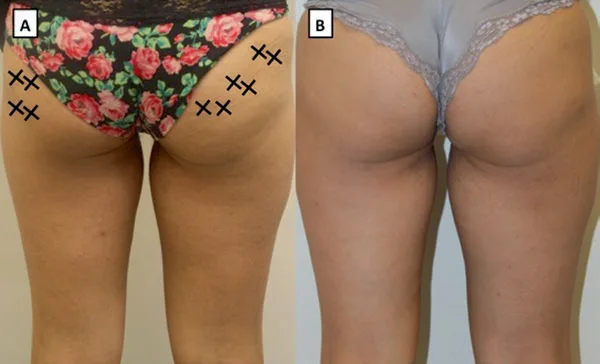 Fig 3. Body-PLLA hip/gluteal recontouring, before (A, injection zones marked) and after (B) one treatment. — (Alam, Evidence-Based Procedural Dermatology, 2019, p.693)
Gluteal / buttock (subcutaneous, always). > ⚠ The gluteal region concentrates the mortality of aesthetic medicine. Gluteal fat grafting (the BBL) has been described as the aesthetic procedure with the highest mortality, from fat/product embolism when material reaches the intramuscular or submuscular plane and enters the gluteal veins [3]. The rule transfers wholesale to any injectable in this region: subcutaneous plane, always; never intramuscular; never deep. The fat-graft detail lives in F5 — Autologous Fat Transfer.en; the plane rule lives here because it governs everything injected into a buttock.
Realistic targets with an injectable: fill the trochanteric depression (hip dip, the best indication), correct asymmetries and post-liposuction/post-injection depressions, and improve gluteal skin quality with a biostimulator [23][26]. Global projection is not cost-efficient with an injectable and does not replace a fat graft or implant; say so at the first consult [23]. PLLA is delivered subcutaneously with dilutions > 7 mL and reconstitution ≥ 24 h before use, usually one session plus a touch-up at one month; a retrospective series reported PLLA safe and effective for gluteal enhancement when adequate quantity (≥ 20 vials for the region) was used [6][23], and procedural-dermatology evidence documents single-treatment PLLA gluteal/hip recontouring (Fig 3) [39]. The novel high-dose body PLLA GANA X (630 mg) was used in 51 patients for upper-gluteus volumisation (90%), lateral depression / hip dip (53%), cellulite dimples (39%) and contour irregularities (41%) [26] (Fig 3). Reviews of minimally invasive buttock augmentation confirm biostimulators and HA as lower-complication alternatives to implants [24][25].
Dorsum of the hand (the three-axis region). The best-return, worst-executed body indication: the change is immediate, objective and self-visible, yet most operators treat only volume, one of three axes.
| Axis | Sign | Treatment |
|---|---|---|
| Volume | prominent tendons/veins from dorsal fat loss | CaHA (on-label), HA, PCL, fat [6][17] |
| Quality/pigment | lentigines, thin atrophic skin, actinic keratoses | photoprotection, depigmenting, IPL, pigment laser, peels, microneedling, intradermal HA [17] |
| Vascular | dilated tortuous dorsal veins | sclerotherapy/laser; ⚠ most delicate (see below) [17] |
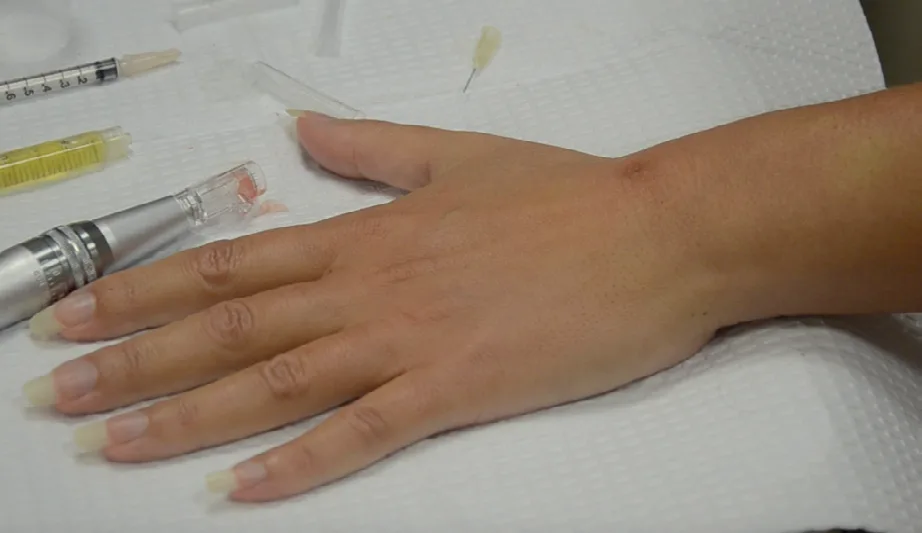 Fig 4. Hand rejuvenation, injection setup and dorsal working field. — (Carruthers, Soft Tissue Augmentation, 2018, p.158)
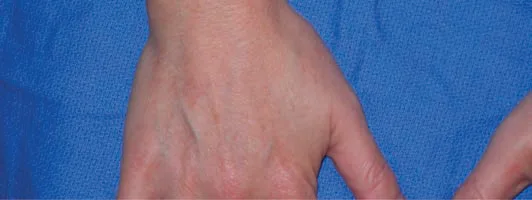 Fig 5. Dorsal hand treated with CaHA (Radiesse), showing camouflage of tendon/vein relief. — (Illustrated Manual of Injectable Fillers, 2011, p.143)
Dorsal anatomy, surface to depth: very thin skin → superficial dorsal venous plexus (very superficial, very visible) → superficial dorsal fascial lamina (the working plane) → extensor tendons → dorsal metacarpal arteries [MODELO]. The plane is between veins and tendons; it is spacious and distributes well, which is why product is spread by massage [15]. CaHA is the preferred hand volumiser and the only on-label option; it is white (disguises structures, no Tyndall) and high-G′ [6][17]; Fig 5 shows the softened tendon/vein relief of a treated dorsum. Two legitimate schools (Fig 4 documents the injection setup and working plane):
Consensus: lift the dorsal skin into a tent to separate it from tendons/veins before injecting, then massage immediately to distribute [6][15][16]. Discrepancy: bolus vs cannula: - A · Needle bolus + tenting: pinch and lift dorsal skin, enter the plane, deposit a central bolus (single bolus 0.5–1.4 mL, or several 0.2–0.5 mL boluses between metacarpals with a 27 G needle), then massage [6][16]. Fast, one entry; unforgiving if the tent is poor. - B · Cannula fanning: single distal/wrist entry, 22–27 G cannula through the same plane, retrograde fanning; multiple 3D double-fanning threads, ~0.05 mL/pass, ~1.3 mL per hand [15]. Lower vascular risk, better spread. Gubanova and Starovatova showed equivalent efficacy and safety between serial-puncture and fanning cannula [6]. - Decide by: vein prominence and operator comfort. Mean injected volume ~2.6 mL/hand, max 2 syringes; 75% achieve > 1-point improvement on the Merz hand scale; effect lasts 1–2 years [6].
⚠ PLLA has fallen out of favour for the hands because of the risk of visible nodules under lax dorsal skin, and it must be diluted more for hands (8–14 mL/vial) than for the face [6][17]. CaHA for hands is diluted at a 0.02–1:1 ratio with saline or lignocaine [17]; FDA mix is 3 mL syringe ↔ 0.3 mL 2% lidocaine [10]. Treat both hands the same session, warn about conspicuous dorsal edema, ice and elevate.
> ⚠ Cribado (screening), hand and décolleté: the dorsum and chest accumulate actinic damage. Actinic keratoses and suspicious lesions are examined and referred before any aesthetic treatment. A hand/décolleté consult is an opportunity to catch a skin cancer. > ⚠ Dorsal veins are real venous access. They are where a patient is cannulated in surgery or an emergency; ablating them has a functional cost a young patient does not imagine. Restore dorsal volume first, which disguises them without destroying them. See K2 — Vascular Aesthetics.en.
Neck, décolletage, arms, abdomen, knees (diffuse subdermal biostimulation). These share one indication: raise skin quality and thickness, not volume. Diluted/hyperdilute CaHA (E2.7) and bioremodeling HA are the tools; the plane is a diffuse subdermal layer, cannula, retrograde, never bolus [11][12]. Abdomen demands one distinction the others do not: separate lax skin from fat from rectus diastasis (ask for an abdominal crunch and palpate the midline gap; diastasis is surgical) [MODELO]. Breast/décolleté: treat the skin (skin boosters, PN, microneedling, very dilute biostimulator on the sternum/upper pole), never the parenchyma; real breast ptosis is a mastopexy, not a thread or a biostimulator (E2.10). Décolleté PLLA is delivered as 16 mL (1 vial) per session, ≥ 4 weeks apart, 3–4 treatments, within the boundaries suprasternal notch / mid-clavicular line / fourth rib [6].
Region-by-region particulars (the detail that changes the gesture):
| Region | Particular | Rule |
|---|---|---|
| Neck | thin, very visible, poor nodule tolerance | ⚠ hyperdilute (1:4–1:6 CaHA), diffuse subdermal, never deep; a nodule here is conspicuous [12] |
| Décolletage | scars badly, vertical rhytides are mechanical | ⚠ treat cause (sleep position) first, then quality; PLLA 16 mL/vial for rhytides [6]; see D14 |
| Inner arm | good skin-quality indication | ⚠ low ceiling if redundant skin; hyperdilute CaHA / bioremodeling HA [12] |
| Abdomen | must separate skin laxity / fat / diastasis | ⚠ ask for a crunch and palpate the midline gap; diastasis is surgical, not injectable [MODELO] |
| Knees / inner thigh | thin skin, modest result | high satisfaction despite modest change; diffuse subdermal only [12] |
| Dorsal foot | mirrors the hand | same tent-and-fan technique; plantar pressure-point pain limits it [16] |
The neck, arm, abdomen and knee share the same failure mode: a high-G′ or under-diluted product placed as a bolus in thin skin becomes a visible nodule, so the rule across all of them is dilute to the skin, spread diffusely, cannula not needle, never a bolus [12]. The abdomen adds the one differential the others do not: a lax-looking abdomen may be fat or a rectus diastasis, and only the pinch-and-crunch examination separates the injectable case from the surgical one [MODELO].
Body vs face: why the plane and product rules differ (the four structural truths). 1. The body consumes product at another order of magnitude. What corrects a cheekbone is invisible on a buttock; the cost becomes a clinical factor because it pushes patient and physician toward cheap, permanent or grey-market products, and almost every catastrophe of the domain starts there [22][MODELO]. 2. Laxity is not treated with injectables. Skin quality and thickness improve; excess skin does not disappear without removing skin. Repeating this at every consult is half the job [MODELO][24]. 3. Body skin heals worse and pigments more than facial skin, and is treated with more conservative parameters, more sessions and a prior test spot; the same rule as the décolleté carries to arms, abdomen and striae [38][MODELO]. 4. The body rarely ages on one axis. Volume, skin quality, pigment and a vascular component coexist; treating only volume is a partial answer the patient senses (E2.10) [MODELO].
These four truths are why a facial protocol never transfers unchanged to the body: the plane is stricter (gluteal subcutaneous rule), the dilution is higher (thin skin), the product bias is toward reversible (irreversibility costs more in poor-healing sites), and the plan is multi-axis rather than a single injection [3][12][MODELO]. The one place the body is more permissive than the face is depth for large-volume support in the buttock subcutis, and even there the intramuscular boundary is an absolute red line, not a preference [3].
Consensus: match the plane to the goal (deep/subcutaneous for volume, diffuse subdermal for quality) and the product to the skin thickness [6][11][12]. Discrepancy: none on plane; the debate is dilution ratio (E2.7) and reversible vs irreversible in thin skin (choose reversible when undecided).
Grading the hand, so the result is measured not felt. The Busso hand-volume scale (0–4) ranks tendon exposure at rest: 0 no tendon exposed; 1 one or two central tendons slightly exposed; 2 all three central tendons partially exposed; 3 all three partially with one or two fully exposed; 4 all three fully exposed at rest [16]. Photograph in the same position and grade before and after; 75% of CaHA-treated hands improve > 1 point on the Merz scale [6][16]. The same aging changes and the same technique apply to the dorsum of the foot (fat loss, tendon/vein prominence), with the caveat that the plantar surface develops pressure-point pain [16].
Gluteal patient selection and expectations (the honest first consult). Realistic targets and their limits sit in one table the patient should see:
| Objective | Realistic with injectable? | Note |
|---|---|---|
| Fill trochanteric depression (hip dip) | ✅ best indication | modest volume, visible silhouette change [23] |
| Correct asymmetry / depressions | ✅ yes | includes prior-injection and liposuction sequelae |
| Improve gluteal skin quality/thickness | ✅ with biostimulator | texture, not projection |
| Significant global projection | ⚠ not cost-efficient | needs volumes that make it expensive and repeated [23] |
| Replace a fat graft or implant | ❌ no | say it at the first consult |
Technique rules that apply to any gluteal injectable (in rules, not numbers): cannula not needle, generous gauge and length; marked and counted entry ports with rigorous antisepsis (high bacterial load, large volume, J5 — Infection, Biofilm & Sterilization.en); subcutaneous plane with the cannula tip palpable at all times (lose the tip, you have lost the plane); retrograde fanning; sessions distributed rather than the whole volume at once (lowers infection risk, allows assessment, spreads cost); standing photographs in the same three projections every time [MODELO]. HA offers the decisive body advantage of reversibility; biostimulators offer thickness and quality but ⚠ are not reversible [MODELO].
HIV facial lipoatrophy, the body-adjacent precedent. The largest human dose-response for a biostimulator (E2.4) came from HIV lipoatrophy, where sufficient staged CaHA volume (9.5 → 16.1 mL) was needed for correction [1]; the same "sufficient volume, staged" principle governs a large body deficit and is why gluteal PLLA consensus specifies a minimum vial count rather than a single-session dose [1][23].
Gluteal aesthetic goals, cellulite dimples and the "thirds" map. The gluteal aesthetic target is the waist-hip proportion and a smooth lateral contour, not raw projection; injectables serve it best by filling the trochanteric depression and correcting focal defects rather than by global augmentation [23]. The gluteal area is planned in thirds for even biostimulator distribution, with higher dilution associated with fewer post-treatment nodules, subcutaneous placement, and usually one session plus a touch-up [23]. Novel body PLLA (GANA X) additionally targets cellulite dimples (39% of cases) and contour irregularities (41%) alongside upper-gluteus volumisation, positioning the biostimulator as a skin-quality-plus-contour tool rather than a pure volumiser [26]. Cellulite structural correction itself (septa, dimples) belongs to the body-contouring and subcision chapters; the E2 contribution is the biostimulator's skin-thickening effect layered on top [26]. ⚠ None of this changes the plane rule: subcutaneous, tip palpable, staged, never intramuscular [3].
> Trampa clásica: injecting a buttock deep to chase projection. It is the lethal error of the domain (gluteal-vein embolism). Subcutaneous, tip palpable, staged. The second classic: treating only hand volume and leaving pigment and quality untouched, so the result reads as partial.
E2.7 · Dose and volume: per point, per region, per session, ceiling before overfill, interval
The body dose ladder (what actually goes in). Body dosing is governed by dilution far more than by absolute volume, because the same vial covers a hand or a whole neck depending on how it is reconstituted. Two ladders: a CaHA dilution ladder (volumise → biostimulate) and a PLLA reconstitution ladder (nodule control by dilution).
CaHA dilution ladder (Radiesse):
| Dilution (CaHA : diluent) | Effect | Body use | Skin thickness |
|---|---|---|---|
| undiluted / +0.3% lidocaine | maximal volume, high G′ | deep support, hip dip | thick |
| 1:1 | volume and biostimulation | hands [2] | normal-thick |
| 1:2 (hyperdilute begins ≥ 1:2) | biostimulation, less volume | neck / décolleté, normal skin [12] | normal |
| 1:4 | mostly biostimulation | thin skin neck/arms [12] | thin |
| 1:6 | biostimulation, no volume | atrophic skin, arms/abdomen [12] | atrophic |
Definitions (consensus): diluted = 1:1, hyperdiluted = ≥ 1:2 CaHA:diluent [12]. When hyperdiluted, biostimulation occurs without relevant dermal volumisation [12]. The foundational neck/décolleté protocol titrates by skin: 1:2 normal, 1:4 thin, 1:6 atrophic [12]. Higher dilution increases microsphere dispersion and improves fibroblast contact (a 1:2 dilution disperses more than 1:1) [5]. Global consensus adds: dilute immediately before use, sterile field, 3–10 mL counter-syringe (larger for higher dilutions), Luer-Lock through a female transfer adapter [5][12][13]. Dedicated dilution-practice guidance formalises the ratio-by-area approach and warns that over-diluting in saline raises post-injection sedimentation and nodule risk [14][33]. FDA lidocaine mix (off-label in the EU): 3 mL syringe ↔ max 0.6 mL (approved protocol produces 0.3 mL 2% lidocaine), 1.5 mL ↔ 0.3 mL, 0.8 mL ↔ 0.16 mL, 0.3 mL ↔ 0.06 mL [10]. For hands specifically, CaHA is diluted at a 0.02–1:1 ratio [17].
PLLA reconstitution ladder (the nodule-driven history):
| Reconstitution volume | Era / school | Nodule signal |
|---|---|---|
| 3 mL (original label) | early | many subcutaneous nodules reported [4] |
| > 5 mL | modern facial | reduced-risk technique with overnight reconstitution + vigorous massage [6] |
| > 7 mL, ≥ 24 h before | gluteal consensus | consensus lower-nodule target [6][23] |
| 8–14 mL / vial | hands | higher dilution for thin dorsal skin [17] |
| ~40 mL / vial | body (Lanluma X 630 mg) | large-surface coverage [MATERIAL GAP] |
Consensus is explicit that higher dilution reduces post-treatment nodules [6][23]. PLLA is massaged by the patient for 5 days after treatment [17]. Chest/décolleté PLLA: 16 mL (1 vial) per session, ≥ 4 weeks apart, 3–4 treatments [6].
Per-region working numbers the corpus resolves: - Hand (CaHA): ~1.3 mL per hand for optimal result; ~0.05 mL (50 µL) per pass in fanning; single bolus 0.5–1.4 mL; mean 2.6 mL/hand, max 2 syringes/hand [15][6]. - Gluteal (PLLA): dilution > 7 mL, ≥ 20 vials for the region across the plan, usually 1 session + touch-up at 1 month [6][23]. - Gluteal (HA, Macrolane-type): add 1 mL diluent per 10 mL syringe (0.3 mL 2% lidocaine + 0.7 mL saline), 18 G needle/cannula, small aliquots deep in the subcutaneous plane, multiple passes [6]. - Décolleté (PLLA): 16 mL/session [6]. - Skin quality (intradermal HA/booster): weekly ×4 raises dorsal-hand skin density on ultrasound [17][20]; mesotherapy course is 3 biweekly sessions then monthly [21].
⚠ The ceiling before overfill, stated plainly: on the body the ceiling is not a single number, it is a rule: reparte el volumen en sesiones (split volume across sessions) to cut infection risk, allow assessment, and spread cost [MODELO]. When two to three biostimulator sessions have not moved the laxity, the fourth will not either; the missing indication is surgical, not another ampoule (the stacking trap, E2.10).
Consensus: dilution sets the effect (volume ↔ biostimulation); higher dilution cuts nodules for PLLA and enables skin-quality use for CaHA; split large body volumes across sessions [5][6][12][23]. Discrepancy: the dilution controversy (do not average): - Low-volume classic reconstitution (PLLA 3–5 mL): historically higher nodule rate; still used facially by some [4][6]. - High-dilution schools (PLLA 8–14 mL hands, up to 40 mL body; CaHA ≥ 1:2): fewer nodules, larger coverage, less volume [12][17][MATERIAL GAP]. - CaHA ratio for a given area is chosen by skin thickness and goal, not by a single consensus number; the literature spans 1:1 to 1:6 and source-policy forbids averaging a value no author defends [12]. The transferable rule is the direction: more dilution for quality and spread, less for volume. - Hydration time (PLLA): ≥ 2 h vs overnight vs ≥ 24 h (gluteal). Add lidocaine or not. Decide by: skin thickness, surface area, nodule history [4][6][23].
Step-by-step body protocol (generic, applies across the four classes; shared session steps in A4):
Consult and selection: 1. Examine the area as a dermatologist before an aesthetician: lentigines, actinic keratoses, suspicious lesions, breast findings. Refer them. 2. ⚠ Ask about prior injections: what, where, when, by whom (especially buttock and breast) [MODELO]. 3. Pinch. The manoeuvre that separates volume from laxity, therefore injectable from surgery. 4. ⚠ Confirm months of weight stability before planning volume. 5. Name the three or four axes at the mirror (volume, quality, pigment, vascular). A plan is decided here, not a procedure. 6. Standardised photography, fixed projections per region, same distance and light.
Consent: 7. Declare in writing the off-label use where present (body hyperdilution for laxity, gluteal/limb PLLA) and the irreversibility of the chosen product. 8. Put the ceiling of the result in writing and, where it exists, the surgical alternative. 9. Agree the number of sessions and calendar, with the warning that biostimulator effect is delayed.
Execution (general body rules): 10. Antisepsis proportional to volume and site; a buttock or abdomen is not a forehead. 11. Cannula by default on the body; needle only with a specific indication. 12. ⚠ Subcutaneous plane, tip palpable. In the buttock, never intramuscular. 13. Retrograde and fanning; no boluses in thin skin. 14. Massage and mould where the technique requires (especially dorsal hand). 15. ⚠ Split volume across sessions: lower infection risk, better assessment, better economy. 16. Cold, compression and elevation where appropriate; warn of edema in writing.
Energy/resurfacing on the body (E2.11): 17. ⚠ Mandatory test spot, never treat tanned skin. 18. Conservative parameters, more sessions than the face. 19. Strict photoprotection as maintenance, not advice.
Follow-up: 20. Review with the same photograph, against baseline not the prior session. 21. Palpate for nodules in every biostimulator-treated area. 22. Reassess the ceiling: if two or three sessions have not moved laxity, stop and rethink, do not stack.
Injection depth, summarised per region: deep subcutaneous / supraperiosteal for large volume (gluteal, hip dip); superficial subcutis above tendons for the hand; diffuse subdermal for neck/décolleté/arm/abdomen skin quality; intradermal for skin boosters and bioremodeling HA [5][11][12][15]. The depth error in thin skin (too superficial) is the nodule; the depth error in the buttock (too deep) is the embolism.
Consolidated body dosing quick-reference (glanceable):
| Region | Product | Dilution/prep | Volume | Plane | Sessions |
|---|---|---|---|---|---|
| Buttock/gluteal | PLLA (Sculptra/Lanluma), GANA X | > 7 mL/vial, ≥ 24 h; Lanluma X ~40 mL | ≥ 20 vials over plan [23] | subcutaneous | 1 + touch-up [6][23][26] |
| Buttock (reversible) | body HA (Macrolane-type) | 1 mL diluent/10 mL syringe (0.3 lido + 0.7 saline) | small aliquots, staged | deep subcutaneous | staged [6] |
| Hip dip | body HA / PLLA | as above | modest | subcutaneous | 1–2 |
| Hand dorsum | CaHA (on-label) | 1:1 or 0.02–1:1 lido/saline; FDA 3 mL↔0.3 mL lido | ~1.3 mL/hand, 0.05 mL/pass, max 2 syringes [15] | subcutis above tendons | 1, review 2 wk |
| Neck | CaHA hyperdilute / bioremodeling HA | 1:2 normal, 1:4 thin, 1:6 atrophic [12] | diffuse, low | subdermal diffuse | 2–3 |
| Décolletage | CaHA hyperdilute / PLLA / Profhilo | as neck; PLLA 16 mL/vial | PLLA 16 mL/session [6] | subdermal | 3–4, ≥ 4 wk apart |
| Inner arm/knee/thigh | CaHA 1:4–1:6 / bioremodeling HA | high dilution | diffuse | subdermal diffuse | 2–3 |
| Body skin quality | skin booster / PN | non-crosslinked | micro-droplet | intradermal | booster weekly ×4; meso 3 biweekly then monthly [17][20][21] |
⚠ Every number in this table is chosen per patient by skin thickness and goal, not applied blind; the hyperdilution ratio in particular has no single consensus value and is titrated (E2.7 discrepancy) [12]. The table is a starting map, not a prescription, and the IFU governs regulatory status.
Intervals and touch-up scheduling per product (the calendar the patient signs up to): - PLLA: sessions ≥ 4 weeks apart, 3–4 treatments for a large area (décolleté 16 mL/vial per session); assess at ~6–8 weeks after the final session because the effect is delayed and cumulative; a premature touch-up over-corrects [6][23]. - CaHA: one session with a review at ~4–6 weeks; a touch-up only after the 3–4-month carrier-resorption trough has passed and the collagen result is judged, not on the early dip [10][33]. - PCL: one session; because the duration is 1–4 years by version, touch-ups are years apart, and a new patient is started on a shorter version to keep an error retrievable-by-time [9]. - Gluteal PLLA: usually one session plus a single touch-up at one month; the total vial count (≥ 20 for the region) is spread across the plan rather than delivered at once, both for the delayed effect and for infection risk [6][23]. - Skin boosters / bioremodeling HA: an induction course (boosters weekly ×4; Profhilo 2 sessions ~4 weeks apart) then maintenance every ~6 months, because the fibroblast stimulus fades without repetition [17][18][20].
The scheduling rule that unifies them: do not re-dose a biostimulator on the early trough; the delayed clock means the true result is read after the collagen matures, and dosing into the dip is the mechanism of overcorrection [10][23][33].
> Trampa clásica: copying a hyperdilution ratio from a lecture slide as if it were "the" number. There is no consensus ratio; it is chosen per area and goal and declared as off-label. Averaging the published range yields a figure no author would defend [12].
E2.8 · Reversibility and managing the excess: what degrades it, in how long, what cannot be undone
The reversibility grid (the hard truth of biostimulators).
| Substance | Antidote? | What degrades / softens it | Time | Irreversible component |
|---|---|---|---|---|
| Body HA | ✅ hyaluronidase | enzymatic depolymerisation [28] | hours; re-inject 24 h [32] | none (that is the point) |
| CaHA | ❌ none | native enzymatic clearance → Ca²⁺/PO₄; off-label salvage (below) | scaffold gone 12–18 mo [8] | overcorrection while it lasts |
| PLLA | ❌ none | metabolisation of microspheres | ~9 mo microspheres, effect ~2 yr [23] | collagen deposited is yours to keep |
| PCL | ❌ none | ester-bond hydrolysis | the rated 1–4 yr [9] | duration is chosen up front |
The core rule: ⚠ PLLA, CaHA and PCL are officially non-reversible. There is no equivalent to hyaluronidase for them [3][17]. In neck, arms and abdomen (thin skin, poor healing) that irreversibility weighs more than on the face: if undecided between a reversible and an irreversible product in a delicate area, choose the reversible one [MODELO]. The only true "reverse" is HA-based body filler with hyaluronidase.
Managing the excess, what the evidence supports (and its limits): - HA overcorrection/nodule: hyaluronidase, 5–50 U per nodule with firm massage, response in 24–72 h, re-inject after 1 week [32]. This dissolves HA; it does not dissolve CaHA/PLLA/PCL. - CaHA excess/lump: immediate massage or removal if fresh; a mislaid bolus in a mobile/thin site (e.g. lip) clumps into a hard calcium nodule [7]. Off-label salvage reports: saline, hyaluronidase (as a diffusion factor, not a solvent), sodium thiosulfate, steroid, 5-FU; one report noted a CaHA nodule resolved > 90% after one week with salvage [29]. Fractional CO₂ laser has softened CaHA nodules [29]. - PLLA non-visible nodules: many resolve spontaneously; some clinicians leave non-visible nodules to self-resolve because intralesional steroid can dissolve perinodular fat and make them more evident, or overlay HA to camouflage [30].
Discrepancy: reversibility of biostimulators (do not average, keep both positions): - Position A · irreversible, prevention is the only control: biostimulators have no antidote; management is prevention (correct dilution, plane, no overcorrection) [3][17]. - Position B · off-label salvage can partly resolve: saline, hyaluronidase-as-diffusion-factor, sodium thiosulfate, steroid and 5-FU have partly resolved CaHA/PLLA nodules in reports [29]. - Decide by: these are off-label, evidence-thin manoeuvres for an established problem; they never justify treating a biostimulator as "reversible" at consent.
⚠ What cannot be undone: the collagen a biostimulator deposits is remodelled host tissue, not a removable implant; a contour error placed too superficially in thin body skin may need laser or surgical revision. And no salvage exists for a permanent product (PMMA, polyacrylamide, silicone): that is precisely why the body must never receive one (E2.9, J7 — Biopolymer & Permanent-Filler Complications.en).
Revising a bad body result (the realistic ladder): for a visible biostimulator nodule or contour irregularity, the options in escalating order are watchful waiting through the product's lifespan (CaHA 12–18 mo, PLLA ~2 yr, PCL the chosen years), intralesional therapy for a true inflammatory nodule (E2.9), fractional laser for superficial CaHA material, and surgical excision as a last resort [8][9][23][29]. None of these is a "reversal"; each is a revision of an established problem, which is why the consent for a body biostimulator states the irreversibility up front rather than implying a filler-like undo [17][MODELO]. For an unknown prior product presenting as a body nodule, the sequence is biopsy (Alcian blue for biofilm), culture, and treatment matched to the finding, never blind immunosuppression (E2.9) [28][41]. The one genuinely retrievable body injectable is HA: a body HA overcorrection is dissolved with hyaluronidase 5–50 U/nodule, response 24–72 h, which is the single strongest argument for choosing reversible HA in a delicate or first-time body case [32].
Prevention is the real "reversibility" for a biostimulator (the levers, ranked). Because there is no antidote, the control is upstream: (1) dilution appropriate to the site (more dilute for thin skin, E2.7); (2) plane (diffuse subdermal, never a superficial bolus in thin skin); (3) no overcorrection (biostimulator effect is delayed, so a day-0 "full" result is an overfill by 4–6 weeks); (4) massage/dispersion to avoid a concentrated depot; (5) session spacing so a developing problem is caught before more product is added [4][6][12]. Every one of these is chosen before the needle enters; none can be undone after.
Timeframes to quote the patient for "when it will be gone": - CaHA: carrier gel resorbs 3–4 months; microsphere scaffold degrades 12–18 months; a contour error persists for that window [8][10]. - PLLA: microspheres metabolised ~9 months; the deposited collagen (and any nodule tendency) persists to ~2 years [23][30]. - PCL: the chosen 1/2/3/4-year duration is also the duration of any error, which is the argument for starting a new patient on the shorter (S/M) versions [9]. - Bioremodeling/booster HA: months, and hyaluronidase-degradable, the one genuinely retrievable option in the group.
A decision rule for the delicate-site choice: in neck, inner arm, abdomen and knee (thin skin, poor healing, high nodule visibility), default to the reversible product (HA-based) unless a specific reason favours the biostimulator, and when a biostimulator is used, dilute to the thin-skin end of the ladder (1:4 to 1:6 CaHA) and place diffusely [12][MODELO]. The cost saving of an irreversible product does not survive a single visible nodule in a thin-skin site.
Managing the excess by product (what actually works, and what does not):
| Product | Fresh overcorrection (day 0) | Established excess/nodule | Never |
|---|---|---|---|
| Body HA | massage; hyaluronidase 5–50 U/nodule, response 24–72 h, re-inject 24 h [32] | hyaluronidase again | leave a mislaid depot uncorrected when it is dissolvable |
| CaHA | immediate massage/expression if fresh [7] | off-label: saline/hyaluronidase-as-diffusion-factor/sodium thiosulfate/steroid/5-FU; fractional CO₂ laser; one report >90% at 1 wk [29] | inject steroid into a fresh packed depot (no response, skin atrophy) [28] |
| PLLA | massage vigorously, disperse | non-visible: observe (steroid can worsen visibility via perinodular fat loss) [30]; visible: triamcinolone 0.02–0.04 mL of 2 mg/mL, or overlay HA to camouflage [30] | over-treat a self-resolving non-visible nodule |
| PCL | massage | as CaHA, off-label; excision as last resort | assume any antidote exists |
The recurring lesson across the grid: HA is the only true reversal, everything else is prevention plus off-label salvage for an established problem, and the wrong first move (steroid into a packed/fresh depot, or into a fluctuant infected nodule) makes it worse [28][29]. A contour error that persists is corrected over the product's lifespan (CaHA 12–18 mo, PLLA ~2 yr, PCL the chosen 1–4 yr) or, if visible and intolerable, by laser or surgical revision, never by "dissolving" [8][9][23][29].
Consensus: only HA is truly reversible; for biostimulators, prevention is the control and salvage is off-label [3][17][29]. Discrepancy: captured above; keep both, average neither.
> Trampa clásica: consenting a body biostimulator as if it could be dissolved "like filler". It cannot. In a thin-skin body site, the irreversibility is the dominant risk and belongs in the written consent [MODELO].
E2.9 · Adverse effects PROPER to the substance (not the generic needle events)
The substance-specific complication grid. Generic injection events (bruise, edema, pain, transient erythema) are in the injection-technique chapters; this block is what these molecules do, and what large body volumes do.
| Complication | Substance | Mechanism | Signature | Management |
|---|---|---|---|---|
| Fibrotic subcutaneous nodule | PLLA (most) | under-hydration, inadequate dilution, overcorrection, too-superficial/thin-skin placement [30] | palpable non-inflammatory lump, weeks–months | dilute more, place deeper, massage; intralesional steroid (below) |
| Hard calcium nodule | CaHA | clumping in mobile/thin site (lip, superficial) [7] | firm nodule in thin cover | prevention; off-label salvage (E2.8) |
| Late giant-cell granuloma | all biostimulators | delayed foreign-body/host reaction | inflammatory nodule months–years | steroid/5-FU/allopurinol (below) |
| Biofilm | all injectables | slow-growing bacteria, exaggerated host response, rare < 0.1% [31] | recurrent/late inflammation, culture-negative | antibiotics + drainage; hyaluronidase can break matrix [31] |
| Vascular occlusion / embolism | any body injectable | intravascular / intramuscular gluteal | ischemia, or fatal PE in gluteal deep plane [3] | E2.9 vascular protocol below |
| Abscess / life-threatening sepsis, migration | biopolymers/PMMA | permanent foreign body | late catastrophic | J7; never use in body |
Nodules and granulomas (the biostimulator-defining event). - PLLA nodule incidence is low: 0.01–0.1% (Vleggaar: 6 granulomas in 3000 patients) [30]. Late nodules appear months after application. First line: intralesional triamcinolone 0.02–0.04 mL of 2 mg/mL, repeat every 2–4 weeks [30]. Non-visible nodules may be left to self-resolve (steroid can dissolve perinodular fat and worsen visibility) [30]. - Granuloma escalation ladder (proven treatments, kept with their scenarios, not averaged): - Intralesional triamcinolone 40 mg (Kenalog), or betamethasone/methylprednisolone; triamcinolone diluted 1:1 with lidocaine; initial dose sufficiently high to avoid recurrence [28]. - Intralesional 5-FU 250 mg/mL + triamcinolone 10 mg/mL + mepivacaine 1 mL, twice then weekly, plus allopurinol 300–600 mg/day [4]. - Alternative dosing set: 5-FU 0.8 mL (250 mg/mL) + 0.1 mL triamcinolone 10 mg/mL, max 1–1.5 mL per session, weekly then spaced; allopurinol 200 mg/day → 400 → 600 [32]; triamcinolone 0.1 mL/granuloma weekly up to 4 wk then monthly 3–6 mo [32]. - van Loghem protocol: 5-FU 0.5 mL of 50 mg/mL + triamcinolone 0.3 mL of 10 mg/mL (or 40 mg/mL by site) + 0.2 mL 2% lidocaine with adrenaline; excision as last resort [29]. - PLLA-specific granuloma: prednisone 60 mg/day, triamcinolone 40 mg/mL every 3 weeks, or minocycline (anti-inflammatory/immunomodulator) [30]. - ⚠ Cystic granulomas after collagen/HA, and packed nodules of Radiesse/silicone/polyacrylamide, do NOT react to intralesional steroids or antimitotics [28]. Drain first; surgical removal for these and for silicone/polyacrylamide granulomas [28]. - Biofilm workup: if the filler is unknown, biopsy, add Alcian-blue stain to distinguish biofilm from foreign-body granuloma, and culture (bacterial, mycobacterial, fungal) before treating [MODELO]. Late hard nodules > 0.5 cm, painful/indurated with surrounding erythema, are a delayed inflammatory reaction, often preceded by a systemic infection (flu, UTI) that lowered host defenses [41]. Suspected biofilm: antibiotics (e.g. ciprofloxacin/clarithromycin) ± prednisone, drainage if fluctuant [29][31][41].
Biofilm, the mechanism that reframed "sterile granulomas". Many reactions once labelled foreign-body granuloma or allergy on the basis of negative cultures are now attributed to biofilm: sessile bacterial communities firmly adhered to the implant, embedded in an exopolysaccharide extracellular matrix that impedes antibiotic penetration and explains the long, treatment-resistant course [31]. The biofilm can lie latent for long periods and be activated by trauma, manipulation or a later injection; laboratory confirmation is difficult, generally requiring biopsy for histology and cultures for bacteria, mycobacteria and fungi, with molecular techniques when cultures are negative [31]. Treatment aims to halt the increased interstitial secretion and inflammatory-cell invasion with corticosteroids, antibiotics (systemic and/or intralesional) and antimetabolites such as 5-FU (active against gram-negative bacteria), and hyaluronidase can help break the biofilm matrix [31]. Prevention is asepsis at implantation, which is why the biofilm story sits at the intersection of E2.9 and J5 — Infection, Biofilm & Sterilization.en; the reported incidence is rare (< 0.1%) but the management is disproportionate to the number [31].
Large-volume and gluteal safety (the fatal facet). > ⚠ Fatal pulmonary embolism is the gluteal risk that dwarfs the rest. Variables associated with decreased fatal PE in gluteal fat/product injection: mid-to-superficial muscle plane (rate ratio 0.18), parallel angulation of the cannula tip (0.58), and cannula ≥ 4.1 mm (0.20) [3]. The 2018 Multi-Society Gluteal Fat Grafting Task Force: subcutaneous space is safest, stay far from gluteal veins and the sciatic nerve, stage rather than inject deep, keep the cannula tip position in mind on every stroke, inject only while the cannula is in motion (no high-pressure bolus), and discuss the risk of death with every patient [3]. The rule transfers to any gluteal injectable: subcutaneous, tip palpable, never intramuscular.
Vascular occlusion with CaHA (the non-HA exception). CaHA has no antidote, yet the intravascular consensus still recommends hyaluronidase for impending vascular compromise regardless of filler type, for its edema-reducing, capillary-permeability and anti-inflammatory effects (to increase flow and promote healing), not because it dissolves CaHA [27]. Reported ischemia dosing: 600 U hyaluronidase per 0.1 mL CaHA immediately, repeated every 2 h up to 4 cycles if no improvement [27]. Early recognition and rapid aggressive treatment are required; there is no reversal, so severe complications are likelier than with HA [27].
Vascular-occlusion response (the sequence, adapted to a non-HA filler): recognise early (disproportionate pain, blanching then dusky mottling, delayed capillary refill); stop injecting; the intravascular consensus applies hyaluronidase for its flow/edema effect (600 U per 0.1 mL CaHA, repeat every 2 h) even though it does not dissolve CaHA; add warmth, massage, and the standard occlusion adjuncts (aspirin, nitroglycerine paste per protocol), and escalate aggressively because there is no antidote [27]. The prevention that matters more than the protocol is the plane: subcutaneous, aspirate is unreliable with thick CaHA so rely on slow retrograde delivery in motion, low pressure, and cannula in large body volumes [3][27]. Detailed facial danger-zone anatomy is in the D-series; the body lesson is the gluteal-vein rule (E2.9 above).
Infection and abscess (the body-volume risk): large subcutaneous volumes in high-bacterial-load regions (buttock, abdomen) raise infection risk; acute infection presents as inflammatory nodules in the first days (ultrasound, culture) and is treated with systemic antibiotics and drainage if fluctuant [MODELO][41]. ⚠ Biopolymer/PMMA abscess and life-threatening sepsis are a separate, catastrophic category with migration and are managed in J7 — Biopolymer & Permanent-Filler Complications.en; the E2 rule is prevention by never using a permanent product in the body [22]. Asepsis proportional to the volume and site, marked and counted entry ports, and distributing volume across sessions are the levers [MODELO]41.
Complication time course (classify by onset, it points to the mechanism):
| Timing | Events | Substance note |
|---|---|---|
| Immediate | pain, hypersensitivity, anaphylaxis; intra-arterial necrosis obvious within a day | any injectable; vascular is the emergency [6] |
| Early (< 2 wk) | swelling, ecchymosis, erythema, infection, overcorrection, superficial bumps | technique/placement; compressed implant is not yet a granuloma [6][28] |
| Late (wk–mo) | HSV reactivation, nodules, granuloma formation, biofilm | the biostimulator-defining window; classify before treating (E2.9) [6][31] |
| Permanent | scarring; irreversible material effects | only with permanent products or deep revision [6] |
The value of the time course is that it separates a fresh compressed depot (early, massage/express, no steroid) from a late inflammatory granuloma (steroid-responsive) from a biofilm (culture-driven), which is the same classification that picks the drug in E2.9 [6][28][31]. A gluteal or abdominal inflammatory nodule days after treatment is read as infection until proven otherwise (ultrasound, culture, drainage if fluctuant), not as an early granuloma [MODELO][41].
Prevention checklist proper to the substance (not the needle): correct dilution for skin thickness; deep-enough plane, never a superficial bolus in thin skin; no overcorrection (delayed effect); patient massage (PLLA 5 days, CaHA/hand immediately); avoid undiluted CaHA in mobile/thin sites; strict asepsis at the dilution step; distribute large body volumes across sessions; and for the buttock, the subcutaneous-plane rule that prevents the fatal event [3][4][6][7][30].
Consensus: the biostimulator-defining complication is the delayed nodule/granuloma (prevent by dilution/plane/depth); the body-volume-defining complication is vascular/embolic (prevent by subcutaneous plane) [3][30]. Discrepancy: hyaluronidase for a non-HA vascular event: School A: give it (edema/flow benefit) [27]. School B: it cannot dissolve CaHA, so value is adjunctive only [27]. Decide by: it is an adjunct in the ischemia protocol, never a substitute for prevention.
Classify the nodule before you treat it (the decision that picks the drug).
| Type | Timing | Feel | Reacts to steroid? | Action |
|---|---|---|---|---|
| Early compressed implant | < 2 wk | small, non-inflammatory | ❌ no (it is packed material, not tissue) [28] | massage/remove if fresh; expectant if small [MODELO] |
| Late non-inflammatory nodule | wk–mo | firm, painless, small | partial | PLLA: triamcinolone 0.02–0.04 mL of 2 mg/mL [30]; observe if non-visible |
| Late inflammatory nodule / granuloma | wk–yr, often post-infection | painful, indurated, erythema, edema | ✅ yes (has cellular ingrowth) [28] | steroid → 5-FU/triamcinolone → allopurinol ladder (above) |
| Fluctuant nodule | any | fluctuant | drain, do not inject steroid | ultrasound, drainage, culture, antibiotics [MODELO] |
| Biofilm | late, recurrent | culture-negative inflammation | antibiotics first | biopsy + Alcian blue, culture, antibiotics ± steroid [31] |
The classification matters because the same "nodule" word covers a packed implant that will never respond to steroid and an inflammatory granuloma that will; injecting steroid into the former wastes time and atrophies skin, and injecting it into a fluctuant/infected nodule can worsen it [28][MODELO]. When the injected material is unknown, biopsy with Alcian-blue stain (biofilm vs foreign-body granuloma) and tissue culture (bacterial, atypical, fungal) come before immunosuppression [MODELO].
Prevention of the biostimulator nodule (the levers that actually work): adequate dilution for the site; deep-enough plane (never superficial in thin skin); no overcorrection; patient massage (PLLA 5 days; CaHA/hand immediately); avoid mobile high-movement sites for undiluted CaHA (it clumps) [4][6][7][30]. Biofilm prevention is asepsis at implantation, the same discipline as J5 — Infection, Biofilm & Sterilization.en; a systemic infection (flu, UTI) can later activate a latent biofilm, so patients are told to report a delayed inflamed nodule promptly rather than wait [31][MODELO].
> Trampa clásica: reaching for intralesional steroid on every biostimulator nodule. A packed CaHA/permanent nodule will not respond and a fresh compressed implant is not a granuloma; classify first (fresh compressed nodule vs late inflammatory granuloma vs biofilm) before choosing the drug [28].
E2.10 · Alternatives: what replaces it, when, and when the right answer is NOT to inject
The substitution grid by goal. Shared substitution logic is in A6; this is the body-specific version, and its most important cell is the last one.
| Goal | Injectable option | Non-inject / when the answer is not to inject |
|---|---|---|
| Gluteal projection (large) | body HA / PLLA (modest) [23][26] | ⚠ fat graft (F5) or implant for real projection; injectable is not cost-efficient [23] |
| Hip-dip / depression | body HA / PLLA (good indication) [23] | fat transfer if global reshape needed |
| Body skin laxity (mild) | hyperdilute CaHA, bioremodeling HA [12][18] | energy: RF, microneedling-RF, HIFU, Renuvion, endolifting [see E4/G5] |
| Body skin laxity (redundant skin) | ⚠ none | surgery: abdominoplasty, brachioplasty, body lift, mastopexy [MODELO] |
| Hand volume | CaHA, HA, PCL, fat [6][17] | pigment/quality lane (IPL, laser, peels) for the other axes |
| Striae | biostimulator is not the tool | staged laser/microneedling-RF (E2.10 below) |
| Breast ptosis | ⚠ none | mastopexy; no filler in parenchyma |
| Facial/body deflation after weight loss | HA + biostimulator (face), energy (mild laxity) | surgery for redundant skin; protein + resistance training for lean-mass loss [35][36] |
When NOT to inject, in order of frequency: 1. ⚠ Redundant skin. Pinch it; if skin folds and stays, it is excess skin, and excess skin = surgery [MODELO]. Biostimulators improve quality and thickness, never remove skin. Saying so at the first consult is a service, not a lost sale. 2. ⚠ The biostimulator-stacking trap. Facing laxity that will not yield, the temptation is to add sessions and products. It does not work, it is expensive, and it is irreversible. When three sessions have not moved the laxity, the fourth will not; the missing indication is surgical [MODELO]. 3. ⚠ Unstable weight. Do not plan volume while weight is still falling (GLP-1 era, E2.10/Novedades): months of stability, not weeks; you would be treating an anatomy that will not exist [35][MODELO]. 4. ⚠ Breast parenchyma / real ptosis. Mastopexy, not injectable. 5. ⚠ Cost-driven demand for a permanent product. The body's large volumes and high legal-product cost push toward permanents and grey-market biopolymers; this is exactly the trap that produces the worst complications. Never [22][MODELO]. See M6 — Unconventional, Off-Label & Grey-Market Practice.en.
Alternatives detailed: - Autologous fat transfer (F5): the real answer for large gluteal projection or global reshaping; carries its own (higher) mortality profile, hence the subcutaneous-only rule [3][MODELO] (Fig 6). - Energy body-contouring: RF, microneedling-RF, HIFU, Renuvion/plasma, endolifting for mild laxity (G5 — Radiofrequency & HIFU Devices.en, E4 — Body-Contouring Devices.en). - Body threads (E3): limited lift; ⚠ a thread does not compensate a 40-kg loss [MODELO] (E3 — Thread Lifting - Face & Body.en). - Body mesotherapy: DMAE, organic silicon, non-crosslinked HA + vitamins/amino acids for flaccidity and skin quality; 3 biweekly sessions then monthly [21]. - Energy/laser for striae (staged, E2.11): vascular laser/IPL for rubrae, fractional laser and microneedling-RF for albae (G3 — Non-Ablative & Fractional Lasers.en, G4 — Vascular, Pigment & IPL.en).
When to refer for surgery (the criteria, so the referral is not a judgement call):
| Finding | Test | Decision |
|---|---|---|
| Skin folds and stays on release | pinch | redundant skin: abdominoplasty/brachioplasty/body lift/mastopexy [MODELO] |
| Midline abdominal bulge on crunch | crunch + midline palpation | rectus diastasis: surgical, not injectable [MODELO] |
| Real breast descent | inframammary/nipple position | mastopexy; no filler/thread substitute [MODELO] |
| Laxity unmoved after 2–3 biostimulator sessions | serial photos vs baseline | stop stacking, refer; the ceiling is surgical [MODELO][24] |
| Large gluteal projection goal | volume estimate vs cost | fat graft (F5) or implant, not injectable [23] |
Recognising the ceiling and referring is part of the medical act; it costs short-term billing and builds a practice long-term [MODELO]. The energy lane (RF, microneedling-RF, HIFU, Renuvion, endolifting) addresses mild laxity only and is detailed in G5 — Radiofrequency & HIFU Devices.en and E4 — Body-Contouring Devices.en; a device does not remove skin any more than a biostimulator does. Threads have a genuine but limited lift and belong to E3 — Thread Lifting - Face & Body.en; ⚠ a thread does not compensate a 40-kg loss.
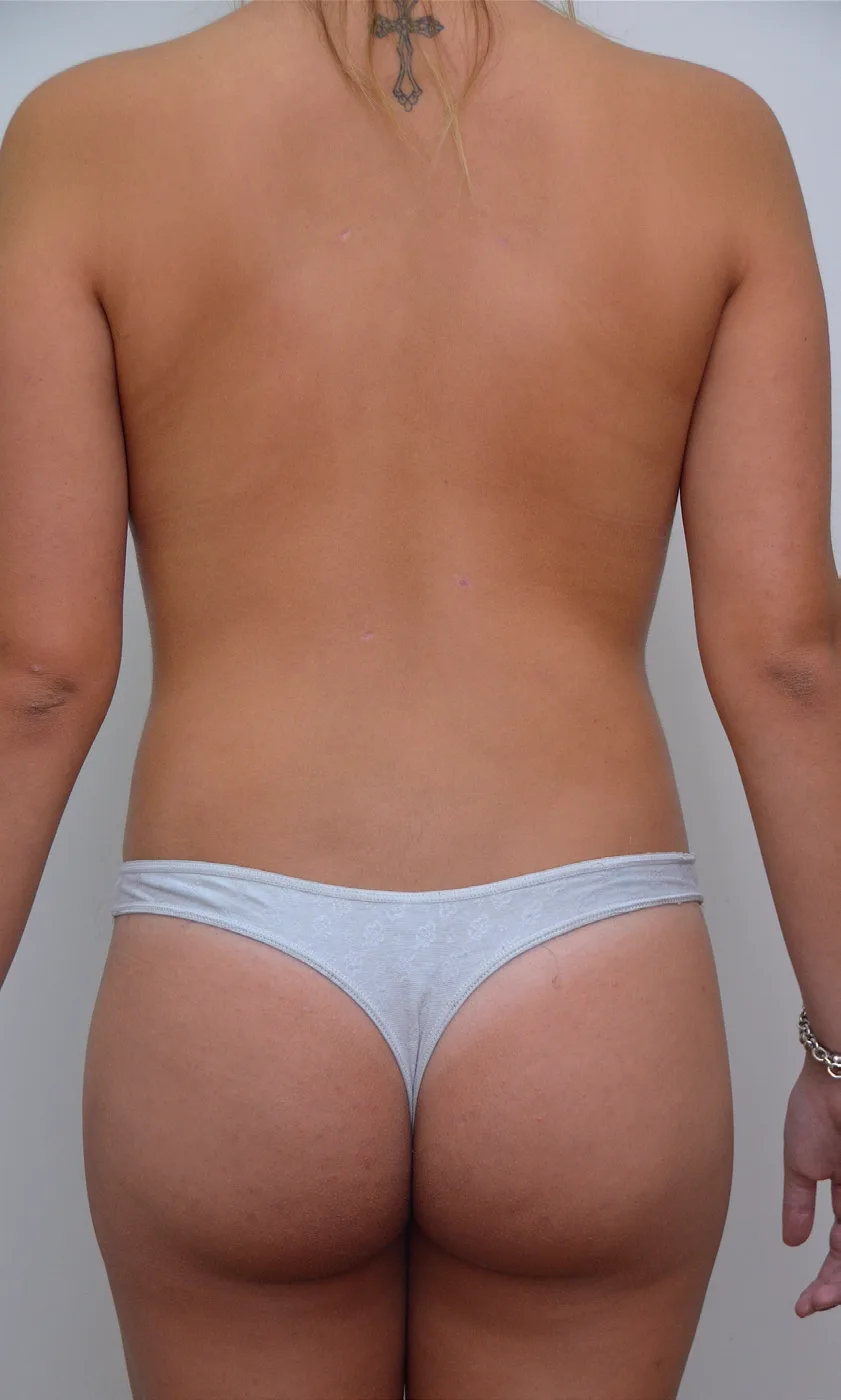 Fig 6. Gluteal/lower-back baseline before contouring; large projection is a fat-graft or implant decision, not an injectable one. — (Carruthers, Soft Tissue Augmentation, 2018, p.166)
The multi-axis body plan (why an injectable is one tool, not the plan). The body almost never ages on a single axis: volume, skin quality, pigment and a vascular component coexist, and treating only volume is a partial answer the patient senses without naming [MODELO]. The endorsed approach names all axes at the mirror and sequences them: reversible volume or biostimulator for contour, bioremodeling/booster HA and PN for quality (E2.11), IPL/laser for pigment and vascular (G4 — Vascular, Pigment & IPL.en), and energy or surgery for laxity. A single-modality body result (pure volumetric, or pure biostimulation sold as a laxity fix) is the common failure, because it leaves the other axes untouched. The most important single sentence of this block, repeated across E2.1, E2.6 and E2.10: injectables improve quality and thickness and fill defined defects; they do not remove skin, and redundant skin is surgery.
Consensus: injectables are a minimally invasive option for volume and skin quality, never a substitute for surgery in true laxity or for large gluteal projection [23][24][25][MODELO]. Discrepancy: schools of body practice (kept, not averaged): - Multi-axis (endorsed): treat volume, quality, pigment and vascular as a plan, not separate procedures. - Pure volumetric: fill what is seen; leaves pigment/quality untreated, the exact tell of an aged hand or décolleté. - Diffuse biostimulation (endorsed within its indication): spread stimulus over a wide subdermal area; ⚠ fails when sold as a laxity treatment. - Session-stacking against laxity (rejected): expensive, irreversible, does not move laxity; masks a surgical indication. - Permanents in the body (rejected without nuance): origin of the worst complication series [22]. - Early surgical referral (endorsed): recognising the ceiling and saying it is part of the medical act.
Post-weight-loss aesthetics (the GLP-1 scenario, salvaged and updated). GLP-1 receptor agonists have multiplied the number of patients arriving with rapid, large weight loss (15–25%+ of body weight over months, not years), a profile that formerly came only from bariatric surgery; the aesthetic consequences are predictable and mostly not solved by injectables [35][36].
| Change | Explanation | Response |
|---|---|---|
| Facial volume loss ("deflation") | deep + superficial facial fat lost with body fat [35] | HA + biostimulator (face): the highest-yield indication (D-series) |
| Facial/cervical descent | skin does not retract at the pace of loss [35] | energy if mild; ⚠ surgery if frank |
| Body laxity (abdomen, arms, thighs, breast) | true redundant skin | ⚠ surgical: abdominoplasty, brachioplasty, body lift, mastopexy [MODELO] |
| Lean-mass loss | part of the weight lost is muscle | ⚠ metabolic, not aesthetic: adequate protein + resistance training (K1 — Anti-Aging Medicine & Longevity.en) |
| "Aged for age" | sum of lost volume + laxity | explain as a sum, not one thing |
The short algorithm: (1) ⚠ is the weight stable? If still falling, do not plan volume; months of stability, not weeks (same rule as planning over a moving anatomy) [MODELO]. (2) Pinch; folding skin that stays is redundant skin, which is surgery, and saying it early is a service [MODELO]. (3) Mild laxity has room for energy (RF, microneedling-RF, HIFU) [MODELO]. (4) Facial volume first (best injectable return). (5) Skin quality and striae later, with patience and sessions (E2.11). (6) Threads have a real limit; a thread does not compensate a 40-kg loss [MODELO]. The literature frames GLP-1 change as more than mechanical deflation: reviews propose direct receptor effects on dermal white adipose tissue, adipose-derived stem cells and fibroblast function, though the clearest established cause remains loss of facial volume, not proven collagen destruction [35][36]. Multimodal sequencing (HA for immediate volume, biostimulator for quality, energy for laxity, individualised at consult) is the described approach; a small case series reported facial measurements held or improved when a hyperdilute CaHA biostimulator was used during active weight loss, but four patients without a control group is a signal, not proof [36].
> ⚠ A selection note that is not optional: very large, rapid weight loss changes the body faster than a person updates their body image. Explore expectations and body-image distress before treating (B2 — Patient Psychology & Selection.en).
> Trampa clásica: stacking a fourth biostimulator session on laxity that three did not move. Recognising the ceiling and referring for surgery is clinical competence, not a lost patient [MODELO].
E2.11 · Body skin-quality agents: bioremodeling, skin boosters, polynucleotides, and striae by stage
Added subchapter (declared in the Verification footer). Body skin quality is a distinct substance family (bioremodeling HA, non-crosslinked boosters, polynucleotides) with its own chemistry, indications and a companion problem (striae) that the 10-block substance template did not otherwise house. It is the body counterpart of the skin-quality lane and the home for the salvaged décolleté / post-weight-loss / striae content of the prior chapter.
The skin-quality agent grid:
| Agent | Composition | Mechanism | Body target | Sessions |
|---|---|---|---|---|
| Profhilo | H-HA 1100–1400 kDa + L-HA 80–100 kDa, NAHYCO, no BDDE [18][19] | bioremodeling: elastin + collagen I/III (fibroblasts), IV/VII (keratinocytes), adipocyte support [18][19] | crepey neck, décolleté, arms, knees | 2 sessions ~1 mo apart, then maintenance |
| Restylane Skinboosters / Vital | non-crosslinked/NASHA HA [17][20] | hydration + type-I collagen, MMP inhibition, isovolemic degradation [20] | dorsal hands, décolleté | weekly ×4 then maintenance [17] |
| Teosyal Redensity I | non-crosslinked HA + amino acids/vitamins/antioxidants [17] | hydration + antioxidant milieu | hands, neck, décolleté | course + maintenance |
| Polynucleotides / PDRN | salmon/trout DNA fragments [21] | fibroblast renewal, ATP/energy metabolism, cAMP mediator, coenzyme precursors (NAD/FAD/CoA) [21] | body skin quality (facial/meso-anchored; body PN thinner, overlaps F2) | 3 biweekly then monthly [21] |
| Body mesotherapy | non-crosslinked HA + vitamins/amino acids/minerals/DMAE/organic silicon [21] | polycomponent skin quality | flaccidity, stretch marks | 3 biweekly then monthly [21] |
Bioremodeling vs volumising, the distinction that defines the block. A cross-linked filler builds a scaffold and adds volume; a bioremodeling HA (Profhilo) has no cross-linker (no BDDE) and adds no volume, working by receptor-mediated stimulation of fibroblasts and keratinocytes [18][19]. In vitro, the hybrid cooperative complex stimulates elastin and collagen expression in keratinocytes and fibroblasts and resists enzymatic degradation despite the absence of chemical modification [19]. NASHA revitalisers raise type-I collagen synthesis with MMP inhibition and improve stratum-corneum hydration, transepidermal water loss, roughness and elasticity over 24 weeks [20]. Ultrasound shows increased dorsal-hand skin density after weekly intradermal HA ×4 [17][20].
Breast and décolleté skin (salvaged, substance view). > ⚠ This is not breast augmentation. No aesthetic injectable safely and durably enlarges a breast, and filler into the breast parenchyma is proscribed: it interferes with palpation, mammography and cancer screening and produces nodules, granulomas and biopsy-forcing findings. One of the clearest red lines in the specialty.
What is treated is the skin: vertical décolleté rhytides (mechanical cause first, then quality), thin crepey skin of the chest/upper pole (skin boosters, PN, microneedling, very dilute biostimulator on the sternum/upper pole), dyschromia/photodamage (photoprotection, depigmenting, IPL), and breast striae (below). ⚠ Plane: superficial subcutaneous over the sternum and upper pole, never parenchyma [MODELO]. Décolleté skin heals poorly: prior test, conservative parameters, more sessions, risk of hypopigmentation and hypertrophic scar (same rule as D14 — Escote (Décolletage).en). Examine before treating; a palpable finding is referred, not treated. Ask about implants, prior surgery and radiotherapy (they change plane, vascularity and healing) [MODELO].
Striae distensae (salvaged, by stage): the first clinical decision.
| Stage | Appearance | What it is | Window |
|---|---|---|---|
| Striae rubrae | red/violaceous, slightly raised, sometimes pruritic | active inflammatory/vascular phase | ✅ the good one: vessel + inflammation to treat, dermis still responds |
| Striae albae | white, pearly, depressed, atrophic | established atrophic scar, thinned dermis, no functional melanocytes | ⚠ much worse: texture improves, colour is not restored |
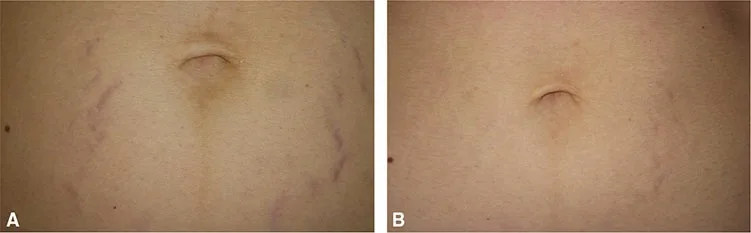 Fig 7. Striae rubrae, abdomen, before (A) and after (B) treatment in the active window. — (Krakowski, Scar Book, 2017, p.508)
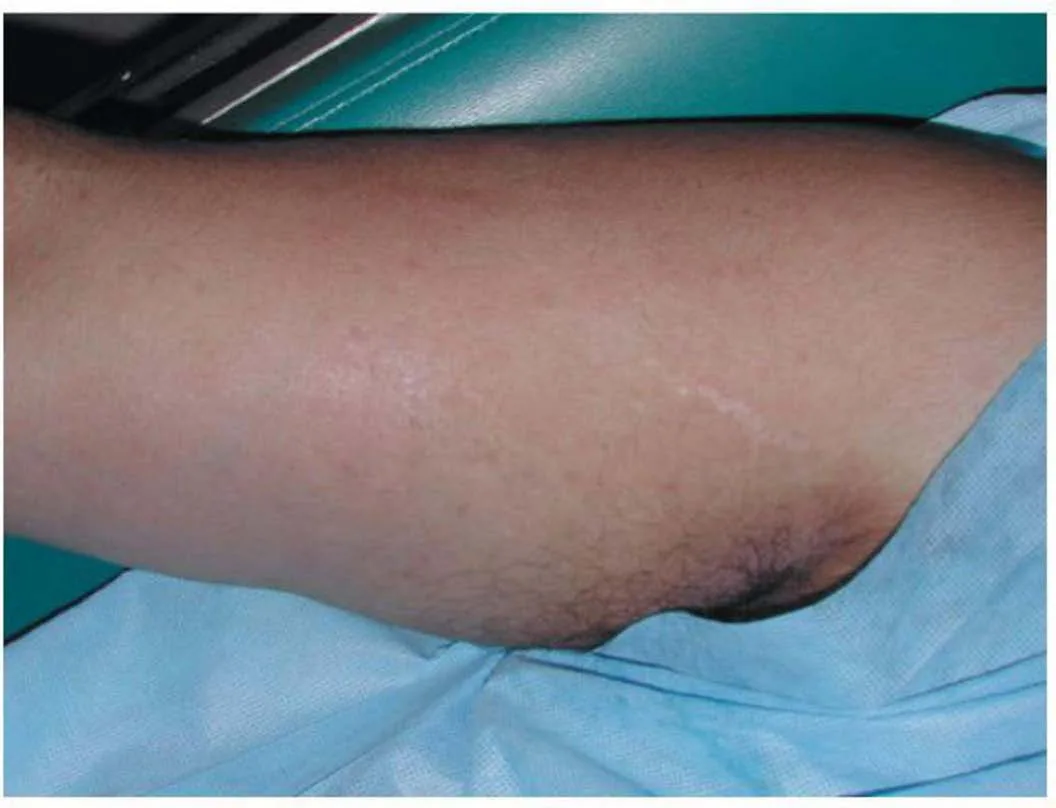 Fig 8. Striae albae, medial arm; atrophic established scar where texture, not colour, is the achievable outcome. — (Tannous, Color Atlas of Cosmetic Dermatology, 2011, p.298)
> The red stria is the moment to treat; the white stria is a scar (Fig 7 vs Fig 8). A patient arriving with rubrae has an incomparably better prognosis than one with albae, and saying so at the start prevents years of misplaced expectation. Conceptually it is scar work; see M2 — Scar Aesthetics & Revision.en.
Approach by stage: - Rubrae: vascular laser / IPL for the vascular-inflammatory component while it exists, topical retinoids, microneedling 37. - Albae: non-ablative or ablative fractional laser, microneedling with radiofrequency, microneedling with inducers, peels, carboxytherapy; the goal is texture and thickness, not colour [38]40. Combination beats monotherapy: fractional CO₂ + microneedle-RF scored 3.4 on a 1–4 improvement scale vs 2.2 (CO₂ alone) and 1.8 (microneedle-RF alone), with histologic epidermal thickening [34]. Body peels (glycolic, TCA, Jessner) are an adjunct for texture and dyschromia with conservative body priming [40]. - Both: photoprotection; control the cause when present (pregnancy, rapid growth, weight gain, corticosteroids) [MODELO].
Striae protocol by stage (the operational detail):
| Stage | First-line device | Adjuncts | Outcome realistic |
|---|---|---|---|
| Rubra | vascular laser / IPL (treat the vessel while it exists) [37] | topical retinoid, microneedling | fading of redness, arrest of progression, best prognosis |
| Alba | fractional laser (non-ablative/ablative) or microneedle-RF [38] | microneedling + inducers, peels, carboxytherapy | texture and thickness, NOT colour restoration |
| Both/mixed | stage-match per lesion | photoprotection, cause control | partial, multi-session |
Combination outperforms monotherapy (fractional CO₂ + microneedle-RF 3.4 vs 2.2 vs 1.8 on a 1–4 scale, with epidermal thickening) [34]. ⚠ Body parameters are conservative and never transferred from facial settings; abdomen, breast, buttock and thigh scar and pigment worse, so a test spot precedes treatment and tanned skin is not treated [MODELO][40]. The written expectation is improvement of texture, relief and visibility, never removal, the commonest complaint of the indication. Carboxytherapy is an adjunct for rubrae and early albae, working through local vasodilation and oxygenation, and pairs with the laser/RF course rather than replacing it.
⚠ Five body-skin safety rules (same as D14 §décolleté): never promise removal (write "improvement of texture, relief and visibility"); high phototypes carry real post-inflammatory hyperpigmentation risk (test spot, conservative parameters, topical prep, B6 — Ethnic, Racial & Cultural Considerations.en); do not treat tanned skin; facial parameters do not transfer to the body (abdomen, breast, buttock, thigh scar worse); many sessions, partial result, always photograph in the same position/light against baseline [MODELO].
Consensus: body skin quality is raised by bioremodeling/booster HA and PN, and striae are staged rubra vs alba before any device is chosen [17][18][20][34][MODELO]. Discrepancy: none clinically decisive on the agents; the striae-stage decision is the only one that changes the plan (device choice), and it is a diagnosis, not a controversy.
Polynucleotides and mesotherapy, the deeper detail. Polynucleotides (PDRN, salmon/trout DNA fragments) favour fibroblast activity and renewal, sustain ATP energy metabolism, act as physiological mediators (cAMP), and serve as nucleic-acid and coenzyme precursors (NAD, FAD, CoA) [21]; the body-specific caveat is that the corpus evidence is facial/mesotherapy-anchored and body-specific PN skin quality is thinner and overlaps F2 [MATERIAL GAP]. Body mesotherapy products are polycomponent: non-crosslinked HA combined with vitamins, minerals, amino acids, nucleotides, coenzymes, antioxidants, DMAE and organic silicon, in varying concentrations, for flaccidity and stretch marks [21]. The standard course is 3 biweekly sessions then monthly maintenance, and mesotherapy combines well with microneedling and peels (surface) and with implants/toxin (deeper) [21]. Delivery is manual syringe or automated injector; jet ("needle-free") injectors exist but have insufficient safety/efficacy data for cross-linked HA [18].
NASHA mechanism, resolved. In vivo, intradermal NASHA versus saline raised type-I collagen synthesis with procollagen expression elevated to 13 weeks, inhibited MMPs (collagen-degrading enzymes), and improved elasticity and roughness over 24 weeks [20]. Its stabilisation gives isovolemic degradation: each molecule binds progressively more water while keeping its size and shape, so correction and stimulus persist longer [20][42]. This is the mechanistic basis for using a skin booster on crepey body skin: it is not a filler effect, it is a fibroblast-stimulus effect.
Delivery and technique for body skin quality (schematic-first):
| Agent | Plane | Pattern | Course |
|---|---|---|---|
| Bioremodeling HA (Profhilo) | subdermal/intradermal, few defined points | bolus-aliquot points (BAP-style) that spread | 2 sessions ~4 wk apart, then every 6 mo [18] |
| Skin booster (NASHA/non-crosslinked) | mid-to-deep dermis | serial puncture / micro-droplet / auto-injector | weekly ×4 then maintenance [17][20] |
| Polynucleotides / PDRN | intradermal / meso | micro-droplet, auto-injector | 3 biweekly then monthly [21] |
| Mesotherapy (polycomponent) | intradermal | nappage / point-by-point / auto-injector | 3 biweekly then monthly [21] |
Boosters and bioremodeling HA are placed manually or by automated injector; the plane is intradermal to mid-dermal, never a deep bolus (they are not volumisers) [17][20]. Blanching on injection signals inadvertent superficial vasculature and mandates stopping and massaging [15]. Carboxytherapy (subcutaneous medical CO₂) is an adjunct for flaccidity, dark under-eye and stretch marks, working through a local Bohr-effect vasodilation and tissue oxygenation; it combines with the biostimulator/booster course rather than replacing it. Combination is the norm: mesotherapy pairs well with microneedling and peels for the surface and with implants/toxin for depth [21].
Post-weight-loss body skin quality (ties to E2.10). After stable large weight loss, the skin-quality lane (boosters, PN, bioremodeling HA) improves crepey texture on arms, knees and abdomen but does not remove redundant skin; it is sequenced after facial volume and before or alongside energy, and only once weight is stable [35][36][MODELO]. The lean-mass loss that accompanies GLP-1 or bariatric loss is metabolic (protein + resistance training), not a skin-quality target (K1 — Anti-Aging Medicine & Longevity.en) [36].
Where body skin quality overlaps other chapters (link, do not re-teach): dermis collagen types I/III, elastin, GAGs and ECM remodeling are in A2; intrinsic aging (telomere biology, senescence, hormones) in A2 §a23; the biostimulator vs HA "clock" comparison in A6; quality tiers for clinic policy in K3. This block adds only the body-region application and the striae-by-stage decision.
> Trampa clásica: treating striae without staging, or promising their removal. Rubra and alba have different prognoses (the first question at the mirror), and colour is not restored in albae; put "improvement, not removal" in writing, the commonest complaint of this indication [MODELO].
Coverage vs UPO
| UPO topic | Status in this chapter | What the atlas adds |
|---|---|---|
| CaHA (Radiesse) composition, mechanism, FDA lidocaine mix (Arenas) [10] | ✅ full (E2.2, E2.4, E2.7) | body dilution ladder 1:1→1:6, consensus mixing, per-brand rheology [12][13][14][16] |
| Hand rejuvenation, filler table (T16.5) [17] | ✅ full (E2.6) | 3-axis model, Busso grading, cannula vs bolus schools, on-label status [6][15][16] |
| Materiales de relleno, tipos/permanentes (Arenas) [11] | ✅ full (E2.2, E2.5) | permanent-product blacklist for body, brand map with registration [22] |
| Complicaciones de rellenos, granuloma doses (Tejero) [32] | ✅ full (E2.8, E2.9) | nodule classification table, biofilm workup, CaHA vascular consensus [27][28][41] |
| Mesoterapia, polinucleótidos (Ordiz) [21] | ✅ full (E2.11) | body PN vs facial overlap, NASHA mechanism, skin-booster grid [18][20] |
| Radiesse viscosity/G′ vs HA chart [10][16] | ✅ full (E2.3) | rheology terms defined, gauge/extrusion per product |
| Hyperdilute CaHA for body (neck/décolleté/arms/abdomen) | ✅ added, external | not a UPO topic: face-and-body consensus + dilution-by-skin-thickness [12][13][14] |
| Gluteal / buttock biostimulation, PLLA body dosing | ✅ added, external | not a UPO topic: gluteal PE risk factors, ≥20 vials, Lanluma/GANA X [3][23][26] |
| Bioremodeling HA (Profhilo/NAHYCO), skin boosters | ✅ added, external | not a UPO topic: H-HA+L-HA chemistry, no-BDDE stabilisation [18][19] |
| GLP-1 post-weight-loss body aesthetics | ✅ added, external | not a UPO topic: multimodal algorithm, weight-stability gate [35][36] |
| Striae by stage (rubra vs alba), PCL Ellansé durations | ✅ added | not a UPO topic: staging decision, combination laser/RF, 1/2/3/4-yr PCL [9][34][37][38] |
Rows the atlas covers that UPO does not teach at all: body PLLA reconstitution schools (7→40 mL) [23], CaHA intravascular management with hyaluronidase-as-diffusion-factor [27], HArmonyCa hybrid [33], PCL duration selection [9], and the body-specific "laxity is surgery" ceiling [24]. UPO is strongest on facial CaHA/HA and complication management; it is silent on body-region indication, which is the core of this chapter. ⚠ UPO slides are the fastest-ageing lane: a dose resting only on a UPO slide is never_sufficient_alone and every UPO-sourced number here is corroborated by a book or an external consensus.
Self-assessment
- A patient wants a bigger buttock with an injectable. What do you say, and what is the plane rule?
Answer
Injectables fill a hip dip and correct depressions but do not give cost-efficient global projection and do not replace a fat graft or implant; say so at the first consult. Plane: subcutaneous only, cannula tip palpable, never intramuscular (gluteal-vein embolism, the highest mortality in aesthetics) [3][23].- Give the CaHA dilution ladder by skin thickness for the neck/décolleté.
Answer
1:2 normal skin, 1:4 thin skin, 1:6 atrophic skin; diluted = 1:1, hyperdiluted ≥ 1:2; hyperdilution biostimulates without volume [12].- Why is PLLA reconstituted with a larger volume for the body than the face?
Answer
Higher dilution reduces post-treatment nodules; gluteal consensus is > 7 mL/vial ≥ 24 h before use, hands 8–14 mL/vial, body (Lanluma X) ~40 mL/vial [6][17][23].- CaHA and PLLA have no antidote. What is the one situation where hyaluronidase is still given for CaHA, and why?
Answer
Impending vascular occlusion: hyaluronidase is given for its edema-reducing, capillary-permeability and anti-inflammatory effects (to increase flow), not to dissolve CaHA; reported 600 U per 0.1 mL CaHA, every 2 h up to 4 cycles [27].- What are the three factors that lower fatal PE risk in gluteal fat/product injection?
Answer
Mid-to-superficial muscle plane (or subcutaneous), parallel cannula-tip angulation, and cannula ≥ 4.1 mm; inject only in motion, stage, discuss death risk [3].- When does CaHA volume "dip", and how does HArmonyCa address it?
Answer
The carrier gel resorbs at 3–4 months (early volume loss, worse in slow collagen-metabolisers); premixed CaHA:CPM-HA lets the HA bridge the gap until neocollagenesis matures [10][33].- Distinguish an early compressed nodule from a late inflammatory granuloma for treatment.
Answer
An early compressed implant (< 2 wk) is packed material and does not react to steroid; a late inflammatory granuloma has cellular ingrowth and does respond to intralesional triamcinolone → 5-FU/triamcinolone → allopurinol; classify (and culture if unknown material) before injecting anything [28][32].- What is the PLLA microsphere size, and what is the CaHA composition?
Answer
PLLA microspheres 40–63 µm (lyophilised with Na-CMC + mannitol); CaHA 30% microspheres 25–45 µm in 70% CMC gel [2][3][7].- Name the substances used for body skin quality and one chemical distinction of Profhilo.
Answer
Bioremodeling HA (Profhilo), non-crosslinked/NASHA skin boosters (Restylane Skinboosters, Teosyal Redensity I), polynucleotides/PDRN; Profhilo is a thermally stabilised H-HA (1100–1400 kDa) + L-HA (80–100 kDa) hybrid made without any BDDE cross-linker, so it adds no volume [18][19].- A striae patient: what is the first decision, and what cannot be restored in the white stage?
Answer
Stage rubra vs alba first; rubrae (active/vascular) have the good window (vascular laser/IPL), albae are established atrophic scars where texture and thickness improve but colour is not restored; never promise removal [37][38][34].What's new and trends
| Year | Change | Reference |
|---|---|---|
| 2018 | Global consensus formalises diluted (1:1) vs hyperdiluted (≥1:2) CaHA for skin tightening | [13] |
| 2019 | Face-and-body hyperdilute CaHA consensus: dilution by skin thickness, buttocks/arms/abdomen/knees covered | [12] |
| 2020 | CaHA intravascular expert consensus: hyaluronidase for CaHA vascular events despite no dissolution | [27] |
| 2021 | Lanluma (body-marketed PLLA) CE-marked; hyperdilute CaHA dilution-practice guidance | [14] |
| 2022 | Minimally invasive buttock augmentation review positions biostimulators/HA below implants in complications | [24] |
| 2023 | HA gluteal augmentation systematic review; Profhilo Structura adipose-homeostasis data | [19][25] |
| 2024 | Novel high-dose body PLLA (GANA X 630 mg) multicentric buttock-recontouring evidence; HArmonyCa 5-yr hybrid data | [26][33] |
| 2024–2026 | GLP-1 "Ozempic face/body": systematic reviews and skin-quality analyses reframe rapid weight loss as an aesthetic driver | [35][36] |
What did NOT change, and why the older references still stand. The material science is stable: CaHA is still 30% microspheres 25–45 µm in 70% CMC gel [2][7], PLLA is still 367.5 mg of 40–63 µm microspheres [3], and the neocollagenesis histology (type III at 4 mo → type I at 9 mo) is unchanged since the 2009 biopsy work [2][5]. The safety architecture is unchanged: the gluteal subcutaneous-plane rule, the "laxity is surgery" ceiling, the permanent-product blacklist, and the breast-parenchyma red line predate all the 2020s consensus and remain the load-bearing rules [3][22][28]. What is new is body-specific evidence (hyperdilution consensus, gluteal PLLA dosing, body-marketed brands, GLP-1 demand), not a change in what the molecules are or how they fail. ⚠ The corpus is Sculptra/Radiesse-era and predates Lanluma, GANA X and the GLP-1 literature; those facets are external and flagged [MATERIAL GAP] where no peer-reviewed anchor exists (Lanluma dosing).
Current directions by maturity class:
| Maturity class | Directions in this chapter |
|---|---|
| Clinically actionable now | hyperdilute CaHA ladder (1:2/1:4/1:6) for neck/décolleté/arms [12][13][14]; gluteal PLLA subcutaneous, > 7 mL, ≥ 20 vials [23]; CaHA on-label hand volumisation [6][17]; hyaluronidase adjunct in CaHA vascular events [27]; nodule/granuloma escalation ladder [28][29] |
| Promising but not validated | novel high-dose body PLLA (GANA X 630 mg) for gluteal recontouring, single retrospective cohort of 51 [26]; HArmonyCa hybrid for early-volume-loss bridging, facial data [33]; hyperdilute CaHA during active GLP-1 weight loss (4-patient case series) [36] |
| Preclinical/speculative | GLP-1 direct dermal-fibroblast effects beyond deflation, mechanism proposed not proven [35][36]; dispersion-metric optimisation of CaHA dilution [5] |
| Unsupported commercial claim | Profhilo marketing figures ("98.7% satisfaction", "100% tissue-quality improvement") appear on promotional pages, not peer-reviewed literature: treat with caution; Lanluma body dosing lacks a peer-reviewed anchor ([MATERIAL GAP]) |
Unexplored directions (AI speculation)
> Disclaimer: the following are AI-generated hypotheses, not evidence and not clinical guidance. Each is tagged [IA-ESPEC], carries no dose, product or protocol a reader could act on, and states what would settle it. They are not [A-D] evidence and not [MODELO] structure.
[IA-ESPEC]Dilution-titrated microsphere dispersion as a measurable outcome. Anchor: a 1:2 CaHA hyperdilution measurably increases microsphere dispersion and improves fibroblast contact versus 1:1 [5]. Proposal: in body sites, dispersion (not dilution ratio) may be the variable that predicts skin-quality gain vs nodule risk. Expected effect: dispersion correlates with dermal-thickness gain and inversely with nodule rate. Confounder: skin thickness and injector spread technique co-vary with dispersion and could drive the association. What would settle it: a trial correlating in-vivo ultrasound microsphere-dispersion metrics with dermal-thickness change and nodule rate across matched dilutions, controlling for site and technique.[IA-ESPEC]PCL duration matched to body-site turnover. Anchor: Ellansé chain length sets 1/2/3/4-year duration [9]. Proposal: the optimal PCL duration may differ by body region (higher-movement/thinner-skin sites favouring shorter versions) rather than being a patient-level preference. Expected effect: shorter-chain PCL shows lower nodule rates in thin/mobile sites at comparable satisfaction. Confounder: injector product preference and baseline skin quality differ by region and could masquerade as a duration effect. What would settle it: a region-stratified comparison of nodule/longevity outcomes across S/M/L/E in matched sites with randomised version allocation.[IA-ESPEC]GLP-1 as a direct dermal variable, not only a deflation cause. Anchor: reviews propose GLP-1 receptor effects on dermal white adipose tissue and fibroblast function beyond fat loss [35][36]. Proposal: biostimulator response during active GLP-1 therapy may be blunted or altered by the drug's direct dermal signalling. Expected effect: neocollagenesis (histologic type-I collagen, dermal thickness) is lower on-drug at matched weight loss. Confounder: concurrent rapid weight loss and caloric/protein deficit independently impair collagen synthesis and mimic a direct drug effect. What would settle it: a controlled comparison of biostimulator collagen response in patients on vs off GLP-1 agonists at matched weight trajectories and nutrition.[IA-ESPEC]Hyaluronidase-as-diffusion-factor quantified for CaHA ischemia. Anchor: consensus gives hyaluronidase in CaHA vascular events for flow/edema effects, not dissolution [27]. Proposal: the benefit, if real, is a tissue-pressure/perfusion effect measurable independent of any filler dissolution. Expected effect: hyaluronidase raises capillary perfusion in CaHA-adjacent ischemia versus saline of equal volume. Confounder: injected fluid volume alone alters tissue pressure and perfusion, so a volume-matched saline arm is essential. What would settle it: a perfusion-imaging study of hyaluronidase versus volume-matched saline in experimental CaHA-adjacent ischemia.[IA-ESPEC]Bioremodeling HA as an adjunct that lowers biostimulator nodule risk. Anchor: premixing CaHA with HA (HArmonyCa) reduced non-inflammatory nodules, and a foaming technique reduced them further [33]. Proposal: co-injecting a non-crosslinked bioremodeling HA with a body biostimulator may cut thin-skin nodule rates by improving dispersion and hydration. Expected effect: lower non-inflammatory nodule incidence in the combined arm at equal biostimulator dose. Confounder: the added HA increases total injected volume and dilutes the biostimulator, which could reduce nodules without any bioremodeling contribution. What would settle it: a split-body RCT of biostimulator alone vs biostimulator + bioremodeling HA on nodule incidence and skin-quality metrics, with a volume-matched saline comparator.[IA-ESPEC]A body-specific "reversibility index" for consent. Anchor: only HA is truly reversible; biostimulator salvage is off-label and evidence-thin [17][29]. Proposal: a composite index (site skin thickness × product irreversibility × surface area) could formalise the "choose reversible when undecided" rule into a consent tool. Expected effect: higher index scores predict higher revision/complication rates. Confounder: injector experience and case selection drive complications independently of any index and could dominate the signal. What would settle it: prospective validation of the index against actual revision/complication rates by site and product, adjusting for injector experience.
Safety
The five body red lines, restated as the operational core (repeat at every consult): 1. ⚠ Gluteal plane. Subcutaneous only, cannula tip palpable, never intramuscular/submuscular; inject in motion, stage large volumes, and discuss the risk of death for any large-volume gluteal procedure [3]. Fatal PE risk falls with mid-superficial-to-subcutaneous placement, parallel tip angulation and cannula ≥ 4.1 mm [3]. 2. ⚠ Laxity is not injectable. Pinch: redundant skin is surgery (abdominoplasty, brachioplasty, body lift, mastopexy). Biostimulators improve quality and thickness, never remove skin; do not stack sessions against laxity that has not moved [MODELO][24]. 3. ⚠ Nothing permanent in the body. No PMMA, polyacrylamide, silicone or "biopolymer"; the body's large volumes and product cost drive this trap, and these products have no salvage and the worst complication series [22][28]. Always ask what was injected before, where, by whom. 4. ⚠ No filler into breast parenchyma. Interferes with palpation, mammography and screening; treat only the skin (sternum/upper pole, superficial), and refer any palpable finding [MODELO]. 5. ⚠ Biostimulators are irreversible. No antidote for CaHA/PLLA/PCL; in thin-skin body sites default to reversible HA when undecided, dilute to the thin-skin end of the ladder, and place diffusely, never a superficial bolus [17][27].
Substance-specific safety: - CaHA: radiopaque (warn re imaging); no skin test; do not place superficially or in mobile thin sites (hard calcium nodules); vascular events have no dissolution, hyaluronidase is adjunctive only [2][7][27]. - PLLA: no day-0 effect (consent), reconstitute/hydrate adequately and dilute (nodule prevention), patient massage 5 days, out of favour for the hands (visible nodules under lax skin); granuloma incidence 0.01–0.1% [4][6][17][30]. - PCL: irreversible for the full chosen 1–4-year duration; start conservative (shorter versions) in new patients [9]. - Skin-quality HA/PN: lowest-risk group; HA-based partly reversible; still respect asepsis (biofilm) [18][31].
Screening and body-skin rules: examine hands/décolleté for actinic keratoses and suspicious lesions and refer before aesthetic treatment; dorsal veins are real venous access (restore volume before ablating); body skin scars worse and pigments more than the face (test spot, conservative parameters, more sessions, never treat tanned skin, high-phototype PIH risk) [MODELO][38]. Nodule/granuloma management is classified before treatment (E2.9): early compressed vs late inflammatory vs fluctuant vs biofilm; culture unknown material before immunosuppression [28][41]. Infection and asepsis discipline: J5 — Infection, Biofilm & Sterilization.en; biopolymer complications: J7 — Biopolymer & Permanent-Filler Complications.en.
> ⚠ The structural warning of the domain (E2.1–E2.6, E2.10): the body is the favourite territory of permanent products, "biopolymers" and the grey market. Large volumes, high legal-product cost and emotionally intense demand are exactly the culture medium. Ask, always, what was injected before, where, and by whom. See M6 — Unconventional, Off-Label & Grey-Market Practice.en.
References
> [A] IFU/approval · [B] primary literature (verified DOI/PMID) · [C] monograph/textbook · [D] slide/opinion · [MEDLIB] own corpus.
- Avram DE, Avram MM. Fat Removal: Invasive and Non-invasive Body Contouring. 1st ed. Wiley-Blackwell; 2015.
[C][MEDLIB] - Draelos ZD. Cosmetic Dermatology: Products and Procedures. Wiley-Blackwell; 2009.
[C][MEDLIB] - Chang JW, Yu D, Percec I. Injectable fillers: comparison of materials, indications and applications; and gluteal fat grafting safety. Adv Cosmet Surg. 2018.
[B][MEDLIB] - André P, André R, Haneke E; Haneke E. Soft-tissue augmentation and complications of fillers. In: Cosmetic Medicine & Surgery. CRC Press; 2016.
[A][MEDLIB] - Piccolo D, et al. A.R.T. Autologous Regenerative Therapy in Aesthetic Medicine. Springer; 2025.
[A][MEDLIB] - Waldorf HA, Emer JJ, Vanaman Wilson M, Trindade de Almeida AR, Banegas RA, et al. Hands, neck/chest and buttocks. In: Carruthers J, Carruthers A, eds. Soft Tissue Augmentation. 4th ed. Elsevier; 2018.
[A][MEDLIB] - Towne BM, Mehra P, eds. Neurotoxinas y sustancias de relleno en cirugía estética facial. Wiley Blackwell; 2019.
[B][MEDLIB] - Viscusi KS, Hanke CW. Soft tissue augmentation. In: Baran R, Maibach HI, eds. Textbook of Cosmetic Dermatology. 5th ed. CRC Press; 2017.
[C][MEDLIB] - Pirayesh A, et al. Aesthetic Facial Anatomy Essentials for Injections. CRC Press; 2020.
[C][MEDLIB] - Arenas D. Radiesse (hidroxiapatita cálcica): experiencia en rejuvenecimiento. UPO Sorted, Máster ME.
[D][MEDLIB] - Arenas D. Técnicas avanzadas y revisión de materiales de relleno. UPO Sorted, Máster ME.
[D][MEDLIB] - de Almeida AT, et al. Consensus Recommendations for the Use of Hyperdiluted Calcium Hydroxylapatite (Radiesse) as a Face and Body Biostimulatory Agent. Plast Reconstr Surg Glob Open. 2019;7:e2160.
[A]DOI 10.1097/GOX.0000000000002160 · PubMed 31044123 - Goldie K, et al. Global Consensus Guidelines for the Injection of Diluted and Hyperdiluted Calcium Hydroxylapatite for Skin Tightening. Dermatol Surg. 2018;44(Suppl 1):S32-S41.
[A]DOI 10.1097/DSS.0000000000001685 - Lorenc ZP, et al. Skin Tightening With Hyperdilute Calcium Hydroxylapatite: Dilution Practices and Practical Guidance. Aesthet Surg J. 2021;42:NP29-NP37.
[A]DOI 10.1093/asj/sjab269 - Reszko AE, Sadick NS. Volumetric approach to rejuvenation of the hands. In: Illustrated Manual of Injectable Fillers. Informa Healthcare; 2011.
[A][MEDLIB] - Carruthers J, Carruthers A. Aumento de tejidos blandos (Dermatología estética). 3ª ed. Elsevier Saunders; 2013.
[C][MEDLIB] - Técnicas de rejuvenecimiento del dorso de las manos. UPO Sorted, T16.5.
[D][MEDLIB] - Wong M. Decision Making in Aesthetic Practice. CRC Press; 2022.
[C][MEDLIB] - Cassuto D, et al. Restoring Adipose Tissue Homeostasis in Response to Aging: Initial Clinical Experience with Profhilo Structura. Gels. 2023;9:614.
[B]DOI 10.3390/gels9080614 · PubMed 37623069 - Vidurrizaga, Esparza, et al. Medicina estética: abordaje terapéutico. 1ª ed. 2011.
[C][MEDLIB] - Ordiz I. Mesoterapia facial y corporal. UPO Sorted, Máster ME.
[D][MEDLIB] - Sánchez-Carpintero I, et al. Materiales de relleno: tipos, indicaciones y complicaciones. Actas Dermosifiliogr. 2010;101:381-393.
[B]DOI 10.1016/j.ad.2010.01.004 - Durairaj KK, et al. Poly-l-Lactic Acid for Gluteal Augmentation Found to Be Safe and Effective in a Retrospective Clinical Review of 60 Patients. Dermatol Surg. 2020;46:S46-S53.
[B]DOI 10.1097/DSS.0000000000002598 - Atiyeh B, Ghieh F, Oneisi A. Safety and Efficiency of Minimally Invasive Buttock Augmentation: A Review. Aesthetic Plast Surg. 2022;47:245-259.
[A]DOI 10.1007/s00266-022-03049-5 · PubMed 35999464 - Mortada H, et al. Effectiveness and Role of Using Hyaluronic Acid Injections for Gluteal Augmentation: A Comprehensive Systematic Review. Aesthetic Plast Surg. 2023;47:2719-2733.
[A]DOI 10.1007/s00266-023-03458-0 · PubMed 37407710 - Russo PR, et al. Multicentric Retrospective Study on Safety and Efficacy of a Novel Injectable Poly-l-Lactic Acid for Buttocks Recontouring. J Cosmet Dermatol. 2024;24:e16580.
[B]DOI 10.1111/jocd.16580 · PubMed 39445541 - van Loghem J, Funt D, Pavicic T, et al. Managing intravascular complications following treatment with calcium hydroxylapatite: an expert consensus. J Cosmet Dermatol. 2020;19:2845-2858.
[A]DOI 10.1111/jocd.13353 - Lemperle G, Gauthier-Hazan N, et al. Foreign Body Granulomas after All Injectable Dermal Fillers. Plast Reconstr Surg. 2009;123:1864-1873.
[B]DOI 10.1097/PRS.0b013e3181858f4f - van Loghem J. Soft Tissue Filler Complications. CRC Press; 2023.
[B][MEDLIB] - Machado Filho CD, et al. Ácido poli-L-láctico: um agente bioestimulador. 2013.
[A][MEDLIB] - Haddad A, et al. Current concepts in the use of poly-L-lactic acid for facial rejuvenation: literature review and practical aspects. Surg Cosmet Dermatol. 2017;9.
[B]DOI 10.5935/scd1984-8773.201791952 - Tejero P. Manejo de las complicaciones de los materiales de relleno. UPO Sorted, T10.
[D][MEDLIB] - Fakih-Gomez N, et al. The Hybrid Filler Technique: A 5-Year Retrospective Analysis. Aesthetic Plast Surg. 2024;49:618-626.
[B]DOI 10.1007/s00266-024-04387-2 - Lapidoth M, Halachmi S, eds. Radiofrequency in Cosmetic Dermatology. Karger; 2015.
[B][MEDLIB] - Daneshgaran G, et al. "Ozempic Face" in Plastic Surgery: A Systematic Review of the Literature on GLP-1 Receptor Agonist-Mediated Weight Loss. Aesthet Surg J Open Forum. 2025;7:ojaf056.
[A]DOI 10.1093/asjof/ojaf056 · PubMed 40626110 - Barone M, et al. Effects of GLP-1 Receptor Agonists on Skin Quality: A Comprehensive Literature Review. Aesthetic Plast Surg. 2026;50:5403-5407.
[A]DOI 10.1007/s00266-026-05820-4 - Krakowski AC, Shumaker PR, eds. The Scar Book: Formation, Mitigation, Rehabilitation and Prevention. Wolters Kluwer; 2017.
[C][MEDLIB] - Tannous Z, Avram M, Avram M, Kaminer M, Tsao S. Color Atlas of Cosmetic Dermatology. 2nd ed. McGraw-Hill; 2011.
[C][MEDLIB] - Alam M, ed. Evidence-Based Procedural Dermatology. Springer; 2019.
[B][MEDLIB] - Small R. A Practical Guide to Chemical Peels, Microdermabrasion & Topical Products. Lippincott Williams & Wilkins; 2013.
[C][MEDLIB] - Tejero P, Mota S. Efectos adversos de los materiales de relleno inyectables. UPO Sorted, T10; 2024.
[D][MEDLIB] - Arenas D. Ácido hialurónico: estabilización NASHA y degradación isovolémica. UPO Sorted, T8.1.
[D][MEDLIB]
Navigate
Prev: E1 — Facial & Submental Lipolysis.en · Next: E3 — Thread Lifting - Face & Body.en · Domain: E — Body Contouring & Aesthetics
Verification: EN canonical chapter, SUSTANCIA template, 11 blocks (E2.1 In-30-seconds + E2.2–E2.11). Added subchapter E2.11 (Body skin-quality agents: bioremodeling, skin boosters, polynucleotides, striae by stage) because body skin quality and striae are a distinct substance family with their own chemistry/indications that the 10-block substance template did not house, and it is the salvage home for the prior chapter's décolleté/post-weight-loss/striae content. Salvage: prior .es.md region-structured chapter (buttock/breast/hands/hyperdilute/post-WL/striae) fully re-homed into the substance template (regions → E2.6, dilution → E2.7, striae/skin-quality/post-WL → E2.10/E2.11); no fact dropped. Evidence: MEDLIB retrieval E2.1–E2.6 (evaluation/runs/E2.*.jsonl, all exit 0) + external consensus/reviews with DOIs Crossref-verified. Every DOI/PMID verified against Crossref (15/15 real; my recalled Cárdenas-Camarena DOI resolved to an unrelated paper and was dropped, gluteal-death data cited via corpus [3]). [MATERIAL GAP]: Lanluma body-PLLA dosing (no peer-reviewed corpus/DOI anchor; Sinclair, scout-sourced). Figures: 8, all opened with Read before captioning. Body attribution kept to Autor año [n]; no PMID/DOI in body.