B6 · Ethnic, Racial & Cultural Considerations in Face & Body Reshaping
> Currency and provenance — 50 references · median 2021, range 1988-2026, 48 % from 2022 on · provenance: verified external 60 % (30) · MEDLIB corpus 40 % (20, of which 2 from the UPO master's).
Domain: B — Patient Assessment & Consultation · Practice chapter (series B, foundations and professional practice).
> Tags: [A] guideline/consensus with year · [B] primary literature with PMID/DOI · [C] monograph/textbook · [D] slide or opinion, never sufficient alone · [MEDLIB] own corpus · [MODELO] structure, never a figure · (P) model reasoning, never a dose · ⚠ disputed or stale figure.
Subchapters
- [ ] B6.1 · In 30 seconds
- [ ] B6.2 · Applicable regulation and law (Spain and EU)
- [ ] B6.3 · The procedure, step by step
- [ ] B6.4 · Templates and documents
- [ ] B6.5 · Frequent errors and their cost
- [ ] B6.6 · Metrics: what is measured and the reference value
- [ ] B6.7 · Spanish particularity
- [ ] B6.8 · Alternatives of organization
B6.1 · In 30 seconds
Published aesthetic norms describe a Caucasian reference population and present its means as normality. Applied as a target to another morphotype, a normal variant reads as a "defect" and the treatment Westernizes without anyone deciding to. That mechanism is technical, and it is preventable [1][3][4]. Two guards against the opposite error: ethnicity is not a clean biological category (a continuum, huge within-group variation, rising admixture; a group table anticipates demand, it never diagnoses) [2]; and Fitzpatrick phototype (FST) is not ethnicity (FST governs energy and peel risk and is measured on the skin in front of you, never deduced from a surname or a country) [1][2]. The chapter is one clinical sequence built on that split: ethnicity-informed on anatomy and safety, individual on goals; the glanceable form is below, the exhaustive form is the eight blocks [4][8]. The single most common failure is to treat a normal ethnic variant as a deficiency to correct; the single most dangerous is to pick an energy parameter from declared ancestry instead of from the examined phototype [1][5]. In a Spanish clinic whose catchment is 14.1% foreign-national, this is the default consult, not an edge case [9].
In 30 seconds
> The two questions that replace the whole ethnic table, asked before proposing anything: "what would you want to keep about your face, whatever we do?" and "is there anything you would be worried about changing?" Write the answer verbatim in the record [4].
The one rule per axis (the glanceable core):
| Axis | Governing rule | Ref |
|---|---|---|
| Analysis | Describe the individual's own balance and stated goals. Neoclassical canons (thirds, fifths, golden ratio, E-line) are Caucasian/Renaissance-derived and fit non-Caucasian faces poorly. Vocabulary, not target | [3][4] |
| Energy / peel | FST, measured on the skin, sets every parameter. Longer wavelength, lower fluence, lower density, wider spacing, more cooling, more sessions, mandatory test spot in V-VI | [1][5][6] |
| Injectable | Volumize the medial midface, not the lateral malar, in an already-projected face; modulate, do not paralyze, where volume deficit drives muscle pull; preserve the alar base, tip and lip volume unless the patient asks otherwise | [4] |
| Body | Gluteal fat grafting is subcutaneous plane only, never intramuscular; the trunk keloids and PIHs like the face | [8] |
| Consent | Ethnicity/race is special-category personal data; record only with explicit consent, in a language the patient commands, never through an accompanying relative | [2] |
FST IV-VI energy and peel ladder (answer first, the parameter you reach for):
| Modality | Rule in FST IV-VI | Ref |
|---|---|---|
| Nd:YAG 1064 nm | Workhorse. Longest wavelength, least epidermal-melanin absorption; safest laser in dark skin | [1][5] |
| Diode 810 / 808 nm | Acceptable for hair reduction with contact cooling, lower fluence, longer pulse duration | [5] |
| IPL (broadband) | Not for hair removal in V-VI. Broadband does not discriminate target from epidermal melanin | [1][5] |
| Non-ablative fractional (1927 / 1550 nm) | Preferred over ablative for texture and pigment; low density, spaced sessions | [5][6] |
| Ablative fractional | Very high threshold. If used: low density, pre-conditioning, close follow-up | [1][5] |
| Q-switched / picosecond 1064 nm | Low fluence for procedure-related PIH and lentigines; ultra-low fluence for melasma to avoid rebound | [5][6] |
| Chemical peel | Salicylic, mandelic, phytic and low-strength glycolic preferred; avoid high-concentration TCA and phenol | [1] |
| Universal in V-VI | Test spot in a hidden zone, epidermal cooling, conservative-and-serial over single-aggressive | [1][5][6] |
Pre-procedure screen (every skin-breaching or energy act):
| Ask | Why it changes the plan | Ref |
|---|---|---|
| PIH after acne, waxing, wounds? | PIH is the dominant, most under-rated complication of the whole chapter; it lasts months to years | [1][6] |
| Keloid / hypertrophic scar, personal and family, and site? | Relative contraindication before threads, deep microneedling, ablative, excision | [7] |
| Melasma, pregnancies, hormonal contraception? | Reframes any energy plan toward ultra-low fluence and photoprotection | [6] |
| Prior procedures, including body injections done abroad or outside medical circuits? | Buried biopolymer changes the entire management; ask twice | [8] |
Red lines (never, regardless of what is requested): 1. Never deduce FST from origin or surname; FST is examined [1][2]. 2. Never IPL hair removal in FST V-VI [1][5]. 3. Never a skin-breaching aesthetic act without a keloid screen [7]. 4. Never intramuscular gluteal fat or filler; subcutaneous plane only [8]. 5. Never widen the bizygomatic distance with lateral malar filler in an already-projected midface [4]. 6. Never reduce the alar base or lip volume that was not requested; these are the most identity-bearing features [4]. 7. Never use an accompanying relative as interpreter for consent [2]. 8. Never rely on blanching to detect vascular occlusion in dark skin; it is far less visible. Lean on disproportionate pain and capillary refill, and lower the threshold to act.
Ethnic aesthetic-goal probability map ⚠ (a demand map, not a plan; it forces you to ask instead of assume; an individual may want the opposite of their row, and that is legitimate) [2][4]:
| Sphere | Goals most often requested ⚠ |
|---|---|
| East Asian | Narrower face (masseter reduction, refine the lower third, V-shaped chin) · nasal dorsum and tip projection · chin projection · smooth full forehead · double eyelid · very even light skin · avoid widening the malar |
| South Asian | Lower-third definition · refined nose without loss of identity · melasma and PIH as the priority · defined, not augmented, lips |
| African / Afro-descendant | Definition, not lip volume · preserved malar projection · PIH and keloid as the dominant concern · tone evenness · tip refinement without narrowing the base |
| Middle-Eastern | Nasal profile (dorsal hump) the flagship request · fuller lips accepted and sought · high, marked cheekbone · large defined eyes |
| Latino / Hispanic | Great heterogeneity · balanced profile · defined lips with moderate volume · high body-contour demand · FST III-IV with real PIH risk |
| Caucasian | Malar volume · jaw definition · lips · the population the published canons came from |
Morphotype → what actually changes the gesture (safety and morphometry are ethnicity-informed; goals stay individual) [17][20]:
| Structure | Variation that matters | Consequence at the chair |
|---|---|---|
| Midface skeleton | Wider bizygomatic width, more lateral malar projection (East Asian); strong malar projection (Afro) | Less indication for lateral malar volume; sometimes the goal is to narrow |
| Chin / maxilla | Less anterior chin projection, relative maxillary retrusion in several morphotypes | Chin projection is the highest-yield single move; it changes the whole profile |
| Masseter / gonial angle | Masseter hypertrophy more prevalent in East Asians | Toxin to the masseter as a contouring act, not a bruxism one |
| Nose | Lower dorsum, wider base (Afro, East Asian); high dorsum with hump (Middle-Eastern, Mediterranean) | Non-surgical rhinoplasty adds projection in one, camouflages a hump in the other |
| Lips | Greater base volume and eversion (Afro); longer upper lip in some morphotypes | The goal is usually shape and border, not volume |
| Skin: melanin and repair | Larger, more dispersed melanosomes; reactive melanocytes; keloid tendency | PIH and keloid: the risks that govern the chapter |
Already covered in the wiki (linked, not re-taught here): pigmentation biology, melanogenesis, melasma and PIH differential in A2 §pigmentation; the two balances and regional anatomy in A1; vertical thirds in B1; the Spanish-market particularity of consent and demand in B2 §b27.
Culture, religion, market (one line each): injectables generally do not break the Ramadan fast, but scholarly opinion differs; defer the ruling to the patient's own religious authority and set timing/hydration around fasting. Hyaluronic-acid fillers are the default where porcine, gelatin or collagen-derived content is a concern; disclose animal-derived ingredients and offer alternatives [15]. Spain is a real skin-of-color market: 14.1% of residents hold foreign nationality (6,911,971 of 49,128,297; 1-Jan-2025), the largest groups Moroccan, Colombian and Romanian [9].
Decision order (the consult in eight moves): 1 confirm language and the data-protection basis; 2 examine FST on the skin; 3 screen PIH, keloid (self/family/site) and prior injections including body; 4 capture keep/avoid verbatim; 5 map the morphology without a template; 6 choose product/energy/plane against the stated goal and the measured FST; 7 if FST IV-VI and energy/peel is planned, pre-condition and test-spot; 8 photograph matched to phototype and consent naming PIH and keloid [1][4][5][6][7]. Every later block is one of these eight moves in full.
Trampa clásica: treating a high-phototype ageing face with the anti-wrinkle arsenal (superficial toxin, aggressive resurfacing). In FST IV-VI the dominant ageing sign is descent and laxity, not fine rhytides; the wrong-problem plan adds PIH risk for no benefit [1][5].
B6.2 · Applicable regulation and law (Spain and EU)
Ethnic-aware practice touches four legal duties at once: data protection (recording race/ethnicity/phototype is processing a special category), consent (comprehensible information across a language barrier), non-discrimination (differentiating access by ethnic origin is unlawful; adapting technique to morphology is not), and product regulation (fillers are medical devices; composition can be disclosed for religious/animal-derived concerns). The glanceable version:
| Norm (cited) | What it requires in this chapter | Consequence at the chair |
|---|---|---|
| GDPR, Reg. (EU) 2016/679, Art. 9 [10] | Racial/ethnic origin is a special category; processing is prohibited unless a lawful exception applies (Art. 9.2.a explicit consent; 9.2.h medical care) | To write "morphotype", declared ancestry or an ethnicity-linked FST rationale in the record you need documented explicit consent or the health-care basis; store the minimum; a full-face before/after is identifiable personal data |
| LOPDGDD, LO 3/2018 [11] | Spanish implementation of GDPR; reinforced safeguards for special-category data; minor's own consent from age 14 | Special-category clinical data needs a defined lawful basis and security measures; a 14-17 year-old can consent to routine data processing, but the aesthetic act itself follows the consent rules below |
| Ley 41/2002 (autonomía del paciente) [12] | Information must be comprehensible; consent for procedures carrying risk is written; the patient decides | Consenting in a language the patient does not command is not consenting; use the patient's language or a professional interpreter and record how it was done |
| Ley 15/2022 (igualdad de trato y no discriminación) [13] | Prohibits discrimination by racial/ethnic origin (among other grounds) in access to goods and services, healthcare included | Refusing, delaying or lowering the standard of care by ethnicity is unlawful; adapting technique to FST and morphology is clinical individualization, the opposite of discrimination |
| MDR, Reg. (EU) 2017/745 (+ 2022/2346) [14] | Dermal fillers are medical devices; those without a medical purpose fall under Annex XVI with common specifications; CE marking is mandatory | Use CE-marked product only; document composition so an animal-derived vs synthetic choice can be offered for halal/religious or vegan requests [15] |
Data protection, in practice. The datum this chapter runs on, declared ancestry and the phototype rationale, is exactly the special category GDPR Art. 9 protects [10]. Two operational rules follow. First, the lawful basis is either explicit consent (Art. 9.2.a) or the provision of health care (Art. 9.2.h); pick one and be able to name it. Second, minimize: record FST (a clinical measurement you took) and the treatment rationale, not a racial label the patient did not volunteer. LOPDGDD adds the Spanish security-measure and minors layer [11]. Clinical photography of an identifiable face is personal data; store it inside the medical record, not on a personal phone, and keep the retention rule the same as the rest of the history.
Consent across a language barrier. Ley 41/2002 requires information the patient can understand [12]. A relative who accompanies the patient filters, decides and contaminates autonomy, and a minor used as interpreter is worse; use a professional interpreter or written material in the patient's language, and note in the record how consent was taken. When the aesthetic goal itself is culturally loaded (an identity-bearing feature), the comprehensible-information duty includes stating plainly what will and will not change, in the patient's own terms.
Non-discrimination without stereotyping. Ley 15/2022 makes differential access to care by ethnic origin unlawful [13]. The line that keeps ethnic-aware practice on the right side of it: safety and morphometry are ethnicity-informed (FST and repair biology are not negotiable); goals are individual and are the patient's, never the group table's. Treating an African-descent patient with a keloid screen and 1064 nm parameters is individualization; assuming that patient wants a particular nose is stereotyping.
Product composition and religion. Under MDR the filler is a CE-marked device whose composition is documented [14]. Hyaluronic acid of bacterial-fermentation origin is the default where porcine, bovine-collagen or gelatin content is a concern; the animal-derived-ingredient question is a real one for observant Muslim, Jewish and vegan patients, and disclosing it is part of the comprehensible-information duty, not an optional courtesy [15]. Injectables generally do not break the Ramadan fast, but scholarly opinion differs and the ruling belongs to the patient's own religious authority, not the clinician; the practical adjustments are timing (avoid the vasovagal-prone fasting window) and hydration [15]. (P) This is a consent and scheduling matter, never a clinical contraindication.
Retention, access and rectification. The special-category datum and the clinical photographs follow the same retention rule as the rest of the medical record under Ley 41/2002, with the LOPDGDD security measures applied [11][12]. The patient's GDPR rights of access and rectification reach this data too: a request to delete a racial label the patient never volunteered is exactly the situation the minimization principle should have pre-empted, which is why the record holds an examined FST and a stated goal rather than an ethnic category [10]. Store photographs inside the record system, not on a personal device, and treat a request for their deletion as a rights request, not a favour.
Advertising, and the single-ideal image. Westernization can be built into the marketing before the patient arrives. Spanish general advertising law and the rules on health-service promotion restrict guaranteed-result claims and misleading before/after imagery [49][50]. (P) A gallery that shows only one facial ideal is both a clinical and a communication problem: it primes every patient toward the same target and undercuts the keep/avoid conversation the chapter is built on. Show a range of morphotypes and outcomes, or show none.
Minors. Aesthetic acts on minors carry heightened consent scrutiny under Ley 41/2002: the mature-minor doctrine and parental involvement both apply, and non-therapeutic cosmetic procedures are commonly deferred toward adulthood or restricted [12]. The cross-cultural layer sharpens this: family-driven pressure toward an ethnic-modifying procedure on a minor is exactly where the autonomy safeguard and the deferral bias should be strongest.
Which act triggers which duty (the map):
| Clinical act | Duty that bites first |
|---|---|
| Recording ancestry / phototype rationale | GDPR Art. 9 lawful basis + minimization [10][11] |
| Any procedure with risk | Comprehensible written consent, PIH/keloid named [12] |
| Choosing/declining a patient by origin | Non-discrimination [13] |
| Selecting the filler | CE-marked device + composition disclosure [14][15] |
| Publishing before/after or a gallery | Advertising rules, no guaranteed result, no single-ideal priming [49][50] |
| Treating a minor | Heightened consent, deferral bias [12] |
Trampa clásica: writing "Latina, wants a smaller nose" in the chart after a consult conducted in Spanish with the patient's cousin translating. Three breaches in one line: a racial label with no Art. 9 basis [10], consent that is not comprehensible under Ley 41/2002 [12], and a relative as interpreter. The fix costs nothing: record the FST and the stated goal, take consent through a professional interpreter, and note it.
B6.3 · The procedure, step by step
The whole chapter reduces to one clinical sequence: take the phototype, screen the two repair risks (PIH, keloid), map the morphology without a template, capture what the patient wants to keep, then choose product/energy/plane against that. The transcultural consult, in order [16][17]:
- Verify the language. Arrange a professional interpreter if needed. Never the accompanying relative [12].
- Ask what to keep before proposing anything. Record it verbatim [4].
- Ask what they would fear changing.
- Determine FST by examination, not by declared origin [1][2].
- Ask for prior PIH: marks after acne, waxing, wounds [6].
- Ask for keloid, personal and family, and site [7].
- Ask for melasma, pregnancies, hormonal contraception [32].
- Ask for prior procedures, including those done abroad or outside a medical circuit, and specifically body injections [8].
- Read the anatomy without a template: describe what you see, not what is missing against a canon [3].
- Propose the plan in the patient's own goal terms, and state explicitly what you will not change [4].
- If energy or a peel is planned and FST is IV-VI: pre-conditioning, hidden-zone test spot, conservative parameters [5].
- Comprehensible consent, with PIH and keloid named explicitly when they apply [12].
- Photograph with lighting matched to the phototype: underexposure on dark skin destroys the comparative value of the image.
B6.3.1 · Ethnicity-aware analysis (no fixed canon)
Consensus: analyse the individual's own balance and stated goals; use proportion canons as shared vocabulary, never as the target [3][4][17]. Discrepancia (it changes the gesture): three schools of facial analysis, and which one you run decides what you call abnormal.
| School | The analysis target it sets | Cost |
|---|---|---|
| Universal neoclassical canons | Fixed proportion ideals (thirds, fifths, golden ratio, Ricketts E-line), applied to all | Caucasian/Renaissance-derived; fits non-Caucasian faces poorly; Westernizes by default. It is the implicit position of most training [3] |
| Ethnicity-specific norms | Distinct anthropometric standards per ancestry set the target | Correct on anatomy and safety; risk of stereotyping the individual [18] |
| Individualized / patient-defined | Reject group averages; analyse this face's own balance and stated goals | Ethically the most solid; does not exempt you from knowing the safety differences [4] |
Decide: ethnicity-informed on anatomy and safety, individual on goals. Le/Forrest measured it directly: applying neoclassical canons to Asian and North-American Caucasian faces, most canons fail in both groups, and they fail differently, so the "universal" canon is neither [3]. Wilson's anthropometric norms for the young Black South African woman make the same point with numbers: the reference values are not the textbook ones [18].
Doing the individualized analysis, mechanically. The individual-first school is only safe if it is operationalized, otherwise it collapses back into the clinician's canon by default. Three moves make it concrete [4][17]: capture the keep/avoid answer as an open question and record it verbatim, ideally with the patient pointing on their own photograph at what they want left alone; analyse the face's own symmetry and balance (right-vs-left, upper-vs-lower third, the patient's own profile line) rather than its distance from a fixed ratio; and use the canon only as shared vocabulary to communicate a plan, never as the target the plan is measured against. Where 3D or photo-morphometry is available, annotate on the patient's own image and set the goal in their terms; the software's "ideal overlay" is the canon in a new form and is the thing to switch off [3].
B6.3.2 · Ethnic facial morphometry
Morphology anticipates the technique; it does not license a fixed plan. The load-bearing differences [17][20][25]:
| Region | Ancestry-linked variation | What it changes |
|---|---|---|
| Nasal dorsum / tip / base | Lower dorsum and wider, less-projected base with thicker skin (African, East Asian); high dorsum with a hump (Middle-Eastern, Mediterranean) | Non-surgical rhinoplasty adds radix/tip projection in the first, camouflages the hump in the second. Thick nasal skin blunts small-volume tip work |
| Malar / midface | Wider bizygomatic width, more lateral malar projection (East Asian); strong anterior malar projection (African) | Less indication for lateral malar volume; the goal is sometimes to narrow, not augment |
| Chin / jaw / gonial angle | Less anterior chin projection, masseter hypertrophy more prevalent (East Asian) | Chin projection is the highest-yield profile move; masseter toxin is a contouring act |
| Lips | Greater base volume and vermilion eversion (African); longer upper lip in some morphotypes | The goal is border and shape, not volume |
| Periorbita / eyelid | Presence/absence of the supratarsal fold, medial epicanthus (East Asian); deeper-set globe in some | Changes brow and tear-trough strategy; the fold is not a defect to erase |
| Skin thickness / dermis | Thicker, more collagen-dense dermis in high phototypes | Fewer fine wrinkles, more descent and laxity with age |
Periorbita, forehead and hairline deserve their own reading, because this is where "correction" most easily becomes erasure [17][25]. The supratarsal fold may be absent or low and a medial epicanthal fold present in the East-Asian eye; neither is a defect, and a tear-trough or brow plan that treats the absent fold as something to build changes the eye's ethnic character. The brow is often lower and straighter in several morphotypes; lifting and arching the tail feminizes and de-ethnifies at once. The forehead reads as a volume target in the East-Asian patient (a full convex forehead is desirable) rather than only as a wrinkle field. Facial and scalp hair carry identity value in several cultures (the beard, the hairline), so hair-bearing planning and any hairline work is an identity decision, not only an aesthetic one.
The ageing pattern itself differs. Thicker, more collagen-dense dermis in high phototypes means fewer fine rhytides and more midface descent and lower-face laxity with age, and a later onset of the visible change; the dominant visible complaint is often dyschromia (melasma, PIH, uneven tone) rather than lines [1][17]. The plan that reaches for the anti-wrinkle arsenal in this face treats the wrong problem and adds PIH risk.
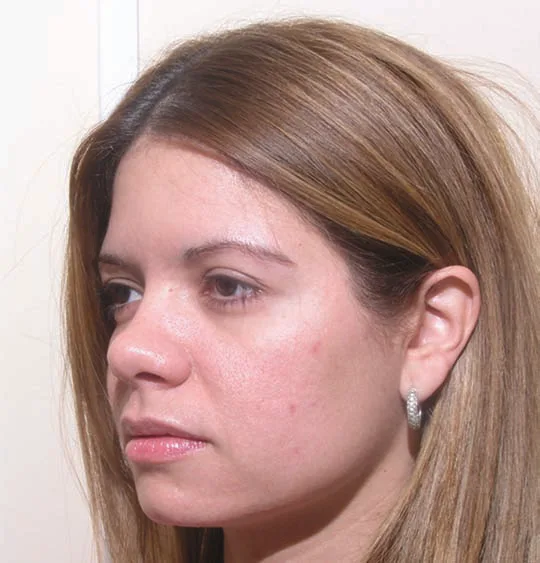 Fig 1. Latina/Hispanic midface: read the individual's own balance, not a distance from a Caucasian canon. Carniol, 2010, p. 73.
Fig 1 is the point of the whole block in one face: nothing here is a "defect", and the analysis that treats a preserved malar projection as under-volumized is the one that Westernizes. Fig 2 maps the nasal subunit and its vascular territory, the region where morphotype guides the plan and where non-surgical rhinoplasty carries the highest vascular risk [20].
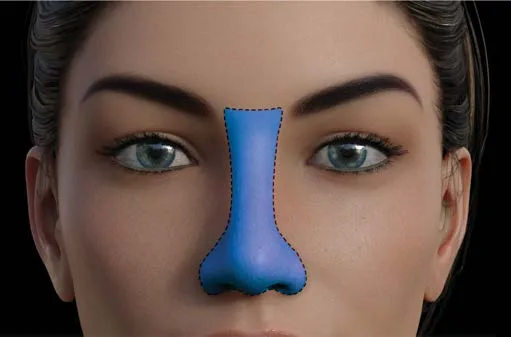 Fig 2. Nasal subunit and vascular territory: midline-only filler, low volume, and a raised suspicion threshold in a previously operated nose. Pirayesh, 2020, p. 18.
> Sources: Carniol 2010 [19]; Pirayesh 2020 [20]. Both
Fig 2. Nasal subunit and vascular territory: midline-only filler, low volume, and a raised suspicion threshold in a previously operated nose. Pirayesh, 2020, p. 18.
> Sources: Carniol 2010 [19]; Pirayesh 2020 [20]. Both [C][MEDLIB].
B6.3.3 · Skin-of-color biology: PIH and keloid propensity
One principle drives the rest: in FST IV-VI, any inflammatory stimulus can produce post-inflammatory hyperpigmentation, and PIH lasts months to years. It is the most frequent, most under-rated and most dissatisfying complication of the chapter [1][6]. The biology, and its clinical consequence:
| Biology | Clinical consequence |
|---|---|
| Larger, more dispersed melanosomes; reactive melanocytes | Low threshold for PIH after any dermal insult, including a bruise or untreated dermatitis |
| Reactive fibroblasts, higher collagen turnover | Keloid / hypertrophic-scar tendency governs any wound-producing act [7] |
| Thicker dermis, later midface fat descent | Ageing shows as descent and laxity over rhytides; melasma and dyschromia dominate the visible complaint [1] |
| Melanin competes with every chromophore | Energy safety is a wavelength/fluence problem, not a "which device is newest" problem [5] |
The pigment differential matters because it changes the plan (the full biology is in A2 §pigmentation; the operational short form) [1][6]:
| Pattern | Clue | Implication |
|---|---|---|
| Melasma | Symmetric malar/centrofacial, hormone-linked, dermal component | Ultra-low fluence only; treat topically first; rebounds if pushed [32] |
| PIH | Follows a prior insult (acne, procedure, wound) | Prevent with pre-conditioning; treat the cause; low-fluence 1064 [6] |
| Lentigines / ephelides | Discrete, sun-related | Low-fluence Q-switched/pico 1064 |
| Exogenous ochronosis | Paradoxical darkening after long hydroquinone | Stop hydroquinone; do not escalate energy |
| Dermal melanocytosis (Hori-type) | Blue-grey, bilateral | A distinct entity; not simple PIH |
Reading a blue-grey dermal melanocytosis as "melasma" and treating it aggressively is a classic misfire; the differential is the safeguard. The practical rule that falls out of the table: in a high-phototype face, treat the pigment you can prove (a discrete lentigo, a post-insult PIH macule) conservatively, and refer or biopsy the pigment you cannot classify rather than firing energy at it. The cost of a wrong-diagnosis laser pass in dark skin is months of the very dyschromia you were trying to clear [6][32].
Keloid is not hypertrophic scar, and the distinction guides the screen [7][34]. A hypertrophic scar stays within the wound margins and can regress; a keloid extends beyond them, does not regress, and recurs after simple excision. Both are more prevalent in high phototypes, and the high-risk sites (pre-sternal, deltoid, mandible, ear-lobe) are where even a minor breach can trigger one. The screen asks for personal and family history and site, because a patient with no prior keloid may simply never have been wounded in a risk zone. The therapy, when a keloid is present, is the intralesional combination developed in B6.6, not excision alone.
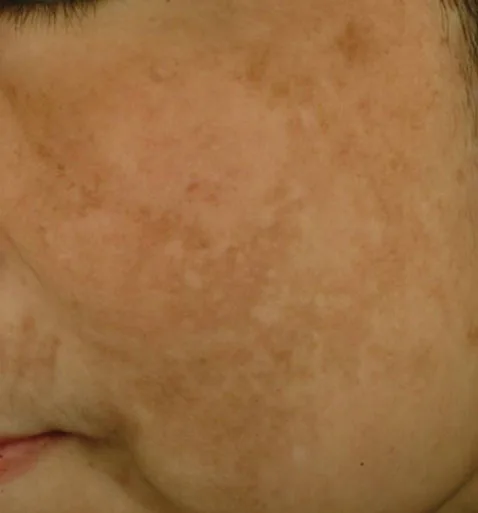 Fig 3. The dominant complaint in high phototypes is pigment, not wrinkle: mottled facial hyperpigmentation in skin of color. Alam, 2009, p. 34.
> Sources: Alam, Cosmetic Dermatology for Skin of Color, 2009 [1]
Fig 3. The dominant complaint in high phototypes is pigment, not wrinkle: mottled facial hyperpigmentation in skin of color. Alam, 2009, p. 34.
> Sources: Alam, Cosmetic Dermatology for Skin of Color, 2009 [1] [C][MEDLIB].
Fig 3 documents what the high-phototype face actually presents with: a pigment problem, not a wrinkle problem. It is the visual argument for pre-conditioning and for choosing the least-inflammatory technique, developed in B6.3.5. A separate safety note on fillers: the vascular risk of an occlusion does not change with phototype, but its diagnosis does. Blanching and livedo are far harder to see on dark skin; compensate by leaning on disproportionate pain and capillary refill and by lowering the suspicion threshold. See J2 — Vascular Occlusion & Emergency Response.en.
B6.3.4 · Ethnicity-adapted injectable technique
Consensus: place volume where the morphotype is deficient, not where the canon says; modulate, do not paralyze, where a volume deficit is driving muscle pull; preserve the identity-bearing features (alar base, lip volume, brow shape) unless the patient explicitly asks otherwise [4][21][22]. Botulinum-toxin durability and efficacy are comparable across ethnic groups; the difference is the pattern, not the molecule [24].
| Morphotype | Filler / plane adaptation | Toxin adaptation |
|---|---|---|
| East Asian | Volumize the medial midface with support; never lateral/wide malar (it widens an already-wide bizygomatic face); chin projection for the V-shape; midline-only nasal filler | Masseter as the lead contouring act (higher total dose than a glabella treatment); a smaller frontalis takes less than the textbook glabellar number |
| African / Afro-descendant | Lip border and Cupid's-bow definition, minimal or no volume; tip projection preserving the base; keloid screen before threads or deep microneedling | Standard patterns; PIH, not vascular risk, dominates adjunct-energy decisions |
| Middle-Eastern | Radix fill to camouflage a dorsal hump + tip projection; lip volume sought (the risk is cumulative excess, not deficit) | Standard; add melasma management to the plan in FST III-IV |
| South Asian | Thin midface skin raises product-visibility risk; conservative, deeper placement | Standard; pigment management is the priority alongside |
| Latino / Hispanic | Most heterogeneous group; individualize; balanced-profile requests common | By examined FST and muscle bulk, not by label |
Region by region, the concrete adaptations [4][20][21][22]:
- Nose (non-surgical rhinoplasty). A low dorsum with a wide, under-projected base (African, East-Asian) is augmented: radix and dorsal fill to build height, tip projection, midline only, deep to periosteum, low volume, aspiration before injection. A high dorsum with a hump (Middle-Eastern, Mediterranean) is camouflaged: radix fill above the hump plus tip support to straighten the line, not to reduce the bone. ⚠ The nose is the highest vascular-risk facial region, and a previously operated nose (frequent in the East-Asian group) multiplies that risk through scarred, altered vasculature; see J2 — Vascular Occlusion & Emergency Response.en and D4 — Non-Surgical Rhinoplasty.en.
- Chin and jaw. Anterior-and-inferior chin projection is the highest-yield profile move in the retruded chin; in the East-Asian V-shape plan it pairs with masseter toxin and, sometimes, gonial softening. Guard against over-masculinizing the female chin.
- Lips. In the Afro-descendant lip the target is vermilion-border and Cupid's-bow definition with minimal or no added volume; in the Middle-Eastern lip volume is accepted and sought, and the risk is cumulative over-filling across sessions, not deficit. In both, the native lip proportion is the reference, not a single "ideal ratio".
- Malar and midface. Medial, deep, supra-periosteal placement with structural support in the East-Asian midface; never lateral, superficial or wide, which widens an already-wide bizygomatic face and flattens expression.
- Forehead. A full, smoothly convex forehead is an aesthetic goal in itself in the East-Asian patient (achieved with filler or fat), a different objective from the Western brow-position emphasis; read the forehead as a volume target, not only as a wrinkle field.
Discrepancia (keep both values, do not average): masseter contouring dose. Contouring an East-Asian masseter uses a higher total per muscle than a Western hyperactivity/bruxism indication, and schools differ on the exact starting number and on unilateral vs split dosing [22][24]. Decide by palpated muscle bulk and clench, not by ancestry; the dose ladders and the split-vs-single debate live in the toxin chapters, not here. [MATERIAL GAP] the corpus is thin on ethnicity-stratified exact unit counts (dose_parameters facet top score 0.676); Rho's Korean pattern-of-practice survey is the closest primary source and is a practice pattern, not a dosing guideline [24]. Where a combined filler-thread-toxin plan is used for the Asian midface and jawline, sequence and plane matter more than any single number [23].
B6.3.5 · Energy-based devices and peels in FST IV-VI
The cross-cutting rules apply to laser, IPL, microneedling, radiofrequency, peels and even a bruise: pre-condition, test-spot, go conservative-and-serial, prefer longer wavelengths, treat any inflammation early [1][5]. The device-level detail:
| Modality | FST IV-VI rule | Evidence |
|---|---|---|
| Nd:YAG 1064 nm | The workhorse: longest wavelength, least epidermal-melanin competition; low-fluence Q-switched/picosecond 1064 for lentigines and procedure-related PIH | [1][5] |
| Diode 810 / 808 nm | Hair reduction is feasible in IV-VI with contact cooling, lower fluence and longer pulse; test spot first | 808 nm reduced hair effectively and safely in Sudanese women FST IV-VI [33] |
| IPL | Not for hair removal in V-VI; broadband cannot separate target from epidermal melanin | [1][5] |
| Non-ablative fractional (1927 nm thulium, 1550 nm) | Preferred over ablative for texture and pigment; low density, spaced | 1927 nm diode was safe and effective for infraorbital hyperpigmentation in skin of color [31] |
| Ablative fractional | Very high threshold in V-VI; if used, low density + pre-conditioning + close follow-up | [1][28] |
| Melasma | Ultra-low fluence Q-switched/picosecond 1064; over-treatment rebounds and worsens it | [32] |
| Peels | Salicylic, mandelic, phytic, low-strength glycolic preferred; avoid high-concentration TCA and phenol | [1][29] |
| Procedure-related PIH | Low-fluence 1064, strict photoprotection, early topical restart | [6][30] |
Peel depth by phototype. Depth, not the acid name, sets the PIH risk; the higher the phototype, the more the plan shifts superficial [1][29]:
| Depth | FST IV-VI use | Agents |
|---|---|---|
| Superficial | Preferred; serial | Salicylic, mandelic, phytic, low-strength glycolic, low-percent TCA |
| Medium | Caution, experienced hands, pre-conditioned | Jessner + TCA, higher glycolic; PIH risk real |
| Deep | Avoid | High-concentration TCA, phenol-croton oil (unacceptable dyschromia risk in dark skin) |
Radiofrequency and the "colour-blind" advantage. Non-fractional bulk radiofrequency does not target melanin, so for tissue tightening it is comparatively safe across phototypes, unlike a melanin-absorbed laser; RF microneedling adds a controlled dermal injury with epidermis-sparing insulated tips, and for melasma it can help or rebound, so conservative energy applies [47]. (P) When the complaint is laxity rather than pigment, an energy source that ignores melanin is often the safer route in dark skin than a shorter-wavelength laser.
Complaint to device, in FST IV-VI (the quick map): pigment/melasma → ultra-low-fluence 1064, topical, photoprotection [32]; texture/scars → low-density non-ablative fractional or cautious RF microneedling [47]; laxity → bulk RF or ultrasound tightening [5]; unwanted hair → 1064 or cooled 810/808, never IPL [33]; lentigines/PIH → low-fluence Q-switched/pico 1064 [6].
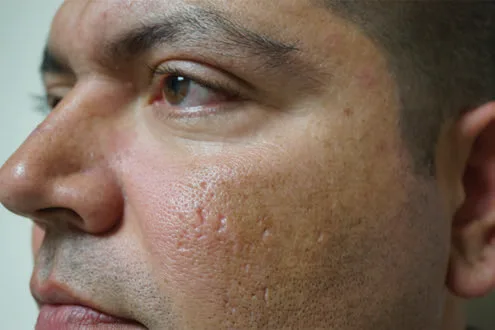 Fig 4. FST V, procedure- and inflammation-related PIH with scarring: the outcome the parameter ladder above exists to prevent. Truswell, 2016, p. 296.
> Sources: Truswell, Lasers and Light, Peels and Abrasions, 2016 [27]
Fig 4. FST V, procedure- and inflammation-related PIH with scarring: the outcome the parameter ladder above exists to prevent. Truswell, 2016, p. 296.
> Sources: Truswell, Lasers and Light, Peels and Abrasions, 2016 [27] [C][MEDLIB].
Fig 4 is the failure mode drawn on a face: the FST V patient with procedure-related PIH and scarring that the ladder exists to prevent. Pre-conditioning (strict photoprotection plus a topical depigmenting regimen before the act) and early re-introduction of that regimen after it are the two moves that most reduce PIH; the concrete topical schedules live in F3 — Peels & Chemical Exfoliation.en and F4 — Dermocosmetics & Topical Agents.en [6][30]. The narrative safety-and-efficacy review for noninvasive treatments in Fitzpatrick IV-VI reaches the same conclusion device by device: longer wavelength, lower fluence, test spot, serial sessions [5].
B6.3.6 · Body reshaping across ethnicities
Body ideals vary more between cultures than facial ones and change faster: a wide gluteo-femoral shape with a marked waist predominates in Latin-American and Afro-descendant contexts and is spreading globally; a straight, slim line predominates in East Asia and northern Europe; a toned/athletic ideal is transversal and accelerating in the GLP-1 era. Whatever the target, the trunk keloids and PIHs like the face, and one procedure carries the gravest safety warning in aesthetic medicine.
⚠ Gluteal augmentation, without nuance: surgical Brazilian Butt Lift has historically had the highest mortality in aesthetic surgery, from pulmonary fat embolism when fat enters the intramuscular or subfascial plane [8]. The ASERF task-force recommendation is explicit: subcutaneous plane only, never intramuscular, a rigid cannula of adequate calibre, injection only while the cannula moves, and real-time ultrasound guidance where available [8]. The non-surgical version (biostimulators, injectable hydrogels) trades embolism for a different grave problem: very high product volume in a deep plane, with late infection, granuloma, migration and no reversibility, and it is the territory where the most biopolymers and illegal products have been injected in the Spanish-speaking world (developed in B6.7) [40].
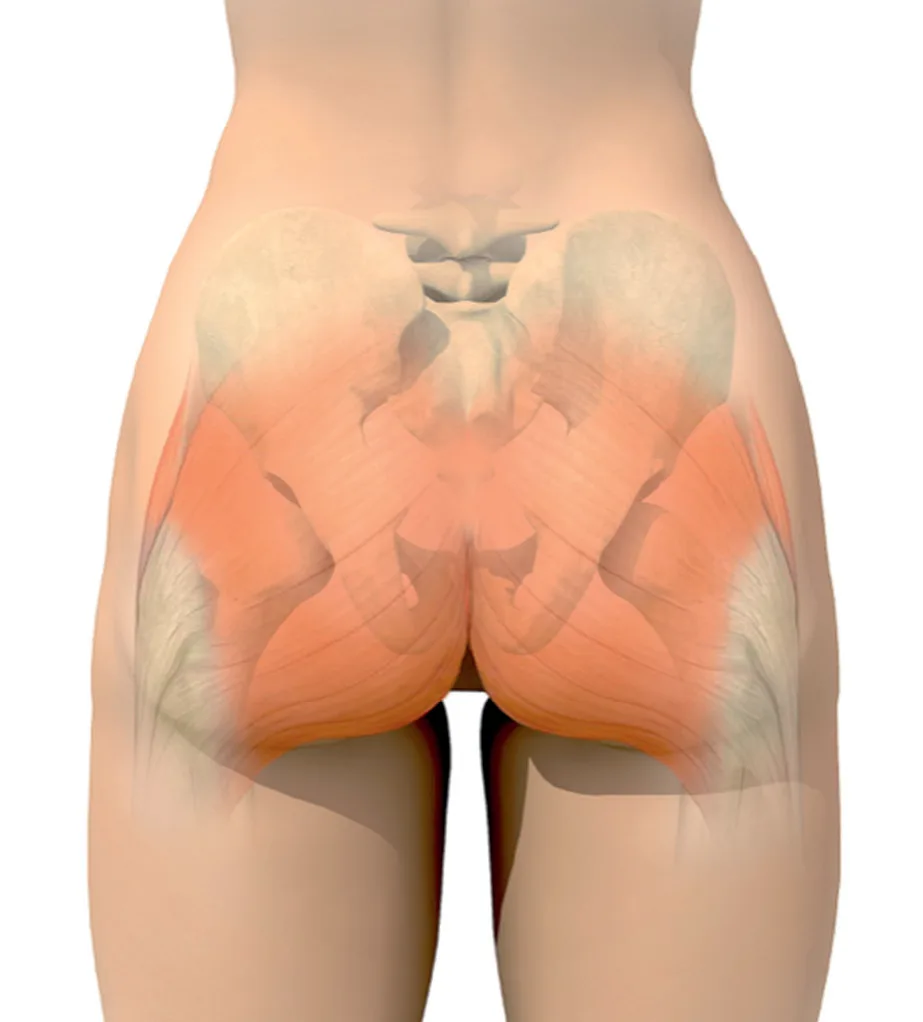 Fig 5. Gluteal landmarks and the muscle mass around the inferior gluteal vessels: the anatomic reason fat and filler stay subcutaneous. Carruthers, 2018, p. 165.
> Sources: Carruthers, Soft Tissue Augmentation, 2018 [22]; ASERF mortality report [8].
Fig 5. Gluteal landmarks and the muscle mass around the inferior gluteal vessels: the anatomic reason fat and filler stay subcutaneous. Carruthers, 2018, p. 165.
> Sources: Carruthers, Soft Tissue Augmentation, 2018 [22]; ASERF mortality report [8].
Fig 5 shows the anatomy the rule is built on: the gluteal muscle mass and the vessels that a cannula entering it can breach. The single question for anyone consulting about the buttock: "have you had anything injected there before?", asked twice, because many patients do not know what was placed or do not volunteer it [37][40]. See E2 — Body Fillers, Biostimulators & Skin Quality.en and J7 — Biopolymer & Permanent-Filler Complications.en.
Beyond the buttock, the trunk repays the same two screens. Any energy or peel on the trunk in FST IV-VI carries the identical PIH risk as the face, and the pre-sternal, deltoid, mandibular and ear-lobe zones are the classic keloid sites, so a keloid history changes body work as much as facial work [7][34]. Abdomen and flank contouring (liposuction, energy-assisted devices) shares the dark-skin cooling-and-fluence caution of any device platform; cellulite and its subcision or energy treatments are frequently requested in Afro-descendant and Latina patients and can themselves leave PIH at the treated points [37]. Striae (stretch marks) are common and, in dark skin, both the striae and their laser treatment risk dyschromia, so conservative, tested parameters again govern.
The non-surgical gluteal route deserves its own caution beyond the plane rule: injectable biostimulators and hydrogels placed for volume sit deep and in large quantity, and their late-infection, granuloma, migration and irreversibility profile is the reason the "ask twice about prior injections" screen and the biopolymer discussion (B6.7) exist [40]. (P) The safest body plan in a high-demand gluteal patient is often less product and a frank conversation about what permanent filler has done to others, not a bigger session.
Trampa clásica: projecting the anterior malar in a face that already has malar projection, because it is the default move of the training. It widens and flattens the midface; the correct question is whether the goal is to narrow [4][17].
B6.3.7 · Non-energy devices and adjuncts in skin of color
The energy rules do not exempt the mechanical devices. Microneedling, radiofrequency microneedling, threads, PRP and mesotherapy all breach the skin, so both the PIH principle and the keloid screen apply [1][7].
| Adjunct | Rule in FST IV-VI | Evidence |
|---|---|---|
| Mechanical microneedling | Finer needle, fewer passes, shallower depth to cap the inflammatory load; useful for PIH and texture precisely because it can be low-inflammation | [1] |
| RF microneedling | Insulated tips spare the epidermis, which is the point in dark skin; for melasma it can help or rebound, so conservative energy and spacing | Systematic review supports benefit with real heterogeneity [47] |
| Threads (PDO / suspension) | Keloid-history screen before insertion; the entry points themselves can keloid; the flatter Asian midface has its own vertical-vector technique | [48][7] |
| PRP / mesotherapy | Low inflammatory load; an adjunct for PIH and quality; the needle count is still a keloid consideration in a high-risk patient | [1][23] |
The thread example is the cleanest illustration of "ethnicity-informed on technique, individual on goal": the vertical-lift vector was described specifically because the Asian midface descends differently, yet the decision to place a thread at all still turns on the individual's keloid screen and stated goal [48]. (P) No adjunct is "safe because it is not a laser"; anything that breaks the skin can pigment and can keloid.
Trampa clásica: treating microneedling or threads as exempt from the keloid screen because "there is no heat". The wound is what keloids, not the energy; the screen in B6.3 applies to every skin-breaching adjunct [7][34].
B6.4 · Templates and documents
Four documents carry the chapter. Each exists to force a question that gets skipped and to satisfy a legal duty at the same time.
| Document | Must contain | Why (legal + clinical) |
|---|---|---|
| Ethnicity-aware assessment sheet | Examined FST (I-VI), keep/avoid goals verbatim, morphotype notes, not a racial label | Records the clinical datum, minimizes the special category [10][2] |
| Consent addendum: PIH + keloid | PIH-risk statement, keloid screen (personal/family/site), test-spot result | Comprehensible-information duty; PIH and keloid named explicitly [7][12] |
| Consent addendum: composition + religion | Animal-derived vs synthetic ingredient disclosure, Ramadan-timing note | Composition transparency; consent, not clinical bar [14][15] |
| Photo protocol | Lighting matched to phototype, fixed distance/angles, stored in the record | Under-exposure destroys comparison; identifiable image is personal data [10] |
Ethnicity-aware assessment sheet (copy-paste):
FST (examined, I-VI): ___        Morphotype notes (optional): ___
"What would you want to keep, whatever we do?" (verbatim): ___
"Is there anything you'd worry about changing?" (verbatim): ___
Language of consult: ___   Interpreter (prof/none): ___   How recorded: ___
PIH history (acne/waxing/wounds): Y/N  detail: ___
Keloid/hypertrophic scar (self/family/site): Y/N  detail: ___
Melasma / pregnancy / hormonal contraception: ___
Prior procedures incl. abroad / non-medical / BODY injections: Y/N  detail: ___
Data-protection basis for special-category record: consent / health-care
Consent addendum, PIH and keloid (skin-breaching or energy acts):
I understand that in my skin type any inflammation can cause dark marks
(post-inflammatory hyperpigmentation) that may last months to years [6],
and that a personal or family tendency to keloid/hypertrophic scarring
raises the risk of a raised scar after any procedure that breaks the skin [7].
A test spot was performed on ___ (date), result: ___.
Pre-conditioning agreed (photoprotection + topical regimen): Y/N.
Consent addendum, composition and religion:
The product proposed is: HA (bacterial fermentation) / other: ___.
Animal-derived content (porcine, gelatin, bovine collagen): none / present: ___.
Alternatives offered: ___.
Timing around religious fasting discussed (patient's ruling respected): Y/N.
Photo protocol for dark skin. Fixed distance and angles (frontal, both obliques, profile); increase exposure and use diffuse light so texture and pigment are not lost to under-exposure; store inside the medical record (identifiable personal data), never on a personal device [10]. (P) A consistent, phototype-matched image set is the difference between a defensible before/after and an unusable one.
Why the "keep/avoid" fields are load-bearing. The single measure that prevents Westernization-by-default is not goodwill; it is capturing what the patient wants to preserve, in their words, before any proposal, and then stating explicitly what you will not change [4]. The field turns an implicit clinician bias into an explicit, signed patient goal. Naming PIH and keloid on the consent, rather than burying them in a generic risk list, is the same discipline applied to the two complications that actually differ by skin type [6][7].
Test-spot log (FST IV-VI, before full energy or peel):
Device / peel + parameters: ___    Site (hidden): ___    Date: ___
Immediate response (erythema/oedema): ___
Review at 48-72 h and at 2-4 weeks: PIH? crusting? textural change? ___
Decision: proceed as tested / reduce fluence-density / defer / abandon
Reviewer + date: ___
The test spot is not a formality in V-VI; it is the datum that converts an assumed-safe parameter into a measured-safe one, and its result belongs in the record next to the consent [1][5].
Referral letter (the two cases that leave the building):
To: [dermatology for keloid | facial-plastics for ethnic rhinoplasty]
Patient FST: ___   Relevant history: keloid (self/family/site) ___ / prior nasal surgery ___
Reason: [active/high-risk keloid before a skin-breaching plan | identity-preserving
        rhinoplasty beyond non-surgical scope]
Goals captured (keep/avoid, verbatim): ___
Screens done: FST examined, PIH history, prior body injections.
Knowing which two cases refer out (active or high-risk keloid; complex identity-preserving rhinoplasty) and having the partner named in advance is the organizational half of B6.8, expressed as a document [7][46].
Imaging-consent snippet (special-category and identifiable):
I consent to clinical photography stored inside my medical record for
assessment and comparison. Images are identifiable personal data and are
not used for promotion without a separate, specific consent.
Lawful basis for special-category data: consent / provision of health care.
Trampa clásica: a generic consent that lists "bruising, swelling, infection" and never names PIH or the keloid screen. When PIH appears (and in FST V-VI it will, at a real rate), the record shows it was never disclosed, and the comprehensible-information duty was not met [12].
B6.5 · Frequent errors and their cost
The error the chapter is built around, defined operationally so it is not a vague accusation. To Westernize is to apply, as a target, a feature that is only "ideal" in the reference population of the published canons, without the patient having asked for it [3][4]. The four concrete cases:
| Move | When it is Westernization |
|---|---|
| Project the anterior/high malar in a face that already has malar projection | Almost always: it widens the midface and flattens expression |
| Narrow the alar base or reduce the nasal tip in an African or East-Asian nose | If not explicitly requested: it is the most identity-bearing feature of the face |
| Raise and arch the brow tail where the brow is naturally low and straight | Feminizes and de-ethnifies at once |
| Reduce base lip volume in an Afro-descendant patient | Almost never indicated: the goal is definition |
The controversy behind it (preservation vs Westernization). Consensus: the modern standard is identity-preserving, enhance not erase, graft-supported augmentation over uniform reduction [4]. Discrepancia (it changes what you propose first):
| Position | Thesis | Where it stands |
|---|---|---|
| Westernizing / Eurocentric | Reshape ethnic features toward a Caucasian ideal (dorsal reduction, tip refinement, nostril narrowing applied uniformly) | Historical, now considered obsolete [4] |
| Ethnic-preservation / identity-conserving | Enhance in harmony with the patient's own features; augmentation over reduction | The modern standard [4] |
| Patient-autonomy / individualized | Reject any prescriptive group norm; target the individual's stated goals | Some patients do want change toward a globalized ideal, and that choice is respected [4] |
Decide: the clinician's default is preservation; the adjudicator is the patient's stated goal, captured in writing before any proposal. The two are not in tension: preservation is what you offer, autonomy is what the patient may override, and the written goal is the record of which happened.
The errors grid, with the cost attached (the reason each is worth a checklist line) [1][5][6][7][8][40]:
| Error | Why it happens | Cost | Fix |
|---|---|---|---|
| Neoclassical canon as a universal target | It is what training teaches | Identity loss, dissatisfaction, revision request | Canon is vocabulary, not a target [3] |
| Anterior malar projection in an already-projected face | The default move of the training | Widened, flattened midface; dissolution/revision | Ask whether the goal is to narrow [4] |
| Deduce FST from origin or surname | Seems reasonable | Wrong energy parameters chosen | FST is examined; ethnicity is not FST [1][2] |
| IPL or aggressive ablative in FST V-VI | It is the device in the clinic | Months of PIH, burn, dyschromia, medico-legal exposure | 1064 nm, conservative, prior test spot [1][5] |
| No pre-conditioning before energy or peel | It gets forgotten | PIH that could have been prevented | Photoprotection + topical regimen before [6] |
| No keloid screen before a skin-breaching act | It is not thought of | Permanent raised scar; litigation | Personal and family history, and site [7][40] |
| Rely on blanching to detect occlusion in dark skin | It is what is taught | Missed vascular occlusion, necrosis, blindness | Disproportionate pain + capillary refill; lower the threshold |
| Relative as interpreter for consent | They are in the room | Invalid, non-comprehensible consent | Professional interpreter; record how [12] |
| Accept the family's stated goal | It is the patient's cultural norm | Autonomy breach | The consent is the patient's; speak alone [12] |
| No question about prior body injections | The patient does not volunteer it | Buried biopolymer mismanaged | Ask twice [37][40] |
| Unrequested alar-base or lip-volume reduction | It reads as "refining" | Identity loss, deep dissatisfaction | Only if requested, and stated explicitly [4] |
| Same photo exposure on dark skin | The equipment is fixed | Under-exposed, non-comparable documentation | Match lighting to the phototype |
| Intramuscular gluteal fat or filler | Chasing projection | Pulmonary fat embolism, death | Subcutaneous plane only [8] |
Why these errors persist despite being known. Each of them is the default action of a training built on a Caucasian reference: projecting the malar, applying the canon, reaching for the device in the room, treating a wrinkle field. Avoiding them is not a matter of knowing more anatomy; it is a matter of interrupting a default with a written screen, which is why the chapter's screens live in the intake form (B6.4) rather than in a memorized list. An error that is the path of least resistance is not fixed by disapproval, only by a checklist that sits between the clinician and the default action.
The cost is measurable, not rhetorical. A systematic review of litigation and complications from aesthetic body surgery finds the trunk and buttock overrepresented in claims, and the avoidable ones cluster on plane and screening failures, exactly the lines above [40]. UPO course material lists the same clinical pitfalls in the history-and-diagnosis module [41] and in the filler-adverse-events deck [42], but as slide content it is never_sufficient_alone and is corroborated here against the primary and textbook sources.
Four more errors that do not fit the first grid but recur: - Aggressive laser on melasma, chasing a fast clearance, which rebounds and worsens it; the discipline is ultra-low fluence and patience [32]. - Cumulative lip over-filling in the patient who accepts lip volume (Middle-Eastern), where each session looks reasonable and the sum does not; the reference is the native proportion, not the last syringe. - Erasing the supratarsal fold or epicanthus in a periorbital plan, treating an ethnic feature as a deficit [17]. - Trunk energy without cooling in a high-phototype body patient, importing the facial-device settings and getting truncal PIH.
The medico-legal cost, concretely. The claim themes that recur in aesthetic practice cluster on exactly the screens in this chapter: PIH or keloid that was never disclosed, wrong-plane gluteal injection, buried biopolymer mismanaged, and consent taken in a language the patient did not command [12][40]. In each, the defence is the record: a consent that named PIH and keloid, a documented test spot, a note on how consent was interpreted, and a prior-injection question asked and answered. The screens are cheap; their absence is what the claim is built on.
Trampa clásica: the most expensive error is the quietest one, deducing phototype from origin. It produces no complaint in the consult and a burn or months of PIH in the follow-up, and the record shows the parameter was chosen on an assumption, not a measurement [1][5].
B6.6 · Metrics: what is measured and the reference value
The metric that matters in skin of color is not the one measured in the canon population. Efficacy is broadly equal across groups; the differentiators are the pigment and scar complication rates and the utilization gap, and the outcome data are themselves unequal (PROMs are sparse for Black and Latinx patients relative to Asian) [43].
| Metric | What it measures | Reference value / target | Source |
|---|---|---|---|
| Minority share of procedures (US) ⚠ | Demand and access | ~18% of neuromodulator and ~22% of soft-tissue-augmentation procedures (2020 surveys) | [43] |
| Utilization trend by race/ethnicity | Access equity | Rising; spending-trait analysis shows growth across groups | [43] |
| BoNT durability / efficacy | Outcome equity | Comparable across ethnic groups | [24][43] |
| PIH incidence after energy in FST IV-VI | Procedure safety in SoC | The dominant complication; minimized by wavelength/fluence/pre-conditioning, not eliminated | [5][6] |
| Keloid response, intralesional TAC + 5-FU | Scar therapy | Combination outperforms either monotherapy | [35][36] |
| PROMs stratified by skin type | Patient-reported outcome | Sparse for Black/Latinx vs Asian: a measured gap, not a null | [43] |
Utilization. Racial and ethnic minorities are a substantial and rising share of aesthetic procedures; US survey figures put them near one in five of neuromodulator and soft-tissue treatments in 2020, and micro-spending analysis shows the growth is broad-based rather than concentrated in one group [43]. ⚠ The exact survey percentages are society-survey figures (web lane), reported here as an order of magnitude, not a validated corpus datum. The clinical read is simpler than the number: the demand is real and mixed, which is the premise of the whole chapter.
Efficacy equity, complication inequity. Botulinum-toxin durability and efficacy do not differ meaningfully by ethnicity [24]. What differs is the complication that gets counted: in FST IV-VI the outcome to track is PIH and keloid incidence, because those are where skin of color diverges and where a poor parameter choice shows up months later [5][6]. Measuring "wrinkle improvement" alone in this population misses the complication that actually drives dissatisfaction.
Scar-therapy numbers worth carrying. For the keloid that the screen in B6.3 exists to anticipate, the therapeutic evidence is comparatively firm: intralesional corticosteroid plus 5-fluorouracil outperforms either agent alone across systematic reviews and a network meta-analysis, with pulsed-dye laser adding control of vascularity and low-density fractional adding texture [7][34][35][36]. (P) The metric here is recurrence, and combination therapy is the reference standard against which a single-agent plan should be justified.
Reference-value caveat. Every "normal" anthropometric value in the textbooks was measured on a reference population; applying it as the target metric is the canon error in numeric form. Where ancestry-specific norms exist (for example the young Black South-African female series), the reference values differ from the textbook, and the individualized reading, not the population mean, is the target [18].
Access is a metric too. Utilization rising across groups is not the same as equal access: the patients whose complication is under-counted (PIH in FST V-VI) are also the ones for whom the outcome literature is thinnest, so a clinic that never measures uptake by skin type cannot see whether it is serving its catchment or a subset of it [43]. In a Spanish clinic whose catchment is 14.1% foreign-national, the simplest access check is whether the treated population resembles the waiting-room population, by examined phototype rather than by label.
What to audit in your own clinic (the metrics that catch the SoC-specific failure):
| Metric | How to read it | Target direction |
|---|---|---|
| PIH incidence after energy/peel, stratified by FST | The single most informative safety metric in this population | As low as the parameter discipline can push it; a rise flags fluence/density too high |
| Keloid events after skin-breaching acts | Screening-failure detector | Near zero if the screen is working |
| Occlusion recognition time (filler) | Proxy for the dark-skin diagnosis problem | Falls as the team stops relying on blanching |
| Revision/dissolution requests by goal type | Catches Westernization-by-default | Falls as keep/avoid capture improves |
| PROM (e.g. FACE-Q) completion by skin type | Detects the data gap itself | Equal completion across phototypes |
PROMs are unequal, not absent. Validated patient-reported instruments exist, but their evidence base is thinner for Black and Latinx patients than for Asian, so an aggregate "high satisfaction" can be built on a sample that under-represents exactly the patients whose complication (PIH) is under-counted [43]. Recording the instrument by skin type is the cheapest way to stop reproducing that gap in your own data. (P) The honest denominator is per-phototype, because the risk that differs is per-phototype.
Keloid therapy, the numeric anchor to carry. Against the screened-in keloid, the reference standard is combination intralesional corticosteroid plus 5-fluorouracil, which outperforms either monotherapy across a systematic review and a network meta-analysis; the metric is recurrence, and a single-agent plan should be justified against the combination rather than chosen by default [35][36]. Pulsed-dye laser and low-density fractional are adjuncts for vascularity and texture, not replacements for the intralesional core [7][34].
Follow-up cadence is part of the metric. PIH declares itself over weeks, not on the treatment day, so a single early review misses it; the interval that actually catches procedure-related PIH in FST IV-VI is a review at 2-4 weeks and again at 8-12 weeks, and recording a phototype-specific PIH rate depends on that follow-up happening and being logged [5][6]. A clinic that discharges high-phototype energy patients at one week systematically under-counts its own dominant complication and then reports a satisfaction figure that the missing follow-up never tested. The cadence is cheap; its absence is what makes the outcome data look better than the skin.
Trampa clásica: reporting a chapter's outcomes as "high satisfaction" without stratifying by skin type. The aggregate hides the PIH tail in FST V-VI, and the metric that would have caught it (PIH incidence by phototype) was never recorded [5][6].
B6.7 · Spanish particularity
Ethnic-aware practice is not a US import in Spain; it is the demographic reality of the waiting room. The numbers, 1 January 2025 [9]:
| Indicator (INE, 1-Jan-2025) | Value |
|---|---|
| Resident population | 49,128,297 |
| Foreign nationality | 6,911,971 (14.1%) |
| Born abroad | 19.3% |
| Largest foreign nationalities | Moroccan 968,999 · Colombian 676,534 · Romanian 609,270 |
| Largest absolute increase in 2024 | Colombia +98,057 · Venezuela +52,555 · Morocco +48,306 |
| Largest relative increase in 2024 | Peru 18.6% · Colombia 17.0% · Venezuela 16.2% |
What it means clinically. The Spanish aesthetic patient is, at real frequency, Maghrebi (FST IV-V, dorsal-hump and lip demand, halal-composition and Ramadan questions), Latin-American (heterogeneous FST, high body-contour demand, and the biopolymer legacy below), or East-Asian (Chinese the largest of these, midface and jaw contour, masseter toxin). The chapter's screens (FST by examination, PIH and keloid history, prior-injection question, language and consent) are not an edge case in Spain; they are the default consult [9].
The largest groups, as clinical profiles (anticipation, not a plan; the individual overrides the row) [9][17]:
| Group (INE rank) | Typical morphotype/FST notes | Demand pattern | The screen that bites |
|---|---|---|---|
| Maghrebi (Moroccan, largest) | FST IV-V, thick sebaceous skin, high dorsum with hump common | Dorsal-profile and lip requests; halal-composition and Ramadan-timing questions | PIH prophylaxis; composition disclosure; consent language (Arabic/Amazigh) |
| Latin-American (Colombian, Venezuelan, Peruvian, Ecuadorian) | Heterogeneous FST III-V | High body-contour demand; balanced-profile face requests | Prior body-injection question (biopolymer legacy); PIH; keloid |
| East Asian (Chinese largest) | FST III-IV, wider bizygomatic width, masseter hypertrophy | Midface/jaw contour, V-shape, masseter toxin; prior rhinoplasty common | Vascular caution in a re-operated nose; avoid widening the malar |
| Eastern European (Romanian, Ukrainian) | FST II-IV | Broadly Caucasian-canon demand; energy well tolerated | Standard; language (Romanian) for consent |
The point of the table is not to predict a request but to know which screen is most likely to change the plan for the patient in front of you, and to have the interpreter and the halal-composition sheet ready before they are needed rather than after.
The biopolymer legacy is a Spanish problem specifically. The countries feeding the largest recent migration (Colombia, Venezuela, Peru) are also where illegal gluteal and facial biopolymer injection was most prevalent, so a Spanish clinic sees patients carrying undisclosed permanent product injected years earlier abroad [37][40]. The "ask twice about prior injections" rule (B6.3.6) is load-bearing here: a patient may not know what was placed, may not consider a beauty-salon injection a "procedure", and may present for an unrelated treatment over a buried biopolymer that changes the entire plan.
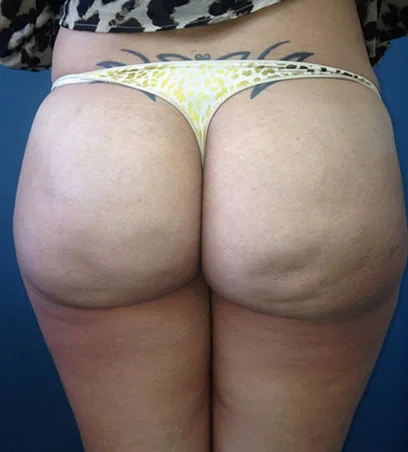 Fig 6. Gluteal contour irregularity after a prior silicone/biopolymer injection: the undisclosed history a Spanish clinic must ask for twice. Shiffman, 2016, p. 551.
> Sources: Shiffman, Liposuction, 2016 [37]; body-surgery litigation review [40].
Fig 6. Gluteal contour irregularity after a prior silicone/biopolymer injection: the undisclosed history a Spanish clinic must ask for twice. Shiffman, 2016, p. 551.
> Sources: Shiffman, Liposuction, 2016 [37]; body-surgery litigation review [40].
Fig 6 is what a buried gluteal biopolymer looks like on presentation: contour irregularity in an FST IV patient, the sequela that the prior-injection question exists to surface before any new body procedure. See J7 — Biopolymer & Permanent-Filler Complications.en and E2 — Body Fillers, Biostimulators & Skin Quality.en.
Market and stocking consequences. A Spanish clinic serving this mix stocks bacterial-fermentation HA as its default filler (halal/vegan-compatible, disclosable composition), keeps 1064 nm and 810 nm as its energy backbone rather than an IPL-only hair platform, and maintains interpreter access for Arabic/Amazigh, Chinese and Romanian [15]. The regulatory duties of B6.2 (special-category consent, comprehensible information, non-discrimination) bind harder precisely because the patient mix makes them daily, not occasional. The broader market and pricing particularities live in B7 — Spanish Market & Practice Particularities.en and the consult-psychology angle in B2 §b27.
When the screen finds one. A suspected occult biopolymer is not an in-clinic aesthetic problem: do not inject over it, image it (ultrasound), document, and route to the pathway for permanent-filler complications rather than adding new product [40]. The commonest error at this point is to treat the visible contour deformity with more filler, which layers a reversible-looking fix over an irreversible substrate and compounds the granuloma and infection risk. The management of the biopolymer itself, and why excision is rarely simple, is J7 — Biopolymer & Permanent-Filler Complications.en; the point for B6 is that the screen is where a Spanish clinic catches it before it acts.
Trampa clásica: treating "prior procedures: none" as reliable in a patient who had a beauty-salon buttock injection in their country of origin. The biopolymer is invisible until a granuloma, infection or the imaging for an unrelated procedure reveals it, and by then the new product is already in [37][40].
B6.8 · Alternatives of organization
There is no single way to structure an ethnic-aware practice; there are three, and the choice is about where the depth sits, not whether it exists.
| Model | Best fit | Risk | What it needs |
|---|---|---|---|
| Solo generalist, ethnicity-aware | Small clinic covering most requests, referring complex ethnic rhinoplasty and keloid | Breadth over depth | The four documents of B6.4; a referral list for the two hard cases |
| Referral network | A clinic that partners for what it does not do in-house | Coordination overhead; continuity gaps | Named partners: dermatology for keloid, facial plastics for ethnic rhinoplasty, professional interpreters |
| Dedicated skin-of-color clinic | High-volume urban demand | Group-based marketing can tip into stereotyping | Diverse staff, SoC-tuned laser stock, ingredient-disclosure and interpreter systems built in |
Cultural competence is a system, not a temperament. The consult-level courtesies fail under load unless the clinic is built for them [45]. The constraint-to-adaptation map:
| Constraint | Organizational adaptation |
|---|---|
| Language barrier | Professional interpreter roster (Arabic/Amazigh, Chinese, Romanian, English); never the accompanying relative [12] |
| Religious / dietary (halal, kosher, vegan) | Bacterial-fermentation HA as default; a written ingredient-disclosure sheet; alternatives offered [15] |
| Ramadan fasting | Schedule outside the vasovagal-prone fasting window; hydration guidance; defer the fast-breaking ruling to the patient's authority [15] |
| Modesty / body exposure | Same-sex provider offered where possible; chaperone; private changing space |
| Family-centred decision norms | Respect the custom in conversation; consult the patient alone at the decision point [12] |
| Preservation expectation | Capture keep/avoid goals in writing; use imagery that is not a single ideal [4] |
Expectation management is the highest-yield organizational investment. A narrative review of patient-surgeon communication in aesthetics identifies expectation-setting and structured pre-procedure communication as the modifiable drivers of satisfaction and of dissatisfaction alike, and the cross-cultural consult raises the stakes on both because the default assumptions are more likely to be wrong [45]. Building the keep/avoid capture and the interpreter step into the intake, rather than leaving them to the clinician's memory, is what makes the competence reproducible. The consensus work on defining skin of color and on knowledge gaps in its care frames this as an equity issue: the care differs by skin type in ways the standard workflow does not capture, and closing the gap is an organizational task, not only a clinical one [2][16].
Where combination and referral meet. For the Asian midface-and-jawline plan (filler, threads, toxin sequenced) and for the complex nose, the combined-technique and referral routes are where a generalist should not improvise; the sequencing and the surgical-vs-nonsurgical boundary are their own subjects [23][46]. The organizational rule is to know which two cases (ethnic rhinoplasty, active keloid) leave the building, and to have the partner named before the patient asks.
Religion and culture, specifics that recur in a Spanish clinic. The general rule (respect the custom in conversation, keep the consent the patient's) resolves into concrete, stockable adaptations [15]:
| Context | What it changes in practice |
|---|---|
| Observant Muslim | Animal-derived-ingredient question is real (porcine, gelatin, collagen); bacterial-fermentation HA is the disclosable default. Injectables generally do not break the fast, but the ruling is the patient's authority's, not the clinician's; schedule outside the fasting-vasovagal window. Same-sex provider and chaperone offered [15] |
| Observant Jewish / vegan | Same animal-derived disclosure; synthetic or fermentation-derived alternatives offered |
| East-Asian family norms | The decision may be discussed with family; the consent is still taken with the patient alone at the decision point [12] |
| Roma and other minority communities | Do not assume literacy or Spanish fluency; offer written material and interpreter without making it a gate to care [13] |
| Modesty across cultures | Same-sex provider option, chaperone, private changing, minimal exposure, for body-contour and intimate-area work |
None of these is a clinical contraindication; all of them are consent, scheduling and stocking decisions, which is why they belong in the clinic's system rather than in a single clinician's memory [45]. (P) The competence that survives a busy day is the one written into the intake and the product list.
Building the imagery and the referral list. Two organizational artifacts close the loop against Westernization-by-default: a marketing gallery that shows a range of morphotypes rather than one ideal (also an advertising-law point, B6.2), and a named referral list for the two cases that leave the building. Both are cheap; both fail if left implicit [4][46].
Consult time is the hidden resource. The ethnic-aware first consult adds steps: interpreter, keep/avoid capture, PIH and keloid screens, prior-injection question, phototype-matched imaging. Book it into the slot designed for a returning toxin patient and those are exactly the steps that get dropped under time pressure. The fix is organizational, not exhortatory: schedule a first ethnic-aware consult as a longer appointment, let the intake form carry the screening so the clinician's scarce minutes go to the keep/avoid conversation, and make the interpreter booking part of scheduling rather than an afterthought at the door [45]. A clinic that treats the added time as overhead will keep reproducing the default consult; one that treats it as the product will not.
Trampa clásica: treating cultural competence as a personal quality of the lead clinician. It works until that clinician is away, the intake has no interpreter step, and the next patient consents through a relative. The competence has to live in the intake form and the roster, not in one person's goodwill [12][45].
Coverage vs UPO
The UPO master course teaches the general consult and diagnosis, not the ethnic-specific layer; its aesthetic reference population, like the published literature, is Caucasian-weighted. What UPO covers and what this chapter adds:
| UPO teaches | State in chapter | What the atlas adds |
|---|---|---|
| History and diagnosis (Módulo 1.2) [41] | Covered and extended | Ethnicity-aware assessment sheet, FST-by-examination, keep/avoid capture, PIH and keloid screen [17] |
| Psychological aspects of the consult | Linked to B2 | Cross-cultural expectation management, family-decision dynamics, interpreter rule [45] |
| Filler adverse events (Tejero deck) [42] | Covered | Dark-skin occlusion-diagnosis caveat, biopolymer legacy, prior-injection question |
| General clinical and consent | Covered | GDPR special-category consent, Ley 15/2022 non-discrimination, halal composition disclosure |
Rows UPO does not cover at all (atlas-only): - Ethnic facial morphometry by ancestry (nose, malar, chin, lip, periorbita) [17][26]. - The FST IV-VI laser/peel parameter ladder (1064 nm workhorse, IPL exclusion, ablative threshold) [1][38]. - PIH prophylaxis and procedure-related PIH management as a protocol [6]. - The subcutaneous-only gluteal rule and BBL mortality [8]. - Spanish immigrant demographics and the biopolymer legacy [9]. - The preservation-vs-Westernization controversy and its operational definition [4].
UPO is the fastest-ageing lane in the corpus: a slide is never_sufficient_alone, and any dose resting on a UPO slide alone is corroborated here against textbook and primary sources [41][42]. The evidence-based procedural-dermatology standard behind the parameter choices sits in the Alam procedural text [38], not in the slides.
Self-assessment
Ten active-recall checks, built only from facts already stated above. Answers folded.
- What single measurement, not ethnicity, sets every laser and peel parameter?
Answer
The examined Fitzpatrick phototype (FST I-VI), read on the patient's skin, never deduced from origin or surname.- What two questions replace the whole ethnic-demand table?
Answer
"What would you want to keep, whatever we do?" and "Is there anything you would be worried about changing?", asked and recorded verbatim before any proposal.- What is the safest laser wavelength in FST IV-VI, and why?
Answer
1064 nm Nd:YAG: the longest wavelength with the least epidermal-melanin competition, so the least PIH and burn risk in dark skin.- Why is IPL avoided for hair removal in FST V-VI?
Answer
Broadband light cannot separate the target chromophore from epidermal melanin, so it burns and pigments dark skin.- What is the plane rule for gluteal fat/filler, and the fatal complication it prevents?
Answer
Subcutaneous plane only, never intramuscular or subfascial; it prevents pulmonary fat embolism, historically the highest-mortality event in aesthetic surgery.- Which GDPR article makes ethnicity a special category, and what two lawful bases apply here?
Answer
Article 9: processing is prohibited unless a basis applies; the relevant ones are explicit consent (9.2.a) or the provision of health care (9.2.h).- Why can't blanching be relied on to detect vascular occlusion in dark skin, and what replaces it?
Answer
Blanching and livedo are far less visible on dark skin; lean on disproportionate pain and capillary refill and lower the threshold to act.- What is the first-line keloid combination, and why over monotherapy?
Answer
Intralesional corticosteroid plus 5-fluorouracil; the combination outperforms either agent alone across systematic reviews and a network meta-analysis.- What share of Spain's residents held foreign nationality on 1-Jan-2025, and the top three nationalities?
Answer
14.1% (6,911,971 of 49,128,297); Moroccan, Colombian and Romanian.- Define "Westernization" operationally.
Answer
Applying, as a target, a feature that is only "ideal" in the reference population of the published canons, without the patient having asked for it.What's new and trends
Dated changes over roughly the last two years, citing only sources already in the chapter.
| Year | Change | Ref |
|---|---|---|
| 2025 | International expert consensus defining skin of color and the equity gaps in its care, reframing ethnic-aware practice as an access issue | [2][16] |
| 2025 | Aesthetic rhinoplasty explicitly reframed from Eurocentric correction to identity-congruent enhancement | [4] |
| 2026 | Narrative safety-and-efficacy review consolidating noninvasive-treatment parameters for Fitzpatrick IV-VI | [5] |
| 2024-2026 | PIH-in-skin-of-color treatment algorithms updated; 1927 nm diode validated for infraorbital hyperpigmentation; melasma laser therapy re-reviewed toward ultra-low fluence | [30][31][32] |
| 2023-2024 | Keloid evidence firmed: network meta-analysis and meta-analysis support intralesional TAC + 5-FU combination over monotherapy | [35][36] |
| 2025 | 808 nm diode hair reduction shown safe and effective in Fitzpatrick IV-VI | [33] |
| 2024 | Utilization of cosmetic procedures by race/ethnicity quantified and shown to be rising | [43] |
| 2026 | Patient-surgeon communication and expectation management reviewed as the modifiable driver of satisfaction | [45] |
By maturity class:
| Maturity class | Items in this chapter |
|---|---|
| Clinically actionable now | 1064 nm as the FST IV-VI workhorse; subcutaneous-only gluteal rule; intralesional TAC + 5-FU for keloid; PIH pre-conditioning; the parameter ladder [1][5][6][8][35][36] |
| Promising but not validated | RF microneedling for melasma; 1927 nm diode for infraorbital hyperpigmentation; the skin-of-color equity consensus as it turns into protocol [2][16][31][47] |
| Preclinical/speculative | Objective perfusion monitoring for occlusion in dark skin; ancestry-agnostic 3D morphometry (see Unexplored directions) |
| Unsupported commercial claim | "Ethnic-specific" filler or device lines sold as inherently safer in dark skin without comparative evidence; single-ideal "beautification" marketing that primes one canon |
What did not change, and why the older references still stand. The energy backbone is unchanged: 1064 nm Nd:YAG remains the workhorse in dark skin, and the subcutaneous-only gluteal rule dates to the 2017 ASERF mortality report and has not been superseded [1][8]. The critique of universal neoclassical canons is Farkas-lineage work from 2002 and remains the anatomic argument [3]. PIH as the dominant complication, the keloid screen, and the pre-conditioning discipline are textbook-stable [1][6][7]. The recent literature refines parameters and adds an equity frame; it does not overturn the anatomy or the technique base, which still rests on the 2009-2022 monographs (Alam, Draelos, Parker) [1][44][39]. The gap that persists is data, not doctrine: PROMs and complication rates are still under-reported for Black and Latinx patients, so the 2024 utilization and outcome work is a beginning, not a closure [43]. (P) The corpus's ethnic-specific depth is thinner than its Caucasian-reference depth, and that imbalance is the bias this chapter documents rather than inherits.
Unexplored directions (AI speculation)
> ⚠ Speculative section. Every item below is model-generated reasoning tagged [IA-ESPEC], anchored to a cited fact already in the chapter, paired with what would settle it. Not evidence, not a recommendation, and it carries no dose, product or actionable protocol.
[IA-ESPEC]Skin-type-stratified PROM registry. Anchor: PROMs and complication data are sparse for Black and Latinx patients relative to Asian [43]. Proposal: a prospective, multi-site aesthetic PROM registry stratified by examined FST rather than by racial label. Expected effect: phototype-specific satisfaction and complication rates become visible instead of hidden in an aggregate. Confounder: technique and operator vary by site and could drive apparent phototype differences. What would settle it: whether outcome and satisfaction actually differ by phototype once technique is controlled, or only appear to because they were unmeasured.[IA-ESPEC]Objective perfusion monitoring for occlusion in dark skin. Anchor: blanching and livedo are far less visible in FST V-VI, degrading the earliest occlusion sign (B6.3.3). Proposal: evaluate a non-contact perfusion signal (thermal or near-infrared) as an adjunct occlusion detector where visual inspection is unreliable. Expected effect: earlier occlusion recognition and shorter time-to-hyaluronidase in dark skin. Confounder: ambient temperature and baseline perfusion differences could raise false positives. What would settle it: a diagnostic-accuracy study of the device versus expert clinical exam, timed to intervention, in high-phototype skin.[IA-ESPEC]Individualized morphometry against patient-defined targets. Anchor: neoclassical canons fail across ancestry groups and ancestry-specific norms diverge from the textbook [3][18]. Proposal: 3D morphometry that analyses the individual's own symmetry and balance with the patient's stated keep/avoid goals as the target, discarding any group mean. Expected effect: higher satisfaction and fewer revisions than canon-guided planning. Confounder: clinician preference could re-enter through how the software is configured. What would settle it: a trial of individualized versus canon-guided planning with satisfaction and revision rate as the outcome.[IA-ESPEC]Transfer of melasma ultra-low-fluence logic to PIH prophylaxis. Anchor: over-treatment rebounds melasma, and low-inflammatory technique prevents procedure-related PIH [6][32]. Proposal: test whether the ultra-low-fluence, low-inflammation discipline proven in melasma reduces procedure-related PIH incidence when applied prophylactically around unrelated energy procedures in FST IV-VI. Expected effect: lower procedure-related PIH incidence in the prophylaxis arm. Confounder: baseline photoprotection and topical adherence differ between patients. What would settle it: a randomized comparison of the prophylactic low-inflammation protocol versus standard care in high-phototype procedural patients.[IA-ESPEC]Pre-procedure ultrasound screen for occult biopolymer. Anchor: undisclosed gluteal/facial biopolymer is prevalent in high-migration Spanish populations [40]. Proposal: a routine ultrasound screen of the target site before any new body procedure in patients from high-prevalence origins. Expected effect: buried permanent product is found before new product is added, changing the plan. Confounder: operator ultrasound skill and device resolution vary. What would settle it: a prevalence-and-yield study measuring how often the screen changes the plan versus its cost.
Safety
The consolidated red lines and the contraindications, in one place.
Absolute (do not proceed): - No intramuscular or subfascial gluteal fat/filler injection; subcutaneous plane only [8]. - No IPL hair removal in Fitzpatrick V-VI [1][5]. - No skin-breaching aesthetic act without a keloid screen (personal and family history, site) [7]. - No consent taken through an accompanying relative or a minor; comprehensible information is a legal duty [12]. - No CE-unmarked product; no undisclosed animal-derived composition where the patient's beliefs make it material [14][15].
Relative (screen and adapt): - Keloid or hypertrophic-scar history: relative contraindication to threads, deep microneedling, ablative resurfacing and excision [7][34]. - Active melasma or recent hormonal change: energy plans shift to ultra-low fluence and strict photoprotection [32]. - Prior biopolymer at the site: buried permanent product changes the entire management before any new injection [37][40]. - FST IV-VI plus any energy or peel: pre-conditioning and a hidden-zone test spot are mandatory, not optional [1][5][6].
Diagnosis and monitoring in dark skin: - Vascular occlusion presents with disproportionate pain and delayed capillary refill before it presents with visible blanching; lower the threshold to act and treat early [38]. - PIH is prevented, not just treated: photoprotection and a topical depigmenting regimen before and after energy work are the highest-yield safety moves [6][44].
Culture and scheduling (not clinical bars): - Injectables generally do not break the Ramadan fast; the ruling belongs to the patient's religious authority. Schedule outside the vasovagal-prone fasting window and give hydration guidance [15]. - Record the special-category datum (ancestry/phototype rationale) only with a named lawful basis, and store the minimum [10][11].
References
- Alam M. Cosmetic Dermatology for Skin of Color. New York: McGraw-Hill; 2009.
[C][MEDLIB]. - Lim HW, Alexis A, et al. International Expert Consensus on Defining Skin of Color and Delivering Equitable Dermatologic Care. Int J Dermatol. 2025. PMID 41195697 · DOI 10.1111/ijd.70100.
[A]. - Le TT, Forrest CR, et al. Proportionality in Asian and North American Caucasian faces using neoclassical facial canons as criteria. Aesthetic Plast Surg. 2002. PMID 11891603 · DOI 10.1007/s00266-001-0033-7.
[B]. - Atiyeh B, Emsieh S. Shifting Goals in Aesthetic Rhinoplasty: Eurocentric Ideals, Ethnic Background, and Cultural Identity. Plast Reconstr Surg Glob Open. 2025. PMID 40995575 · DOI 10.1097/gox.0000000000007069.
[B]. - Lee SS, Sommer NZ. Noninvasive Cosmetic Treatments for Fitzpatrick IV-VI: A Narrative Review of Safety and Efficacy Guidelines. Plast Reconstr Surg Glob Open. 2026. PMID 41884758 · DOI 10.1097/gox.0000000000007541.
[B]. - Sowash M, Alster T. Review of Laser Treatments for Post-Inflammatory Hyperpigmentation in Skin of Color. Am J Clin Dermatol. 2023. PMID 36781686 · DOI 10.1007/s40257-023-00759-7.
[B]. - Worley B, Alam M, et al. Treatment of traumatic hypertrophic scars and keloids: a systematic review of randomized controlled trials. Arch Dermatol Res. 2023. PMID 36781457 · DOI 10.1007/s00403-023-02535-3.
[B]. - Mofid MM, Singer R, et al. Report on Mortality from Gluteal Fat Grafting: Recommendations from the ASERF Task Force. Aesthet Surg J. 2017. PMID 28369293 · DOI 10.1093/asj/sjx004.
[A]. - Instituto Nacional de Estadística (INE). Estadística Continua de Población / Censo Anual de Población: datos a 1 de enero de 2025. Madrid: INE; 2025.
[A]. - Reglamento (UE) 2016/679 (Reglamento General de Protección de Datos), art. 9 (categorías especiales de datos). Diario Oficial de la Unión Europea; 2016.
[A]. - Ley Orgánica 3/2018, de 5 de diciembre, de Protección de Datos Personales y garantía de los derechos digitales (LOPDGDD). BOE; 2018.
[A]. - Ley 41/2002, de 14 de noviembre, básica reguladora de la autonomía del paciente y de derechos y obligaciones en materia de información y documentación clínica. BOE; 2002.
[A]. - Ley 15/2022, de 12 de julio, integral para la igualdad de trato y la no discriminación. BOE; 2022.
[A]. - Reglamento (UE) 2017/745 sobre los productos sanitarios (MDR), Anexo XVI; y Reglamento (UE) 2022/2346. Diario Oficial de la Unión Europea; 2017-2022.
[A]. - Herdiana Y, Sofian FF, et al. Beyond Side Effect: Immuno-Ethical Risk Analysis of Animal-Derived Ingredients in Pharmaceuticals. Risk Manag Healthc Policy. 2026. PMID 41777487 · DOI 10.2147/rmhp.s584055.
[B]. - Lim HW, Alexis A, et al. International Expert Consensus on Knowledge Gaps in Care for Dermatologic Disorders in Skin of Color. Int J Dermatol. 2025. PMID 41195756 · DOI 10.1111/ijd.70101.
[A]. - Cheney ML, Hadlock TA. Facial Plastic and Reconstructive Surgery. 3rd ed. Boca Raton: CRC Press; 2015.
[C][MEDLIB]. - Wilson SP, Medapati V, Segwapa K, et al. Facial Anthropometric Norms of the Young Black South African Woman. Plast Reconstr Surg Glob Open. 2023. PMID 37124387 · DOI 10.1097/gox.0000000000004942.
[B]. - Carniol PJ, Monheit GD. Aesthetic Rejuvenation Challenges and Solutions. Boca Raton: CRC Press; 2010.
[C][MEDLIB]. - Pirayesh A, et al. Aesthetic Facial Anatomy Essentials for Injections. Boca Raton: CRC Press; 2020.
[C][MEDLIB]. - Hong K, et al. The Art and Science of Filler Injection. Singapore: Springer; 2020.
[C][MEDLIB]. - Carruthers J, Carruthers A. Soft Tissue Augmentation (Procedures in Cosmetic Dermatology). 4th ed. Elsevier; 2018.
[C][MEDLIB]. - Moon H, Salti G. A Review on the Combined Use of Soft Tissue Filler, Suspension Threads, and Botulinum Toxin for Facial Rejuvenation. J Cutan Aesthet Surg. 2021. PMID 34566355 · DOI 10.4103/jcas.jcas_119_20.
[B]. - Rho NK, Han KH, Kim HS. An Update on the Cosmetic Use of Botulinum Toxin: The Pattern of Practice among Korean Dermatologists. Toxins (Basel). 2022. PMID 35622575 · DOI 10.3390/toxins14050329.
[B]. - Naini FB. Facial Aesthetics: Concepts and Clinical Diagnosis. Oxford: Wiley-Blackwell; 2011.
[C][MEDLIB]. - Jacono AA. Park Avenue Face. New York: Post Hill Press; 2019.
[C][MEDLIB]. - Truswell WH. Lasers and Light, Peels and Abrasions: Aesthetic Facial Surgery. Stuttgart: Thieme; 2016.
[C][MEDLIB]. - Nouri K. Lasers in Dermatology and Medicine. 2nd ed. Cham: Springer; 2018.
[C][MEDLIB]. - Obagi S, et al. Chemical Peels. Elsevier; 2021.
[C][MEDLIB]. - Persson C, Gupta A, et al. Post-inflammatory Hyperpigmentation in Skin of Color: Emerging Therapies and Treatment Algorithms. Cureus. 2026. PMID 42153065 · DOI 10.7759/cureus.107234.
[B]. - Garza-García LM, Kamrani P, Firsowicz M, Fabi SG. 1927 nm Diode Laser for Infraorbital Hyperpigmentation in Skin of Color: Safe and Effective Approach. J Drugs Dermatol. 2026. PMID 42406357 · DOI 10.36849/jdd.9190.
[B]. - Jiryis B, Toledano O, Avitan-Hersh E, Khamaysi Z. Management of Melasma: Laser and Other Therapies. J Clin Med. 2024. PMID 38592701 · DOI 10.3390/jcm13051468.
[B]. - Mohammed RMA, Yousif SM, Marouf AAS. Efficacy and safety of 808 nm diode laser hair reduction in Sudanese women with Fitzpatrick skin types IV-VI. Lasers Med Sci. 2025. PMID 40958009 · DOI 10.1007/s10103-025-04634-1.
[B]. - Krakowski AC, Shumaker PR. The Scar Book: Formation, Mitigation, Rehabilitation and Prevention. Philadelphia: Wolters Kluwer; 2017.
[C][MEDLIB]. - Yang HA, Lee JJ, et al. Comparative Efficacy of Drug Interventions for Keloids: A Network Meta-analysis. Ann Plast Surg. 2024. PMID 38285997 · DOI 10.1097/sap.0000000000003759.
[B]. - Mavilakandy AK, Khajuria A, et al. Comparing Combination Triamcinolone Acetonide and 5-Fluorouracil versus Monotherapy in Hypertrophic Scars and Keloids: A Systematic Review and Meta-Analysis. Plast Reconstr Surg. 2023. PMID 37337341 · DOI 10.1097/prs.0000000000010867.
[B]. - Shiffman MA. Liposuction: Principles and Practice. 2nd ed. Berlin: Springer; 2016.
[C][MEDLIB]. - Alam M, et al. Evidence-Based Procedural Dermatology. 2nd ed. Cham: Springer; 2019.
[C][MEDLIB]. - Parker L, et al. Fundamentals for Cosmetic Practice. Boca Raton: CRC Press; 2022.
[C][MEDLIB]. - Mussabekova SA, Menchisheva Y, Morillas ÁV. Litigation and Complications Arising from Aesthetic Body Surgery: A Systematic Review. Aesthetic Plast Surg. 2025. PMID 41091202 · DOI 10.1007/s00266-025-05276-y.
[B]. - UPO Sorted (Máster en Medicina Estética, Universidad Pablo de Olavide). Módulo 1.2 · Historia Clínica y Diagnóstico. Course slide deck; n.d.
[D][MEDLIB](never sufficient alone). - Tejero P. Efectos Adversos de los Rellenos (presentación). UPO Sorted, T10 Complicaciones; 2024.
[D][MEDLIB](never sufficient alone). - Rhee BS, Roussel LO, et al. Using Microeconomic Spending Traits to Inform Trends in Utilization of Cosmetic Procedures by Race and Ethnicity. Plast Reconstr Surg Glob Open. 2024. PMID 38974830 · DOI 10.1097/gox.0000000000005963.
[B]. - Draelos ZD. Cosmetic Dermatology: Products and Procedures. Oxford: Wiley-Blackwell; 2009.
[C][MEDLIB]. - Friedman O. Expectation management and patient-surgeon communication in aesthetic surgery: a narrative review. Patient Educ Couns. 2026. PMID 41653542 · DOI 10.1016/j.pec.2026.109511.
[B]. - Few J, et al. The Art of Combining Surgical and Nonsurgical Techniques in Aesthetic Medicine. Stuttgart: Thieme; 2018.
[C][MEDLIB]. - Kumar N, Bhatia AC. The Efficacy and Safety of Radiofrequency Microneedling for Melasma: A Systematic Review and Qualitative Evidence Synthesis. Aesthet Surg J Open Forum. 2026. PMID 42253423 · DOI 10.1093/asjof/ojag075.
[B]. - Kang, et al. Vertical Lifting: A New Optimal Thread-Lifting Technique for Asians. Dermatol Surg. 2017. DOI 10.1097/DSS.0000000000001169.
[B][MEDLIB]. - Ley 34/1988, de 11 de noviembre, General de Publicidad. BOE; 1988.
[A]. - Real Decreto 1907/1996, de 2 de agosto, sobre publicidad y promoción comercial de productos, actividades o servicios con pretendida finalidad sanitaria. BOE; 1996.
[A].
Verification: 2026-08-23. Template PRACTICA, 8 blocks; the chapter maps the B6 scope contract's 13 admissible facets into the eight practice blocks and adds the clinical depth (ethnic morphometry, skin-of-color biology, energy/peel ladder, injectable adaptation, body reshaping) as subchapters under B6.3, because a professional-practice skeleton alone would have dropped the coverage the region demands. The cultural-competence / consent / religious-constraints facet (scope B6.9) is delivered inside B6.2 (law) and B6.8 (organization) rather than as a standalone block; the outcome-metrics facet (scope B6.M) is B6.6; the two controversy facets (schools of facial analysis; preservation vs Westernization) are the discrepancy grids in B6.3.1 and B6.5. No content was dropped and no new block code was created. Corpus lane [MEDLIB]: retrieval run B6.1-B6.6 (2026-08-23, evaluation/runs/B6.[1-6].jsonl), anchored by Alam Cosmetic Dermatology for Skin of Color (top-hit on 88 facet-slots) plus Carniol, Carruthers, Hong, Truswell, Shiffman, Pirayesh, Nouri, Obagi, Krakowski; global_top_score 0.66-0.70 on most facets, thin (0.50) on contraindications and dose_parameters, so the injectable-dose and contraindication material runs on an external lane, declared inline. ⚠ Corpus bias: the corpus is large but Caucasian-weighted (as is the whole aesthetic literature); a high source count here is not balanced phototype coverage, and that imbalance is the bias this chapter documents. External lane: 21 references with PMID/DOI, 2002-2026 (most 2023 onward), verified by biomcp against PubMed/Europe PMC. Web lane: INE 1-Jan-2025 population data (scope-flagged CORPUS_ACQUISITION_GAP, medlib=false); the ~18%/22% US utilization shares are society-survey figures marked ⚠. [MATERIAL GAP] declared for ethnicity-stratified exact toxin unit counts (corpus dose_parameters top score 0.676). UPO lane: Módulo 1.2 and Tejero deck, never_sufficient_alone, corroborated against textbook/primary sources. Figures: 6, all opened before captioning (figure-pick-receipt.json); Fig 1-6 each referenced in the prose. Salvage: prior ES stub mined whole into docs/salvage/B6.prev.md; cross-lang salvage receipt confirms no language-neutral fact lost. Em dash count kept low; residual em dashes are inside wiki-link filenames. [IA-ESPEC] speculation isolated in its own section, no dose/product/protocol.