B10 · Competency, Assessment & Certification Pathway
> Currency and provenance — 37 references · median 2017, range 1990-2025, 19 % from 2022 on · provenance: verified external 43 % (16) · MEDLIB corpus 57 % (21, of which 2 from the UPO master's) · 2 flagged [D] never_sufficient_alone.
Domain: B — Patient Assessment & Consultation · The chapter about you, not the patient. It closes domain B on one question almost nobody asks aloud: how do you know you already know how to do this?
> Tags: [A] guideline/consensus with year · [B] primary literature with PMID/DOI · [C] monograph · [D] slide or opinion, never sufficient alone · [MEDLIB] own corpus · [MODELO] structure, never a figure · [IA-ESPEC] AI speculation, never evidence · [MATERIAL GAP] corpus silent, filled from the external lane · ⚠ disputed or stale figure. Attribution is a token (Author year [n]); the study design lives in the reference line. (P) marks the model's own reasoning and never carries a dose.
Subchapters
- [ ] B10.1 · In 30 seconds
- [ ] B10.2 · Applicable regulatory rules, with the norm cited (ES and EU)
- [ ] B10.3 · The step-by-step procedure
- [ ] B10.4 · Templates and documents
- [ ] B10.5 · Frequent errors and their cost
- [ ] B10.6 · Metrics: what is measured and the reference value
- [ ] B10.7 · Spanish particularity
- [ ] B10.8 · Organizational alternatives
B10.1 · In 30 seconds {#b101}
| Axis | The red line | Reference value |
|---|---|---|
| Legal act (ES) | Injecting a filler or toxin is a medical act; the filler is a class III implantable device, the injection is not a device it is an act reserved to a physician [5][7] | Real Decreto 1277/2003 unit U.48 (non-surgical aesthetic medicine, medical lead) vs U.47 (aesthetic surgery, surgical specialist) [5] |
| Who may practise (ES) | No official MIR specialty of aesthetic medicine exists; there is no assigned tutor, no external exam, no minimum case count imposed by the State [4] | Diploma acreditativo (DIACAP, OMC, 2004-) or a university máster; both are títulos propios, neither is a specialty [8] |
| Competence ≠ attendance | Having attended a course is knows how; competence is shows how and does, proven in an assessed setting [1][2] | Miller pyramid: Knows → Knows how → Shows how → Does [1] |
| The scaling rule | The ladder is per technique and per region; being independent in lips does not make you independent in the temple [14][25] | Low → medium → high (temple, glabella, nose, tear trough) → very high (revision, permanent product) |
| The peak-danger window | ⚠ Not day one. It is after the first 20-50 uneventful cases, when confidence outruns competence (Dunning-Kruger) | Measure, do not feel: log every case with its supervision level |
| Emergency precondition | Do not perform a procedure whose serious complication you could not manage today, with the material on the shelf today | Anaphylaxis: adrenaline 0.3-0.5 mg IM, first and without hesitation [20][19]; HA vascular event: high-dose pulsed hyaluronidase, minutes to first dose [16][18] |
| Recertification | Certificates and CPD/CPPD records are your credential where the State issues none; they expire silently | Board time-limited cert model: 10-year cycle (ABA/ABMS analogue) [28][29]; UK licensing wave now legislating a tiered scheme [10] |
Thesis. More training is not the remedy for a course-shaped credential. Structured training, supervised practice, a case log, and drilled emergencies are. This chapter is the scaffold that keeps that from being an empty sentence. It maps the regulatory frame (§B10.2), the competency-to-certificate pathway (§B10.3), the documents that prove it (§B10.4), the errors and their cost (§B10.5), the metrics (§B10.6), the Spanish particularity (§B10.7) and the organizational alternatives (§B10.8).
> Covered elsewhere, linked not repeated: team governance as error prevention → B4 — Practice Management & Business Development.en §B4.5. The assessment consultation step by step → B1 — Facial Assessment & Aesthetic Analysis.en §B1.3. The general Spanish-market primer and the organizational-model primer → B2 — Patient Psychology & Selection.en §B2.7 and §B2.8. What to measure in a longevity intake → K3 — Geroscience Foundations.en. The emergency doses themselves → J2 — Vascular Occlusion & Emergency Response.en, J3 — Hyaluronidase — Pharmacology & Clinical Protocols.en, J6 — Emergency Preparedness & Basic Life Support.en. This chapter covers only its own angle: how competence is built, proven, certified and maintained.
The map of the chapter
This chapter closes domain B by answering the question a whole industry avoids: how do you know you already know how to do this? In Spain the question bites hardest, because there is no official specialty of aesthetic medicine: no MIR, no assigned tutor, no compulsory external exam, no imposed minimum case count. The competence-guarantee system is the operator. The thesis, in one line: having attended a course is not having acquired a competence, and the operator's own perception of competence is the worst measuring instrument available. The remedy is not more courses; it is structured training, supervised practice, a contemporaneous case log, and drilled emergencies. Everything below is the scaffold that turns that sentence into something a regulator, an insurer and a patient can verify. The transverse dependencies are made explicit throughout: photography and assessment (B1 — Facial Assessment & Aesthetic Analysis.en), ethics and record-keeping (B3 — Ethics, Consent & Medicolegal.en), the schools and the over-filled-face problem (B5 — Schools of Facial Beautification.en), the market and no-specialty primer (B2 — Patient Psychology & Selection.en), evidence appraisal (B9 — Evidence-Based Practice.en), and the emergencies themselves (J2 — Vascular Occlusion & Emergency Response.en, J3 — Hyaluronidase.en, J6 — Emergency Preparedness & BLS.en).
B10.2 · Applicable regulatory rules, with the norm cited (ES and EU) {#b102}
Two things are regulated by two different bodies of law, and confusing them is the root error of the whole debate: the product (the filler, the toxin, the device) and the act (the injection, performed by a person on a patient). The product is governed by device law; the act is governed by health-professional and clinic-authorization law. The State can certify a syringe of hyaluronic acid to the milligram and still say nothing about who is allowed to push the plunger.
| Jurisdiction | Instrument | What it governs | The operative rule |
|---|---|---|---|
| ES, clinic | Real Decreto 1277/2003 [5] |
Authorization of the unidad asistencial by the CCAA | Non-surgical aesthetic medicine = unit U.48 (medical lead, no surgical specialty required); aesthetic surgery = U.47 (surgical specialist). The centre, not only the doctor, must be authorized |
| ES, patient | Ley 41/2002 [6] |
Patient autonomy, clinical record, informed consent | Consent is the rule; in medicina satisfactiva the information duty is more rigorous, not less [36] |
| ES/EU, product | Reglamento (UE) 2017/745 (MDR), Anexo XVI [7] |
Devices with no intended medical purpose: dermal fillers, aesthetic lasers and IPL, equipment for lipolysis/fat reduction | Brings purely aesthetic products under device law with clinical-evidence and operator-qualification requirements. It regulates the product, not professional competence |
| ES, data | RGPD 2016/679 + LOPDGDD 3/2018 [35] |
Health data (a special category) | Photographs and the clinical record are health data; a breach can reach 20 M€ or 4% of turnover [35] |
| UK, historic | Keogh Review 2013 → HEE 2016; JCCP + CPSA register 2018 [9] | Voluntary standards; HEE qualification levels 4-7 | Pre-2023 the register was voluntary and PSA-accredited; a lay operator had "no more protection than buying a toothbrush" |
| UK, frontier | Health and Care Act 2022 s.180 → DHSC response 7 Aug 2025 [10] |
Statutory licensing of non-surgical cosmetic procedures | Red/Amber/Green tiered risk model (see below). Not yet in force; further consultation expected 2026 [10] |
| UK, minors | Botulinum Toxin and Cosmetic Fillers (Children) Act 2021 [11] |
Under-18s | Ban on toxin/filler to under-18s for cosmetic purposes already in force [11] |
The Spanish frame in one paragraph
The infiltration of a filler or a botulinum toxin is an acto médico: a reserved medical act. RD 1277/2003 [5] classifies the place it is done, separating the non-surgical U.48 unit (whose médico responsable needs no surgical specialty) from the surgical U.47 unit; the autonomous community authorizes and inspects the centre. Ley 41/2002 [6] governs the record and the consent. The filler itself is a class III implantable product sanitario under MDR Annex XVI [7], which regulates the product (evidence, labelling, traceability) and not the competence of the injector. The consequence to hold in mind: a CE-marked filler in an authorized U.48 clinic is fully legal and still tells you nothing about whether the person injecting it is competent. That gap is exactly what this chapter exists to fill. [MATERIAL GAP] The corpus is near-silent on the Spanish regulatory detail (run-id B10.5-20260824, facet regulation_spain_eu, top score 0.02); the norms above are the primary legal texts, not a corpus reading.
The clinic authorization, in practice
RD 1277/2003 regulates the place, not only the person, and this is the lever the State actually holds over aesthetic practice [5]. The autonomous community authorizes the unidad asistencial, inspects it, and can close it; the U.48 classification (non-surgical aesthetic medicine) sets what may be done there and requires a médico responsable who need not be a surgical specialist, while U.47 (aesthetic surgery) demands a surgical specialist and a different physical standard [5]. The operative consequences for competence: the authorization presumes a defined scope, a named responsible physician, adequate premises and equipment (including the emergency material of §B10.6), and record-keeping under Ley 41/2002 [6]. A procedure performed outside the authorized scope of the unit is a regulatory breach independent of whether it went well. The clinic authorization is, in effect, the nearest thing Spain has to a competence gate, and it gates the room, not the operator.
The EU is not one rule
The one thing that is harmonized is the product, through MDR Annex XVI [7]. Who may inject is not harmonized at all. Much of continental Europe treats the injectable as a restricted medical act; the Netherlands protects the title "Aesthetic Physician" (KNMG) behind a two-year full-time training; Ireland historically prohibited nurse botulinum injection unless doctor-prescribed. This heterogeneity is why a "European diploma" is a market signal and not a licence: the licence is national, and the map changes at every border.
The UK statutory wave: the direction of travel [MATERIAL GAP]
The corpus knows only the pre-2023 voluntary JCCP/CPSA register [9] (its newest UK-regulation source predates the reform). The current position is web/primary-source grounded and is a moving frontier, so it carries an external-lane note by design [10][11]:
| Tier | Example procedures | Who may perform / where |
|---|---|---|
| Green | Microneedling, superficial peels | Any licensed practitioner meeting the standard |
| Amber | Botulinum toxin, facial dermal fillers | Local-authority licence plus named regulated healthcare-professional oversight |
| Red | Liquid BBL, breast/buttock/genital augmentation | Regulated HCP only, on CQC-registered premises (legislated first) |
The DHSC government response of 7 Aug 2025 confirmed this three-tier design under the Health and Care Act 2022 Part 5 s.180 [10]; the scheme is not yet in force and a further consultation is expected in 2026. The under-18 ban on toxin and filler for cosmetic purposes is already law [11]. Why it belongs in a Spanish clinician's chapter: the UK model is the most cited European template for risk-stratified licensing, and MDR Annex XVI [7] pushes every member state toward operator-qualification requirements. The autorregulación era is closing.
Consensus and discrepancy: who may legally inject
Consensus: the injectable is a clinical act that requires medical-level knowledge of anatomy, product and complication management; unqualified lay injection is the target of every reform [9][10][15].
Discrepancy (it changes who stands in the room, so it stays): - Physician-only [4][5]: the act is reserved to doctors (much of continental Europe; Spain as acto médico; the Netherlands behind a protected title). Decide by: national law of the country you practise in. - Delegation / physician-extender [9]: nurses, dentists or PAs inject under medical supervision (UK, US state-dependent), the supervising physician liable under respondeat superior. Decide by: whether your jurisdiction and your indemnity actually permit and cover it. - Permissive / non-medical [10]: lay operators, historically unrestricted, now being pulled into the Red/Amber/Green tiers. Decide by: this route is closing, and building a record now is the hedge.
Supervision is a graded scale, not a yes/no
Competence is built under supervision, and supervision is itself layered. The Spanish anaesthesia Libro Blanco maps the levels formal training systems use, from direct presence through immediate availability to distant availability, and notes that the US and Canada expand them to five to reward teaching (Moral, SEDAR [4]). For the aesthetic injector with no residency, the practical translation is the three-step ladder embedded in the case log: observed (you watch), supervised (you inject, a competent operator present and able to take over), independent (you inject alone, with a written protocol and a phone). The delegation model adds a legal layer on top: where a nurse, dentist or PA injects under a physician, the supervising doctor carries the liability under respondeat superior [9], so "supervision" on paper is legal exposure in fact. A supervisor who is not physically able to intervene is not supervising; they are lending a name to a procedure they cannot rescue.
Record-keeping is a regulatory duty, not a courtesy
Every one of these systems ties the right to practise to a contemporaneous record. Good-medical-practice standards require the clinician to keep clear, accurate, legible notes made at the time or as soon as possible after (a duty the UK codified decades ago and that revalidation now audits [30]); Ley 41/2002 makes the historia clínica a legal obligation in Spain [6]. The competence lesson: the record is not paperwork you do after the medicine, it is part of the medicine, and it is the first thing a regulator, an insurer or a court asks for.
What changes for you the day licensing lands
The autorregulación era is closing, and the practical question is what a practitioner does now to be ready. If Spain follows the European direction (MDR operator-qualification pull [7], the UK tiered model as template [10]), the day a scheme lands the operators who already hold a contemporaneous case log, a specific consent set, standardized photography, a CPD record and a drilled team will comply on day one. The operators who do not will be asked for evidence they never gathered, and a retrospective file does not count. Nothing in this section is speculative about your preparation: every document the future scheme will demand is a document you can start today, at no cost beyond discipline. The regulation is uncertain in timing and detail; the value of being ready for it is not.
Classic trap: reading MDR Annex XVI [7] as if it licensed you. It licenses the device. Your right to inject comes from professional and clinic law (RD 1277/2003, Ley 41/2002 in Spain [5][6]), and it is exactly there that no aesthetic-medicine specialty exists to certify you. The device is regulated; the injector is, for now, self-regulated. Do not mistake the CE mark for a competence certificate.
B10.3 · The step-by-step procedure {#b103}
The procedure this chapter describes is not an injection: it is how you go from qualified to competent to certified in one technique. Run it once per technique, from scratch, with no shortcut for prior experience.
This is the load-bearing block of the chapter, because it turns the abstract idea of competence into a repeatable sequence with checkpoints. The sequence has five layers, each answering a different question. Miller's four rungs say what kind of knowing you have reached [1][2]. The five rungs of progression say how far along the hands-on climb you are [14]. Risk stratification says which staircase a given technique even requires [25][26]. The competency domains say what a defensible exam must actually test [3][9]. The certification staircase says what a body will award at the end [12][34]. Read together they answer the only question that matters in the chair: is this specific technique, in this specific region, within my proven competence today? The layers below build that answer from the bottom up, and the one-page protocol at the end compresses all five into a checklist you run every time you add a technique, with no exemption for seniority. A senior injector adopting a new device starts at rung one exactly like a junior; the only difference is how fast they climb, and even that is measured against a case log, not assumed from a CV [14].
Layer 1: the four rungs of Miller [1][2]
| Rung | Meaning | How it is assessed | Where a course leaves you |
|---|---|---|---|
| Knows | Anatomy, pharmacology, indications | Exam, reading, conversation | ✅ |
| Knows how | Can describe the procedure and its decisions | Case discussion, planning | ✅ (and it sells you a certificate here) |
| Shows how | Executes correctly in an assessed setting | OSCE, simulation, supervised practice | ❌ the gap |
| Does | Executes correctly in real practice, systematically | Case log, outcomes, audit | ❌ the gap |
The structural error of the sector, stated precisely: a typical course carries you from knows to knows how and hands you a certificate that looks like a does. Miller's own framing (Miller 1990 [1]) and its use as the summative/formative backbone in procedural training (Farhadieh 2015, Miller's triangle Fig 77.1 [2]) both put the load-bearing evidence at shows how and does: it is demonstrated in an assessed setting, not in your own chair with your own judgement. If nobody has watched you do it, you have demonstrated nothing.
Layer 2: the five rungs of progression, per technique
| Rung | What you do | You may advance when |
|---|---|---|
| 1 · Theory | Regional anatomy, target plane, arteries at risk, product, complication and its management | You can draw the arterial course from memory and state what you would do if the worst happens [25][31] |
| 2 · Observation | Watch the technique several times, more than one operator if possible | You can narrate aloud what the operator will do before they do it |
| 3 · Supervised practice | You inject, an experienced operator present and able to intervene | You execute without correction across consecutive cases and recognize when to stop [14] |
| 4 · Independent with a net | You inject alone, someone reachable by phone, a written protocol on the wall | You have managed your own deviations and your results are reproducible |
| 5 · Full independence | Autonomous practice, complex cases included | You teach, and your complications are detected and resolved |
The rule that governs every jump is not the case count: shows how is proven in an assessed setting (rung 3), not certified by your own satisfaction. Learning-curve data outside aesthetics makes the same point (Unger 2023: procedural competence is timed and observed, and early sessions carry more adverse events [14]).
Layer 3: risk stratification: not every technique needs the same staircase
| Risk | Techniques | Requirement |
|---|---|---|
| Low | Upper-third toxin; skinboosters; superficial mesotherapy | Rungs 1-3 complete |
| Medium | Lip, nasolabial fold, chin, jawline filler; lower-third and masseter toxin | Prolonged supervision; hyaluronidase and the protocol mastered before the first case [16][18] |
| High | Temple, glabella, nose, periorbital/tear-trough, deep cannula work, threads, facial biostimulators | Specific training, extensive supervision, ultrasound desirable, not before rung 5 in medium risk [25][26] |
| Very high | Nose after previous rhinoplasty; correcting others' complications; removing permanent product | Referral or advanced practice. See J7 — Biopolymer & Permanent-Filler Complications.en |
⚠ The Dunning-Kruger window is the central occupational hazard of this chapter. The most dangerous moment is not day one; it is after the first 20-50 uneventful cases, when confidence rises far faster than competence and the operator starts treating high-risk zones. The only counter is to measure instead of feel.
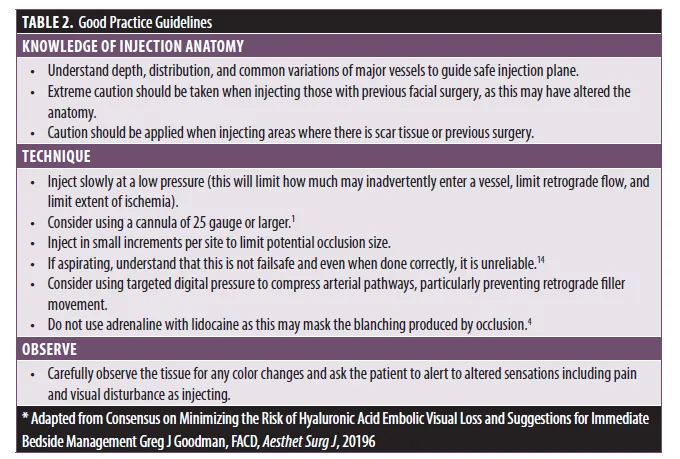 Fig 1. A pre-built competence checklist under three headings, Knowledge of injection anatomy, Technique, Observe, usable directly as the scored items of a practical assessment: understand vessel depth and variation; extreme caution after previous facial surgery; inject slowly at low pressure; consider a cannula 25 G or larger; aspiration is not fail-safe and is unreliable even when done correctly; targeted digital pressure over arterial pathways; no adrenaline with lidocaine because it masks the blanching of occlusion; observe the tissue for colour change and ask the patient to report pain or visual change. — (Tejero, UPO 2024, p.91; adapted from Goodman 2020 [17][20]).
> Sources: [17] Goodman GJ et al. Aesthet Surg J 2020 · [20] Tejero P, UPO máster 2024 slide set.
Fig 1. A pre-built competence checklist under three headings, Knowledge of injection anatomy, Technique, Observe, usable directly as the scored items of a practical assessment: understand vessel depth and variation; extreme caution after previous facial surgery; inject slowly at low pressure; consider a cannula 25 G or larger; aspiration is not fail-safe and is unreliable even when done correctly; targeted digital pressure over arterial pathways; no adrenaline with lidocaine because it masks the blanching of occlusion; observe the tissue for colour change and ask the patient to report pain or visual change. — (Tejero, UPO 2024, p.91; adapted from Goodman 2020 [17][20]).
> Sources: [17] Goodman GJ et al. Aesthet Surg J 2020 · [20] Tejero P, UPO máster 2024 slide set.
The competence to refer is a competence
The highest-value decision an operator makes is sometimes not to treat. Referral is not a failure of competence; it is one of its markers. The referral triggers: a very-high-risk indication beyond your current rung (a nose after previous rhinoplasty, correction of a permanent product, a complication from another clinic); a patient whose expectation cannot be met or whose psychology contraindicates treatment (screen for body dysmorphic disorder, see B2 — Patient Psychology & Selection.en); a request outside your product or anatomical familiarity; and any case where the serious complication would exceed what you could manage today with the material on the shelf [16]. Knowing the edge of your own competence, and acting on it before the needle, prevents more harm than any rescue protocol. The operator who never refers is not more competent; they are less aware of the edge.
Layer 4: the competency domains a certificate should cover
A defensible curriculum tests all of these, not just the needle: facial and danger-zone anatomy (Fig 4); injection technique (needle vs cannula, plane, movement); product and device knowledge; patient assessment and selection; communication and expectation-setting; complication recognition and emergency management (vascular occlusion, hyaluronidase, anaphylaxis); asepsis and sterile technique; informed consent; and the medicolegal and psychological frame. The named aesthetic-specific standard is the JCCP Competency Standards (V8, 2018) [9]; the generic backbone is competency-based medical education and CanMEDS (Frank 2010 [3], echoed in the Spanish anaesthesia Libro Blanco [4]).
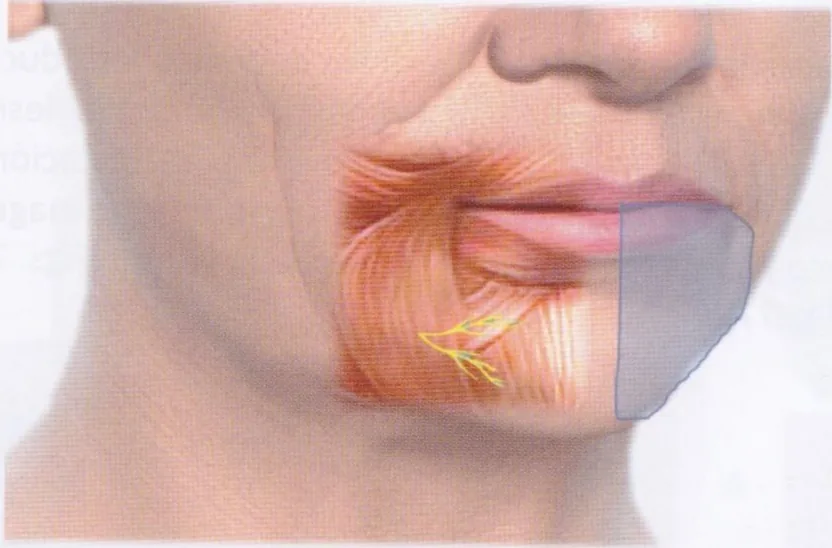 Fig 4. Lower-face muscular anatomy with the marginal mandibular branch of the facial nerve (yellow) and a shaded danger zone lateral to the oral commissure. The competence being assessed in station 1 of a practical exam is precisely this: the candidate must be able to draw such a territory from memory and name what runs through it before a needle is allowed near it. — (Libro de Zonas Peligrosas en Medicina Estética Facial, p.22, Figura 74 [25]).
> Sources: [25] Libro de Zonas Peligrosas en Medicina Estética Facial (corpus, danger-zone atlas).
Fig 4. Lower-face muscular anatomy with the marginal mandibular branch of the facial nerve (yellow) and a shaded danger zone lateral to the oral commissure. The competence being assessed in station 1 of a practical exam is precisely this: the candidate must be able to draw such a territory from memory and name what runs through it before a needle is allowed near it. — (Libro de Zonas Peligrosas en Medicina Estética Facial, p.22, Figura 74 [25]).
> Sources: [25] Libro de Zonas Peligrosas en Medicina Estética Facial (corpus, danger-zone atlas).
The competency domains, itemized: what each one tests
A defensible exam scores every domain against an observable behaviour, not a feeling. The grid an assessor can actually mark:
| Domain | What it tests (observable) | Fail signature | Source |
|---|---|---|---|
| Danger-zone anatomy | Draw the at-risk arteries and safe planes from memory, per region (Fig 4) | Cannot place the angular or dorsal nasal artery | [25][31] |
| Injection technique | Needle vs cannula choice, plane, angle, speed, pressure, volume per point | High pressure, fast bolus, wrong plane | [17][20] |
| Product and device knowledge | Rheology, indication per product, reconstitution/dilution, batch traceability | Treats all fillers or all toxins as interchangeable | [7][13] |
| Assessment and selection | History, goal, expectations, red-flag screening, scarred-bed risk | Injects a scarred bed without recognizing the raised risk | [32] |
| Communication | Expectation-setting, risk disclosure including blindness, shared decision | Promises a result; omits the serious risk | [23][36] |
| Complication recognition | Distinguish bruise, vascular compromise, vasovagal, oedema, infection | Calls an occlusion a bruise | [16][17] |
| Emergency management | Execute the occlusion and anaphylaxis protocol with the real material | Does not know where or how much rescue material there is | [16][19] |
| Asepsis and sterile technique | Skin prep, field, single-use, sharps handling | Breaks the field; reuses | [20] |
| Informed consent | Specific, in-reach, ≥24 h reflection, documented | Generic consent, no reflection window | [6][20][36] |
| Medicolegal and psychology | Record-keeping, the acto médico frame, screening for BDD/unrealistic demand | No contemporaneous record; treats a body-image disorder | [4][36] |
The learning curve is real and countable
"A few cases" is not a curve. Outside aesthetics, where competence has been measured, procedural skill for some blocks is reached only after roughly 45 to 60 supervised attempts, and departments have had to restructure staffing to give trainees that exposure (Raj, regional anaesthesia [37]). The hair-restoration model measures the same climb with timed 3/6/12-month assessments against numeric goals (Unger [14]), and early sessions carry more adverse events than later ones [14]. The lesson transfers directly: the number that matters is not a magic minimum, it is the shape of your curve, which only a case log with a supervision-level field can show you.
Layer 5: the certification staircase
The corpus holds concrete staged models. The academy path is a written-then-oral staircase (AAAM: Level 1 Certificate → Level 2 Diploma → a 6-month practice interval → Level 3 Board exam, open to any licensed physician [34]); the surgical training-algorithm path stacks didactic theory onto cadaver anatomy, observation, supervised hands-on and proctorship before independent practice (Cosmetic Medicine & Surgery training algorithm [13]). A minimum-standards template that names the rungs concretely: a two-day minimum of didactic and experiential training, observation of two to three procedures, proctorship for the first cases, then a case-list to satisfy credentialing or grandfathering (Goodman 2016 [12]). These numbers are program conventions, not validated thresholds (§B10.6 argues why the atlas prints no single number as the standard).
The one-page protocol: adopting a new technique
Applied every time, no exception for prior experience: 1. Study the regional anatomy until you can draw the at-risk arteries and safe planes from memory [25][31]. 2. Study the serious complication of this technique and its management before the technique [16][18]. 3. Verify you hold the rescue material, in date and in quantity. If you do not, the technique does not enter your menu [16]. 4. Structured training with a hands-on component, not attendance alone [13]. 5. Observe an experienced operator, and if possible more than one with differing criteria. 6. Practise supervised, with someone able to intervene present [14]. 7. Self-assess against the practical checklist of §B10.6, on video if possible. 8. Start with low-risk cases: favourable anatomy, moderate expectation, a known patient. 9. Log every case with supervision level and a 2-4 week result [12][24]. 10. Review your first cases in a block at 3 months, with comparable photographs. 11. Do not extend to higher-risk zones until results are reproducible in the current one. 12. Repeat the emergency drill for that technique annually (§B10.6).
Classic trap: doing step 4 (a course) and skipping steps 5-7 (observe, supervised practice, assessed self-check), then treating the certificate as if it proved does. The signature is a confident injector with a wall of course diplomas, a rising complication rate, and no logbook to show the progression that was never actually built.
B10.4 · Templates and documents {#b104}
Two document families do two different jobs, and clinicians conflate them. The clinical record proves what you did to this patient; the competency portfolio proves to a certifying body that you are fit to do it at all. You need both, and one cannot substitute for the other. The distinction is not academic: a regulator or an insurer asks for the second, a court asks for the first, and most operators keep only the first [6][9]. The two families share raw material, since a treated case generates both a record entry and a log entry, but they serve different readers, and the competence is in maintaining both from the first case rather than reconstructing either under pressure [12][24].
| Family | Documents | What it proves | Where it lives |
|---|---|---|---|
| Clinical record [6][21][22] | Aesthetic history; specific informed consent; standardized before/after photography; batch/UDI traceability; adverse-event reporting | What was done to this patient, and that they agreed | The patient's historia clínica, under Ley 41/2002 [6] and data law [35] |
Competency portfolio [MATERIAL GAP] [9] |
Supervised-procedure logbook; CPD/CPPD record + reflective accounts; appraisal record; case-list for credentialing/grandfathering | That you are competent, over time | Your own file; sampled by a register (JCCP PSA 5% audit) [9] |
The clinical record, field by field
The aesthetic clinical history differs from a general one because the presenting complaint is not a disease (Módulo 1.2, UPO [22]). The load-bearing pieces:
- Specific informed consent. In medicina satisfactiva the information duty is heavier, not lighter: the Spanish Supreme Court has held the information must be more rigorous (STS 15-feb-2017) and that consent protects physical integrity as a fundamental right (STC 37/2011) [36]. Practice standard: allow ≥24 h of reflection between explaining the procedure and performing it (Tejero, UPO 2024 [20]). The consent must name the serious risks in the patient's reach, including vascular occlusion and visual loss (Kontis 2019 consent templates name bleeding, asymmetry, lumps, vascular injury/occlusion [23]).
- Standardized before/after photography. "There is a before and an after; the after can be seen, the before must be documented, because it is not repeatable" (Fernández-Tresguerres 2019 [21]). A non-standardized photo is not documentation, it is an anecdote, and in litigation it plays against you as often as for you. Use the fixed five-view, six-variable protocol of B1 — Facial Assessment & Aesthetic Analysis.en §B1.8. Store images with the record, chronologically, access-controlled (Carruthers 2013 photo-storage discipline [24]); consent for the image separately from consent for the procedure [24].
- Traceability. Record the brand, batch/lot and UDI of every implantable product. It is a device-law obligation [7] and the only way to answer a recall or an inflammatory-reaction workup two years later.
- Adverse-event reporting. The physician must report an adverse effect of a medicine or device to the autonomous-community health authority or to AEMPS (Tejero, UPO 2024 [20]).
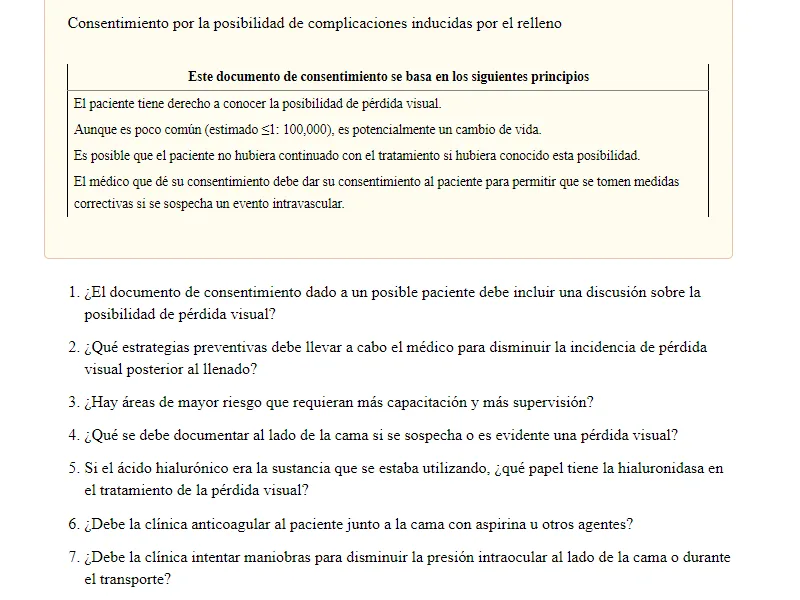 Fig 2. A specific consent block for filler-induced complications, built on four principles (the patient has the right to know that visual loss, though rare at ≤1:100,000, is potentially life-changing; that they might not have proceeded had they known; and that the physician is authorized to take bedside corrective measures if an intravascular event is suspected), followed by the seven questions a competent injector must be able to answer at the chairside: should consent discuss visual loss; what prevention strategies; are there higher-risk areas needing more training and supervision; what to document bedside; the role of hyaluronidase; bedside anticoagulation; and intraocular-pressure maneuvers. Note the third question ties consent directly to competence. — (Tejero, UPO 2024, p.175; principles from Goodman 2020 [17][20]).
> Sources: [17] Goodman GJ et al. Aesthet Surg J 2020 · [20] Tejero P, UPO máster 2024 slide set.
Fig 2. A specific consent block for filler-induced complications, built on four principles (the patient has the right to know that visual loss, though rare at ≤1:100,000, is potentially life-changing; that they might not have proceeded had they known; and that the physician is authorized to take bedside corrective measures if an intravascular event is suspected), followed by the seven questions a competent injector must be able to answer at the chairside: should consent discuss visual loss; what prevention strategies; are there higher-risk areas needing more training and supervision; what to document bedside; the role of hyaluronidase; bedside anticoagulation; and intraocular-pressure maneuvers. Note the third question ties consent directly to competence. — (Tejero, UPO 2024, p.175; principles from Goodman 2020 [17][20]).
> Sources: [17] Goodman GJ et al. Aesthet Surg J 2020 · [20] Tejero P, UPO máster 2024 slide set.
The competency portfolio: the instrument the corpus does not hold [MATERIAL GAP]
The corpus returns only the clinical record for every documentation query; the concrete competency-portfolio templates are entirely web/JCCP-anchored (run-id B10.2-20260824, subchapter "Case logbook & portfolio": no logbook/CPD template surfaced; top hits were consent and before/after material, on-target 0.39-0.61). The instruments that prove competence to a certifying body [9]:
- Supervised-procedure logbook / treatment-log: every case, with the supervision level field (observed / supervised / independent). That one field is what turns a treatment list into evidence of progression.
- CPD / CPPD record + reflective accounts: hours of continuing professional development, each with a short reflective note (what changed in your practice).
- Appraisal record: an annual structured review of the above.
- Case-list for credentialing / grandfathering: the volume evidence a register or board accepts in place of a formal exam.
A worked reflective account
A CPD reflective account is the piece most operators skip and the one that turns activity into competence. It is short and structured: what I did (a case, a course, a complication), what I learned, what I will change, and the evidence that I changed it. A worked example, anonymized: "Case: a nasolabial fold in a patient with a previous rhinoplasty. Observation: I hesitated on the plane because I had not revised the altered anatomy of an operated mid-face. Change: I now revise regional anatomy before any case with prior surgery, and I moved this indication one rung up my risk ladder. Evidence: the next three operated-face cases have a pre-procedure anatomy note in the log." That paragraph does three things a certificate cannot: it proves reflection, it documents a concrete change, and it dates it. A register samples exactly this (JCCP CPD reflective accounts [9]); a court reads it as a clinician who learns from events. The competence is not the course you attended; it is the change you can show.
The case-log, field by field (the minimum that makes it evidence)
Anonymized or pseudonymized [35]:
| Field | Detail |
|---|---|
| Date, age, sex, phototype | Phototype examined, not assumed |
| Indication and the patient's stated goal | In their words |
| Technique, product, lot/UDI | Traceability is mandatory for a device [7] |
| Volume or units, per zone | Broken down. This is what enables the cumulative count |
| Plane and tool | Needle/cannula, gauge, depth |
| Supervision level | Observed / supervised / independent. The field that makes the log evidence of progression |
| Result at 2-4 weeks | With a standardized photograph |
| Complications, deviations, retouches | Including those that came to nothing |
| Reflection: what you would do differently | One line. It is the line that makes the log teach |
The field almost nobody keeps and that yields the most: cumulative volume per patient and per year. It is the only practical defence against the over-filled face, because nobody decides to overfill; it arrives by uncounted accumulation (see B5 — Schools of Facial Beautification.en §B5.6).
The photography protocol, made reproducible
A photograph documents only if it is repeatable. The standardized set is five views (frontal, two obliques, two profiles) held constant across six variables: distance, focal length, lighting, background, patient position and expression, and framing (see B1 — Facial Assessment & Aesthetic Analysis.en §B1.8). Store the set with the record, chronologically, access-controlled, with a separate consent for the image itself (Carruthers 2013 [24]). The competence point: an operator who cannot reproduce the baseline lighting cannot prove their own result, and in a claim the non-standard photograph is evidence for the other side (Fernández-Tresguerres 2019 [21]).
The consent, component by component
A specific aesthetic consent is not a signature on a generic sheet. Its components: the procedure and its realistic goal; the material and its reversibility; the foreseeable complications named in the patient's reach, including bruising, asymmetry, nodules and the serious vascular and visual risks [23]; the alternatives, including doing nothing; the ≥24 h reflection window [20]; and the authorization to take bedside corrective measures if an intravascular event is suspected (Fig 2). The Spanish courts weight the information heavily: in medicina satisfactiva the duty to inform is more rigorous, and a defect in consent is itself actionable independent of any technical fault [36].
Data protection is a competence, not an afterthought
The record and the photographs are health data, a special category under RGPD and LOPDGDD [35]. The operative rules: a lawful basis and explicit consent for the image; storage limitation with a retention policy; access control; and a breach-notification duty. The figure that concentrates attention: a breach can reach 20 M€ or 4% of turnover [35]. The photograph that is your best medicolegal defence is at the same time your largest data liability, and holding both facts at once is part of the competence, not a separate administrative chore.
Classic trap: keeping an excellent clinical record and no portfolio, then, the day a register or an insurer asks for evidence of competence, improvising a retrospective file. A reconstructed logbook is worthless: its whole value is that it was contemporaneous. Start the portfolio on the first case, not on the first demand.
B10.5 · Frequent errors and their cost {#b105}
Every competence failure has a clinical signature and a price. The price is paid in three currencies: the patient's tissue (necrosis, blindness, granuloma), the clinician's licence and indemnity, and the sector's freedom to self-regulate.
| Error | Why it happens | Clinical / practical signature | The cost |
|---|---|---|---|
| Treating a course certificate as competence | It is what the sector sells | Confident injector, no logbook, rising complications | A course reaches knows how [1]; competence is demonstrated in an assessed setting |
| Extrapolating competence between zones | "I already know how to inject" | Lip-competent operator injecting the temple | The ladder is per technique and per region; lip ≠ temple [14][25] |
| Starting with high-risk zones | They are the most demanded and best paid | Nose/glabella/tear-trough early in the curve | These at the end of the ladder, never the start (Fig 5) [25][26] |
| Trusting one's own perception of competence | It is the instrument closest to hand | Escalation right after the first uneventful cases | ⚠ It is the worst instrument; the risk peak follows the first 20-50 clean cases |
| Not logging cases | It takes time and nobody demands it | No evidence of progression, no mirror | Your only competence evidence and your only real mirror is gone [12][24] |
| Photographing without a protocol | Done with a phone, in a hurry | Non-comparable images | Unstandardized, it does not document, and in litigation can turn against you [21] |
| Reading the emergency protocol instead of rehearsing it | It feels sufficient | Fumbling for the hyaluronidase mid-event | Under stress the automatism fires, not the reading. Drill with the material in hand [16][19] |
| Injecting HA without enough in-date hyaluronidase | It is assumed to be there | An occlusion with no antidote on the shelf | It is a condition of the indication, not a recommendation. Check quantity and expiry [16][18] |
| Letting BLS/AED lapse | It expires silently | An expired certificate discovered during an event | Calendar the expiry for the whole team [30] |
| Excluding reception from the emergency drill | "They are not clinical" | The worsening-at-home call mishandled | Reception takes the call from the patient who deteriorates at home [19][30] |
| Learning technique and brand as one thing | They are taught together | Cannot transfer a principle to another product | Separate the technical principle from the specific product (see B9 — Evidence-Based Practice.en) |
| Chasing a "minimum case number" | It gives a false sense of a target | A tally with no supervision field | No validated number exists; documented progression and supervision count [12] |
| Waiting until licensing is mandatory | "No rush" | A retrospective, worthless file | The retrospective archive does not count. Start the record today [10] |
| Practising beyond competence / weekend-course model | An 8-hour single day marketed as a licence | Vascular anatomy neither recent nor drilled | The recognized driver of complications from both physician and non-physician injectors [15] |
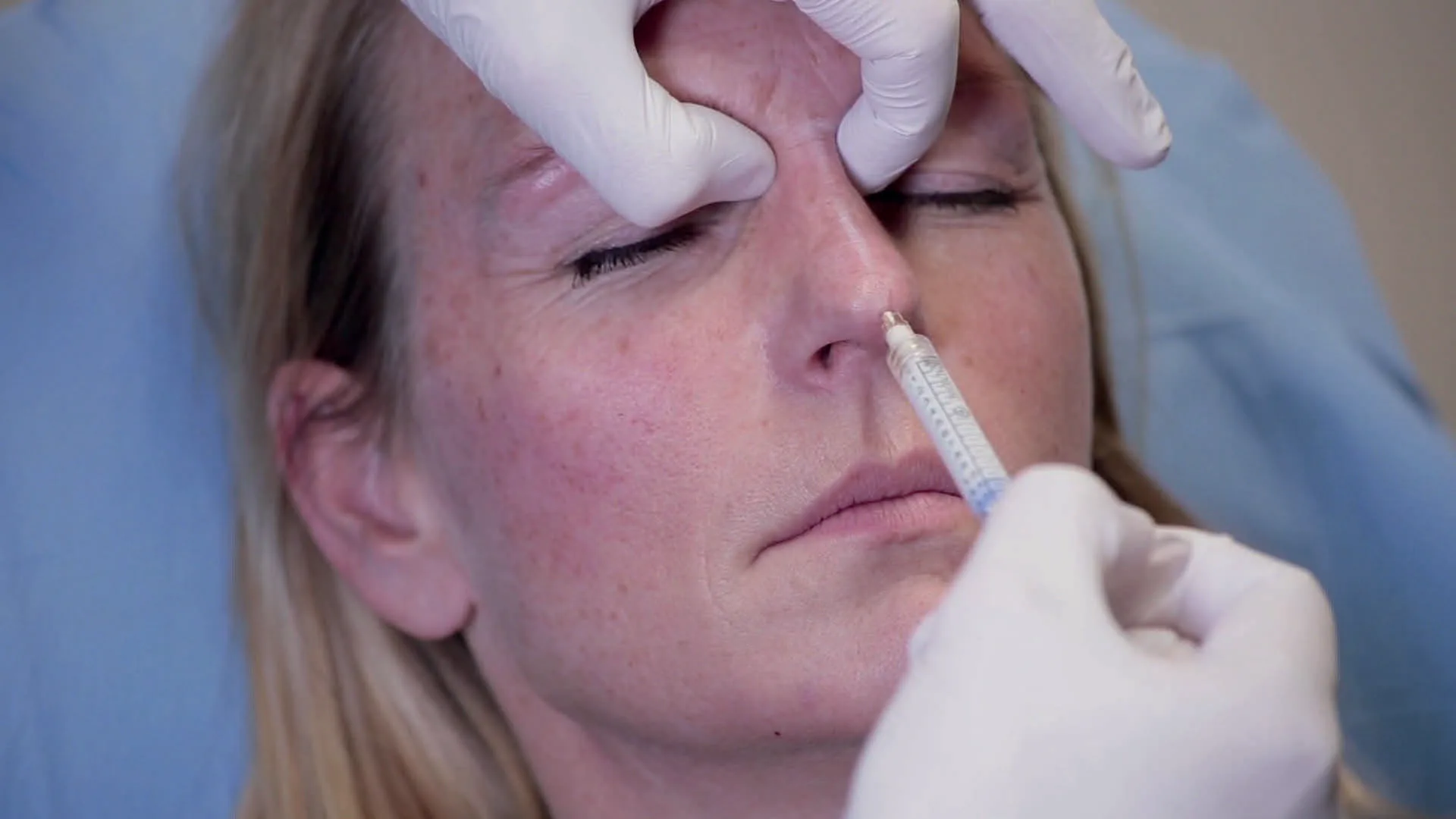 Fig 5. Filler injection at the nasal tip with the non-dominant hand stabilizing the dorsum. The nose is a high-risk territory (dorsal nasal and lateral nasal arteries, watershed to the ophthalmic circulation): the technique itself is unremarkable, but the competence required to do it safely, and to rescue an occlusion here, sits at the top of the ladder, not the bottom. A candidate who reaches for this region before proving reproducible results in medium-risk zones is the error grid above made flesh. — (van Loghem, Soft Tissue Filler Complications, 2023, p.22 [26]).
> Sources: [26] van Loghem J. Soft Tissue Filler Complications (2023), corpus monograph.
Fig 5. Filler injection at the nasal tip with the non-dominant hand stabilizing the dorsum. The nose is a high-risk territory (dorsal nasal and lateral nasal arteries, watershed to the ophthalmic circulation): the technique itself is unremarkable, but the competence required to do it safely, and to rescue an occlusion here, sits at the top of the ladder, not the bottom. A candidate who reaches for this region before proving reproducible results in medium-risk zones is the error grid above made flesh. — (van Loghem, Soft Tissue Filler Complications, 2023, p.22 [26]).
> Sources: [26] van Loghem J. Soft Tissue Filler Complications (2023), corpus monograph.
The cost, tallied in three currencies
Every row of the grid above is paid in one or more of three currencies, and naming them keeps the stakes concrete:
| Currency | What is spent | Who ultimately pays |
|---|---|---|
| The patient's tissue | Necrosis, blindness, granuloma, infection, an over-filled face | The patient, irreversibly in the worst cases |
| The clinician's standing | Licence exposure, a claim, indemnity that will not cover, reputation | The operator, often years later |
| The sector's autonomy | Every avoidable harm feeds the licensing wave | Every practitioner, through tightening regulation [10] |
The point of the three-currency view: a complication is never only a clinical event. The blindness that costs a patient their sight also costs the operator a defence they never documented and costs the whole sector another argument for statutory control. Competence is the only intervention that spends none of the three.
The medicolegal cost, made concrete
Negligence turns on four elements: duty, breach, causation, damages. Two Spanish-law specifics change how they bite in aesthetic practice [36]:
- Obligation of means, not of result. Aesthetic medicine is medicina satisfactiva, so the courts have edged the obligation toward the result and, decisively, toward the information: the duty to inform is more rigorous than in curative medicine (STS 15-feb-2017), the lex artis is the yardstick for the act itself (STS 20-nov-2009), and consent protects a fundamental right (STC 37/2011) [36]. The practical translation: your defence is your record, your consent and your standardized photographs, or it is nothing.
- Respondeat superior. In a delegation model, the supervising physician is liable for the extender's negligence [9]. Supervision is not a title on a wall; it is legal exposure.
- Data-protection exposure. A health-data breach (a leaked before/after set) can reach 20 M€ or 4% of turnover under
RGPD/LOPDGDD[35]. The photograph that is your best defence is also your largest data liability. - Indemnity that does not cover the act. Rising claims against médicos estéticos meet policies that exclude the very procedure performed, or exclude delegated injection. Read the policy for the named procedure, not the specialty.
The 2025 signal you cannot ignore. UK public-health authorities recorded clusters of iatrogenic botulism traced to unlicensed or counterfeit toxin injected by inadequately trained operators, which is one of the drivers of the statutory-licensing wave [10]. The cost of the weekend-course model is now measured in hospitalized patients, not only in bad outcomes.
The beginner-clinic recipe for a complication
Several low-competence errors compound in the same setting and produce the same result. The recipe: a new injector, a high-demand high-risk zone chosen for its price, a schedule with minimal time per patient, no recent vascular-anatomy revision, and no drilled rescue. Each ingredient is defensible alone; together they are a predictable complication. The harm mechanisms are not exotic: necrosis from arterial occlusion or compression, blindness from retrograde embolization to the ophthalmic circulation, granuloma and biofilm from late or foreign-body reaction, and infection from broken asepsis. The competence failure is not usually a single dramatic mistake; it is the quiet stacking of small ones in a chair that moves too fast (Parker 2022 on the cosmetic-practice curriculum [15]; Few 2018 on anatomy as the prerequisite [31]).
Why the indemnity gap is a competence problem
Rising claims against médicos estéticos meet three recurring failures that are competence failures wearing a legal costume: a policy that excludes the exact procedure performed or the delegated injection; a retrospective, non-contemporaneous record that cannot support a defence; and a consent that named neither the vascular nor the visual risk [23][36]. The obligation-of-means defence in medicina satisfactiva stands or falls on the lex artis and the information given [36], and both are documented, not asserted. An operator who kept the log, the standardized photographs and the specific consent has a defence; one who did not has a settlement.
Classic trap: believing that indemnity insurance is the safety net. It is not: it pays after the harm, only if the policy covers the exact act, and the record it will demand from you is the very logbook, consent and photographs the error grid above shows most injectors never kept. The net is the competence and the documentation, not the policy.
B10.6 · Metrics: what is measured and the reference value {#b106}
If you cannot measure it, you are feeling it, and feeling is the worst instrument you own. This block gives the instruments, and every reference value with its source, and it refuses to average two sources that disagree.
It moves in four steps: what is measured and the reference value [12]; the named work-based-assessment instruments the corpus does not hold [1]; the seven-station practical exam and how it is scored [2][17]; and the emergency-response milestones that must be drilled rather than read [16][19]. The through-line is Miller once more: knowledge is tested by a written exam, applied performance by an observed one, and systematic performance by an audit of the log [1]. A program that stops at the written exam certifies knows; one that adds an OSCE certifies shows how; only the case log and the outcome audit certify does [1][2]. Where the corpus measures competence only informally (supervision, proctorship, case count), the named instruments and their pass thresholds are imported from medical education and declared as gaps [1][12]. Every number below carries its source, and where two sources disagree, both are kept with their name and the deciding variable is stated, because averaging an adrenaline dose or a case count is how a false standard is born [19][20].
What is measured, and the reference value
| Dimension | Instrument | Reference value (with source) | Who uses it |
|---|---|---|---|
| Baseline hands-on exposure | Observation + supervised practice | Observe 2-3 procedures, proctorship of the first cases (Goodman 2016 [12]) | Minimum-standards template |
| Credentialing / grandfathering | Case-list | e.g. ≥20 cases of a defined procedure for grandfathering (Goodman 2016 [12]); a register may ask ≥2-3 years of experience [9] | Boards, registers |
| Ongoing volume | Annual logbook | JCCP toxin modality: on the order of ≥10 cases/year + 30 h/year CPPD [9] | JCCP register [9] |
| Skill maintenance | Bench drill | Microdroplet-on-mirror and comparable timed drills; repeat on adopting a technique [14][31] | Self / preceptor |
| Timed procedural skill | Graded skill assessment | 3 / 6 / 12-month evaluations against numeric goals (Unger, hair-restoration model [14]) | Structured programs |
| Knowledge | Written exam | AAAM board: 2 h / 100 MCQ, pass 70% [34] [MATERIAL GAP] |
AAAM [34] |
| Applied performance | Oral / patient cases | AAAM oral on 2-3 patient cases after a 6-month practice interval [34]; QMUL MSc end-of-year OSCE [33] [MATERIAL GAP] |
AAAM, QMUL |
⚠ The atlas prints no single "minimum number of cases" as the standard. The numbers above are program conventions (2-3, 10/year, 20 for grandfathering), not evidence-derived thresholds, and they vary between programs; printing one as the number would lend it a false authority. What is exigible is verifiable: log every case, record its supervision level, and demonstrate progression. Where two sources disagree, both are kept with their name, never averaged.
Why supervised hands-on is non-negotiable
Every corpus source that measures competence at all converges on the same non-negotiable: supervised hands-on practice, then proctorship of the first independent cases, then a documented case-list (Goodman 2016 [12]; the SEDAR competency model [4]; the hair-restoration training model [14]). The reason is the gap Miller named: reading and discussion certify knows how, and only observed execution certifies shows how and does [1][2]. No volume of theory substitutes, because the failure modes of injection (wrong plane, high pressure, unrecognized blanch) are motor and perceptual, not cognitive, and are visible only to an observer standing at your shoulder. This is also why the manufacturer course and the congress, valuable as they are, cannot close the loop: they deliver knows how efficiently and leave shows how to be built somewhere else, usually nowhere.
The three time-points of a structured evaluation
Programs that assess procedural skill seriously do it more than once, because a single snapshot cannot show a curve. The hair-restoration model evaluates at 3, 6 and 12 months against numeric goals, expecting measurable improvement between them (Unger [14]); the academy model inserts a 6-month practice interval between the written and the oral exam so the candidate accumulates real cases before the applied test (AAAM [34]). The lesson for the solo Spanish operator with no program around them: build your own three time-points into the case log. At month 3, review your first cases in a block with comparable photographs; at month 6, audit your retouch and complication rates; at month 12, decide, on evidence, whether to extend to a higher-risk region. The dates are arbitrary; the discipline of re-measuring at fixed points is not.
The formal work-based-assessment instruments [MATERIAL GAP]
The corpus measures competence only informally (supervision, mentorship, proctorship, case count; run-id B10.3-20260824, subchapter "OSCE-style practical assessment": no named WBA instrument surfaced, top 0.598). The named tools are general medical-education anchored and must be imported: OSCE (Objective Structured Clinical Examination), DOPS (Direct Observation of Procedural Skills), mini-CEX, CbD (Case-based Discussion), EPAs (Entrustable Professional Activities), and the structured written-plus-oral board exam. Their shared virtue is that they move assessment out of the operator's own chair (Miller shows how / does [1][2]).
The seven OSCE stations of an aesthetic-medicine exam
Scored by an item checklist plus a global rating (the combination beats either alone [2]). The safety-critical items are eliminatory, not weighted: points elsewhere do not compensate failing to recognize an ischaemia.
| Station | What is assessed | Immediate-fail criterion |
|---|---|---|
| 1 · Applied anatomy | Draw the angular, facial, supratrochlear, supraorbital, dorsal nasal and superficial temporal courses; name safe planes (Fig 4) [25][31] | Not identifying an artery in a risk zone |
| 2 · Consult and consent | History, patient goal, expectations, risk information including blindness, consent | Omitting the serious vascular risk [23][36] |
| 3 · Selection and planning | Choose product, plane, volume, sequence; justify it | A plan with no anatomical justification |
| 4 · Asepsis and preparation | Skin prep, field, product handling, batch traceability [7] | Breaking asepsis; not recording the lot |
| 5 · Injection technique | On a simulator: angle, plane, pressure, speed, aspiration where appropriate, volume | High, fast pressure; wrong plane [17] |
| 6 · Complication recognition | Simulated case: distinguish haematoma, vascular compromise, vasovagal, oedema | Not recognizing a vascular occlusion [16][17] |
| 7 · Emergency management | Execute the occlusion or anaphylaxis protocol with real material | Not knowing where the hyaluronidase or the adrenaline is [16][19] |
How to build it without a simulation centre (the realistic Spanish route): a silicone head or synthetic skin; a more-experienced colleague with the checklist in front of them (the checklist is what turns an opinion into an assessment); video of your own execution for self-review (uncomfortable, and the highest-yield exercise in the chapter); a simulated patient with a script for stations 2-3; cadence at each new technique plus an annual re-run of stations 6-7.
Emergency-response competency: it is drilled, not read
The principle, without qualification: an emergency is executed as it was rehearsed, not as it was read. Under stress, behaviour drops to the level of available automatism. Reading the occlusion protocol produces no automatism; executing it does.
| Scenario | Pass criterion (with source) |
|---|---|
| Filler vascular occlusion | Early recognition (disproportionate pain, pallor, livedo, delayed refill) → stop → high-dose pulsed hyaluronidase over the whole territory → adjuncts → hourly follow-up → referral if needed. Time to first hyaluronidase dose: minutes [16][18]. See J2 — Vascular Occlusion & Emergency Response.en, J3 — Hyaluronidase.en |
| Visual compromise | Recognize ocular pain, vision loss, ophthalmoplegia in the act → stop → protocol → urgent ophthalmology referral, route and phone already known. The window is short and does not tolerate improvisation [17] |
| Anaphylaxis | Adrenaline IM first, without hesitation → position → oxygen → call 112 → observe for a biphasic reaction. Reference dose: 0.5 mg (500 µg) IM, repeat every 5 min (Whyte 2022 [19]); the UPO slide set states 0.3-0.5 mg IM [20]. See J6 — Emergency Preparedness & BLS.en |
| Vasovagal | The most frequent by far. Recognize the prodrome, lie the patient flat with legs raised, and above all distinguish it from the serious events [20] |
⚠ Discrepancy preserved, not averaged: for anaphylaxis, RCUK-derived guidance gives adrenaline 500 µg (0.5 mg) IM for an adult, repeatable at 5 min [19]; the UPO master slide states 0.3-0.5 mg IM [20]. Both are shown with their source; the clinical variable that decides is patient weight/age and the vial you actually stock. Corticoids are no longer routine first-line in anaphylaxis under current RCUK guidance [19], a change from older corpus manuals.
The rescue material you must be able to point to
Competence in an emergency is partly knowing the protocol and partly the kit being present, stocked and in date. The updated filler emergency kit organizes the material by the four scenarios it must cover (Fakih-Gómez 2023 [16]); the exact hyaluronidase units and the adrenaline dosing live in J3 — Hyaluronidase.en and J6 — Emergency Preparedness & BLS.en, and this block certifies only that you can reach for them without thinking:
| Scenario (UFEK) | What the kit must hold | Competence tested |
|---|---|---|
| Acute vascular occlusion | High-dose pulsed hyaluronidase, warm compress, per-protocol vasodilator, aspirin | Reconstitute and flood the whole territory in minutes [16][18] |
| Late vascular occlusion | Hyaluronidase, antibiotics, pentoxifylline, collagenase ointment for the late wound | Recognize the delayed, atypical presentation [16] |
| Blindness / visual compromise | Immediate-stop discipline, ophthalmology route and phone pre-known, per-protocol bedside measures | Act inside a short window and refer, not improvise [17] |
| Anaphylaxis | Adrenaline (IM), oxygen, second-line antihistamine/salbutamol | Adrenaline first, no hesitation; corticoids not routine first-line [19][20] |
The competence being certified is not memorizing the table; it is the receptionist, the assistant and the injector all able to lay hands on the right box in seconds, having rehearsed it. A kit in a locked drawer whose key nobody can find fails the same test as no kit at all.
How an OSCE is actually scored
Two instruments run together per station: an item checklist (did the candidate do each observable step) and a global rating by the examiner; the combination outperforms either alone (Farhadieh 2015 [2], Miller 1990 [1]). The pass mark is not arbitrary: standard-setting methods (borderline-group, borderline-regression) derive it from how the examiners rate candidates judged to be at the threshold, not from a round number. On top of that sits the eliminatory rule: the safety-critical items (recognize an occlusion, locate the rescue material) are pass/fail gates, and a high global rating cannot buy them back. That single design choice is what separates a serious assessment from a ceremonial one.
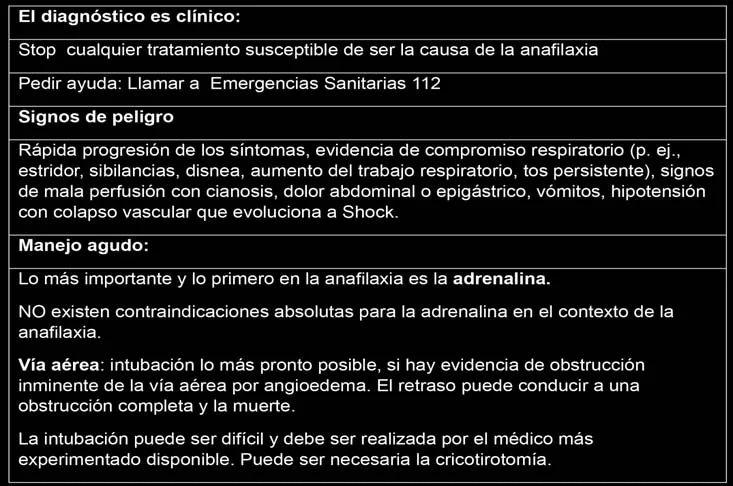 Fig 3. Acute anaphylaxis management as a decision box: the diagnosis is clinical; stop any treatment that could be the cause; call emergency services (112); danger signs are rapid symptom progression, respiratory compromise (stridor, wheeze, dyspnoea, persistent cough), poor perfusion with cyanosis, abdominal pain, vomiting, and hypotension collapsing to shock; acute management puts adrenaline first (there are no absolute contraindications to adrenaline in anaphylaxis), then airway (intubate early if angioedema threatens obstruction, by the most experienced clinician, cricothyroidotomy if needed). This is exactly the content of OSCE station 7, and the competence it tests is execution with the material in hand, not recall. — (Tejero, UPO 2024, p.111 [20]).
> Sources: [20] Tejero P, UPO máster 2024 slide set · [19] Whyte AF et al. Clin Med 2022 (concise anaphylaxis guidance).
Fig 3. Acute anaphylaxis management as a decision box: the diagnosis is clinical; stop any treatment that could be the cause; call emergency services (112); danger signs are rapid symptom progression, respiratory compromise (stridor, wheeze, dyspnoea, persistent cough), poor perfusion with cyanosis, abdominal pain, vomiting, and hypotension collapsing to shock; acute management puts adrenaline first (there are no absolute contraindications to adrenaline in anaphylaxis), then airway (intubate early if angioedema threatens obstruction, by the most experienced clinician, cricothyroidotomy if needed). This is exactly the content of OSCE station 7, and the competence it tests is execution with the material in hand, not recall. — (Tejero, UPO 2024, p.111 [20]).
> Sources: [20] Tejero P, UPO máster 2024 slide set · [19] Whyte AF et al. Clin Med 2022 (concise anaphylaxis guidance).
What "drilled" means, concretely
- You can say in 10 seconds where the hyaluronidase is, how much there is, and whether it is in date.
- You can say where the adrenaline is, and its dose and route.
- You have run the full drill aloud, with the material in hand, not pointing at it.
- The whole team has done it, including reception, who takes the call from the patient worsening at home.
- The written protocol exists and is on the wall, not only filed.
- The referral phone numbers were verified this year, not copied from a template.
Cadence: on any new team member joining, and at least annually, with a written record that it was done (that record has medicolegal value too [30][36]). BLS with AED current for all clinical staff; ALS advisable for the physician injecting high-risk zones. Certifications expire, and they expire silently.
Skill-maintenance drills between patients
Competence decays without use, and the antidote is cheap. Bench drills keep the hand calibrated: the microdroplet-on-a-mirror exercise (a Tonnard-style drill of placing consistent micro-aliquots on a flat surface) trains volume control and injection pressure without a patient; a silicone head trains plane and angle; a timed run trains the safety sequence. On adopting a technique and at intervals thereafter, run the drill and record it (Unger's timed-assessment logic transfers directly [14]; Few 2018 on slow, controlled placement [31]). For the emergency side, BLS with AED current for all clinical staff and ALS advisable for the physician injecting high-risk zones; both expire and both expire silently [30]. A drill that is never repeated is a certificate, not a competence.
The rule that closes the block, the most important in the chapter: do not perform a procedure whose serious complication you could not manage today, with the material you have in the clinic today. If there is not enough in-date hyaluronidase, hyaluronic acid is not injected [16]. It is not prudential advice; it is the condition of the indication.
Classic trap: the "certificate of attendance" at a BLS or complication course standing in for a drilled team. Attendance is knows how; a timed, material-in-hand, whole-team run is does. The signature of the trap is a beautifully filed certificate and a receptionist who does not know where the adrenaline is.
B10.7 · Spanish particularity {#b107}
> The general Spanish-market and no-specialty primer lives in B2 — Patient Psychology & Selection.en §B2.7. Covered there, not repeated here. This block covers only the certification angle: what a "médico estético" credential in Spain actually is, and what it certifies.
The Spanish particularity, in one line: there is no official specialty, so the competence-guarantee system is you. No MIR, no assigned tutor, no compulsory external exam, no State-imposed minimum case count. Everything the rest of this chapter builds (structured training, supervised practice, case log, drilled emergencies) is, in Spain, self-imposed or it does not exist.
| Route | What it is | What it certifies | Recognized by |
|---|---|---|---|
| Colegiación | Registration as a physician (any degree) | Legal right to practise medicine, including the acto médico of injection [5] | The State / colegio |
| DIACAP (OMC) | Diploma Acreditativo de Capacitación in aesthetic medicine, since 2004 | Structured aesthetic-medicine training; the only credential the profession's own body recognizes [8] | OMC / colegios; not a specialty |
| University máster / experto | Título propio, 1-2 years, ~7 universities offer it | Structured training with assessment. The principal route in Spain | The university; a título propio, not an official degree |
| SEME / UIME membership | Scientific society | Continuing education, congresses, sector self-regulation | The society; not a competence certificate |
| Manufacturer courses | Product and technique training | Product familiarity | The manufacturer; a catalogue, not an independent certificate |
Why none of these is a specialty
An official specialty would require meeting the criteria for creating one (the requirements of RD 589/2022 on specialist training), and aesthetic medicine does not currently meet them: there is no MIR programme, no accredited teaching units, no national board exam. So the DIACAP and the university másters are títulos propios and capacitation diplomas: real, valuable, but legally they document training, not a protected specialist title [4][8]. The consequence, stated plainly: two physicians with identical colegiación can present radically different competence, and the State's paperwork cannot tell them apart. Your archive is what tells them apart.
The scale of the gap [MATERIAL GAP]
Sector estimates seeded from the Phase-0 scout (SEME/registry data, web-grounded, ⚠ approximate and corpus-absent): on the order of ~5,244 authorized U.48 units and roughly 4,500-6,000 professionals practising aesthetic medicine in Spain, against zero official specialists (because the specialty does not exist). The same vacuum is the entry point for intrusismo: non-medical collectives performing what is legally an acto médico, which is the fastest-moving front in Spanish sector regulation (AEMPS, colegios and societies on intrusism and advertising). The corpus is silent on these figures (run-id B10.7/B10.1-20260824, regulatory facet returned Spanish anaesthesia training material, not aesthetic-market data); they are declared as external.
Spain against the European map
Spain sits at one end of a wide European spread on who may inject and how they are certified. The map, useful because a "European credential" means different things in different countries:
| Country | Who may inject | Certification route |
|---|---|---|
| Spain | Any médico colegiado (injection is an acto médico) [5] | Título propio máster / OMC DIACAP; no specialty [8] |
| Netherlands | Protected title behind training | "Aesthetic Physician" (KNMG), two-year full-time training |
| Ireland | Doctor, or nurse only if doctor-prescribed | Professional-body standards |
| UK | Moving to tiered licensing [10] | JCCP register + statutory scheme (Amber tier for toxin/filler) [9][10] |
The lesson for a Spanish practitioner shopping for a credential: the rigour lives in the training behind the title, not in the word on the certificate, and a two-year protected-title model and a weekend certificate can both be described as "European aesthetic training".
Intrusismo is the shadow of the missing specialty
Because no specialty gate-keeps the field, the vacuum is filled from two sides. On the medical side, physicians from unrelated disciplines enter with a short course. On the non-medical side, lay operators perform what is legally an acto médico, which is intrusismo and is the fastest-moving front in Spanish sector regulation (AEMPS, colegios and scientific societies acting on unqualified practice and on advertising). SEME and UIME provide the sector's self-regulation and continuing education, and on the order of seven universities offer the postgraduate másters that are, in practice, the principal structured route [4]. None of this is a substitute for a specialty; it is what a profession builds when the State has not built one for it.
What to do about it, concretely
- Archive all your training with dates and hours. Reconstructing it later is impossible.
- Keep a case log from now, not from when it is demanded [12][24].
- Keep the emergency drills documented [30].
- Formalize it before it is compulsory. Whoever already holds a log and a portfolio complies on day one of any licensing scheme; whoever does not improvises a retrospective file, which is exactly what does not count [10].
The personal competence audit, since nobody else runs it
Where the State runs no audit, you run your own, on a schedule. The questions to answer honestly, in writing, per technique in your menu:
- Can I draw the at-risk anatomy of this region from memory, today [25][31]?
- Have I been observed doing this by a competent peer, or only self-certified [1]?
- What is my retouch rate and my complication rate this quarter [12]?
- Is my cumulative volume per patient trending toward the over-filled face [24]?
- Do I hold the rescue material for this technique, in date and in quantity, today [16]?
- Has the whole team drilled the emergency for this technique in the last 12 months [19][30]?
- Is my consent for this technique specific, and does it name the vascular and visual risk [23][36]?
- Are my before/after photographs standardized enough to prove my own result [21]?
- Is my CPD for this technique current and documented [9][12]?
- If a regulator asked tomorrow for evidence of competence, what would I hand them?
A "no" or a blank on any line is not a moral failing; it is a work item with a date. The audit is the Spanish substitute for the external exam that does not exist, and it is only worth anything if it is written down and repeated.
Classic trap: reading "no official specialty" as "no standard, therefore anything goes." The opposite is true: because the State certifies nothing, the lex artis, the consent and the record carry the entire evidentiary weight in a claim [36]. The absence of a specialty raises your documentation burden, it does not lower it.
B10.8 · Organizational alternatives {#b108}
> The general organizational-model primer (solo vs group vs franchise) lives in B2 — Patient Psychology & Selection.en §B2.8. Covered there, not repeated. This block covers the alternatives that certify and maintain competence: the certifying bodies, the learning models, and the revalidation systems, ranked by rigour and honestly labelled.
It separates three things that are constantly confused [9][27][34]. The certifying bodies (recognized boards, academy diplomas, university degrees, practitioner registers) differ by years of training behind the same word "board" [27][34]. The learning models (course, preceptorship, academic, manufacturer, licence) differ by which rung of Miller they actually build [1]. The maintenance systems (CPD, CPPD, board recertification, regulator revalidation) differ by how often they re-measure [9][12][28]. The organizing principle is that no single model is complete: the academy diploma answers do you know, the OSCE answers can you show, the case log answers do you systematically, the register answers can you prove it to an outsider, and the licence answers are you allowed [1][9]. A practitioner can top one axis and be empty on another, which is why the block ends where the chapter began: the contemporaneous log and the annual drill are the instruments that keep the other four honest [12][19].
Certifying bodies: same word, very different rigour
Consensus: some independent marker of competence beats a self-declared one; a physician who has passed any external assessment has cleared a bar the weekend-course injector has not [9][34].
Discrepancy (it changes what a "board-certified" badge actually means, so it stays):
| Model | Thesis | What it certifies | Rigour / limit |
|---|---|---|---|
| Recognized medical board / core specialty | Residency + fellowship (ABMS-equivalent; plastic surgery, dermatology, ORL, ophthalmology, maxillofacial) is the only "valid" credential | Years of accredited training + board exam | Highest bar. Limit: covers few aesthetic physicians; a core-specialty badge does not by itself prove aesthetic-injectable competence [27][28] |
| Academy examination diploma | A society exam (AAAM Board, ECAMS) is a valid proficiency marker, open to any licensed physician | Written + oral against a syllabus [34] | Accessible and structured. Limit: rigour varies; the critique (Jacono) is that some "boards" need "a couple of courses and an exam" rather than a residency + fellowship |
| University máster / capacitation diploma | The academic route (QMUL MSc, UPO Máster, OMC DIACAP) certifies structured training with assessment | A degree/diploma with an OSCE or equivalent [8][33] | Solid model. Limit: the practical component varies enormously between programs |
| Practitioner register | A register (JCCP, PSA-accredited) sets entry standards and audits | Meeting a competency standard + ongoing CPD [9] | Raises the floor and audits (5% sample). Limit: voluntary until a statutory scheme lands [10] |
⚠ The "board" ambiguity is the trap here. "Board-certified in aesthetic medicine" can mean a residency-plus-fellowship credential or a self-styled academy that awarded a diploma after a short course and an exam. The word is identical; the training behind it can differ by years. Read what the board actually required, not the badge.
The register model, up close
The practitioner register is the model most likely to reach Spain next, so it is worth seeing its concrete instruments. A register (JCCP, accredited by the PSA) sets entry standards against a competency standard, then keeps members in by requiring evidence over time: a treatment-log, a CPD record with reflective accounts, per-modality CPPD hours (on the order of 30 h/year for toxin) and case numbers (on the order of 10/year), plus a 5% audit of a sample of members [9]. It raises the floor and it audits, which the diploma models do not. Its limit is that it is voluntary until a statutory scheme makes it otherwise, which is exactly what the UK is now legislating [10]. For a Spanish practitioner, building a portfolio to a register's standard now is the cheapest insurance against the day one is imposed.
Learning models: how competence is actually acquired
| Model | Thesis | Limit |
|---|---|---|
| Course-based | Intensive course → immediate practice | The sector default. Skips the shows how rung [1], where the avoidable complications happen |
| Preceptorship | One mentor, prolonged supervision, progression by cases | The most effective; scarce, informal, unrecognized in Spain [14] |
| Formal academic (QMUL, ECAMS, AAAM, máster) | A program with assessment and a credential | Sound in theory; the practical component varies enormously [33][34] |
| Manufacturer as educator | Product training = clinical training | Broad and accessible; the syllabus is bounded by the catalogue |
| Regulatory by licence | The State defines who may do what, by risk | The direction of the wind [10]. Raises the floor; does not guarantee excellence |
Synthesis (P): the academic model gives the frame, preceptorship gives the competence, the manufacturer gives the product technique, and the licence will give the floor. None of the four replaces the case log and the emergency drill, which are the only things that measure what you actually do.
Each model answers a different question, and confusing which question a model answers is the recurring error of the whole chapter. The academy diploma answers do you know; the OSCE answers can you show; the case log answers do you, systematically; the register answers can you prove it to an outsider; the licence answers are you allowed. A practitioner can hold the highest badge on one axis and be empty on another: a residency-plus-fellowship board cert (top of are you allowed and do you know) with no recent drill is empty on do you, systematically. The competent injector is not the one with the most impressive certificate; it is the one whose answer on all five axes is documented and current. That is why the chapter ends where it began: the case log and the annual drill are not one model among five, they are the instruments that keep the other four honest.
The academy and congress routes, disambiguated
Two organizational forms are constantly confused because they share venues and faces. An academy examination diploma (AAAM Board, ECAMS) is a structured assessment against a syllabus: written then oral, with a defined pass mark, open to any licensed physician [34]. A congress (AMWC, IMCAS, and the boot-camp / hands-on / one-to-one formats around them) is an update and a marketplace: valuable for currency, but attendance certifies presence, not competence. The critique that sharpens the distinction (Jacono): some self-styled "boards" require only "a couple of courses and an exam", where a core-specialty board requires a residency and a fellowship [27]. Both may print the word "board" on the certificate; the training behind them differs by years. When you read a colleague's credential, or build your own, read the requirement, not the badge.
Revalidation and maintenance: competence has a shelf life
Certification is a snapshot; competence decays. The maintenance systems:
| System | What it requires (with source) |
|---|---|
| CME/CPD credits | e.g. 25 category-1 units per 5 years for a minimum-standards model (Goodman 2016 [12]); accredited content only |
| CPPD by modality | JCCP toxin: 30 h/year CPPD + ~10 cases/year + a PSA 5% audit sample [9] |
| Mandatory annual emergency training | Annual BLS + anaphylaxis retraining (ACE-group-style requirement; RCUK-aligned) [19][30] |
| Board maintenance | Time-limited certificates on a 10-year cycle with a maintenance-of-certification program (ABA/ABMS model, since 2000) [28][29] |
| Regulator revalidation | Periodic demonstration of fitness to practise to one's own regulator (GMC-style revalidation) [30] |
| Congresses | AMWC, IMCAS, boot-camps, hands-on/one-to-one formats: update, not a competence certificate |
The Spanish version, absent a board, is voluntary recertification run by the scientific societies, built on a competency-based model (Moral, SEDAR Libro Blanco [4]). Voluntary, so the burden falls back on you: your dated CPD archive is your recertification.
A one-page maintenance calendar
Competence maintenance fails silently unless it is on a calendar with an owner. The minimum recurring schedule, assembled from the maintenance systems above:
| Interval | Task | Source / rationale |
|---|---|---|
| Per patient | Contemporaneous record, standardized photograph, consent, batch/UDI | [6][7][24] |
| Weekly / monthly | Bench skill drill on adopting a technique; review of any complication | [14][31] |
| Quarterly | Personal audit: retouch rate, complication rate, mean volume per zone | [12] |
| Per new technique | Full re-run of the §B10.3 protocol and the OSCE self-check | [1][17] |
| Annually | Whole-team emergency drill (occlusion + anaphylaxis), material in hand, written record; verify referral phones; check BLS/AED currency; CPD tally | [19][20][30] |
| Every 1-5 years | CPD/CPPD credit target met (e.g. 25 cat-1 units / 5 yr [12]; 30 h/yr toxin CPPD [9]); board maintenance where held (10-yr cycle [28][29]) | [9][12][28] |
The owner of the calendar is not "the clinic"; it is a named person, because a task owned by everyone is done by no one. Reception owns the referral-phone check as readily as the physician owns the CPD tally.
Classic trap: collecting the highest-rigour badge available and treating it as terminal. A residency-plus-fellowship board cert obtained a decade ago, with no recent CPD, no drilled team and no current logbook, certifies what you were, not what you are. Every model in this block has an expiry, and the only maintenance that measures current practice is the contemporaneous log and the annual drill.
Coverage vs UPO
The UPO master teaches this material embedded inside the complications module (M2 · T10, Dra Tejero) and the clinical-history module (M1.2), never as a standalone competency-and-certification theme. The mapping, and what the atlas adds:
| UPO teaches (module) | Status in this chapter | What the atlas adds |
|---|---|---|
| Anaphylaxis acute management (T10, Fig 3) [20] | ✅ integrated in §B10.6 | Reframed as a drilled competency milestone with a pass criterion, not just a protocol to read |
| Filler vascular-occlusion management (T10) [17][20] | ✅ §B10.6 | Turned into OSCE stations 6-7 with eliminatory safety items |
| Danger-zone facial anatomy (T10, Fig 4) [25] | ✅ §B10.3 | Made the anatomy station of a practical exam; tied to risk stratification |
| Informed consent for visual loss (T10, Fig 2) [20][23] | ✅ §B10.4 | Linked to the más rigurosa Spanish jurisprudence and the competence question inside the consent |
| Aesthetic clinical history (M1.2) [22] | ✅ §B10.4 | Separated from the competency portfolio, the document family UPO does not teach |
| Standardized before/after photography [20][21][24] | ✅ §B10.4 | Framed as documentation-of-competence and a data-law liability |
| "Slow and low", cannula, aspiration-is-unreliable [17][20] | ✅ §B10.3, Fig 1 | Turned into scored checklist items |
| Miller's pyramid / competency levels | ❌ UPO absent | Imported as the spine of the whole chapter [1][2] |
| OSCE / DOPS / mini-CEX / EPA | ❌ UPO absent | Imported as the named assessment instruments [1][33] [MATERIAL GAP] |
| Certification bodies & their rigour (boards, academies, register) | ❌ UPO absent | The §B10.8 comparison grid [9][27][34] |
| Regulatory wave (MDR Annex XVI, UK licensing, DIACAP) | ❌ UPO absent | §B10.2, §B10.7 [5][7][8][10] |
| Competency portfolio / logbook / CPPD | ❌ UPO absent | §B10.4 [9] [MATERIAL GAP] |
| Medicolegal cost & negligence elements | ❌ UPO absent | §B10.5 [36] |
⚠ UPO is the corpus lane that ages fastest here. Its complication slides are strong and current (2024), but they teach what to do, not how to prove you can do it or how the field is being regulated. Every ❌ row above is a theme the master does not cover and the atlas had to build from the surgical/anaesthesia analogues and the external regulatory lane. A dose or protocol resting only on a UPO slide is never_sufficient_alone and is corroborated in-text with a primary or consensus source.
Self-assessment
- What is the difference between knows how and shows how on Miller's pyramid, and which one does a typical course certify?
Show answer
*Knows how* is being able to describe the procedure and its decisions (assessed by case discussion); *shows how* is executing it correctly in an **assessed setting** (OSCE, simulation, supervised practice). A typical course certifies *knows how* while looking like a *does* [1][2]. ([§B10.1](#b101), [§B10.3](#b103))- In Spain, which authorization unit covers non-surgical aesthetic medicine, and what does the injecting doctor need in terms of specialty?
Show answer
Unit **U.48** under `RD 1277/2003`; the *médico responsable* needs **no surgical specialty**. Aesthetic surgery is the separate **U.47** unit requiring a surgical specialist [5]. ([§B10.2](#b102))- MDR 2017/745 Annex XVI regulates the product or the injector?
Show answer
The **product** (dermal fillers, aesthetic lasers/IPL, lipolysis equipment), with clinical-evidence and operator-qualification requirements. It does not confer the right to inject, which comes from professional and clinic law [7]. ([§B10.2](#b102))- Name the three tiers of the UK statutory licensing model and an example of each.
Show answer
**Green** (microneedling, superficial peels: any licensed practitioner), **Amber** (botulinum toxin, facial fillers: local-authority licence + regulated-HCP oversight), **Red** (liquid BBL, breast/buttock/genital augmentation: regulated HCP only on CQC-registered premises) [10]. ([§B10.2](#b102))- When is the peak-danger window in an injector's learning curve, and why?
Show answer
After the first **20-50 uneventful cases**, when confidence rises faster than competence (Dunning-Kruger) and the operator starts treating high-risk zones. The counter is to measure (log with supervision level), not to feel. ([§B10.1](#b101), [§B10.3](#b103))- What single field turns a treatment list into evidence of competence progression?
Show answer
The **supervision level** field (observed / supervised / independent). Without it a logbook is a tally; with it, it documents progression [12]. ([§B10.4](#b104))- Why does the atlas refuse to print a single "minimum number of cases"?
Show answer
Because the circulating numbers (observe 2-3, ≥10/year, ≥20 for grandfathering) are program conventions, not evidence-derived thresholds, and they vary between programs; printing one would give it false authority. What is exigible is documented progression with supervision level [12]. ([§B10.6](#b106))- State the anaphylaxis adrenaline reference doses and the discrepancy between the two sources given.
Show answer
RCUK-derived guidance: **0.5 mg (500 µg) IM**, repeatable at 5 min [19]; the UPO slide set: **0.3-0.5 mg IM** [20]. Both are kept with their source, not averaged; the deciding variable is patient weight/age and the vial stocked. Adrenaline is first-line and has no absolute contraindication in anaphylaxis. ([§B10.6](#b106))- What are the two safety-critical, eliminatory OSCE stations, and what fails a candidate there?
Show answer
Station 6 (complication recognition: **not recognizing a vascular occlusion** fails) and station 7 (emergency management: **not knowing where the hyaluronidase or adrenaline is** fails). Safety-critical items are eliminatory, not weighted [16][17][19]. ([§B10.6](#b106))- State the rule that is the precondition of the indication for hyaluronic acid injection.
Show answer
Do not perform a procedure whose serious complication you could not manage today, with the material on the shelf today; if there is not enough in-date hyaluronidase, HA is not injected [16]. It is the condition of the indication, not prudential advice. ([§B10.6](#b106))What's new and trends
| Year | Change | Maturity class | Consequence for competence/certification |
|---|---|---|---|
| 2021 | Botulinum Toxin and Cosmetic Fillers (Children) Act (UK): under-18 cosmetic toxin/filler ban in force [11] | clinically actionable now | Age is now a hard competency/legal gate, not a judgement call |
| 2021-2022 | RCUK anaphylaxis guidance: adrenaline IM first; corticoids no longer routine first-line [19] | clinically actionable now | Older corpus manuals (stacked steroids) are superseded; drills must teach the current algorithm |
| 2023 | MDR Annex XVI applying to purely aesthetic devices; updated filler emergency kit (UFEK) formalized for 4 scenarios [7][16] | clinically actionable now | Operator-qualification requirements and a standardized rescue kit reach the injector |
| 2024 | Ultrasound protocols for facial aesthetics mature (real-time Doppler for danger zones) [26] | promising but not validated | Ultrasound moves from "desirable" toward a competence marker for high-risk zones |
| 2025 | UKHSA iatrogenic botulism clusters from unlicensed/counterfeit toxin; DHSC licensing response 7 Aug 2025 (Red/Amber/Green) [10] | promising but not validated | The weekend-course model now has a measured public-health cost; statutory licensing is being legislated (not yet in force) |
| 2023-2025 | Manufacturer "certifications" and academy "board" badges marketed as independent competence credentials | unsupported commercial claim | A course or product badge certifies attendance or product familiarity, not shows-how competence [15][27] |
| 2024-2025 | VR/AR and instrumented-needle scoring proposed for objective injection-skill assessment | preclinical/speculative | No validated tool yet; belongs in the speculation block below, not in practice [1] |
What did NOT change, and why the older references still stand. The spine of the field is stable and older-still-current: Miller's pyramid (1990) remains the assessment model [1]; competency-based medical education and CanMEDS (2010) remain the domain model [3]; the acto médico status of injection in Spain and the absence of a specialty are unchanged [4][5]; the primacy of supervised practice, proctorship and drilled emergencies over course attendance is unchanged [12][14]; the Goodman vascular-safety consensus (2020) remains the bedside reference for embolic visual loss [17]; and DeLorenzi's high-dose pulsed hyaluronidase (2017) remains the occlusion-rescue backbone [18]. The novelty is regulatory and organizational (who may inject, and who audits), not a change in what competence is. This section synthesises references already cited; it introduces no new claim.
Unexplored directions (AI speculation)
> The following are AI-generated research directions, not evidence and not recommendations. Every item is tagged [IA-ESPEC] and states its anchor (a cited fact already in the chapter), a proposal, the expected effect, the main confounder, and what would settle it. None carries a dose, a product or an actionable protocol.
[IA-ESPEC]VR/AR objective scoring of injection technique. Anchor: OSCE station 5 scores plane, pressure and speed by human observation, which is subjective [17]. Proposal: an instrumented needle or VR rig that logs depth, plane and injection pressure could produce an objective competence score for shows how. Expected effect: tighter inter-rater reliability and earlier detection of unsafe technique than a human examiner. Confounder: simulator fidelity may not transfer to live tissue, so a high sim score need not mean a safe injector. What would settle it: a trial comparing live-patient complication rates of injectors passed by instrumented scoring versus conventional supervised sign-off.[IA-ESPEC]A voluntary national competency registry keyed to the supervision-level field. Anchor: the case-log supervision-level field is the proposed progression evidence [12]. Proposal: a registry linking anonymized case-log volume, supervision level and outcome could replace unvalidated "minimum numbers" with an evidence-derived competence signal. Expected effect: a defensible, data-derived threshold to replace program conventions. Confounder: self-reported logs suffer selection and under-reporting of complications, biasing any derived threshold. What would settle it: whether registry-derived thresholds predict complications better than the current 2-3 / 10-per-year conventions in a prospective cohort.[IA-ESPEC]Ultrasound competence as the gate to high-risk zones. Anchor: risk stratification lists ultrasound as "desirable" for high-risk regions [26]. Proposal: making pre-injection Doppler screening a formal competency requirement for temple, nose and tear-trough could lower embolic events. Expected effect: fewer intra-arterial injections in the highest-risk territories. Confounder: operator ultrasound skill varies widely, so the intervention tests two competences at once (scanning and injecting). What would settle it: a controlled comparison of vascular-event rates in high-risk zones with versus without a mandatory ultrasound competency.[IA-ESPEC]Portfolio analytics as a Dunning-Kruger early-warning. Anchor: the peak-danger window follows the first 20-50 uneventful cases [1]. Proposal: an analytic on the logbook (rate of expansion into higher-risk zones versus elapsed supervised time) could flag over-confidence before a complication. Expected effect: an alert precedes the escalation that precedes the harm. Confounder: fast, safe learners and reckless ones can show the same expansion curve, risking false positives. What would settle it: whether such a flag precedes complications more often than chance in a retrospective logbook cohort.[IA-ESPEC]Cross-domain transfer of aviation-style team drills to the aesthetic clinic. Anchor: the emergency drill must include reception, who takes the deterioration call [19][30]. Proposal: structured crew-resource-management simulation, not just a BLS certificate, may improve time-to-adrenaline and time-to-hyaluronidase. Expected effect: shorter, more reliable team response times under stress. Confounder: clinics that adopt CRM training may already be safer, so the training and the outcome are confounded by baseline culture. What would settle it: a before-and-after measurement of drilled response times against an untrained baseline in the same clinics.
§ Safety
The safety of this chapter is not a technique; it is a set of preconditions and eliminatory rules. Competence is a safety instrument, and its failures are the failure modes below.
- The precondition rule is absolute. Do not perform a procedure whose serious complication you could not manage today, with the material on the shelf today. No in-date hyaluronidase in sufficient quantity → no hyaluronic acid injected [16]. This is the condition of the indication.
- Anaphylaxis: adrenaline first. Adrenaline 0.5 mg (500 µg) IM (RCUK-derived [19]) or 0.3-0.5 mg IM (UPO slide [20]), first and without hesitation; no absolute contraindication in anaphylaxis; corticoids are no longer routine first-line [19]. Then airway, oxygen, 112, and observation for a biphasic reaction. Doses are shown with their source and are not averaged; the full protocol is J6 — Emergency Preparedness & BLS.en.
- Vascular occlusion: minutes, not hours. Early recognition, stop, high-dose pulsed hyaluronidase over the whole territory, hourly follow-up, referral; time to first dose measured in minutes [16][18]. Visual compromise is an immediate ophthalmology referral with the route and phone already known [17]. The doses live in J2 — Vascular Occlusion.en and J3 — Hyaluronidase.en; this chapter certifies only that you can execute them.
- Eliminatory competence items. Not recognizing a vascular occlusion, and not knowing where the rescue material is, are eliminatory in any honest assessment; no score elsewhere compensates them [16][17][19].
- The per-region ladder. Competence does not transfer between regions. High-risk zones (temple, glabella, nose, tear trough) sit at the top of the ladder and after previous surgery become very-high-risk; they are not entry points [25][26].
- Documentation is a safety act. Standardized photography, specific consent naming vascular and visual risk, batch/UDI traceability and the contemporaneous log are what make a complication defensible and recallable [6][7][23][36]. A leaked image is also a data liability up to 20 M€ / 4% turnover [35].
- Expiry is silent. BLS/AED, ALS, indemnity, hyaluronidase and adrenaline all expire without announcing it. Calendar every expiry for the whole team [30].
(P)The single highest-yield safety intervention in this chapter is the annual, material-in-hand, whole-team emergency drill with a written record; it is the only thing that converts a read protocol into an executed one, and it costs an afternoon a year.
References
- Miller GE. The assessment of clinical skills/competence/performance. Acad Med. 1990.
[A][https://doi.org/10.1097/00001888-199009000-00045](https://doi.org/10.1097/00001888-199009000-00045 - Farhadieh RD, Bulstrode NW, Cugno S (eds). Plastic and Reconstructive Surgery: Approaches and Techniques. 2015.
[C][MEDLIB](Miller's triangle Fig 77.1; formative vs summative assessment) - Frank JR, Snell LS, Ten Cate O, et al. Competency-based medical education: theory to practice. Med Teach. 2010.
[A][https://doi.org/10.3109/0142159X.2010.501190](https://doi.org/10.3109/0142159X.2010.501190 - Sociedad Española de Anestesiología, Reanimación y Terapéutica del Dolor (SEDAR). Libro Blanco. 2021.
[C][MEDLIB](competency definition; supervision levels; voluntary recertification by scientific societies) - Real Decreto 1277/2003, de 10 de octubre, bases generales sobre autorización de centros, servicios y establecimientos sanitarios (unidades U.47/U.48). BOE.
[A][https://www.boe.es/eli/es/rd/2003/10/10/1277](https://www.boe.es/eli/es/rd/2003/10/10/1277 - Ley 41/2002, de 14 de noviembre, básica reguladora de la autonomía del paciente y de derechos y obligaciones en materia de información y documentación clínica. BOE.
[A][https://www.boe.es/eli/es/l/2002/11/14/41](https://www.boe.es/eli/es/l/2002/11/14/41 - Reglamento (UE) 2017/745 del Parlamento Europeo y del Consejo sobre los productos sanitarios (MDR), Anexo XVI. EUR-Lex.
[A][https://eur-lex.europa.eu/eli/reg/2017/745/oj](https://eur-lex.europa.eu/eli/reg/2017/745/oj - Organización Médica Colegial / CGCOM. Diploma Acreditativo de Capacitación (DIACAP) en Medicina Estética.
[A][https://www.cgcom.es](https://www.cgcom.es - Joint Council for Cosmetic Practitioners (JCCP). Competency Standards for Cosmetic Practice (V8, 2018) and register structure (CPPD by modality; PSA 5% audit).
[A][https://www.jccp.org.uk](https://www.jccp.org.uk - Department of Health and Social Care (UK). Licensing of non-surgical cosmetic procedures: consultation and government response, 7 Aug 2025 (Red/Amber/Green tiered model; Health and Care Act 2022 s.180). gov.uk; House of Commons Library CBP-10331.
[A][https://www.gov.uk/government/consultations/licensing-of-non-surgical-cosmetic-procedures](https://www.gov.uk/government/consultations/licensing-of-non-surgical-cosmetic-procedures - Botulinum Toxin and Cosmetic Fillers (Children) Act 2021 (UK). legislation.gov.uk.
[A][https://www.legislation.gov.uk/ukpga/2021/9](https://www.legislation.gov.uk/ukpga/2021/9 - Goodman MP. Female Genital Plastic and Cosmetic Surgery. 2016.
[C][MEDLIB](minimum standards: 2-day didactic+experiential; observe 2-3; proctorship of first cases; grandfathering case-list; CME 25 cat-1 units/5 yr) - Cosmetic Medicine & Surgery. 2016.
[C][MEDLIB](training algorithm; botulinum toxin dilution Table 51.1) - Unger W, Unger R, Unger M (eds). Hair Transplantation. 2023.
[C][MEDLIB](ISHRS/ABHRS core competencies; learning curve; timed 3/6/12-month skill assessment) - Parker N. Fundamentals for Cosmetic Practice. 2022.
[C][MEDLIB](UK cosmetic practice; contraindications; practical-skills curriculum) - Fakih-Gómez N, et al. Updated Filler Emergency Kit: Next-Generation Emergency Solution. Aesthetic Plast Surg. 2023.
[B][MEDLIB][https://doi.org/10.1007/s00266-023-03722-3](https://doi.org/10.1007/s00266-023-03722-3 - Goodman GJ, Magnusson MR, Callan P, et al. A Consensus on Minimizing the Risk of Hyaluronic Acid Embolic Visual Loss and Suggestions for Immediate Bedside Management. Aesthet Surg J. 2020.
[A][https://doi.org/10.1093/asj/sjz312](https://doi.org/10.1093/asj/sjz312 - DeLorenzi C. New High Dose Pulsed Hyaluronidase Protocol for Hyaluronic Acid Filler Vascular Adverse Events. Aesthet Surg J. 2017.
[B][https://doi.org/10.1093/asj/sjw251](https://doi.org/10.1093/asj/sjw251 - Whyte AF, Soar J, Dodd A, et al. Emergency treatment of anaphylaxis: concise clinical guidance. Clin Med (Lond). 2022.
[A][https://doi.org/10.7861/clinmed.2022-0073](https://doi.org/10.7861/clinmed.2022-0073 - Tejero P. Efectos adversos y manejo de complicaciones de los rellenos (slide sets, T10). Máster en Medicina Estética, UPO. 2024.
[D][MEDLIB](anaphylaxis rapid-management box; ≥24 h reflection; before/after photography; Slow-and-Low technique) - Fernández-Tresguerres J. Medicina Estética y Antienvejecimiento. 2019.
[C][MEDLIB](documentation of the baseline; the un-repeatable "before") - Módulo 1.2, Historia Clínica y Diagnóstico. Máster en Medicina Estética, UPO.
[D][MEDLIB](aesthetic clinical history) - Kontis TC, Lacombe VG. Cosmetic Injection Techniques: A Text and Video Guide to Neurotoxins and Fillers. 2019.
[C][MEDLIB](consent forms naming vascular injury/occlusion) - Carruthers J, Carruthers A. Soft Tissue Augmentation (Aumento de tejidos blandos). 2013.
[C][MEDLIB](photography storage and consent discipline) - Libro de Zonas Peligrosas en Medicina Estética Facial.
[C][MEDLIB](facial danger zones; Figura 74) - van Loghem J. Soft Tissue Filler Complications. 2023.
[C][MEDLIB](high-risk regions; ultrasound in facial aesthetics) - Truswell WH. Lasers and Light, Peels and Abrasions in Facial Plastic Surgery / credentialing. 2016.
[C][MEDLIB](need for valid, reliable board credentialing; IFFPSS) - Vacanti CA, Sikka PK, Urman RD, et al. Essential Clinical Anesthesia. 2011.
[C][MEDLIB](ABMS certification; MOCA maintenance-of-certification) - Kaplan JA, et al. Cardiac Anesthesia. 2011.
[C][MEDLIB](ABA 10-year time-limited certificates since 2000; lifelong CME) - Schofield JK, Kneebone R. Brown's Skin and Minor Surgery: A Text and Colour Atlas. 2015.
[C][MEDLIB](RCUK anaphylaxis algorithm; CPD/revalidation expectations) - Few J, et al. The Art of Combining Surgical and Nonsurgical Techniques in Aesthetic Medicine. 2018.
[C][MEDLIB](detailed anatomy as a prerequisite; slow injection; aspiration before high-risk sites) - Jones DH, et al. Injectable Fillers: Facial Shaping and Contouring. 2019.
[C][MEDLIB](watch the skin not the syringe; scarred-bed patient selection) - Queen Mary University of London. MSc Aesthetic Medicine (end-of-year OSCE).
[A][https://www.qmul.ac.uk/postgraduate/taught/coursefinder/courses/aesthetic-medicine-online-msc/](https://www.qmul.ac.uk/postgraduate/taught/coursefinder/courses/aesthetic-medicine-online-msc/ - American Academy of Aesthetic Medicine (AAAM). Board Certification (2 h / 100 MCQ written, 70% pass; oral on 2-3 patient cases; 6-month practice interval).
[A][https://www.aaamed.org](https://www.aaamed.org - Reglamento (UE) 2016/679 (RGPD) y Ley Orgánica 3/2018 de Protección de Datos Personales y garantía de los derechos digitales (LOPDGDD). EUR-Lex / BOE.
[A][https://eur-lex.europa.eu/eli/reg/2016/679/oj](https://eur-lex.europa.eu/eli/reg/2016/679/oj - Jurisprudencia española sobre medicina satisfactiva: STS 15-feb-2017 (información más rigurosa); STS 20-nov-2009 (lex artis); STS 22-nov-2007; STC 37/2011 (consentimiento e integridad física). CENDOJ.
[A][https://www.poderjudicial.es/search/indexAN.jsp](https://www.poderjudicial.es/search/indexAN.jsp - Raj PP (ed). Textbook of Regional Anesthesia. 2002.
[C][MEDLIB](procedural learning curve: for some blocks the expected skill level is reached only after 45-60 supervised attempts)
Verification: Author, 2026-08-24. Corpus pass on disk: evaluation/runs/B10.1.jsonl … B10.5.jsonl (medrag CLI, k=8, figure-k=6). Structure change declared: the retired ES version used a 5-subchapter layout (Miller pyramid · case log · OSCE · emergency · certification); this canonical EN version follows the PRACTICA 8-block template (In-30-seconds · regulatory rules · step-by-step · templates · errors+cost · metrics · Spanish particularity · organizational alternatives) and salvages every fact of the old file into the new blocks (see docs/salvage/B10.salvage.json), adding the regulatory, portfolio and formal-WBA material the old NEW-status chapter lacked. Three declared [MATERIAL GAP] facets (corpus silence proven by run-id top scores 0.016-0.033): UK 2025 statutory licensing (Red/Amber/Green), the competency-evidence portfolio templates (JCCP), and the named formal assessment instruments (OSCE/DOPS/mini-CEX/EPA); each filled from the external/primary-source lane and tagged. Deliberately no invented "minimum case number" is printed as a validated standard; conflicting reference values (adrenaline 0.5 mg vs 0.3-0.5 mg IM; observe 2-3 vs ≥10/yr) are shown with their source, never averaged. Figures: 5, all opened before captioning (figure-pick-receipt.json); UPO complication slides and corpus danger-zone/complication monographs; no purpose-built competency diagram exists in the corpus, so Miller's pyramid and the OSCE are rendered as tables, not figures. Currency: foundational reference works are stable-and-old (Miller 1990, CBME 2010) by design; the regulatory frontier is 2025-current; year profile in the Currency and provenance block below.